Introduction
In addition to severe affective dysregulation and the core symptoms of bipolar disorder (DSM-IV-TR; American Psychiatric Association, 2000), patients with pediatric bipolar disorder (PBD) exhibit deficits in emotion processing (Guyer et al., Reference Guyer, McClure, Adler, Brotman, Rich, Kimes and Leibenluft2007; McClure et al., Reference McClure, Treland, Snow, Schmajuk, Dickstein, Towbin and Leibenluft2005; Passarotti, Sweeney, & Pavuluri, Reference Passarotti, Sweeney and Pavuluri2010a; Pavuluri, O'Connor, Harral, & Sweeney, Reference Pavuluri, O'Connor, Harral and Sweeney2007; Rich et al., Reference Rich, Vinton, Roberson-Nay, Hommer, Berghorst, McClure and Leibenluft2006, Reference Rich, Grimley, Schmajuk, Blair, Blair and Leibenluft2008) as well as cognitive deficits in the domains of sustained attention and working memory (Dickstein et al., Reference Dickenstein, Garvey, Pradella, Greenstein, Sharp, Xavier Castellanos and Leibenluft2005; Doyle et al., Reference Doyle, Willcutt, Seidman, Biederman, Chouinard, Silva and Faraone2005; Passarotti, Sweeney, & Pavuluri, Reference Passarotti, Sweeney and Pavuluri2010b,Reference Passarotti, Sweeney and Pavuluric; Pavuluri et al., Reference Pavuluri, Schenkel, Aryal, Harral, Hill, Herbener and Sweeney2006; Pavuluri, West, Hill, Jindal, & Sweeney, Reference Pavuluri, West, Hill, Jindal and Sweeney2009). There is also growing evidence that in challenging situations children with PBD exhibit not only increased emotional reactivity but also reduced attentional performance in tasks with negative contingencies and feedback (Gorrindo et al., Reference Gorrindo, Blair, Budhani, Dickstein, Pine and Leibenluft2005; Rich et al., Reference Rich, Schmajuk, Perez-Edgar, Pine, Fox and Leibenluft2005), and worse recall of short story details when negative emotional content is involved (Jacobs et al., Reference Jacobs, Pavuluri, Schenkel, Palmer, Shah, Vemuri and Little2011). Therefore, both child and adult patients with BD might be more sensitive to negative emotions (Geller, Warner, Williams, & Zimerman, Reference Geller, Tillman, Bolhofner and Zimerman2008), which may be an additional stressor that hinders affect regulation, the ability to cope with familial or social conflict, and may lead to relapse.
To date, it is still not well understood how affective over-reactivity may interfere with cognition in PBD relative to healthy peers. There is evidence of a biological mechanism involving sub-cortical and cortical neural circuits for attentional vigilance (Holmboe et al., Reference Holmboe, Elsabbagh, Volein, Tucker, Baron-Cohen, Bolton and Johnson2010) that ensures an adaptive and automatic attentional bias toward emotionally relevant or potentially harmful stimuli, such as angry faces (Compton et al., Reference Compton, Banich, Mohanty, Milham, Herrington, Miller and Heller2003; Lobue & Deloache, Reference Lobue and DeLoache2008; Williams, Matthews, & McLeod, 2001). However, in illnesses involving anxiety and mood disorders there is an exacerbation of this bias, leading to maladaptive reactions that affect cognitive functioning and social interactions (Davis & Whalen, Reference Davis and Whalen2001; McClure et al., Reference McClure, Monk, Nelson, Parrish, Adler, Blair and Pine2007; Roy et al., Reference Roy, Vasa, Bruck, Mogg, Bradley, Sweeney and Pine2008). To address the issue of attentional bias toward emotion (Davis & Whalen, Reference Davis and Whalen2001; Hakamata et al., Reference Hakamata, Lissek, Bar-Haim, Britton, Fox, Leibenluft and Pine2010; March, Reference March2010; McClure et al., Reference McClure, Monk, Nelson, Parrish, Adler, Blair and Pine2007; Pine, Helfinstein, Bar-Haim, Nelson, & Fox, Reference Pine, Helfinstein, Bar-Haim, Nelson and Fox2009; Roy et al., Reference Roy, Vasa, Bruck, Mogg, Bradley, Sweeney and Pine2008), we examined the effect of emotional stimuli presented during a semantic judgment task in PBD patients.
Most studies of the attentional bias have been conducted on patients with anxiety disorders, revealing a link between attentional bias to potentially threatening stimuli and clinical anxiety in both adults (Mogg & Bradley, Reference Mogg and Bradley1998) and youth (Monk et al., Reference Monk, Nelson, McClure, Mogg, Bradley, Leibenluft and Pine2006; Pine et al., Reference Pine, Mogg, Bradley, Montgomery, Monk, McClure and Kaufman2005). A recent adult BD study found evidence of an attentional bias away from positive emotional words in mildly depressed BD patients, whereas euthymic patients were comparable to healthy controls (HC), possibly suggesting mood-related attentional bias in BD (Jabben et al., Reference Jabben, Arts, Jongen, Smulders, van Os and Krabbendam2012). Moreover, Brotman et al. (Reference Brotman, Rich, Schmajuk, Reising, Monk, Dickstein and Leibenluft2007) found that BD adolescents with lifetime anxiety showed greater attentional bias to angry faces relative to HC during a visual-probe paradigm. However, the bias seemed to be related to the severe anxiety levels since BD adolescents without lifetime anxiety did not differ from HC. Therefore, it is still to be elucidated whether an attentional bias may be present in PBD, and the degree to which its severity may be mood related. A deeper understanding of this phenomenon may ultimately inform cognitive modification techniques to foster better affect regulation in PBD.
Importantly, this study also afforded us the opportunity to examine PBD patients with and without attention-deficit hyperactivity disorder (ADHD). Deficits in executive functions, attention, and working memory are key features in ADHD (Barkley, Reference Barkley1997; Doyle et al., 2008) and there is some evidence that they may be worse in ADHD than in PBD (Galanter & Leibenluft, Reference Galanter and Leibenluft2008; Rucklidge, Reference Rucklidge2006). Moreover, there is emerging evidence that PBD patients with ADHD comorbidity may exhibit more severe working memory and attention deficits relative to patients with PBD only (Biederman et al., Reference Biederman, Faraone, Mick, Wozniak, Chen, Ouellette and Lelon1996; Doyle et al., Reference Doyle, Willcutt, Seidman, Biederman, Chouinard, Silva and Faraone2005; Pavuluri et al., Reference Pavuluri, Schenkel, Aryal, Harral, Hill, Herbener and Sweeney2006), which possibly suggests a different clinical profile for the comorbid group (Adler et al., Reference Adler, Delbello, Mills, Schmithorst, Holland and Strakowski2005; Kim & Miklowitz, Reference Kim and Miklowitz2002). Therefore, while in this study the focus is on PBD pathophysiology, we also wished to assess how attention deficits due to the ADHD symptomatology may worsen emotional interference on cognitive processes in PBD.
Neurocognitive studies do not always find clear-cut group differences in the attentional bias to positive or negative valence stimuli in PBD relative to HC (Rich et al., Reference Rich, Brotman, Dickstein, Mitchell, Blair and Leibenluft2010). It is possible that the difficulty level of the task, the emotional intensity of the stimuli, or the type of cognitive and affective processes involved may strongly affect the attentional bias to emotions in PBD during behavioral performance. Therefore, more targeted paradigms are needed to explicate this effect. To this goal, we designed a novel synonym matching task. This task is a variation of an affective color matching task (Passarotti et al., Reference Passarotti, Sweeney and Pavuluri2010b; Pavuluri, O'Connor, Harral, & Sweeney, 2008), where participants matched the word color to either of two colored circles presented underneath the word while trying to ignore the emotional content of the word. The synonym matching task requires a semantic decision, that is, deciding which one of two probe words is the synonym of the target word, in the presence of words that can have negative, positive, or neutral valence. This new task is more attentionally challenging than the color matching task, because here the task-relevant (i.e., semantic) and the distracting (i.e., emotional valence) information are embedded within the same stimulus, thereby making it more difficult to filter out the emotional content. Moreover, in this task, the cognitive load is manipulated by varying the emotional valence of the target and probe words (i.e., neutral, negative, positive), with the assumption that the cognitive load is greater for emotional words than for neutral words since emotional words engender more interference than neutral ones even in healthy adults (Compton et al., 2003; Williams et al., 1996). We expected negative words to create the greatest interference, especially in PBD patients because of their over-reactivity to negative emotions.
The present neurocognitive study examined emotional impact on attentional processes in acutely ill youth with pediatric bipolar disorder (PBD), with and without attention-deficit hyperactivity disorder (ADHD), relative to healthy controls (HC). Based on previous studies (Passarotti et al., Reference Passarotti, Sweeney and Pavuluri2010a,Reference Passarotti, Sweeney and Pavulurib; Shenkel, Pavuluri, Herbener, Harral, & Sweeney, Reference Shenkel, Pavuluri, Herbener, Harral and Sweeney2007), we hypothesized first that both PBD groups would exhibit lower accuracy and possibly longer Response Time on trials with negative valence words relative to the other trial types, and that this effect would be greater in the PBD groups relative to HC. Second, we hypothesized that PBD patients with ADHD may show worse accuracy and greater interference in this task relative to patients with PBD only. Third, we hypothesized that there may be a correlation between severity of clinical symptoms and performance levels. In particular, we predicted that performance levels would be worse with more severe manic or depressive or ADHD symptoms.
Methods
Participants
Patient participants were recruited from the Child Psychiatry Clinics at the University of Illinois at Chicago (UIC), and healthy controls were recruited from the neighboring community through written advertisements and word-of-mouth. Of the patients contacted for participation 72% agreed to participate in this study. The present study was approved by the Institutional Review Board at UIC, and human data included in this study were obtained in compliance with regulations at UIC. We obtained an assent for children younger than age 15, and an informed consent for children older than age 15. Consent from at least one parent or legal guardian was also obtained. The sample (age range = 7–19 years; mean age = 12.97 ± 3.13 years) consisted of 40 un-medicated, acutely ill patients with PBD without ADHD (Type I, manic: n = 29, mixed, n = 6; Type II, hypomanic: n = 4, depressed, n = 1); 20 un-medicated, acutely ill PBD patients with ADHD (Type I, manic: n = 13, mixed: n = 4; Type II, hypomanic: n = 3); and 29 HC. We made every effort to match groups based on age, gender, socio-economic status (SES), handedness [as assessed by a handedness questionnaire (Annett, Reference Annett1970)], race, and Intelligence Quotient (IQ) as estimated with the Wechsler Abbreviated Scale of Intelligence (WASI; Psychological Corporation, 1999). All participants were at the standard age-appropriate educational level.
The subject and a parent or legal guardian were interviewed by a board-certified child psychiatrist (M.N.P.) and two board certified doctoral level clinicians within our research program, to confirm diagnoses using the Kiddie Schedule for Affective Disorders and Schizophrenia for School-age Children – Present and Lifetime Version (K-SADS-PL) (Kaufman et al., Reference Kaufman, Birmaher, Brent, Rao, Flynn, Moreci and Ryan1997) in combination with the mood disorder supplement of the Washington University in St. Louis Kiddie Schedule for Affective Disorders and Schizophrenia (WASH-U-KSADS) (Geller et al., Reference Geller, Warner, Williams and Zimerman1998).
DSM-IV criteria (DSM-IV, American Psychiatric Association, 2000) were followed to determine a diagnosis of bipolar disorder Type I or II, or ADHD comorbidity in the comorbid group. Clinicians who were blind to diagnosis rated all subjects on the Young Mania Rating Scale (YMRS; Young, Biggs, Ziegler, & Meyer, Reference Young, Biggs, Ziegler and Meyer1978) and the Child Depression Rating Scale-Revised (CDRS-R; Poznanski et al., Reference Poznanski, Grossman, Buchsbaum, Banegas, Freeman and Gibbons1984). A Parent ADHD Rating Scale-IV (DuPaul, Reference DuPaul1998) was also administered.
Inclusion criteria were as follows: 10 to 18 years of age for all subjects; for the PBD group axis one diagnosis of bipolar disorder Type I or II based on DSM-IV criteria (DSM-IV-TR; American Psychiatric Association, 2000) and YMRS scores > 12. PBD patients with a diagnosis of comorbid ADHD based on the DSM-IV criteria were accepted in the study. Patients were studied if they were medication free, or when medication was withdrawn due to ineffective regime or to a wash-out before starting new medication. Close clinical supervision and monitoring was provided during drug free periods. None of the patients were on fluoxetine or aripiprazole that warrant a longer washout period. Medication was reduced gradually over a 3-week period, so that patients were drug-free for at least 7 days before testing. We excluded patients who had schizophrenia, autism spectrum, or pervasive developmental disorders. Patients and HCs were excluded from the study if they had a history of head trauma with loss of consciousness for more than 10 min, neurological symptoms, speech or hearing difficulties, an IQ score of less than 70, or a history of substance abuse.
The Synonym Matching Task
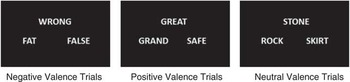
This 15-min computerized task examined how emotional words affect attentional processing by assessing the ability to match emotional or neutral words based on their semantic meaning (i.e., synonyms). On each trial participants saw a target word, flashed for 1300 ms, and two probe words presented for 3 s beneath the target word, on the left and right side of computer screen. Subjects had 3 s to indicate which one of the two probe words was a synonym of the target word by key press (“f” and “h” on the keyboard). All trials were match trials (i.e., one of the two probe words was always a synonym of the target word), and the triad of words presented on any given trial had always the same emotional valence (Figure 1). On half of the randomly presented trials the matching word was presented on the right side of the screen and on half it was presented on the left side. There were 10 blocks for the negative valence condition (e.g., three words that were presented: “wrong, fat, false”), and 10 blocks for the positive valence condition (e.g., “great, grand, safe”), while neutral trials (e.g., “stone, rock, skirt”) were embedded within the negative and the positive blocks. Each block lasted 30 s and had 10 trials (5 emotional and 5 neutral). Blocks were randomly intermixed during presentation. Words were taken from a database of emotional and neutral words (Affective norms for English words; Bradley & Lang, Reference Bradley and Lang1999), they were at an 8-year-old reading level, and were comparable in usage frequency and emotional intensity (Bradley & Lang, Reference Bradley and Lang1999; Gilhooly & Logie, Reference Gilhooly and Logie1980; Klein, Reference Klein1964; Kucera & Francis, Reference Kucera and Francis1967). Moreover, to avoid habituation words were not repeated within the experiment.
Synonym Matching Task. Illustration of visual display for trials with negative, positive and neutral valence words. On each trial all three words appeared at the same time. The top target word disappeared after 1300 ms, whereas the two bottom probe words were on screen for 3000 msec.

Demographic, Clinical, and Behavioral Data Analyses
Separate analyses of variance (ANOVAs) were carried out for each demographic and clinical measure (Age, Estimated IQ, SES, YMRS, CDRS, ADHD-R-IV), with group as the within-subjects factor (PBD only, PBD+ADHD, HC). Fisher's p tests (two-tailed) were carried out for categorical variables (gender, handedness, race). With regard to behavioral performance analyses, the accuracy and median Reaction Time (RT) distributions were normalized using a Log10 transformation. Then, to test the primary hypotheses and examine possible within-group and between group differences in performance that may be modulated by word emotional valence, separate analyses of covariance were carried out for accuracy and median RT data, with group as the between-subjects factor and word emotion valence (negative, positive, neutral within a negative valence block, neutral within a positive valence block) as the within-subjects factor. Age was included as a covariate to assess whether the participant age may affect performance. We used median RT instead of mean RT since it considerably reduces the high RT variability that is often present in pediatric psychiatric population. Moreover, we conducted secondary analyses to better characterize in a quantitative way group differences in the degree of interference caused by negative or positive words relative to neutral words. Specifically, both for accuracy and RT we calculated a weighted “Negative Valence Interference” index and a weighted “Positive Valence Interference” index. For the Negative Valence Interference index, we adopted the following formulas: Accuracy =[(Accuracy on Neutral trials within the negative blocks − Accuracy on Negative trials) / (Accuracy on Neutral trials within the negative blocks + Accuracy on Negative trials)]; Median RT = [(Negative trials RT – RT for Neutral trials within the negative blocks) / (Negative trials RT+RT for Neutral trials within the negative blocks)].
For the Positive Valence Interference index, we adopted the following formulas: Accuracy =[(Accuracy on Neutral trials within the positive blocks − Accuracy on Positive trials) / (Accuracy on Neutral trials within the positive blocks + Accuracy on Positive trials)]; Median RT= [(Positive trials RT – RT for Neutral trials within the positive blocks) / (Positive trials RT + RT for Neutral trials within the positive blocks)]. Separate ANOVAs for RT and accuracy were then carried out on these interference indexes.
Finally, to test our third hypothesis on correlations between performance scores (median RT and accuracy) and clinical measures (YMRS, CDRS, ADHD-R-IV), we carried out Spearman's Rho correlation analyses for the patient groups.
Results
Demographic and Clinical Data Results
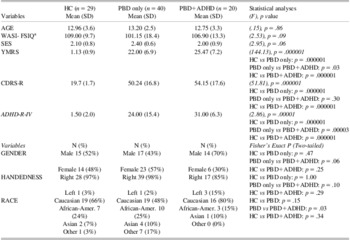
Demographic and clinical data for the two patient groups and HC are summarized in Table 1. The groups did not differ on demographic measures and IQ (p > .05). The two patient groups differed for racial composition but they did not differ from HC in this regard. As expected, there were significant group differences on clinical measures of manic (YMRS) and depressive (CDRS-R) scores, and on ADHD symptoms. For YMRS, the PBD+ADHD group had significantly higher ratings than HC and the PBD only group. The PBD only group had higher scores than HC. For CDRS-R the two patient groups did not differ from each other, but exhibited higher scores than HC. For the ADHD Rating Scale, the PBD+ADHD group had significantly higher scores than the PBD only group and HC.
Demographic and clinical characteristics for the HC group, the PBD only group, and the PBD+ADHD group

Note. PBD = pediatric bipolar disorder; ADHD = attention deficit hyperactivity disorder; PBD+ADHD = PBD group with ADHD comorbidity; HC = healthy control.
aFSIQ was estimated with Wechsler Abbreviated Scale of Intelligence (WASI; Matrix Reasoning and Vocabulary Subtests); SES = Socioeconomic status; YMRS = Young Mania Rating Scale; CDRS-R = Child Depression Rating Scale-Revised; ADHD-R-IV = ADHD Rating Scale-IV; African-Amer. = African-American.
Behavioral Performance Results
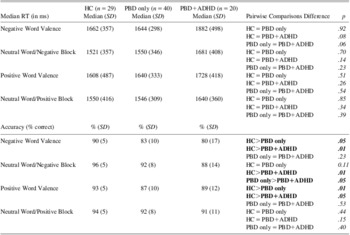
Table 2 illustrates Median RT and Accuracy data for the study conditions in each group.
Average Median RT and Mean Accuracy in each group for each word valence condition (with standard deviations in parentheses)

Note. For Median RT, there was no group effect. The effect of word valence was significant [F(3,258) = 25.50, p = .00001]. For Accuracy, the interaction of group by word valence was significant [F(6,258) = 2.85, p = .01].
PBD = pediatric bipolar disorder; ADHD = attention deficit hyperactivity disorder; PBD+ADHD = PBD group with ADHD comorbidity; HC = healthy control; SD = standard deviation; RT = reaction time.
Median RT
With regard to median RT, the main effect of group [F(2,85) = .97; p = .38] or the interaction of group by word valence [F(6,258) = 1.53; p = .17] were not significant. However, there was a main effect of word valence [F(3,258) = 25.50; p = .00001] in that in all groups median RT was significantly higher for negative than for positive word trials [F(1,86) = 11.09; p = .001]. Furthermore, RT was significantly higher for negative word trials than for neutral word trials in negative blocks [F(1,86) = 111.16; p = .00001], and for positive word trials than for neutral word trials in positive blocks [F(1,86) = 28.39; p = .00001]. There were no significant differences between the neutral word trials in negative and in positive blocks (p = .83), confirming that across groups there were no contextual effects of neutral words being embedded in either the negative or the positive valence block. There were no significant effects of Age as a covariate.
Accuracy
The Accuracy results are illustrated in Table 2. The significant main effects of group [F(2,85) = 4.56; p = .01] and of word valence [F(3,258) = 28.48; p = .0001] were modified by the significant two-way interaction of group by word valence [F(6,258) = 2.85; p = .01]. Planned comparisons were carried out on this significant interaction to further investigate within-and between-group differences depending on word emotional valence. Similar to the median RT data, none of the groups showed a significant difference in accuracy for the neutral word trials in the negative valence blocks compared to the neutral word trials in the positive valence blocks (for all groups p > .10). Also, for accuracy, there were no significant effects of Age as a covariate.
Within-group differences in word valence effects on accuracy With regard to accuracy, both the PBD group [F(1,86) = 4.17; p = .04] and the PBD+ADHD group [F(1,86) = 14.88; p = .0002] showed significantly lower accuracy for negative than for positive valence word trials, whereas in HC this difference reached only a non-significant trend [F(1,86) = 3.38; p = .07]. Moreover, when we examined within-group differences between emotionally valenced and neutral trials in the PBD only group, negative word trials yielded lower accuracy than neutral word trials in negative blocks [F(1,86) = 43.29; p = .00001], and positive word trials yielded lower accuracy than neutral word trials in positive blocks [F(1,86) = 24.31; p = .00004]. On the contrary, a significant difference in accuracy was present only between negative word trials and neutral word trials from negative blocks in the PBD+ADHD group [F(1,86) = 20.92; p = .000002] and in HC [F(1,86) = 13.82; p = .0004].
Between-group differences in word valence effects on accuracy Results on group differences in Accuracy are presented in Table 2. Relative to HC, both the PBD only and the PBD+ADHD groups exhibited significantly lower accuracy for negative and positive words. Moreover, the PBD+ADHD group exhibited significantly lower accuracy than HC and PBD only for the neutral word trials in negative blocks.
Positive and negative valence interference index effects
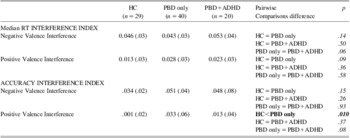
Interference Index data and group differences are illustrated in Table 3. For median RT, there were no significant group effect, or significant interaction of group by interference type (ps > .05). The effect of interference type was significant [F(1,86) = 25.60; p = .000002] in that negative valence interference was greater than positive valence interference in all groups.
Negative and Positive Interference Indexes for Median RT and Accuracy in each group (with standard deviations in parentheses)

Note. For median RT, there was no significant group effect, and a significant effect of interference type [F(1,86) = 25.60, p = .000002]. For Accuracy there was a significant group effect [F(2,86) = 3.80, p = .03].
PBD = pediatric bipolar disorder; ADHD = attention deficit hyperactivity disorder; PBD+ADHD = PBD group with ADHD comorbidity; HC = healthy control; RT = reaction time.
With regard to accuracy there was a main effect of group [F(2,85) = 3.72; p = .03], in that the PBD only group demonstrated overall significantly higher interference than HC [F(1,86) = 7.59; p = .007). The interaction of group by interference type was not significant [F(2,86) = 1.08; p = .34]. There was also a significant effect of interference type [F(1,86) = 23.32; p = .00006] in that for each group Negative Valence Interference was greater than Positive Valence Interference.
Correlations Between Behavioral Performance and Clinical Measures
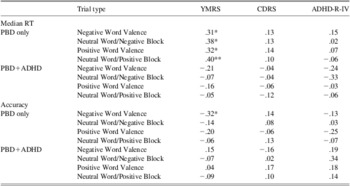
No correlation results survived Bonferroni corrections. However, our correlation analyses were hypothesis-driven rather than exploratory, therefore reducing the need for multiple comparisons corrections (Rothman, Reference Rothman1990). Table 4 illustrates significant (with an uncorrected p < .05) and non-significant results for the correlation analyses. Of note, the PBD only group exhibited a significant negative correlation between YMRS scores and accuracy for negative word trials, and a positive correlation between YMRS scores and median RT for all the four trial conditions.
Correlations between word emotion valence conditions (median RT, accuracy) and clinical measures in the two patient groups

PBD = pediatric bipolar disorder; ADHD = attention deficit hyperactivity disorder; PBD+ADHD = PBD group with ADHD comorbidity; YMRS = Young Mania Rating Scale; CDRS-R = Child Depression Rating Scale-Revised; ADHD-R-IV = ADHD Rating Scale-IV.
**Correlation is significant at the .01 level (two-tailed).
*Correlation is significant at the .05 level (two-tailed).
Discussion
The present findings are among the first to indicate significantly greater emotional interference on cognitive processes in PBD relative to HC during a semantic judgment task with emotional challenge. Negative and positive valence words worsened attentional performance during a synonym matching task in PBD relative to HC. This effect was greater with negative words and observed regardless of whether PBD patients also met diagnostic criteria for ADHD comorbidity. These results did not change when we included age as a covariate in our analyses, suggesting that group differences were not significantly modulated by age.
Emotional Interference Differs in PBD Relative to HC
In all groups, negative valence words yielded lower accuracy relative to neutral words. In agreement with our first hypothesis, both PBD patient groups exhibited significantly lower accuracy for negative than for positive valence word trials. This result, which was not significant in HC, suggests greater interference from negative emotions on attentional performance in PBD relative to healthy peers.
Moreover, relative to HC the PBD only group exhibited lower performance accuracy, both for negative and for positive word trials. These results suggest a heightened sensitivity to emotions in this patient group, with greater impact of both positive and negative emotional content on attentional performance (Compton et al., Reference Compton, Banich, Mohanty, Milham, Herrington, Miller and Heller2003; Posner et al., Reference Posner, Russel, Gerber, Gorman, Colibazzi, Yu and Peterson2009; Stormark, Nordby, & Hugdahl, Reference Stormark, Nordby and Hugdahl1995; Williams et al., Reference Williams, Mathews and MacLeod1996). This pattern suggests more pervasive emotional influence of negative and positive emotional content on performance, that may underlie a compromised affect regulation system in PBD (Passarotti & Pavuluri, Reference Passarotti and Pavuluri2011; Pavuluri & Passarotti, Reference Pavuluri and Passarotti2008) and may affect important cognitive functions such as memory and learning (Jacobs et al., Reference Jacobs, Pavuluri, Schenkel, Palmer, Shah, Vemuri and Little2011). It is possible that the attentional system in PBD patients is more sensitive or biased toward processing emotional information first. Alternatively, the attentional system in PBD may not be able to efficiently tune out emotional information while performing cognitive processing, and this leads in turn to greater interference from emotional information. While the current study could not differentiate between the two possible explanations, new studies will need to determine whether the attentional bias may be caused by affective over-reactivity to emotional information in the presence of fairly intact attentional functions, or by a maladaptive attentional system that may not be able to strategically tune out excessive emotional information as part of regulation processes.
Deficits in the ability to self-regulate when dealing with negative or challenging stimuli and events are confirmed by initial studies on reward-related processes in PBD. These studies have shown increased frustration associated with reduced attentional performance, increased emotional reactivity especially to negative contingencies and feedback, with poor ability to adapt to changing contingencies during reversal learning tasks, both in children (Gorrindo et al., Reference Gorrindo, Blair, Budhani, Dickstein, Pine and Leibenluft2005; Rich et al., Reference Rich, Schmajuk, Perez-Edgar, Pine, Fox and Leibenluft2005) and adults (Pizzagalli, Goetz, Ostacher, Iosifescu, & Perlis, Reference Pizzagalli, Goetz, Ostacher, Iosifescu and Perlis2008) with BD. Extending these findings, the present study shed some light on the mechanisms by which emotional and attentional systems interact in PBD, where emotional content may capture and divert attentional resources, leaving fewer resources for the remaining cognitive processes (Schneider, Dumais, & Shiffrin, Reference Schneider, Dumais and Shiffrin1984). In line with the present results, a recent verbal memory study from our laboratory found negative emotional impact during encoding and recall of short story details in PBD (Jacobs et al., Reference Jacobs, Pavuluri, Schenkel, Palmer, Shah, Vemuri and Little2011). Moreover, a study using an affective n-back task found working memory deficits in the presence of negative emotional faces in adolescents with PBD (Type I) (Shenkel, Passarotti, Sweeney, & Pavuluri, Reference Shenkel, Passarotti, Sweeney and Pavuluri2012).
However, different from our findings in the attentional domain, a previous study by Rich et al. (Reference Rich, Brotman, Dickstein, Mitchell, Blair and Leibenluft2010) that used an “emotional interrupt” task did not find differences between PBD and HC in how emotional IAPS (International affective picture system) stimuli (Lang, Bradley, & Cuthbert, Reference Lang, Bradley and Cuthbert1997) presented before and after a target influenced attentional performance. Future studies will need to further examine whether more robust significant differences between PBD and HC may be found in the working memory domain only, or may be present also in the attentional domain, given certain task difficulty constraints. For example, when the emotional content and the target content are embedded in the same stimulus, as in the present study, there may be potentially greater interference from emotional aspects, relative to other tasks where the emotional content may be temporally or spatially separated from target processing.
Effects of ADHD Comorbidity on Emotional Interference
The results from the present study did not confirm our second hypothesis that the PBD group with ADHD might exhibit worse interference from negative valence words relative to the PBD only group, although there was a non-significant trend (p = .06) in that direction for the median RT data. There were, however, some noteworthy differences between the PBD group with ADHD and the other two groups that may at least partially be due to attention deficits. That is, while both PBD groups exhibited significantly lower accuracy for negative word trials and for positive word trials relative to HC, the PBD+ADHD group showed lower accuracies than the other two groups for neutral trials within negative word blocks. This is possibly due to the fact that more severe attention deficits, as confirmed by the higher scores on the ADHD rating scale, may prevent the PBD+ADHD group from efficiently separating the emotional valence in single trials from the overall emotional valence in a block of trials. This interpretation of reduced selective attention capacity in the presence of negative emotion is also supported by the fact that the PBD+ADHD group had the lowest accuracy on negative valence trials compared to the other two groups, although the group difference was not statistically significant. This finding, that directly relates to the effects of negative emotions on attention, is also in line with a study by Shenkel et al. (Reference Shenkel, Pavuluri, Herbener, Harral and Sweeney2007), showing that relative to children with PBD only children with PBD and ADHD comorbidity exhibited more severe impairment in facial emotion discrimination and emotion intensity tasks in the presence of negative facial emotions.
Previous studies on attentional performance which did not include an emotional challenge have either found a worsening in attentional performance due to ADHD comorbidity in PBD or failed to find this trend. In a neurocognitive study, Pavuluri et al. (Reference Pavuluri, Schenkel, Aryal, Harral, Hill, Herbener and Sweeney2006) found that ADHD comorbidity worsened deficits in attention, working memory, and executive function; but some functional magnetic resonance imaging (fMRI) studies examining response inhibition (Leibenluft et al., Reference Leibenluft, Rich, Vinton, Nelson, Fromm, Berghorst and Pine2007; Singh et al., Reference Singh, Chang, Mazaika, Garrett, Adleman, Kelley and Reiss2010) or sustained attention during a single-digit continuous performance task (Adler et al., Reference Adler, Delbello, Mills, Schmithorst, Holland and Strakowski2005) did not find greater performance impairment in the comorbid group. While more research comparing PBD children with and without ADHD is certainly needed, it will be important to replicate and extend findings from the existing literature, which suggest that PBD patients with ADHD perform significantly worse than patients with PBD only in cognitive and affective tasks that tap into working memory capacity (Pavuluri et al., Reference Pavuluri, Schenkel, Aryal, Harral, Hill, Herbener and Sweeney2006). On the contrary, when tasks require interfacing of affective and cognitive processes, the two patient groups may perform more similarly because of the pervasive affect regulation deficits present in children with a primary PBD diagnosis regardless of ADHD comorbidity (Passarotti & Pavuluri, Reference Passarotti and Pavuluri2011).
Correlations Between Attentional Bias and Mania in the PBD only Group
With regard to our third hypothesis on possible correlations between clinical scores and performance, we found that in the PBD only group greater manic symptoms correlated with decreased accuracy for negative word trials, suggesting a relationship between mania and attentional bias to negative emotions in PBD. Moreover, greater YMRS scores correlated significantly with increased RT for all trial conditions, possibly suggesting a relationship between impairment in response speed and manic symptoms. There were no significant correlations with other measures on attention or depression. It has been proposed that the degree of emotional interference or attentional bias may be modulated by internal state or trait-related affective states (Bishop, Jenkins, & Lawrence, Reference Bishop, Jenkins and Lawrence2007; Jabben et al., Reference Jabben, Arts, Jongen, Smulders, van Os and Krabbendam2012). Our preliminary findings possibly suggest that the severity of manic symptoms may contribute to the severity of the attentional bias to emotions in PBD patients. However, these preliminary correlation findings need to be considered with caution, because not all of them were consistent with the hypotheses, and moreover, they did not survive multiple comparison corrections.
Moreover, different from our predictions the correlation pattern found for the PBD only group was not significant in the PBD group with ADHD. Presently, we do not have a clear explanation for this outcome. It is possible that the ADHD symptoms may introduce variability in how clinical symptoms relate to performance. Alternatively, the much smaller sample in the PBD+ADHD group may have limited the statistical power to find significant results in the correlation analyses. Studies with comparable sample sizes for the two patient groups are needed to disentangle this issue.
The neural mechanisms underlying the attentional bias toward emotional stimuli are still poorly understood. It has been postulated that a threat-alerting mechanism relying on interactions between limbic and prefrontal pathways (Beck & Clark, Reference Beck and Clark1997; Hakamata et al., Reference Hakamata, Lissek, Bar-Haim, Britton, Fox, Leibenluft and Pine2010; Pine et al., Reference Pine, Helfinstein, Bar-Haim, Nelson and Fox2009; Vuilleumier, Reference Vuilleumier2005) biases attentional orienting toward emotionally salient stimuli, especially those related to threat (Lobue et al., 2008). The amygdala is involved in emotion processing (Adolphs, Reference Adolphs2003), but it also relates the affective valence of stimuli to the ventral striatum, as well as to brainstem and arousal systems, alerting these circuits of potentially negative stimuli to be avoided (Cardinal, Parkinson, Hall, & Everitt, Reference Cardinal, Parkinson, Hall and Everitt2002; Ernst et al., Reference Ernst, Nelson, Jazbec, McClure, Monk, Leibenluft and Pine2005). These same circuits are also impaired in PBD, where amygdala hyperactivity coupled with poor fronto-striatal control may contribute to altered fronto-limbic interactions and to a chronic attention bias to threat (Passarotti et al., Reference Passarotti, Sweeney and Pavuluri2011; Passarotti & Pavuluri, 2011; Pavuluri et al., Reference Pavuluri, O'Connor, Harral and Sweeney2008; Rich et al., Reference Rich, Vinton, Roberson-Nay, Hommer, Berghorst, McClure and Leibenluft2006). This may be associated with a worsening of emotional interference on cognitive processes that may contribute to poor cognitive performance and affect regulation (Foland et al., Reference Foland, Altshuler, Bookheimer, Eisenberger, Townsend and Thompson2008; Passarotti & Pavuluri, Reference Passarotti and Pavuluri2011). Our behavioral findings, while preliminary, are in line with this biological model of the attentional bias in PBD. Future neurocognitive, fMRI, and functional connectivity studies may further elucidate the underlying neural circuits and behavioral mechanisms for healthy and pathological development of the “attentional bias to threat” and how it relates to affect dysregulation and symptom severity in PBD.
Some limitations of the current study require caution in the interpretation of our results. In general, the PBD patient group may suffer from clinical ascertainment bias, in that these patients were recruited from a clinical setting rather than from the community. Moreover, YMRS scores differed significantly between the PBD only group and the PBD+ADHD group. This difference in severity of mania symptoms may have affected group differences in the scope of the attentional bias. Also, we were not able to directly compare performance between patients with BD Type I and patients with BD Type II, since the vast majority of our bipolar patients were Type I. However, this is an important issue to address in future studies, since there is initial evidence that BD patients Type I and Type II may differ in terms of affective and cognitive dysfunction (Shenkel et al., Reference Shenkel, Passarotti, Sweeney and Pavuluri2012; Solé et al., Reference Solé, Martínez-Arán, Torrent, Bonnin, Reinares, Popovic and Vieta2011). Our patients were un-medicated, which eliminates medication confounds on attentional performance, but they were also acutely ill, and it is possible that they may show more severe deficits in attentional performance relative to euthymic patients (Shenkel et al., Reference Shenkel, Pavuluri, Herbener, Harral and Sweeney2007). Finally, since there is growing evidence of deficient emotional processing and regulation in ADHD (Barkley, Reference Barkley1997; Nigg, Goldsmith, & Sachek, Reference Nigg, Goldsmith and Sachek2004; Rapport, Friedman, Tzelepis, & VanVoorhis, Reference Rapport, Friedman, Tzelepis and VanVoorhis2002), it will be important that future studies directly compare a PBD+ADHD group to an ADHD group to better understand how ADHD symptoms may affect emotional interference independently of PBD.
Conclusions
Our research findings, while preliminary, have implications for intervention, in that they shed some light on the possible mechanisms underlying the ‘attentional bias’ to emotion, which may be a marker of emotional dysregulation in PBD. This increased sensitivity to emotional information may impact on many aspects of a child's life in that it affects the child's ability to accurately process emotions, to appropriately read social cues during social interactions, and to learn or benefit from therapy and psychosocial interventions. Studies suggest that the attentional bias to emotion may be remediated through training focused on “attention bias modification” treatments (March, 2010), or improvement of emotion processing and regulation through cognitive evaluation of challenge and reappraisal techniques (Passarotti & Pavuluri, Reference Passarotti and Pavuluri2011; Pavuluri et al., Reference Pavuluri, Graczyk, Henry, Carbray, Heidenreich and Miklowitz2004; West & Pavuluri, Reference West and Pavuluri2009). Characterizing the differential mechanisms of emotion processing and regulation in interaction with cognition across different pediatric groups may help better define the pathophysiology of affect dysregulation, and, ultimately, improve its treatment.
Acknowledgments
We thank the children and families who participated in this study. Thanks also to Ms. Stephanie Parnes and Mr. Binu Varghese for their help with subject testing and data processing. This work is supported by NIH R01MH081019, NIH RC1MH088462, NIH R01MH085639, NIH K24MH096011, NIH K23 RR18638-01, the Dana Foundation, and NARSAD. Dr. Passarotti's work, unrelated to this manuscript, is supported by a NARSAD Young Investigator Award and the Depression and Bipolar Disorder Alternative Treatment Foundation Award. Ms. Fitzgerald has no financial relationships to disclose. Dr. Sweeney has received support from NIH, Takeda, and Janssen that is unrelated to this work. Dr. Pavuluri's work, unrelated to this manuscript, is supported by NICHD, Janssen, and Bristol-Myers Squibb. All authors report no conflict of interest.