Who will guard the guardians? Plato first posed the question in the Republic, and his answer was that it would be ridiculous to suggest that the guardians of the city-state required oversight. No one could be their superior, because the guardians were of the highest moral caliber. The guardians would police themselves, Plato claimed in his famous noble lie, guarded by a sense of professional responsibility and the myth of their superior origins, which instilled noblesse oblige.Footnote 1 Centuries later, however, the Roman poet Juvenal came to the opposite conclusion in a different case. Juvenal mused that wives could not be trusted to resist the temptations of infidelity, but placing them under guard was not a solution since the guards could not be trusted either.Footnote 2
The American founders answered the question of who guards the guardians not primarily by a call to virtue, but by proposing a structural solution: the separation of the executive, legislative, and judicial powers of government to dilute the concentration of power, and checks and balances as means by which the branches could defend their prerogatives.Footnote 3 As the bureaucracy emerged as a center of power, however, elected politicians pursued forms of oversight to make sure that government agencies pursued their missions in a way that was consistent with politicians’ wishes. Bert Rockman has defined oversight as “the legislative supervision and monitoring of the executive, whether overt or covert.”Footnote 4 Subsequent analysis of legislative oversight focused on abstract categories such as formal and informal means of oversight, on oversight’s role in the representative process, or occasionally on politicians’ brazen attempts to bring purportedly neutral and scientific agencies in line with political objectives.Footnote 5
While there are many forms of political oversight of the bureaucracy, from reporting rules to ad hoc inquiries, the creation and filling of positions dedicated to oversight offers a twentieth-century American answer to Plato’s enduring question about whether guardianship can be institutionalized in a class of people. These positions are theoretically interesting because oversight positions provide an alternative logic to politicization, which refers to politicians’ attempts to fill the bureaucracy with loyalists subject to temporary appointments who have policy preferences close to those of elected politicians. Bert Rockman defines politicization as the “effort of a government (in the United States, a presidential administration) to manipulate the bureaucracy by organization and/or personnel so as to ensure the loyalty of the bureaucracy to the government’s (president’s) preferences and political interests.”Footnote 6 For Rockman and most political scientists, politicization begins with the presidency, and serves to fill government with partisan patrons and to move the political ideology of government policy closer to that of elected politicians, particularly the president. Politicization is fundamentally a mechanism of control.Footnote 7
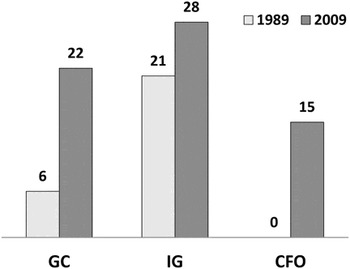
What accounts for the growing ranks of appointed inspectors general (IG), general counsels (GC), and chief financial officers (CFO) scattered across American government? Figure 1 highlights growth in numbers of presidentially appointed, Senate-confirmed (PAS) IGs, GCs, and CFOs between 1989 and 2009. We think the expansion of these positions represent an alternative logic to the prevailing account of politicization. As the state grew, members of Congress also reached for new instruments of accountability. Morris Fiorina noticed a change in Congress in the 1960s, when members eschewed running for office based on controversial policy positions and “instead place[d] heavy emphasis on nonpartisan, nonprogrammatic constituency service.”Footnote 8 Members of Congress funded and authorized bureaucratic programs, contributing to the growth of the state, but they also responded to citizens’ demands for help as the state grew. Constituents bothered by bureaucratic duty or confused by a maze of administrative procedures, wondering to whom they should write, or how they could appeal for a decision in some matter, sought the help of their representative or senator, and members could win the allegiance of voters by responding to these demands.Footnote 9 As Morris Fiorina observed, “In a very real sense each congressman is a monopoly supplier of bureaucratic unsticking services for his district.”Footnote 10
Congress may seek to politicize the bureaucracy by filling it with partisan cronies, but members have other objectives besides the boldest forms of politicization. Where oversight positions with statutory independence are professionals selected according to what, rather than who, they know perhaps Congress may instead be looking for problems worth solving.Footnote 11 Financial and legal professionals who fill oversight positions use their expertise to hold agencies accountable to politicians and, indirectly, to the public, by exposing waste, fraud, and abuse.Footnote 12 So that these positions would be more likely to serve politicians than the bureaucracy, the president and Congress lodged them in the peculiarly American presidentially appointed, Senate-confirmed (PAS) process.
Oversight positions represent only a small portion of the oversight activities mandated by Congress and presidents to monitor the bureaucracy. In the United States, oversight processes such as administrative law also constrain bureaucratic activity by subjecting it to the rules of the legal profession.Footnote 13 Government organizations like the Government Accountability Office and Congressional Research Service and a growing variety of interest groups and news providers engage in continuous, often-unacknowledged oversight of government activities.Footnote 14 Rather than examine the phenomenon of oversight, we analyze one category of the institutionalization of oversight.
We examine three appointed oversight positions now standard in many U.S. government agencies: inspectors general (IG), chief financial officers (CFO), and general counsels (GC). These positions differ in their requirements and responsibilities. The oversight position is an ideal type, characterized by: (a) formal and de facto independence from the agency they oversee; (b) adherence to professional norms that characterize a self-regulating community outside government; and (c) statutory responsibility to report on agency performance to politicians.Footnote 15 Inspectors general most clearly conform to the ideal, chief financial officers conform somewhat, and general counsels to a lesser degree.
The means by which each position type reports to politicians varies—from reporting to congressional committees directly, other times to the Office of Management and Budget, and in some cases merely to appointed agency leaders—but each position was intended by Congress and the president to serve as a “police patrol,” as in the famous metaphor, delivering information to Congress and the public about agency performance.Footnote 16 Congressional committees perform some oversight functions, but they have sufficient resources to respond to problems only when a metaphorical fire erupts.Footnote 17 Creating appointed positions within agencies gives committees and presidents the ability to gather more information through hearings and reporting requirements, allowing appointees to patrol agencies and, in an especially visible hearing or report, sound an alarm.
Lodging substantial oversight authority in appointed positions that scour the bureaucacy to uncover waste, fraud, and abuse creates opportunities for politicians to find problems to solve, but it also impairs the exercise of oversight because of appointed positions’ susceptibility to political conflict and, therefore, extended vacanies and turnover. Presidentially appointed, Senate-confirmed positons in American government are created to give politicians greater control over the bureauracy, yet problems with the appointments process give politicians less control over the bureaucrracy than they intended.
This article begins by examining the logic of creating oversight positions: politicians and agency leaders seek standardized information to manage a growing bureaucracy, and they seek legitimacy. We then analyze the specific histories of each of the three position types. Gaining a complete picture of the costs associated in performing oversight through appointed positions requires turning from historical analysis to a quantitative picture of how long appointees serve and how long positions remain vacant. During our study, oversight appointee positions are vacant roughly a fifth of the time they are in existence. Finally, we consider possible remedies for extended turnover, vacancies, and limited authority in the oversight function, and conclude that the problems associated with oversight positions result from the nature of political bargaining in the American system of government.
VARIATION AMONG OVERSIGHT POSITIONS
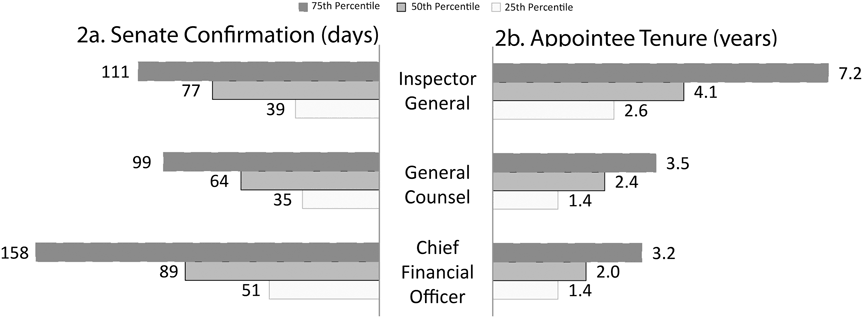
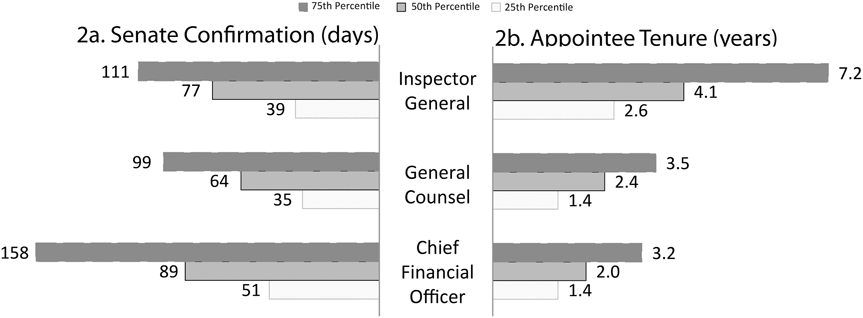
Oversight positions grow in fits and starts, and they vary substantially from the “ideal type” in terms of their level of independence, conformity to professional norms, and statutory reporting responsibility. Two observable parameters are duration of appointee tenure and the periods appointee positions are “vacant,” or between confirmed appointees. Because positions are sometimes the source of political controversy, they can sit vacant for long periods of time or be subject to frequent turnover, which can limit their effectiveness. Figure 2 shows the differences among length of tenure across position types. Inspectors general have the longest average tenure, 5.2 years, while general counsels serve 2.7 years on average and chief financial officers 2.3 years. The IGs’ distribution is particularly long-tailed: a quarter of all IGs serve more than seven years, and some inspectors general served a decade or longer. The greater length of tenure for inspectors general probably results from two factors. First, inspectors general are subject to formal rules and laws designed to insulate them from political pressure. Presidents may remove IGs, but, unlike with other appointees, they are required to “communicate the reasons for any such removal to both Houses of Congress.”Footnote 18 Second, the insulation of the inspector-general position, which stems from formal rules and from the informal power over information inherent in the position, makes serving as an IG especially rewarding. The position’s power to gather and publicize information about agency performance gives the most adept inspectors general an exceptional capacity to cultivate support among members of Congress, further insulating the positions from influence by the agency and administration, and making the work of an inspector general unusually rewarding. Although IGs have encountered obstacles in pursing their work, they do not face the same constraints on their activities that bind either CFOs, through reporting requirements, or general counsels, through their close relationship with agency heads.Footnote 19 Among the three types of positions, general counsels most often support the mission of an agency, while inspectors general most often publicly criticize the agency’s work.
Contentious agency politics may also reduce the length of tenure in addition to statutory differences among the positions. General counsels serve longer on average than CFOs, and general counsels are more likely to be supportive of an agency’s mission than a CFO, who on average may be more critical and spend more of his or her time on strictly oversight activities.
The length of tenure of oversight appointees matters because political appointees are notable for their transience compared to career civil servants. Appointees are often drawn from outside the career civil service, which may help them bring a fresh perspective to agency work. Yet appointees are “birds of passage” with brief tenures, between two and three years on average, while oversight appointees in particular serve longer, between two and five years on average (see fig. 2).Footnote 20 Thus, it is important that appointed oversight positions not go unfilled for long periods of time or have extreme turnover because of the experience deficit among appointees.
While origin and development of each position is in some ways idiosyncratic, appointed oversight positions constitute a single category for several reasons. Oversight positions are characterized by neutral competence and professional expertise; and they appeal to purportedly neutral professional norms in law and finance that obligate both career civil servants within agencies and elected politicians. For inspectors general, neutral competence is part of the authorizing statute. Unlike most other presidentially appointed, Senate-confirmed positions, they are to be appointed “without regard to political affiliation and solely on the basis of integrity and demonstrated ability in accounting, auditing, financial analysis, law, management analysis, public administration, or investigations.”Footnote 21 Similarly, CFOs are to conduct their work in a way that “complies with applicable accounting principles, standards, and requirements, and internal control standards.”Footnote 22 For general counsels, their legal training, background in the law, and job duties ensure that they are responsive to the norms of the legal profession.
All three positions have statutory obligations to report information to elected politicians. Inspectors general and CFOs issue regular reports—the former to Congress and the latter to the OMB—and they keep presidentially appointed agency heads informed of their findings. General counsels advise agency heads, but they also have formal responsibilities to other authorities: the attorney general, whose involvement in and attention to legal matters within agencies varies, the legal profession, and the president who appointed them. All three positions issue findings that are available to the public, media, and interest groups.
Finally, all three positions conduct investigations of a general type with the power to command access to records, reports, audits, and reviews relating to agency performance. Inspectors general explicitly have the power to subpoena information or take affidavits, and CFOs are granted “access to all records, reports, audits, reviews, documents, papers, recommendations, or other material which are the property of the agency or which are available to the agency,” though they are explicitly not granted access greater than that permitted to inspectors general in the 1978 Act.Footnote 23 The authority of general counsels varies according to individual statutes and agency characteristics, but many general counsels have the power to conduct investigations to obtain information. For example, the general counsel at the Securities and Exchange Commission has the power to conduct investigations of attorney violations of securities practices and to name and remove officers who take testimony and conduct investigations.Footnote 24
INSPECTORS GENERAL
While oversight positions share common characteristics, each type emerged through distinct developments. The first inspector general was created in 1777 to improve military performance—hence the title of “general.” George Washington wanted to ensure tactical competence among his troops in carrying out his orders, and the Continental Congress sought better information about an important government function. The twentieth-century incarnations of oversight positions, however, went beyond the military context and were shoehorned into the norms and rules of existing inspectors general and presidentially appointed, Senate-confirmed positions.
Mark Moore and Margaret Gates emphasize how modern inspectors general were created in the late 1970s to satisfy a “demand for accountability” because of the growing complexity of government.Footnote 25 While these positions arose amid demands for a particular version of accountability with punitive implications, it is important to note how scandal and media attention to perceived waste, fraud, and abuse drove the creation of many appointed watchdog positions, including inspectors general. Borne out of scandal themselves, watchdog appointees bring more scandal to light, which makes these positions particularly controversial and prone to opposition from politicians and from the agencies they oversee.
The U.S. Department of Agriculture inspector general is recognized as the first modern IG. Secretary of Agriculture Orville Freeman created an inspector general in the wake of a cotton price-fixing scandal, but it is not clear from testimony why the 1964 hearings about the scandal led to the creation of a department-wide IG.Footnote 26 Paul Light concludes that the Agriculture IG was just one of a long list of reforms, albeit one with an important legacy.Footnote 27
Soon after, a scandal in the Health, Education, and Welfare department led Congress to create another inspector general. Agencies within the department had engaged in fraud and unnecessary kickbacks in Medicaid billing, among other abuses. Rather than blame individual malfeasance, Congress depicted the problem as excessive organizational complexity and insufficient chains of accountability. In one hearing, L. H. Fountain, who would author the IG Act two years later, concluded that “units responsible for combating fraud and abuse were scattered throughout HEW in a haphazard, fragmented, and confusing pattern, with no single unit having the overall responsibility and authority necessary to provide effective leadership.”Footnote 28 Following the hearings, Congress created the Health, Education, and Welfare inspector general in 1976. The new position generated policy feedback; creating an inspector general because of scandal brought more scandal to light. The HEW IG’s first report in 1979 led to a Los Angeles Times article claiming that the Social Security Administration wasted $2 billion annually.Footnote 29
With precedent for inspectors general in other agencies and mounting pressure for organizational solutions to problems of accountability, Congress gave IGs broad powers in the Inspector General Act of 1978.Footnote 30 The act consolidated audit and investigative functions and created offices of Inspectors General in twelve agencies and departments.Footnote 31 The 1978 Inspector General Act provides a direct grant of oversight authority, creating statutory inspectors general to “conduct and supervise audits and investigations relating to the programs and operations of the establishments.”Footnote 32 In addition to preventing and detecting “fraud and abuse,” IGs are to promote “economy and efficiency” in government, a phrase that prefigures the concern for performance.
The IG Act was passed by the House of Representatives by a vote of 388 to 6, and it was approved by the Senate by unanimous consent amid broad support for government reform. The Civil Service Reform Act and the Ethics in Government Act passed in the same year. President Jimmy Carter called the new inspectors general a “powerful new tool for the discovery, the prevention, and the elimination of fraud.” Perhaps making clear that these new positions were not the same as other appointees or civil servants, Carter added that the inspectors “have broad powers and a significant degree of independence.”Footnote 33
The inspectors general themselves were only one manifestation of a growing cadre of reviewers of government activity, from increases in congressional staff and media coverage to GAO investigators. The positions grew out of a long-standing drive for accountability among members of Congress, and particularly the view of accountability that prevailed at the time, which favored control, reporting, and oversight. Critics worried that Congress’s understanding of accountability privileged pro forma reporting at the expense of creativity, entrepreneurship, and support of the agency missions.Footnote 34
Inspectors general conduct audits and investigations of programs within their agencies, and review existing and proposed legislation and regulations for impacts on efficiency and performance. Inspectors general have access to all records and information of an agency and can command the agency head’s time. They issue a variety of written reports to the agency or department head and are allowed to issue reports to Congress subject to review and comment but not alteration by the department or agency head.Footnote 35
The inspector general is the only executive branch presidential appointee who reports directly to Congress without going through other bodies such as the Office of Management and Budget, which gives the IG unusual independence from the agency head.Footnote 36 Like other appointees, inspectors general are removable without cause by the president, but the 1978 act has an unusual proviso: they are to be selected “without regard to political affiliation and solely on the basis of integrity and demonstrated ability in accounting, auditing, financial analysis, law, management, public administration, or investigations.” Relative to other appointees and even other oversight positions, inspectors general have unusual independence, which explains their unusually long average tenures. Yet because of their formal insulation, inspectors general have a greater “relational distance” from the agencies they oversee, and their oversight activities are generally more critical than those of general counsels or CFOs.Footnote 37 Thus, inspectors general often meet resistance from the agencies they oversee. The number of inspectors general varies by agency. Treasury has the most inspectors general as of 2010, eight, and DHS and OPM have the least, with one each. Most departments have between three and five.
Relations between the agencies and their IGs have always been ambivalent. Although many agencies resisted the Inspector General Act of 1978, some of the agencies that experienced scandals created their own offices of inspectors general prior to 1978. This may have been to avoid the passage of legislation or simply because they wanted to make sure they did not suffer the same public criticism they endured under earlier scandals. New agency administrators, in particular, may favor the creation of an inspector general to distinguish themselves from their predecessors or to avoid a repeat of earlier scandals. The source of agency ambivalence toward the inspector general lies in the position’s dual roles of monitoring waste, fraud, and abuse and monitoring agency capacity and performance to support the agency’s mission. The 1978 Inspector General Act formalizes dual roles, giving the position the authority to seek out waste, fraud, and abuse and to promote “economy and efficiency,” a phrase that prefigures the concern for government performance that emerged in the 1990s.Footnote 38
State Department inspector general Sherman Funk once called this dual role “straddling a barbed wire fence.”Footnote 39 June Gibbs Brown, a former Health and Human Services inspector general, described the tensions inherent in her dual role: “You’re walking a fine line. To satisfy Congress you need to make sure your work is respected on both sides of the aisle. To satisfy the agency you have to be accurate and thorough—it only takes one bad product to sour people.”Footnote 40 Brown emphasized the importance of building a good relationship with the agency head, even though she had an oversight role. For example, she made a habit of informing the agency head about what would be in a future report even though she had no legal requirement to do so. “If they don’t respect your office and what you’re producing, you may as well forget it, because you’re not going to get changes as a result of your work,” she said.Footnote 41 Inspectors general who do not develop a good relationship with their agency leaders may leave their positions sooner than expected even though they have statutory independence from the agency head.
The Inspector General Reform Act of 2008 reinforced the position’s independence. The Act improved pay levels, required that the president give Congress thirty days’ notice before removing or transferring an inspector general, and gave IGs additional law-enforcement powers.Footnote 42
CHIEF FINANCIAL OFFICERS
Chief financial officers are the senior executive branch officials responsible for financial management. While the government has always had financial managers, the Chief Financial Officers Act of 1990 incorporated sixteen CFOs into the system of presidential appointments and Senate confirmation.Footnote 43 In 1990, Congress passed the act to create chief financial officers as watchdogs for financial management.Footnote 44 The CFO Act established the positions to bring financial expertise to government agencies both to “assure the issuance of reliable financial information” and to “deter fraud, waste, and abuse of Government resources.”Footnote 45
Advocates of reform were determined to learn from earlier financial management mandates widely regarded as lacking teeth. The savings-and-loan crisis in the late 1980s revealed shortcomings in federal financial oversight, and scandals in the Department of Housing and Urban Development and elsewhere exposed insufficient financial controls. Members of Congress worried that the Office of Management and Budget had neglected financial management functions and the improvements within and among agencies because the OMB’s primary concern was the budget.Footnote 46 As in many other cases, advocates for reform used a narrative of crisis to press for new regulation and controls.Footnote 47
The act and subsequent legislation defined the duties of the CFO to pick up where the OMB left off: constructing budgets and developing financial management and performance reporting systems. The act mandated that federal agencies produce financial statements and audits—long common practices in the private sector—and required new internal controls. Since then, many CFOs have moved from auditing and compliance functions to the front office of public policymaking.Footnote 48 Like inspectors general, they have a dual mission. CFOs are called upon to creatively improve government services using fewer resources, as well as to police waste, fraud, and abuse. Doing both to the satisfaction of congressional committees and interest-group constituencies has proven difficult, however. CFO Magazine’s conclusion in 2004 is typical of evaluations of the CFO Act.Footnote 49 It finds that “sloppy accounting continues to plague federal agencies and evade congressional attention.”Footnote 50 The Government Accountability Office’s annual report on the effects of the Federal Financial Management Improvement Act of 1996, which shored up CFO responsibilities, found that thirteen of twenty-four CFO Act agencies “are not providing reliable, useful, and timely information to help manage agency programs more effectively.”Footnote 51 Progress in implementing CFO oversight was erratic, and by 2006, 75 percent of agencies were not complying with at least one of the Federal Financial Management Improvement Act’s (FFMIA) requirements, which include meeting federal financial systems and accounting standards.Footnote 52
In addition to its precarious position balancing oversight and supporting agency missions, CFOs have struggled with the sheer complexity of the tasks for which they are responsible.Footnote 53 The CFO Act requires that chief financial officers follow standard financial accounting practices and produce private-sector-style financial statements, which are popular with members of Congress, but may not serve the demands of government agencies lacking clear profit-and-loss measures. Mandating private-sector financial accounting practices proved popular among members of Congress, but these practices are not aligned with measuring the effectiveness and efficiency of government agencies that lack clear profit-and-loss measures. A survey of federal CFOs in 2008 called attention to the drain on CFO resources caused by legally mandated compliance and reporting requirements that did not support the agency’s mission. “There is a sense in the federal community that CFOs are not relevant because they are consumed with issues that have nothing to do with managing the mission of an entity. If compliance requirements are about things that are not important to running an entity and they consume a lot of time, then the system is broken,” the report concluded.Footnote 54
Despite disappointments, the CFO Act institutionalized attention to financial management as a central part of policymaking. Unlike other financial management reforms, the act left a legacy of institutionalized human capital. Although the practices of federal financial management may change, the chief financial officer positions remain. They have some of the same watchdog characteristics of inspectors general because CFOs are de facto comptrollers. Yet compared to other political executives, CFOs report their findings more often to the executive branch’s Office of Management and Budget and to inspectors general. Thus, CFOs’ primary principals are other political executives rather than members of Congress or the president directly.
CFOs come from a wide variety of backgrounds and have varying levels of experience within the federal government. For example, the current chief financial officer for the Department of Energy holds a B.S. and M.A. in aerospace engineering, while the Department of Labor’s CFO is a certified Project Management Professional with degrees in accounting. Unlike general counsels, who have J.D.s and usually hail from the private sector, CFOs typically have experience in the public sector.
GENERAL COUNSEL
General counsels are typically more involved in an agency’s political program than the inspector general or chief financial officer. General counsels work closely with agency leadership, supporting the priorities of its appointed leader, while making sure the agency’s work proceeds within legal limits. The general counsel’s primary job is to give legal advice to the head of an agency about which actions are legal and which actions may violate the law.Footnote 55
General counsels were first recognized as a class by the 1870 law creating the Department of Justice that brought all law officers of government formally under the Attorney General.Footnote 56 Since then, appointed general counsels have drawn their authority from acts that create or reorganize agencies and isomorphically create positions for a chief legal officer. For instance, the Homeland Security Act gives the general counsel responsibility for all of the department’s legal determinations. Like all appointees, general counsels face a tension between serving elected politicians and serving the agency’s mission as articulated by careerists. The act gives the general counsel responsibility for ensuring that the agency’s regulatory actions comply with relevant statutes and executive orders or, in other words, the wishes of the president and Congress.
In addition to serving the agency head and the law, the general counsel reports to the Justice Department, the Office of Management and Budget, and congressional oversight bodies. Unlike other government attorneys, the general counsel is first a counselor, not a litigator, and he or she rarely takes the lead in litigation. At the founding, the attorney general served as the government’s sole source for legal advice. In the nineteenth century, the departments of Treasury and Justice added lawyers to provide legal and policy advice.Footnote 57 And as the modern administrative state took shape after the New Deal and with the growth of safety and environmental regulation, Congress placed general counsels with specialized expertise in new agencies to help navigate regulatory thickets.
Agency general counsels are technically appointed by the president, but in many cases the president defers to the judgment of the agency head for guidance in selection.Footnote 58 Thus the general counsel may be more loyal to the appointed leader of an agency than to the president. Some presidents, however (notably Clinton), have selected second-tier appointees directly in order to ensure loyalty.Footnote 59
Agency general counsels are technically subordinate to the attorney general, but the Department of Justice does not usually claim direct authority.Footnote 60 Attorney General Griffin Bell famously expressed dismay about the lack of control he had over the diffuse network of agency general counsels: “These lawyers are distributed through the departments and agencies, and practically no agency is too small to have its own “General Counsel.” . . .Footnote 61“Although I am the chief legal officer in the executive branch, I have learned that I have virtually no control or direction over the lawyers outside the Department of Justice, except indirectly in connection with pending litigation.” The law relevant to agency general counsels is often specific to a policy field, and the diffusion of the law itself in addition to the spread of the federal bureaucracy gives general counsels unusual independence compared to other government lawyers. The complexity of legal rules and knowledge gives members of the legal profession a degree of insulation from political control, even by other lawyers, though particular general counsels may be loyal to an agency head or an agency’s mission.
CREATING AND FILLING OVERSIGHT POSITIONS
While the majority of IGs and CFOs trace their authority to recent authorizing statutes, general counsels emerged gradually during the nineteenth and twentieth centuries, usually with legislation creating or reorganizing an agency. The number of these positions increased during the 1990 and 2000s. After a long period of expansion, the overall number of PAS positions in the federal government plateaued during the 1980s and remained relatively constant in the decades that followed.Footnote 62 During the same years, as Figure 1 illustrates, the ranks of oversight PAS appointees expanded dramatically. The CFO Act of 1990 created CFOs for twenty-four federal departments and agencies, accounting for much of the position’s growth. General Counsel positions nearly tripled through a process that was largely ad hoc and piecemeal. Inspectors general grew at a slower pace, increasing by almost one-third after 1989, with most created by the 1978 act.
Increase in Senate-confirmed oversight appointee positions by position type, 1989 and 2009.

Confirmation and tenure of oversight appointees by quartile, 1989 to 2009.
While each has distinctive characteristics, all positions share a common oversight function written into their authorizing statutes, an aspiration toward neutral professional competence, the power to conduct investigations, and the obligation to report their findings to agency leadership, elected politicians, and the public. Political scientists often view the term “neutral competence” with suspicion and trace it to the Progressive Era, where it was one of a number of reforms meant to build a more scientific and rational state. Public administration scholars, however, view neutral competence as an enduring and necessary value; it is not a “direct dial line to some over-arching, non-partisan sense of the public interest.”Footnote 63 Rather than a rejection of politics, neutral competence holds that civil servants should give politicians their most expert judgments so that politicians may choose the best means to arrive at democratically sanctioned ends.Footnote 64 Agencies perform tasks that are both legislative and executive, writing and implementing rules, and administrative law adds a judicial function to their work. Appointed positions of all stripes can enhance democratic accountability by injecting the preferences of elected politicians who select appointees into the bureaucracy.
Oversight positions are created out of the convergence of three processes: institutional competition among branches of government, the emergence of professional communities, and the demands of agencies.Footnote 65 Congress and the president are the primary agents in the story, and they address their need for information about agency activity by creating appointed oversight positions. Following creation, the president and Senate fill the positions, or they engage in extended bargaining that leaves the positions unfilled. Politicians created the positions at the culmination of three developments in institutions, professions, and agencies.
First, oversight positions emerged as part of institutional politics, specifically the growing congressional demand for oversight. With the development of the positive state in which the bureaucracy implements federal government programs that directly impact individual citizens, Congress demanded more information about program performance. In particular, Congress demanded standardized information to support decentralized control over agency activities.Footnote 66 The profusion of standardized information began when Congress developed a legislative division of labor relying on committee government beginning in about 1920 and lasting until roughly 1970.Footnote 67 The turn to committee government grew out of a revolt against the near-absolute power of House Speaker Joseph Cannon over the legislative process. In an attempt to curb power, Congress devolved power to committees.
Party leaders during this period were “concerned with the flow of legislation rather than its detailed contents,” according to scholar Randall Ripley, while congressional committees wielded enormous power over legislative details and processes.Footnote 68 Subsequent formal and informal reforms after 1970 returned power to party leaders, who used standardized information about agency activities for their own partisan purposes, rather than the constituent service and pork-barrel purposes of committee chairs seeking goods for their districts. Reforms in the late twentieth century, such as the Whip system, gave party leaders control over the congressional agenda and, consequently, over agency activity. Committee chairs still wielded great authority, however, and members of Congress have far more independence in their vote choices than representatives in most parliamentary systems.
As government reached into new areas of American life, the details of government activities became far too complicated for members of Congress—or any small group of individuals—to master completely. Congress and the president developed standardized information as a tool to help manage programs and to make incremental improvements, identify problems, or deliver benefits to voters in their districts in order to win the allegiance of voters. While members of Congress have many goals, assuming that they want to win reelection above all else works reasonably well as a rule of thumb, since members who seek reelection will win reelection more often than those who do not.
Members of Congress today are probably not more interested in reelection than their predecessors, however. As Morris Fiorina observes, “What has changed is the set of resources he possesses to invest in his reelection effort. Today’s congressmen have more productive political strategies than previously. And these strategies are an unforeseen (at least by us) by-product of the growth of an activist federal government.”Footnote 69
Oversight positions deliver information about broken or cumbersome bureaucratic processes that members of Congress can claim credit for fixing. Members of Congress lodge oversight in appointed positions staffed by financial and legal professionals because they favor the use of standardized financial and managerial information in order to counter the private information that might be shared within a bureaucracy or between a subcommittee and the agency.Footnote 70 Standardized information allows committee staff to monitor agency activity in areas where the member is not expert, and it allows interest groups to monitor agency activities externally. The president and his staff have similar motivations, and in conjunction with Congress create appointed oversight positions to produce and analyze information.
Congressional appetite for appointed positions with the legal and financial expertise necessary to provide a particular version of accountability arose in a specific historical context, the post-1970 reform era in which Congress returned power to party leaders.Footnote 71 Investigative journalism emerged at the same time, either spawned by or contributing to increasing distrust in government.Footnote 72 Journalists made names for themselves by exposing scandal and abuse.
At the same time, Congress reasserted its authority, creating demand for oversight. Committee staff and hearing days more than doubled between 1969 and 1977, before leveling off in the 1980s and 1990s, perhaps in part because a limited number of staff and members can devote only so much time to formal hearings.Footnote 73 Among members of Congress, increased party polarization and party cohesion led to decreased congressional bipartisanship and more divided government.Footnote 74 As a result, deficits and legislative stalemate shifted attention to oversight and investigation. Increasingly partisan oversight from Congress and politicization in the agencies led to a demand for a neutral official—the oversight appointee—with the expertise to stand apart from partisan politics.Footnote 75
The logic of creating appointed oversight positions competes with the logic of politicization found in the rational choice scholarly literature on appointees. The first generation of rational choice scholarship on appointees found that presidents create new appointed positions because they want to influence agency activity toward their policy preferences and away from the agency’s own direction.Footnote 76 The second generation of appointees literature framed the creation of new positions in terms of politicians’ search for an acceptable compromise between two extremes. The first is politicians’ complete control of agency activity, which potentially sacrifices competence by filling the bureaucracy with partisan hacks—a technique sometimes labeled politicization.Footnote 77 The second extreme is complete neutrality among administrators who become mere instruments of politicians, a function that is potentially disconnected from democratic accountability, which is central to oversight.Footnote 78
Rather than as tools for politicization, however, we find that appointed positions arose because politicians seek agents with neutrality toward partisan disputes and distributive politics. Rather than use oversight appointees for patronage, politicians insulated these positions with qualifications on who can be selected and how they can be dismissed, and through an informal commitment to select professional investigators, lawyers, and auditors. Professionals deliver information that members of Congress can use to help their constituents.
In the second development, while institutional politics among Congress, the president, and the bureaucracy created a demand for oversight appointees, the emergence of audit and legal professions provided the supply. In order to generate standardized information, politicians need people to exercise what Eliot Freidson, a scholar of professions, calls discretionary specialization.Footnote 79 In the information specializations, there is a competition over what facts are most relevant. Some ways of arranging facts are likely to prevail over others simply because they are more logical. Professions that are strong adopt logical, internally standardized concepts, and politicians are more likely to adopt formal abstractions with high integrity into law.Footnote 80
Yet the competition over what facts are relevant, and over what should be inferred from those facts, is also a status competition. Professions gain when the facts they privilege are institutionalized by being written into law as essential for the policy and administrative process. Professions are coalitions of esteem, buoyed by the reputation they have among politicians, experts, and the public, and high-status professions are more likely to gain formal institutionalization in the policy process.Footnote 81 If high-status organizations have chief financial officers, the argument goes, other organizations will imitate.
General counsels arose for a variety of reasons, including but not limited to status claims. In the twentieth century, government agencies took on greater regulatory roles, and they were exposed to legal challenges, which required in-house counsels to provide defense and helped agencies stay out of trouble. There is reason to believe that functional demands were not the only reasons why politicians institutionalized legal and financial accountability in formal professionally oriented organizations, however. The legal and financial professions conferred status or, in the language of Daniel Carpenter and others, legitimacy, on organizations.Footnote 82
The twentieth century saw the rise of a number of weakly professionalized groups in government: library science, policy analysis, public relations, and information systems. Yet these professions have a lower status than audit and legal professionals, and they are not statutory positions subject to presidential appointment and Senate confirmation. General counsels became a standard part of an agency’s structure because of the high status of the legal profession and the ample supply of lawyers, in addition to the functional demands for legal advice because of government’s increasing regulatory action.Footnote 83 Professions contribute to the emergence of oversight appointees because they claim to be able to interpret the most important facts. Legal and financial professions compete to provide facts to the political system, and institutions develop around new sources of information such as legal and accounting standards.
Finally, the particulars of agency politics and personalities interact with institutions and professions to create noisy data rather than the clean lines of linear relationships preferred by social scientists, who analyze causal relationships. In other words, particular agencies adopt oversight positions, and these positions become subject to appointment at different times for agency-specific reasons. Nevertheless, some general agency-level trends lead to the creation of appointed positions. Civil servants may be suspicious of oversight positions created to monitor agency activity, yet sometimes even they recognize the problems of internal control in large bureaucracies. In the positive state, where government agencies intervene in the lives of individual citizens or distribute resources to subnational governments, civil servants demand standardized information for monitoring and control in order to act according to values of neutrality, competence, and expert judgment. Civil servants’ commitment to performing their mission rather than simply shirking explains why some agencies seek oversight positions, and why some occupants of these positions are revered within an agency.
In other cases, civil servants seeking status are more likely to welcome oversight appointees. The high-status professions of law and finance lend esteem to agency processes. Furthermore, the presidential nomination and Senate confirmation of oversight appointees lends prestige and authority to these positions. Recently, some members of Congress attempted to reform the appointee system by reducing the number of positions subject to Senate confirmation. In response, a senior government executive said that he opposed eliminating Senate confirmation for his general counsel because Senate confirmation lent importance to the agency and its work.Footnote 84
While broad trends govern agency attitudes toward the creation of appointed oversight positions, length of tenure, turnover, and vacancies are subject to agency particulars. Politicians may uncover facts that lead to an appointee’s departure, but these facts are difficult to predict because they depend on personality and because there is not always a clear standard of evidence for what counts as a fact that disqualifies an appointee from holding office. In one era, having smoked marijuana in college may have been cause for an appointee to withdraw, but in another it may have been merely a curiosity. Agency-level factors might be summarized as simply contingency, but they also include the tendency for agencies to seek out appointees’ oversight positions to improve performance, navigate regulatory environments, and boost the status of an agency or program.
CHANGE AND CONTINUITY
To gain a more complete picture of the costs associated with lodging the oversight function in appointed positions, we turn from historical analysis to quantitative pictures of how long oversight appointees serve and how long positions remain vacant. The costs of making the oversight function subject to the rules governing appointees are evident in cases of extreme turnover, confirmation delays, and long vacancies. Oversight appointees are not the only means by which politicians monitor the bureaucracy and solve problems for constituents, but these positions are one important means of oversight and are worthy of close inspection.
To gain a picture of how long appointees serve—which is necessary to understand the negative consequences to wedding oversight functions to presidentially appointed, Senate-confirmed positions—we measure appointee tenure by the length of time between confirmation and departure.Footnote 85 We reviewed all PAS appointees, identifying the tenures of GCs, IGs, and CFOs according to Congressional Research Service reports and appointments data available through Thomas.gov in all departments, single-headed independent agencies, and Executive Office of the President organizations between 1989 and 2009. A total of 296 confirmed appointments are included.Footnote 86 We also reviewed relevant statutes to identify which positions qualified as oversight appointees. General counsels proved the most difficult to identify of the three positions types because they were not created by a single statute, and agencies have accumulated many lawyers with general responsibilities. Nevertheless, only one general counsel per agency serves as the senior adviser on legal matters to an agency or department head, and for our purposes this position is the general counsel.Footnote 87
The continuity of IGs varies widely across agencies. During the Clinton administration, for example, the Treasury Department had three confirmed IGs and several more acting IGs. In contrast, the Justice Department’s inspector general, Glenn Fine, has served since 2000. Fine has led investigations into problems in the department’s civil rights division and domestic spying programs, among others. His reports contain frank criticism of the department’s leadership, but they have earned bipartisan praise in Congress. His reputation is due, at least in part, to his length of service. Senator Arlen Specter of Pennsylvania, who has served on the Senate Judiciary Committee, explains that “Fine has had more opportunities . . . to prove his mettle.”Footnote 88
In contrast to inspectors general, CFOs and GCs are characterized by substantially greater turnover. Figure 2 shows that one-quarter of appointees confirmed to these positions serve less than sixteen months. More lucrative opportunities in the private sector may lure these appointees from government service.Footnote 89 Professional positions in accounting, law, and lobbying generally have greater compensation than government service.Footnote 90 Of course, appointees serve for many reasons other than financial rewards. Most senior government appointees are motivated by the intrinsic rewards of public service. At the same time, the intense political pressures of some positions may drive appointees from public service, or at least lead to extended vacancies and appointment delay.Footnote 91
In some departments, general counsels have long periods of continuity. Agency heads work closely with their general counsels, so in agencies where general counsels and department heads remain intact for several years, the general counsel can shape an agency’s legal approach. For example, during the Clinton presidency, the general counsels and secretaries at Education, Health and Human Services, and Interior were remarkably stable. These agencies were central to Clinton’s welfare reform, education, and environmental agendas.
The length of time it takes for a nominee to be confirmed by the Senate varies according to the insulation and independence of the position and the policy controversies of the day. If a senator is critical of an agency’s performance or a nominee’s background, or if a senator wants to punish the president for an unrelated reason, a single senator can place a hold on a nomination indefinitely. More often, strong opposition in the Senate will mean that the Senate never votes on confirmation. On May 27, 2010, President Obama nominated Paul Tiao for Inspector General of the Department of Labor. Advocates for business opposed Tiao for having close ties to labor unions, and Tiao was never confirmed. President Obama renominated him during the new Congress on January 26, 2011, but on May 12 Tiao asked that Obama withdraw the nomination for “personal reasons,” presumably to be able to resume his life and legal career without waiting in limbo. The Department of Labor had been without a confirmed inspector general since 2008.
Sometimes, positions are weakened because of lengthy periods between the time a president nominates an appointee and the time the Senate confirms that nominee. Figure 3 gives a picture of the average time to confirmation for each position type by congressional term. Among the three positions, CFOs wait the longest for confirmation, with an average of 51 days at the 25th percentile and 158 days at the 75th percentile. Oversight appointees sometimes wait months to be confirmed, and so most agencies employ acting inspectors general, counsels, or financial officers who carry on the work of the office until a new appointee is in place. An inspector general’s office might continue its investigations without a nominee, but the office would not carry the same authority with an acting head as it would with a presidentially nominated and Senate-confirmed leader.
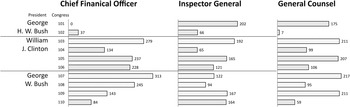
IG, GC, and CFO position vacancies, average position days vacant by congressional term, 1989–2009.

VACANCIES, TURNOVER, AND CONFIRMATION DELAYS
Presidents and Congress seek accountability for bureaucratic activity by creating appointed positions to provide standardized information about agency behavior that can be monitored by politicians themselves or by external groups such as journalists or interest groups. Nevertheless, lodging the oversight function to various degrees in appointed positions has costs for accountability when positions have high turnover, confirmation delay, and extended vacancies. In such cases, oversight functions are either left undone or are performed by officials with insufficient political capital to successfully perform the more demanding forms of oversight. Oversight appointee positions are vacant roughly one-fifth of the time they are in existence during our study. CFO positions are vacant ninety-seven days per year on average, and general counsels are vacant seventy-eight days per year on average. Inspectors general are vacant for a shorter period, sixty-seven days per year, which is consistent with predictions for greater stability in these positions. Even though vacancies sometimes result from disagreement between a president of one party and a Senate of another, the presence of divided government does not greatly influence how long a position is vacant.Footnote 92 Vacancies and lengthy confirmation times are endemic to the system of political appointments, which relies on a time-consuming vetting process for nomination by the president, time for deliberation by the Senate, and several tactics available to delay a vote on confirmation until the president or a nominee decides to call it quits.
Vacancies and length of tenure matter because appointees with extraordinarily long tenure, often inspectors general, have the potential to amass extraordinary political capital by cultivating relationships and gaining knowledge. At the same time, empty offices in oversight positions in key agencies weaken the ability of Congress, the president, and the public to monitor agency performance. Civil servants who monitor an agency’s financial, legal, and policy performance do not have the clout to go toe to toe, if necessary, with an agency’s leadership. “Acting” officials or professionals in oversight offices may be competent, but they lack authority. Asa Hutchinson, who led the Drug Enforcement Administration and was undersecretary for Border and Transportation Security at the Department of Homeland Security, expressed concern about the number of vacancies among appointed positions in the Obama administration. “You can’t sit at the table with the same level of influence until you have the power of the president behind you,” he said. “Obviously, he’s got other issues on the plate. But these law enforcement positions are critically important.”Footnote 93 In the most thorough account of appointee vacancies, Anne O’Connell found that lengthy vacancies and frequent turnover lead to agency inaction and confusion among civil servants.Footnote 94
PERSONALITIES AND PROFESSIONS IN OVERSIGHT POSITIONS
The turnover in the George W. Bush administration’s Office of Legal Counsel illustrates some of the problems that vacancies in oversight positions pose for accountability. Steven G. Bradbury was a lawyer in private practice in Washington, D.C., until he was nominated and confirmed as the Principal Deputy Assistant Attorney General for the Office of Legal Counsel in 2004, an appointed position that does not require Senate confirmation. Bradbury wrote controversial legal opinions defending the legality of the “enhanced interrogation techniques” used by the Central Intelligence Agency. In June 2005, Bradbury was nominated as the Assistant Attorney General for the Office of Legal Counsel. His nomination was approved by the Senate Judiciary Committee in November 2005, but it was never voted on by the full Senate because many Democrats opposed his nomination.
Senate Democrats held pro forma sessions during the normal winter recess period, which officially kept the Senate open and prevented President Bush from making a recess appointment.Footnote 95 Bush officially nominated Bradbury four times after 2005, and each time the Senate blocked the nomination because of Bradbury’s controversial work on legal opinions on interrogation techniques of terrorism suspects.
Bradbury appeared to surpass limits on how long an official can serve in an acting capacity without Senate confirmation. The Federal Vacancies Reform Act of 1998 allows acting officials to serve 210 days after nomination, and an additional 210 days if the nomination is returned to the president. Yet after congressional inquiries, the Government Accountability Office found that Bradbury’s official period as acting assistant attorney general ended in 2007 and that the job was officially vacant during Bush’s second term. By implication, Bradbury’s opinions were officially issued with the authority of his previous position as the Office of Legal Counsel’s principal deputy assistant.
President Bush supported Bradbury, who favored expansive executive power and aggressive techniques to combat terrorism. Democrats in the Senate, however, objected to Bradbury’s legal opinions concerning the rights of suspected terrorists and executive power. As a result, Bradbury continued to issue legal opinions that guided agency work, but his opinions did not carry the full support of the Senate in its advice-and-consent function, and many of his positions were reexamined at the end of his term. Because Bradbury served without the full constitutional authority of a confirmed appointee, his advice put bureaucrats in federal agencies in a difficult position, being given advice from the executive branch about executive power that did not carry the support of the Senate.
While the problems extended vacancies pose for democratic accountability are relatively straightforward, the more routine churn among appointees also leads to results that may not be in keeping with the expert and neutral accountability function intended by the creators of oversight positions. The average appointee serves between two and five years, but this period of service is usually part of a career trajectory in government and the private sector. For some—the Glenn Fines of the world, the Justice inspector general who has served since 2000—the appointment may be the culmination of a successful career. For most, however, it is one stop on a career path that may take them into more purely policy advisory positions or into private industry.
Alexander Azar, appointed by George W. Bush as general counsel in the Department of Health and Human Services in 2001, is typical of an oversight appointee who gained valuable policy and industry-specific knowledge in his job. He was a partner at a major firm with Republican ties and a law clerk for Supreme Court Justice Antonin Scalia until he was appointed by President Bush. He had no particular medical background before his appointment, but while counsel he supervised approximately twenty-one thousand litigation matters. He served as the department’s senior legal adviser in high-profile issues such as the response to September 11 and subsequent anthrax attacks and the formulation of bioterrorism laws as well as drug and medical-device approvals. In 2005, he was appointed deputy secretary of Health and Human Services, where he served until 2007. In 2009, Azar became a vice president for LillyUSA, a pharmaceutical company.
Azar’s career illustrates the difference between the appointees themselves and the positions they fill. Appointed oversight positions were designed with unusual independence in order to set them apart from the agencies they oversee and, in some cases, from short-term political trends. But the positions are filled by individuals pursuing a career path, with particular legal and auditory knowledge, and the class of oversight appointees that has arisen in recent years inside the United States government is a far cry from Plato’s separate class of guardians. While there are formal limits on political control of oversight appointees, the independence of these positions also stems from a myth about their origins as watchdogs on behalf of the public, accountable to professional ideals, and serving in order to hold government accountable for waste, fraud, abuse, and sometimes performance.
In the second stage of appointee nomination, service, and departure, institutional politics and individual career trajectories sometimes clash with the accountability ideals that lead to the creation of these positions in the first place. Despite the problems of confirmation delays and extended vacancies exacerbated by having so many appointed positions, Congress and the president continue to create new positions—the first stage—to satisfy demands for accountability. Witness proposals in 2005 by then Senator Barack Obama and Republican Senator Tom Coburn of Oklahoma to create a chief financial officer to oversee all federal spending related to Hurricane Katrina, even though the Department of Homeland Security, under which most Katrina relief efforts fell, already had its own CFO.Footnote 96
PROBLEMS WITH APPOINTEE OVERSIGHT
Creating appointed oversight positions is not the only way politicians can monitor bureaucratic activity. For instance, in 2010 the House approved an amendment to the Defense Authorization Act requiring the Director of National Intelligence to cooperate with the Government Accountability Office in the performance of audits and investigations requested by congressional intelligence committees.Footnote 97 Career civil servants in the GAO, not appointed oversight officials in agencies, would perform audits and investigations. Several members of Congress opposed the measure, however, and they feared that it could risk a veto by the president who warned that GAO oversight would undermine the independence of intelligence agencies. The president also likely feared a loss of authority if someone other than his appointee performed oversight. Because Congress and the president share control, the system of PAS positions proved an attractive option for institutionalizing oversight functions.
This article analyzes oversight appointees against an ideal type, reflecting on sources of commonality: an oversight function with statutory origins, claims to neutral professional competence that are intended to mediate between political and partisan agendas, formal investigatory powers, and the obligation to report findings to politicians and the public. We trace the development of oversight positions from institutional politics between the president and Congress, the supply of professional expertise, and agency politics. We show how inspectors general more closely correspond to the ideal type than CFOs, and CFOs more than general counsels. We then explore the consequences of making these positions subject to presidential nomination and Senate confirmation. In particular, confirmation delays and extended vacancies during the nomination and confirmation process can frustrate the accountability goals for which Congress and the president created these positions in the first place.
The degree to which appointed oversight positions do not live up to the ideal because of turnover, confirmation delays, and limits on their independence appears to be a problem waiting for a solution. Congress and the president have agreed on minor fixes, such as increasing oversight appointees’ staff sizes or reducing red tape so that offices can devote more resources to detecting waste, fraud, and abuse and monitoring performance. Yet the problems of vacancies, turnover, and limited authority remain. One solution may be to create an independent office, a Director of Inspectors General, which would bring all inspectors general under one roof and give them common career advancement and performance standards.Footnote 98 The new inspectors general cadre could also assume financial and legal oversight responsibilities by drawing on the accounting and legal advice from the office of the director. Centralizing oversight functions in one office would give the oversight function formal autonomy and enhance its power. Furthermore, the Senate could confirm the director but allow the president or even the director to nominate inspectors general, speeding up the confirmation process.
To borrow Plato’s famous formulation, a Director of Inspectors General would be a super-guardian of the guardians. The American political system, however, relies on mechanisms of democratic accountability rather than virtue in its leaders. These mechanisms combine civic virtue with self-interest. Politicians, by and large, seek reelection by claiming credit for good government performance and claiming to fix public problems or government failures. The oversight function in the United States is constrained by the degree to which it is a compromise among politicians’ competing interests in expert performance by agencies, benefits for constituents, and the ability to find problems to solve (and for which to receive credit). Members of Congress sought oversight appointees to find problems with bureaucracy that members could solve on behalf of their constituents, and they installed an oversight function in the system of presidential appointments in order to give the positions independence from the bureaucracy. Differences among branches of government, parties, ideologies, and congressional districts, as well as the cumbersome rules governing appointments and the press of congressional business, lead the oversight function to be subject to the same problems that other appointed positions face. The problems of vacancy, turnovers, and limited authority result from the partisan and institutional bargaining that is at the heart of appointed oversight positions in American government.