Introduction
Early marriage and early childbearing may produce somatic costs that can affect different aspects of maternal health and well-being (Gurven et al., Reference Gurven, Costa, Trumble, Stieglitz, Beheim and Rodriguez2016; Marphatia et al., Reference Marphatia, Amable and Reid2017). Despite the pervasiveness of child marriage (first marriage before 18 years of age) and subsequent early childbearing among Roma women, there is little empirical evidence regarding an association between early marriage/early reproduction and Roma women’s health. Previous research on the determinants of Roma women’s health outcomes have primarily focused on contemporary factors such as health differentials with non-Roma, socioeconomic status (SES), educational levels and utilization of, and access to, health care (Janevic et al., Reference Janevic, Jankovic and Bradley2012; Sedlecky & Raševic, Reference Sedlecky and Rašević2015; Logar et al., Reference Logar, Pavlič and Maksuti2015). Evidence is mixed on the effects of reproduction on Roma women’s health: a recent study suggested an inverse relationship between reproductive effort and health (Čvorović & Coe, Reference Čvorović and Coe2017) but, at the same time, women in isolated Roma groups were found to have relatively good health and reproductive outcomes, despite early marriage, high fertility and poverty (Coe & Čvorović, Reference Coe and Čvorović2017). An important ‘missing’ variable associated with early age at first reproduction and reproductive and health outcomes may be childhood health, indicated by a measure of adult height (Silventoinen, Reference Silventoinen2003; Monden & Smits, Reference Monden and Smits2009; Waynforth, Reference Waynforth2012).
Roma are a diverse population of South Asian stock whose nomadic lifestyle dispersed them to various parts of the world including Europe, where they started to arrive sometime after 1100 AD (Gresham et al., Reference Gresham, Morar, Underhill, Passarino, Lin and Wise2001). Throughout history, the Roma have been subject to enslavement and discrimination, including forceful attempts at changing their way of life. For the most part, the Roma have remained a traditional, hard-to-reach population with high levels of unemployment, sub-standard housing, lack of education and skills, and a deepening dependence on state benefits and services (Ladányi & Szelényi, Reference Ladányi and Szelényi2002; FSG, 2009). Health data across Europe show that being Roma is associated with much poorer health outcomes, including lower life expectancy and higher child mortality, than those seen in the majority populations or among other ethnic minority groups (see review in Cook et al., Reference Cook, Wayne, Valentine, Lessios and Yeh2013).
Early marriage, defined as marriage under the age of 18, persists particularly in the Commonwealth countries, known as global hotspots for child marriage (Nour, Reference Nour2006; Amin et al., Reference Amin, Asadullah, Hossain and Wahhaj2017), but also in parts of Eastern Europe (Raj, Reference Raj2010). Age at marriage is one of the most significant aspects in population dynamics as well as a public health concern since it influences the fertility, mortality and health of women and children, having a strong effect on a variety of social, economic, demographic and public health factors (Rah et al., Reference Rah, Christian, Shamim, Arju, Labrique and Rashid2008; Santhya, Reference Santhya2011; Black et al., Reference Black, Fleming and Rome2012; Godha et al., Reference Godha, Hotchkiss and Gage2013; Koh, Reference Koh2014; Kamal et al., Reference Kamal, Hassan, Alam and Ying2015; Marphatia et al., Reference Marphatia, Amable and Reid2017).
In many traditional societies childbirth usually follows soon after marriage. Previous studies have suggested that the optimal maternal age for first reproduction (age at first reproduction, AFR) in traditional societies is 18 years; the costs of postponed AFR include longer generation time and a greater chance of dying before reproducing (see review in Liu & Lummaa, Reference Liu and Lummaa2011).
Available studies of AFR, number of children and health in later life provide mixed support for links between an early entry into motherhood and physical health outcomes (Gagnon, Reference Gagnon2015). While some studies have shown poorer later health and higher mortality among women with an early AFR (Grundy & Tomassini, Reference Grundy and Tomassini2005; Mirowsky, Reference Mirowsky2005; Thato et al., Reference Thato, Rachukul and Sopajaree2007; Pirkle et al., Reference Pirkle, de Albuquerque Sous,a, Alvarado and Zunzunegui2014; Grundy & Read, Reference Grundy and Read2015), others have found no such effect (Lao & Ho, Reference Lao and Ho1997; Smith & Pell, Reference Smith and Pell2001; Gurven et al., Reference Gurven, Costa, Trumble, Stieglitz, Beheim and Rodriguez2016). In some populations early childbearing has been found to be associated with negative social, rather than direct medical, costs to the mother (Spence, Reference Spence2008; Hardy et al., Reference Hardy, Lawlor, Black, Mishra and Kuh2009). Furthermore, the long-term effects of childbearing may differ for women of different race and ethnicity (Geronimus, Reference Geronimus2003; Spence & Eberstein, Reference Spence and Eberstein2009). Across studies, the strongest finding is that risk is concentrated only in the youngest of mothers – generally those under 15 years of age (Kramer & Lancaster, Reference Kramer and Lancaster2010).
Throughout Eastern Europe, Roma cultural traditions have encouraged division into groups based on descent alone, and early endogamous marriages and high fertility (Bošnjak & Acton, Reference Bošnjak and Acton2013; Berta, Reference Berta2013; Čvorović, Reference Čvorovic2014; Osmanaj, Reference Osmanaj2014; Roth & Toma, Reference Roth and Toma2014). Roma women often enter motherhood as teenagers, while the virginity of a girl is considered obligatory for a ‘good’ marriage (Pamporov, Reference Pamporov2007). There are around 600,000 Gypsies in Serbia, comprising 8.18% of the total population (Council of Europe, 2010). For the most part, Roma women in Serbia live in poverty, reside in sub-standard housing in segregated communities and are poorly educated; they lack both the skills for, and access to, jobs, and have cultural practices that often limit women’s choices (Coe & Čvorović, Reference Coe and Čvorović2017). In comparison with other high-fertility groups in Serbia, the Roma have the earliest average age at marriage and first reproduction (Čvorović & Lynn, Reference Čvorović and Lynn2014). According to official estimates, almost 40% of Roma females had their first child before their 18th birthday, while 10% became mothers before 16 years of age (UNICEF, 2014).
Height is frequently used as a measure of long-term health as it proxies childhood circumstances, i.e. height serves as an indicator of growth, nutrition and social environment in earlier life (Smith et al., Reference Smith, Hart, Upton, Hole, Gillis, Watt and Hawthorne2000; Silventoinen, Reference Silventoinen2003; Deaton & Arora, Reference Deaton and Arora2009; Case & Paxson, Reference Case and Paxson2010; Perelman, Reference Perelman2014), but there is a lack of such data for non-Western populations (Sear, Reference Sear2010). A previous study on Serbian Roma anthropometric measures found that stature (but not BMI) reflects a statistically significant heterogeneity in Roma females despite equal socioeconomic status and similar genetic makeup (Gallagher et al., Reference Gallagher, Čvorović and Štrkalj2009). Research on early marriage and reproduction, and anthropometric measures as proxies of early-childhood circumstances that might predispose Roma women to increased health adversity, remains limited.
The present study assessed the associations between early marriage, age at first reproduction, maternal height and health outcomes in a sample of women from the traditional Roma population in Serbia.
Methods
Fieldwork was conducted in 2015–2017 in three neighbouring Roma communities inhabited by a distinct Roma group self-named Gurbeti, in western Serbia, as a part of a larger anthropological study on health, culture and social networks among Roma women (Čvorović, Reference Čvorovic2010; Čvorović & Coe, Reference Čvorović and Coe2017). The settlements were rural and relatively poor – typical for Roma. The sample consisted of 414 Roma women, recruited through personal contacts and Roma organizations. All women had been married at least once, and had given birth to at least one child. All participants had personal ID and health cards. In all cases, interviews were carried out at the participant’s home or that of a neighbour. All women were fluent in Serbian while some also spoke the Romani language. The majority of women were recipients of social welfare while health care was covered by state-funded health insurance.
A general questionnaire was designed to collect information about women’s age, level of education, marital and reproductive history (age at first menarche, age at first marriage, AFR, parity/full-term pregnancies and number of surviving children) and health. All measures were cross-sectional and self-reported.
In field surveys, the use of self-rated health is a frequent measure as it independently predicts health outcomes, including all-cause mortality, morbidity and health service utilization (Schnittker & Bacak, Reference Schnittker and Bacak2014). Cultural conventions of describing symptoms and health vary between ethnic groups and evidence suggests that somatization may be more common in some socio-cultural groups than others, which may affect the measurement of self-rated health (Chandola & Jenkinson, Reference Chandola and Jenkinson2000). In general, women, individuals of low socioeconomic status and older people tend to rate their health as worse (Darviri et al., Reference Darviri, Fouka, Gnardellis, Artemiadis, Tigani and Alexopoulos2012), so instead of the Roma’s ‘internal’ view of their health, the study participants were asked whether their doctor had told them that they had a chronic disease (the responses were 1 for ‘Yes’ [i.e. poor health/presence of chronic disease] and 2 for ‘No’ [i.e. good health/absence of chronic disease]). This same measure has been used in previous studies on Roma health (Čvorović & James, Reference Čvorović and James2017; Čvorović & Coe, Reference Čvorović and Coe2017; Coe & Čvorović, Reference Coe and Čvorović2017). Anthropometric measures, i.e. stature and body weight, were collected using standard procedures (Gallagher et al., Reference Gallagher, Čvorović and Štrkalj2009). Both measures are correlated, but weight is affected both by the ability to acquire energy in adulthood and by reproductive events themselves (Winkvist et al., Reference Winkvist, Rasmussen and Lissner2003).
To assess the relationship between age at first marriage and health outcomes, the Roma women were divided into three groups based on age of first marriage: those who first married at 12–15, 16–17 and≥18 years of age. Similar cut-off points were used for AFR at ages 13–15, 16–17 and≥18 years. These cut-off points were chosen based on the sample characteristics (i.e. the earliest age at first marriage was 12, and the earliest age at first reproduction was 13) and previous studies (Reichman & Pagnini, Reference Reichman and Pagnini1997; Pirkle et al., Reference Pirkle, de Albuquerque Sous,a, Alvarado and Zunzunegui2014), and because very young age at marriage and childbirth (<15 years) are more likely to be risk factors for poor maternal health (Gibbs et al., Reference Gibbs, Wendt, Peters and Hogue2012).
Descriptive statistics, chi-squared tests, ANOVA and ANCOVA tests were used to detect differences in demographic, anthropometric, health and reproductive variables between Roma women in different marriage and AFR cut-off groups. Because age at first marriage was found not to be significant with regard to health, it was dropped from further analyses (see Results).
Three logistic regression models were performed. The health outcome variable was dichotomous (with 0 being good health, i.e. absence of chronic disease, and 1 being poor health, i.e. presence of chronic disease). As parity may be a function of age at first reproduction, only the number of surviving children was used. It is the closest proxy for reproductive success among populations with relatively high child mortality (Sear, Reference Sear2010) and, among Roma, has been found to be significant in previous studies (Čvorović et al., Reference Čvorović, Rushton and Tenjevic2008; Čvorović & Coe, Reference Čvorović and Coe2017). In all models there were three categories for the AFR variable: first reproduction at 13–15 years of age, first reproduction at 16–17 and first reproduction at≥18 years of age. Also, and to remove the effect of age on the variation in height, height was transformed into z-scores (the regression residuals – height was regressed on age and age-squared – were divided by the standard error of the estimate of the regression model). Given the poor education of the Roma, level of schooling was dichotomized as 4 grades or fewer and 5 grades or more. Number of surviving children, age and weight were continuous variables.
It is difficult to estimate socioeconomic status (SES) for the Roma since, in their case, traditional measures of this (such as level of education and income) are not very instructive (Čvorović & Coe, Reference Čvorović and Coe2017). The majority of Serbian Roma survive through a combination of welfare benefits and informal work. In the absence of more objective measures, Roma women’s own perceptions of (their husband’s) family social standing relative to others in their communities were used instead. Thus, SES had three modalities: poor SES, average SES and above-average SES.
In the first model, the independent variables were reproductive: AFR and number of surviving children. In the second model, height was added to the reproductive variables. The third, full model, in addition to reproductive variables and height, included age, weight, SES and dichotomized level of schooling.
Results
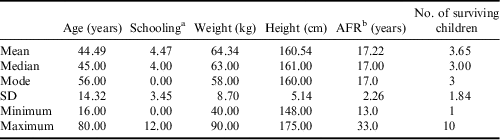
The sample included 414 Roma women of middle age and little schooling (see Table 1). Mean age at first menarche was 12.77 (SD=1.13). The majority (80.7%) entered marriage as teenagers, at an average age of 16 (15.90; SD=1.58). Thirty-five per cent of the women married at ages 12–15, 46% at 16–17 and 19% at≥18. The majority of marriages were arranged by the woman’s family (70%) and all first births took place within marriage. Mean AFR was 17, with an average of four children per woman (see Table 1).
Descriptive statistics of the sample of Roma women from Serbia, 2015–2017 (N=414)

a Years spent in school.
b AFR: age at first reproduction.
The majority of Roma women (54.1%) fell primarily within the acceptable nutritional status (BMI 18.5–24.9, mean=22.5, SD=1.55), although a substantial proportion were overweight (34.9%, mean=27.1, SD=1.40) and some were obese (10.1%, mean=31.1, SD=1.13). There were no underweight women. Regarding SES, 41.7% of women reported poor SES, 52.6% reported average (poor) SES while only 5.6% reported above-average SES.
In regard to health, the majority of Roma women (58%) reported good health (absence of chronic disease diagnosis); for the Roma women who reported poor health (43%) the most common complaints were hypertension and diabetes. For all groups there was no statistically significant association between age at first marriage, health status (χ²=2.89, p=0.408) and specific diseases (diabetes: χ²=3.06, p=0.382; hypertension: χ²=4.62, p=0.201), so age at first marriage was not used in further analyses.
Fifteen per cent of the Roma women had their first child between the ages of 13 and 15, most (55%) gave birth for the first time at 16–17 while 30% gave birth to their first child at≥18. Concerning differential AFR and health association, the majority of Roma women (78%) who gave birth for the first time between ages 13 and 15 reported good health (absence of chronic disease diagnosis) compared with women who gave birth for the first time at older ages (48% of women with AFR 16–17 reported good health, and 65% with AFR≥18). The differences in self-rated health and SES for the three groups were statistically significant (χ²=21.776, p<0.001, and χ²=232.001, p<0.001, respectively).
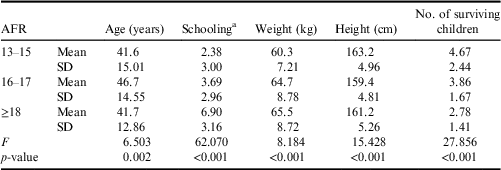
Roma women in the AFR group 13–15 had the earliest menarche (F=7.567, p<0.001) and more full-term pregnancies (F=23.344, p<0.001) than women in older AFR groups. Also, Roma women in the earliest AFR group were the youngest, with the least amount of time spent in school; they were lighter and taller than women in the two older AFR groups and had more surviving children – five on average (see Table 2). Additionally, ANCOVA showed that even after controlling for age, women from the earliest AFR group had more surviving children than the rest (F(2.410)=27.178, p<0.001).
Demographic and anthropometric characteristics of the sample Roma women by age at first reproduction (AFR) (N=414)
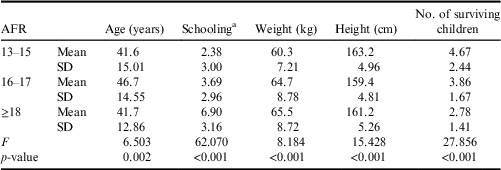
a Years spent in school.
Height and weight were found to be correlated (p<0.001); additionally, height was positively correlated with schooling (p=0.002) and inversely correlated with chronic disease (p<0.001), while weight was correlated with age (p=0.011), chronic disease (p<0.001) and AFR (p<0.001) but not with the number of surviving children (p=0.487).
All three models were statistically significant. The first model (χ²(3)=28.07, p<0.001) with two independent variables – AFR and number of surviving children – explained between 6.6% (Cox and Snell R 2) and 8.8% (Nagelkerke R 2) of the variance of the dependent variable. The overall percentage of cases correctly predicted by the model was 59.4%. Both independent variables – AFR and number of surviving children – significantly contributed to the model (p<0.05). An increase in number of surviving children increased the risk of chronic disease occurrence (OR=1.15; 95% CI=1.02–1.30; p=0.020). In regard to AFR, having a first child between the ages of 13 and 15 increased by 4.5 times the possibility of chronic disease occurrence in comparison to having first birth at 18 and older (OR=4.54; 95% CI=2.27–9.05; p<0.001). An AFR of 16–17 raised the possibility of chronic disease occurrence 2.64 times, in comparison with the AFR group of 18 and older (OR=2.64; 95% CI=1.22–5.71; p=0.01).
The second model (χ²(4)=44.01, p<0.001) with two reproductive variables (AFR and number of surviving children) and height explained between 10.1% (Cox and Snell R 2) and 13.5% (Nagelkerke R 2) of the variance of the dependent variable. The overall percentage of cases correctly predicted by the model was 64.7%. All variables significantly contributed to the model (p<0.05). An increase in number of surviving children increased the risk of chronic disease occurrence (OR=1.14; 95% CI=1.01–1.29; p=0.031). Having an AFR of 13–15 increased the possibility of chronic disease occurrence in comparison to having an AFR of 18 years and older (OR=3.43; 95% CI=1.67–7.04; p=0.001). An AFR of 16–17 also increased the possibility of chronic disease occurrence in comparison to the group 18 and older (OR=2.25; 95% CI=1.01–5.00; p=0.046). In contrast, an increase in height reduced the risk of chronic disease occurrence (OR=0.56; 95% CI=0.43–0.74; p<0.001).
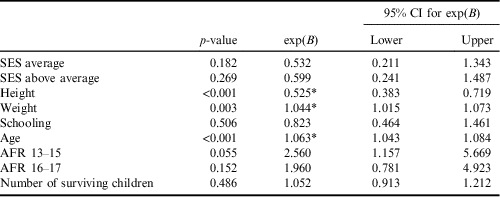
Table 3 shows the results of the full (third) model. This model (χ 2(4)=119.234, p<0.001), which included all the predictor variables, explained between 25% (Cox and Snell R 2) and 33.6% (Nagelkerke R 2) of the variance of the dependent variable. The overall percentage of cases correctly predicted by the model was 74.2%. Statistically significant variables were height, weight and age (p<0.05). An increase in height of 1 cm reduced the risk of chronic disease occurrence (OR=0.53; 95% CI=0.38–0.72; p<0.001). An increase in weight increased the risk of chronic disease occurrence (OR=1.04; 95% CI=1.02–1.07; p=0.003). An increase in age also increased the risk of chronic disease occurrence (OR=1.06; 95% CI=1.04–1.08; p<0.001). Age at first reproduction, number of surviving children, SES and level of schooling were not found to be statistically significant.
Logistic regression: predictors of Roma women’s health status

*p<0.05.
Discussion
The combined effects from the full regression model, which included all predictors, showed that age and weight increased the risk of self-rated poor health (chronic disease occurrence) while greater height contributed to a reduced risk of self-rated poor health in this sample of Roma women in Serbia. Age at first reproduction, number of surviving children, SES and level of schooling were not significant in regard to the self-rated health of these women.
Age and weight are two well-known factors associated with an increased risk of a range of major chronic diseases (Prasad et al., Reference Prasad, Sung and Aggarwal2012; Zheng et al., Reference Zheng, Manson, Yuan, Liang, Grodstein and Stampfer2017), while, for women, ageing is consistently associated with gains in weight (Gurven et al., Reference Gurven, Costa, Trumble, Stieglitz, Beheim and Rodriguez2016). In turn, height is a very valuable proxy for ‘metabolic capacity’, which is the ability to maintain homoeostasis (Wells, Reference Wells2011). For example, short stature is now a well-established risk factor for cardiovascular disease and diabetes, whilst obesity is a second well-established risk factor (Leon et al., Reference Leon, Smith, Shipley and Strachan1995; Jousilahti et al., Reference Jousilahti, Tuomilehto, Vartiainen, Eriksson and Puska2000; Smith et al., Reference Smith, Hart, Upton, Hole, Gillis, Watt and Hawthorne2000; Perelman, Reference Perelman2014; Pereira et al., Reference Pereira, Costa, Santos, Cunha, Correia-Neves, Palha and Sousa2016). In addition, adult body height is highly influenced by childhood environment (inclusive of socioeconomic, nutrition and health conditions) and early-life events (Guven & Lee, Reference Guven and Lee2015). The early-life burden of undernutrition and disease is not only responsible for mortality in childhood but also leaves a residue of long-term health risks for survivors – risks that express themselves in adult height and in late-life disease (Bozzoli et al., Reference Bozzoli, Deaton and Quintana-Domeque2009). For Roma women, any potential losses from early reproduction, ageing and weight gain seem to be moderated by greater height, suggesting that early-childhood conditions have long-lasting effects (Case & Paxson, Reference Case and Paxson2010).
In contrast to many studies (Santhya, Reference Santhya2011; Ganchimeg et al., Reference Ganchimeg, Ota, Morisaki, Laopaiboon, Lumbiganon and Zhang2014; Pirkle et al., Reference Pirkle, de Albuquerque Sous,a, Alvarado and Zunzunegui2014; Marphatia et al., Reference Marphatia, Amable and Reid2017; Amin et al., Reference Amin, Asadullah, Hossain and Wahhaj2017), AFR and number of surviving children explained only a small percentage (less than 10%) of self-rated health outcome. This finding is consistent with studies suggesting that the long-term effects of early childbearing may not always be associated with poorer health status (Geronimus & Korenman, Reference Geronimus and Korenman1991; Hoffman, Reference Hoffman1998; Helle et al., Reference Helle, Lummaa and Jokela2005; Gurven et al., Reference Gurven, Costa, Trumble, Stieglitz, Beheim and Rodriguez2016). Variation among women may be so large that both early reproduction and good health are expressed by the same women (van Noordwijk & de Jong, Reference Van Noordwijk and de Jong1986). Previous studies have suggested that age at first reproduction is a good predictor of individual quality (Viallefont et al., Reference Viallefont, Cooke and Lebreton1995; Oli et al., Reference Oli, Hepp and Kennamer2002; Sear, Reference Sear2007; Zhang et al., Reference Zhang, Vedder, Becker and Bouwhuis2015; Fay et al., Reference Fay, Barbraud, Delord and Weimerskirch2016), greater reproductive success and adult survival (Stulp et al., Reference Stulp, Buunk, Verhulst and Pollet2015). For the Roma, it is likely that women who are capable of reproducing very early and staying healthy in later life are probably very healthy to begin with, as indicated by the differences in height (Doblhammer & Oeppen, Reference Doblhammer and Oeppen2003; Gagnon, Reference Gagnon2015). In the present study, Roma women in the earliest AFR group were the tallest, had earliest menarche and greater parity than women in other AFR groups. Cross-cultural studies have found that girls who reach menarche early tend to marry and have their first child at a younger age (Kramer & Lancaster, Reference Kramer and Lancaster2010) and, for Roma women, these allow a head-start on reproduction but without later health consequences (but see Helle, Reference Helle2008; Sear, Reference Sear2010). Even after controlling for age, women from the earliest AFR group had more surviving children than the rest suggesting that early AFR may be adaptive, providing the advantage of greater fertility and more surviving children.
In developed populations, early age at first birth has been found to be associated with chronic disease risk factors in both males and females implying a social, rather than biological, path (Hardy et al., Reference Hardy, Lawlor, Black, Mishra and Kuh2009). For Roma women, the traditional marriage pattern may act as an additional protectant, as teenage motherhood is the customary childbearing pattern and marriage and childbearing take place within the context of extended kinship networks, where child care and other support are readily available (Newson & Richerson, Reference Newson and Richerson2009; Kramer & Lancaster, Reference Kramer and Lancaster2010). Roma women become mothers at a relatively early age, and given the universal early age of marriage and reproduction, they also become grandmothers early – another possible benefit of early AFR, as grandmothers are expected to help with child care (Čvorović & Coe, Reference Čvorović and Coe2017). As chronic diseases are mostly detected at relatively older ages, Roma children thus benefit from relatively young mothers and grandmothers at the same time. Cross-culturally, evidence suggests that the presence of kin is important in improving child survival, with grandmothers being reliable sources of help (Sear & Mace, Reference Sear and Mace2008).
Finally, social benefits may have an additional protective effect such that any costs of reproduction may not be sufficiently severe to be apparent (Hinkula et al., Reference Hinkula, Kauppila, Näyhä and Pukkala2006; Grundy & Kravdal, Reference Grundy and Kravdal2007, Reference Grundy and Kravdal2010; Čvorović & Coe, Reference Čvorović and Coe2017).
Given the heterogeneity of Roma groups, the overall findings of this study do not rule out the possibility that within other groups the associations may differ from the ones observed here. Furthermore, the sample included volunteer participants while health and other variables were self-reported, which may have led to numerous biases. Future studies should assess specific childhood social conditions such as parental investment and kin relations, and whether these interactions may be correlated with health and well-being outcomes in adulthood (Case & Paxon, Reference Case and Paxson2010; Oesch & Dunbar, Reference Oesch and Dunbar2015).
Ethical Approval. Informed consent was obtained from all participants. The author asserts that all procedures contributing to this work comply with the ethical standards of the Helsinki Declaration of 1975, as revised in 2008. Approval to conduct a study of human subjects was awarded by the Institute of Ethnography SASA research committee.
Conflicts of Interest. The author has no conflicts of interest to declare.
Funding. This research was supported by Serbian Ministry of Education, Science and Technological Development, project number 177028.