I. INTRODUCTION
Hydrodesulfurization (HDS) is an important reaction during the refining process of crude oil for low contaminant liquid fuel production.Reference Delmon and Froment1,Reference Topsøe, Clausen, Massoth, Anderson and Boudart2 HDS is characterized by the sulfur removal from sulfur-containing molecules as contained in crude oils, reducing sulfur emissions after combustion. Even though molybdenum disulfide (MoS2) nanoparticles have been widely used as HDS catalysts for decades, their atomic level HDS mechanism is still not very clear. In recent years, stringent environmental regulations3 on the sulfur level in fuels have renewed the interest in the understanding of HDS mechanisms, which is essential for developing efficient catalysts and processes for deep HDS.
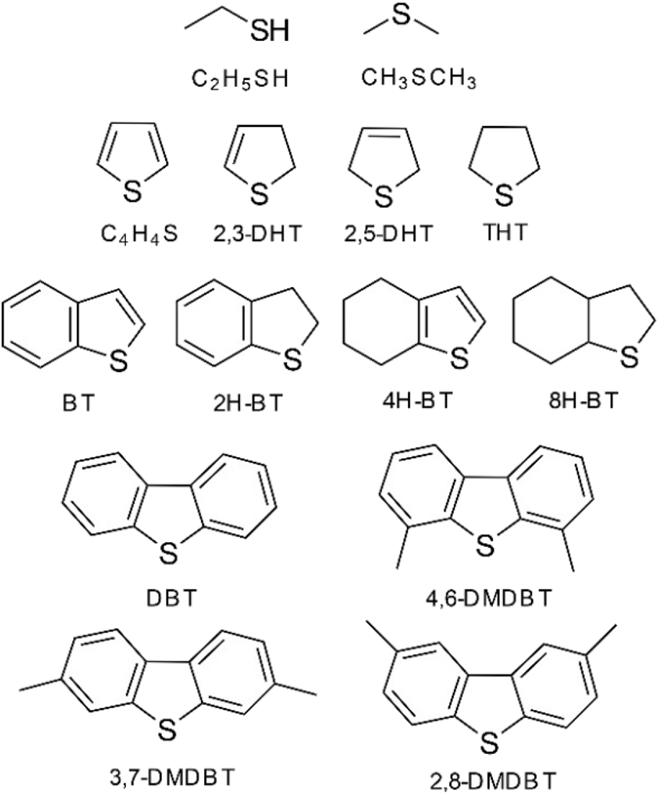
Sulfur-containing molecules in petroleum or synthetic oils are generally classified into two types: nonheterocycles and heterocycles (Scheme 1). The former includes thiols, sulfides, and disulfides. Heterocycles mainly include thiophene and its derivatives with one or several fused aromatic rings and their alkyl or aryl substituents. In heterocycles, thiophene is a widely used model for the HDS process on MoS2 in both experimentReference Mills, Korlann, Bussell, Reynolds, Ovchinnikov, Angelici, Stinner, Weber and Prins4–Reference Komarneni, Sand and Burghaus8 and theory,Reference Atter, Chapman, Hester, Green, Mitchell and Tomkinson9–Reference Cristol, Paul, Schovsbo, Veilly and Payen14 while benzothiophene (BT), dibenzothiophene (DBT), and their derivatives have been widely used as models for deep HDS of fuels in experiment.Reference Mijoin, Pérot, Bataille, Lemberton, Breysse and Kasztelan15–Reference Duayne Whitehurst, Isoda, Mochida, Eley, Haag, Gates and Knözinger17 Nonheterocycles, on the other hand, may compete with heterocycles in adsorption and subsequent surface reactions.
Sulfur-containing compounds and their numbering systems.

Previous efforts to establish the HDS reaction pathways of thiopheneReference Raybaud, Hafner, Kresse, Toulhoat, Delmon and Grange18 and BTReference Cristol, Paul, Payen, Bougeard, Hafner, Hutschka, Delmon and Grange19 applying density functional theory (DFT) methods in MoS2 revealed that the energy profiles depend on the adsorption mode, which further depend on the sulfur coverage of MoS2 active sites. Hence, determination of the detailed adsorption mode of the sulfur containing molecules on various sites of MoS2 is still of vital importance in understanding the HDS mechanism.
The adsorption and reaction of thiols (CH3SHReference Todorova, Prins and Weber20 and C2H5SHReference Todorova, Prins and Weber21) on the metallic edge of 2H-MoS2 was studied by Todorova et al. Yogesh et al.Reference Joshi, Ghosh, Venkataraman, Delgass and Thomson22 calculated the adsorption energies of various sulfur containing molecules on Co/MoS2 and found the electronic effects on adsorption energies, where it is possible to achieve a linear correlations for prediction of adsorption energies in bimetallic catalyst clusters. A study on similar systems by Šarić et al.Reference Šarić, Rossmeisl and Moses23 shows the preference of physisorption on the S-edges and chemisorption on the Mo-edges.
Thiophene is typically used as a model reactant for understanding the mechanism of HDS. Thiophene adsorption on the crystallographic surfacesReference Moses, Mortensen, Lundqvist and Nørskov24 and edgesReference Raybaud, Hafner, Kresse and Toulhoat13,Reference Cristol, Paul, Schovsbo, Veilly and Payen14,Reference Raybaud, Hafner, Kresse, Toulhoat, Delmon and Grange18,Reference Orita, Uchida and Itoh25–Reference Yao, Li and Jiao27 of MoS2 has been investigated. The coordinately unsaturated sites (CUS) are found to be the functioning sites, rather than the basal planes, and thiophene could adsorb in both flat and perpendicular modes. Thiophene HDS over MoS2 catalysts has been studied experimentally by some groups.Reference McCarty and Schrader28,Reference Salnikov, Burueva, Barskiy, Bukhtiyarova, Kovtunov and Koptyug29 The mechanism proposed by Sullivan et al.Reference Sullivan and Ekerdt7 suggested that DHT, tetrahydrothiophene (THT), and 1-butanethiolate are intermediates in thiophene HDS.Reference Sullivan and Ekerdt7,Reference Hensen, Vissenberg, de Beer, van Veen and van Santen30–Reference Devanneaux and Maurin35 The HDS of sulfur containing molecules generally proceeds by two pathways: a hydrogenation (HYD) pathway involving aromatic ring HYD, followed by C–S bond cleavage, and a hydrogenolysis pathway via direct C–S bond cleavage without aromatic ring HYD, which is also called the direct desulfurization (DDS) pathway.
Yang et al.Reference Yang, Fairbridge and Ring36,Reference Yang, Fairbridge, Chen and Ring37 have studied the adsorption of various methyl-substituted DBT derivatives on a clean Mo edge of Mo10S18 cluster by DFT methods and showed the differences among the substituted, nonsubstituted, and hydrogenated derivatives. Using a periodic model, Cristol et al.Reference Cristol, Paul, Payen, Bougeard, Hutschka and Clémendot38 calculated the adsorption of BT, DBT, and their derivatives on both the S and Mo edges of MoS2 surfaces. Using similar methods, Moses et al.Reference Moses, Mortensen, Lundqvist and Nørskov24 calculated the adsorption of benzene, thiophene, and BT on the basal plane of MoS2. Furthermore, the mechanisms of HDS for BT,Reference de Beer, Dahlmans and Smeets39–Reference Van Parijs, Hosten and Froment41 DBT,Reference Mijoin, Pérot, Bataille, Lemberton, Breysse and Kasztelan15,Reference Ho and Sobel42,Reference Kim, Ma, Song, Lee and Oyama43 and their derivatives have been widely studied.
However, neither a too small cluster nor a too large extended slab are good models of real size MoS2 nanoparticles, due to the quantum size effect and local structure effects (such as vacancies). First, as the high resolution scanning tunneling microscopy (STM) studyReference Tuxen, Kibsgaard, Gøbel, Lægsgaard, Topsøe, Lauritsen and Besenbacher44 reveals, the adsorption properties of MoS2 nanoclusters toward the HDS refractory DBT vary with cluster size. Second, STM and DFT studiesReference Tuxen, Füchtbauer, Temel, Hinnemann, Topsøe, Knudsen, Besenbacher and Lauritsen45 by Tuxen and coworkers suggested the importance of sulfur vacancies in the adsorption of DBT. It has also shown recently that the vacancy plays an important role in determining the thiophene HDS pathway on MoS2.Reference Zheng, Duan, Chi, Zhao, Zhang, Xu, Zhao, Song, Wang and Fan46 The breakthrough in the structural studies of the active nanostructures in HDS using STMReference Helveg, Lauritsen, Lægsgaard, Stensgaard, Nørskov, Clausen, Topsøe and Besenbacher47 motivates us to produce numerical simulations in larger and more realistic MoS2 nanoparticles.
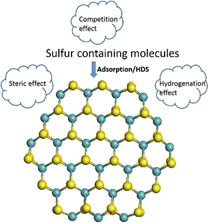
In this work, we present a study to determine the adsorption of different sulfur-containing molecules including C2H5SH, CH3SCH3, THT, thiophene, BT, DBT, and their derivatives (Scheme 1) on the CUS of both S and Mo edges of real size Mo27Sx (Mo27S48, Mo27S50, Mo27S54, Mo27S55) nanoparticles. Our study is mainly focused on the following three effects: the competition effects of the nonheterocycles with heterocycles; the HYD effects on the adsorption of unsaturated heterocycles and the steric effects of the DBT due to methyl substitution. The calculated adsorption energies are then correlated with the temperature programmed desorption (TPD) experiments, to understand the significance of the adsorption configurations which are found in the theoretical study.
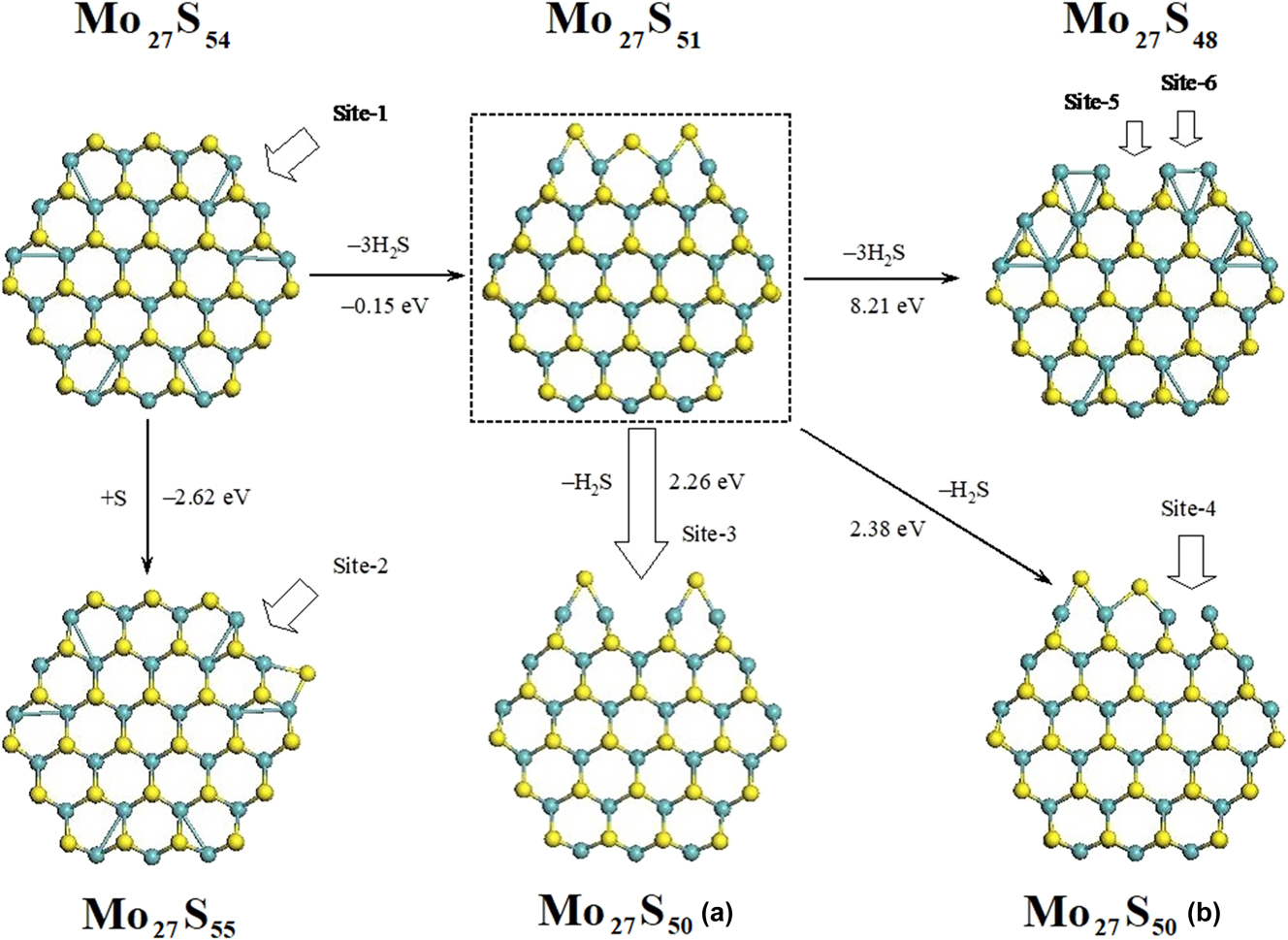
To model the nanometer-sized crystallites observed experimentally, Mo27Sx real size clustersReference Silva and Borges48 in Fig. 1 are used. The finite slab represents  $\left( {\bar{1}010} \right)$ for the S edge and
 $\left( {10\bar{1}0} \right)$ for the Mo edge of MoS2. To study the structural and electronic properties of MoS2, the Mo27S54 cluster was used, following the work by Li et al.Reference Li, Pang and Delmon49 and Orita et al.Reference Orita, Uchida and Itoh50 Later, in our previous work, the Mo27S54 cluster was used to calculate S coverage on both Mo and S edges independently with thermodynamic arguments.Reference Wen, Zeng, Li, Wang and Jiao51 There are two types of terminations for MoS2 edges, Mo-terminated edge (or Mo edge, for short), and S-terminated edge (or S edge). In terms of S coverage, the Mo edge without any additional S atom by definition has 0% S coverage, while the S edge without losing any S atoms by definition has 100% S coverage. The meaning of other sulfur coverages in percentage can be calculated using these two extreme situations as references. In addition, an MoS2 cluster has two edges, on each end. These two edges are different (one is Mo edge and the other is S edge) to keep the stoichiometry of the cluster close to bulk MoS2. In this work, based on our previous studies, for sulfur coverage on Mo edges, there are two stable structures with 33 and 50% sulfur coverage on Mo edge; for these two Mo edges, the corresponding S edges on the other side of the cluster have 100% sulfur coverage (33% S on Mo edge & 100% S on S edge, and 50% S on Mo edge & 100% S on S edge). For sulfur coverage on S edge, there is only one stable structure with 67% sulfur coverage on S edge and 0% sulfur coverage on Mo edge (67% S on S edge & 0% S on Mo edge).
Mo27Sx (x = 48, 50, 51, 54, 55) clusters. The six adsorption sites and their formation energies are listed. The Mo atoms are in cyan and the S atoms are in yellow.

To be specific, we have chosen four clusters (Mo27S48, Mo27S50, Mo27S54, Mo27S55) for the adsorption of sulfur-containing molecules. The detailed geometric and electronic information about these clusters can be found in our previous studies.Reference Li, Pang and Delmon49,Reference Wen, Zeng, Li, Wang and Jiao51 Six adsorption sites on S edge or Mo edge are chosen in four clusters, as shown in Fig. 1. The studied adsorption sites are named as site-1 to site-6. The adsorption site-1 (Mo27S54) and site-2 (Mo27S55) are situated on the Mo edge, while site-3 [Mo27S50(a)] and site-4 [Mo27S50(b)] as well as site-5 (Mo27S48) and site-6 (Mo27S48) are located on the S edge. There are two adsorption sites (site-3 and site-4) on the S edge with 33% S coverage, and two adsorption sites (site-5 and site-6) on the S edge with 0% sulfur coverage. The sites 3, 4, and 5 are all vacancy sites. As Fig. 1 shows, the formation energies of site-3 and site-4 from the Mo27S51 cluster with 50% sulfur coverage on the S edge are 2.26 and 2.38 eV, respectively. The formation energy of site-5 (and site-6) from the Mo27S51 cluster with 50% sulfur coverage on the S edge is 8.21 eV. However, the formation energy of site-2 from site-1 by adding one S on the Mo edge is negative (−2.62 eV). These formation energies are calculated from Eq. (1) for adding sulfur on the Mo edge or from Eq. (2) for deleting sulfur on the S edge.
Mo edge:
 $${\rm{M}}{{\rm{o}}_{27}}{{\rm{S}}_x} + n{{\rm{H}}_2}S = {\rm{M}}{{\rm{o}}_{27}}{{\rm{S}}_{x + n}} + n{{\rm{H}}_2}\quad ,$$
 $$\Delta {E_{{\rm{Mo ‐ edge}}}} = \left[ {E\left( {{\rm{M}}{{\rm{o}}_{27}}{{\rm{S}}_{x + n}}} \right) + nE\left( {{{\rm{H}}_2}} \right)} \right] - \left[ {E\left( {{\rm{M}}{{\rm{o}}_{27}}{{\rm{S}}_x}} \right) + nE\left( {{{\rm{H}}_2}{\rm{S}}} \right)} \right]\quad .$$
S edge:
 $${\rm{M}}{{\rm{o}}_{27}}{{\rm{S}}_x} + n{{\rm{H}}_2} = {\rm{M}}{{\rm{o}}_{27}}{{\rm{S}}_{x - n}} + n{{\rm{H}}_2}{\rm{S}}\quad {\rm{,}}$$
 $$\Delta {E_{{\rm{S ‐ edge}}}} = \left[ {E\left( {{\rm{M}}{{\rm{o}}_{27}}{{\rm{S}}_{x - n}}} \right) + nE\left( {{{\rm{H}}_2}{\rm{S}}} \right)} \right] - \left[ {E\left( {{\rm{M}}{{\rm{o}}_{27}}{{\rm{S}}_x}} \right) + nE\left( {{{\rm{H}}_2}} \right)} \right]\quad .$$
Two adsorption modes are considered, one is the μ2 coordination mode of the sulfur atom bridging two CUS Mo atoms and another is the π-face coordination of the five- or the six-membered aromatic ring. Due to the ring sizes, more continuous CUS Mo atoms are needed for the π-face coordination. Therefore, we use the S edge (0% sulfur coverage, site-5 and site-6) of the Mo27S48 cluster and the Mo edge (0% sulfur coverage, site-1) of the Mo27S54 cluster.
The adsorption energy for sulfur molecules on these clusters is defined in Eq. (3). The E mol+cluster is the total energy of the sulfur molecule and the cluster. E mol and E cluster are the total energies of the free sulfur molecule and the cluster, respectively.
 $$\Delta {E_{{\rm{ads}}}} = {E_{{\rm{mol}} + {\rm{cluster}}}} - \left( {{E_{{\rm{mol}}}} + {E_{{\rm{cluster}}}}} \right)\quad .$$
II. METHODS
A. Experimental methods
The MoS2 powders were first pretreated to 40–60 mesh, then four groups of 100 mg MoS2 particles were impregnated to sufficient thiophene, thiophane, ethanethiol, and dimethyl sulfide solvent, respectively, for 6 h to guarantee the saturated adsorption. Afterward, the samples were purged with a flow rate of 20 mL/min in argon atmosphere at room temperature overnight. TPD of four organic sulfides over MoS2 was performed on the instrument of N2-TPD (TP-5080 version, Xianquan Company, Tianjin, China). Before desorption, 100 mg MoS2 particles were put into a quartz tube, then it was carried out at a heating rate of 10 °C/min with N2 (30 mL/min) from room temperature to 110 °C for 1 h to remove the physical adsorption and other impurity on the MoS2 as much as possible, followed by cooling to 30 °C. Then, the samples were heated to 900 °C at a rate of 10 °C/min with a He flow (30 mL/min), and the tail gas was detected by using a mass spectrometer (Omnistar TM, Asslar, Germany). Following the same operational protocol, the TPD of four organic sulfides chemisorbed on the MoS2 with a 10 vol% H2/N2 mixture (30 mL/min) was performed with the same instruments.
B. Theoretical calculations
All calculations were performed with program package DMol3 in the Materials Studio package of Accelrys Inc., San Diego, California. The physical wave functions were expanded in terms of accurate numerical basis sets.Reference Delley52–Reference Delley54 The doubled numerical basis set with p-polarization function (DNP) for hydrogen and d-polarization functions for other elements was used, while the Stuttgart quasi-relativistic effective core potentialReference Bergner, Dolg, Küchle, Stoll and Preuß55,Reference Andrae, Häußermann, Dolg, Stoll and Preuß56 was used for molybdenum, for which the 28 core electrons are treated as effective potential, and the outer 14 valence electrons are treated explicitly. In the numerical basis set of DMol3, the atomic basis sets are generated numerically, and the atomic orbitals are exact spherical. Therefore, the molecule can be dissociated exactly to its constituent atoms, and the basis set superposition error (BSSE) is minimized. As was benchmarked in the literature,Reference Inada and Orita57 the BSSE corrections in dMol3 DNP are less than those in the Gaussian 6-311+G (3df,2pd) basis set. The generalized gradient corrected functional by Perdew and Wang (GGA-PW91)Reference Perdew and Wang58 was used and the numerical integration was performed with medium quality mesh size. The tolerances of energy, gradient, and displacement convergence are 2 × 10⁻⁵ au, 4 × 10⁻³ au/Å, and 5 × 10⁻³ Å, respectively. The real space cutoff of atomic orbitals is set at 5.5 Å, and a Fermi smearing of 0.002 is used for orbital occupancy. We compare the smearing 0.002 and 0.0005 by using the structures 1 (shown in Fig. 2) with thiophene flat adsorption on the Mo27S48 cluster. The adsorption energy is −2.217 and −2.219 eV, respectively, that is, the adsorption energy difference is very little. These conditions have been used in our previous studiesReference Wen, Zeng, Teng, Zhang, Li, Wang and Jiao59 and showed accurate results.
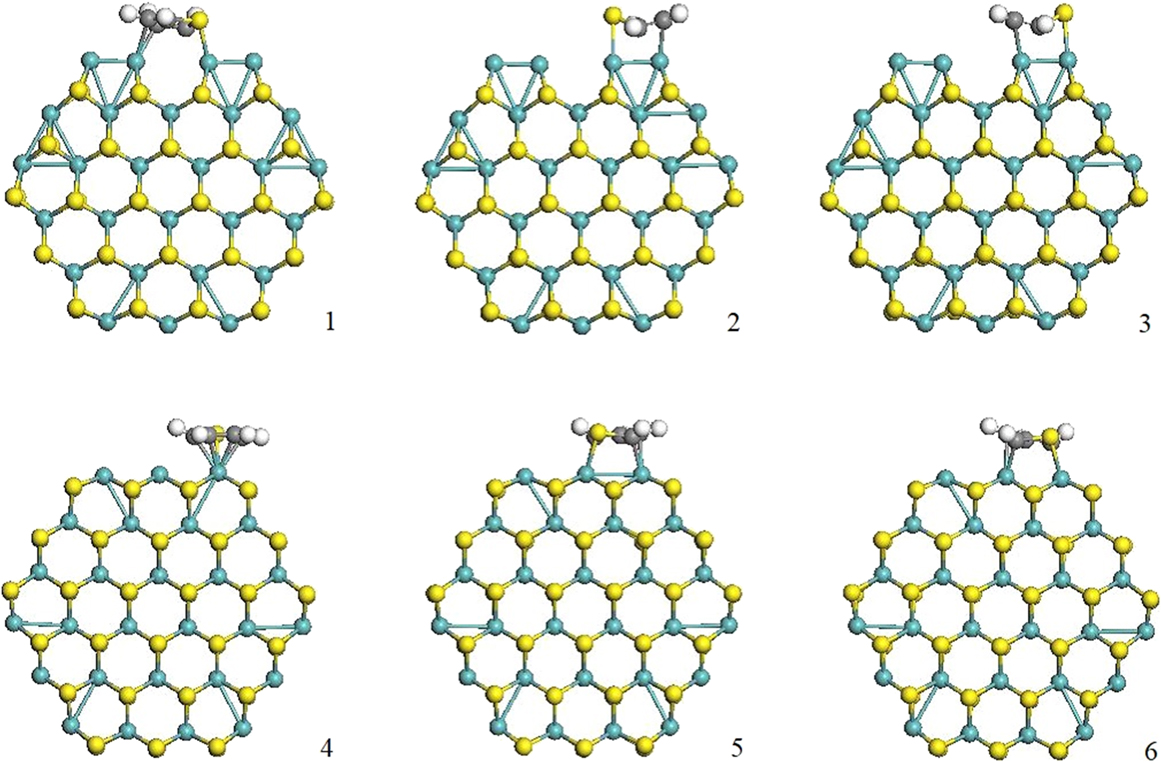
Different flat adsorption structures for thiophene. Adsorption on S edge (0% sulfur coverage) is shown in structures 1, 2, and 3. Adsorption on Mo edge (0% sulfur coverage) is shown in structures 4, 5, and 6. The Mo atoms are in cyan and the S atoms are in yellow.

III. RESULTS AND DISCUSSION
A. Adsorption of different sulfur containing molecules
1. μ2 coordination
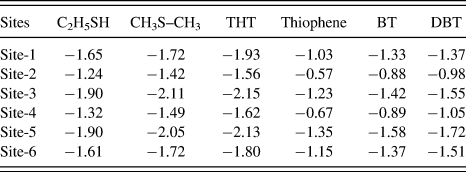
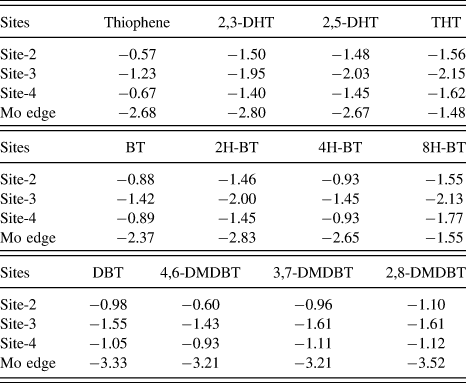
Since all the sulfur containing molecules have an S atom, these S atoms can bind to the catalyst clusters through a Mo–S–Mo bridge, which is called μ2 coordination in coordination chemistry. Geometrically, in μ2 coordination, all the molecules adsorb on the Mo27Sx clusters in a perpendicular way. The adsorption energies for the different sulfur-containning molecules on different sites in μ2 coordination are listed in Table I. The calculated negative adsorption energies indicate that all the adsorptions are exothermic. THT as a nonaromatic heterocycle has stronger adsorption than those of C2H5SH and CH3SCH3 at all the possible adsorption sites. It also shows that CH3SCH3 has stronger adsorption than C2H5SH. For the aromatic heterocycles, DBT has the strongest adsorption energies compared to BT and thiophene, indicating that the fused benzene rings in BT and its derivatives enhance the adsorption compared to the five-member ring molecule of thiophene. The rank of the magnitude of adsorption energy follows the order of THT > CH3SCH3 > C2H5SH > DBT > BT > thiophene for all adsorption sites. Clearly, the adsorption of nonaromatic molecules is generally more stronger than the aromatic molecules in the perpendicular adsorption modes.
Calculated adsorption energies (ΔE ads, eV) for the different sulfur molecules on different adsorption sites by the perpendicular adsorption mode.

2. π-Face coordination
In addition to the μ2 coordination, the aromatic heterocycles including thiophene, BT, and DBT can also bind to the Mo27Sx clusters with their aromatic rings through π electrons, which is called π-face coordination (Table II). Because of the parallel nature of the aromatic rings with the cluster surfaces, in all the π-face coordination configurations, the molecules sit flat on the surface and are in the flat adsorption mode. This adsorption mode has been discussed on the S edge (0% sulfur coverage) of Mo27S48 cluster on site-5 and site-6, and the Mo edge (0% sulfur coverage) of Mo27S54 on site-1. As shown in Fig. 2, structures 1, 2, and 3 are the adsorption geometries with thiophene on S edge (0% sulfur coverage) of Mo27S48. Thiophene in structure 1 is adsorbed on two edge Mo atoms, while thiophene in structures 2 and 3 adsorbs on one edge Mo and one corner Mo. Meanwhile, the S atom in thiophene of structures 2 and 3 is bonded with an edge Mo, and a corner Mo atom on the S edge with 0% sulfur coverage, respectively. Structures 2 (−2.67 eV) and 3 (−2.64 eV) are energetically more stable than structure 1 (−2.22 eV) (Table II).
Calculated adsorption energies (ΔE ads, eV) for the different sulfur molecules on different adsorption sites by flat adsorption modes. The corresponding structure is labeled as bolded numbers in the parentheses.

Structures 4, 5, and 6 show the cases of the thiophene adsorption on the Mo edge (0% sulfur coverage) of Mo27S54. Structure 4 is thiophene adsorption on one corner Mo atom, while the thiophene in structures 5 and 6 is adsorbed on one corner Mo and one edge Mo atom. In structure 5, the S atom in thiophene is bonded with an edge Mo atom, while in structure 6, the S atom is bonded with a corner Mo atom. The adsorption energies for structures 5 and 6 (−2.68/−2.68 eV) are both higher than 4 (−1.69 eV), indicating that the adsorption of thiophene is more favorable on two CUS Mo atoms.
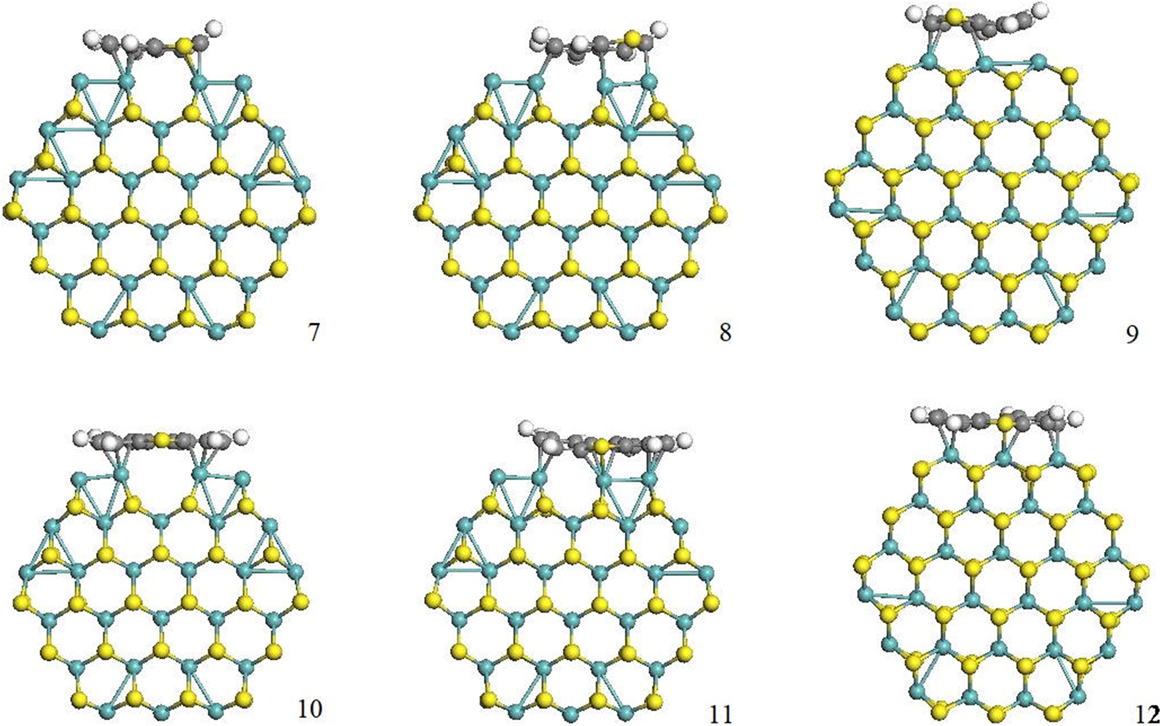
The structures of BT π-face coordination are shown in Fig. 3. BT is adsorbed on the S edge (0% sulfur coverage) of the Mo27S48 cluster in structures 7 and 8. Structure 7 features the BT molecule adsorbed on two edge Mo atoms, with the thiophene ring in BT binding with one of the edge Mo atoms. The BT in structure 8 is adsorbed on one corner Mo and two edge Mo atoms, and the thiophene ring is adsorbed on the two edge Mo atoms. The adsorption structure 8 can be seen as the BT molecule moved overall to right side from its position in structure 7. Structure 9 displays the structure of BT adsorption on the Mo edge (0% sulfur coverage) of the Mo27S54 cluster, and the thiophene ring is adsorbed on one corner Mo and one edge Mo atom. However, it is interesting that the benzene ring in structure 9 is slightly tilted off from the thiophene ring, suggesting the possible destabilizing the aromaticity of the molecule by weakening the in-plane π-bonding. To some degree, the interaction between the benzene ring in structure 9 and CUS is decreased; this may affect the adsorption energy of structure 9. As shown in Table II, the adsorption energy of structure 7 is highest in magnitude among the three adsorption structures.
Different flat adsorption structures for BT (7, 8, 9) and DBT (10, 11, 12). Adsorption on S edge (0% sulfur coverage), as shown in structures 7, 8, 10, and 11. Adsorption on Mo edge (0% sulfur coverage), as shown in structures 9 and 12. The Mo atoms are in cyan and the S atoms are in yellow.

The structures of DBT π-face coordination on the Mo27Sx clusters are also shown in Fig. 3. There are three adsorption structures with DBT having a flat adsorption. In structures 10 and 11, DBT is adsorbed on a Mo27S48 cluster. The two benzene rings in DBT of structure 10 are adsorbed on two separate edge Mo atoms, with the thiophene ring being placed between the two edge Mo atoms. By moving DBT in structure 10 right in the plane, we get structure 11, with the thiophene ring in DBT adsorption on one edge Mo atom. In structure 12, DBT is adsorbed on two corner Mo atoms and one edge Mo atom, and the thiophene ring is binding with an edge Mo atom. The adsorption energies for structures 10, 11, and 12 are −3.09, −3.50 and −3.33 eV, respectively, as shown in Table II. Comparing the adsorption energies of structures 10 and 11, it is clear that the adsorption energy of DBT strongly depend on how the thiophene ring in the DBT molecule interacts with the nanoparticles. The adsorption mode with the molecule binding with more coordinated Mo atoms is more preferred than those binding with less coordinated Mo atoms. Specifically in structure 11, the additional coordinated Mo atom binds with the S atom in DBT.
How significant is the competition effect between the adsorption of nonaromatic sulfur-containing molecules and that of the aromatic ones? To answer this question, we would need to compare the adsorption of the two types of molecules in their most stable adsorption geometries, i.e., perpendicular adsorption for nonaromatic ones (Table I) and flat adsorption for aromatic ones (Table II). Clearly, large aromatic molecules such as BT and DBT are much stronger than the nonaromatic ones such as C2H5SH and CH3–S–CH3 by more than 1 eV, therefore we do not expect much competition effect exist between these two types of molecules. However, small aromatic molecules such as thiophene have, especially at low sulfur coverage sites, comparable adsorption energy with C2H5SH and CH3–S–CH3. Therefore, much compeition effect is expected to exist between these two types of molecules.
B. Effect of HYD for thiophene and BT
1. μ2 coordination on site-2, site-3, and site-4
Few groups have reported the comparison of the adsorption of thiophene and BT compounds with their hydrogenated derivatives. For DBT and its hydrogenated derivatives, only Yang et al.Reference Yang, Fairbridge and Ring36 discussed the effect of HYD on the Mo edge of the Mo10S18 cluster. To understand the effect of HYD for thiophene and BT, we compare these adsorption energies with different sites among thiophene, BT, and their hydrogenated derivatives. The group including thiophene, 2,3-DHT, 2,5-DHT, and THT is discussed to understand the effect of HYD for thiophene, while the group including BT, 2H-BT (HYD in thiophene ring), 4H-BT (HYD in benzene ring), and 8H-BT (HYD in all ring) is used to study the effect of HYD for BT.
It has been indicated by many experiments that the –SH group plays an important role in HYD and HDS.Reference Helveg, Lauritsen, Lægsgaard, Stensgaard, Nørskov, Clausen, Topsøe and Besenbacher47,Reference Delmon, Trimm, Akashah, Absi-Halabi and Bishara60,Reference Li, Rodriguez, Hrbek, Huang and Xu61 Particularly, if there are sulfur atoms on this adsorption sites of site-2, site-3, and site-4, then the –SH groups can be formed in these adsorption sites to offer hydrogen atoms for HYD. Therefore, the adsorption structures with perpendicular adsorption for the sulfur molecules are studied on site-2, site-3, and site-4.
All the adsorption energies for the group of thiophene and its hydrogenated derivatives are listed in Table III. The magnitude of the adsorption energies of hydrogenated derivatives on site-2, site-3, and site-4 is higher than that of thiophene on the same sites. Among the three sites, all the molecules in this group prefer site-3 than site-2 or site-4. On the same adsorption sites, the order of adsorption energies in magnitude for these thiophene compounds is THT > 2,5-DHT ≈ 2,3-DHT > thiophene. There are little differences (−0.02/0.08/0.05 eV) of adsorption energies for 2,3-DHT and 2,5-DHT on the same site. From a thermodynamic point of view, they may coexist in the process of HYD or HDS. That is to say, both 2,3-DHT and 2,5DHT are possible intermediates in the reaction of thiophene HDS. From these adsorption energies on different sites, we propose that HYD is more favorable on site-3, in which two S atoms on the tips of the adsorption site, once hydrogenated to –SH, can relocate to more effectively offer hydrogen atoms in the reaction process.
Calculated adsorption energies (ΔE ads, eV) for the hydrogenated thiophene, BT, and DBT on different adsorption sites (μ2 coordination on site-2, site-3, and site-4; and π-face coordination to the Mo edge site).

In addition, the adsorption of BT and its hydrogenated derivatives on site-2, site-3, and site-4 are also discussed, with the adsorption energies listed also in Table III. In the three adsorption sites, the adsorption on site-3 is generally more stronger than site-2 and site-4, which is also true for the thiophene compounds as we discussed above. On the same adsorption sites, the adsorption of BT hydrogenated derivatives are stronger than BT itself. The adsorption of 4H-BT with the benzene ring hydrogenated is only slightly stronger than that of BT. However, the adsorption of 2H-BT (with the thiophene ring hydrogenated) and 8H-BT (with complete HYD in all the rings) is much stronger than that of 4H-BT and BT. Our results indicate that 2H-BT and 8H-BT are thermodynamically more strongly binding to the catalyst surfaces and have a higher chance to be observed on the surface. Indeed, the 2H-BT with intermediates in BT HDS have been found on the MoS2 catalyst in an experiment.Reference de Beer, Dahlmans and Smeets39
2. π-Face coordination on Mo edge
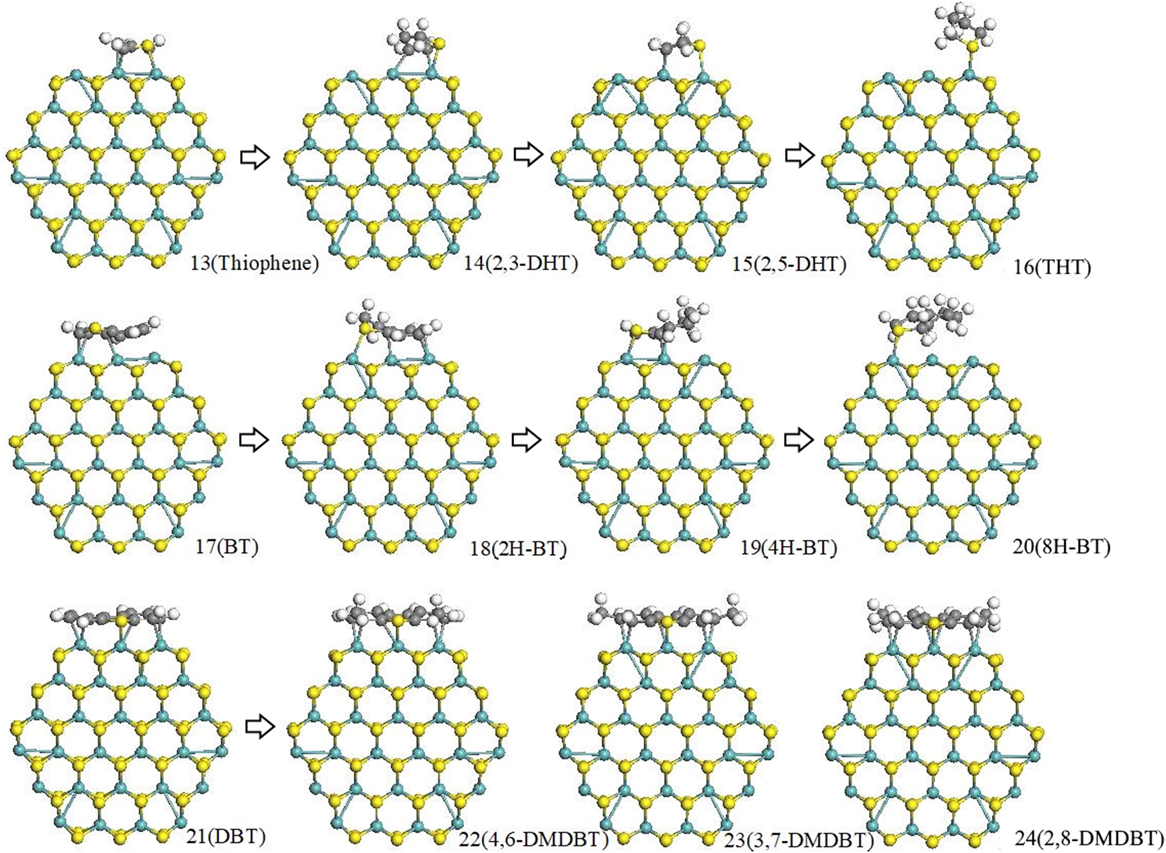
To compare with perpendicular adsorption, the adsorption of thiophene and BT and their hydrogenated derivatives on the Mo edge by flat adsorption modes are discussed herein as well. The adsorption structures of thiophene and its derivatives are shown in Fig. 4, with the corresponding adsorption energies listed in Table III.
Different flat adsorption structures for thiophene, BT, DBT and their hydrogenated derivatives. The Mo atoms are in cyan and the S atoms are in yellow.

Generally, with HYD, we see an initial rise, then a fall in the magnitude of adsorption energy of both thiophene and BT. The highest point in both cases is the dihydrogenated molecule. However, among 2,3-DHT and 2,5-DHT, the former is thermodynamically more stable than the latter in the flat adsorption model. Once BT is hydrogenated, the hydrogenated part will detach from the adsorption site. The partially hydrogenated BT (2H-BT and 4H-BT) binds to the active site stronger than BT. Comparing the adsorption energies of 2H-BT and 4H-BT, it seems that it is more favorable for HYD to happen at the thiophene ring than at the benzene ring. This is consistent with the results that are obtained in perpendicular adsorption.
The structures with the weakest adsorption strength are the fully hydrogenated products THT and 8H-BT. Overall, the trend of stronger binding at partial hydrogenated intermediate then much weaker binding at fully hydrogenated product is dramatically different from the trend on the perpendicular adsorption on site-2, 3, and 4 as we discussed earlier. A possible explanation for this is that in flat adsorption modes, the π electrons in the aromatic ring play an important role in the interaction between the molecules and the surfaces.Reference Liu, Tkalych, Zhou, Köster and Salahub62 When the aromatic rings are completely hydrogenated, the loss of the π electrons makes the interaction between the molecule and the nanoparticles much weaker. In the perpendicular adsorption mode, the loss of π electron by HYD does not affect much of this type of interaction.
Yang et al.Reference Yang, Fairbridge and Ring36 calculated the adsorption of DBT and its hydrogenated derivatives on the Mo edge (0% sulfur coverage) of the Mo10S18 cluster. Their results indicate that the adsorption energy in the flat adsorption mode decreased when the aromatic ring was saturated, while the adsorption energies in the perpendicular mode increased with progressive saturation of DBT. Our results for thiophene, BT, and their hydrogenated derivatives agree with that of Yang et al. in the perpendicular adsorption mode. However, in flat adsorption modes, our results show a different trend to that of Yang et al. From the difference, we propose that the HDS mechanism for thiophene and BT may be different from that of DBT, and that the HDS mechanism of the different types of sulfur molecules needs to be studied separately.
C. The steric effect for DMDBT
1. μ2 coordination on site-2, site-3, and site-4
To understand the steric effect on the adsorption of DMDBT, we investigated the adsorption steric effect at site-2, site-3, and site-4, where steric effects are likely to be significant. The sulfur molecules of 4,6-DMDBT, 3,7-DMDBT, and 2,8-DMDBT are adsorbed on the three sites by the perpendicular adsorption mode. For comparision, the case of DBT adsorption on these three sites is also presented (Table III).
For all three substituted DMDBT isomers, the adsorptions are strongest at site-3. This is in accordance with our previous studies on μ2 coordination. It is interesting that the adsorption of 4,6-DMDBT is weakest on the same adsorption site, which clearly indicates that the methyl groups in the 4,6-positions prevent the main body of the molecule from approaching the catalyst surface in the perpendicular adsorption model. This type of steric effect in 4,6-DMDBT manifests itself in the all three adsorption sites. By comparing the difference (0.38 eV on site-2; 0.12 eV on site-3; 0.12 eV on site-4) in adsorption energy between DBT and 4,6-DMDBT on the same site, it is clear that the difference (0.38 eV) is mostly on site-2. Meanwhile, the adsorption energy of 3,7-DMDBT (−0.96 eV) on site-2 is lower in magnitude than that of 2,8-DMDBT (−1.10 eV), while the adsorption energy for 3,7-DMDBT on site-3 and site-4 is similar compared with that of 2,8-DMDBT. These results show that site-2 (Mo egde with S atom) is very sensitive to the steric effect. In fact, not only 4,6-DMDBT but also 3,7-DMDBT have clear steric effects on site-2.
To evaluate the activation of the S–C bonds in these DMDBTs, the S–C bond lengths in the adsorbed molecules are shown in Table S1. Although the adsorption energy of 4,6-DMDBT is the weakest, the S–C bond lengths in 4,6-DMDBT (1.812 Å on average) on the three adsorption sites are consistently longer than the other DMDBT molecules (1.793 Å on average). The reason for the greater activation of the S–C bond in 4,6-DMDBT is probably because of the stronger steric effect caused by the two methyl groups in 4,6-positions. These two down-pointing methyl groups prevent the binding interactions between the two sides of the molecule with the nanoparticles, leaving only the central S atom as the effective interaction channel. As such, more electrons can be transferred from the central S atom in DMDBT to the nanoparticle. Thus the S–C bonds are weakened more than other isomers of DMDBT, and we see a more stretched S–C bond length in 4,6-DMDBT. Our results suggest that the steric effect does not only weaken the overall binding of the molecule with the nanoparticle as everyone realize but also can slightly enhance the activation of the key chemical bonds (like S–C) through a compensation effect.
2. π-Face coordination on the Mo edge
The optimized structures of DBT and DMDBTs on the Mo edge with flat adsorption modes are shown in Fig. 4, and the adsorption energies are listed in Table III. The adsorption energies are the same for 4,6-DMDBT and 3,7-DMDBT. Also, the adsorption energy for DBT and 2,8-DMDBT is only slightly higher than that of 4,6-DMDBT and 3,7-DMDBT. The obtained structures show that in flat adsorption modes, all the methyl groups in the DMDBT derivatives are streched out of the plane and have little steric interaction with the nanoparticle.
To evaluate the degree of the steric effect quantitatively, we define an adsorption energy error (n%) using 4,6-DMDBT as an example. That is, n% = [E ads(4,6-DMDBT) − E ads(DBT)]/E ads(DBT). From our calculation, n% varies from −7.7 to −38.8% when these sulfur molecules are adsorbed in perpendicular adsorption modes. However, in flat adsorption modes, n% is only −3.6%. This indicates that the steric effect from flat adsorption is much smaller than that from perpendicular adsorption. However, due to the loss of steric effect, as we argued ealier, the S–C bonds will be less weakened. Indeed, as Table S-1 shows, the S–C bond lengths of all the molecules in flat adsorption modes on the Mo-edges are consistently shorter than that on those sites with steric effects (site-2, site-3, and site-4).
There are some experimental studies on the rate of the HDS for DBT and DMDBTs.Reference Kim, Ma, Song, Lee and Oyama43,Reference Houalla, Broderick, Sapre, Nag, de Beer, Gates and Kwart63–Reference Michaud, Lemberton and Pérot66 The rate of DBT conversion is slightly higher than that of 3,7-DMDBT and 2,8-DMDBT and is about 10 times higher than that of 4,6-DMDBT. Under conventional HDS conditions, the DDS pathway contributed 80% to the overall HDS of DBT, while only 20% to the HDS of 4,6-DMDBT. It was shown that the presence of methyl groups in the 4 and 6 positions in 4,6-DMDBT inhibited the DDS pathway, whereas the HYD pathway was hardly affected. Meanwhile, the low reactivity of 4,6-DMDBT is mainly due to the inhibition of the DDS pathway.Reference Topsøe, Clausen, Massoth, Anderson and Boudart2 Since the adsorption energies for 4,6-DMDBT on the three adsorption sites are lower than that for DBT, the steric effects are most significant if the methyl groups are located in the 4 and 6 positions of DMDBT.
There is still a controversy on active sites for HYD (HYD reactions) and DDS (hydrogenolysis of the C–S bonds). Some authorsReference Bataille, Lemberton, Michaud, Pérot, Vrinat, Lemaire, Schulz, Breysse and Kasztelan64 propose that a single site is the origin of both reactions. OthersReference Houalla, Broderick, Sapre, Nag, de Beer, Gates and Kwart63 suggest that there are two different active sites by the inhibiting effect of H2S that H2S inhibits the DDS more strongly than the HYD path. The DFT calculation results of Cristol et al.Reference Cristol, Paul, Schovsbo, Veilly and Payen14,Reference Cristol, Paul, Payen, Bougeard, Hutschka and Clémendot38 support the latter. Our results imply that the HYD and DDS processes begin from the flat adsorption and perpendicular adsorption models, respectively, therefore supporting the latter argument.
First, DBT favors the adsorption on site-1 (Mo edge) with flat adsorption, while it favors adsorption on site-3 with perpendicular adsorption. If we accept the hypothesis that site-1 (Mo edge) and site-3 are possible HYD and DDS active sites, then the fact of H2S inhibition effect can be explained. We have calculated the adsorption of H2S on site-1, site-2, site-3, and site-4. The adsorption energy is −1.06 eV, −0.77 eV, −1.44 eV, and −1.29 eV, respectively. In other words, it is easier for H2S to deposit a sulfur atom on site-3 than site-1 and site-2. This shows that the active sites of DDS are more strongly affected than those of HYD by the deposition of sulfur from H2S. Accordingly, the number of site-3 (DDS active sites) will be decreased under the presence of H2S; thus, the rate of DDS path may be affected more than the HYD path. Indeed, the preference of HYD over DDS is confirmed by the experiment.Reference Romero-Rivera, Camacho, Del Valle, Alonso, Fuentes and Cruz-Reyes67
Another possible hypothesis for site-3 is that it contributed not only to the DDS pathway but also to the HYD pathway. Under HDS conditions, the –SH groups can be easily formed by the binding of the two tip S atoms at site-3 with H atoms from dissociated molecular hydrogen. Then, the atomic hydrogen in the formed –SH groups can migrate from the S atoms to DBT. Therefore, the processes of DDS and HYD can both take place on the site-3, and there would be a ratio that desulfurization happens by the two pathways. This argument is supported by recent experimental studies,Reference Romero-Rivera, Camacho, Del Valle, Alonso, Fuentes and Cruz-Reyes67,Reference Trakarnpruk and Seentrakoon68 which shows that the HDS of DBT can happen through both the DDS pathway, yielding biphenyl, and the HYD pathway, yielding cyclohexylbenzene and tetrahydrodibenzothiophene (THDBT, or 4H-DBT in our notation). Due to the different chemical surroundings for the sites, the ratio of DDS/HYD is also different. It is therefore possible to change the ratio of DDS/HYD (in other words, control the reaction selectivity) by changing the ratio of active sites with H2S. Further validation requires a detailed mechanism study of DBT HDS on different active sites from experimental or theoretical studies.
The difference in the ratio (DDS/HYD) for DBT and 4,6-DMDBTReference Trakarnpruk and Seentrakoon68 can be understood from our DFT calculations. Since the steric effect in flat adsorption is much smaller than that in perpendicular adsorption, 4,6-DMDBT favors flat adsorption mostly due to steric effects. It is known that HYD would happen more easily if the aromatic molecules are adsorbed in the flat mode, causing a significant destabilizing of the aromatic ring. Therefore, the experimental finding that HYD contributes more to the overall HDS of 4,6-DMDBT can be explained by our theoretical study.
D. Temperature programmed desorption-mass spectroscopy
With the adsorption configurations of sulfur containing molecules on MoS2 nanoparticles obtained in the above theoretical results, it would be interesting to know which of these configurations contribute more on the actual MoS2 catalysts than others. For this purpose, we use four model molecules (thiophene, THT, C2H5SH, and CH3SCH3) to examine the experimental desorption peaks on MoS2, assuming that the five Mo27Sx nanoparticle models have captured the most important adsorption sites in MoS2 particles in the experiment.
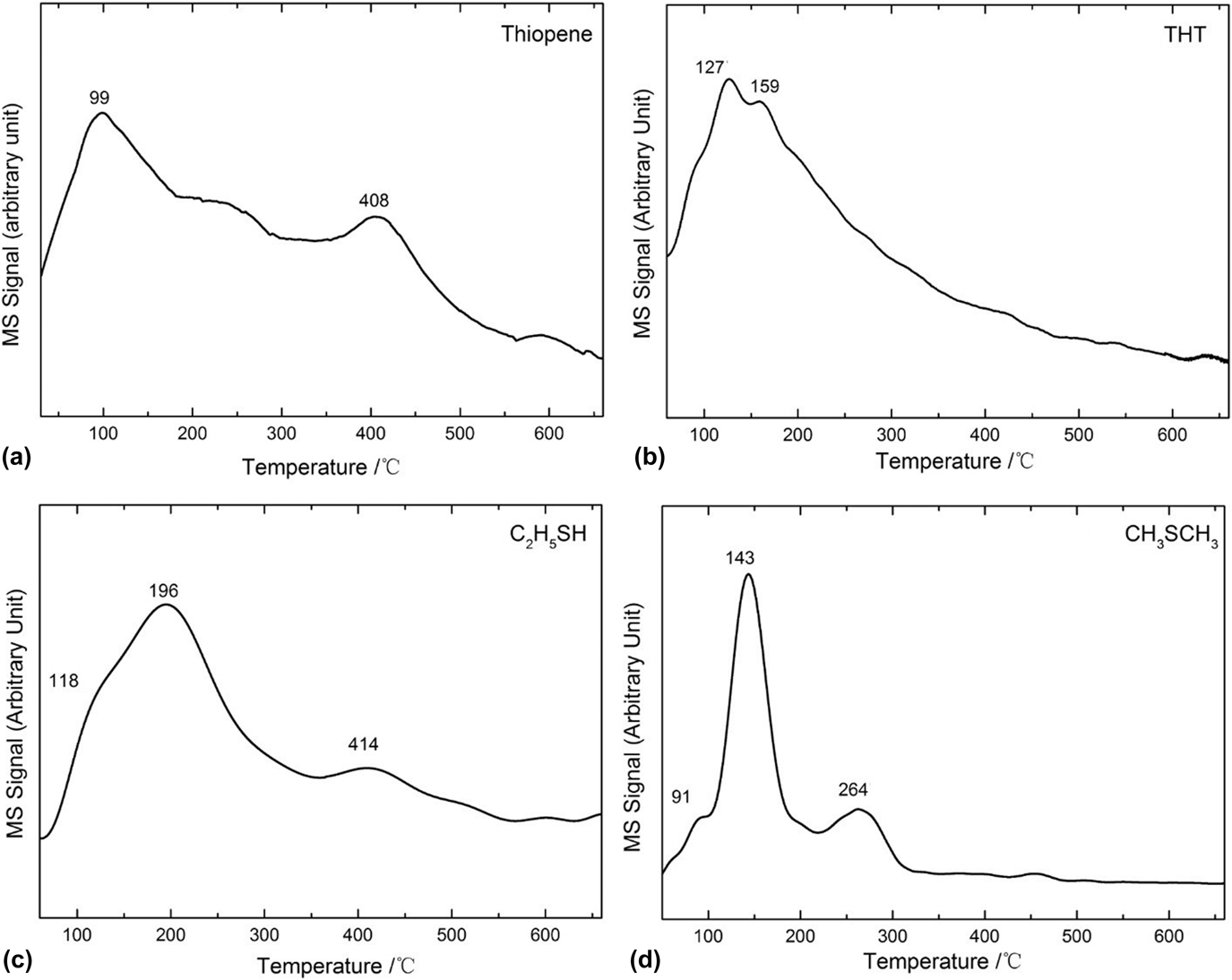
Figure 5(a) shows the temperature programmed desorption-mass spectra (TPD-MS) of thiophene on MoS2 with He protection. There are two high desorption peaks, one located at 99 °C and the other narrower one at 408 °C. Besides, a low and broad desorption peak occurs around 200 °C. These observations are generally in agreement with our DFT predictions. Most of the perpendicular adsorption modes have fairly small adsorption strengths, and the range has peaks at 99 and 200 °C. The flat adsorption modes, however, involve quite strong interactions with a very narrow range (−2.22 to −2.68 eV, Table II). The only exception in the flat adsorption mode with a smaller adsorption energy is the case when thiophene is on the top site of the Mo edge with 0% S coverage (4 in Fig. 2). We can also learn from Fig. 5 that the majority of the thiophene molecules adsorb on the weak-binding sites of Mo2S such as site-2 and site-4.
TPD-MS spectra of thiophene, THT, C2H5SH, and CH3SCH3 in He protection.

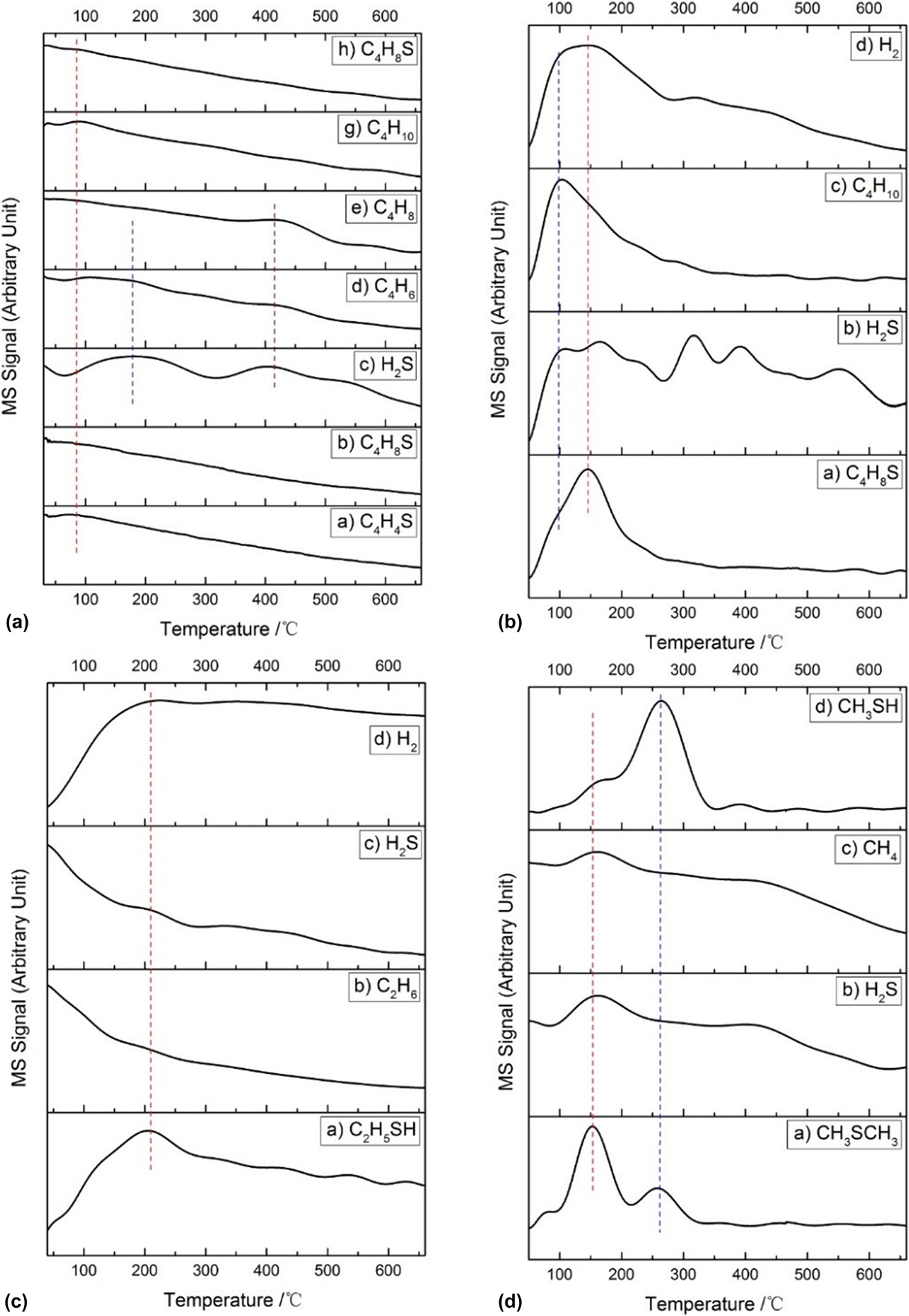
In the HYD environment [Fig. 6(a)], thiophene was found to be easily hydrogenated throughout the heating process, yielding sulfur-containing products like C4H8S (THT) and C4H10S, and sulfur-free products like C4H6 and C4H8 through hydrogenolysis and H2S elimination. This implies that thiophene desulfurization can happen through either DDS or HYD desulfurization, although Moses et al. have suggested that DDS is more favorable.Reference Moses, Hinnemann, Topsøe and Nørskov69 Figure 6(a) also shows that the highest desorption peak of thiophene occurs at about 99 °C, although with partial HYD which forms C4H10 (butane).
TPD-MS spectra of thiophene (a), THT (b), C2H5SH (c), and CH3SCH3 (d) in the mixture of Ar/H2.

Since BT, DBT, and their derivatives are solid in normal conditions, it is extremely difficult to carry out similar TPD studies. However, we can make some reasonable inferences from the case of thiophene. When the aromatic ring extends, the flat adsorption mode would gain more binding strength with the surface, while the perpendicular adsorption mode would not, leading to even larger difference in the adsorption energy and therefore corresponding desorption peaks in TPD. The former inference is in line with our DFT studies. For instance, in Table I, the perpendicular adsorption mode of BT and DBT has adsorption energies of (−0.88 eV to −1.58 eV) and (−0.98 eV to −1.72 eV), respectively. However, as Table II shows, their flat adsorption modes have adsorption energies as large as −3.80 eV and −3.50 eV, respectively.
THT in He protected TPD-MS spectra [Fig. 5(b)] shows two peaks very close to each other at 127 and 159 °C. This suggests that the difference in adsorption configurations does not have much effect on the adsorption energy. Indeed, this matches with our DFT prediction which shows that the adsorption strength is mild, and the range of adsorption energy is relatively narrow, from −1.48 to −2.15 eV (Tables II and III). In the H2 environment [Fig. 6(b)], THT desulfurization is clearly through HYD, rather than DDS, which is reflected by the simultaneous decrease of the THT signal with H2 and C4H10 signal from 150 to 300 °C. The major HYD products are butane and H2S. However, there might be some intermediates that can be directly desulfurized, as the H2S peaks at 300, 400, and 550 manifest.
The aliphatic sulfur compound C2H5SH has a quite unique shape in the TPD profile [Fig. 5(c)]. Instead of a sharp peak, it shows a broad, ascending desorption band between 118 and 196 °C, corresponding to the DFT adsorption energy of −1.24 to −1.90 eV. However, C2H5SH has a broad desorption at very high temperature near 400 °C, outside the prediction of DFT. This can be explained by the dissociative adsorption which forms a strongly binding thiolate metal complex C2H5S–Mo on the surface.Reference Todorova, Prins and Weber21 In the HYD environment [Fig. 6(c)], these strongly binding species were hydrogenated, forming C2H6 and H2S. This is evidenced by the disappearance of the high temperature peak at 414 °C in the TPD spectra under N2/H2 flowing conditions. This is in accordance with the DFT study,Reference Todorova, Prins and Weber21 which showed that the C2H6 formation has a lower energy barrier than C2H4 formation. At low temperature, there are strong H2S and C2H6 signals, accompanied by a weak H2 signal (suggesting high H2 consumption), showing that at low temperature, C2H5SH desulfurization happens mainly through the HYD mechanism. However, when the temperature is increased, there is still a large amount of C2H5SH on the surface, but the existence of high H2 concentration seems to prohibit the desulfurization process, suggesting that the DDS pathway, although less efficient than HYD, is the only feasible pathway at high temperatures. We can thus propose that the C2H5SH desulfurization mechanism is temperature dependent.
As the isomer of C2H5SH, CH3SCH3 has three peaks on the TPD-MS profile: a sharp one at 143 °C, a shoulder peak at 91 °C, and a broader one at 265 °C [Fig. 5(d)]. The intense sharp peak and its shoulder peak correspond to the weak adsorption sites of site-2, site-4, site-1, and site-6, with adsorption energies between −1.42 and −1.72 eV. The latter broad peak corresponds to the stronger adsorption sites of site-3 and site-5, with adsorption energies of −2.11 eV and −2.05 eV, respectively. In the HYD condition, CH3SCH3 has only two HYD products: CH4 and CH3SH, showing that the breaking of C–S bond as the only mechanism for its HYD [Fig. 6(d)].
IV. CONCLUSIONS
The adsorption of different sulfur compounds including C2H5SH, CH3SCH3, THT, thiophene, BT, DBT, and their derivatives have been computed systematically at the level of DFT. More importantly, these sulfur compounds were adsorbed on several different active sites of S and Mo edges for experimental accurate cluster size of the MoS2 catalyst (Mo27S48, Mo27S50, Mo27S54, and Mo27S55) clusters. On the basis of the adsorption energies for sulfur compounds, the order of exothermic energies is THT > CH3SCH3 > C2H5SH > DBT > BT > thiophene for adsorption on the same adsorption site by perpendicular adsorption modes. Competition of adsorption may exist in these molecules. The adsorption site-2 and site-5 may play a key role on adsorption and activation. The flat adsorption modes are more favorable than the perpendicular adsorption modes for aromatic molecules.
The hydrogenated derivatives of thiophene and BT have been reported in this work to study the effect of HYD on the adsorption energies. It is demonstrated that the adsorption energy in the perpendicular adsorption mode increased when the aromatic ring was saturated. However, under the flat adsorption mode, the adsorption energy for partial hydrogenated thiophene and BT are higher than that of thorough hydrogenated derivatives.
By comparing the adsorption of DBT and two methyl-substituted DBT (DMDBT) adsorption on different sites, the steric effect of 4,6-DMDBT is observed on the adsorption sites studied. Its effect depends on the nature of the adsorption site. Specifically, the steric effect by flat adsorption is smaller than that of by perpendicular adsorption.
The DFT predicted adsorption energies are compared with the He-protected and unprotected TPD experiments. From the comparison, the significance of the theoretical adsorption configurations on experimental MoS2 particles for the various classes of sulfur-containing molecules can be understood. Our results also support the mechanism that HYD and DDS paths happen simultaneously, but on different active sites.
Supplementary Material
To view supplementary material for this article, please visit https://doi.org/10.1557/jmr.2018.309.
ACKNOWLEDGMENTS
The authors are grateful for financial support from the National Natural Science Foundation of China (Nos. 21473229, 91545121, 21776304, 21603252, and 21473231), No. 201601D021048 from the Shanxi Province Science Foundation for Youth, and from Synfuels China, Co. Ltd. We also acknowledge the innovation foundation of Institute of Coal Chemistry, Chinese Academy of Sciences, National Thousand Young Talents Program of China, Hundred-Talent Program of Chinese Academy of Sciences, and Shanxi Hundred-Talent Program.