Introduction
It is well documented that a substantial proportion of patients suffering from the schizophrenia-spectrum disorders exhibit a variety of neurocognitive dysfunctions (Heinrichs & Zakzanis, Reference Heinrichs and Zakzanis1998; Lenzenweger, Reference Lenzenweger, Lenzenweger and and Dworkin1998; Egan et al. Reference Egan, Goldberg, Gscheidle, Weirich, Rawlings, Hyde, Bigelow and Weinberger2001; Seaton et al. Reference Seaton, Goldstein and Allen2001; Fioravanti et al. Reference Fioravanti, Carlone, Vitale, Cinti and Clare2005), which may also be observed (to a lesser extent) in their clinically unaffected biological first-degree relatives (Steinhauer et al. Reference Steinhauer, Zubin, Condray, Shaw, Peters, Van Kammen, Tamminga and and Schultz1991; Cornblatt et al. Reference Cornblatt, Lenzenweger, Dworkin and Erlenmeyer-Kimling1992; Faraone et al. Reference Faraone, Seidman, Kremen, Pepple, Lyons and Tsuang1995; Mirsky et al. Reference Mirsky, Ingraham and Kugelmass1995; Cornblatt & Obuchowski, Reference Cornblatt and Obuchowski1998; Egan et al. Reference Egan, Goldberg, Gscheidle, Weirich, Rawlings, Hyde, Bigelow and Weinberger2001). In addition to findings of specific deficits in attention, working memory and executive function (Shallice et al. Reference Shallice, Burgess and Frith1991; McGrath et al. Reference McGrath, Scheldt, Welham and Clair1997; Seaton et al. Reference Seaton, Goldstein and Allen2001), many studies highlight a general impairment in intellectual functioning (Pollack et al. Reference Pollack, Woerner and Klein1968; Dieci et al. Reference Dieci, Vita, Silenzi, Caputo, Comazzi, Ferrari, Ghiringhelli, Mezzetti, Tenconi and Invernizzi1997; Bilder et al. Reference Bilder, Reiter, Bates, Lencz, Szeszko, Goldman, Robinson, Lieberman and Kane2006; Woodberry et al. Reference Woodberry, Anthony and Seidman2008; Urfer-Parnas et al. Reference Urfer-Parnas, Mortensen, Saebye and Parnas2010b). The extent of this impairment was originally thought to be a powerful predictor of subsequent functioning, even more so than current symptom levels (Velligan et al. Reference Velligan, Mahurin, Diamond, Hazelton, Eckert and Miller1997, Reference Velligan, Bow-Thomas, Mahurin, Miller and Halgunseth2000; Harvey et al. Reference Harvey, Howanitz, Parrella, White, Davidson, Mohs, Hoblyn and Davis1998; Green et al. Reference Green, Kern, Braff and Mintz2000). More recently, these findings have been challenged by studies showing that baseline neurocognitive dysfunction only accounts for 0–10% of the variance in both 1-year and 7-year outcomes (Milev et al. Reference Milev, Ho, Arndt and Andreasen2005; Perlick et al. Reference Perlick, Rosenheck, Kaczynski, Bingham and Collins2008).
The general notion that schizophrenia is associated with impaired cognitive functioning has been conceived in terms of neurodevelopmental models (O'Donnell, Reference O'Donnell2007), in which cognitive impairment is already present in childhood and implicated in the developing disease process prior to onset, and decline models (Keefe & Fenton, Reference Keefe and Fenton2007), in which a marked deterioration from pre-morbid levels of cognitive functioning is associated with onset and/or the disease progression after onset. A combination of both models is also possible. Note that the question of the temporality of cognitive deficit, raised by these models, is separable from the question of the nature of the cognitive deficit involved. As noted earlier, both specific neurocognitive functions and general intellectual functioning have been implicated. Owing to methodological constraints, this paper principally examines the evidence for a general intellectual deficit.
Evidence for neurodevelopmental models is provided by several studies that identify a relationship between lower pre-morbid IQ and later schizophrenia (Lane & Albee, Reference Lane and Albee1964; Offord, Reference Offord1974; Crawford et al. Reference Crawford, Besson, Bremner, Ebmeier, Cochrane and Kirkwood1992; Jones et al. Reference Jones, Rodgers, Murray and Marmot1994; Cannon et al. Reference Cannon, Jones, Huttunen, Tanskanen, Huttunen, Rabe-Hesketh and Murray1999); however, other studies do not find this relationship (Lane & Albee, Reference Lane and Albee1968; Isohanni et al. 1998 b). Five large epidemiogical studies of male draftees (David et al. Reference David, Malmberg, Brandt, Allebeck and Lewis1997; Davidson et al. Reference Davidson, Reichenberg, Rabinowitz, Weiser, Kaplan and Mark1999; Tiihonen et al. Reference Tiihonen, Haukka, Henriksson, Cannon, Kieseppä, Ilmo, Sinivuo and Lönqvist2005; Reichenberg et al. Reference Reichenberg, Weiser, Caspi, Knobler, Lubin, Harvey, Rabinowitz and Davidson2006; Urfer-Parnas et al. Reference Urfer-Parnas, Mortensen, Saebye and Parnas2010b) have demonstrated a clear relationship between low IQ as measured at the military draft evaluation and a subsequent risk for hospitalization for schizophrenia and other psychoses.
Evidence for decline models is offered by reports finding a significant fall between pre-morbid and post-onset intellectual assessments of schizophrenia patients (Frith et al. Reference Frith, Leary, Cahill and Johnstone1991; David, Reference David1998; Gold, Reference Gold1998; Sheitman et al. Reference Sheitman, Murray, Snyder, Silva, Goldman, Chakos, Volavka and Lieberman2000). Although the traditional assumption is that cognitive performance continues to deteriorate after onset (Lubin et al. Reference Lubin, Gieseking and Williams1962; Schwartzman & Douglas, Reference Schwartzman and Douglas1962; Frith, Reference Frith1992; Green, Reference Green1996; Caspi et al. Reference Caspi, Reichenberg, Weiser, Rabinowitz, Kaplan, Knobler, Davidson-Sagi and Davidson2003; Hoff et al. Reference Hoff, Svetina, Shields, Steward and DeLisi2005; Seidman et al. Reference Seidman, Buka, Goldstein and Tsuang2006), and cross-sectional comparisons of chronic versus first-episode patients have been offered to support this notion (Bilder et al. Reference Bilder, Lipschutz-Broch, Reiter, Geisler, Mayerhoff and Lieberman1992), several cross-sectional and longitudinal reports have instead found a deficit at the time of onset that remains stable over the course of illness (Hyde et al. Reference Hyde, Nawroz, Goldberg, Bigelow, Strong, Ostrem, Weinberger and Kleinman1994; Mockler et al. Reference Mockler, Riordan and Sharma1997; Rund, Reference Rund1998; Gold et al. Reference Gold, Arndt, Nopoulos, O'Leary and Andreasen1999; Heaton et al. Reference Heaton, Gladsjo, Palmer, Kuck, Marcotte and Jeste2001; van Winkel et al. Reference van Winkel, Myin-Germeys, Delespaul, Peuskens, De Hert and van Os2006).
One problem with drawing definite conclusions from this work is that most studies are conducted after the onset of psychosis; that is, there are few, if any, designs that prospectively select a group of individuals and follow them from adolescence through the period of psychotic onset and into adulthood. Longitudinal high-risk studies, which follow cohorts at elevated genetic risk for schizophrenia from adolescence into adulthood, may provide a partial answer to these questions. Thus far, support for a neurodevelopmental deficit model among high-risk studies is weak. We previously found that pre-morbid IQ does not predict adult schizophrenia in the Copenhagen High-Risk Project (CHRP; Watson, Cannon, Schulsinger, Parnas & Mednick, unpublished observations). Similar negative results for predicting schizophrenia-related psychosis from general intellectual measures have been reported by the New York High-Risk Project (Ott et al. Reference Ott, Spinelli, Rock, Roberts, Amminger and Erlenmeyer-Kimling1998) and the Israeli Kibbutz High-Risk Study (Mirsky et al. Reference Mirsky, Ingraham and Kugelmass1995). To the best of our knowledge, the question of cognitive decline has not been addressed in a high-risk paradigm.
The longitudinal nature of the CHRP, with its two IQ assessments, multiple diagnostic evaluations, and repeated measures of severity of psychopathology and of the level of functioning until midlife, provides us with a unique opportunity to test the decline model more closely. Moreover, the study allows for charting the potential influences of adolescent IQ on early adult functioning, and of early adult IQ on midlife functioning; these effects that can be investigated in relation to genetic risk, gender, socio-economic status (SES), diagnostic status and severity of illness.
Methods
Participants
This study uses data drawn from the CHRP, a longitudinal study of over 40 years' duration. The selection procedures have been described in detail previously (Mednick & Schulsinger, Reference Mednick and Schulsinger1965). Essentially, 207 children (aged 10–18 years) of schizophrenic mothers were matched to 104 children of parents without psychiatric history. No children showed any severe psychopathology at this time. These participants were then followed up prospectively at approximately 5, 10 and 25 years from first contact. Attrition has not been excessive, as 94% were contacted at either the 10-year or 25-year assessment (and 76% participated in both); this follow-up rate is substantially better than other comparable longitudinal high-risk studies (Parnas et al. Reference Parnas, Cannon, Jacobsen, Schulsinger, Schulsinger and Mednick1993).
Procedures and measures
Genetic risk
Genetic risk was defined as the number of biological parents with a schizophrenia-spectrum disorder. At the outset of the study, mothers' schizophrenia diagnoses were drawn from hospital records; these criteria were fairly stringent and have been shown to have high agreement with DSM-III-R (and especially DSM-IV) criteria (Jorgensen et al. Reference Jorgensen, Teasdale, Parnas, Schulsinger, Schulsinger and Mednick1987). In 1980, mothers without a psychiatric history in 1962 were screened a second time through the Danish psychiatric register, and one mother was found to have been hospitalized for schizophrenia. Fathers' diagnoses were principally derived from a psychiatric interview conducted in 1980–1983 and supplemented with information from the psychiatric register and the mothers' hospital charts. In all, 67 participants had fathers who were diagnosed with a schizophrenia-spectrum condition. From this information, 63 participants were assigned a risk of 2, 149 received a risk of 1, and 99 received a risk of 0. We note that this risk classification differs from the ‘high-risk’/'low-risk' distinction used in many reports of these data (Mednick & Schulsinger, Reference Mednick and Schulsinger1965; Cannon & Mednick, Reference Cannon and Mednick1993; Parnas et al. Reference Parnas, Cannon, Jacobsen, Schulsinger, Schulsinger and Mednick1993).
Other demographic variables
Gender was dummy-coded with males=1 and females=0. SES was measured using a seven-point (0–6) classification of the father's occupation (Svalastoga, Reference Svalastoga1959). Both SES and age of assessment (in 1962–1964) were drawn from a Social Worker's Interview conducted as part of Assessment I (as follows).
Assessment I: 1962–1964
At first contact (1962–1964), all 311 participants (average age 15 years) completed a day-long assessment that included a standard administration of Weschler's Intelligence Scale for Children (WISC). Standard subtest scale scores, Verbal IQ, Performance IQ, and Full-Scale IQ were obtained; Full-Scale IQ was used for the present study. During the same period, each participant's primary teacher was asked to fill out a brief report that included the participant's grades in Reading, Writing, Arithmetic, and Oral Speaking. These grades were reported on a five-point scale, with high marks indicating excellent academic performance. An overall grade was calculated by summing the four subject grades. Students missing one or more grades were given pro-rated scores based on available grades. Although grades are presumed to be related to intellectual functioning, we note that previous reports have not found them to predict psychosis (Isohanni et al. 1998 a; Cannon et al. Reference Cannon, Jones, Huttunen, Tanskanen, Huttunen, Rabe-Hesketh and Murray1999).
Assessment II: 1967–1968
At approximately 5 years from the first assessment, 94% (n=293) of participants were interviewed by a social worker. The social worker also interviewed the parents or other collateral sources when possible. In addition, an ‘alarm network’ of area psychiatric hospitals notified the research team of all hospitalizations of any study participants. Twenty of the CHRP cohort evidenced signs of serious psychopathology by this point, and were labelled the ‘sick’ group. This ‘sick’ designation is considered to be a useful index of an early onset for individuals who were later formally diagnosed as psychotic.
Assessment III: 1972–1974
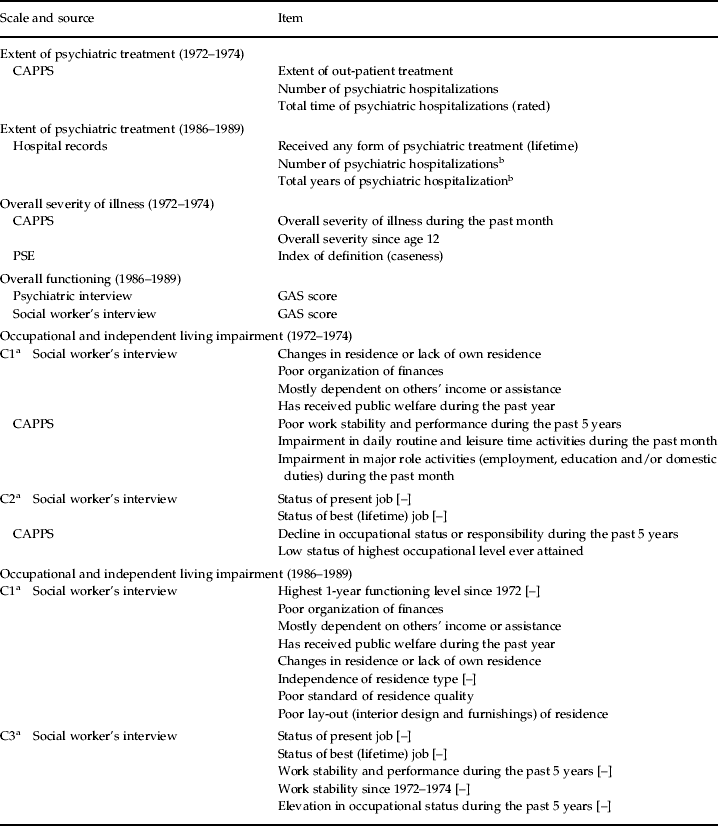
Of the original 311 participants, 86% (n=267; average age 24 years) were included in a major follow-up approximately 10 years after the first assessment. Of the 44 participants left out of Assessment III, five had died, six had emigrated, three were untraceable, and 30 refused to participate (Parnas et al. Reference Parnas, Cannon, Jacobsen, Schulsinger, Schulsinger and Mednick1993). Diagnostic assessments consisted of the Present State Examination (PSE), the Current and Past Psychopathology Scale (CAPPS), and additional items developed by the researchers. Consensus diagnoses were assigned at the time; these diagnoses were later re-evaluated in 1992 in light of DSM-III-R criteria. For the purposes of the present analyses, the 1992 diagnoses were converted into three dummy-coded variables: psychosis (mostly schizophrenia), spectrum (cluster A; mostly schizotypal) personality disorder, and other mental illness. No mental illness was indicated by a 0 on all three variables (for a description of this technique, see Pedhazur & Schmelkin, Reference Pedhazur and Schmelkin1991). Two additional outcome variables were created from the psychiatric data. A measure of the extent of psychiatric treatment was constructed using three ordinal items from the CAPPS, and a measure of the overall severity of illness was derived from two items from the CAPPS and one item from the PSE (see Table 1 for a list of these items). To calculate each outcome variable, items were equally scaled and then summed.
Composition of adult functional outcome scales

CAPPS, Current and Past Psychopathology Scale; PSE, Present State Examination; GAS, Global Assessment Scale; [–], item is reverse scored.
a The components composing the overall variable. See text for details.
b Log-transformed.
A short version of Weschler's Adult Intelligence Scale (WAIS) was given in the course of the assessment. It consisted of two verbal subscales (Vocabulary and Similarities) and two performance subscales (Block Design, Object Assembly). This choice of subscales was perhaps not ideal (as neither attention nor working memory were assessed), but the correlation of the sum of these subscales with Full-Scale IQ is likely to be high. Therefore, an estimated IQ was created by assuming that, for the 99 participants without a family history of mental illness (i.e. genetic risk=0), the average distribution of IQ scores in 1972 would be roughly the same as the distribution of IQ scores in 1962. The raw sums of the WAIS subscales for this group were first normed using the mean and standard deviation of the 1962 Full-Scale IQ for the same group. Then, the WAIS subscale sums for all other participants were converted to IQ equivalents using the zero-risk group's benchmarks. Although this method has the disadvantage of not being able to establish any absolute increases or decreases in IQ for the zero-risk group as a whole, individual improvements and declines in performance can readily be assessed relative to this overall ‘normal’ reference point.
Additionally, the participants were interviewed by a social worker, who asked questions related to educational and occupational achievement and also housing and financial situation. Based on these items, educational level was scored on a six-point ordinal scale developed by the researchers to take into account Denmark's multi-tiered educational system. A measure of occupational and independent living functioning was derived from both the CAPPS and the social worker's interview. First, six items from the CAPPS and 11 items from the social worker's interview were rationally selected for their relevance to participants' work, role functioning, finances, and home environment. These items were subjected to principal components analysis (SPSS FACTOR command, principal components extraction and varimax rotation) and the first two components were retained. Component scales were computed by summing all items loading more than 0.40 on each component. The items composing each component are listed in Table 1. Because of the conceptual and empirical overlap between these two scales (r=0.46), we decided to sum the two component scales (after equal weighting) into a single index of occupational and independent living impairment.
Assessment IV: 1986–1989
In 1986–1989, approximately 25 years after the participants' first contact with the CHRP, 86% (n=267; average age 42 years) were located and consented to reassessment. Of the 44 participants with missing data, 14 had died, 15 had emigrated, four were untraceable, and 11 refused to participate. A psychiatrist conducted several semi-structured diagnostic interviews, including the PSE (both last month and lifetime psychosis versions), the Schedule for Affective Disorders and Schizophrenia (SADS) and the Personality Disorder Examination (PDE), and symptom scales such as the Scale for the Assessment of Positive Symptoms (SAPS) and the Scale for the Assessment of Negative Symptoms (SANS). Preliminary diagnoses were re-evaluated in 1992 and DSM-III-R diagnoses were assigned. Once again, these diagnoses were converted into three dummy-coded variables. A thorough review of all available hospital records was also conducted in 1986–1989, from which treatment data were coded. A measure of the extent of psychiatric treatment (similar to the 1972–1974 outcome measure) was formed from three of the hospital records items (see Table 1). The number and duration of hospitalizations were log-transformed to correct for excessive positive skew prior to all items being equally weighted and summed.
A social worker's interview was also conducted. Overall functioning was calculated by averaging the Global Assessment of Symptoms (GAS) score assigned by the psychiatrist and the GAS score given by the social worker (see Table 1). This overall measure is presumed to be substantially similar to the overall severity index used for the 1972–1974 follow-up, albeit in the opposite direction. Education level was again scored on the same six-point scale as used for 1972–1974. As the CAPPS was not used in 1986–1989 and the social worker's interview items concerning work and independent living were somewhat changed from before, a new measure of occupational and independent living functioning needed to be created. A principal components analysis was performed on relevant items from the social worker's interview. Three components were extracted. The second component was dropped because of excessive missing data and its low correlation with other measures of work functioning. Component scales for components 1 and 3 were computed by summing items loading more than 0.40 on each component. The items composing each component are shown in Table 1. The two component scales were found to be highly intercorrelated (0.67), so the two component scales were summed after equal weighting to create a new index of occupational and independent living impairment. Unfortunately, no standardized test of intellectual functioning was given in 1986–1989, so 25-year IQ must remain a lacuna.
Rationale of the analyses
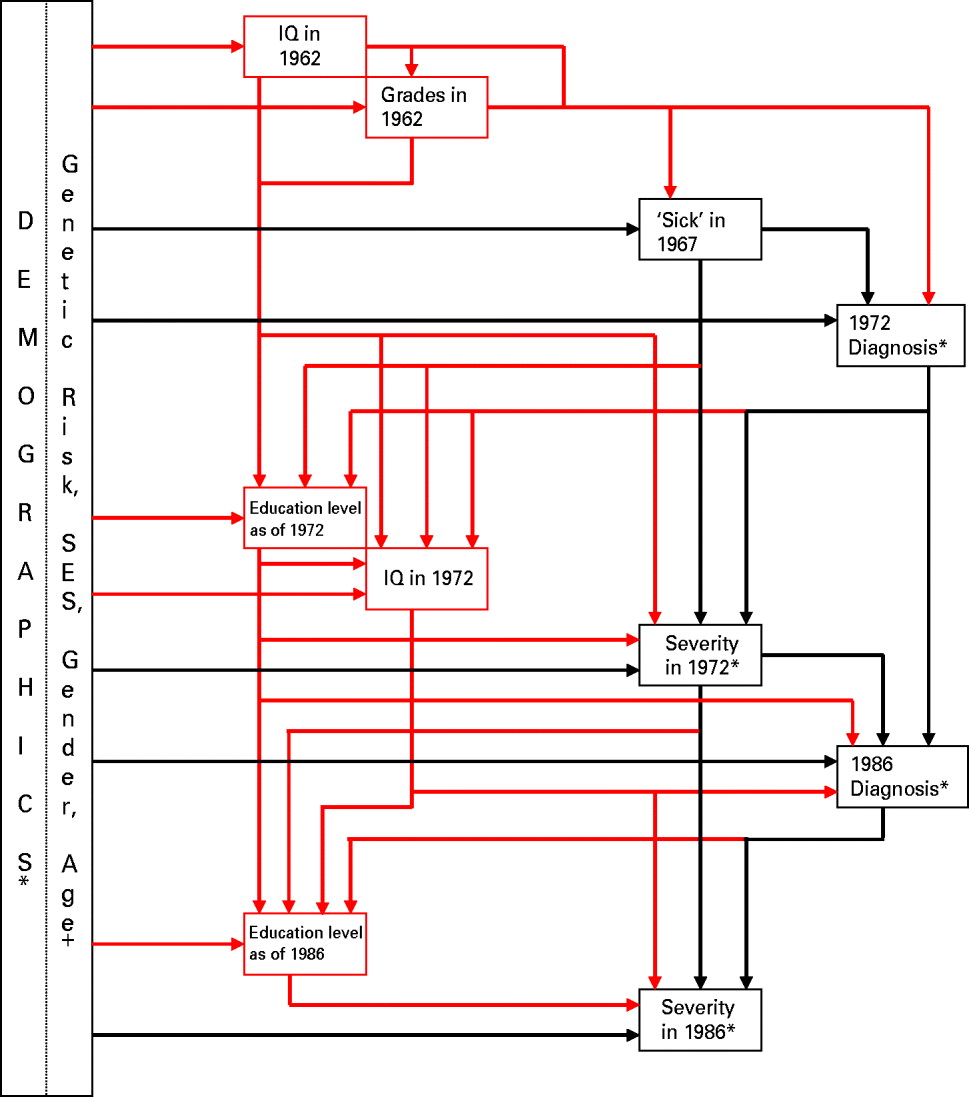
Based on the existing findings and theoretical models in the literature, we created the hypothesized path model diagrammed in Fig. 1. It is useful to think of these proposed connections in terms of two separable systems: the basic disease model and the influence of intellectual variables. The basic disease model is represented by the paths and variables outlined in black; it shows a simple genetic-risk→severity-of-schizophrenia-spectrum-illness chain of events broadly consistent with polygenetic theory (Gottesman & Shields, Reference Gottesman and Shields1982). This model specifies that genetic risk (perhaps in conjunction with demographic factors) predicts psychosis and spectrum personality at 10-year and 25-year follow-ups, and greater genetic risk (again, possibly in conjunction with demographic factors) presages increased severity of illness, as indicated by earlier age of onset (and thus more likely ‘sick’ by the 5-year follow-up) and decreased adult functioning in several domains: greater extent of psychiatric treatment, decreased occupational performance and independent living skills, and poorer overall functioning.
The hypothesized path model. * General construct contains more than one variable. Diagnosis includes indicators of psychosis, spectrum personality, and other mental illness. Severity includes overall severity/functioning, extent of psychiatric treatment, and occupational and independent living impairment. Black paths and variables correspond to the basic disease model. Red paths and variables represent the role of intellectual functioning variables.+Age at assessment in 1962 is a hypothesized covariate for all analyses involving 1962 assessments (IQ in 1962 and Grades in 1962). SES, socio-economic status.

The influence of intellectual variables is represented by the variables and paths outlined in red. The key question is whether IQ and educational performance add appreciably to the prediction of spectrum illness and adult functioning and whether spectrum illness adds appreciably to the prediction of post-onset IQ. In this regard, our analyses will test three main hypotheses:
(1) Decreased intellectual functioning predicts schizophrenia-spectrum diagnoses, particularly schizophrenia and other psychoses. This is tested in two stages: (i) does pre-morbid IQ and/or school performance predict diagnosis at the 10-year follow-up and (ii) does adult IQ predict additional cases by the 25-year follow-up?
(2) Intellectual functioning predicts adult adjustment in three domains: occupational and independent living capabilities, use of psychiatric treatment services, and overall functioning. Again, this proposal is divided into two testable stages: (i) does pre-morbid IQ and/or school performance predict adjustment at the 10-year follow-up and (ii) does adult IQ predict sustained adjustment at the 25-year follow-up?
(3) Spectrum diagnosis, particularly psychosis, leads to a decline in adult IQ as compared to pre-morbid IQ. Furthermore, early-onset cases will show greater decline relative to later-onset cases.
Statistical analyses
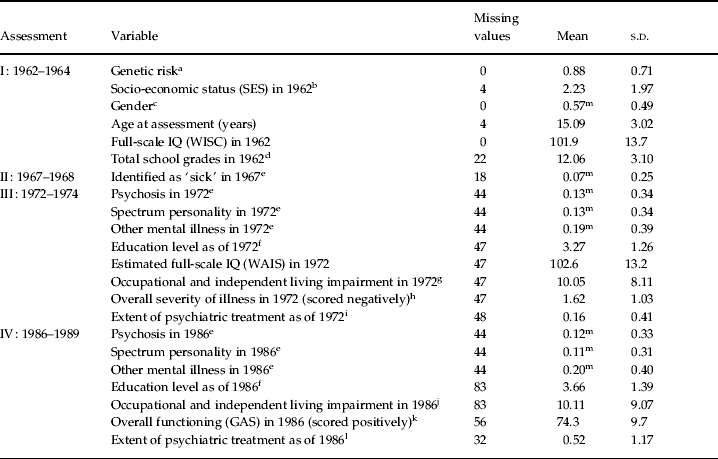
The variables used in the analysis are listed in Table 2, together with their means, standard deviations, and the number of missing values for each. Note that all participants completed Assessment I, but 44 were missing in both Assessment III and IV. Any additional missing values noted were due to specific data sources. Multiple regression was used for all analyses. Following the logic of the rationale (see Fig. 1), each intermediate outcome was regressed on all hypothesized predictors, and backwards selection was used to trim variables with non-significant paths (p<0.10) from the analysis. As both 1972 and 1986 diagnoses were dummy-coded into three variables, these variables were handled together. The diagnostic indices were entered first into the equation. Then, after backwards selection had removed non-significant predictors, the p values for the three diagnostic codes were examined. Diagnosis was only removed from the model when all three p values were non-significant; otherwise, it was retained in full.
Descriptive summary of variables used

WISC, Weschler's Intelligence Scale for Children; WAIS, Weschler's Adult Intelligence Scale; GAS, Global Assessment Scale; s.d., standard deviation.
a Number of schizophrenia spectrum parents (0–2).
b Scaled from 0 (Low) to 6 (High).
c Dummy-coded with Male=1 and Female=0.
d Scores range from 4 (Low) to 20 (High).
e Dummy-coded (1=Yes, 0=No).
f Scaled from 1 (Low) to 6 (High).
g Scores ranged from −4.9 (Good functioning) to 37.7 (Impaired functioning).
h Scaled from 0 (No disturbance) to 4 (Severe disturbance).
i Scaled from 0 (No treatment) to 2 (Extensive treatment).
j Scores ranged from −1.0 (Good functioning) to 44.3 (Impaired functioning).
k GAS scores range from 1 (Extreme impairment) to 100 (Superior functioning).
l Scores ranged from 0 (No treatment) to 7.3 (Extensive treatment).
m Means for all dummy-coded variables can be read as the proportion of the sample in the scored category (i.e. ‘Male’ for Gender, ‘Sick’ for Sick in 1967, and receiving the corresponding diagnosis for all diagnostic variables).
For each analysis, cases with missing values in the criterion were excluded. Missing values in the predictors were generally handled through mean substitution. Although this solution tends to produce middle-heavy distributions and underestimates total variance, it has the advantage of maintaining sample means and only minimally reducing intercorrelations between variables. Because of assumptions of high stability, missing data in intellectual predictors were imputed. Missing IQ values in 1972 were set to the existing values in 1962. The mean differential between 1972 and 1986 education levels was used to impute missing values on one variable from valid data on the other. If data were missing at both time points, mean substitution was used.
Results
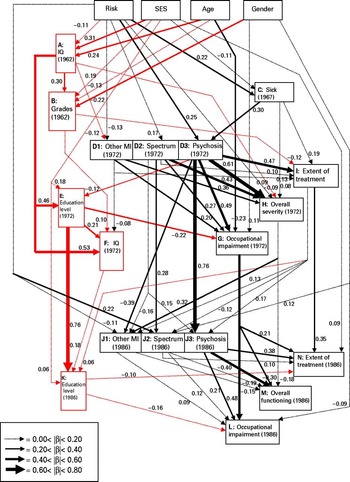
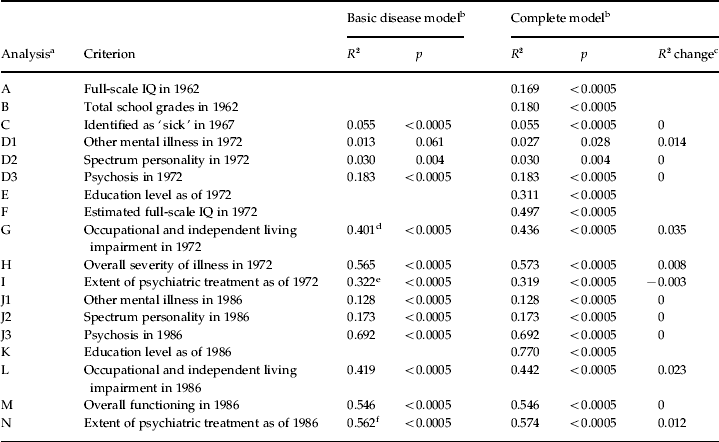
For each regression analysis (labelled A–N) composing the path analyses, the overall proportion of variance explained (R 2) and the significance level (p) are reported in Table 3, and the final path diagram (reporting all significant predictors' β coefficients) is displayed in Fig. 2. Following our rationale above, we consider the results of the path analyses in two steps: first, considering only the relationships described by the basic disease model (i.e. the links between demographics, diagnoses and functional outcomes), and second, gauging the contributions of intellectual functioning variables to the prediction of diagnostic and functional outcomes.
The final path model. A, B, etc. designate the criterion variable for each regression analysis composing the path model. Black paths and variables correspond to the basic disease model. Red paths and variables represent the role of intellectual functioning variables. SES, socio-economic status.

Summary of regression results

a Corresponding to letters designated on final path diagram (Fig. 2).
b All significant predictors for the complete model are shown as paths in Fig. 2, together with their standardized regression (β) coefficients. In most cases, the significant predictors for the basic disease model are the same, excluding any intellectual variables. Exceptions are indicated here in the following notes.
c Due to the inclusion of intellectual variables.
d In addition to the predictors shown on the path diagram, the basic disease model for analysis G includes socio-economic status (SES) (β=–0.11).
e In addition to the predictors shown on the path diagram, the basic disease model for analysis I includes genetic risk (β=0.09) and SES (β=–0.10).
f The basic disease model for analysis N includes other mental illness in 1986 (β=0.08) but does not include SES.
Basic disease model
The final paths derived for the basic disease model are displayed in black in Fig. 2. To maximize visual clarity, the approximate size of each coefficient is shown by the line width for the respective path (see Fig. 2). All paths shown are significant at the p<0.10 level, and the thicker paths (β>0.20) are highly significant (p<0.001). For each analysis, the R 2 and associated significance level for the basic disease model are listed in the middle columns of Table 3.
Although the inter-relationships among these variables are complex, the overall pattern clearly supports the hypothesized basic disease paths from Fig. 1. Genetic risk influences outcomes in 1967, 1972 and 1986 in the direction of schizophrenia-spectrum pathology. Diagnostic severity (i.e. psychosis and spectrum personality, in that order) is consistently reflected in more severe functional outcomes. The only hypothesized relationships not supported by the results are (1) an effect of being ‘sick’ in 1967 on occupational and independent living impairment in 1972 and (2) most of the direct effects of risk on functional outcomes.
Intellectual variables
The complete model, displayed in Fig. 2 by both black and red paths, consists of the addition of the variables of IQ, school grades, and education level (red variables and paths) to the basic disease model. In Table 3, the R 2 for the complete model is listed to the far right for each analysis, together with its overall significance. In the last column of the table, the basic disease model R 2 is subtracted from the corresponding complete model R 2 to obtain a change in R 2 due to intellectual variables.
Among the intellectual variables, the most notable results are (1) the consistent time-lagged relationships between IQ and educational achievement and (2) the persistent benefit of higher SES on almost all intellectual outcomes.
In the rationale, we proposed three hypotheses concerning the relationship between intellectual functioning and schizophrenia-spectrum illness. These hypotheses are now evaluated on the basis of their fit to the data.
(1) Decreased intellectual functioning predicts schizophrenia-spectrum diagnoses, particularly psychosis
This hypothesis fails to be supported on two counts. First, neither IQ nor grades in 1962 are significant predictors of schizophrenia-spectrum diagnoses in 1972. Second, IQ in 1972 is not predictive of additional spectrum cases by 1986. The only predictive relationship that holds is a small tendency for lower IQ to predict cases of other (non-spectrum) mental illness in 1972. For both psychosis and spectrum personality outcomes, the change in variance explained (R 2) due to intellectual variables is 0.
(2) Intellectual functioning predicts adult adjustment in three domains: occupational and independent living capabilities, use of psychiatric treatment services, and overall functioning
This is a bit of a mixed picture. IQ in 1962 does not predict occupation and independent living or extent of treatment in 1972. Decreased IQ does slightly predict overall severity in 1972 (β=−0.09); however, upon further (post-hoc) analysis, IQ does not predict severity for those with spectrum illnesses, only for those with other (non-spectrum) illnesses (β=−0.28 for this subsample). IQ in 1972 does not predict functioning in mid-adulthood. Although intellectual capability does not seem to be related to adult functioning, there is an important link between education level and concurrent occupational and independent living success (β=−0.22 in 1972, β=−0.16 in 1986, both in the expected direction). Changes in R 2 corresponding to this education–occupational functioning link are 0.035 in 1972 and 0.023 in 1986. Additionally, higher education level contributed to less psychiatric treatment by 1986. Upon further analysis, this protective effect is both pronounced among and restricted to those with psychotic disorders (β=−0.41 for this subsample).
(3) Spectrum diagnosis, particularly psychosis, leads to a decline in adult IQ as compared to pre-morbid IQ
The evidence from our sample is to the contrary; there is no significant decline in IQ (i.e. 1972 IQ controlled for 1962 IQ) associated with a concurrent psychotic or spectrum personality diagnosis. Second, early onset of spectrum disorder (‘Sick’ in 1967) does not seem to influence IQ in 1972.
Discussion
The longitudinal nature of the CHRP has allowed us to paint a thorough picture of the intellectual, symptomatic and functional development of those at risk for schizophrenia from adolescence into mid-adulthood. Our analyses point to the operation of two distinct systems: the first being intellectual ability and its manifestation in educational achievement; the second being a schizophrenia-spectrum disease process that, especially in instances of psychosis, dramatically impacts adult functioning. Contrary to models proposed in the literature, we find no evidence for any significant relationship between these two systems, excepting a pragmatic benefit of higher education evidenced in better occupational and independent living status at both age 24 and 42 and reduced reliance on treatment by age 42.
Similarly to the findings from other high-risk projects (Mirsky et al. Reference Mirsky, Ingraham and Kugelmass1995; Ott et al. Reference Ott, Spinelli, Rock, Roberts, Amminger and Erlenmeyer-Kimling1998), we fail to find that decreased full-scale IQ predicts later schizophrenia-related psychosis. Although the New York High-Risk Project reports a trend for lower performance IQ (PIQ) among pre-psychotic individuals (Ott et al. Reference Ott, Spinelli, Rock, Roberts, Amminger and Erlenmeyer-Kimling1998), and has had substantial success using an attentional measure that includes the Digit Span subtest (Erlenmeyer-Kimling et al. Reference Erlenmeyer-Kimling, Rock, Roberts, Janal, Kestenbaum, Cornblatt, Adamo and Gottesman2000), no subtest or index was found to be predictive in our own sample (Watson et al., unpublished observations). A recent reanalysis of the Copenhagen sample seems to show that coding deficits can predict schizophrenia-spectrum outcome (Sorensen et al. Reference Sørensen, Mortensen, Parnas and Mednick2006); however, as these deficits are associated with genetic risk for schizophrenia, and genetic risk was not controlled for in the regression analyses, these results are inconclusive.
The lack of predictive power of intellectual functioning for later psychotic diagnosis is strongly at variance with the substantially lower IQ found among pre-schizophrenia patients in three recent draft studies (David et al. Reference David, Malmberg, Brandt, Allebeck and Lewis1997; Davidson et al. Reference Davidson, Reichenberg, Rabinowitz, Weiser, Kaplan and Mark1999; Urfer-Parnas et al. Reference Urfer-Parnas, Mortensen, Saebye and Parnas2010b). Rescaled mean IQ scores for pre-schizophrenic individuals are 95.3 for the Israeli cohort, 92.5 for the Swedish cohort, and 94.4 for the Danish cohort (versus mean=100 and standard deviation=15 for normal controls). Other population studies, such as the British 1946 birth cohort, have noted pre-morbid deficits as large as one standard deviation (Jones et al. Reference Jones, Rodgers, Murray and Marmot1994).
There are several possible explanations for this difference. First, these population studies are only able to identify hospitalized schizophrenic patients, whereas our study includes non-treated and non-hospitalized cases as well. If our sample is any indication, as much as 33% of schizophrenic individuals are never hospitalized and 15% evade treatment of any sort. However, this difference in target samples cannot satisfactorily account for our findings. If treated cases were indicative of greater cognitive dysfunction, we would have expected a relationship between pre-morbid IQ and treatment severity, which was not present. In addition, when we reran the regression analyses for hospitalized patients only, the prediction was not improved.
Another difference lies in the diagnostic criteria. We used DSM-III-R criteria, and combined both schizophrenia (n=33) and other (mostly atypical) psychoses (n=10) into a single category; the population studies used the clinical ICD-8/9 criteria for schizophrenia, which were very conservative, reflecting a clearly deteriorating Kraepelinian prototype (Jorgensen et al. Reference Jorgensen, Teasdale, Parnas, Schulsinger, Schulsinger and Mednick1987). Three pieces of evidence argue against the salience of this difference for our results. First, we observed no relationship between IQ and illness severity (except for non-spectrum cases). Second, we found no increase in predictive efficacy when the analyses were rerun using a diagnostic outcome of schizophrenia instead of psychosis. Third, low pre-morbid IQ in the Swedish and Danish draft studies was also predictive of non-affective psychoses that did not meet ICD criteria for schizophrenia, a category possibly included in the DSM-III-R conception.
Another possible explanation for the discrepancy in findings is that population cohorts studies do not select for or assess genetic risk. As an effect of genetic risk on lower IQ has been documented (Mednick & Schulsinger, Reference Mednick and Schulsinger1968; Landau et al. Reference Landau, Harth, Othnay and Sharfhertz1972; Ott et al. Reference Ott, Spinelli, Rock, Roberts, Amminger and Erlenmeyer-Kimling1998; Watson et al., unpublished observations), population studies may be simply detecting low IQ as a spurious predictor, which, in reality, is indexing a genetic risk level.
Additionally, we did not detect any decline in IQ between pre-morbid and early adult assessments due to psychosis; nor did early onset of spectrum pathology affect later IQ. These negative findings are at odds with findings from many follow-back studies (Frith et al. Reference Frith, Leary, Cahill and Johnstone1991; David, Reference David1998; Gold, Reference Gold1998; Sheitman et al. Reference Sheitman, Murray, Snyder, Silva, Goldman, Chakos, Volavka and Lieberman2000), although they have received some previous support (Albee et al. Reference Albee, Lane, Corcoran and Werneke1963; Russell et al. Reference Russell, Munro, Jones, Hemsley and Murray1997). Most remarkably, when pre-morbid IQ was removed from the regression equation, no concurrent relationship between diagnostic status and IQ in 1972 was detected. This means that not only did CHRP psychotic individuals not experience a decline in their intelligence but also their post-onset intelligence was equivalent to that of other groups.
It is possible that the ‘quest for decline’ noted in the literature may be as much theory driven as evidence based, perhaps influenced by the Kraepelinian notion of ‘Verblödung’ (increasing ‘feeble-mindedness’) (Kraepelin, Reference Kraepelin1913), and Goldstein's influential notion of a ‘loss of abstract attitude’ (Goldstein, Reference Goldstein and Kasanin1964). In some theoretical formulations, the obvious changes in thought processes and belief formation that occur in schizophrenia may be seen as sequelae of more general information-processing or language deficits (Landre & Taylor, Reference Landre and Taylor1995; Frith, Reference Frith1996). Indeed, one article entertained a causal link between intellectual impairment and propensity to false beliefs (David et al. Reference David, Malmberg, Brandt, Allebeck and Lewis1997). Countering this view, cognitive deficits are not detected in all patients with schizophrenia (Goldstein et al. Reference Goldstein, Beers and Shemansky1996) and clinical experience teaches us daily that exceedingly bright persons suffer from typical and full-blown schizophrenic syndromes; therefore, it seems that general intellectual impairment cannot be a necessary component of the illness (Urfer-Parnas et al. Reference Urfer-Parnas, Mortensen and Parnas2010a).
Aside from the obvious limitations in drawing firm causal conclusions from naturalistic data, our study was limited by its relatively small sample and the likelihood that more severe individuals were over-represented in data missing from the adult assessments (Parnas et al. Reference Parnas, Cannon, Jacobsen, Schulsinger, Schulsinger and Mednick1993). One major caveat to our findings is that they are restricted to measures of general intellectual functioning. Neither the WISC nor the WAIS is geared to assessing the discrete neurocognitive deficits which hold the most promise as indicators of psychosis. It is likely that more predictive results might have been obtained if measures of discrete cognitive functions (such as the Wisconsin Card Sort, Stroop, Continuous Performance Test, Attention Span Task, and Halstead–Reitan neuropsychological battery) had been used in the Copenhagen study. In this respect, recent multi-center longitudinal studies using standardized clinical and neurocognitive assessments hold promise for clarifying the precise relationship between schizophrenia-spectrum illness and neurocognition (Braff et al. Reference Braff, Freedman, Schork and Gottesman2007; Calkins et al. Reference Calkins, Dobie, Cadenhead, Olincy, Freedman, Green, Greenwood, Gur, Gur, Light, Mintz, Nuechterlein, Radant, Schork, Seidman, Siever, Silverman, Stone, Swerdlow, Tsuang, Tsuang, Turetsky and Braff2007; Carter & Barch, Reference Carter and Barch2007; Nuechterlein et al. Reference Nuechterlein, Green, Kern, Baade, Barch, Cohen, Essock, Fenton, Frese, Gold, Goldberg, Heaton, Keefe, Kraemer, Mesholam-Gately, Seidman, Stover, Weinberger, Young, Zalcman and Marder2008; Woods et al. Reference Woods, Addington, Cadenhead, Cannon, Cornblatt, Heinssen, Perkins, Seidman, Tsuang, Walker and McGlashan2009).
Although we originally set out to analyze the effects of intellectual functioning, the most incisive findings from the current study highlight the robustness of the basic disease model. The overall result is a consistent pattern of linear associations between increased risk, decreased age of onset of psychopathology, and increased severity of spectrum condition. The level of genetic risk (measured over three values) predicts the earliest breakdowns, spectrum syndromes (especially psychosis) in early adulthood, and additional spectrum cases later in life. In turn, 1972 spectrum personality outcome predicts additional cases of psychosis later in life. In addition to these patterns, we verify that psychosis results in a severe and sustained impairment across diverse functional domains; this impairment is also noted to a lesser degree with spectrum personality disorders. We note that although many previous studies have identified links between certain pairs of these variables, this is the first study we are aware of that shows time-lagged relationships among all of them in the same sample.
This pattern of results is consistent with a model positing a single, continuous dimension of disease severity operating through time. Earlier age of onset, decompensation into psychosis, and extent of functional impairment can all be seen as aspects of schizophrenia-spectrum severity associated with higher levels of genetic risk. Lower levels of genetic risk and/or spectrum severity may result in later age of onset, spectrum personality outcome, and only moderate functional deficits. This model supports continuous-threshold theories of schizophrenia etiology (Gottesman & Shields, Reference Gottesman and Shields1982), and implies that dimensional spectrum severity is manifested through several distinct domains of functioning, such as symptomatology, societal functioning, chronicity, and the like (in agreement with Strauss & Carpenter, Reference Strauss and Carpenter1972) . Although these conclusions are intriguing, further research using continuous multivariate models is needed to specify the mechanisms at work.
Acknowledgments
This study was supported by Danish Medical Research Foundation grant 52-00-1041 and Copenhagen Hospital Corporation grant 9889, both to Dr J. Parnas.
Declaration of Interest
None.