




No CrossRef data available.
Article contents
Comment on “A New Method to Obtain a Consensus Ranking of a Region's Vintages' Quality”
Published online by Cambridge University Press: 25 February 2013
Extract
Issues with the Cordorcet method used in the subject paper to aggregate rankings are presented. These arise because critical information contained in each voter's ranking is ignored. The mathematically superior Borda Count, which uses the complete information provided by each voter, is used to aggregate the rankings and the results are compared.
Information
- Type
- Commentary
- Information
- Copyright
- Copyright © American Association of Wine Economists 2013
References
Borda, J. C. (1781). Mémoire sur les élections au scrutin. Histoire de l'Académie Royale des Sciences, Paris. English translation in: McLean, I. and Urken, A.B. (eds) (1995). Classics of Social Choice. Ann Arbor: The University of Michigan Press, 83–89.Google Scholar
Borges, J., Real, A. C., Cabral, J. S. and Jones, G. V. (2012). A new method to obtain a consensus ranking of a region's vintages’ quality. Journal of Wine Economics, 7, 88–107.CrossRefGoogle Scholar
Hulkower, N. D. (2009). The Judgment of Paris according to Borda. Journal of Wine Research, 20, 171–182.Google Scholar
Quandt, R. E. (2006). Measurement and inference in wine tasting. Journal of Wine Economics, 1, 7–31.CrossRefGoogle Scholar
Saari, D. G. (2000a). Mathematical structures of voting paradoxes I: pairwise vote. Economic Theory, 15, 1–53.Google Scholar
Saari, D. G. (2000b). Mathematical structures of voting paradoxes II: positional voting. Economic Theory, 15, 55–101.CrossRefGoogle Scholar
Saari, D. G. (2001a). Chaotic Elections! A Mathematician Looks at Voting. Providence, RI: American Mathematical Society.Google Scholar
Saari, D. G. (2001b). Decisions and Elections: Explaining the Unexplained. Cambridge, UK: Cambridge University Press.Google Scholar
Saari, D. G. (2008). Disposing Dictators, Demystifying Voting Paradoxes, Social Choice Analysis. New York: Cambridge University Press.Google Scholar
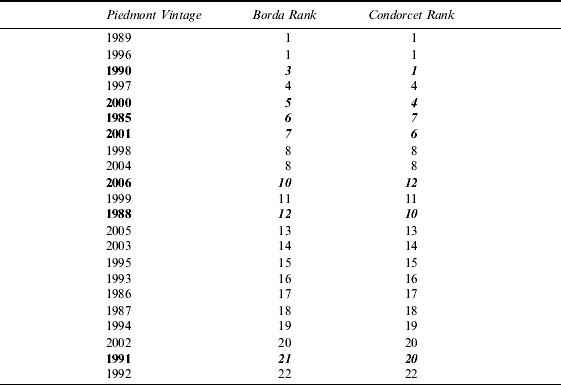
Table 1 Comparison of Borda and Condorcet: Piedmont
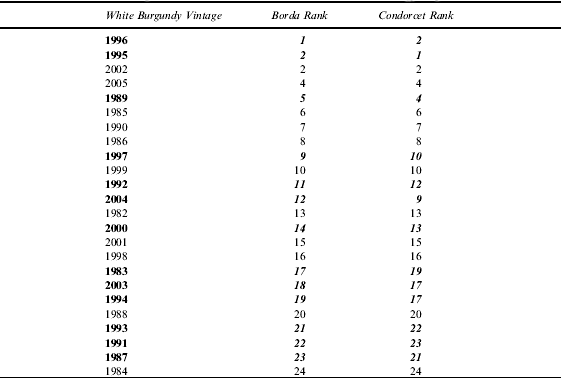
Table 2 Comparison of Borda and Condorcet: White Burgundy
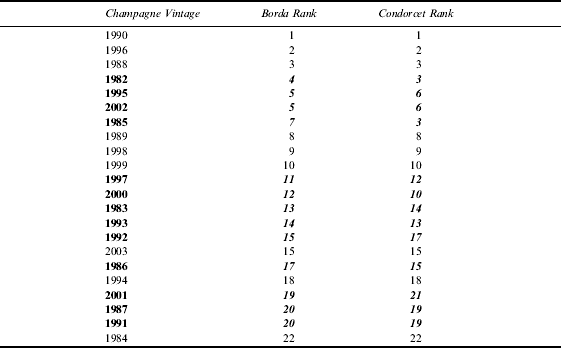
Table 3 Comparison of Borda and Condorcet: Champagne
 You have
Access
- 5
- Cited by
Issues with the Cordorcet method used in the subject paper to aggregate rankings are presented. These arise because critical information contained in each voter's ranking is ignored. The mathematically superior Borda Count, which uses the complete information provided by each voter, is used to aggregate the rankings and the results are compared.
Borges, et al. (Reference Borges, Real, Cabral and Jones2012) state that “In his work, Arrow … has shown that when voters have more than two alternatives, it is not possible to convert the individual rank preferences into a ranking that meets a set of reasonable axioms.” While this is true for the set of axioms Arrow selected, it is not true if one of the axioms is changed. Saari (Reference Saari2001a, Reference Saari2008) pointed out that two of Arrow's axioms, transitivity and independence of irrelevant alternatives (IIA), negate each other. In other words, if you insist on IIA, you cannot guarantee transitivity of the outcome. This problem goes away if instead of IIA, the method must satisfy the intensity form of independence of irrelevant alternatives (IIIA) where intensity is measured by the number of alternatives separating the two being compared. Saari (Reference Saari2000a) proved that the Borda Count (Borda, Reference Borda, McLean and Urken1781) is the only method that satisfies IIIA and Arrow's other three axioms: transitive outcome, unrestricted domain and the Pareto condition. The Borda Count works as follows: for n alternatives, points, called Borda scores, are assigned to each voter's ranking as (n − 1, n − 2,….,1,0). In the case of ties, each alternative receives the average of the Borda scores assigned to the rankings the group occupies. The aggregated ranking of alternatives, or societal outcome, is determined by the descending sums of the voters' Borda scores.
Borges, et al. (Reference Borges, Real, Cabral and Jones2012) dismiss the aggregation method used by Quandt (Reference Quandt2006) because it “does not respect the Condorcet property.” Quandt's method, which he calls “votes against,” is in fact equivalent to the Borda Count (Hulkower, Reference Hulkower2009). A key attribute of the Borda Count is that it uses all of the information provided by each voter whereas the Condorcet property ignores critical information, specifically the intensity of preference. So when looking at when A ≻ B (A is preferred to B), Condorcet treats A ≻ B ≻ C ≻ D the same as A ≻ C ≻ D ≻ B whereas Borda does not. In doing so, Condorcet discards critical information, namely the relative rankings of C and D, that Borda retains to determine the societal outcome.
Borges, et al. (Reference Borges, Real, Cabral and Jones2012) also highlight the fact that when alternatives (in this case, vintages) are removed that “the Condorcet property ensures that the relative positioning of …years is maintained.” In other words, Condorcet satisfies IIA but not IIIA. And so Condorcet is not using the fact that each voter has transitive preferences and hence cannot guarantee a transitive societal outcome! The problem is that when a collection of rankings, called a profile, contains a so-called Condorcet n-tuple, a cycle that results in a tie, violation of IIA, or rank reversal, unavoidably is a potential outcome (Saari Reference Saari2000a, 2008). The reason it does not result in rank reversal with Condorcet is because all of the information in the profile is not used. Therefore Condorcet does not yield a societal outcome that best reflects the voters' complete preferences.
Tables 1 to 3 compare the rankings based on the Borda Count to those done by Condorcet in Borges, et al. (Reference Borges, Real, Cabral and Jones2012). The differences are highlighted in bold italics.
Comparison of Borda and Condorcet: Piedmont
Condorcet ranks from Table 7 in Borges, et al. (Reference Borges, Real, Cabral and Jones2012).
Comparison of Borda and Condorcet: White Burgundy
Condorcet ranks from Table 10 in Borges, et al. (Reference Borges, Real, Cabral and Jones2012).
Comparison of Borda and Condorcet: Champagne
Condorcet ranks from Table 14 in Borges, et al. (Reference Borges, Real, Cabral and Jones2012).
For more complete discussions of the Borda Count and the problems with Condorcet and other voting methods see Saari (Reference Saari2000a, 2000b, 2001a, 2001b, 2008).