Introduction
Bilateral vocal fold paralysis is a life-threatening condition that presents a challenge to laryngologists. It requires emergency surgical intervention which must be weighed against the potential effects on both the patient's airway and vocal quality.Reference Segas, Stavroulakis, Manolopoulos, Yiotakis and Adamopoulos1, Reference Dursun and Gokcan2 The main concern of bilateral vocal fold paralysis becomes protection of the airway. Patients with bilateral vocal fold paralysis exhibit a lack of abduction during inspiration, and have variable degrees of stridor, but generally good phonation. Patients' aerodynamic function is always compromised, as severe dyspnoea, even at rest, is present; however, a few patients complain of dysphonia and of difficulty in swallowing.Reference Loughran, Alves and MacGregor3 The most common aetiological factor is surgical trauma.Reference Rosenthal, Benninger and Deeb4, Reference Feehery, Pribitkin, Heffelfinger, Lacombe, Lee and Lowry5 The possibility of post-operative dyspnoea due to bilateral vocal fold paralysis after cervical surgical procedures, especially thyroid surgery, must always be taken into account. Although the exact incidence of bilateral vocal fold paralysis is unknown, the condition is included in upper airway obstruction aetiology.Reference Loughran, Alves and MacGregor3
Many surgical techniques have been developed in an attempt to improve the glottic airway, and thereby avoid a breathy voice and glottic insufficiency. The surgical treatment of bilateral vocal fold paralysis should aim for a compromise between respiratory and phonatory performance, and should be adjusted according to the patient's needs; surgical procedures in which the glottic aperture is widened meet these criteria. Tracheotomy is the most effective surgery for bilateral vocal fold paralysis.Reference Dennis and Kashima6 However, the invasiveness of the procedure and the associated social problems, like scarring tissue and reduced voice quality, are the main problems of tracheotomy. In addition, tracheotomy is not acceptable to patients as a long-term solution.Reference Segas, Stavroulakis, Manolopoulos, Yiotakis and Adamopoulos1, Reference Gokcan, Kurtulus, Ustuner, Ozyurek, Kesici and Erdem7 Long-term surgical options include endoscopic partial or total arytenoidectomy, posterior transverse cordotomy, arytenoid abduction, suture lateralisation, and laryngeal reinnervation to eliminate the need for tracheotomy.Reference Li, Pearce, Mainthia, Athavale, Dang and Ashmead8, Reference Sapundzhiev, Lichtenberger, Eckel, Friedrich, Zenev and Toohill9 All surgical procedures for bilateral vocal fold paralysis are subjects of controversy when it comes to the balance between relieving airway obstruction and other laryngeal functions, especially phonation. Ideal techniques should provide improved respiratory function and avoid impaired phonatory function to the greatest extent possible.
Laser posterior transverse cordotomy, a surgical procedure in which the glottic aperture is widened, was first described in 1989 by Dennis and Kashima.Reference Dennis and Kashima6 The primary goals of the surgery are to prevent aspiration and to improve phonation while preserving the airway.Reference Dennis and Kashima6 Laser posterior transverse cordotomy is the most commonly performed and accepted procedure because of its minimally invasive nature.Reference Li, Pearce, Mainthia, Athavale, Dang and Ashmead8 Tracheotomy is not needed unless airway obstruction develops as the result of oedema. Compared to arytenoidectomy, laser posterior transverse cordotomy has a lower risk for aspiration, and has better long-term aerodynamic and acoustic results.Reference Sapundzhiev, Lichtenberger, Eckel, Friedrich, Zenev and Toohill9 Aside from airway oedema, the most common complication is the development of granulation tissue in the cordotomy line. It is also the most common reason for revision surgery.Reference Olthoff, Zeiss, Laskawi, Kruse and Steiner10 According to the literature, the frequency rate of revision surgery is reported to be between 19 and 66 per cent.Reference Moorthy, Balfour, Jeannon and Simo11
Many studies have been published on the significantly compromised vocal performance experienced by bilateral vocal fold paralysis patients after undergoing laser posterior transverse cordotomy. Laryngeal aerodynamic functions and respiratory function are always compromised by bilateral vocal fold paralysis. For this reason, these issues are not often studied by otolaryngologists. Moreover, little has been published on the effects of bilateral vocal fold paralysis and laser posterior transverse cordotomy on laryngeal aerodynamic functions. This prospective study aimed to evaluate the aerodynamic and acoustic effects of unilateral carbon dioxide (CO2) laser posterior transverse cordotomy in bilateral vocal fold paralysis patients.
Materials and methods
The study protocol was approved by the ethics committee of Gulhane Military Medical Academy.
Study group
Consecutive patients with dyspnoea due to bilateral vocal fold paralysis were included in the study: between April 2012 and February 2014, there were 11 patients with bilateral vocal fold paralysis, who served as the study population. All patients had undergone laser posterior transverse cordotomy.
Subjective and objective vocal assessments
The voice handicap index, the grade-roughness-breathiness-asthenia-strain scale, and the Multi-Dimensional Voice Program (model 5105, version 2.3; Kay Elemetrics, Lincoln Park, New Jersey, USA), which is a computer-based analysis system for the clinical assessment of speech and voice functions, were used, respectively, for patient-reported, perceptual, and objective voice measurements pre- and post-operatively.
Voice recordings were performed in a standard room. Fundamental frequency (f0), jitter, shimmer, noise-to-harmonic ratio and soft phonation index were calculated from a 4-second recording of the sustained vowel /a/. A Shure® dynamic cardioid microphone (model C606N) was used to make the recordings using the Multi-Dimensional Voice Program.
The voice handicap index and the subjective grade-roughness-breathiness-asthenia-strain scale were administered by a single laryngologist. The voice handicap index, a self-evaluation of vocal performance, was first designed in 1989 by Jacobson.Reference Jacobson12 It features questions addressing the patient's physical, emotional and social status related to vocal performance.Reference Jacobson12 The grade-roughness-breathiness-asthenia-strain questionnaire involves assessment of the patient by a physician and an audiologist or speech and language pathologist.Reference Havas, Lowinger and Priestley13 The evaluation includes a perceptual assessment of overall voice quality (grade), vibration irregularity (roughness), breathiness, voice weakness (asthenia) and strain. Each of these parameters is graded on a scale of 0 to 3: 0 = normal, 1 = a mild disorder, 2 = a moderate disorder and 3 = a severe disorder. The score increases in proportion to the severity of the vocal disorder.
Subjective airway and aerodynamic assessment
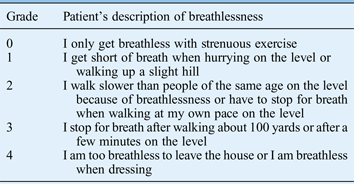
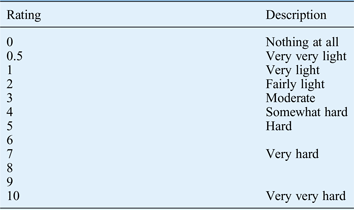
Patients were asked to grade their respiratory discomfort pre- and post-operatively using the Modified Medical Research Council dyspnoea scale (Table I) and the Modified Borg dyspnoea scale (Table II).Reference Mahler and Wells14, Reference Camargo and Pereira15 These are commonly used measures to subjectively assess patients' perceptions regarding their respiratory problems. On the scales, the minimum point indicates normal breathing and the maximal point indicates the most dyspnoeic state. In the Modified Borg dyspnoea scale, which was developed in 1970, patients are asked to grade their level of dyspnoeic discomfort on a scale of 1 to 10. This scale is accurate in assessing dyspnoea subjectively during exercise.Reference Camargo and Pereira15 Maximum phonation time was also measured during sustained phonation of the vowel /a/ at a favourable pitch and volume.
Modified medical research council dyspnoea scaleReference Camargo and Pereira15

Borg dyspnoea scaleReference Mahler and Wells14
Objective airway and aerodynamic assessment
All subjects were examined pre- and post-operatively via respiratory function tests with a spirometer (Jaeger APS Pro Spirometry device; CareFusion, San Diego, California, USA). The equipment was calibrated prior to each set. The parameters used for analysis included the ratio of forced expiratory volume in 1 second (FEV1), forced vital capacity, peak expiratory flow and peak inspiratory flow, all of which were calculated according to the sex, age, height and weight of each patient.
The aerobic capacity of all patients was also assessed via the use of a bicycle ergometer (Vmax Encore Viasys Program and ViaSprint 150P bicycle; CareFusion). The maximal aerobic capacity, which is the maximum rate of oxygen consumption as measured during incremental exercise,16 was examined during bicycle ergometry testing. Accurate measurement of maximal aerobic capacity involves a physical effort sufficient in duration and intensity to fully tax the aerobic energy system. Clinical testing usually involves a graded exercise test in which exercise intensity is progressively increased while ventilation and oxygen and CO2 concentrations of the inhaled and exhaled air are measured.16 When oxygen consumption remains at a steady state despite an increase in workload, maximal aerobic capacity is reached.16
All subjective and objective analyses were performed within the two-week period prior to surgery and during the second post-operative month.
Surgery
All surgical procedures were performed by a single senior laryngologist (HB). Under general anaesthesia, a number six cuffed endotracheal tube (Chilecom Medical Devices, Guandong, China) was introduced to the patient's trachea and advanced anteriorly to provide maximum exposure of the posterior glottis. The endotracheal tube was covered with wet cotton gauze. A CO2 laser (Ultrapulse, Lumenis, Yokneam, Israel) and a microscope (400 mm Zeiss Opmi 1; Zeiss, Jena, Germany) were used for all procedures. The CO2 laser was used in the continuous mode at 4 W with minimum spot size. First, the posterior section of the ventricular band was resected. A 2 mm triangular wedge of vocal fold, just anterior to the vocal process of the arytenoid and including the bottom of the ventricle, was then vaporised until the thyroid cartilage perichondrium was reached.
Statistical analysis
Comparisons between pre- and post-operative data were performed using the Wilcoxon signed-rank test, depending on the result of the test of normality (the Kolmogorov–Smirnov test). Differences in dependent variables between pre- and post-operative data were analysed using the Mann–Whitney U test. The changes in parameters were evaluated using SPSS 20.0 software for Windows (IBM, Chicago, Illinois, USA), and p < 0.05 was set a priori as statistically significant.
Results
Study group data
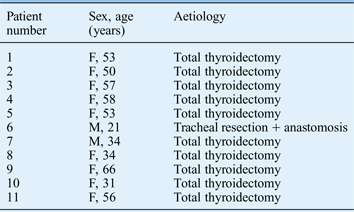
This study was conducted on a sample of 11 patients with bilateral vocal fold paralysis (9 females and 2 males, with a mean age of 46.6 ± 14.1 years) between April 2012 and February 2014. These patients, who underwent laser posterior transverse cordotomy, were evaluated objectively and subjectively via aerodynamic and voice assessment. The statistical analyses for all parameters utilised data from all 11 patients.
None of the patients required tracheotomy before or after laser posterior transverse cordotomy. The average time from the onset of symptoms to definitive treatment was 48.5 months. No major complications were noted. No revision procedures or tracheotomies were required. An overview of the subjects' aetiologies and characteristics is presented in Table III.
Patient characteristics and aetiology
F = female; M = male
Subjective airway and aerodynamic data
Table IV shows the means and standard deviations (SDs) of the pre- and post-operative measurements of the Modified Medical Research Council dyspnoea scale, the Borg dyspnoea scale and the maximum phonation time. Compared with the pre-operative data, all subjective aerodynamic parameters showed statistically significant improvements in the post-operative period.
Subjective airway and aerodynamic data
SD = standard deviation; max = maximum; MMRC = Modified Medical Research Council
Objective airway and aerodynamic data
Table V shows the means and SDs for the pre- and post-operative measurements of FEV1, forced vital capacity, peak expiratory flow and peak inspiratory flow. All spirometric parameters showed significant increases post-operatively. The difference between the pre- and post-operative maximal aerobic capacity values was also statistically significant. Maximal aerobic capacity significantly increased post-operatively (Figure 1).
Box and whisker plots of patients’ (a) pre-operative and (b) post-operative maximal aerobic capacity (VO2 max). Blue and grey portions of the boxes represent analytical numbers of maximal aerobic capacity values between 25 and 75 per cent.
Objective airway and aerodynamic data
SD = standard deviation; FEV1 = forced expiratory volume in 1 second; VO2 max = maximal aerobic capacity
Subjective vocal data
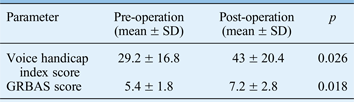
As illustrated in Table VI, the means and SDs of pre- and post-operative subjective voice measurements, which were assessed by the voice handicap index and grade-roughness-breathiness-asthenia-strain scale, demonstrated significant increases post-operatively.
Subjective vocal data
SD = standard deviation; GRBAS = grade-roughness-breathiness-asthenia-strain scale
Objective vocal data
Table VII shows the means and SDs of pre- and post-operative objective voice measurements. The changes in the objective acoustic parameters (fundamental frequency (f0), jitter, shimmer, soft phonation index and noise-to-harmonic ratio) were statistically non-significant.
Objective vocal data
SD = standard deviation
Discussion
Laser posterior transverse cordotomy, first described in 1989 by Dennis and Kashima,Reference Dennis and Kashima6 is a surgical procedure in which the glottic aperture is widened. The primary goals of posterior cordotomy are to prevent aspiration and to improve phonation while preserving the airway.Reference Dennis and Kashima6 Dennis and Kashima reported that endoscopic CO2 laser posterior transverse cordotomy is safe, easy to perform and effective in relieving airway obstruction in bilateral vocal fold paralysis patients.Reference Dennis and Kashima6 The quality of the patient's voice is generally good after laser posterior transverse cordotomy because the anterior three-quarters of the fold is preserved.Reference Olthoff, Zeiss, Laskawi, Kruse and Steiner10 Potential complications include post-operative oedema, granuloma and scarring, probably caused by post-operative debris and gastroesophageal reflux.Reference Li, Pearce, Mainthia, Athavale, Dang and Ashmead8, Reference Hans, Vaissiere, Crevier-Buchman, Laccourreye and Brasnu17
Bilateral vocal fold paralysis is a life-threatening clinical condition that arises as a result of recurrent laryngeal nerve paralysis. A major symptom is dyspnoea, which is the result of glottic airway impairment. Many patients develop bilateral vocal fold paralysis after undergoing total thyroidectomy; it has also been reported as an aetiological factor with respect to other cervical surgical procedures.Reference Dursun and Gokcan2 Ten of the 11 patients in the present study had total thyroidectomies. The surgical treatment of bilateral vocal fold paralysis is a challenge for laryngologists because there must be a compromise between respiratory and phonatory performance, and adjustments must be made according to the individual patient's needs; surgical procedures in which the glottic aperture is widened meet these criteria.
Many studies have attempted to quantify and qualify the outcomes and disadvantages of laser posterior transverse cordotomy, with a focus on the aerodynamic function of the larynx, vocal quality and swallowing function. The available results of studies on this topic are somewhat inadequate; however, most studies conclude that after cordotomy the spirometric values or mean airflow at the glottic level may improve, although the voice is occasionally worsened.Reference Dursun and Gokcan2, Reference Hans, Vaissiere, Crevier-Buchman, Laccourreye and Brasnu17, Reference Maurizi, Paludetti, Galli, Cosenza, Di Girolamo and Ottaviani18 Much of the relevant literature describes studies that have used spirometric assessment for aerodynamic and airway evaluation. Spirometry is a stable testing process, but it is not appropriate for use during daily activities and exercise. We planned and conducted this study to evaluate real-time airway conditions with bicycle ergometry before and after laser posterior transverse cordotomy. Maximal aerobic capacity, which is evaluated by bicycle ergometry, is one of the defining paradigms of the exercise and real-time lung oxygen ventilation.
Many laser posterior transverse cordotomy study results related to aerodynamic outcomes have been based on spirometric assessment for airway evaluation.Reference Dursun and Gokcan2, Reference Li, Pearce, Mainthia, Athavale, Dang and Ashmead8, Reference Olthoff, Zeiss, Laskawi, Kruse and Steiner10, Reference Hans, Vaissiere, Crevier-Buchman, Laccourreye and Brasnu17 Kashima reported that spirometry identified the level (extrathoracic or intrathoracic), nature (variable or fixed) and severity of upper airway obstruction.Reference Kashima19 Our results indicate that all parameters of spirometry and bicycle ergometry may improve after laser posterior transverse cordotomy. While we recognise that many factors affect aerodynamics in a narrowed glottic airway, our results are reasonable for laser posterior transverse cordotomy: the enlarged glottic airway restored the glottis.
In this study, we also completed real-time airway assessment with bicycle ergometry, and concluded that the need for real-time assessment is as critical as the need for spirometric assessment. Li et al. chose to use peak inspiratory flow for spirometric assessment and reported that inspiratory flow, relative to expiratory flow, is a limiting criterion in determining ventilation of the lung.Reference Li, Pearce, Mainthia, Athavale, Dang and Ashmead8 The authors also determined that intrapulmonary pressures create suction force on the glottic airway and increase the turbulent effect of the air.Reference Li, Pearce, Mainthia, Athavale, Dang and Ashmead8 We thus propose that ergometric evaluation of aerodynamic laryngeal function may be more useful and sensitive than spirometric tests in the aerodynamic assessment of the larynx and ventilation of the lung.
Subjective parameters were also improved after laser posterior transverse cordotomy, in line with the objective assessments in this study, as was expected. The mean score of the subjective Borg scale prior to surgery was 7.4 ± 0.7 and the mean score after surgery was 3.4 ± 1; there was a statistically significant improvement in the Borg scale score post-surgery (p = 0.003). Similarly, the mean Modified Medical Research Council scale score before surgery was 2.9 ± 0.7, while it was 0.9 ± 0.5 after the surgery, revealing another statistically significant improvement (p = 0.003). Patients' subjective complaints were improved after laser posterior transverse cordotomy.
Most studies have reported that voice quality may be described subjectively as good after CO2 laser procedures; however, temporary phonatory impairment is a major disadvantage of laser posterior transverse cordotomy.Reference Dennis and Kashima6, Reference Lawson, Remacle, Hamoir and Jamart20 In the current study, all objective parameters of the Multi-Dimensional Voice Program vocal assessment remained unchanged after two months; therefore, our results demonstrate an objectively better voice outcome after laser posterior transverse cordotomy. Our finding that the pre- and post-operative voice quality data were unchanged was expected, as the anterior part of the vocal fold is left intact and the voice is thus preserved.
• This prospective study evaluated the aerodynamic and acoustic effects of unilateral carbon dioxide (CO2) laser posterior transverse cordotomy in bilateral vocal fold paralysis patients
• Pre-operative and two-month post-operative assessments included dyspnoea scales, maximum phonation time measurement, spirometry and bicycle ergometry
• All subjective and objective aerodynamic parameters showed significant improvements post-operatively
• Objective voice parameter changes were non-significant, but subjective voice parameter improvements were significant
• Unilateral CO2 laser posterior transverse cordotomy is an effective procedure
• The procedure results in improved dyspnoea and aerodynamic performance, with some worsening of voice parameters
While performing an analysis of perceptual voice by patient, we observed that perceived vocal quality altered and worsened. Although the objective acoustic Multi-Dimensional Voice Program parameters (fundamental frequency (f0), jitter, shimmer, noise-to-harmonic ratio and soft phonation index) were unchanged in our series of patients, changes in the patients' quality of speech, which is assessed by the perceptual voice handicap index and grade-roughness-breathiness-asthenia-strain scale, were significantly statistically worsened. These findings were not expected, and are not in line with the objective parameters, which were unchanged. Based on our observations, we propose that the patients, who are informed about the potential worsening of vocal performance after surgery during the informed consent process, may expect their voice to worsen during the post-operative period; this is likely to influence responses on the perceptual scale. We believe that the patients' perceptions regarding speech quality may reach favourable, more acceptable levels over time. Lawson et al. reported objectively good voice quality at an average of 15.2 months after laser posterior transverse cordotomy.Reference Lawson, Remacle, Hamoir and Jamart20 Hans et al. also reported significant voice improvements within a two-year post-operative period.Reference Hans, Vaissiere, Crevier-Buchman, Laccourreye and Brasnu17
Conclusion
This prospective series of comprehensively studied patients with bilateral vocal fold paralysis indicates that unilateral CO2 laser posterior transverse cordotomy is an effective procedure that results in improved dyspnoea and aerodynamic performance, although voice parameters may worsen to some degree. The study revealed improvements both in subjective complaints of dyspnoea and objective aerodynamic parameters. The effects of laser posterior transverse cordotomy may not be significantly demonstrated in an objective acoustic assessment of the voice; however, in a subjective assessment of vocal performance, the patient's vocal quality may be seen to worsen, especially in the early post-operative period. Subjective parameters of vocal performance, which are assessed by the patients, may improve over time.
Acknowledgement
The authors wish to thank Dr Guven Oysul for his help in performing the statistical analysis.