Frances Andrews chose a presidential theme that might have been thought ever timely for ecclesiastical historians, yet only now has the Ecclesiastical History Society tackled it squarely. True, a few volumes of Studies in Church History, for instance Popular Belief and Practice, Religious Motivation and Elite and Popular Religion, gave doubt some coverage.Footnote 1 But in the present volume doubt is the focus of attention. Frances Andrews is a later medieval historian, with a special interest in southern Europe. She is one of a distinguished band: John Edwards thought doubt ‘an intrinsic part of faith’; Sandy Murray identified pia dubitatio as an element in thirteenth-century Italian piety; more recently John Arnold has found in ‘some beliefs, or rather unbeliefs, . . . evidence for doubts as much as conscious dissent’.Footnote 2 In an illuminating paper to the Royal Historical Society on medieval scepticism, Susan Reynolds pointed out that ‘Christianity, even medieval Christianity, tends to invite a modicum of personal commitment, and therefore lays itself open to conscious, if often unacknowledged, doubt’.Footnote 3 Bob Moore has come close to contemplating the thing itself in the eleventh and twelfth centuries, and John Arnold in considering unbelief addresses what he explicitly calls doubt expressed by numerous later medieval people. It is perhaps surprising, then, that neither Moore's book nor Arnold's has an index entry for doubt.
Doubt has long been considered a symptom of modernity par excellence. Historians of doubt have preferred to focus on early modern and modern periods. Medievalists used to skip from the thrills of Christian Late Antiquity to the spills of the later Middle Ages. The present volume's span is part of a step-change, already signalled by the work of Moore and Arnold. Dorothea Weltecke's excellent contribution to Arnold's recent Oxford Handbook of Medieval Christianity starts with the twelfth century. Pace the assumptions of many later medievalists and early modernists, the early Middle Ages were not doubt-free either; and in this essay, I treat them as part of a continuum of pre-modern Christianity.Footnote 4 Taking ‘Carolingian’ as a chronological marker covering roughly the mid-eighth to the later ninth centuries, I look at some early medieval Christians who seem to be grappling with varieties of doubt: tormented by the problem of theodicy, anxiously pondering biblical paradoxes, uncertain of the fate of the individual soul and body after death, passionately engaged in big doctrinal debates over Christology and predestination, and questioning the authenticity and meaning of relics. Material is much scantier and more refractory than for earlier and later times. Pauperes, less powerful and illiterate people, are seldom documented directly. Nevertheless, in the belief that there is enough evidence even in this source-poor period, this essay aims to expose and de-pathologize Carolingian religious doubt and, positively, to take seriously doubters among high and low.
Tribulation and Doubt
Opening up doubt historically means choosing instances to examine in particular contexts of time and place. Frances Andrews has asked when doubt might be a necessary corollary to achieving certainty.Footnote 5 Christians have often doubted when afflicted by unforeseen sufferings or misfortunes, for which a generic term in the Carolingian period was tribulationes. The term was biblical. It was in the Psalms, especially, that an individual believer could be found begging for divine help in times of tribulation. In the early 840s, particularly fraught years of civil war, a Frankish noblewoman called Dhuoda wrote a handbook offering moral guidance to her son William.Footnote 6 She gives the reader some precise dates – something seldom encountered in an earlier medieval author – which could be said to peg the personal to the public. William, she said, was born on 29 November 826, and she began writing the handbook on 30 November 841, ‘on the Feast of St Andrew and at the beginning of Advent’. William, already at the Carolingian court of King Charles the Bald serving in the royal retinue of comilitones, had come of age at fifteen the day before, five months after an exceptionally bloody battle between Franks on 22 June 841.Footnote 7 She finished writing ‘on the feast of the Purification of the Holy and Ever-Virgin Mary’, 2 February 843, when preparations were already being made for the Treaty of Verdun which in July 843 divided the Carolingian empire effectively for good.Footnote 8
Dhuoda never mentioned doubt directly, but she offered indirect reflections on it. They cluster in Book 5,Footnote 9 which consists of eight chapters about tribulationes, tristitiae and angustiae temptationum, ‘tribulations’, ‘sadnesses’ and the ‘problems of temptations’, followed by a ninth on ‘giving glory to God in all things’. The third longest chapter in the book's 72 chapters (5.1) is a series of indirect reflections on doubt. Here Dhuoda sees the tribulations of this life as trials, temperamenta, that test faith, and from which faith emerges strengthened.Footnote 10 She treats tribulationes and tristitiae as more or less synonymous, but distinguishes lower and higher forms of tristitiae, one carnal and this-worldly, leading to death, the other, spiritual and nobler, drawing to eternal life. No time or place could ever be called free of tribulations, of course, but in the Carolingian period, tribulations appeared more often than before under that name, partly because rulers and their advisers took cognizance of famines and extreme climatic events in terms of divine punishment, partly because, at the same time, rulers and their agents were making strenuous efforts to cope with their effects by creating their own version of a welfare state.Footnote 11 In Book 5, Dhuoda approached tribulations through the Bible. In chapter 1, following St Paul (2 Cor. 7: 10), Tristitia saeculi mortem operatur, ‘The sadness of this world wreaks death’, Dhuoda distinguishes carnal tristitia from ‘the more noble spiritual kind that promotes the soul's utility’. She comments that ‘though that sadness assails the human heart for all kinds of reasons, the wisest men say that thinking critically [about it] is preferable to forgetting about it’.Footnote 12 She then cites Job 14: 1, ‘man that is born of woman . . .’, and 7: 5–6: ‘My skin is parched and withered . . . My days have passed more quickly than the weaver cuts his cloth’. Dhuoda comments with a characteristic expansion of the simile and a personalized touch: ‘The felicity of the human condition is fragile to such a great extent, and so brief is its duration, according to the wise, that even for someone who lived for a thousand years, his last day would be counted as having been as lasting as a spider's web’.Footnote 13 Later in the chapter, after a string of citations from Job and Ecclesiastes, Dhuoda cites Psalm 1: 3: ‘For those that can see [Christ, the true vine], and have sure faith in him, can be compared to the lovely tree planted by the banks of the running waters’.Footnote 14 Dhuoda, after thus indirectly reflecting on the possibility that spiritual sadness can engender doubt about the power of God, sees fiducia certa as the antidote to the withering that results from carnal tristitia.
In chapter 4, titled ‘Si tribulatio fuerit’, Dhuoda cites a little string of Psalm passages: ‘I cried to the Lord when I was afflicted' (Ad Dominum cum tribularer clamavi, Ps. 119: 1); ‘In my affliction you have called to me, “I have delivered you and heard you”’ (In tribulatione invocasti me, liberavi et exaudivi te, Ps. 80: 8); then, with a special comment for her son's benefit: ‘You, my son, when you come into tribulation, cry out so that you are worthy to be heard. And having been heard, you will be able to praise [him] in faith (fiducialiter) and to say: “I called upon the Lord in my tribulation and he heard me in a large way”’.Footnote 15 The Christian's trajectory, for Dhuoda, is through trials and tribulations and unarticulated doubt to God through faith.
A final point about Dhuoda's understanding of doubt as a result of suffering is that she does not mention penance as a remedy, nor indeed is she acquainted with the penitential psalms as such (though Cassiodorus's list had existed since the sixth century). She seldom mentions priests; and on the subject of confession she says only: ‘make your confession to them [sacerdotes] secretly, as far as you can, with a sigh and with tears’.Footnote 16 To her son, she commends prayer, not just in church but wherever an opportunity is offered him, and still more strongly does she commend direct appeal to God through the self-help of daily private prayer. This strikes me as a distinctively lay form of piety. William must pray in these words: ‘O Merciful One, . . . give me memory and sensitivity, so that I can understand how to believe in you, love, fear, praise and thank you, and accomplish [this] in every good work through right faith and good will, O Lord my God'. She strongly recommends to William that the best way to protect himself against the Devil is prayer at bedtime, and specifically to ‘make the sign of the cross on your forehead and over your bed . . . like this +, and say: “I worship your cross, Lord, and I believe in your holy resurrection . . . The cross is my salvation, the cross my defence, . . . The cross is life to me, but to you, Devil, death, you enemy of truth and bringer-forth of what is vain!”’Footnote 17 This is a layperson's do-it-yourself exorcism.
Doubts about Doctrine: Gottschalk on Predestination
It is often assumed, wrongly, that there was little if any doctrinal doubt in this period. In the case of predestination, for instance, intellectual historians tend to skip from Augustine to Calvin. But predestination was a burning question in the Carolingian period also. I want to focus in this section on Gottschalk (c.805–c.870). He was a child-oblate who grew to be an unwilling monk (that unwillingness tells us a lot about the man). He was a passionate student of Augustine, from the Confessions to The City of God. In the course of a lengthy visit/journey south of the Alps, where he was sheltered at the courts of Marquis Eberhard of Friuli and then of King Tripimer of Croatia, for whom he apparently fought, Gottschalk became convinced that predestination was double: the elect were predestined to heaven, the damned to hell.Footnote 18 The teachings of this sciolus (a dilettante, one with a smattering of knowledge) were summarized by Archbishop Hrabanus of Mainz, writing to Marquis Eberhard of Friuli:
[Gottschalk] dogmatized that God's predestination constrained every human being, so that if anyone wanted to be saved and strove for this with a righteous faith and good works so that he would come to eternal life through God's grace, that person would be toiling in vain and pointlessly if he was not predestined to life, as if God by his predestination – he who is the author of our salvation, not our perdition – compelled a person to die. And through this he, and that sect (haec secta) that was with him, led many into despair, so that they said, ‘Why should I have to toil for my salvation and eternal life, because if I do good and I am not predestined to life, nothing can help me, but if I do evil, that is no obstacle to me for God's predestination will make me reach life eternal'.Footnote 19
Three of Gottschalk's crucial insights were Augustinian. One was his citing of Augustine on love:
A body by its weight tends to move upward to its proper place. Oil poured under water is drawn to the surface on top of water . . . My weight is my love. Wherever I am carried my love carries me. By your gift we are set on fire and carried upwards: we grow red-hot and ascend.Footnote 20
The second insight was that things were not as they seemed. Gottschalk gave an example of his own: ‘just as a bough in a stream looks broken, and your fingers look shorter seen in water – something people who have not experienced can try out in the bath (quod inexpertes experiri possunt in balneo) – so verisimilitude deceives those who do not look with care’.Footnote 21 As David Ganz put it, grace was ‘the fragile link between the elect and the salvation of which they could never be sure. Gottschalk's writings record his doubt.’Footnote 22 Gottschalk's third insight was that doubt was inevitable: he cited and labelled Augustine's laudabilis dubitatio over ‘why the innocent new-born needs the grace of baptism’.Footnote 23 Gottschalk's was the doubt of the justified sinner.
Archbishop Hincmar of Reims wrote a treatise ‘to those who have withdrawn from the world (monks, nuns, hermits) and to his beloved children, the simple believers of his see’, warning them against Gottschalk and assuring them that ‘there is but one predestination to redemption through Christ's sacrifice and through the grace of God almighty’.Footnote 24 It was an episcopal view, a professional's view. It prevailed. The king of the West Franks, who already had imperial pretensions, assumed what he viewed as his God-given role as summoner of theologians’ opinions and arbiter of them. Ten more or less lengthy written submissions were the result. Though some came near to predestinarian readings of relevant works of Augustine, none fully endorsed Gottschalk. Indeed, in 849 Gottschalk was locked up in a monastic prison at Hautvilliers near Rheims, where he died in 868.Footnote 25
Archbishop Elipand of Toledo on Adoptionism
A second high-level doctrinal dispute with cross-border dimensions related to Adoptionism.Footnote 26 On this subject, conflicting positions had hardened and left little room for doubt on the part of any participant on either side. Even when Pope Hadrian I mentioned Thomas's ‘exploration’ of Christ's wounds, it was because he wished to affirm the argument that no evangelist or apostle ever called Christ a ‘servant’ or ‘slave’ but only ‘Lord' or ‘God'.Footnote 27 Archbishop Elipand of Toledo (c.716–805) knew how to fight ad hominem in a way calculated to raise doubts; he addressed his chief opponent, the Anglo-Saxon Alcuin, Charlemagne's theological adviser, thus: ‘Beware of becoming another Arius, who turned the Christian emperor Constantine into a heretic, so that Isidore said of him, Alas, the beginning was good, the end was bad'. The warning was repeated at the end of his diatribe.Footnote 28 Elipand's case was thoroughly orthodox; but doubts arose because Alcuin did not understand (any more than Pope Hadrian did) the concept of Christ's self-emptying, as in Philippians 2: 6–7: ‘Who being in the form of God, thought it not robbery to be equal with God: But emptied himself, taking the form of a servant, being made in the likeness of men, and in habit found as a man.’Footnote 29 This, as John Cavadini pointed out, was ‘the fundamental parameter of [Adoptionist] reflection’.Footnote 30 From this came a creed: ‘that He [Christ] was made of a woman, under the law, Son of God not by generation but by adoption, and not by nature but by grace, as the same Lord testifies, saying, “The Father is greater than I” [Joh. 14: 28]’.Footnote 31
Two contextual features created further and particular possibilities of doubt. One was that if you lived in late eighth-century Toledo, you coexisted perforce with Islam, and various types of accommodation ensued. It has been argued that some Spanish Adoptionists chose to ‘sound Nestorian’ in order to make concessions to Muslims. Cavadini convincingly rebuts this. But debates between different peoples of the book happened in this period, with the effect that doubts sometimes turned into apostasy, as in the case of the Frankish Christian Bodo, who converted to Judaism in Spain.Footnote 32 The other contextual feature was the suggestion by Alcuin and others that heresy had become rife in south-western parts of the Carolingian empire, that is, Septimania (southern Gaul) and Catalonia. Was Adoptionism changing from an elite to a popular heresy, and did that raise political concerns at the court of Charlemagne?Footnote 33 On that toxic combination scholarly debates are still rumbling audibly enough to indicate that religious doubts and high-powered doctrinal discussions were live in this part of Charlemagne's world.
Doubts about Conversion
I want now to discuss in more detail three kinds of doubt, along with some aptly dubious documentation. The first is doubt about conversion. My text is the Life of an eighth-century missionary saint, Wulfram, who spent years trying and failing to convert the Frisian chief Radbod (d. 718). The author of the Life gave himself a false identity, and claimed to have been writing early in the eighth century, but he was actually a monk from the royally patronized monastery of St-Wandrille, near Rouen, writing between 796 and 807.Footnote 34 Fortunately Radbod is documented in a number of strictly contemporary works of history and hagiography.Footnote 35 The details of the encounters between Radbod and Wulfram are unique to the Life, but the Frisian setting and Wulfram's interest in Frisia are corroborated by the contemporary evidence. The Life is not what it seems, then. Yet it does throw light on doubt by giving a plausible account of why the Frisian chief in the early eighth century, despite the fact that some of his own people converted, had doubts about doing so himself. The cult of the ancestors was a central feature of Frisian religion. If the Franks wanted to ease the transition to Christianity they had to allay Frisian doubts about the posthumous fate of the ancestors.Footnote 36
The key passage is as follows:
The above-mentioned princeps Radbod, when he was being imbued (imbueretur, ‘dampened' or ‘being instructed') to receive baptism, and was being earnestly questioned by the holy Bishop Vulfram, binding himself with oaths by the name of God [asked]: ‘could the bishop promise where would be the greater number of kings and princes and nobles of the people of the Frisians, whether in that heavenly region which he would reach if he were to be baptized, or in that hellish damnation which he, the bishop, was speaking about?’
Then the blessed Wulfram [replied]: ‘Make no mistake about it, O famous princeps, with God the number of the elect is certain. As for your predecessors it is certain that the principes of the people of the Frisians who died without the sacrament of baptism have received the judgement of damnation.’
The chief (dux), hearing this, no longer wished to believe (incredulus [erat]) – he had already reached the font – and, so it is reported, he withdrew his foot from the font, saying that he could not be without the companionship of his predecessors the principes of the Frisians, and instead reside in that heavenly kingdom with only a small number of poor people. No! he would not find it easy to give his assent to new instructions – rather than that, he would stay among those whom he had for a long time served with the whole people of the Frisians . . .
At this point, some Frisians converted, but Radbod still refused. Wulfram asked another bishop to help him but they were unable to persuade Radbod. ‘But because he was saying that he was doubting the Catholic Faith and tempting the bishops through all sorts of [lies?] (quia dubitando in fide catholica et temptando per omnia sanctos antistes loquebatur), he was found unworthy to gain what he had sought under false pretences.’Footnote 37
The author of the Vita Wulframni was writing in the final phase of the Franks’ conquest of pagan Saxony. There, difficulties similar to those with the Frisians were encountered on a much larger scale with the expansion of Frankish power and Frankish Christianity into Saxony. Saxons cremated their dead, and buried the ashes in burial mounds;Footnote 38 these mortuary rites were a stumbling block, and this suggests Radbod's doubts could have become topical again in the context of missions to late eighth-century Saxony. Was Charlemagne's law commanding that Saxons should be buried in Christian cemeteries a ‘generous gesture’, or only the appearance of one?Footnote 39 Was it, indeed, aimed at suppressing Saxon identity? If so, it was not a success. But I think what the Franks aimed at was co-existence and Saxon participation in the Frankish realm, on condition that they became Christians. Some aristocrats did so, rapidly; others more slowly. The upshot was never in doubt: it was a form of subsidiarity. Charlemagne's uncle married a Saxon, presumably a converted one; one of Charlemagne's concubines was a Saxon, likewise a convert. These women did not lose their Saxon identities, for their descendants recorded them. The pagan Saxon leader Widukind converted in 785, and no further hostility to the Franks is recorded for him: in the mid-ninth century his descendants were devoutly cultivating his memory and importing relics from Rome to reinforce the family's standing: there is no doubt about any of that.Footnote 40
Radbod's was literally a marginal case, the doubter on the margin of Christendom and pagandom. This is part of a pattern in which doubts arise on frontiers. Here at the very time scholars in Charlemagne's circle were engaging in hagiographical battles, pitting one missionary saint (and his local Church) against another in Frisia and Saxony, in the frontier zone between Francia and Spain, nearly all of which had been for eighty years under Muslim rule, Adoptionism rumbled on; and there is intermittent but telling evidence of interfaith dialogue, even if it was often a dialogue of the deaf.Footnote 41
The Relics of Saint Helena
The second case study concerns doubt about relics. My text is the Translatio Sanctae Helenae, written between 845/6 and 853 by Almannus, a monk of Hautvilliers in the province of Reims.Footnote 42 The removal of the relics from Rome to Francia is said to have occurred in 840/842, the procedures of authentication in 846. The story will remind a medievalist of Einhard's account of how relics of two saints were brought back for him and Abbot Hilduin of St-Denys from Rome in 828.Footnote 43 ‘At night’ is a key phrase in Almannus's as in Einhard's account: that is, these were furta sacra – holy thefts – and there were some shady characters in Rome who engaged in this lucrative trade. Almannus's story rings true because doubts were rife. By the eighth and ninth centuries, the little silk-wrapped bundles of bone or hair or cloth were often authenticated by tiny labels: ‘from the cloth with which he wiped the feet of the disciples’; ‘from the finger of St Denis’; ‘from the beard of St Boniface’ – to mention just three of those recently discovered in a reliquary at the convent of Chelles whose contents were collected by Charlemagne's sister abbess Gisela and labelled in a hand of c.800 – although more often the label read simply reliquias sancti . . . .Footnote 44 In the minds of the patrons who commissioned furta sacra, and the communities who received God-given gifts of egregious robbery (egregiae dona rapinae), belief and doubt coexisted. Cognitive dissonance is not necessarily experienced nowadays as discomfort and apparently was not in the Carolingian context either. What Almannus records is a series of more complicated responses than those in Einhard's equivalent account:
Theutgisus, a priest of the province of Reims, was ill for five years. Trusting St Helena would help him, and telling no-one but God of his vow he went to Rome. . . . God gave him the gifts of an exceptional theft (egregia rapina): he managed to remove [parts of] Helena's body at dead of night, and take them back to his homeland (patria). As he approached its border, the utility of doubt was born in the breasts of many people: how could it be that a woman of such great holiness in God that she was even worthy to find the wood of the Holy Cross and of such highness and nobility in this life that she became the mother of the empire and mistress of the world, could be in the hands of such a humble priest? And so as many people were continuing in this sort of struggle of doubt and dispute, because of the great need for the people not to be deluded by the dark cloud of error, a meeting was held at the church of Reims, and the histories were searched through and a map of the city of Rome was brought out and they discussed with each other, and asked and sought and took counsel and were led by the help of truth to a general certitude. They took the relics to Hautvilliers . . . but there envy was easily brought into being because so great a relic ought to be in a very excellent city rather than in a little monastery, so they said . . . and there was an unfaithful contention.
The monks fasted, performed litanies and masses, then sought a judicial inquiry to reveal the truth. But lest this inquiry be insufficient to win the certitude of the people, two priests and a monk were sent to Rome so that this word should stand firm in the mouths of two or three witnesses. They returned from Rome and brought back with them to Hautvilliers not only the [result of] the enquiry into the truth (veritatis indaginem) but also a double joy for they also brought the body of St Polycarp, relics of St Sebastian and Saints Urban and Quirinus . . . After all this some people still had doubts (quibusdam dubitantibus). Christ deigned to show them that a three-day fast and a judgement by water would be the judgement that gave proof (iudicium probabile). This is how it happened. King Charles who had heard about what had been brought to Hautvillers refused to believe it (nullo modo credere volebat). So he summoned Archbishop Hincmar of Reims along with many abbots to Hautvilliers, and wanted a public judgement to be held . . . And they judged that this would not be thought believable (non aliter credendum) unless the same monk who had brought her [Helena] back to us, as a testimony of the truth, were to go naked into the hot water and immerse his whole body, which he did. And in the eyes of all present, God kept him unharmed amidst the heaving waters (inter fervidas aquas). Once this testimony had been seen, the faith of the king and his leading men was strongly towards believing (fides . . . ad credulitatem invaluit) and the king thereafter revered this place with the greatest devotion . . .Footnote 45
Almannus not only acknowledged varieties of doubt, but saw how doubt could be thought useful: utilitas dubietatis innascitur pectoribus plurimorum. At one level, cognitive dissonance on the part of the populus is explicit, unabashed. The certitude of the people was something the monastery needed to gain, which was why further attempts were made to verify the authenticity of the original acquisition by sending men to Rome. They returned with yet more relics, presumably signifying clear support from papal officials. It was at this point that Christ put the idea of a judgement of God, that is, an ordeal, into the mind of the king, and the king mobilized the archbishop of Reims, who helpfully suggested that the ordeal be undertaken by the very man who had first brought the relics from Rome. On the part of the king and his entourage, ‘faith strengthened into belief’ (fides . . . ad credulitatem invaluit, invaluit being an intensive form of the verb valere). This was an ordeal that worked, uniting great church and monastery, king and populus in recognition of a iudicium probabile, meaning proven, commanding assent. There was no room left for doubt.
Doubting Thomas
The doubter everyone knows is Thomas, whose response to Christ's resurrection is uniquely recorded in the Gospel of John (20: 24–9):
Thomas autem unus ex duodecim, qui dicitur Didymus, non erat cum eis quando venit Jesus. Dixerunt ergo ei alii discipuli: Vidimus Dominum. Ille autem dixit eis: Nisi videro in manibus ejus fixuram clavorum et mittam digitum meum in locum clavorum, et mittam manus meam in latus ejus, non credam.
Et post dies octo, iterum erant discipuli ejus intus, et Thomas cum eis. Venit Jesus, januis clausis, et stetit in medio et dixit: Pax vobix. Deinde dicit Thomae: Infer digitum tuum huc, et vide manus meas, et affer manum tuam, et mitte in latus meum; et noli esse incredulus, sed fidelis. Respondit Thomas, et dixit ei: Dominus meus et Deus meus. Dixit ei Jesus: Quia vidisti me, Thoma, credidisti; beati qui non viderunt et crediderunt’.
The word ‘doubt’ does not appear in this passage. Thomas told the other disciples there was no believing without seeing. The risen Christ himself then told Thomas: ‘because you have seen you have believed', but ‘blessed are those have not seen and [yet] believed'. ‘Do not be incredulus – unbelieving – but be fidelis – one that has faith / is faithful'. John's Gospel was often thought difficult in the earlier Middle Ages. That was the view shared by Charlemagne's sister Gisela, the abbess of Chelles, and her niece Rotrud, who, when not residing at court, was a nun at Chelles. In the spring of 800, Gisela wrote to Alcuin for help:
We have come late to this study, and you are far away. . . . Please send us a commentary on St John, and give us also the interpretations of the Fathers. We have got Augustine's sermon on St John [i.e. John's Gospel] but it is in many places too obscure and in too elaborate language for the small intelligence of our littleness to penetrate. All we want is a small stream of pure water to drink, we do not want to launch our prows on deep waters with whirlpools. It is not for us to climb to the top of tall cedars, we just want, because we are not tall, like Zacchaeus to position ourselves in a sycamore, to watch Christ go by . . .Footnote 46
Alcuin eventually produced a partial commentary, making plentiful use of Augustine and specifically in the section related to the Thomas passage, Gregory the Great's Gospel Homily 26.Footnote 47
The Lord returned again and offered his side to the disbelieving disciple to feel about in it, and when he showed the open incision of his wounds, he healed Thomas's wound. . . . Did it happen by chance, do you think, that that chosen disciple was absent, and then came and heard, and hearing doubted, doubting felt about, and feeling about believed? No! this happened not by chance but by divine dispensation . . . so that the doubting disciple when he felt about in the wounds in the flesh of his master healed the wounds of unbelief in us all. Thomas's unbelief did us more good for our belief than the belief of the believing disciples did for them: for since [Thomas] was led back to faith by feeling about, so our mind was made firm in belief once all doubt had been put aside. Thus [Christ] after his resurrection allowed his disciple to doubt, but he did not abandon him in doubt. For thus that disciple in doubting and feeling about was made a witness of the true resurrection.Footnote 48
Via Alcuin's and especially Gregory's exegesis, this interpretation became widely influential throughout the Middle Ages.Footnote 49 In Gregory's lexicon, doubt was a wound, and doubts were wounds. Yet through doubt, and metaphorically feeling about, the wounds of unbelief were healed and faith made firm. Acquiring belief was a sensory as well as an intellectual process: though hearing, he doubted, through doubting he felt about, and through feeling about he believed.
It is apropos to add a near-final word on the expanded dimensions of faith – fides – as a corollary of concern about Carolingian doubt. Fides, in addition to the heavy load of overlapping, connecting meanings it already carried, gained (or regained) an additional political one. Adult males all had to swear to the king an oath of fidelity on holy relics. They were addressed collectively by Charlemagne as the fideles Dei et regis. As well as Christian belief, fides was loyalty, trust, trustworthiness, credence, good faith. The centrality of the oath was underlined by old tales where men had been duped into swearing loyalty on empty relic-boxes: infamous betrayals on the part of the powerful which raised doubt in the hearts of fideles. In a recently published sermon, one of eight written early in the ninth century in northern Francia for a local priest or priests to convey to a lay audience in the lingua romana (Latin shifting into a vernacular Romance language), the preacher identifies twelve sins.
Sin number 11. A person (homo) who perjures himself and breaks his faith (fides) is like a body without a soul. A person without faith is like a blown-up bag. What great works it is (sic) for a person to have good faith! for this is what the faith of men (fides virorum) is made for, just as the chastity of women adorns them and keeps them safe, and leads them to glory.Footnote 50
The fidelis was exactly that: a man of good faith, who could be trusted to swear a truthful oath not just to the king but as a witness in all contexts connected with the law. The bits of evidence are linked by a recurrent connection. Doubt starts as personal, as in Dhuoda's struggle to makes sense of suffering, or, differently, in Radbod's determination not to lose contact with the ancestors. Like faith, its obverse, doubt or unbelief, can become public and collective, as (at several levels) in the case of St Helena's relics, and finally when doubt is resolved, and dissolved, by a judgement of God, discerned by all those present, from king and archbishop to fideles in general. The Carolingian preacher presents good faith as constituting a man's social identity just as chastity constitutes a woman's. These are categorical words of reassurance keeping doubt at bay. But the preacher ends his sermon with an awful warning: ‘Woe to an unbelieving people (Vae populi increduli), because you have not believed, on that Day [of Judgement] which is to come.’Footnote 51 The religious dimension stretched into the eschatological, not in the way imagined by Gottschalk, but in Hrabanus's conception of universally available grace. That dimension also connected the original Israel with the new Israel, Charlemagne's fideles Dei et regis: the old law with the new law of the gospel.
Alcuin (with some help from Augustine and Gregory) helped Gisela and Rotrud to understand the incarnation. Thomas signified everyman, Christ's beneficiary, just as Moses received God's law for the people of Israel. A poem by the theologian Johannes Scotus Eriugena, whose commentary on the Gospel of John alas survives only in fragments, describes ‘the peak of Mount Sinai shrouded in mist: then God taught Moses the ancient law’ (lines 6–7), and near the poem's close (lines 71–2) alludes to a new law: ‘You Christ, redeemer, cleanse the wounds of believers with the fount from your side’ (‘tu Christe, redemptor, | fonte tui lateris credentum vulnera tergis’).Footnote 52
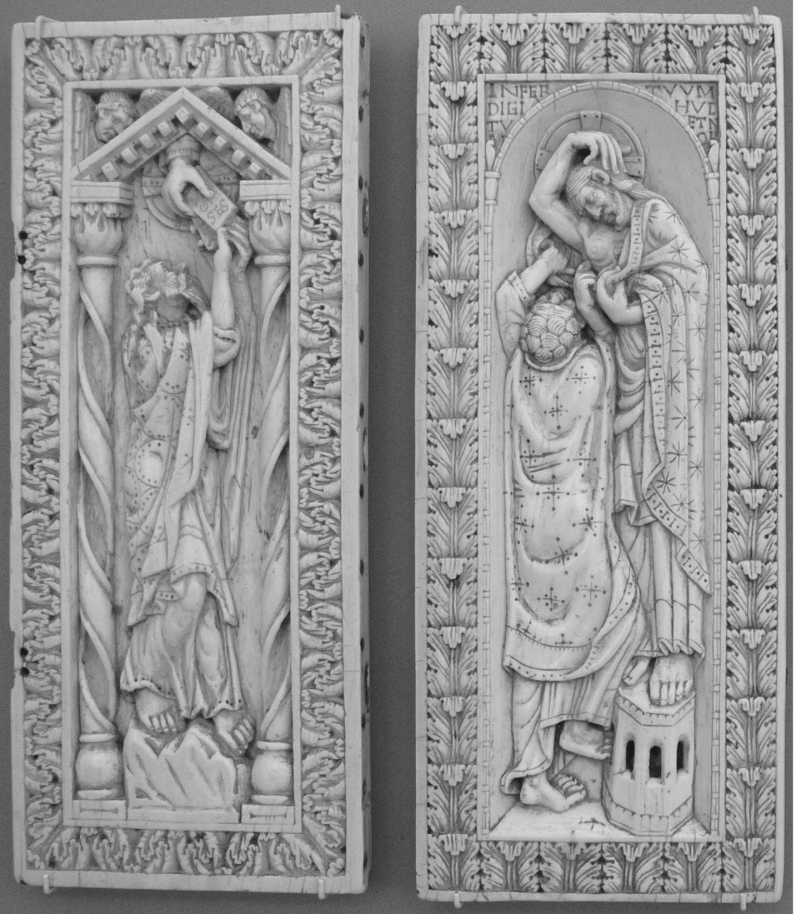
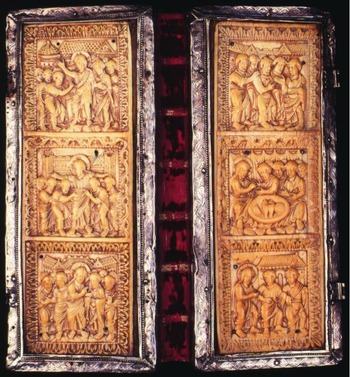
I end with two images. The first is an ivory panel made at Charlemagne's court workshop early in the ninth century, showing the risen Christ who appears to the disciples, and shows his wound to Thomas, as in John 20: 26–9 (Fig. 1). The second is an ivory diptych made nearly two hundred years after Charlemagne's death, but inspired by a thoroughly Carolingian concept, double and connective, of old law, handed down vertically by God's hand to Moses from heaven, and new law made accessible laterally by Christ to Thomas who simply has to stretch a little to reach and feel about in the wound that heals and cleanses and brings salvation through Christ made flesh and blood (Fig. 2). For people in the Carolingian world – and I end where I began, but I hope having made clearer why – ‘doubt was an intrinsic part of faith’.
Ivory panel, Aachen, early ninth century, Domschatzkammer, Inv.-Nr. G 8, reproduced in Frank Pohle and Peter van den Brink, eds, Karl Charlemagne der Grosse, Kurzführer (Dresden, 2014), 106, panel top left. I am very grateful indeed to Frank Pohle for help in enabling me to use this image, and to Gertraut Sofia Mockel on behalf of the Director of the Domschatzkammer, Dr Georg Minkenberg, for kindly supplying me with a CD scan and granting permission to reproduce it.

Ivory Diptych, probably Trier, late tenth century, Bode Museum, Berlin, on Wikimedia Commons, online at: <http://commons.wikimedia.org/wiki/File:Trier_10_Jh_Diptychon_Moses_Thomas.jpg>, last accessed 29 May 2015.