Introduction
Workplace incivility is increasingly becoming a pervasive aspect of the work–life domain (Pearson, Andersson, & Porath, Reference Pearson, Andersson and Porath2000; Lim, Cortina, & Magley, Reference Lim, Cortina and Magley2008). For example, in a study by Cortina and Magley (Reference Cortina and Magley2009), 75% of the 1,711 respondents from a sample of university employees reported experiencing workplace incivility within a year. More recently, Porath and Pearson (Reference Porath and Pearson2013) reported that about 98% of workers experience incivility and that about 50% of these workers experience such behaviors on at least a weekly basis. With the increase in the incidence of incivility in the workplace has also come a growing field of research that has sought to better understand its nature and effects. In general, research findings indicate that workplace incivility is a significant problem for individuals and their organizations, and results in outcomes such as negative workplace attitudes and behaviors and decrements in employees’ psychological wellbeing (for reviews, see Schilpzand, De Pater, & Erez, Reference Schilpzand, De Pater and Erez2016; Cortina, Kabat-Farr, Magley, & Nelson, Reference Cortina, Kabat-Farr, Magley and Nelson2017).
Thus far, research on workplace incivility has helped advance our understanding of this workplace trend. Yet, research gaps remain. For instance, the question of what role, if any, the individual may play in inviting incivility from others, remains largely overlooked in the literature (Schilpzand, De Pater, & Erez, Reference Schilpzand, De Pater and Erez2016). Additionally, despite research that indicates that workplace incivility may be enacted by a variety of people in the workplace (e.g., coworkers, supervisors, and customers; e.g., Cortina, Magley, Williams, & Langhout, Reference Cortina, Magley, Williams and Langhout2001; Cortina & Magley, Reference Cortina and Magley2009; Sliter, Sliter, & Jex, Reference Sliter, Sliter and Jex2012; Arnold & Walsh, Reference Arnold and Walsh2015), much of the research does not differentiate between its sources to better isolate each source’s particular nature, effects, and antecedents (Schilpzand, De Pater, & Erez, Reference Schilpzand, De Pater and Erez2016).
The goal of this study is to advance scholarship on workplace incivility through an investigation in which I explore the role the employees may play in precipitating a particular form of incivility – supervisor incivility – against themselves. Research has linked supervisor incivility to a variety of deleterious outcomes such as increased negative affect and lower mental, emotional, and social energy (Giumetti, Hatfield, Scisco, Schroeder, Muth, & Kowalski, Reference Giumetti, Hatfield, Scisco, Schroeder, Muth and Kowalski2013), reduced psychological well-being (e.g., Giumetti, McKibben, Hatfield, Schroeder, & Kowalski, Reference Giumetti, McKibben, Hatfield, Schroeder and Kowalski2012), reduced job commitment and employee satisfaction (Reio, Reference Reio2011), reduced engagement and poorer task performance (Reio & Sanders-Reio, Reference Reio and Sanders-Reio2011; Giumetti et al., Reference Giumetti, Hatfield, Scisco, Schroeder, Muth and Kowalski2013), absenteeism (Giumetti et al., Reference Giumetti, McKibben, Hatfield, Schroeder and Kowalski2012), turnover intentions (e.g., Giumetti et al., Reference Giumetti, McKibben, Hatfield, Schroeder and Kowalski2012; Ghosh, Reio, & Bang, Reference Ghosh, Reio and Bang2013), and supervisor and organizational retaliation (Kim & Shapiro, Reference Kim and Shapiro2008; Meier & Gross, Reference Meier and Gross2015).
Although we now know more about the consequences of supervisor incivility, the same cannot be said about our knowledge of its antecedents. While we do have some insights on possible antecedents of supervisor incivility (for a review, see Schilpzand, De Pater, & Erez, Reference Schilpzand, De Pater and Erez2016), this knowledge is based on studies that explored incivility from coworker and supervisor together. Consequently, it remains unclear what factors may predict supervisor incivility specifically. In the present study, I draw from the victim precipitation theory (Amir, Reference Amir1967; Curtis, Reference Curtis1974) to examine whether employees may inadvertently make themselves vulnerable to experience supervisor incivility at work when they engage in presenteeism.
Presenteeism refers to the act of going to work despite being ill (Aronsson, Gustafsson, & Dallner, Reference Aronsson, Gustafsson and Dallner2000). Research indicates that presenteeism can be a serious problem for employees and their organizations that can result in a variety of negative outcomes (e.g., Johns, Reference Johns2010, Reference Johns2011; Pohling, Buruck, Jungbauer, & Leiter, Reference Pohling, Buruck, Jungbauer and Leiter2016). As yet, presenteeism has not been linked to experienced incivility. Nevertheless, I conceive of such a relationship in this study by proposing presenteeism as an antecedent of supervisor incivility. Specifically, I posit that employees who experience productivity loss due to presenteeism may inadvertently make themselves targets of their supervisor’s uncivil behaviors. I conceptualize productivity loss to be a consequence of psychological resource depletion experienced by presentees as they try to meet job demands while working even though sick. Furthermore, I conceptualize supervisor incivility as a form of supervisory response toward the employee for failing to meet expected performance standards. The supervisor may view the employee as deserving of mistreatment (e.g., incivility) if the supervisor perceives the employee’s productivity loss to be due to the his/her laziness at work, or possibly, the employee’s shirking of his/her job duties.
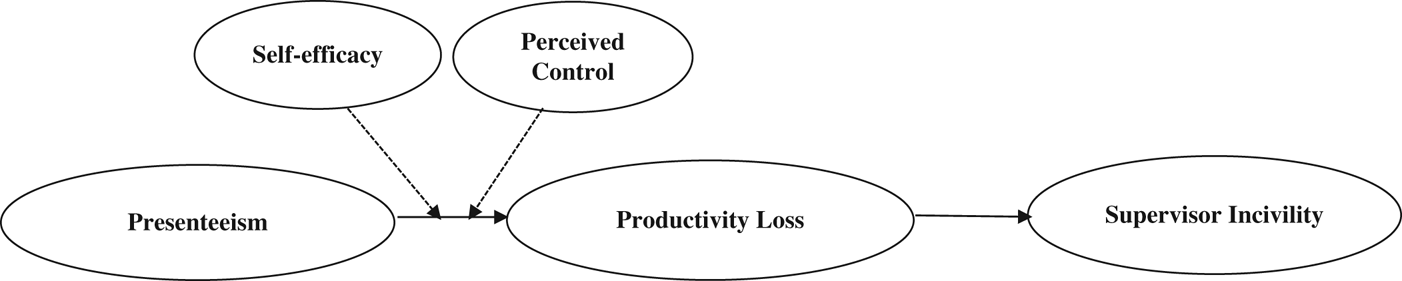
Although I propose that productivity loss due to presenteeism may lead to supervisor incivility, it is likely that not all presentees may necessarily become targets of supervisor incivility. It is possible that certain factors may operate as boundary conditions of the proposed relationship between presenteeism and productivity loss, consequently reducing or even negating the presentee’s victimization with experienced supervisor incivility. I explore this proposition by testing whether two psychological resources that have the potential to influence presentees’ job performance during stressful times – presentees’ self-efficacy (a personal resource), and perceived control (a condition resource) – attenuate the proposed relationship. I apply propositions from the Conservation of Resources Theory (COR; Hobfoll, Reference Hobfoll1989) to explain the proposed mediation, and moderated mediation pathways through which presenteeism relates to supervisor incivility. See Figure 1 for the various hypothesized relationships.
Graphical illustration of the study’s hypothesized relationship

Literature review, theory, and hypotheses
Supervisor Incivility
Andersson and Pearson defined workplace incivility as a ‘low intensity deviant behavior with ambiguous intent to harm the target in violation of workplace norms for mutual respect. Uncivil behaviors are characteristically rude and discourteous, displaying a lack of regard for others’ (Reference Andersson and Pearson1999: 457). Workplace incivility is typically differentiated from other forms of workplace interpersonal mistreatment such as abusive supervision (e.g., Tepper, Reference Tepper2000), bullying (e.g., Hoel & Cooper, Reference Hoel and Cooper2001) and social undermining, (e.g., Duffy, Ganster, & Pagon, Reference Duffy, Ganster and Pagon2002), on the basis of two key characteristics: the level of intensity of the negative behaviors, and the ambiguity of the intent to harm of the behaviors (Andersson & Pearson, Reference Andersson and Pearson1999) such that the target of such behaviors may be unclear as to whether the negative behaviors were deliberate or simply an oversight on the part of the perpetrator. Examples of uncivil behaviors include hostile stares, disparaging tones and remarks, and giving another the ‘silent treatment’ (Lim, Cortina, & Magley, Reference Lim, Cortina and Magley2008; Pearson & Porath, Reference Pearson and Porath2009).
As noted earlier, much of research on workplace incivility has examined targets’ experiences as nonsource specific. However, in recent times, a developing stream of research has begun addressing this (e.g., Leiter, Price, & Spence Laschinger, Reference Leiter, Price and Spence Laschinger2010; Leiter, Laschinger, Day, & Oore, Reference Leiter, Laschinger, Day and Oore2011; Reio, Reference Reio2011; Reio & Sanders-Reio, Reference Reio and Sanders-Reio2011; Leiter, Day, Oore, & Laschinger, Reference Leiter, Laschinger, Day and Oore2012) with findings providing interesting insights on this form of workplace incivility. In particular, it is theorized that although supervisor incivility occurs less frequently than incivility from other sources (e.g., coworker incivility; Cortina et al., Reference Cortina, Magley, Williams and Langhout2001), it is not an uncommon form of workplace incivility (e.g., Johnson & Indvik, Reference Johnson and Indvik2001; Porath & Pearson, Reference Porath and Pearson2013; Kabat-Farr, Walsh, & McGonagle, Reference Kabat-Farr, Walsh and McGonagle2017) and presents potentially more harmful consequences for targets when experienced (Lim, Cortina, & Magley, Reference Lim, Cortina and Magley2008; Cortina & Magley, Reference Cortina and Magley2009). The serious harmful consequences of supervisor incivility may arise because targets depend on their supervisors for evaluations and rewards, and may become fearful that the uncivil relations may generalize to other aspects of their work–life (Schilpzand, De Pater, & Erez, Reference Schilpzand, De Pater and Erez2016). Furthermore, because a supervisor holds the position of organizational representative responsible for managing appropriate workplace behavior, when subordinates experience incivility from their supervisor, they may perceive autonomy and identity loss, and injustice (Reio, Reference Reio2011).
Presenteeism
Various conceptualizations of presenteeism have been proffered in the literature (Pohling et al., Reference Pohling, Buruck, Jungbauer and Leiter2016). Although some scholars have conceptualized presentism as productivity loss due to illness, health risks, and specific medical conditions (e.g., Schultz & Edington, Reference Schultz and Edington2007), others have described it in terms of the act of attending work while sick (e.g., Aronsson & Gustafsson, Reference Aronsson and Gustafsson2005; Johns, Reference Johns2010) (cf. Pohling et al., Reference Pohling, Buruck, Jungbauer and Leiter2016). This latter conceptualization has emerged as a generally accepted definition of presenteeism in the Organizational Behavior literature (Johns, Reference Johns2010; Niven & Ciborowska, Reference Niven and Ciborowska2015) and is adopted in this study.
Notwithstanding the noted differences in its conceptualization, presenteeism is generally viewed as a health problem caused by both individual factors as well as working conditions (Johns, Reference Johns2010, Reference Johns2011; Pohling et al., Reference Pohling, Buruck, Jungbauer and Leiter2016; for reviews, see Schultz & Edington, Reference Schultz and Edington2007; Miraglia & Johns, Reference Miraglia and Johns2016). Presenteeism has been linked to various serious negative costs to both the employee and the organization, including further decrements on the employee’s health (e.g., Bergström, Bodin, Hagberg, Lindh, Aronsson, & Josephson, Reference Bergström, Bodin, Hagberg, Lindh, Aronsson and Josephson2009; Demerouti, Le Blanc, Bakker, Schaufeli, & Hox, Reference Demerouti, Le Blanc, Bakker, Schaufeli and Hox2009; Gustafsson & Marklund, Reference Gustafsson and Marklund2011; Lu, Lin, & Cooper, Reference Lu, Lin and Cooper2013; Niven & Ciborowska, Reference Niven and Ciborowska2015), aggravation of quality of life and health status, negative effects on colleagues, increased occupational accidents, declining products and services quality (e.g., Yamashita & Arakida, Reference Yamashita and Arakida2006), negative work-related attitudes (Lu, Lin, & Cooper, Reference Lu, Lin and Cooper2013), and productivity loss (e.g., Burton, Conti, Chen, Schultz, & Edington, Reference Burton, Conti, Chen, Schultz and Edington2002; Goetzel et al., Reference Goetzel, Long, Ozminkowski, Hawkins, Wang and Lynch2004; Lerner et al., Reference Lerner, Adler, Chang, Lapitsky, Hood, Perissinotto and Rogers2004; Johns, Reference Johns2010; Pohling et al., Reference Pohling, Buruck, Jungbauer and Leiter2016).
Although research on presenteeism continues to grow, there remains much that we do not understand about this workplace phenomenon (Schultz & Edington, Reference Schultz and Edington2007; Niven & Ciborowska, Reference Niven and Ciborowska2015). Of particular relevance to the current study are the unexamined impacts of presenteesim on the employee’s interpersonal relationships at work. For instance, one way in which presenteeism may impact on the presentee’s workplace interpersonal relationships is through his/her poor job performance. As noted earlier, research indicates that presenteeism results in productivity loss (e.g., Johns, Reference Johns2010, Reference Johns2011; Pohling et al., Reference Pohling, Buruck, Jungbauer and Leiter2016). Research has also shown that there exists a link between poor job performance and negative interpersonal relations at work (e.g., Jensen, Patel, & Raver, Reference Jensen, Patel and Raver2014). Taken together, these research findings suggest the possibility that experiencing productivity loss due to presenteeism may be associated with negative workplace interpersonal relationships.
I explore the above proposed effect of presenteeism on the presentee’s interpersonal relationships at work, focusing specifically on the link between presentee’s job performance, and his/her interpersonal relationship with his/her supervisor.
Linking presenteeism to supervisor incivility: The mediating role of productivity loss
To explicate the relationship between presenteeism and supervisor incivility, I draw from the victim precipitation theory. According to victim precipitation theory, individuals’ characteristics and/or behaviors, and/or others’ perceptions of the individuals’ behaviors as a sign of vulnerability or deservingness of mistreatment may make them susceptible to victimization (Amir, Reference Amir1967; Curtis, Reference Curtis1974; Aquino & Thau, Reference Aquino and Thau2009; Jensen, Patel, & Raver, Reference Jensen, Patel and Raver2014). Research indicates that victim precipitation may occur not only when the target directly provokes the perpetrator, but also as a result of an unintentional act on the part of the individual which aggravates the perpetrator (Amir, Reference Amir1971; Siegel, Reference Siegel2008; Tepper, Duffy, Henle, & Lambert, Reference Tepper, Duffy, Henle and Lambert2006). Research that has examined victimization in the workplace indicates that certain personality factors and behaviors may act as precipitating factors in an individual’s mistreatment at work, including the individual’s negative affectivity, aggressive behaviors, conflict management styles, self-esteem, speaking up about past mistreatment, and job/task performance (e.g., Aquino, Grover, Bradfield, & Allen, Reference Aquino, Grover, Bradfield and Allen1999; Aquino, Reference Aquino2000; Cortina & Magley, Reference Cortina and Magley2003; Tepper et al., Reference Tepper, Duffy, Henle and Lambert2006; Jensen, Patel, & Raver, Reference Jensen, Patel and Raver2014; for a review, see Aquino & Thau, Reference Aquino and Thau2009). Regarding the link between job/task performance and victimization specifically, research indicates that low job performance is associated with victimization. For instance, in a study which investigated the links between job performance level and peer victimization, Jensen, Patel, and Raver (Reference Jensen, Patel and Raver2014) found that employee who performed poorly were targeted with overt forms of victimization from others (e.g., yelling/raising one’s voice and making threats).
Consistent with the above theoretical and empirical research, I theorize that engaging in presenteeism will be positively associated with the presentee’s victimization in the form of supervisor incivility. I theorize that this effect will be because of the loss of productivity experienced by the presentee.
It is generally expected that presentees are unlikely to be fully productive while at work (Miraglia & Johns, Reference Miraglia and Johns2016). Indeed, empirical support has been found for the positive relationship between presenteeism and productivity loss (e.g., Pohling et al., Reference Pohling, Buruck, Jungbauer and Leiter2016). For instance, in a study examining the antecedents of presenteeism and the processes underlying these relationships, Pohling et al. (Reference Pohling, Buruck, Jungbauer and Leiter2016) found that engaging in acts of presenteeism was positively associated with individuals’ reported health-related lost productivity.
One theoretical framework useful for explaining the negative effects of presenteeism on productivity loss is the COR theory. According to COR theory, people are motivated to acquire, protect, and retain material, social, and personal resources to avoid strain and accomplish goals and may use resources to replace others when they are lost (Hobfoll, Reference Hobfoll1989, Reference Hobfoll2001). Examples of resources include personal resources (e.g., traits or skills such as self-efficacy and self-esteem), objects (e.g., one’s car and/or home), energy resources (e.g., time, money, and knowledge), conditions (e.g., job autonomy and perceived job control), and social support (e.g., supervisor, coworker, organization, and/or spousal support) (Wayne, Grzywacz, Carlson, & Kacmar, Reference Wayne, Grzywacz, Carlson and Kacmar2007; Halbesleben, Neveu, Paustian-Underdahl, & Westman, Reference Halbesleben, Neveu, Paustian-Underdahl and Westman2014). Furthermore, COR theory argues that when individuals perceive threats to, or experience resource loss, they may engage in defensive strategies aimed at restoring or conserving the resources (e.g., Halbesleben & Bowler, Reference Halbesleben and Bowler2007; Halbesleben, Reference Halbesleben2010) including withdrawing from the workplace (Wright & Cropanzano, Reference Wright and Cropanzano1998) and/or decreasing performance (Hobfoll, Reference Hobfoll1988).
An employee who attends work while sick suffers resource loss in the form of a denied opportunity to avail of some time off from work to recover from the illness (Lu, Lin, & Cooper, Reference Lu, Lin and Cooper2013), and the lost chance to gain new resources during the recovery time off (Fritz & Sonnentag, Reference Fritz and Sonnentag2006). Furthermore, the presentee continues to face the demands of working while ill (e.g., stressors such as meeting workload requirements), leading to further resource loss and further decrements in his/her health and well-being (e.g., Bergström et al., Reference Bergström, Bodin, Hagberg, Lindh, Aronsson and Josephson2009; Demerouti et al., Reference Demerouti, Le Blanc, Bakker, Schaufeli and Hox2009; Gustafsson & Marklund, Reference Gustafsson and Marklund2011; Lu, Lin, & Cooper, Reference Lu, Lin and Cooper2013; Niven & Ciborowska, Reference Niven and Ciborowska2015). Ultimately, this resource loss with its attendant increase in poor health and well-being will result in the increased experience of stress (Hobfoll, Reference Hobfoll1998). COR theory and research (e.g., Wright & Cropanzano, Reference Wright and Cropanzano1998) suggest that such resource depletion due to stress may prompt the individual to engage in actions aimed at conserving other resources, while minimizing the experience of stress, including putting less effort into work which consequently, may result in poor job performance (i.e., decreasing productivity levels).
Past research theorizing (e.g., Johns, Reference Johns2010) indicates a link between reduced productivity and others’ impressions of presentee’s ineffectiveness at work. Thus, a supervisor who views the reduced productivity to be a result of the employee’s laziness at work, or possibly, the employee’s shirking of his/her job duties may respond by behaving uncivilly toward the employee as a way of showing displeasure at the employee’s failure to maintain expected performance standards. Although prior research (e.g., Jensen, Patel, & Raver, Reference Jensen, Patel and Raver2014) suggests that poor performers are targeted with more overt form of victimization, I explore supervisor incivility as comprising both covert and overt forms of mistreatment directed against the presentee. Although the use of overt forms of mistreatment is consistent with the previously noted research on response to poor job performance, the use of covert forms of incivility is in keeping with theorizing that acts of incivility may appear unintentional and ambiguous so that the employee does not know whether he is being targeted. Thus, the supervisor may yell, shout, or swear at the employee, or address the employee in unprofessional terms. The supervisor may also give the presentee hostile looks, stares, or sneers, or pay little attention to the presentee’s statements. In sum, I hypothesize that:
Hypothesis 1: Presenteeism is positively associated with experienced supervisor incivility.
Hypothesis 2: Productivity loss mediates the positive relationship between presenteeism and experienced supervisor incivility.
Exploring moderated mediation relations: Self-efficacy and perceived control as moderators
According to COR theory, individuals who have more resources conserved, are less likely to be harmed following resource loss because they are able to draw on resource reserves when under stress. Thus, it is plausible that a presentee with high levels of personal and condition resources such as self-efficacy and/or perceived control may draw from these resource reserves to cope with the effects of resource depletion due to attending work while sick.
Self-efficacy is defined as ‘the belief in one’s capabilities to organize and execute the courses of action required to manage prospective situations’ (Bandura, Reference Bandura1995: 2). Put in other words, self-efficacy is a person’s belief in his/her ability to not only set challenging goals, but to also act confidently so as to succeed in a given situation (Lu, Lin, & Cooper, Reference Lu, Lin and Cooper2013).
Scant research has examined the effects of self-efficacy within the literature on presenteeism. The limited studies that have done so indicate that self-efficacy may operate both as an antecedent of presenteeism (e.g., Lu, Lin, & Cooper, Reference Lu, Lin and Cooper2013), and a moderator of the relationship between presenteeism and the employee’s health over time (e.g., Lu, Peng, Lin, & Cooper, Reference Lu, Peng, Lin and Cooper2014). In the latter case, self-efficacy was found to buffer the negative effects of presenteeism on the employee’s health (e.g., Lu et al., Reference Lu, Peng, Lin and Cooper2014).
With respect to the presenteeism–productivity relationship in particular, research has yet to investigate what role, if any, self-efficacy plays in the noted relationship. Nevertheless, the finding that self-efficacy serves as a buffer between presenteeism and its other outcomes (e.g., health and well-being; Lu et al., Reference Lu, Peng, Lin and Cooper2014), suggests that it is not unreasonable to expect that it may play a similar role in the presenteeism–productivity relationship. Furthermore, findings from other literatures suggest that self-efficacy may serve as a personal resource that individuals draw from to achieve performance standards (for reviews, see Sadri & Robertson, Reference Sadri and Robertson1993; Stajkovic & Luthans, Reference Stajkovic and Luthans1998; Judge & Bono, Reference Judge and Bono2001; Judge, Jackson, Shaw, Scott, & Rich, Reference Judge, Jackson, Shaw, Scott and Rich2007). For instance, in a meta-analytical study in which they examined the relationship between generalized self-efficacy and job performance, Judge and Bono (Reference Judge and Bono2001) suggested, and found that individuals high in self-efficacy (defined as individuals’ perceptions of themselves as able to cope, perform, and be successful) behaved consistent with their self-view; with self-efficacy found to be positively related to job performance. Past research (e.g., Lu, Du, & Xu, Reference Lu, Du and Xu2016) also indicates that self-efficacy can serve as a buffer during stressful conditions that impact the employee’s job performance.
Drawing from the research discussed above, it is reasonable to expect that self-efficacy will buffer the negative effects of presenteeism on employees’ productivity such that high self-efficacy presentees will be less likely to experience productivity loss due to the presenteeism. Research suggests that high self-efficacy individuals are capable of drawing from their psychological resources to address stressful demands (Hobfoll, Reference Hobfoll2002). Past research also provides theoretical and empirical support for the buffering role self-efficacy plays during stressful conditions in the context of presenteeism (e.g., Lu et al., Reference Lu, Peng, Lin and Cooper2014). Therefore, I expect that presentees who are high in self-efficacy will be able to draw from their resource reserves to meet the stressful demands that are part of attending work while sick. I also expect that in drawing from their psychological resources, presentees who indicate high self-efficacy will be able to maintain/meet job performance, consequently removing them from the path to victimization in the form of supervisor incivility. In sum, I hypothesize that:
Hypothesis 3: Self-efficacy will moderate the mediating effect of productivity loss in the presenteeism–supervisior incivility relationship such that this relationship will be weaker for individuals with high self-efficacy.
Perceived control refers to the extent to which individuals believe they can act directly on their environment to produce desired outcomes or avoid negative ones (Spector, Reference Spector1986). Some examples of perceived control include the ability to start and stop work as one desires, to work fast or slowly, and to work at home if one so desires (Davidson et al., Reference Davidson, Eden, Westman, Cohen-Charash, Hammer, Kluger, Krausz, Maslach, O’Driscoll, Perrewé, Quick, Rosenblatt and Spector2010). Research indicates that perceived control functions as a psychological resource that can buffer the individual against the negative effects associated with meeting work demands (for reviews, see Skinner, Reference Skinner1996; Häusser, Mojzisch, Niesel, & Schulz-Hardt, Reference Häusser, Mojzisch, Niesel and Schulz-Hardt2010).
Scant research has examined the role perceived control may play in the relationship between presenteeism and the individual’s productivity. The limited research that has done so indicates a positive relationship between the perceived lack of control, and productivity loss (e.g., Alavinia, Molenaar, & Burdorf, Reference Alavinia, Molenaar and Burdorf2009).
At present, research has yet to examine whether perceived control functions as a psychological resource that may buffer the negative effects of presenteeism on productivity. Nonetheless, a theoretical argument can be made for this effect of perceptions of control. In particular, the COR theory proposition regarding the buffering role of psychological resources suggests that individuals who perceive control at work are less likely to experience negative outcomes related to resource loss because perceived control acts as a buffer against such outcomes (Davidson et al., Reference Davidson, Eden, Westman, Cohen-Charash, Hammer, Kluger, Krausz, Maslach, O’Driscoll, Perrewé, Quick, Rosenblatt and Spector2010). Applying this theoretical proposition, I argue that employees who come to work while sick may not experience productivity loss if they perceive control over how they do their job. For instance, a presentee who perceives control over his/her work may take rest breaks in-between work as needed, to recover from work demands. Research (e.g., Alavinia, Molenaar, & Burdorf, Reference Alavinia, Molenaar and Burdorf2009) theorizes that adjusting the pace of work allows the presentee to adapt task performance to his/her current physical and mental state of health ‘on the day.’ Past research (e.g., Drory, Reference Drory1985; Tucker, Reference Tucker2003) indicates that individuals who take rest breaks are better able to maintain performance.
And so, drawing from the theoretical and empirical research discussed, I expect that high perceived control will buffer the negative effects of presenteeism on productivity such that the presentee will be less likely to experience productivity loss. I also expect that the presentee’s ability to avoid productivity loss as a result of drawing from his/her psychological resources, will consequently, make it less likely that he/she would become a target of supervisor incivility. In sum, I hypothesize that:
Hypothesis 4: Perceived control will moderate the mediating effect of productivity loss in the presenteeism–supervisior incivility relationship such that this relationship will be weaker for individuals with high perceived control.
Method
Respondents and Procedure
Institutional ethics approval was obtained prior to data collection. To test the study’s hypotheses, cross-sectional data were collected from workers in a variety of industries. Respondents in this study were 281 working adults in the United States who were recruited using Amazon Mechanical Turk (Mturk), an online data collection system operated by Amazon.com. Recruiting the sample from MTurk facilitated access to a pool of research respondents from a diversity of sociodemographic backgrounds (Goodman, Cryder, & Cheema, Reference Goodman, Cryder and Cheema2013). Past research indicates that samples recruited through MTurk are comparable to traditional samples (Goodman, Cryder, & Cheema, Reference Goodman, Cryder and Cheema2013) and that data obtained through this means are as reliable and valid as those obtained through traditional internet survey methods (Buhrmester, Kwang, & Gosling, Reference Buhrmester, Kwang and Gosling2011).
To recruit respondents, recruitment advertisements referred to as Human Intelligence Tasks were posted on the Mturk website and included the link to the survey and instructions regarding the process for completing the survey questionnaire. The electronic survey was hosted on the Qualtrics website (a user-friendly web-based survey tool useful for conducting survey research). Informed consent was sought from individuals before completing the survey. Six respondents were excluded due to missing data. Three respondents reported that they had attended work while sick for more days than expected in the 6-month period noted in the survey (e.g., 200 days in 6 months). These were identified as outliers and excluded from further analyses. Following further statistical analyses that were conducted to identify extreme outliers in all variables for the remaining 272 respondents, 31 respondents (11%) were excluded, resulting in a final sample of 241 (140 males, 101 females). Most respondents self-identified as Caucasian (81.32%). Approximately 70.54% were within 21–40 years age range. Respondents were from diverse industries including healthcare, information technology, food services, retail, manufacturing, entertainment, government, not-for profit, and education. Fifty percent of the respondents occupied nonmanagerial positions, 23.6% in first level supervisory position, and 26.36% were in mid-level to executive level positions.
The survey included several attention checks in the form of questions on different well-known nursery rhymes in which respondents were provided a nursery rhyme and asked questions related to it. Respondents were asked to select the answer that is contrary to the generally accepted answer. For instance, respondents were asked the question, ‘Mary had a little lamb its (space for answer) was white as snow? The answer is fleece. To know if you are paying attention, please select the second option.’ The two options provided were wool and fleece. Respondents who selected ‘wool’ were stopped from completing the survey. Each respondent was compensated $6.00US.
Measures
Experienced supervisor incivility
This construct was measured using the Cortina, Kabat-Farr, Leskinen, Huerta, and Magley (Reference Cortina, Kabat-Farr, Leskinen, Huerta and Magley2013) 12-item Workplace Incivility Scale. Respondents were asked to indicate on a 5-point scale (1=‘never,’ to 5= ‘many times’) how frequently their supervisor engaged in a variety of rude, disrespectful, or condescending behaviors towards them in the preceding 6 months. Sample items include whether their supervisor ‘Made insulting or disrespectful remarks about you’ ‘addressed you in unprofessional terms.’ The scale showed very good internal consistency reliability estimate with a Cronbach’s α of 0.91.
Presenteeism
In line with what has been used by past research (e.g., Johns, Reference Johns2011) presenteeism was measured by asking respondents the question ‘How many days did you go to work in the past six months even though you were sick or not feeling well?’ Respondents provided their answers using a fill-in-the-blank response format.
Productivity loss
This construct was measured using the output demands subscale of the Work Limitations Questionnaire (Lerner, Amick, Rogers, Malspeis, Bungay, & Cynn, Reference Lerner, Amick, Rogers, Malspeis, Bungay and Cynn2001). Respondents were asked to indicate using a 5-point scale (1=‘no difficulty,’ to 5=‘so much difficulty I couldn’t do it’) how much difficulty they had experienced in the period of the preceding 6 months in doing the following five activities because of their health: handling workload; working fast enough; finishing work on time; satisfying others; doing all they are capable of doing. The scale showed a highly acceptable level of internal consistency reliability with Cronbach’s coefficient αs of 0.93.
Self-efficacy
This construct was measured using the Sherer, Maddux, Mercandante, Prentice-Dunn, Jacobs, and Rogers (Reference Sherer, Maddux, Mercandante, Prentice-Dunn, Jacobs and Rogers1982) 17-item self-efficacy scale. Respondents were asked to use a 7-point scale (1=‘strongly disagree,’ to 7=‘strongly agree’) to indicate the degree of their agreement or disagreement with each statement. Sample statements include: ‘when I make plans, I am certain I can make them work’; ‘If I can’t do a job the first time. I keep trying until I can’; and ‘If something looks too complicated, I will not even bother to try it.’ All negatively worded items were reversed coded. The Cronbach’s coefficient α of the scale was 0.95, indicating a high level of internal consistency reliability.
Perceived control
An item from the Ashford, Lee, and Bobko (Reference Ashford, Lee and Bobko1989) powerlessness scale was used to measure this construct. Respondents were asked to use a 5-point scale (1=‘strongly disagree,’ to 5=‘strongly agree’) to indicate the degree of their agreement or disagreement with the statement: ‘I have enough power in my organization to control events that might affect my job.’
Control variables
I controlled for two demographic variables: gender and age. Research suggests that individuals may become targets of workplace interpersonal mistreatment because of their gender and/or age (e.g., Aquino & Bradfield, Reference Aquino and Bradfield2000; Cortina et al. Reference Cortina, Magley, Williams and Langhout2001, Reference Cortina, Kabat-Farr, Leskinen, Huerta and Magley2013; for a review, see Bowling & Beehr, Reference Bowling and Beehr2006). Thus, it is reasonable to expect that individuals who perceive themselves as possible targets of victimization because of their gender, and/or age may become hypervigilant about possible risks of mistreatment (Kramer, Reference Kramer1998; Allen & Badcock, Reference Allen and Badcock2003) and may be more likely to report perceived interpersonal mistreatment. Moreover, gender and age have been found be related to the act of presenteeism (e.g., Miraglia and Johns, Reference Miraglia and Johns2016). I controlled for an additional variable – preexisting health conditions – in my tests of the hypothesized mediation relationship, and each moderated mediation relationship because past research has found preexisting health conditions to be related to productivity losses (cf. Pohling et al., Reference Pohling, Buruck, Jungbauer and Leiter2016). Gender was coded as 0= male; 1= female; Age was reported in six categories with 10 years as the class interval and coded as ranging from 1= 18–20 years old, to 6= Above 60 years. Preexisting health conditions was assessed by asking respondents whether they were currently living with any chronic health conditions. Responses were coded as 0=No, and 1=Yes.
Results
Preliminary analysis
Given that data were collected using via a self-report survey, there is the concern that some of the relationships among variables may be driven by common method bias (CMB) which could threaten the validity of the present study’s findings (Podsakoff, MacKenzie, & Podsakoff, Reference Podsakoff, MacKenzie and Podsakoff2012). To assess whether CMB is a major concern in the present study, I used two commonly reported methods for testing CMB (for reviews, see Podsakoff, MacKenzie, Lee, & Podsakoff, Reference Podsakoff, MacKenzie, Lee and Podsakoff2003; Podsakoff, MacKenzie, & Podsakoff, Reference Podsakoff, MacKenzie and Podsakoff2012). First, I conducted a Harman’s single-factor test (Harman, Reference Harman1960) using exploratory factor analysis. In this test, all variables are loaded onto a single factor and constrained so that there is no rotation. If the single factor explains large variance, then CMB may be present (Podsakoff & Organ, Reference Podsakoff and Organ1986). Results from this analysis show that one factor accounted for 32.85% of the underlying variance, indicative that CMB is not a serious threat to the validity of the current study’s results. Second, I conducted confirmatory factor analysis using Lavaan version 0.5-17 in R version 3.0.2 (R Core Team, 2013) in which I assessed fit of two models (i) a 1-factor model in which all items loaded to a single factor and (ii) a 5-factor model in which all the items reported on a Likert scale (i.e., productivity loss, supervisor incivility, self-efficacy, and perceived control) were set to load on their hypothesized latent factors. A common-factor model that shows a better fit than the five-factor model would be indicative that CMB is a concern. Results of the confirmatory factor analysis show that the data fit for the 5-factor model is significantly better χ2(614)=1,234.70, p<.001, root mean square error of approximation [RMSEA] = 0.07, CFI = 0.90 than a 1-factor model, χ2(629)=2,208.60, p<.001; RMSEA = 0.10, CFI = 0.86; Δ χ2(15)=973.9, p<.001. Taken together, the results from these two tests are suggestive that CMB is unlikely a factor threatening the validity of the present study’s findings.
Main results
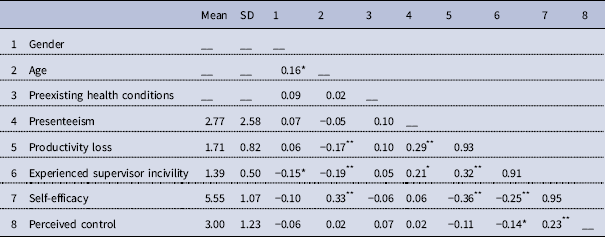
Descriptive statistics, Cronbach’s αs, and correlations among all study variables are shown in Table 1. All analyses were conducted using SPSS 25. Before conducting the analyses, all variables, except for the control variables, were standardized to test for interaction terms (Aiken & West, Reference Aiken and West1991).
Means, standard deviations, Cronbach’s αs, and correlations among all study variables

Note. Presenteeism (last 6 month); Gender: 0=Male, 1=Female; Age: 1=18–20 years, 2=21–30 years, 3=31–40 years, 4=41–50 years, 5=51–60 years, 6=above 60 years; Preexisting health conditions: 0=No, 1=Yes; N=241; Cronbach’s α reported on the diagonal of the matrix.
*Correlation is significant at the 0.05 level (two-tailed); **correlation is significant at the 0.01 level (two-tailed).
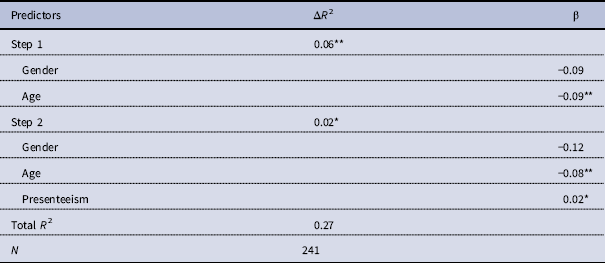
Hypothesis 1 argued a main effects relationship between presenteeism and experienced supervisor incivility. To test this hypothesis, I used hierarchical multiple regression analyses, with gender and age included as covariates in step 1, and presenteeism in step 2. Table 2 summarizes the results from the test of Hypothesis 1. Presenteeism was significantly related to experienced supervisor incivility (β=0.02, p<.05), providing support for Hypothesis 1.
Summary of hierarchical regression analysis examining presenteeism as an antecedent of experienced supervisor incivility

Note. *p<.05, **p<.01.
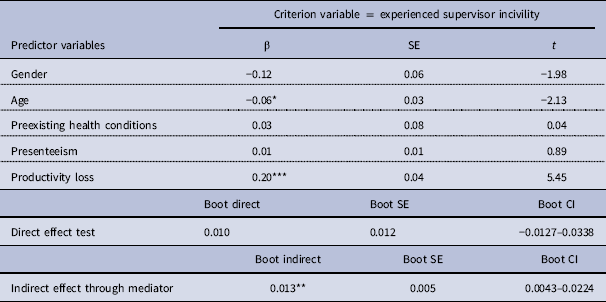
Hypotheses 2 proposed that productivity loss would mediate the relationship between presenteeism and experienced supervisor incivility. To assess this hypothesized mediation relationship, I used model 4 of the PROCESS (v3.0; Hayes, Reference Hayes2017) computational procedure in SPSS, with 5,000 bootstrapped samples used, and controlled for gender, age, and preexisting health conditions. Results for Hypothesis 2 are outlined in Table 3. The indirect effect of presenteeism on experienced supervisor incivility through productivity loss was significant (β=0.01, p<.01).The bias corrected 95% confidence intervals (CI) for productivity loss did not contain zero, suggesting that it is a mediator of the relationship between presenteeism and experienced supervisor incivility. Thus, Hypothesis 2 is supported.
Results of mediation analysis examining productivity loss as a mediator of the relationship between presenteeism and experienced supervisor incivility

Note. N=241. 1. Bootstrap sample size = 5,000. 95% bootstrap confidence intervals (CI) reported.
*p<.05, **p<.01, ***p<.001.
To assess the moderated mediation relationships proposed in Hypotheses 3 and 4, I estimated the conditional indirect effects from bootstrapping results using model 7 of the PROCESS (v3.0; Hayes, Reference Hayes2017) computational procedure in SPSS. Two separate regression models were analyzed. Gender, age, and preexisting health conditions were all entered as covariates in the 2 models analyzed.
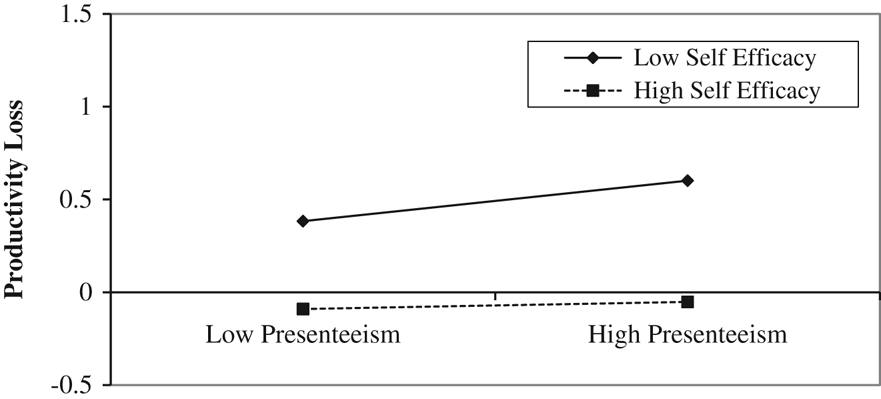
For Hypothesis 3 which proposed that self-efficacy will moderate the mediating effect of productivity loss in the presenteeism–supervisior incivility relationship, the index of moderated mediation indicates a significant negative effect of presenteesim on supervisor incivility through productivity loss conditional on presentees’ self-efficacy (β=−0.009, SE = 0.004, 95% CI [−0.0188, −0.0024]). This result supports the moderated mediation hypothesis. In line with Hayes (Reference Hayes2017), I assessed the indirect effect at select values of self-efficacy: the mean, 1 SD below the mean, and 1 SD above the mean. See Table 4 for the conditional effects results that indicate that two of the three conditional effects (i.e., mean, and −1 SD) are significantly different from 0. To facilitate interpretation of the interaction, a graph was produced as recommended by research (Aiken & West, Reference Aiken and West1991). As the graph shows (see Figure 2), the presenteeism–productivity loss relationship is moderated by self-efficacy such that the relationship is stronger for individuals with low self-efficacy. Thus, Hypothesis 3 is not supported.
Moderated mediation: testing the indirect effect at select values of self-efficacy

Note. N=241. Bootstrap sample size = 5,000. 95% bootstrap confidence intervals reported.
LLCI =lower limit confidence interval; ULCI=upper limit confidence interval.
Two-way interaction effects of the presenteeism and self-efficacy on presentees’ productivity loss

For Hypothesis 4 which proposed that perceived control will moderate the mediating effect of productivity loss in the presenteeism–supervisior incivility relationship, contrary to expectations, the index of moderated mediation indicates a nonsignificant effect of presenteesim on supervisor incivility through productivity loss conditional on presentees’ perceived control (β=−0.004, SE = 0.003, 95% CI [−0.0105, 0.0015]). Thus, the lack of moderated mediation does not support Hypothesis 4.
Discussion
The goal of the present study was to investigate the role employees may play in precipitating supervisor incivility against themselves. Drawing from victim precipitation theory, I posited that presentees who experiences productivity loss, may inadvertently make themselves targets of supervisor incivility. Additionally, I proposed some boundary conditions of this proposed relationship. Specifically, applying arguments from the COR theory, I argued that high self-efficacy and high perceived control may buffer the positive presenteeism–productivity loss relationship such that presentees will be less likely to experience productivity loss, which in turn, makes it less likely that they will become targets of experienced supervisor incivility.
I found that presenteesim is positively associated with experienced supervisor incivility. I also found, consistent with past research (e.g., Pohling et al., Reference Pohling, Buruck, Jungbauer and Leiter2016), that presenteeism is positively associated with experienced productivity loss, and that this loss of productivity mediates the presenteeism–supervisor incivility relationship. Regarding the proposed moderated mediation relationship in which I argued that high self-efficacy moderates the presenteeism–productivity loss relationship such that the presentee is less likely to experience productivity loss, the results showed that while self-efficacy did moderate the mediation relationship, this effect occurred at low levels of self-efficacy such that presentees who reported low self-efficacy were more susceptible to being victimized in the form of experienced supervisor incivility. I did not find that perceived control moderates the presenteeism–supervisor incivility relationship. Taken together, these findings contribute to research on supervisor incivility and presenteeism in a number of ways.
Regarding research on supervisor incivility, the finding that presenteeism is positively associated with experiencing such mistreatment extends the limited research on the antecedents of this form of incivility (e.g., Leiter et al., Reference Leiter, Laschinger, Day and Oore2011, Reference Leiter, Day, Oore and Laschinger2012; Reio, Reference Reio2011) by identifying presenteeism as a possible predictor of supervisor incivility. The supported mediation relationship suggests that the link between presenteeism and experienced victimization in the form of supervisor incivility may be through productivity loss. Furthermore, the moderated mediation relationship found sheds light on the role low self-efficacy may play in increasing an individual’s susceptibility to supervisor incivility.
With respect to research on presenteeism, the finding that presenteeism is associated with experienced supervisor incivility extends the literature by showing that negative workplace interpersonal relations can result from presenteeism. Thus far, research has paid scant attention to examining what implications presenteeism poses for the presentee’s interpersonal relationships at work, such as vulnerability to experienced workplace interpersonal mistreatment, as found in the present study (for a review, see Miraglia & Johns, Reference Miraglia and Johns2016). The finding that low self-efficacy moderates the presenteeism–productivity loss relationship also extends the literature by highlighting a possible individual difference that may influence this effect of presenteeism. Specifically, it suggests that presentees who are low on this psychological resource are more likely to experience productivity loss.
Theoretical implications
The current study reveals various implications for theory development for both research on workplace incivility, and presenteeism. With respect to research on workplace incivility, the finding that individuals who engage in presenteeism inadvertently makes themselves targets of supervisor incivility, while providing further support for past research on individuals’ role in precipitating mistreatment against themselves (e.g., Amir, Reference Amir1967; Curtis, Reference Curtis1974; Aquino et al., Reference Aquino, Grover, Bradfield and Allen1999; Aquino, Reference Aquino2000; Cortina & Magley, Reference Cortina and Magley2003; Tepper et al., Reference Tepper, Duffy, Henle and Lambert2006; Jensen, Patel, & Raver, Reference Jensen, Patel and Raver2014; see also Aquino & Thau, Reference Aquino and Thau2009), also points to the need for the consideration of such effects in research on workplace incivility. Thus far, scant research (e.g., Milam, Spitzmueller, & Penney, Reference Milam, Spitzmueller and Penney2009) has examined this possibility, owing, perhaps to a construal of the victim precipitation model in general, as an attempt to ‘blame the victim,’ (Jensen, Patel, & Raver, Reference Jensen, Patel and Raver2014: 297; for a review, see Cortina, Rabelo, & Holland, Reference Cortina, Rabelo and Holland2018). Yet, as argued by past research (e.g., Bowling & Beehr, Reference Bowling and Beehr2006; Schilpzand, De Pater, & Erez, Reference Schilpzand, De Pater and Erez2016) to gain a thorough understanding of the target’s experience of workplace mistreatment (in the present study, supervisor incivility) the examination of the role the individual plays in such experiences is necessary.
Additionally, related to the previous point, the finding that low self-efficacy moderates the presenteeism–productivity loss relationship such that the presentee becomes a more likely target of supervisor incivility indicates that the relationship between supervisor incivility and its antecedents is a more complex one. The limited research on the antecedents of supervisor incivility has largely investigated direct relationships (e.g., Leiter et al., Reference Leiter, Laschinger, Day and Oore2011, Reference Leiter, Day, Oore and Laschinger2012; Reio, Reference Reio2011) with limited consideration of the factors may make an individual more or less likely to become a target of supervisor incivility. Findings from the present study suggest the usefulness of exploring individual differences in terms of levels personal resources as possible moderators of these relationships.
Regarding research on presenteeism, the lack of support found for the argument that presentees with high self-efficacy and high perceived control can draw from these psychological resources and in doing so, avoid experienced productivity loss, presents a number of theoretical implications. First, regarding the unsupported hypothesized moderating role of high self-efficacy, this finding is surprising given past research (e.g., Lu et al., Reference Lu, Peng, Lin and Cooper2014) which suggests the possibility that high self-efficacy, may act as a buffer in the presenteeism–outcomes relationships, and other research (e.g., Lu, Du, & Xu, Reference Lu, Du and Xu2016) that indicate that high self-efficacy can serve as a buffer during stressful conditions that impact the employee’s job performance. One possible reason for this finding is that perhaps in the context of the presenteeism–productivity loss relationship specifically, other factors may be at play that attenuate the moderating effects of high self-efficacy. Indeed, prior research (e.g., Judge et al., Reference Judge, Jackson, Shaw, Scott and Rich2007) suggests that individual differences such as individual conscientiousness can attenuate the effects of high self-efficacy on the individual’s job performance. Thus, it is plausible that a presentee who is low in individual conscientiousness may experience productivity loss even though he/she is high in self-efficacy. Further research that explores this complex relationship in more depth is needed.
Notwithstanding the result on the nonsignificant moderating effect of high self-efficacy, the current study’s finding that low self-efficacy strengthens the positive presenteeism–productivity loss relationship while in line with past research theorizing and empirical work that indicate a similar effect in other contexts (e.g., Bandura, Reference Bandura1986, Reference Bandura1997; Lu, Du, & Xu, Reference Lu, Du and Xu2016), also presents a key theoretical implication for research on presenteeism. Specifically, the identification of a condition under which the effects of presenteeism on productivity loss may be strengthened highlights the need for more a in depth examination of the psychological processes underlying this relationship. Hitherto, research (e.g., Johns, Reference Johns2010, Reference Johns2011; Pohling et al., Reference Pohling, Buruck, Jungbauer and Leiter2016; for a review, see Miraglia & Johns, Reference Miraglia and Johns2016) has focused largely on examining the direct relationship between presenteeism and productivity loss. However, recent work on presenteeism (e.g., Pohling et al., Reference Pohling, Buruck, Jungbauer and Leiter2016) has called for such research that investigates the factors that may attenuate or strengthen the relationships between presenteeism and its various consequences. This study heeds this call in the literature and the finding represents initial evidence regarding the dynamics involved in this relationship.
With respect to the hypothesized attenuating effect of high perceived control on the presenteeism–productivity loss relationship, the nonsignificant interaction effect found suggests that being high in this resource may not shield the presentee from experiencing productivity loss. Having said that, however, it is pertinent to note that the above noted result may be associated with the use of a 1-item scale to measure perceived control. I discuss this further in the study limitations and future research section below.
Practical implications
The study’s findings present several practical implications for individuals, supervisors, and their organizations. For the individual, findings indicate that engaging in presenteeism may result in negative workplace interpersonal relations in the form of experienced supervisor incivility. Past research indicates that such mistreatment in the workplace can result in negative health and well-being for the individual (for a review, see Schilpzand, De Pater, & Erez, Reference Schilpzand, De Pater and Erez2016). Taken together, these research findings suggest compounded negative impacts on the presentee. Specifically, not only does the presentee have to deal with the demands of working while sick, but he/she also has to do so while navigating possible negative interpersonal interactions in the workplace. This potential for a compounded negative impact should give pause to individuals, who for various reasons, both positive and negative (see Johns, Reference Johns2011; see also Miraglia & Johns, Reference Miraglia and Johns2016), choose to work while sick.
For supervisors, the findings from this study suggest the importance of being mindful of one’s reactions when subordinates experience productivity losses. I argued that the supervisor, who perceives such loss of productivity to be linked to the employee’s laziness at work or, the shirking of the job duties may become uncivil towards the employee for failing to meet expected performance standards. Yet, this study’s findings suggest that presenteeism may also be a plausible explanation for the employee’s productivity loss. Thus, a supervisor who is uncivil to the sick employee may add to the decrease in the employee’s health and well-being at work.
This study’s findings also present a number of practical implications for organizational. First, the finding regarding the occurrence of supervisor incivility in the workplace provides further voice to past research that indicate the pervasiveness of this phenomenon in the work–life domain. Moreover, the finding that presenteeism (a hitherto unexamined factor) may predict supervisor incivility indicates that there are a multiplicity of factors in the workplace that can elicit such mistreatment (for reviews, see Cortina et al., 2016; Schilpzand, De Pater, & Erez, Reference Schilpzand, De Pater and Erez2016).
Second, in identifying presenteeism as an antecedent of supervisor incivility, this study can inform organizational efforts that are aimed at identifying and eliminating predictors of incivility in the workplace. For example, the finding suggests that employees who take time off work to recuperate rather than going to work while sick may be less likely to be targets of supervisor incivility. However, past research (e.g., Miraglia & Johns, Reference Miraglia and Johns2016) indicates that organizational human resources policies can constrain absence from work, resulting in elevated presenteeism. Thus, by enforcing less strict absence policies, organizations may concurrently, also reduce the incidence of supervisor incivility associated with presenteeism.
Third, the study’s suggestion that supervisor incivility caused by employees’ acts of presenteeism may lead to further negative consequences, indicates the need for organizations to consider approaches for ensuring all employees behave appropriately in the workplace. For instance, in line with recommendations from past research (e.g., Pearson & Porath, Reference Pearson and Porath2005), organizations can develop and implement policies that specify appropriate workplace conduct, particularly for supervisors. Such policies can serve as guides for supervisors’ behaviors at all times, even in situations in which an employee may be experiencing productivity loss.
Study limitations and future research
This study is not without its limitations. First, data were collected using self-reports from respondents, a methodology that is typically associated with CMB. To mitigate CMB, certain recommended (e.g., Podsakoff et al., Reference Podsakoff, MacKenzie, Lee and Podsakoff2003; Podsakoff, MacKenzie, & Podsakoff, Reference Podsakoff, MacKenzie and Podsakoff2012) procedural remedies were used, including a form of temporal separation of measurement in which respondents were given tasks to complete (i.e., in the form of attention checks), which allowed them to focus briefly on answering questions unrelated to the predictor and criterion variables. Other procedural remedies used include allowing respondents’ answers to be anonymous, and assuring respondents that there are no right or wrong answers so as to encourage them to answer questions honestly. Additionally, the various statistical analyses conducted suggest that CMB was not a significant concern in the present study. Thus, the noted concerns are likely overstated. Further to the above, given the interaction effect that was hypothesized and found in the study, it is less probable that common method variance influenced the results (Evans, Reference Evans1985; Wall, Jackson, Mullarkey, & Parker, Reference Wall, Jackson, Mullarkey and Parker1996; Totterdell, Hershcovis, Niven, Reich, & Stride, Reference Totterdell, Hershcovis, Niven, Reich and Stride2012). Nevertheless, to further bolster the current findings, future research testing this study’s hypotheses using other sources of data such as objective data (e.g., on productivity levels) and a longitudinal design methodology is encouraged.
Second, given that data were collected via a cross-sectional methodology, causality can only be speculated. Future research using an experimental methodology may be useful in determining such causal linkages.
Third, I used a single-item measure of perceived control, which may have contributed to the lack of support for the hypothesized moderation effect, and also the nonsignificant direct effect of perceived control on productivity loss which is contrary to what has been found in past research (e.g., Alavinia, Molenaar, & Burdorf, Reference Alavinia, Molenaar and Burdorf2009). Although past research indicates the utility of single-item measures in exploratory research such as the present work (e.g., Wanous & Reichers, Reference Wanous and Reichers1996; Wanous, Reichers, & Hudy, Reference Wanous, Reichers and Hudy1997; Nagy, Reference Nagy2002; Bergkvist & Rossiter, Reference Bergkvist and Rossiter2007; Fuchs & Diamantopoulos, Reference Fuchs and Diamantopoulos2009), it has been argued that single-item scales can be prone to issues with content and construct validity, and internal consistency and test-retest reliability problems (e.g.,Hinkin & Schriesheim, Reference Hinkin and Schriesheim1989; Hinkin, Reference Hinkin1995). Thus, it is possible that future research using a more comprehensive measure of perceived control may yield other results.
Fourth, although I argued that supervisor incivility may be provoked if a supervisor believes productivity loss to be as a result of the employee’s laziness or the shirking of employee’s job duties, I did not measure these perceptions. Future research should consider assessing supervisor perceptions to better establish the posited linkage.
Fifth and finally, it is possible that other resources aside from the two examined here (e.g., self-esteem), may moderate the presenteeism–productivity loss relationship. Future research is encouraged to identify and test such factors.
Conclusion
In conclusion, the findings from this study highlight the role employees may play in precipitating supervisor incivility against themselves. Specifically, the results indicate that presentees who experience productivity loss may in doing so, provoke uncivil reactions from their supervisors. Furthermore, findings indicate that presentees low in self-efficacy, are more likely to experience productivity loss and, as a result, are more likely to become targets of supervisor incivility. This study provides initial evidence that individuals can provoke their supervisor’s uncivil mistreatment, and that certain conditions (i.e., low self-efficacy) increase the likelihood that the presentee will be targeted with supervisor incivility. Taken together, these findings suggest the need for employees to take time from work to recover when sick, as doing so may prevent their potential victimization at work. Additionally, the findings indicate the need for managers to seek to understand the source of their employees’ loss of productivity as this may foster positive workplace interpersonal relations and contribute to employee well-being.
Acknowledgements
The author acknowledges the helpful comments of the two anonymous reviewers.