Introduction
Proteins in many forage legumes are often poorly utilised by ruminants because of their extensive, rapid degradation to ammonia in the rumen (Wilkins and Jones, Reference Wilkins and Jones2000). This rapid degradation has two major effects: (1) a large portion of the ammonia produced is absorbed and converted into urea, which is then excreted in the urine, resulting in poor nitrogen (N) use efficiency by the rumen microorganisms and (2) some of the soluble proteins released in the rumen can form foams, which, if allowed to persist, may cause bloat (Jones et al., Reference Jones, Anderson and Ross1973; Min et al., Reference Min, Pinchak, Fulford and Puchala2005).
This excessive ruminal protein degradation in temperate forage legumes at the recommended harvest stages needs to be studied in order to identify and control the factors influencing the amount of forage proteins that survive ruminal degradation and pass into the lower digestive tract.
Condensed tannins (CT) are polyphenolic compounds that can react with plant proteins by hydrogen bonding at pH 3.5 to 7 to form CT–protein complexes that are stable and insoluble at rumen pH. These CT–protein complexes are hydrolysed in the acidic conditions of the abomasum and at the beginning of the small intestine, where the pH is below 3.5 (Jones and Mangan, Reference Jones and Mangan1977), thus increasing the amount of feed proteins available for subsequent digestion in the small intestine (Perez-Maldonado et al., Reference Perez-Maldonado, Norton and Kerven1995). Many studies have demonstrated a decrease in protein degradation in the rumen and a decrease in the incidence of bloat when tannins are present in forage legumes or are added to the diet. However, the effects of CT in the rumen and the intestine differ according to the amount and structure of the CT and the nature of the proteins (Min et al., Reference Min, Barry, Attwood and McNabb2003; Mueller-Harvey, Reference Mueller-Harvey2006). Also, the CT content varies with the growth stage (Lees et al., Reference Lees, Gruber and Suttill1995).
The objective of this study was to compare two forages: a CT-containing legume (sainfoin) with a non-CT-containing legume (lucerne) used as reference. The effects of growth stage and conservation (hay) on the in vivo measurements (ingestibility, digestibility and N balance) were also investigated. The digestive characteristics of these forages were also assessed by in situ measurements in the rumen and the intestine.
Material and methods
Forages
Sainfoin (Onobrychis viciifolia L., var. Zeus) and lucerne (Medicago sativa L., var. Aubigny) swards were sown in spring 2003 on the site of INRA Clermont-Ferrand/Theix (France), at an altitude of 800 m on a deep-silt loam soil. Average climatic conditions were mild (15°C to 20°C). Mineral fertiliser was supplied in spring at 37 kg P and 56 kg K/ha.
The experiments were conducted during 2004 with fresh sainfoin and lucerne. These forages were harvested at two stages (stages 1 and 2) in the first growth cycle. Both forages were harvested at the same dates (last week of May and second week of June for stages 1 and 2, respectively). The sum of temperatures from 1 March was on average 508.5°C for stage 1 and 668.8°C for stage 2. For sainfoin, stage 1 was defined as the vegetative stage (30 to 40 cm height), and stage 2 as early flowering (5% to 10% of stems observed in a metre row with at least one open flower). At the same date, a lucerne crop was cut in order to compare both forages. Phenologic stages of lucerne when it was cut were vegetative stage and budding stage for stages 1 and 2, respectively.
The hays were made from the fresh forages harvested at stage 2. They were cut on 10 June and were field-cured for 3 days under good weather conditions (without rainfall, average temperature = 17.3°C).
Animals and experimental design
Two series of measurements were conducted:
• Experiment 1. Measurements were made in spring (24 to 30 May with the fresh forages at stages 1 and 7 to 13 June with the fresh forages at stage 2).
• Experiment 2. The second set of evaluations was conducted in autumn with hays (24 to 30 October).
In each experiment, two groups of six Texel sheep (12-month old, 60 ± 3 kg live weight) were used simultaneously for digestibility and N balance measurements on each forage. Concurrently, two groups of four adult Texel sheep, fitted with a large ruminal cannula, were used to measure ruminal degradability of sainfoin and lucerne using the nylon bag technique. With another group of four adult Texel sheep, fitted with duodenal and ileal T-type cannula, intestinal digestibility was determined using the mobile nylon bag technique. The latter determination was performed successively on each forage, owing to the time needed to prepare rumen residues.
All the sheep were housed indoors in individual pens for in situ measurements or in individual crates for in vivo measurements. They were given ad libitum access to water and to a salt block. The sheep were drenched with anthelmintic (Ivomec, Merial, Lyon, France) to eliminate internal and external parasites before starting the experiments. The animals were fed rations ad libitum (10% refusal) at 0900 h and 1700 h every day. In experiment 1, forages were cut daily using a sickle bar mower at about 5-cm cutting height, and then chopped into 5- to 10-cm pieces with a chaff cutter to prevent wastage by the animal. The forages were fed immediately in the morning and were stored at 4°C for the evening meal. The experiment was conducted with fresh forages, because freezing at −20°C modifies forage characteristics and rumen degradability (Hristov, Reference Hristov1998).
In experiment 2, hays were also given chopped using the same chaff cutter as for fresh forages. Each experimental period lasted for 3 weeks. Sheep were allowed to adapt to the diet and to the crate during the first 2 weeks of each period for fresh forages and hay. Measurements were performed in the third week.
In vivo digestibility, N balance and sampling
Digestibility and N balance measurements were performed on 6 consecutive days. The sheep were housed in metabolic crates equipped for daily collection of total faeces and urine. Loss of ammonia from urine was prevented by daily addition of 50 ml of 30% (w/v) sulphuric acid to the collection flask. Daily aliquots of faeces and urine were pooled per sheep for the week of measurements. During this week, the forages offered were sampled every day when fresh and twice weekly for the hays, and then pooled over the week. Samples of fresh forages, refusals and faeces were dried in a forced air oven at 60°C for 72 h before being pooled. All samples were ground through a 1-mm sieve before analysis. Pooled samples of urine were conserved at −20°C.
In situ degradation in the rumen
Dry matter (DM) and N degradability was measured using the nylon bag procedure. Dacron bags (pore size 53 ± 15 μm; Ankom Co., Fairport, New York, USA) with an internal surface of 5 × 11 cm were used. Before weighing up, fresh forages sampled in the middle of the week of the in vivo measurements were shredded (Dulphy et al., Reference Dulphy, Demarquilly, Baumont, Jailler, L’Hotelier and Dragomir1999). Hays were ground to pass through a 4-mm sieve. The forage fed to sheep was always the same as the forage placed in the bags.
Bags were filled with a forage quantity equivalent to 2.5 g DM, and then heat-sealed. Bags of fresh forages were quickly frozen in liquid nitrogen and conserved at −20°C until used. Incubation periods were 2, 4, 8, 16, 24 and 48 h, with two bags for 2, 4 and 8 h, six for 16 h and three for the 24 and 48 h measurements. A standard hay was incubated (8 h) daily in duplicate in the rumen of each animal to detect any changes in the level of rumen degradation activity during the experiment. After removal from the rumen and washing, the bags were kept at −20°C. Before analysis the bags were thawed and then washed in a washing machine (3 × 10 min) with cold water until the rinse water was clear. The bags were then beaten for 7 min in a ‘stomacher’ (Merry and McAllan, Reference Merry and McAllan1983), followed by a further washing (2 × 10 min), and then dried at 60°C for 48 h and ground through a 1-mm screen. In order to take into account adherent bacteria not detached by this treatment, a correction was performed according to Michalet-Doreau and Ould-Bah (1989). The soluble N fraction was determined by soaking the bags containing the samples in warm water (40°C) for 1.5 h, followed by drying for the other time points and was considered as the proportion of forage N that had disappeared from the bags at 0 h.
In situ intestinal digestibility
In situ intestinal N digestibility of sainfoin and lucerne was measured subsequently in a separate experiment using the mobile nylon bag technique. As in the rumen degradability measurements, the four sheep used were fed the same forage as that placed in the bags. Part of the dried residue recovered after 16 h of rumen incubation was considered to be representative of the forage residues escaping from the rumen, and was used to fill the intestinal nylon bags (18 mm × 18 mm, 48 μm pore size, 100 mg per bag). The bags were closed by heat-sealing. Before being placed in the duodenum, the bags were incubated for 1.5 h at 39°C in a hydrochloric acid solution (HCl) (0.01 N, pH 2.7) of pepsin (2 g/l, Merck 2000 FIP-UIG; Darmstad, Germany) to simulate abomasal digestion. After the morning meal, five bags per sheep were introduced into the duodenum at a rate of one bag every 30 min, i.e. 5 × 4 bags for each growth stage of each fresh forage or hays of each species. The ileal cannulae were opened 3 h after the bags were introduced into the duodenum, and the effluent was checked for bag recovery every 30 min. The recovered bags were roughly rinsed under cold tap water and stored at −20°C. After thawing, all the bags were washed (5 × 2 min) using a standardised procedure of shaking in 1 l flasks containing 500 ml of warm water (39°C), and then dried in a forced air oven at 60°C for 48 h. Although forage components disappeared from the bags in the abomasum (samples were treated with HCL-pepsin to simulate abomasal incubation) and in the small intestine (SI), the results are presented as digestibility in the SI.
Laboratory analyses
Total N content in forages, faeces and urines was determined using the Kjeldhal method, while N in samples from in situ measurements was analysed by the Dumas method.
Neutral detergent fibre (NDF), acid detergent fibre (ADF) and acid detergent lignin (ADL) were analysed according to Goering and Van Soest (Reference Goering and Van Soest1970). Pepsin-cellulase digestibility was determined according to Aufrère and Michalet-Doreau (1983). CT content were determined using the HCl-butanol technique (Terrill et al., Reference Terrill, Rowan, Douglas and Barry1992).
Calculations and statistical analysis
From in vivo measurements, the efficiency of N utilisation by the animal, defined as the ratio of N retained to N intake and called E Nr, was calculated as the ratio of the daily amount of N intake minus the daily amount of N excreted in faeces and urine, to the daily amount of N intake. The coefficient of N retention was defined as the ratio of N retained to N digested and was calculated as N retained to N intake minus N excreted in faeces. The amount of N retained was expressed per kg DM intake and per day.
The in situ forage N disappearance curves were fitted to the model of Ørskov and McDonald (Reference Ørskov and Mc Donald1979) using a non-linear regression procedure (SAS, 2000). The proportion of N degraded at time t was calculated according to the equation N degraded = a + b (1 − exp−ct), where a is the rapidly degradable fraction, b is the slowly degradable fraction and c is the degradation rate of the slowly degradable fraction, while (100 − a − b) was considered as the undegradable fraction. The effective degradability of N (DegN) was calculated according to the equation: DegN = a + (b × c) / (c + kp), with the fractional passage rate kp assumed to be equal to 0.06/h.
The same model was used to calculate the effective degradability of DM (DegDM).
The in situ estimated forage N digestion (E Nd), called the efficiency of N digestion, was calculated as the fraction of initial forage N disappearing from mobile bags in the abomasum and the small intestine.
Data of in vivo and in situ measurements for testing growth stage (G) and species (S) effects on fresh forages were submitted to analysis of variance according to a repeated measurement model. Growth stage (G) was considered as the repeated variable and animal as a random variable.
Data of in vivo and in situ measurements on hays for testing species effect were submitted to analysis of variance. Animal was considered as a random variable.
All analyses were performed using the Mixed Procedure of the SAS software package (2000).
Results
Chemical composition
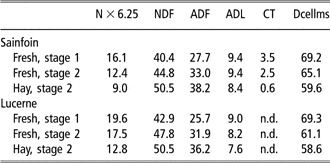
Nitrogen content was lower in sainfoin than in lucerne, while only small differences were observed for cell-wall contents (Table 1). As expected, within each species, N content was lower and NDF and ADF contents were higher with plant maturity. Pepsin-cellulase digestibility remained similar between species and was lower with plant maturity. N content and pepsin-cellulase digestibility were lower for hays, whereas NDF and ADF content were higher than fresh forages. The CT content of sainfoin decreased with growth stage and was lower for sainfoin hay.
Chemical composition (%DM) and pepsin-cellulase digestibility (Dcellms) of sainfoin and lucerne studied as fresh forages at the vegetative and the early flowering (stage 1 and stage 2, respectively), and as hay corresponding to stage 2

DM = dry matter; CT = condensed tannins; n.d. = not determined.
Ingestibility, digestibility and N balance
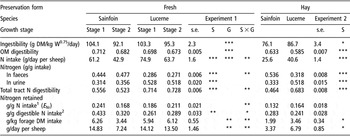
Ingestibility (g DM/kg W0.75) and organic matter digestibility (OMD) were similar on fresh forages at the same date and decreased within each species (P < 0.001) with growth stage (Table 2). The OMD of sainfoin hay was higher than that of lucerne hay (P < 0.001). The N intake (g/day per sheep) was lower for sainfoin (P < 0.001) and decreased within each species (P < 0.001) with growth stage.
Ingestibility (g/kg W0.75), N intake (g/day per sheep), organic matter (OM) and nitrogen (N) digestibility in the total tract and N retention variables measured on two groups of six sheep fed ad libitum simultaneously sainfoin or lucerne as fresh forage at the vegetative stage (stage 1) and the early flowering stage (stage 2) (experiment 1), and for both forages studied as hays at stage 2 (experiment 2)

Probability of significant effects due to the species (S), the growth stage (G) and their interaction (S×G) in the first statistical analysis for fresh forages and probability of significant effects due to the species (S), in the second analysis for hays (*P < 0.05; **P < 0.01; ***P < 0.001).
1Called efficiency of N utilisation in the text.
2Called coefficient of N retention in the text.
N digestibility was much lower (by 0.16 to 0.20 unit, P < 0.001) for sainfoin than for lucerne. N digestibility decreased with plant maturity for sainfoin only (S × G, P = 0.0015). The relative proportions of N excreted in the urine and in the faeces differed markedly between species: the urinary fraction was much larger than the faecal fraction with lucerne, whereas the opposite pattern was observed with sainfoin. For both forages, the fraction of N excreted in the urine did not vary with growth stage.
Hence, the efficiency of N utilisation (E Nr) did not differ between species. Sainfoin and lucerne exhibited similar E Nr values at the vegetative stage, and maturity led to a decrease in E Nr only for sainfoin. The coefficient of N retention was highest for sainfoin at the vegetative stage (0.43 v. 0.26, P < 0.01) and similar in the other forages. The amount of N retained per kg DM intake did not differ between species at the vegetative stage (6.3 and 5.9 g N/kg DM) and decreased with maturity only for sainfoin (S × G, P = 0.002). The amount of N retained per kg DM intake was lower for sainfoin hay (P = 0.02) than for lucerne hay. The variations in the amount of N retained per day paralleled those of N retained per kg DM intake. N retained per day was high and similar with both species at the vegetative stage. As forages matured, N retained per day remained high for lucerne but was halved for sainfoin (S × G, P = 0.003). N retained per day was halved for sainfoin hay (P = 0.026) compared to lucerne hay.
In situ dry matter and N degradability in the rumen
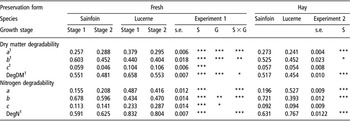
In the fresh forages, the DegDM of sainfoin was lower (P < 0.001) than that of lucerne (by 0.07 to 0.10 unit) and decreased with growth stage (P < 0.001) for both species (Table 3). The DegDM of sainfoin hay was higher than that of lucerne hay (P < 0.001).
In situ rumen degradability (Deg) of dry matter (DM) and Nitrogen (N) in sainfoin and lucerne studied as fresh forges at the vegetative stage (stage 1) and at the early flowering stage (stage 2) (Experiment 1) and for both forages studied as hays at stage 2 (Experiment 2)

1a = rapidly degradable fraction, b = slowly degradable fraction, c = degradation rate of fraction b; DegDM or DegN: in situ ruminal degradability of DM or N: in situ ruminal degradability of DM or N calculated with a passage rate of 0.06/h.
Probability of significant effects due to the species (S), the growth stage (G) and their interaction (S × G) in the analysis for fresh forages (Experiment 1) and probability of significant effects due to the species (S) in the analysis for hays (Experiment 2).
*P < 0.05; **P < 0.01; ***P < 0.001.
DegN was lower for sainfoin than for lucerne (P < 0.001). With lucerne, DegN showed a small decrease with growth stage (S × G, P < 0.001). The soluble N fraction ‘a’ was much smaller for sainfoin than for lucerne, and the opposite pattern was observed for fraction ‘b’. Within each species, both fractions showed small variations with growth stage. The same variations of fractions ‘a’ and ‘b’ were observed for hays.
In situ N digestion in the small intestine
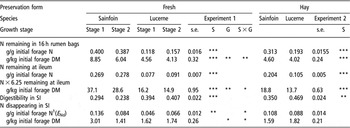
In agreement with the results measured for DegN, the fraction of forage N remaining in the nylon bags after 16-h incubation in the rumen was much higher for sainfoin than for lucerne, regardless of growth stage (Table 4). The fraction of forage N remaining in the bags recovered at the ileum was 2 to 3 times higher for sainfoin than for lucerne, with small variations within each species. This amount of indigestible forage N, which was expressed as gN × 6.25 per kg DM, showed small variations in the lucerne forages and was much higher for sainfoin forages, decreasing further with growth stage. The digestibility of rumen-undegraded forage N in the SI was low with both species and much lower (P < 0.001) for sainfoin than for lucerne. Digestibility in the SI was unaffected by growth stage.
Forage nitrogen (N) remaining in bags after 16-h incubation in the rumen and after passage through the abomasum and the small intestine (SI); digestibility in the SI of 16 h rumen residual forage N; forage N disappearing from mobile nylon bags in the SI. All results were expressed in gN or N × 6.25/g initial forage N and in g/kg initial forage DM, except digestibility in SI

Probability of significant effects due to the species (S), the growth stage (G) and their interaction (S × G) in the first statistical analysis and probability of significant effects due to the species (S) in the second analysis for hays (*P < 0.05; **P < 0.01; ***P < 0.001).
1Called efficiency of forage N digestion in the text (E Nd).
The efficiency of N digestion (E Nd) was much higher with vegetative sainfoin than with all other forages, which showed no differences. Finally, the amount of N disappearing from bags in the small intestine, expressed as per kg of forage DM, was twice higher for fresh sainfoin at stage 1 than for the other forages studied.
Discussion
Chemical composition
The differences in N and cell-wall contents between sainfoin and lucerne compared at the same stage agreed with the literature data (Jarrige, Reference Jarrige1989; Kraiem et al., Reference Kraiem, Garrett, Meiske, Goodrich and Marten1990). The decrease in CT content with age in sainfoin was probably due to the increase in the stem-to-leaf ratio with growth stage (Lees et al., Reference Lees, Gruber and Suttill1995). This rapid change at the beginning of flowering also explained the more rapid decrease of N content in sainfoin than in lucerne. Losses of leaves in the hay during the hay-making process and sun exposure may explain the low CT content in hay (Borreani et al., Reference Borreani, Peiretti and Tabacco2003). CT content in fresh sainfoin was within the optimal range where tannins improve N digestion efficiency in ruminants (30 to 40 g/kg DM, Barry and McNabb, Reference Barry and McNabb1999). Growth stage may alter not only CT content but also its structure in a way that makes tannins more reactive (Koupai-Abyazani et al., Reference Koupai-Abyazani, McGallum, Muir, Bohm, Towers and Gruber1993). Hence, in the present study, sainfoin at stage 2 had a lower CT content, but these CT may have been more reactive than at stage 1.
The differences in chemical composition (total N, NDF, ADF, pepsin-cellulase digestibility) between fresh forages at stage 2 and hay were due to the loss of leaves when drying forage.
Energy value and ingestibility
Energy value is mainly determined by OMD. In agreement with in vitro digestibility, OMD was slightly higher for sainfoin than for lucerne. Kraiem et al. (Reference Kraiem, Garrett, Meiske, Goodrich and Marten1990) observed no differences between lucerne, birdsfoot trefoil and sainfoin when compared as hays or silage harvested at the early flowering stage. Comparing fresh sainfoin and white clover at the vegetative stage, Ulyatt and Egan (Reference Ulyatt and Egan1979) found a lower OMD for sainfoin (76% v. 84%), but white clover is known to be more digestible than lucerne.
It is likely that lucerne has a high passage rate through the rumen, which could explain the higher ingestibility and lower digestibility (Dewhurst et al., Reference Dewhurst, Evans, Scollan, Moorby, Merry and Wilkins2003). The higher digestibility of sainfoin hay may be due to a greater cell-wall digestibility compared with lucerne (Harrison et al., Reference Harrison, Beever, Thomson and Osbourn1973) and a lower leaf loss during drying.
Waghorn et al. (Reference Waghorn, Ulyatt, John and Fisher1987) and Wang et al. (Reference Wang, Waghorn, McNabb, Barry, Hedley and Shelton1996) found no effect of CT on OMD and ingestibility when studying Lotus corniculatus with 2% to 3% active CT. In a study on Lotus pedunculatus, which is more CT-rich than the sainfoin used, Waghorn et al. (Reference Waghorn, Shelton and McNabb1994a) observed no effect of CT on OMD, but they highlighted a decrease in DM ingestibility. Reported increases in CT content in L. pedunculatus (Barry and Manley, Reference Barry and Manley1984; Barry et al., Reference Barry, Manley and Duncan1986) resulted in a decrease in OMD. Bermingham et al. (Reference Bermingham, Hutchinson, Revell, Brookes and McNabb2001), comparing fresh sainfoin with sulla, obtained a higher OMD with sainfoin than with sulla. The tannin effect assessed by PEG addition showed a less-marked decrease for sainfoin OMD than for sulla. The CT in sainfoin and L. pedunculatus are known to have a similar structure and to be more reactive than the CT of L. corniculatus and sulla (Marais et al., Reference Marais, Mueller-Harvey, Vincent Brandt and Ferreira2000; Min et al., Reference Min, Barry, Attwood and McNabb2003).
Based on these comparative data between different forage legumes, there appears to be no relationship between the amount and nature of CT and their effects on OMD and ingestibility.
Nitrogen value
In vivo measurements
The higher amount of N lost with lucerne than with sainfoin through faeces and urine must be related to the higher N content of the former, whereas digestible OM content was similar in the two species. The presence of CT associated with the lower N content would logically suggest a higher E Nr for sainfoin, but the comparison between fresh forages at stage 1 only indicated a tendency (P = 0.08). The lower E Nr of fresh sainfoin at stage 2 compared with stage 1 is related to the higher N excretion in faeces and urine, and more precisely to a lower coefficient of N retention, whereas there is no change with lucerne. The low E Nr with hays was mainly due to the decrease in N digestibility with both species. In agreement with our results, Egan and Ulyatt (Reference Egan and Ulyatt1980) observed that N retained (g/day) was halved with a late-cut sainfoin compared with an early-cut sainfoin.
As expected, the fraction of N intake excreted in the faeces showed an inverse relationship with feed N content and N intake, being higher for sainfoin than for lucerne forages. However, the difference between species for this fraction, and consequently for N digestibility (0.16 to 0.20 unit), is too large to be attributable solely to differences in the N content between forages. The differences are also caused by the presence of CT in sainfoin (Harrison et al., Reference Harrison, Beever, Thomson and Osbourn1973; Kraiem et al., Reference Kraiem, Garrett, Meiske, Goodrich and Marten1990). Thus there is a systematic decrease in N digestibility when CT are present. The amplitude of this effect varies according to forage species, CT content and structure. The CT in L. corniculatus led to a less-marked decrease in N digestibility (Waghorn et al., Reference Waghorn, Ulyatt, John and Fisher1987; Chiquette et al., Reference Chiquette, Cheng, Rode and Milligan1989) than the CT in L. pedunculatus (Barry et al., Reference Barry, Manley and Duncan1986; Waghorn et al., Reference Waghorn, Shelton, McNabb and McCutcheon1994b) or the CT in our sainfoin.
The high urinary N excretion for lucerne contrasted with that observed for sainfoin. It results from the high digestible N content and the high ruminal N degradability in lucerne compared with sainfoin, whereas both forages have similar OMD. The CT in sainfoin protects proteins from ruminal degradation, as shown by the large difference between the two species for DegN and urinary N. However, the intestinal digestibility of sainfoin was lower than that of lucerne, resulting in a higher excretion in faeces. Hence N retention was similar.
In situ measurements
There are few reports of studies on tannin-containing forages involving in situ measurements using nylon bags in the rumen and intestine. The technique makes it possible to estimate the amount of feed N digested in the small intestine, contributing along with microbial N, to the N value of the forage.
Rumen degradability
The mean DegN for the three sainfoin forages (0.62) in the present work was close to the value reported by O. Necdet (personal communication), whereas Turgut and Yanar (Reference Turgut and Yanar2004) found a DegN of 0.70 for lucerne and sainfoin hays. As expected, the DegN for lucerne decreased with the growth stage, while small differences were observed among sainfoin fresh forages (S × G, P < 0.001), probably as a result of the opposite effects of growth stage and variation in CT content. The most notable difference was the higher DegN of lucerne compared with sainfoin forages. The high N content and the high values of the ‘rapidly degradable fraction’ and ‘degradation rate’ for lucerne led to a high N wastage in urine compared with sainfoin, as discussed above.
Intestinal digestibility
The SI digestibility of residual N from lucerne, which was estimated using the mobile nylon bag technique, was lower than the published values for tannin-free forages (Hvelplund et al., Reference Hvelplund, Weisberg and Andersen1992; Trinacty et al., Reference Trinacty, Homolka, Zeman and Ritcher2003). Nevertheless, for lucerne, the concentration of residual N at the end of the small intestine was similar to published values for tannin-free forages (Nozieres et al., 2005). This residual N in the ileum is a more reliable estimate of feed N availability than N digestibility in the small intestine, which can be strongly affected by methodological constraints such as representativeness of the 16-h rumen feed residue placed in the mobile bags, correction for microbial N contamination or site of bag recovery (Yang, 1991; Hvelplund et al., Reference Hvelplund, Weisberg and Andersen1992). In the present study, microbial N interferences were eliminated as much as possible, and digestion of residual feed N in the large intestine was ruled out by the ileal recovery of intestinal bags. These measurement conditions certainly contributed to the low level of N digestibility obtained. The decrease in forage N digestibility in the SI with sainfoin at stage 2 contrasts with the decrease in CT content, but this may have resulted from the decrease in N content as the forage matured, or be due to the different structure of CT and a higher binding capacity to the protein.
The higher E Nd (Table 4) for fresh sainfoin at stage 1 resulted from a significant N escape from the rumen that was not counterbalanced by lower forage N digestibility. This level of N escaping the rumen (0.37 to 0.40) was in the upper range of values reported. The similar E Nd among fresh sainfoin at stage 2, sainfoin hay and the lucerne forages reflected low CT and N contents for sainfoin and N wastage for lucerne.
The amount of forage N digested in the small intestine per kg DM intake is a component of the feed N value. Since this amount is the product of E Nd and N content, its variations paralleled those of E Nd. For sainfoin, the high N content at stage 1 enhanced the difference from the two other sainfoin forages. For lucerne, the decrease in N content with growth stage and the low value with hay prevented an increase in E Nd. Finally, the in situ estimate of forage N disappearing from bags in the small intestine (g/kg DM intake) was twice higher for fresh sainfoin than for all the other forages, which did not differ. This agrees with the results of Harrison et al. (Reference Harrison, Beever, Thomson and Osbourn1973). Comparisons of sainfoin with lucerne (Kraiem et al., Reference Kraiem, Garrett, Meiske, Goodrich and Marten1990) or white clover (Egan and Ulyatt, Reference Egan and Ulyatt1980) showed a similar E Nd among these species, but the N content in sainfoin was lower. Kraiem et al. (Reference Kraiem, Garrett, Meiske, Goodrich and Marten1990) also found no difference in N digestion between isonitrogenous L. corniculatus and lucerne, showing that CT in lotus had no beneficial effect. Conversely, Bermingham et al. (Reference Bermingham, Hutchinson, Revell, Brookes and McNabb2001) reported that the E Nd was lower for sainfoin than for sulla. This was the result of a lower N content in sulla and a lower reactivity of sulla CT, leading to a higher N digestibility in the small intestine.
The accordance between variations in E Nd (in situ estimate) and variations in E Nr obtained by direct balance measurements on animals should be underlined. The only valuable results for comparisons with in situ measurement of forage N digestion and total N retention by animals are from in vivo digestive balance studies with intestinal flow measurements where N of both feed and microbial origins were estimated separately. However, there are few published reports allowing these correlations. Generally, CT improve ruminal digestive N balance (duodenal N flow/N intake), through an increase in feed N by-passing the rumen, which is modulated by variations (increases or decreases) in the effect of CT on microbial N flow. Conversely, CT decrease intestinal N digestibility through an incomplete dissociation of tannin–protein complexes or by impairing the absorption process at the intestinal wall under the acidic conditions of the abomasums and duodenum, or from an adverse effect on proteolytic enzymes within the intestinal content or in the vicinity of residual forage particles inside the bags (Silanikove et al., Reference Silanikove, Perevolotsky and Provenza2001). The relative importance of these opposite effects determines the nutritional utility of CT in terms of N digested in the small intestine per g N intake or per kg DM intake.
Conclusion
In vivo N balance trials showed that the efficiency of N utilisation by the animal as well as N retained per kg forage DM intake or per day in sheep fed ad libitum were similar only for fresh sainfoin and lucerne, at the vegetative stage. In both species, a decrease in these parameters was observed with hays, mainly because of the lower forage N content.
Compared with lucerne, sainfoin greatly increased the in situ estimate of forage N escaping from the rumen but decreased its intestinal digestibility. The amount of forage N disappearing from the bags in SI per g forage N (E Nd) or per kg DM was highest for fresh vegetative sainfoin in stage 1 and remained similar for all the other fresh forages (experiment 1) and hays (experiment 2) studied. The decrease in forage N digestibility in the SI for sainfoin at stage 2 contrasts with the decrease in CT content, but this may have been a result of the lower N content as the forage matured, or to the different structure of CT and a higher binding capacity to the protein.
In each species, similar variations were observed between E Nd (in situ estimate) and E Nr (direct balance measurements on animals). The present results show that harvesting fresh sainfoin at the vegetative stage for grazing would afford a good feed value. Further research is needed to study the structure of tannins according to the growth stage and the kinetics of the tannin–protein interaction throughout the digestive tract.
Acknowledgements
The authors thank the entire staff of the experimental farm (‘Annexe Elevage’) for their diligent care of experimental animals, Bernard Debotte for his advice on establishing sainfoin swards and Eric Villeneuve and his staff for growing and cropping the forages.