Background
Correlating patients' perceptions of asymmetrical nasal obstruction with their objective contributory anatomical factors is important before surgical intervention. Managing a patient whose assessment of asymmetry does not match their clinical findings can be challenging.
Rhinomanometry can provide reliable and objective information about nasal airflow. Hirschberg and Rezek demonstrated a correlation between subjective assessment of nasal obstruction and objectively measured unilateral nasal airway resistance, and found that subjective reporting of the more obstructed side had a specificity of 84 per cent.Reference Hirschberg and Rezek1 Additionally, a patient's ability to identify the more obstructed side was better in those with pathological as compared with normal nasal resistance.Reference Sipila, Suonpaa and Laippala2 It was also better when the airflow difference between the two sides was larger relative to total airflow: when the difference in airflow was greater than 100 cm3/second, the sensitivity of subjective assessment was 95 per cent.Reference Clarke, Hopkins and Eccles3
While rhinomanometry is a good objective measure, it is affected by changes in the nasal cycle. Repeated measures in the same nostril need to account for such intrinsic variability. True asymmetry in unilateral nasal airway resistance may be better defined by only including cases in which the difference between sides is greater than the intrinsic variability. The latter can be estimated from the co-efficient of variation of unilateral nasal airway resistance, which has been reported to be up to 15–17 per cent.Reference Silkoff, Chakravorty, Chapnik, Cole and Zamel4, Reference Thulesius, Cervin and Jessen5
Similarly, assessment of unilateral nasal obstruction using a visual analogue scale (VAS) results in wide variability, and sole reliance on VAS scores to predict airflow differences can be challenging.Reference Clarke, Hopkins and Eccles3 Differences in VAS scores for nasal obstruction may reach statistical significance, especially in large samples, even if such differences are not clinically significant for individual patients. True VAS score asymmetry can be better indicated by determining the point at which the VAS score difference is equal to or greater than the minimal clinically important difference.Reference Norman, Sloan and Wyrwich6, Reference Sloan7 This latter parameter represents the smallest difference in nasal obstruction VAS score which is considered significant in a population of patients.Reference Hays and Woolley8 Determining the minimal clinically important difference for nasal obstruction VAS score provides a basis for assessing whether the difference in subjective nasal obstruction between sides is clinically significant in any one patient.
The aims of the present study were: (1) to describe the characteristics of subjective unilateral nasal obstruction perception and objective unilateral nasal airway resistance measurement in patients with nasal obstruction; and (2) to determine the accuracy of subjective assessment of nasal obstruction compared with objective measures.
Materials and methods
We performed a cross-sectional study of patients undergoing nasal airflow assessment for nasal obstruction.
Ethics committee approval was obtained.
The age and gender of each patient were recorded.
Patients with inflammatory nasal polyposis, sinonasal neoplasms, choanal atresia or stenosis, nasal septal perforation or piriform aperture stenosis were excluded.
Assessment
All patients underwent active anterior rhinomanometry to determine objective unilateral nasal airway resistance, and also completed a VAS indicating their subjective degree of unilateral nasal obstruction. Both were performed without decongestion. Rhinomanometry was performed in accordance with the 2005 consensus report of the International Rhinologic Society, in order to determine unilateral nasal airway resistance at 150 Pa.Reference Clement and Gordts9
It is known that topical decongestion reduces the effect of the nasal cycle and allows anatomical nasal patency to be assessed.Reference Williams and Eccles10, Reference Moore and Eccles11 As the aim of this study was to compare subjective and objective assessments of nasal obstruction at one time point under physiological conditions, rhinomanometric measurements were obtained without decongestion to avoid the potential for altered subjective assessment of airflow resulting from the use of a topical agent.Reference Andre, Vuyk, Ahmed, Graamans and Nolst Trenite12
Objective nasal obstruction assessment
Objective asymmetry in nasal obstruction was determined by calculating the difference in unilateral nasal airway resistance between sides (i.e. the unilateral nasal airway resistance on the right side minus the unilateral nasal airway resistance on the left side), based on results from active anterior rhinomanometry. A positive value (i.e. higher unilateral nasal airway resistance on the right) represented right-sided obstruction, while a negative value (i.e. higher unilateral nasal airway resistance on the left) represented left-sided obstruction.
To account for the variability of unilateral nasal airway resistance measurements, as previously explained, true asymmetry was defined as a percentage difference in unilateral nasal airway resistance between sides (i.e. unilateral nasal airway resistance (higher) – unilateral nasal airway resistance (lower)/unilateral nasal airway resistance (higher) × 100 per cent) of more than 15 per cent.Reference Silkoff, Chakravorty, Chapnik, Cole and Zamel4, Reference Thulesius, Cervin and Jessen5 A difference in unilateral nasal airway resistance of less than 15 per cent was taken to indicate symmetrical nasal obstruction.
Subjective nasal obstruction assessment
Patients rated their nasal obstruction on a linear scale from 0 to 100 mm (0 mm = no obstruction; 100 mm = complete obstruction). Their perceptions of nasal obstruction for both the left and right sides were recorded. A patient's subjective perception of the sidedness of their nasal obstruction asymmetry was determined by subtracting the VAS score for the left side from that for the right side (i.e. difference in VAS score = Score(right) – Score(left)).
Patient perception of the sidedness of nasal obstruction asymmetry was defined using two thresholds: absolute difference and minimal clinically important difference.
When using the absolute difference, a positive or negative value represented the perception of right or left nasal obstruction, respectively. Equivalence of VAS score between sides indicated perception of symmetrical nasal obstruction.
The minimal clinically important difference was calculated (using a distributional method) to equate to half the standard deviation (SD) of the nasal obstruction VAS score for the whole group.Reference Wyrwich, Tierney and Wolinsky13 If the nasal obstruction asymmetry sidedness value was more than the minimal clinically important difference, this was classified as perception of right nasal obstruction if positive and left nasal obstruction if negative. If the nasal obstruction asymmetry sidedness value was less than the minimal clinically important difference, this was classified as perception of symmetrical nasal obstruction.
Perception of the magnitude of nasal obstruction asymmetry was calculated by subtracting the VAS score of the less obstructed side from that of the more obstructed side (i.e. VAS(higher side) – VAS(lower side)).
Statistical analysis
One-way analysis of variance (ANOVA) was calculated for nasal obstruction asymmetry sidedness (right minus left) and nasal obstruction asymmetry magnitude (more minus less obstructed), for each group. Bonferonni post-hoc analysis was applied if the p value for one-way ANOVA was less than 0.05.
The accuracy of subjective nasal obstruction asymmetry sidedness for correctly identifying the more obstructed side (as defined objectively by unilateral nasal airway resistance) was calculated using two by two tables, with either the absolute difference or the minimal clinically important difference as the threshold. Receiver characteristic operator curves for subjective nasal obstruction asymmetry sidedness as a predictor of objective asymmetry (i.e. unilateral nasal airway resistance) were generated.
Statistical analysis was performed using the IBM SPSS version 17.0 software program (SPSS Ltd, Chicago, Illinois, USA).
Results
Patient characteristics
One hundred and forty-five patients were assessed. These patients' mean age ± SD was 42.8 ± 16.6 years. Female patients made up 54.5 per cent.
Objective nasal obstruction assessment
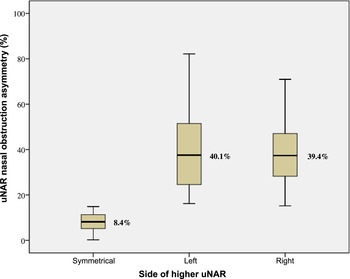
Rhinomanometric results indicated that unilateral nasal airway resistance was symmetrical in 31.0 per cent of patients (n = 45) and asymmetrical in 69.0 per cent (n = 100); the corresponding mean percentage difference between unilateral nasal airway resistance for each side of the nose is shown in Figure 1. Nasal obstruction was right-sided in 32.4 per cent of participants (n = 43) and left-sided in 36.6 per cent (n = 57).
Box plot showing objective nasal obstruction asymmetry (expressed as percentage difference in unilateral nasal airway resistance (uNAR) between the more and less obstructed side) versus side of higher uNAR. Central bars and figures indicate means. Symmetry was defined as a uNAR difference of less than 15 per cent.

Subjective nasal obstruction assessment
Nasal obstruction asymmetry
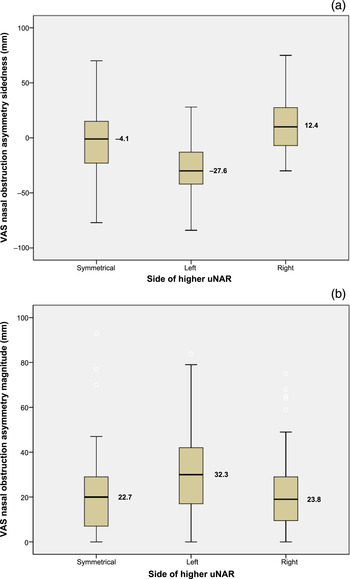
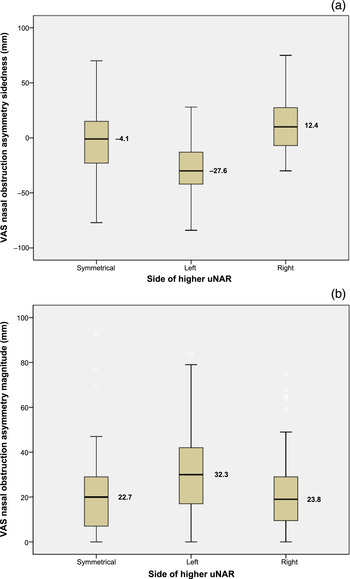
The means ± SDs for perceptions of the sidedness of nasal obstruction asymmetry (i.e. differences in nasal obstruction VAS scores, right side minus left side) for patients with right-sided, left-sided and symmetrical nasal obstruction were respectively 12.4 ± 28.7 mm, −27.6 ± 27.1 mm and −4.1 ± 30.6 mm (one-way ANOVA, p < 0.001) (Figure 2a). The means ± SDs for perceptions of the magnitude of nasal obstruction asymmetry (i.e. differences in nasal obstruction VAS scores, more obstructed side minus less obstructed side) for patients with right-sided, left-sided and symmetrical nasal obstruction were respectively 23.8 ± 20.1 mm, 32.3 ± 21.2 mm and 22.7 ± 20.6 mm (one-way ANOVA, p = 0.043; Bonferroni test, p > 0.05) (Figure 2b).
Box plots showing subjective perception of nasal obstruction asymmetry versus objective assessment of unilateral nasal airway resistance (uNAR). Central bars and figures indicate means. (a) Patients' perception of nasal obstruction asymmetry sidedness, calculated as the difference between visual analogue scale (VAS) scores, right minus left side (positive = right-sided obstruction; negative = left-sided obstruction). (b) Patients' perception of nasal obstruction asymmetry magnitude, calculated as the difference between VAS scores, more obstructed minus less obstructed side. For both parameters, symmetry was defined as a uNAR difference of less than 15 per cent.
Nasal obstruction minimal clinically important difference
This parameter was calculated to equal 13 mm (SD, 0.5 mm), based on a nasal obstruction VAS score SD of 26.0 mm for the whole group.
Sensitivity, specificity and positive predictive value of subjective nasal obstruction asymmetry
The sensitivity and specificity of patients' subjective perception of nasal obstruction asymmetry sidedness, for correctly identifying the more obstructed side, were respectively 86.9 and 41.1 per cent when using the minimal clinically important difference as the threshold value to define subjective asymmetry. When the absolute difference in nasal obstruction VAS scores was used as the threshold value, the specificity of subjective obstruction scoring was only 15 per cent.
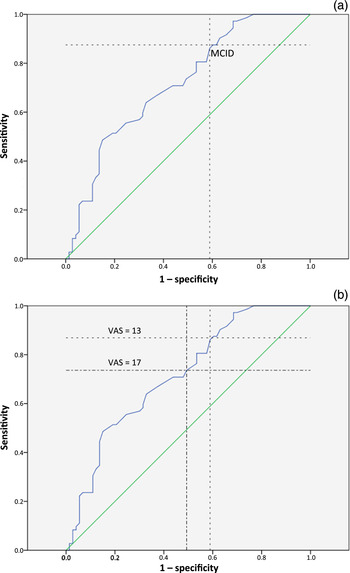
The positive predictive value was 59.4 per cent using the absolute difference between nasal obstruction VAS scores, and 53.7 per cent using the minimal clinically important difference. Receiver operator characteristic curve analysis detected a correlation between subjective nasal obstruction asymmetry sidedness values and objective unilateral nasal airway resistance (p < 0.001), and suggested that a value of 13–17 mm for the former parameter best predicted the presence of asymmetrical resistance according to the latter parameter (Figure 3).
Receiver operator characteristic curves for the accuracy of nasal obstruction asymmetry sidedness in predicting the side with higher unilateral nasal airway resistance. (a) Curve using minimal clinically important difference (MCID; see text for explanation). (b) Curve using absolute nasal obstruction visual analogue scale score difference, within the range 13–17 mm. Blue line = receiver operator characteristic curve; green line = plot line for set of co-ordinates defining a test not differentiating one state from the other

Discussion
A majority of patients report asymmetry in their sense of nasal obstruction. The choice of the appropriate surgical procedure is simple if the patient's symptoms can be correlated with the clinical findings. Objective testing provides additional information about the nasal airway and may assist in the evaluation of patients for surgery. To this end, both anterior rhinoscopy and nasal endoscopy have been shown to correlate with rhinomanometry.Reference Tompos, Garai, Zemplen and Gerlinger14, Reference Sanz, Guerrero and Rivera15
However, some patients may be symptomatic and have perceived asymmetry in nasal breathing, in addition to the overall level of obstruction.Reference McKee, O'Neill, Roberts and Lesser16 Therefore, surgical procedures aimed at correcting nasal obstruction should also strive to achieve symmetry in nasal breathing, in order to maximise patient satisfaction. This is especially pertinent in the case of revision nasal and rhinoplasty surgery.Reference Thomson and Mendelsohn17
While systematic review suggests that subjective overall nasal obstruction correlates well with unilateral nasal airway resistance, discrimination of the more obstructed side is not consistent and becomes unreliable when the difference between sides is less.Reference Clarke, Hopkins and Eccles3, Reference Andre, Vuyk, Ahmed, Graamans and Nolst Trenite12 Many non-anatomical factors affect subjective assessment of nasal airflow, such as an altered sensation of airflow, and may explain this phenomenon.Reference Naclerio, Bachert and Baraniuk18
The nasal cycle affects the state of nasal congestion and hence airflow over time.Reference Arbour and Kern19 The aim of the present study was to compare subjective versus objective nasal obstruction (using nasal obstruction VAS score and unilateral nasal airflow resistance, respectively) at one time point under physiological conditions. The nasal obstruction VAS score was assessed just before rhinomanometry. While it is possible that the degree of nasal congestion could have changed between subjective and objective assessments, such a change is unlikely to have been of significant magnitude to invalidate interpretation of results, given that changes in the nasal cycle occur over a period of hours.Reference Moore and Eccles11 Furthermore, the use of the minimal clinically important difference as a threshold for defining subjective asymmetry may help to minimise potential confounding in relation to nasal cycle changes. Without applying this threshold, absolute values of nasal obstruction VAS score alone had very little value in distinguishing which side was more obstructed.
Patients' perceptions of which side was more obstructed correlated with unilateral nasal airway resistance findings (Figure 2a). This suggests that if a true asymmetry in nasal resistance was present, patients were likely to correctly identify the more obstructed side. Patients' perceptions of nasal obstruction asymmetry sidedness had a sensitivity of 86.9 per cent for detecting unilateral nasal airway resistance, using the minimal clinically important difference as the threshold; this concurs with Thulesius and colleagues' recent report that nasal obstruction VAS score correlates with rhinomanometric assessment of nasal airway asymmetry in 82.3 per cent of patients.Reference Thulesius, Cervin and Jessen20
• Patient-perceived nasal obstruction sidedness does not always correlate with objective measures
• This study assessed correlation between rhinomanometry and visual analogue scale (VAS) scores (100 mm scale) for nasal obstruction
• To account for intrinsic variability, a (statistically derived) minimal clinically important difference of VAS 13 mm was used as an asymmetry detection threshold
• Subjective VAS score asymmetry had a sensitivity, specificity and positive predictive value of 86.9, 41.1 and 53.7 per cent, respectively, in detecting the more obstructed side
• Objective airway testing may be helpful when patients' perceptions do not match clinical findings
Nevertheless, patients' perceived magnitude of nasal obstruction asymmetry did not differ significantly between groups, suggesting that patients without significant nasal resistance asymmetry were approximately as likely to perceive asymmetry as those with significant nasal resistance asymmetry (Figure 2b). Patients sometimes identified a greater sense of obstruction on the side where airway resistance was actually less, as was the case for 17.7 per cent of patients in Thulesius and colleagues' study.Reference Thulesius, Cervin and Jessen20 In that study, while the correlation between nasal obstruction VAS score and rhinomanometry was significant at a difference in unilateral nasal airway resistance of 0.36 Pa/cm3/second or more, smaller differences in unilateral nasal airway resistance were more likely to result in discordance between subjective and objective assessment. This highlights the difficulty in interpreting small differences in nasal airway resistance in the context of rhinomanometric test variability.Reference Thulesius, Cervin and Jessen5 This issue emphasises the potential value of defining a threshold with which to identify a true difference in unilateral nasal airway resistance between sides; this was a key part of the methodology of the present study.
In summary, while nasal obstruction VAS score is sensitive for identifying the more obstructed side when there is asymmetry in nasal breathing, its low specificity limits its value as a sole discriminatory tool, even when the minimal clinically important difference is used as the threshold. Concordance of subjective perception with clinical findings can increase the positive predictive value; conversely, a lack of agreement should prompt consideration of objective testing, especially if this will affect surgical decision-making.
Conclusion
The accuracy of subjective perception of nasal obstruction asymmetry is limited. Corroboration with objective airway assessment may be helpful in evaluating patients whose symptoms are incongruous with clinical findings. A 13 mm minimal clinically important difference is recommended when using a 100 mm VAS.