


Introduction
What do young generations of voters care about? This question has recently (re-)gained importance since many younger voters across Western Europe are turning away from mainstream parties and supporting new political alternatives (Milosav et al. Reference Milosav, Dickson, Hobolt, Klüver, Kuhn and Rodon2025; Steiner Reference Steiner2023). While age is typically a well-documented predictor of differences in party choice (Geys et al. Reference Geys, Heggedal and Sørensen2022; Rekker Reference Rekker2024), candidate preferences (Eshima and Smith Reference Eshima and Smith2022; Sevi Reference Sevi2021), or political attitudes (Peterson et al. Reference Peterson, Smith and Hibbing2020; O’Grady Reference O’Grady2023), less is known about whether these age differences extend to issue salience. However, given that political competition increasingly revolves around the salience of specific issues rather than parties’ programmatic positions (Carella and Raffaelli Reference Carella and Raffaelli2026; Green-Pedersen Reference Green-Pedersen2007; Kurella and Rapp Reference Kurella and Rapp2026a), investigating whether young and older citizens disagree about “what matters” in politics could be central to understanding the ongoing transformation of Western European politics, partly driven by younger generations.
Following the issue salience literature, I assume that some political issues matter more to some groups of individuals than others (Dennison Reference Dennison2019; Krosnick Reference Krosnick1990; Moniz and Wlezien Reference Moniz and Wlezien2020; RePass Reference RePass1971). Despite its importance, subgroup variation in issue salience has rarely been comprehensively and rigorously analyzed (Lauderdale and Blumenau Reference Lauderdale and Blumenau2025; Paul and Fitzgerald Reference Paul and Fitzgerald2021). Age, in particular, has been largely empirically neglected as a factor leading to salience differences (Umeda Reference Umeda2022), even though different theoretical reasoning offers arguments about why age groups might prioritize issues differently, with literature identifying life-cycle (Busemeyer et al. Reference Busemeyer, Goerres and Weschle2009) and socialization effects (Grasso et al. Reference Grasso, Farrall, Gray, Hay and Jennings2019) affecting political ideology. Despite these theoretical expectations, existing studies either often focus on a relatively narrow set of issues (Umeda Reference Umeda2022), rely on methodologically limited instruments such as the “most important problem” question, which has often been criticized (see Moniz and Wlezien (Reference Moniz and Wlezien2020); Wlezien (Reference Wlezien2005)), or do not disentangle issue attitudes from issue salience when analyzing political differences between the young and old. Using original survey data from Germany and Switzerland, this paper aims to address these limitations by applying two complementary methods: rating tasks, in which respondents distribute fictional points across six issue areas according to their priorities, and a pairwise choice experiment in which respondents compare 42 political issues drawn from widely used voting advice applications (“Wahl-O-Mat” from Germany and “Smartvote” from Switzerland).
The results from both approaches show that some meaningful differences emerge when salience perceptions of young and older generations are compared: Younger respondents in both countries consistently assign more salience to issues related to gender equality and less salience to immigration. The findings regarding gender equality hold across both countries and are robust to controls for issue attitudes, suggesting that the differences reflect genuine divergence in political priorities rather than only attitudinal polarization. Some country differences also emerge, with young respondents in Switzerland prioritizing a selection of age-specific material concerns such as minimum wages and public transport prices, whereas young respondents in Germany diverge in issue prioritization from older ones regarding army spending and immigration issues.
Overall, the paper makes two main contributions to the literature on issue salience. First, methodologically, it introduces a novel combination of two analytical approaches in order to study issue salience, offering a more comprehensive and nuanced measurement than prior approaches. Second, it argues that age groups hold different priority perceptions for two main reasons and provides systematic evidence that younger voters’ political priorities diverge due to both cohort-level value change (regarding gender equality and immigration issues) and life-stage-specific self-interest (regarding age-related socioeconomic issues). These findings, therefore, have implications for how we understand electoral developments in the post-industrial societies of Western Europe. The results add an important piece to understanding these trends by showing that younger voters not only hold different issue attitudes than older generations, but that they also prioritize different issues.
Argument
Issue salience
Issue salience has become one of the most important factors to explain electoral behavior and political ideology more generally (Bélanger and Meguid Reference Bélanger and Meguid2008; Danieli et al. Reference Danieli, Gidron, Kikuchi and Levy2022; Hanretty et al. Reference Hanretty, Lauderdale and Vivyan2020; Krosnick Reference Krosnick1988; Meguid Reference Meguid2005; RePass Reference RePass1971). The concept’s relevance is especially high in today’s democracies, where electorates have become more volatile (Dassonneville Reference Dassonneville2017, Reference Dassonneville2022) and voters base their decisions increasingly on issues and less on previously important factors such as class or partisan identification (Danieli et al. Reference Danieli, Gidron, Kikuchi and Levy2022), resulting in parties’ strategic approaches to push certain issues on the agenda and shaping voters’ priority perceptions on these issues (Dennison Reference Dennison2020; Kurella and Rapp Reference Kurella and Rapp2026a).
While issue salience is a frequently used concept to explain political outcomes, it has been defined differently or, more often than not, even remained “unspecified” as a theoretical and empirical concept in political science studies (Hanretty et al. Reference Hanretty, Lauderdale and Vivyan2020; Wlezien Reference Wlezien2005). As a common denominator, most research agrees that issue salience refers to the degree to which people engage with a certain political topic, making some issues more central than others for their decision-making and political beliefs (Krosnick Reference Krosnick1990; Moniz and Wlezien Reference Moniz and Wlezien2020). Broadly put, two main conceptualizations of salience have emerged in the literature: First, a socio-psychological understanding, and second, an understanding that treats salience as a weight of an individual’s behavior. In this paper, I rely on the former, socio-psychological definition of salience, deviating from the latter, “behavioral” perspective (Dennison Reference Dennison2019). Accordingly, salience is understood as a form of attitude, rather than only a “component” of an attitude that would be used to understand behavior. I define issue salience as the subjective importance that an individual attaches to a certain issue (or issue area) and the extent to which they deal with this issue cognitively (Moniz and Wlezien Reference Moniz and Wlezien2020; Wlezien Reference Wlezien2005). This places salience as a more fundamental concept, as it means that a person can be more receptive to issue-related information, more aware of party positions for that issue, and make more accurate decisions, or that a person is more willing to participate in the first place when this issue is at stake in an election. This socio-psychological perspective on issue salience must be distinguished from a macro-perspective which defines salience as an issue’s prominence in party manifestos, media debates, or campaigns (Kriesi and Hutter Reference Kriesi and Hutter2026; Soroka et al. Reference Soroka, Stecula and Wlezien2015).
While certain issues are more salient within society as a whole, there are reasons to expect that not all individuals perceive the same issues as equally important for politics (Off and Trastulli Reference Off and Trastulli2026). In this regard, three main factors have been identified that distinguish whether different individuals perceive issues as differently salient than others: Social-identification, self-interest, and value-based reasons (Dennison Reference Dennison2019; Krosnick Reference Krosnick1990). The first refers to group-based factors according to which a commonly shared identity leads individuals to relate more strongly to an issue. For example, people with a migration background have been shown to perceive immigration issues as more important because people identify with the targeted group, even if they might not be affected by the specific policy (Paul and Fitzgerald Reference Paul and Fitzgerald2021). Second, self-interest can lead to different salience considerations (Busemeyer and Lober Reference Busemeyer and Lober2020; Busemeyer Reference Busemeyer2024). For example, low-income individuals perceive low rent prices to be more important than people with high incomes because a specific policy outcome will have significant (material) consequences for them. Third, different political values likely affect salience perceptions. For example, highly educated individuals are more likely to perceive questions of multiculturalism or same-sex marriage as important, resulting from liberal values attained in higher education (Lindskog and Oskarson Reference Lindskog and Oskarson2022). In general, partisan ties can reinforce these values and affect salience perceptions (Neundorf and Adams Reference Neundorf and Adams2018).
While inherently present in the conceptualization of salience, empirical attempts to detect these differences have been surprisingly scarce, partly due to its methodological complexity (Lauderdale and Blumenau Reference Lauderdale and Blumenau2025). Still, recent approaches that attempted to analyze different groups’ salience have found subgroup differences in issue salience. For example, they show that voters from the new middle class put more emphasis on social expansion demands (Ares et al. Reference Ares, Häusermann, Enggist and Pinggera2024; Häusermann et al. Reference Häusermann, Pinggera, Ares and Enggist2022) and multiculturalism (Off and Trastulli Reference Off and Trastulli2026), and highly educated voters more strongly prioritize cultural progressive issues when evaluating a party’s program (Abou-Chadi et al. Reference Abou-Chadi, Häusermann, Mitteregger, Mosimann and Wagner2025). In contrast, in the two-party contexts of the US and the UK, voters with different ideologies only slightly differ in their degree of issue salience (Lauderdale and Blumenau Reference Lauderdale and Blumenau2025). Overall, revealing subgroup differences regarding issue salience provides important insight into voters’ motivations and behavioral patterns, and also why some voters do not react similarly to positional changes by parties (Magistro and Wittstock Reference Magistro and Wittstock2021).
Age differences in salience
Against this backdrop, empirical approaches studying age as a dividing line for issue salience are surprisingly rare (Umeda Reference Umeda2022), although age has been one of the most frequently studied determinants of political differences, with many researchers pointing to substantial divergences between younger and older citizens regarding attitudes, party identification, candidate preferences, and behavior (Busemeyer et al. Reference Busemeyer, Goerres and Weschle2009; Eshima and Smith Reference Eshima and Smith2022; Geys et al. Reference Geys, Heggedal and Sørensen2022; Peterson et al. Reference Peterson, Smith and Hibbing2020; O’Grady Reference O’Grady2023; Rekker Reference Rekker2024; Sevi Reference Sevi2021).
Often, salience has been studied by focusing on its macro-role as an explanatory variable for age groups’ behavior and ideology, e.g., by relying on party manifesto data or media analysis (see, for example, Hall et al. (Reference Hall, Evans and In Kim2023)) and disregarding whether different voters also share these salience perceptions. This contrasts with the fact that issue-based voting has become a more important determinant of the electoral behavior of younger generations (Jocker et al. Reference Jocker, van der Brug and Rekker2025; van der Brug and Rekker Reference van der Brug and Rekker2021), while some formerly important determinants of voting behavior, such as religiosity and union membership, have lost their relevance for the political preferences of younger cohorts (Gomez Reference Gomez2022; Shorrocks Reference Shorrocks2018). Furthermore, party attachments have weakened, leading younger voters to be more volatile in their political behavior (Dassonneville Reference Dassonneville2017). In this context of structural re- and dealignment, issue salience is an important factor to explain differences in political behavior and ideology.
Two main understandings of age-related effects regarding salience exist. One stream of researchers has sought to explain differences by arguing that salience perceptions among different age groups diverge due to age-related material needs specific to a certain life-stage (Busemeyer et al. Reference Busemeyer, Goerres and Weschle2009; Busemeyer and Lober Reference Busemeyer and Lober2020; Peterson et al. Reference Peterson, Smith and Hibbing2020; Umeda Reference Umeda2022). Accordingly, age differences in salience would exist regarding material and immaterial policies with clear age-related consequences, such as pension reforms or lowering the voting age, as these would affect the conditions of young and older citizens differently. Indeed, research has shown that individual issue salience of different welfare issues is a key predictor of voting differences between young and older voters (Umeda Reference Umeda2022). Thus, the idea of salience as a result of individuals’ life-stages assumes that salience remains flexible over an individual’s life. However, other evidence challenges this idea, demonstrating that issue salience tends to be relatively stable for individuals when they are repeatedly observed over time (Krosnick and Alwin Reference Krosnick and Alwin1989; Paul and Fitzgerald Reference Paul and Fitzgerald2021).
Alongside this, a second explanation emphasizes socialization experiences as drivers of salience differences between age groups. Following this idea, salience differences are formed when individuals become politically mature. In those impressionable years of “mental plasticity,” individuals are most open to new discourses, political actors, and debates, whereas this openness diminishes significantly with age (Peterson et al. Reference Peterson, Smith and Hibbing2020; Rekker et al. Reference Rekker, Keijsers, Branje and Meeus2015). In studies on postmaterialism (see Dalton Reference Dalton1984; Inglehart Reference Inglehart2008), individuals are thought to hold a hierarchy of values in which individual needs are ranked differently. Relying on the socio-psychological idea of material scarcity laid out by Maslow (Reference Maslow1943), core beliefs that lead to this hierarchy are derived from individuals’ socioeconomic surroundings: The more well-off an individual is, the more eagerly this person wishes to fulfill demands that rank higher on the “hierarchy of needs” and go beyond material safety and security. Accordingly, citizens place greater personal value on goods that are in relatively short supply. However, these priority perceptions are not thought of as deterministic, immediate, and short-term reactions, but rather as a subjective perception of a certain social context. They leave the strongest imprint in adolescence and are expected to persist as individuals age (Inglehart Reference Inglehart2018; Rekker et al. Reference Rekker, Keijsers, Branje and Meeus2015). Following this reasoning, newer generations are expected to consistently diverge from their predecessors’ political priorities depending on their social and economic surroundings in the years they have become politically mature, as their formative subjective experiences in a context of lower scarcity lead them to develop a different understanding of political importance (Henn et al. Reference Henn, Oldfield and Hart2018).
Besides this, I expect that issue salience differences between age groups result from a shift in electoral competition and political discourse in Western European democracies, leading to a different understanding of “what is at stake” in politics. Importantly, political actors and parties more specifically often try to, directly and indirectly, affect public perceptions of issue salience and contribute to different issues’ salience (Adams et al. Reference Adams, Samuel Merrill and Zur2024; Bélanger and Meguid Reference Bélanger and Meguid2008; Hall et al. Reference Hall, Evans and In Kim2023). These predominant narratives, which refer to the salience environment in formative years, shape and reinforce voters’ perceptions of which issues are most crucial (Carella and Raffaelli Reference Carella and Raffaelli2026). During the first decades of the 20th Century, voters grew up in a time when the decisive political debates centered around the distribution of wealth and the role of state intervention in liberal markets. Social-democratic parties and conservative parties most clearly represented this economic conflict dimension (Beramendi et al. Reference Beramendi, Häusermann, Kitschelt and Kriesi2015; Kitschelt Reference Kitschelt1994). Since the early 1980s, however, a second, often-labeled “cultural” (or GAL-TAN) dimension has become a crucial conflict line in advanced democracies (Hall et al. Reference Hall, Evans and In Kim2023; Häusermann and Kriesi Reference Häusermann and Kriesi2015; Hooghe and Marks Reference Hooghe and Marks2018; van der Brug and van Spanje Reference van der Brug and van Spanje2009). In most European countries, far-right and green parties have been electorally successful and particularly emphasized cultural issues’ importance for electoral competition (Dennison Reference Dennison2020; Dennison and Kustov Reference Dennison and Kustov2023; Williams and Hunger Reference Williams and Hunger2022). Consequently, Western European societies have witnessed increasingly salient debates around new cultural issues, such as immigration, multiculturalism, environment and climate, social lifestyle, and gender equality. These issues have been found to represent the cultural conflict dimension in almost all contemporary Western European party systems (Binding et al. Reference Binding, Koedam and Steenbergen2024; Kriesi and Hutter Reference Kriesi and Hutter2026). Debates regarding cultural issues have manifested in various ways and have been persistently present in media outlets and political campaigns (Carella and Raffaelli Reference Carella and Raffaelli2026; Jeannet and Dražanová Reference Jeannet and Dražanová2023; Kustov et al. Reference Kustov, Laaker and Reller2021), and increasingly so in 21st Century Europe (Kriesi and Hutter Reference Kriesi and Hutter2026).
Because voters in their formative years are especially receptive to new discourses, emerging narratives, and political identity formation, they are more susceptible to these macro-level changes in issue salience (Schmuck and Matthes Reference Schmuck and Matthes2015; Sears and Valentino Reference Sears and Valentino1997). In that regard, Umeda (Reference Umeda2022) has shown that salience differences rooted in material self-interest between young and older voters can be mitigated by political discourses around these topics. In fact, different attitudes are differently correlated to political variables depending on a voter’s socialization period. Voters’ positions on cultural issues have become increasingly relevant for more recent cohorts’ left-right self-positions, while “classic” economic issues, such as redistribution or welfare issues, are less important for more recently socialized cohorts’ left-right self-positions (Steiner Reference Steiner2023). Furthermore, alignment with party positions on the cultural dimension is a more relevant factor for younger cohorts than for the oldest cohorts, pointing to this issue’s crucial role for younger individuals’ party evaluations and voting decisions (Abou-Chadi et al. Reference Abou-Chadi, Häusermann, Mitteregger, Mosimann and Wagner2025; Jocker et al. Reference Jocker, van der Brug and Rekker2025; van der Brug and Rekker Reference van der Brug and Rekker2021). In line with these findings, salience differences for cultural issues more likely point to cohort rather than (only) age effects, because most of these policies have limited age-stratifying consequences.
Following this, the answer to the question of what is “politically at stake” in elections and political debates is expected to differ between generations today, which should not only be present for issue attitudes but (probably even more so) for issue salience, where this disagreement regarding importance should be most strongly visible. I thus expect that younger and older individuals diverge in issue salience (H1). Specifically, younger individuals are more likely to perceive issues connected to the cultural dimension as more important, as they spent most of their political upbringing in a time when these issues were on the political agenda and subsequently became relevant in election campaigns. These patterns thus reflect an actual value change, as well as a shifted partisan discourse, making these issues more important for people who have just come of age. Acknowledging the relevance of a shifted cleavage structure in Europe, differences in salience can be understood as an expression of this shift. Following these arguments grounded in the literature on generational differences, I therefore expect that young voters attach higher salience to issues connoted with the cultural dimension than older voters (H2).
Case selection and data
Case selection
This study uses the cases of Switzerland and Germany to study age-group differences in issue salience. Germany and Switzerland are best understood as two illustrative Western European cases that share broadly comparable patterns of party competition and social structures, but differ in ways that make this cross-national comparison informative. In general, conducting the study in both contexts likely strengthens the external validity of the findings: If age patterns hold across both countries despite their institutional differences, this provides stronger evidence for treating them as genuine age-based or generational differences rather than as country-specific factors driving these patterns.
First, regarding many socioeconomic factors, Switzerland and Germany are largely comparable to each other and to neighboring Western European countries: Both countries are characterized by deindustrialization, a strong knowledge economy, and increasing tertiarization (Häusermann et al. Reference Häusermann, Pinggera, Ares and Enggist2022). Second, the countries are also illustrative cases regarding political developments, since both countries have undergone a substantial transformation of their party landscapes, becoming more fragmented, and characterized by the increasing electoral strength of far-right and left-progressive parties (Bornschier et al. Reference Bornschier, Häusermann, Zollinger and Colombo2021), similar to many other Western European countries. In both contexts, debates about immigration, multiculturalism, gender equality, and climate change have increasingly dominated the political discourse in recent years (Jin Reference Jin2025; Kriesi and Hutter Reference Kriesi and Hutter2026). Third, Switzerland and Germany are both organized in a federalistic manner. Fourth, both countries also share German as an official language. Hence, biases stemming from language-specific issue formulations are largely ruled out.
At the same time, important institutional differences between the two countries exist and likely affect political debates and citizens’ ideology. Unlike Germany, Switzerland is neither a member of the European Union nor of NATO, which means that issues such as EU relations or military spending are debated differently in each country. Moreover, Switzerland is characterized by a semi-direct democratic system with elements of consociationalism, whereas Germany has a purely representative parliamentary system. Besides this, other political characteristics (such as different welfare states or taxation systems) imply that some issues may be more salient in one country than in the other. These country differences should always be kept in mind when interpreting the results.
Subgroup definition: age groups
Importantly, a meaningful classification of age groups and cohorts according to theoretically and empirically grounded criteria is essential for any analysis of political differences (Jocker et al. Reference Jocker, van der Brug and Rekker2025). Because no universal consensus exists in age-focused social science research on the precise cutoffs defining “young” generations and age groups (Rekker et al. Reference Rekker, Keijsers, Branje and Meeus2015), different thresholds regarding age and generation have been used in earlier work studying political differences between young and older voters, depending on the research question of interest (e.g., (Häusermann et al. Reference Häusermann, Bornschier, Zollinger and Steenbergen2026; Zagórski et al. Reference Zagórski, Roch, Tudó-Cisquella, López-Yagüe and Cordero2025)).
Here, I distinguish between voters aged 18 to 34 and those aged 35 and older. The chosen classification reflects both life-stage and generation-specific considerations, since the present design does not allow for disentangling the two empirically. Turning to the former consideration, this life-stage, often referred to as “early adulthood” (Jocker et al. Reference Jocker, van der Brug and Rekker2025; Rekker et al. Reference Rekker, Keijsers, Branje and Meeus2015), is characterized by higher economic precarity, ongoing education and residential instability, whereas other material factors, such as homeownership, or family and pension planning, are less relevant (Busemeyer et al. Reference Busemeyer, Goerres and Weschle2009). These conditions shape issue priorities, with younger individuals being more sensitive to issues such as rent prices, minimum wages, and childcare availability, while being less immediately affected by pension policy or healthcare costs. From a generational perspective, this group – born between 1990 and 2006, with a socialization period spanning 2008 to 2024 – came of age immediately after the Eurozone Crisis. According to Kriesi and Hutter (Reference Kriesi and Hutter2026) or Jin (Reference Jin2025), this corresponds to a period in which new cultural issues featured much more prominently on the political agenda. Concerning the contexts analyzed in the present study, both in Switzerland (Mitteregger and Haffert Reference Mitteregger and Haffert2025) and in Germany (Steiner Reference Steiner2024), these voters have been socialized in a political system characterized by a new cleavage and political parties representing this conflict. Younger voters in these two countries have been found to disproportionately support Green parties (Mitteregger Reference Mitteregger2024; Rekker Reference Rekker2024) as well as far-right parties (Steiner Reference Steiner2023) – party families that have been central in pushing cultural issues onto the political agenda. A final point concerns statistical power considerations, since setting the threshold at 34 rather than at a lower age ensures that the younger subgroup is of sufficient size to conduct meaningfully powered statistical analysis. Particularly in the pairwise choice experiments, this might not be achievable if the category were restricted to even younger individuals, because the analyses are run separately for both countries. Nonetheless, to test the sensitivity of the results to this choice, I conduct robustness checks using an alternative threshold (comparing 18-29 year-olds with respondents aged 30 or olderFootnote 1 and comparing 18-24 year-olds with respondents aged 25 or olderFootnote 2 ), as well as specifications treating age as a continuous variable in the rating taskFootnote 3 and in the pairwise choice experiment (comparing 18-29 year-olds with respondents aged 30 or olderFootnote 4 ).
Data
The experiments employed in this paper are based on original survey data collected in (the German-speaking part of) Switzerland and Germany in April 2024.Footnote 5 The survey was preregisteredFootnote 6 and approved by an Ethics Board. Fieldwork was conducted in cooperation with a professional survey institute (Bilendi), relying on their online panels in both countries. Respondents were reimbursed for their participation according to country-specific rates. The target population was each country’s adult population (18 years and older), and the sample was constructed using country-specific population quotas for age, education, and gender to approximate representativeness. In the survey, respondents were first presented with the pairwise choice comparisons, followed by further questions on issue importance, and finally the rating task in which they distributed points across issue areas (Ares et al. Reference Ares, Häusermann, Enggist and Pinggera2024; Häusermann et al. Reference Häusermann, Pinggera, Ares and Enggist2022). After filtering out “speeders” (respondents who completed the survey in under four minutes (median completion time of 14 minutes)), incomplete, and low-quality answers, the final sample consists of 2,509 respondents in Germany and 2,494 in Switzerland. In all analyses, I present separate results for the two countries. I also present pooled results in the online Appendix.Footnote 7
Method
Measuring issue salience
The measurement of issue salience is a complex task for both empirical and substantive reasons (Cavaillé et al. Reference Cavaillé, Chen and Van der Straeten2025; Dennison Reference Dennison2019; Hanretty et al. Reference Hanretty, Lauderdale and Vivyan2020; Lauderdale and Blumenau Reference Lauderdale and Blumenau2025). The “most important problem” (MIP) question is widely used in both political polling and academic surveys, but the measurement properties of this survey instrument have been widely criticized by social scientists. They mainly emphasize that it remains unclear what is measured when people are asked about “problems,” and that respondents’ answers are often too broad to make sense of (Lauderdale and Blumenau Reference Lauderdale and Blumenau2025; Moniz and Wlezien Reference Moniz and Wlezien2020; Wlezien Reference Wlezien2005). Furthermore, only asking about a single MIP provides little information about the variety of importance that respondents might attach to numerous issues they perceive to be politically relevant. Other ways of measuring salience, that rely on asking individuals how important different issues are (see Off and Trastulli (Reference Off and Trastulli2026)), lack the trade-off nature that often structures issue salience considerations.
Other ways to empirically assess issue salience have demonstrated that a more nuanced measurement significantly enhances our understanding of voters’ perceptions of salience. Recently, various methodological approaches have been applied: For example, Quadratic Voting for Survey Research (QVSR) methods (e.g., Cavaillé et al. (Reference Cavaillé, Chen and Van der Straeten2025); Kamphorst (Reference Kamphorst2024)) ask respondents to indicate the strength of their attitudes, where this strength comes with a (fictional) cost of points. Moreover, other measurements have aimed at deriving issue salience in a choice setting, such as conjoint experiments (see Abou-Chadi et al. (Reference Abou-Chadi, Häusermann, Mitteregger, Mosimann and Wagner2025)). Conjoint experiments have been proposed to better understand the mechanism by which issues drive support for politicians, party programs, and parties. While they have empirical and theoretical merit, a conjoint setting is complex: Respondents are confronted with various attributes and levels, which makes comparing two candidates or programs often a cognitively demanding task (Rudolph et al. Reference Rudolph, Freitag and Thurner2024). For example, research relying on eye-tracking has demonstrated that respondents rarely read all attributes featured in a conjoint experiment (Jenke et al. Reference Jenke, Bansak, Hainmueller and Hangartner2021), and there is considerable debate in the literature on whether conjoint experiments are suited to measure salience and voting behavior at all (Abramson et al. Reference Abramson, Koçak and Magazinnik2022). In addition, conjoint experiments inherently assume that salience is a component of behavior rather than a form of attitude itself. Finally, a conjoint setting, but also many other forms of experiments (like the QVSR method), restrict the number of issues that can feature in a survey and from which respondents can choose.
In this paper, I aim to overcome this issue and rely on two alternative approaches to test for subgroup differences in salience. First, to understand broad subgroup differences in issue area salience, the survey included a rating task (also called point distribution). Rating tasks (for earlier political science applications of this method, see Ares et al. (Reference Ares, Häusermann, Enggist and Pinggera2024); Häusermann et al. (Reference Häusermann, Pinggera, Ares and Enggist2022)) present respondents with a trade-off situation in which they have to distribute a limited amount of points according to their priorities. This has the major advantage of presenting respondents with a trade-off while imposing relatively few cognitive constraints, as they are only presented with a limited number of potential “receiving” answer options. Rating task questions have already been shown to be suited for analyzing priority differences between subgroups of respondents (Häusermann et al. Reference Häusermann, Pinggera, Ares and Enggist2022), particularly since they require respondents to weigh different options.
Second, I make use of pairwise choice experiments to analyze the priority assessment of more precisely defined issues. This approach originated in the 1950s (see the eponymous Bradley and Terry (Reference Bradley and Terry1952), as well as Rao and Kupper (Reference Rao and Kupper1967) or Davidson (Reference Davidson1970) for further applications and developments of the method) and recently received renewed attention in political science (Hopkins and Noel Reference Hopkins and Noel2022; Lauderdale and Blumenau Reference Lauderdale and Blumenau2025; Zucco Jr et al. Reference Zucco, Batista and Power2019). In a pairwise choice setting, respondents are presented with two options at a time and asked to indicate which they prefer, forcing them to favor one over the other. This distinguishes pairwise choice experiments from conjoint experiments not only in their simplicity of presentation, but also in their analytical focus: while conjoint experiments expose respondents to profiles defined by multiple attributes simultaneously and aim to analyze the relative importance of each attribute-level, pairwise choice experiments present only two options at a time and are primarily concerned with establishing a rank ordering or scaling of those options based on overall preference (Lauderdale and Blumenau Reference Lauderdale and Blumenau2025). This makes pairwise comparisons less cognitively demanding, less time-consuming, and less susceptible to the design sensitivity that often affects conjoint results (Rudolph et al. Reference Rudolph, Freitag and Thurner2024). These experiments also come with the advantage of being able to analyze the perceived importance of a wide range of political issues. They thus help to overcome constraints that potentially exclude important issues due to questionnaire limitations (Moniz and Wlezien Reference Moniz and Wlezien2020).
In addition, both chosen analytical approaches can help overcome the burden of asking people to indicate a single “most important problem,” as people may refer to the one issue that they think others, or the “broad public” perceives as important, leading respondents to predominantly mention issues that are present in media debates, a known challenge when measuring salience in surveys (Moniz and Wlezien Reference Moniz and Wlezien2020; Wlezien Reference Wlezien2005). Taken together, the rating task and pairwise choice experiment form a methodologically coherent and complementary approach to measuring issue salience. Both instruments apply the same logic by measuring issue priorities through trade-offs, yet they operate at different levels of specificity: the rating task captures broad issue area priorities and yields a continuous value of assigned points, while the pairwise design yields a detailed ranking of more precisely defined issues. This combination allows for both a general and a granular empirical measurement of salience, while addressing some of the cognitive and design-related problems associated with other approaches.
Issue area salience: rating task
In the rating task, respondents were asked to distribute a total of 100 points to six issue areas (see Table 1), according to the importance they attach to the presented issue areas (see Häusermann et al. (Reference Häusermann, Pinggera, Ares and Enggist2022) or Ares et al. (Reference Ares, Häusermann, Enggist and Pinggera2024) for a detailed explanation of the method). The issue areas were selected to cover both the economic and the cultural conflict dimensions that structure contemporary Western European party competition (Ford and Jennings Reference Ford and Jennings2020; Hooghe and Marks Reference Hooghe and Marks2018; Kriesi and Hutter Reference Kriesi and Hutter2026). Specifically, I aimed to present an equal number of issue areas for each conflict dimension. Three issue areas are primarily associated with the economic dimension and capture three different core issue areas of this issue dimension (economic policies, social policy, and costs of living) (Binding et al. Reference Binding, Koedam and Steenbergen2024; Häusermann et al. Reference Häusermann, Pinggera, Ares and Enggist2022) and three core issue areas related to the cultural dimension (environment and climate, migration, and gender equality) (Binding et al. Reference Binding, Koedam and Steenbergen2024; Kurella and Rapp Reference Kurella and Rapp2026b). In addition, this selection is consistent with the issue areas used in comparable survey-based studies analyzing priority differences in Western European electorates (Abou-Chadi et al. Reference Abou-Chadi, Häusermann, Mitteregger, Mosimann and Wagner2025; Off and Trastulli Reference Off and Trastulli2026). All issue areas were briefly explained by listing policy examples in another question about issue area importance (see the policy examples in Table 1).
Rating task: issue areas (including policy examples listed in earlier questions). Note: Issue Area Order was randomized for each respondent

Table 1. Long description
A table with six rows and two columns. The first column lists six issue areas, and the second column provides examples of policies included in each area. Row 1: Environment and Climate Policies, examples include security of supply, CO2 emissions, biodiversity. Row 2: Migration Policies, examples include immigration, integration, asylum. Row 3: Economic Policies, examples include trade and crafts, labor market regulation, corporate taxes, economic growth. Row 4: Social Policies, examples include unemployment insurance, pension policy, financing of social services. Row 5: Gender Equality Policies, examples include equal pay, freedom of choice and equal rights, childcare. Row 6: Costs of Living, examples include housing and ancillary costs, health insurance costs, everyday expenses.
In the rating task, respondents were asked to freely allocate 100 fictional points. They could, for example, divide them equally among all six issue areas or assign all points to one area. The only requirement was that respondents needed to allocate all 100 points.Footnote 8 The issue areas appeared in a randomized order, ruling out potential ordering effects.
Issue salience: pairwise choice experiment
Pairwise choice: issue selection
In the second step of the empirical analysis, I focus on specific political issues, by applying a pairwise choice experiment. Crucial to this step is an adequate selection of relevant political issues. This endeavor is especially challenging when a large list of specific political issues is required. As an example, Lauderdale and Blumenau (Reference Lauderdale and Blumenau2025) assessed salience (“political priority”) by a broad definition of political problems. The authors define political problems as a “type of event that is understood by at least some people as being associated with a bad outcome” (Lauderdale and Blumenau Reference Lauderdale and Blumenau2025, 6). While they rely on media outlets to construct a variety of “potential problems,” I diverge from that definition, because not every salient political issue is necessarily framed and perceived as a “problem.”
To compile a long list of relevant and debated political issues, I rely on the most frequently used Voting Advice Applications (VAA) in Germany (“Wahl-O-Mat”) (Bundeszentrale für politische Bildung 2026) and Switzerland (“Smartvote”) (Politools – Political Research Network 2026). The advantage of these tools also lies in their logic for selecting the presented political issues. While the issues are partly selected by the engineers of the tools, the selection in both countries also includes various actors from society, political parties, media, and others. Before the tools go online, their issue selection is pre-tested with a selected group of respondents (Bundeszentrale für politische Bildung 2026; Politools – Political Research Network 2026). Due to this logic, this approach also partly addresses – yet, without overcoming this entirely – the repeatedly raised concern in the salience literature that issues are “preselected by researchers [and] there may be issues that people are passionate about but that researchers never ask” (Moniz and Wlezien Reference Moniz and Wlezien2020, 18). In Switzerland, “Smartvote” was developed by a group of political scientists and launched in 2003 (Ladner et al. Reference Ladner, Fivaz and Pianzola2012). This tool has been widely used by voters ahead of Swiss regional and national elections, with an estimated 25 percent of all voters using it ahead of the most recent national elections (Fivaz et al. Reference Fivaz, Giger, Schwarz and Walder2024; Walder Reference Walder2024; Walder et al. Reference Walder, Fivaz and Schwarz2026). In the most recent (national) version of 2023, respondents were asked to indicate their position on up to 70 political issues (which could also have been submitted by voters themselves). In Germany, the “Wahl-O-Mat” is a very similar tool, organized by the Federal Agency for Civic Education, and was launched in 2002 (Graichen et al. Reference Graichen, Heller, Bhatia and Lodha2024). In this VAA, voters are asked to indicate their political position on around 40 political issues to get a voting recommendation (Marschall and Schultze Reference Marschall and Schultze2015; Wurthmann et al. Reference Wurthmann, Hagemann and Marschall2026). In recent iterations, more than 20 million German citizens used the tool ahead of the federal elections (Graichen et al. Reference Graichen, Heller, Bhatia and Lodha2024).
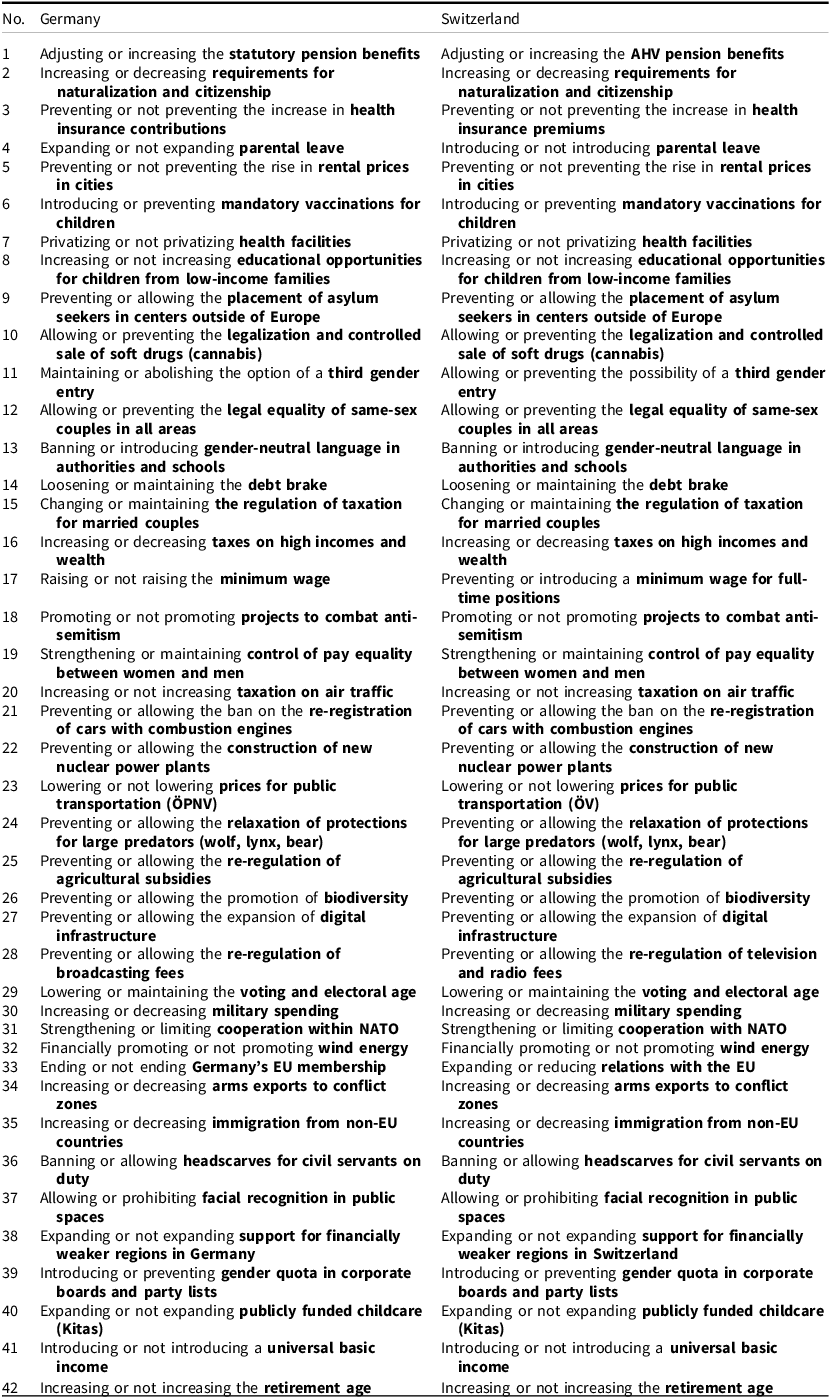
To come up with an equally large and comparable selection of issues in Germany and Switzerland, I relied on issues that featured in recent national and regional versions of the VAA tools of both countries.Footnote 9 If possible, I relied on the exact policy wording of both tools to present respondents with potentially familiar political issues. Where necessary, I harmonized the wording to make them comparable across country contexts. I ended up with a battery of 42 political issues that respondents must decide on in a pairwise choice setting, as this allows me to calculate the necessary estimates. The selected issues cover a wide variety of discussed political issues in the two countries and in Western Europe more generally.
In most instances, the political issues were presented in the same wording to respondents in both countries.Footnote 10 One challenging issue is that it is sometimes difficult to fully disentangle attitudes and salience towards an issue, both theoretically and empirically. However, since I tried to formulate all issues in a non-directional way, this minimizes the risk that specific pairings affect attitudinal responses rather than salience judgments. The full list of issues can be seen in Table 2. Footnote 11
Selected policy issues in Germany and Switzerland

Long description
A table comparing selected policy issues in Germany and Switzerland. The table has 42 rows and 3 columns. The columns are labeled No., Germany, and Switzerland. Each row lists a specific policy issue and how it is addressed in both countries. The policy issues range from adjusting pension benefits and naturalization requirements to environmental and social policies. Each row provides a clear comparison of the approaches taken in Germany and Switzerland for each policy issue.
Pairwise choice: task
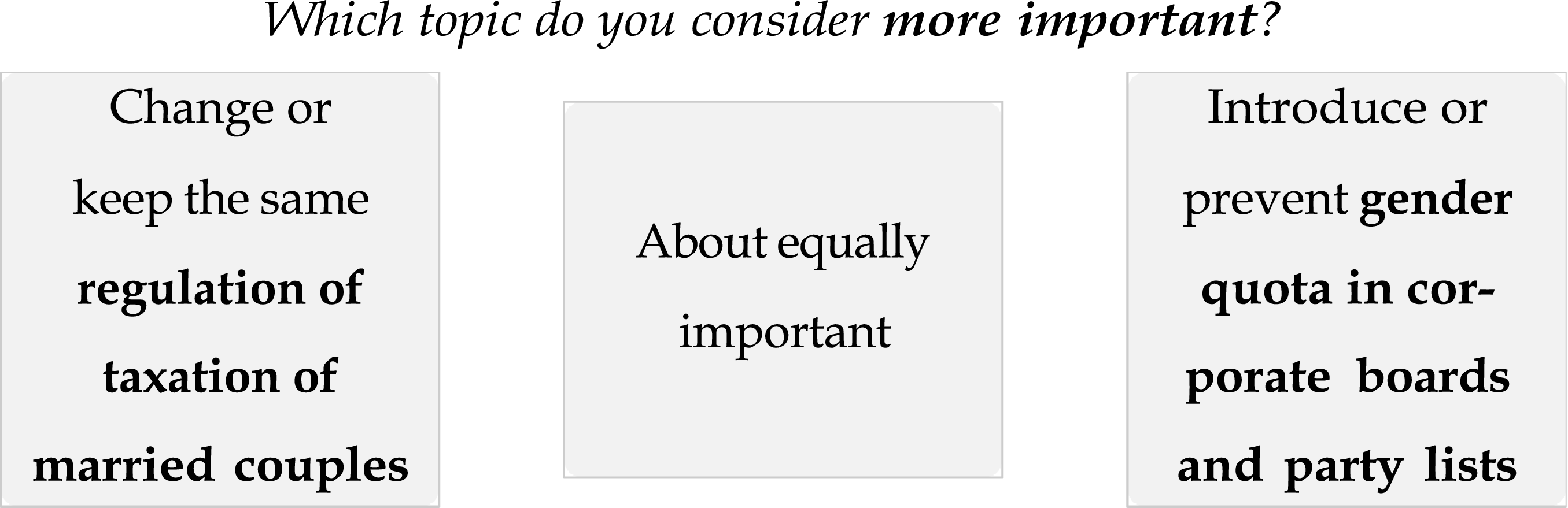
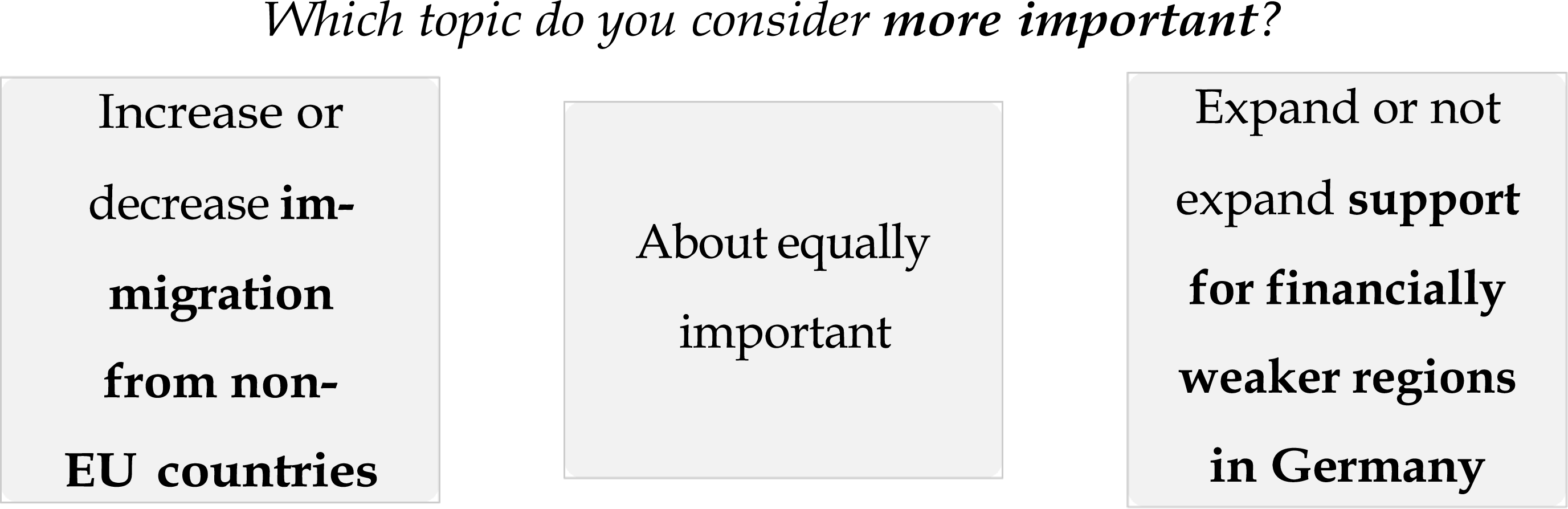
An introduction made it explicit that respondents were encouraged to think of political issues and that they should state what they think is important, rather than what is objectively seen as important.Footnote 12 Respondents were then presented with six comparisons, with each showing a randomly drawn selection of two out of the pre-defined 42 political issues and asked to indicate which one of the two they perceived as more important (see Figure 1 and Figure 2 for the setup of the question). Since the left and right placement of issues was randomized across respondents, it is ensured that no issue was systematically advantaged by its position, and ordering effects could be avoided. Indeed, respondents were equally likely to select an issue presented on the left or on the right.Footnote 13 The design also ensured that respondents never had to compare the same issue with itself.
Example from Switzerland.

Example from Germany.

Respondents always had the option to state that they perceived both issues as equally important (“tie”), an option always placed between the two issues. In Switzerland, this option was chosen in 21.89 percent of cases, in Germany in 23.44 percent,Footnote 14 suggesting that a majority was able to decide which of the two issues was more important.
In particular, the specific pairing of issues could, in principle, affect responses if certain combinations prime particular considerations. However, in a pairwise choice setting, each option appears in over 700 randomized comparisons against a variety of opposing issues, so any pairing-specific effects are averaged out across the full set of comparisons. These comparisons provide information about how respondents rate each issue relative to all others (Lauderdale and Blumenau Reference Lauderdale and Blumenau2025). This can be analyzed using Bradley-Terry Models (BTM), which have been applied in pairwise choice settings in political science (Hopkins and Noel Reference Hopkins and Noel2022; Lauderdale and Blumenau Reference Lauderdale and Blumenau2025; Loewen et al. Reference Loewen, Rubenson and Spirling2012; Zucco Jr et al. Reference Zucco, Batista and Power2019). Following the original application from Bradley and Terry (Reference Bradley and Terry1952), a BTM assumes that in a “contest” between any two “players/teams,” e.g., team a and team b (a, b ∈ {1, …, K}), the odds that a beats b are
 $^{\underline{{\alpha_{a}}}}$
, where α
a
and α
b
are positive-valued parameters which can be thought of as representing “ability.”Footnote
15
For all Bradley-Terry Models, I omit “ties” from the analysis, since other analyses have shown relatively equal results when dropping those cases or that these simplified models even perform somewhat better when ties are omitted from the analysis (Turner and Firth Reference Turner and Firth2012; Lauderdale and Blumenau Reference Lauderdale and Blumenau2025; Rao and Kupper Reference Rao and Kupper1967).
Results and discussion
Rating task
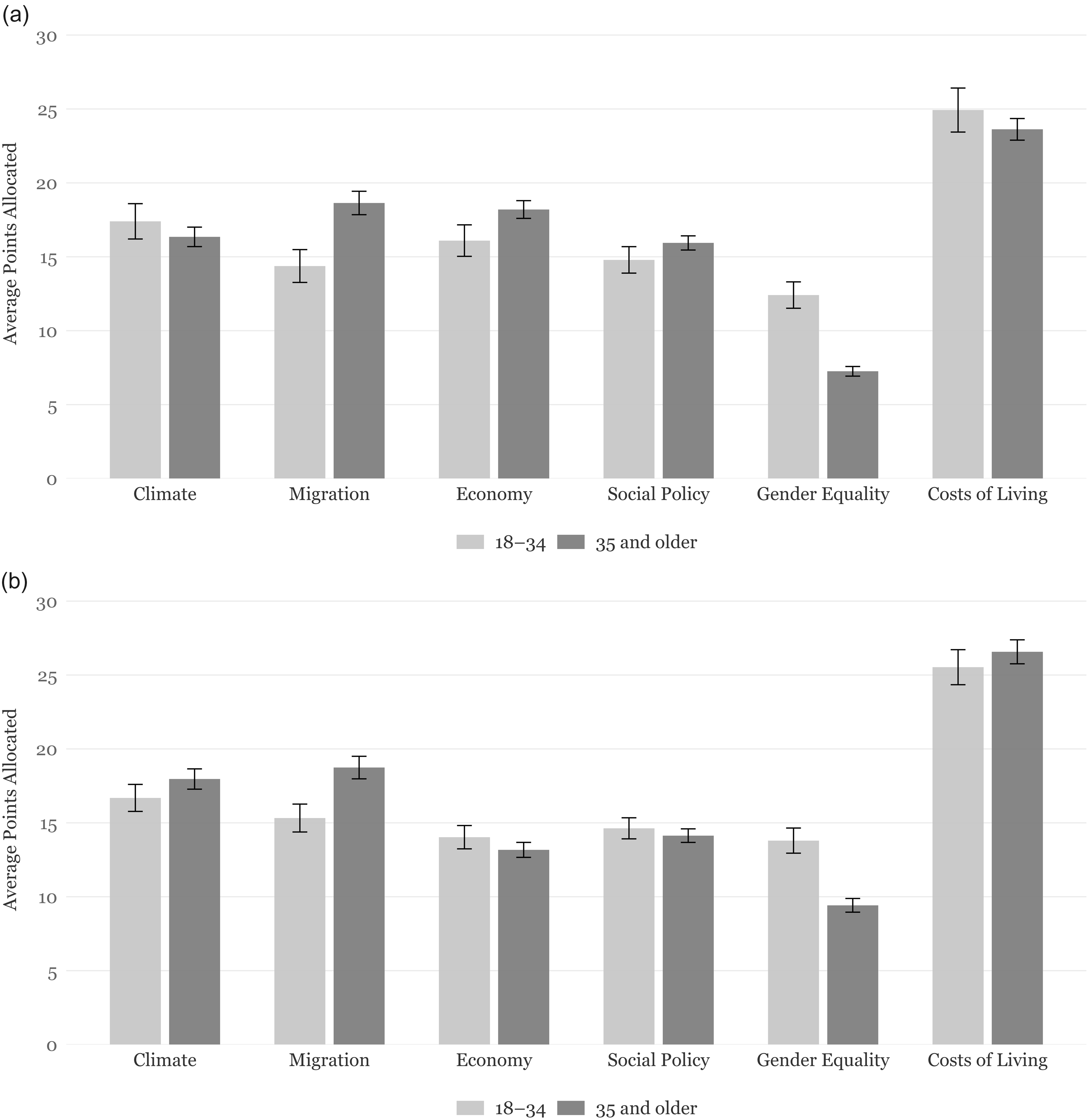
In this section, I first present and discuss the results of the rating tasks. Figure 3 displays the mean values for the rating tasks (including 95 percent confidence intervals) for young individuals (aged 18–34) and those aged 35 and older, shown separately for Germany (a) and Switzerland (b).Footnote 16
Average Points Allocated to Six Issue Areas by Age Group, by Country. Bars show mean points allocated by respondents aged 18–34 (light gray) and 35 and older (dark gray); error bars represent 95 percent confidence intervals. (a) Germany (b) Switzerland.

In both countries, respondents across both age groups clearly assign the most points to the issue area of costs of living (around 25 out of 100 points). Among young respondents, all issue areas receive similar points, except for the costs of living, which receives significantly more points. In contrast, older respondents show more variation across issue areas than younger respondents. Furthermore, the descriptive analysis reveals differences between age groups: while young and older respondents differ little regarding costs of living, the economy, and social policy, they diverge more clearly on migration policies and gender equality. Most strikingly, younger respondents in both Germany and Switzerland assign more points to gender equality than respondents aged 35 and older; in Germany, almost twice as many points as older respondents. In contrast, older respondents in both countries assign more points to immigration.
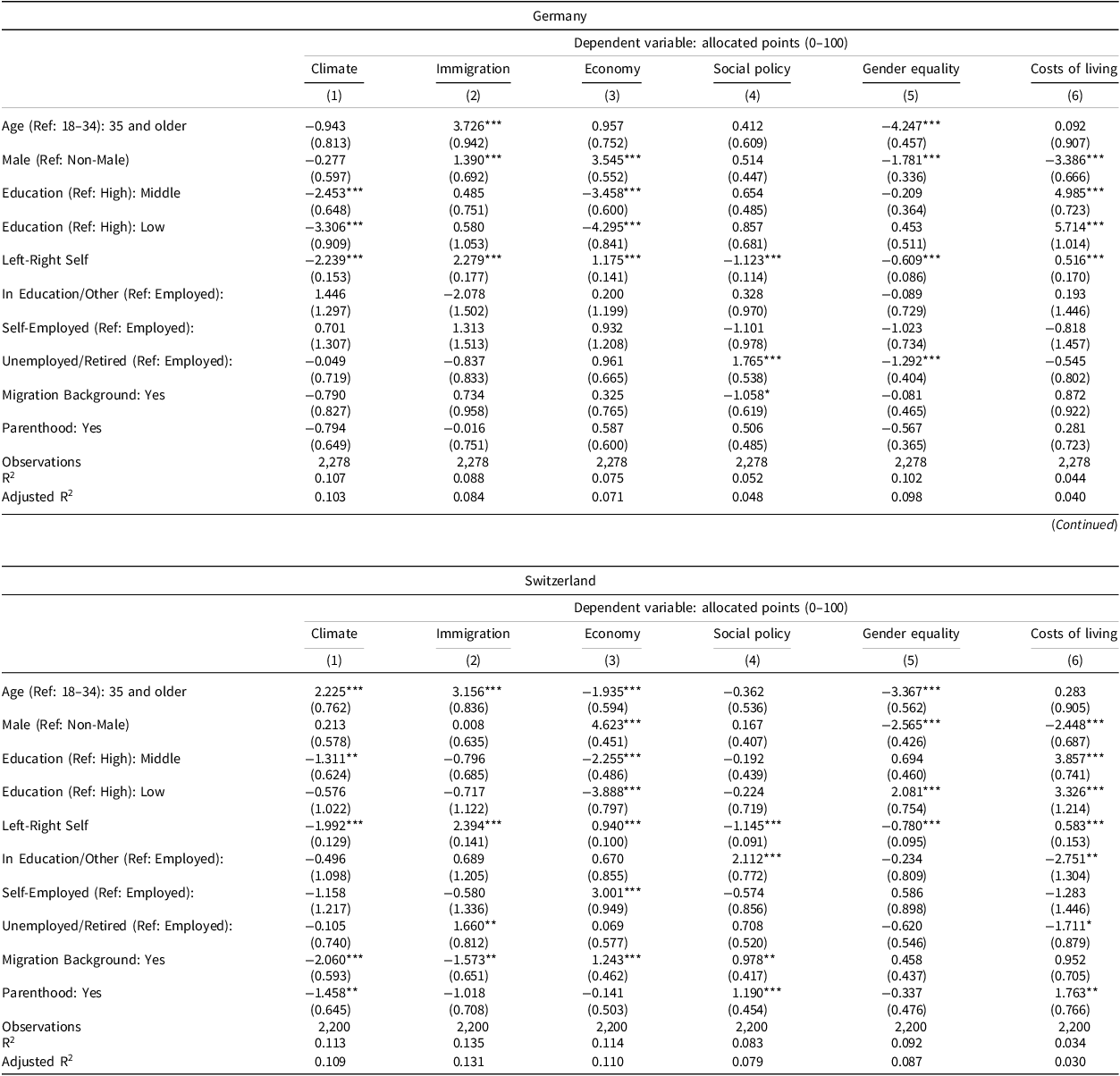
To test for significant subgroup differences while controlling for relevant covariates, I run twelve (six per country) multivariate OLS regressions with the number of points allocated to different issue areas as the dependent variable. In these regressions, I account for several covariates: Gender, education, occupational status, parenthood, and migration background.Footnote 17 I control for gender,Footnote 18 as men and women have been found to diverge in the importance they attach to different political issues (Cavaillé et al. Reference Cavaillé, Chen and Van der Straeten2025; Yildirim Reference Yildirim2022). EducationFootnote 19 is included as it shapes both material circumstances and cultural progressivism (Lindskog and Oskarson Reference Lindskog and Oskarson2022). Occupational statusFootnote 20 captures life-stage and labor market position, both of which are theoretically relevant for the prioritization of economic issues, particularly related to costs of living (Busemeyer Reference Busemeyer2024). Similarly, parenthoodFootnote 21 shifts political priorities, particularly due to different economic needs related to childcare (Busemeyer Reference Busemeyer2024). Migration backgroundFootnote 22 has been shown to affect issue salience, particularly regarding immigration-related issues (Paul and Fitzgerald Reference Paul and Fitzgerald2021). Finally, to ensure that observed age differences are not simply a result of ideological sorting, I control for left-right self-placement.Footnote 23 I present regression results separately for the two countries.
In Table 3, negative coefficients indicate that the young group allocates more points than older respondents. In Germany, the results show no significant age differences for social policy, economy, and costs of living: young respondents do not allocate significantly more or fewer points to these issue areas. In Switzerland, there is a significant difference between young and older respondents regarding the economy. However, that difference is not robust for all age cutoffs (see Table B2 and Table B4) and should be interpreted carefully. Interestingly, there is a different age gap in climate salience in the two countries. Whereas in Germany, young respondents do not allocate significantly more points to climate, in the Swiss case, older citizens even care significantly more about the climate issue area than younger respondents. This divergence likely points to the fact that climate priority in Switzerland has diffused beyond its initial, younger support base. This is in line with other studies on generational differences in Switzerland, showing that environmental concern barely differs between generations and that period effects play a more important role in explaining the temporal development of these attitudes in Switzerland (Mitteregger and Haffert Reference Mitteregger and Haffert2025).
Linear regression results by country

Table 3. Long description
The table compares linear regression results by country, Germany and Switzerland, for various factors affecting allocated points on different issues. The table has 12 columns and 20 rows. The columns are labeled as follows: Climate, Immigration, Economy, Social policy, Gender equality, and Costs of living. Each of these columns has sub-columns labeled (1) to (6). The rows are labeled with different variables such as Age, Male, Education, Left-Right Self, Occupation, Migration Background, and Parenthood. Each row contains values corresponding to the columns. The table shows the coefficients and their significance levels for each variable in relation to the allocated points on different issues. The table is divided into two sections for Germany and Switzerland, each with its own set of observations, R-squared values, and adjusted R-squared values.
Note: *p < 0.1; **p < 0.05; ***p < 0.01.
The strongest age differences that are consistent across the two countries concern immigration and gender equality. In both contexts, older respondents perceive immigration as significantly more important than younger voters (which is robust for different age specificationsFootnote 24 ). In contrast to this higher salience for immigration, younger respondents are significantly more likely to assign more points to gender equality, the largest difference observed across all six issue areas in both countries. Notably, the age effect on gender equality salience is larger than the difference between male and female respondents in both countries. This finding is robust across different operationalizations of the age threshold and persists when controlling for attitudes toward gender equality,Footnote 25 suggesting it reflects a genuine divergence in priorities rather than merely attitudinal differences between age groups. Taken together, these results suggest that the young indeed diverge from older citizens in their perceptions of salience and thus lend support to H1. However, the key salience divide between young and older citizens is not straightforwardly a trade-off between economic and cultural issue areas (as I had expected in H2), but rather a within-cultural-dimension divide: younger respondents in both countries prioritize gender equality more, while older respondents prioritize immigration more. Regarding climate, country differences point in opposite directions, yet the effects are substantially weaker than for immigration and, especially, gender equality.
To further assess whether the differences in immigration and gender equality salience simply reflect diverging levels of progressivism regarding these two issues, I re-run the analysis restricting the sample to respondents with neutral/conservative and progressive attitudes on immigration and gender equality, respectively.Footnote 26 . The age difference for gender equality persists in both ideological subgroups, which strengthens the interpretation that it reflects a more fundamental generational divergence in priorities relevant for both progressive and more conservative respondents. For immigration, however, the age difference in Germany is only statistically significant within the conservative subset. This complements earlier findings from Kustov (Reference Kustov2023) who shows that conservative voters generally care more about the immigration issue than progressive voters. This might result from the general framing of immigration as a “political problem” by conservative voters and suggests that partisan cueing and identity shape immigration salience (Dennison Reference Dennison2020), particularly among the older electorate.
Pairwise choice experiment – All respondents
The following sections now turn to the results from Bradley-Terry Models and subgroup analyses based on the pairwise choice experiment. In the first step, I determine a baseline level of issue salience by identifying the most salient issue in Germany and Switzerland, respectively, that is used as the baseline comparison issue in all subsequent subgroup analyses. This is achieved by running a Bradley-Terry Model for all respondents, which yields a ranking of issues.
The graphs below summarize the results for Germany and Switzerland. The dashed red line represents the average relative importance of all issues compared to a randomly selected baseline issue (in this case, the protection of predatory mammals (wolf, bear, and lynx)).
The results can be interpreted as follows: Respondents favor all policies with a positive estimate (ability score) relative to this baseline issue (i.e., to the right of the vertical dashed red line). Conversely, respondents disfavor policies with negative estimates relative to the baseline question (i.e., positioned to the left of the vertical dashed red line). I report 95 percent confidence intervals based on quasi-standard errors calculated from the ability scores. This enables me to compare estimates across policies relative to the baseline (Turner and Firth Reference Turner and Firth2012; Lauderdale and Blumenau Reference Lauderdale and Blumenau2025).
The results in Figure 4 show that the general population in both countries perceives socioeconomic issues as more salient, particularly those that are related to immediate material circumstances (such as pension benefits, rent prices, or health insurance costs) or questions of social inequality (such as equal educational opportunities and taxation of high incomes). Besides socioeconomic issues, some issues that are more closely tied to the cultural dimension are also ranked high, such as immigration from outside the EU, and gender wage equality. In contrast, “newer” cultural issues, like the legal third gender option or gender-inclusive language, rank lowest in the salience ranking in both countries. These findings are broadly in line with earlier research pointing to “luxury goods voting,” meaning that voters are more likely to turn away from post-material issues when faced with increased economic hardship and insecurity (Abou-Chadi and Kayser Reference Abou-Chadi and Kayser2017). Finally, some notable country differences exist, the most striking one being Swiss citizens much more strongly prioritizing healthcare issues.Footnote 27
Pairwise choice experiment, total population: Bradley-Terry model by country (Note: 95 percent Confidence intervals of quasi-standard errors calculated from the ability scores). (a) Germany (b) Switzerland.

Figure 4. Long description
Two vertical bar graphs compare the relative strength of issue importance in Germany and Switzerland. Panel A: Germany. The bar graph shows the relative strength of issue importance for various issues in Germany. The horizontal axis represents the issues, while the vertical axis represents the relative strength of issue importance. Issues are listed from top to bottom, with health insurance costs being the most important and third gender being the least important. Each bar has a 95 percent confidence interval. Panel B: Switzerland. The bar graph shows the relative strength of issue importance for various issues in Switzerland. The horizontal axis represents the issues, while the vertical axis represents the relative strength of issue importance. Issues are listed from top to bottom, with health insurance costs being the most important and third gender being the least important. Each bar has a 95 percent confidence interval.
Pairwise choice experiment: subgroup analysis
This section now turns to age-group differences. For this purpose, I compare young and older respondents’ perceptions of issue salience by contrasting the highest-ranking issue in the general population – health insurance costs in Switzerland and equal education opportunities in Germany – with all issues. As a first step, I do this by running a Bradley-Terry Model separately for both younger respondents and older respondents. The results can be found in Appendix C.Footnote 28 These results reveal that both young and older respondents attach the highest importance to socioeconomic issues in both countries. However, these models also reveal descriptive differences between the two groups. Whereas health insurance costs rank highest among older respondents in the Swiss context, younger Swiss respondents perceive rent prices and equal education opportunities to be similarly important as this issue. In Germany, age groups are largely similar in their ranking of the most salient issues, with the exception of immigration issues ranking significantly lower and gender wage equality significantly higher among the young (in line with the results from the rating task). The results also show that both older and younger respondents perceive issues related to gender identity as least salient (gender-inclusive language and entry of a third gender), a pattern visible in both countries.
Unfortunately, standard Bradley-Terry Models implemented in most statistical software did not allow for the direct inclusion of interaction terms at the time of the analysis (Turner and Firth Reference Turner and Firth2012; Turner et al. Reference Turner, Firth and Turner2022), which is why an alternative approach is applied to test for significant subgroup differences: I define a set of variables that are +1 if a given policy is policy A in the pairwise choice, 0 if it does not appear, and −1 if that policy is policy B in the pairwise choice, and then code the dependent variable in terms of whether a policy is chosen (0 = B is more important, 0.5 = neutral response (“equally important”), 1 = A is more important). I then interact this set of dummy variables with the respondent-level variable (age group) to estimate the policy-specific variation in the ability parameter as a function of the respondent-level variable. I then calculated OLS regressions with 41 interactions, where I always interacted “age group” with the issue that was compared to the overall most salient issue among the total sample in the respective country. As in the rating task, all regressions control for respondents’ education, gender, left-right placement, occupational status, parenthood, and migration background. To visualize the effects,Footnote 29 I plot them ordered by effect strength, in descending order.Footnote 30 The dashed red line represents the (most salient) baseline issue in the two countries, respectively. Positive values indicate a higher likelihood of young respondents choosing this issue over the baseline compared to voters older than 34.
First, the results in Figure 5 support the expectation in H1 that young and old assign different levels of salience to different issues, confirming the earlier results. Yet, Figure 5 shows that the two countries differ regarding age divides in issue salience. Generally, age divides are significantly larger in Switzerland than in Germany when comparing salience with the highest-ranking issue.Footnote 31 Some of these differences are in line with country-specific political differences: One concerns army spending being more salient for older respondents in Germany, since Germany is a NATO member, and mandatory military conscription has become a debated topic dividing young and old, see Schleehauf et al. (Reference Schleehauf, Reinbold, Kurz, Fröhle and Jäckle2025), whereas the larger age divide on parental leave in Switzerland likely stems from the fact that Switzerland lacks such a scheme - as one of the last European countries. Still, age-group differences exist in both countries and reveal three general patterns. First, there is a relatively consistent pattern indicating that issues either closely or broadly related to gender equality (parental leave, the introduction of a third gender, the legal status of same-sex couples, controlling gender wage equality, and gender quota) are perceived as more salient by younger individuals compared to older ones. While young citizens are more affected by some of those policies (as they are most likely to still need to rely on parental leave, for example), other issues are more likely to refer to a value difference between age groups, as they are expected to have a less stratifying material effect on age groups (for example, the third gender issue). Thus, these findings are in line with the theory of an increased political importance of the cultural dimension. In addition, a second group of issues broadly refers to a “postmaterialist” perception of politics that is more prevalent among young respondents: The protection of predatory mammals, the lowering of the voting age, as well as the projects to fight anti-semitism. Similarly, the security-related issue of army spending is significantly less salient for young respondents in Germany. Third, young respondents (particularly in Switzerland) are more likely to perceive economic policies that affect younger people more strongly as more important: Rent prices in cities (as more young people live in rented apartments), minimum wages, the universal basic income (young people have on average lower salaries), and prices for public transport. In contrast to the rating task, in which older respondents had assigned significantly more points to the issue area importance of immigration, there is no significant difference for more specifically defined immigration issues in Switzerland. Still, it is visible in Germany (naturalization, immigration from outside the EU). The country differences are strongerFootnote 32 in the pairwise choice experiment compared to the rating task, but they point in a similar direction in both countries. Overall, and similar to the rating task, the pairwise choice task lends mixed evidence for H2, revealing within cultural-dimension divides in salience, instead of a clear difference between age groups regarding the salience of economic versus cultural issues.
Pairwise Choice Experiment: Differences between 18–34 year-olds vs. older (35+) respondents by Country (Note: *= p < 0.1; **= p < 0.05; ***= p < 0.01). (a) Germany (b) Switzerland.

Conclusion
This study aimed to investigate whether young citizens differ from older ones in their assessment of salience across a variety of political issues and issue areas in contemporary politics. I argue that studying whether younger generations hold different salience perceptions helps to understand the shifting political considerations of younger cohorts who more strongly align their voting behavior along parties’ cultural positions (Carella and Raffaelli Reference Carella and Raffaelli2026; Jocker et al. Reference Jocker, van der Brug and Rekker2025). Based on these findings rooted in realignment theories, I expected younger voters to diverge from older generations in issue salience, and particularly regarding issues tied to the cultural dimension.
Following this reasoning, this paper applies a novel empirical strategy to understand age differences in issue area and issue salience in contemporary societies: It combines (1) trade-off rating tasks to assess a broader salience of issue areas with (2) pairwise choice experiments that attempt to provide a more nuanced understanding of specific issue salience. To date, it is the first study to apply these methods in combination. Indeed, the results from two countries (Germany and Switzerland) show salience differences for different age groups. While there is an agreement between young and older respondents that economic issues with immediate, direct material consequences and payoffs constitute the most important issues in absolute terms (similar to the findings from Wlezien (Reference Wlezien2005)), young and old still diverge in their assessment of salience. This lends support for Hypothesis 1. Furthermore, the results show that younger people perceive gender wage equality, parental leave, and gender quotas as more important than older respondents. In contrast, security-related issues (such as army spending) and immigration are less salient for younger respondents, particularly in Germany. These findings are broadly consistent with the results of the rating task in both countries, which show that the youngest respondents attach significantly more importance to the issue area of gender equality and less importance to immigration than older respondents, even when controlling for issue attitudes. In addition to these differences, age-specific (material) self-interest plays an important role in Switzerland, as evidenced by younger respondents prioritizing issues such as rental prices and minimum wages, which is in line with other findings on this question (see Busemeyer and Lober (Reference Busemeyer and Lober2020)), whereas these differences are less prominent in the German case. Overall, the findings lend mixed support to my expectations in Hypothesis 2, revealing that it is not necessarily economic and cultural issue salience that divides young and old, but rather specific issues and issue areas within these political dimensions.
The findings come with several limitations that could be addressed by future research. First, the results can only provide a snapshot of salience that may change in the future, as people are likely to adapt their salience perceptions across contexts and as they age. While studies on issue salience have demonstrated within-individual stability of salience over time (Dennison Reference Dennison2019), it is plausible that young citizens still change salience perceptions when getting older. As the paper’s approach does not rely on over-time data to test a generational claim, this bears an important limitation. Second, the context in which the study was conducted likely affected the findings, because respondents in both countries were experiencing rising costs of living and salient security discourses. Future research should thus try to replicate the present findings in other country contexts. Third, the present study does not directly link the findings to the electoral arena. Future research specifically interested in the relevance of salience for the final voting decision should analyze the relationship between these two factors. Fourth and related to this, the paper is agnostic towards other factors potentially influencing younger voters’ electoral considerations, such as candidate character traits (see Eshima and Smith (Reference Eshima and Smith2022); Sevi (Reference Sevi2021)). Analyzing how these candidate evaluations potentially interact with salience perceptions might provide a fruitful avenue for future research. Fifth and finally, the paper comes with the methodological limitation that, while the chosen approach presents respondents with a variety of issues to compare against, it may still be that the list was missing issues that would be important for voters’ political considerations.
Still, the findings provide a valuable insight into the political similarities and differences between age groups, allowing a better understanding of the issues that younger individuals prioritize. As the concept of issue salience has become increasingly relevant in explaining electoral transformations in both the long and short term, understanding the differences between young and older voters is important. Here, the question of gender equality emerges as the issue that most strongly divides older and younger respondents in terms of perceived importance. This is particularly important in order to make sense of research showing increasingly diverging electoral and attitudinal patterns among young women and men (see Off et al. (Reference Off, Alexander and Charron2025); van Ditmars and Shorrocks (Reference van Ditmars and Shorrocks2025)). In sum, issues related to gender equality will likely play an increasingly important role in shaping younger generations’ political preferences.
Supplementary material
The supplementary material for this article is available at https://doi.org/10.1017/S1755773926100617.
Data availability statement
All Data and Replication Files can be publicly accessed here on Swissubase: www.swissubase.ch, project 20928.
Acknowledgements
I want to thank the two anonymous reviewers and the editors from EPSR for their very constructive feedback for earlier versions of this manuscript. Previous versions of this paper were presented at the NoPSA Conference in Bergen 2024, at the CES 2024 in Lyon, and at the Pre-Publication Seminar of the University of Zurich in 2024. I wish to thank the participants for their helpful comments on these occasions. I am especially grateful for valuable and insightful input from Jelle Koedam, Iva Srbinovska, and Josefina Sipinen. I also want to thank Markus Wagner and Markus Kollberg for their detailed feedback on the methodology and the experiment. In addition, I want to thank Delia Zollinger, Tabea Palmtag, Reto Bürgisser, Fabienne Eisenring, and Silja Häusermann for their helpful comments on earlier versions of the survey design. Finally, I want to highlight that the title of the paper is a special nod to Phoebe Bridgers’ cover of “Nothing else matters”, a song that helped me writing this paper.
Funding statement
The research for this article has benefited from support from the Swiss National Science Foundation (SNSF Doc.CH Grant No. 203868).
Competing interests
The author reports no conflicting financial or non-financial interests.
Ethical standards
The experiment has been preregistered on Open Science Framework (OSF) and has been approved by the Ethics Board of the University of Zurich (Study No. 24.02.07).




 Open access

