Introduction
The Developmental Origin of Health and Disease (DOHaD) hypothesis, developed based on the concept of Barker’s hypothesisReference Barker and Osmond1 advocating long-term effect of fetal origins on adult disease, suggests that adverse environmental exposure during fetal and neonatal development might increase the susceptibility for developing a wide range of lifestyle-related diseases in later life.Reference Gluckman, Hanson and Cooper2 This hypothesis has led to increasing research interest being focused on how in utero nutrient exposure affects postnatal health outcomes, and previous studies have demonstrated that this disease risk might partly be determined by maternal and paternal diet.Reference Gluckman and Hanson3–Reference Kawakubo-Yasukochi, Kondo and Mizokami5
Although the biological mechanism underlying the DOHaD hypothesis remains incompletely elucidated, alteration in epigenetically regulated gene expression has been examined as a strong candidate mechanism.Reference Waterland6 Specifically, the DNA methylation patterns and phenotype of offspring can be determined by maternal dietary changes in one-carbon availability,Reference Waterland6 and one-carbon metabolism-related nutrients, such as methionine, choline, betaine, folates, and vitamin B12, are recognized as methyl sources for the epigenetic modifications of DNA and histone tails.Reference Yang and Vousden7 Among these, folate is a key dietary source of the nutrients necessary for the synthesis of S-adenosyl methionine, the universal methyl donor. Thus, folate is essential for modulating DNA methylation, and a low folate status has been reported to be associated with an increased risk of cancers.Reference Lamprecht and Lipkin8 Accordingly, global hypomethylation and targeted hypermethylation are frequently detected in various cancers.Reference Fernandez, Assenov and Martin-Subero9, Reference Feinberg and Vogelstein10
Conversely, adequate maternal consumption of folic acid (FA), particularly in early pregnancy, is critical for preventing neural tube defects in the offspring. Furthermore, recent studies focused on the effects of maternal FA intake on the DNA methylation status in offspring have demonstrated that folate/FA in the maternal diet can potentially alter the DNA methylation status in the offspring in a highly organ-specific manner.Reference McKay, Adriaens and Evelo11–Reference McKay, Williams and Mathers16 However, the physiological mechanism by which maternal FA intake regulates the offspring phenotype remains to be elucidated.
Maternal FA regulates the expression levels of numerous genes in the offspring through methylation. An interesting gene that is epigenetically altered in an organ-specific manner by maternal FA insufficiency is Cyld Reference McKay, Adriaens and Evelo11–Reference McKay, Williams and Mathers16; the gene encodes the deubiquitinating enzyme cylindromatosis, which is absent or downregulated in nonalcoholic steatohepatitisReference Ji, Huang and Yang17 and several types of cancer, such as melanoma,Reference Massoumi, Kuphal and Hellerbrand18 myeloma,Reference Annunziata, Davis and Demchenko19 and cancers of the skin,Reference Bignell, Warren and Seal20 colon,Reference Hellerbrand, Bumes and Bataille21 liver,Reference Hellerbrand, Bumes and Bataille21, Reference Nikolaou, Tsagaratou and Eftychi22 and breast.Reference Hayashi, Jono and Shinriki23 Especially in the skin, Cyld functions physiologically as a regulator of epidermal differentiation,Reference Alameda, Fernández-Aceñero and Moreno-Maldonado24 and its deficiency in the skin accelerates sensitivity to chemically induced skin-tumor development in mice.Reference Massoumi, Chmielarska and Hennecke25, Reference Jin, Wang and Cho26
In this study, we examined whether the effects of insufficient maternal FA consumption may induce squamous neoplasia (skin and tongue) in the offspring for the first time and test whether our novel assumption of this being mediated by Cyld is correct or not, using mouse model.
Materials and methods
Animal experiments
All animal experiments were approved by the Animal Ethics Committee of Fukuoka University (permission nos. 1611986 and 1703029). Mice were housed under a 12/12-h light-dark cycle (lights on from 07:00 to 19:00) and provided ad libitum access to chow and water. Diet compositions were modified from AIN-93GReference Reeves27 (CLEA Japan, Tokyo, Japan). Eight-week-old female C57Bl/6N mice were allocated randomly to either a FA-depleted (FA(−)) diet or normal AIN-92G diet (2 mg FA/kg (FA(+)) group and maintained for 9–10 days (from 2 to 3 days before mating to 7 days post-conception), and their offspring were used for chemical carcinogenesis studies as previously described,Reference Li, Liang and Yu28, Reference Kawakubo, Yasukochi and Okamoto29 with minor modifications (Fig. 1).
Experimental protocol. Eight-week-old female mice were mated with age-matched males and assigned randomly to two groups that were fed either a normal diet (FA(+)) or a folate-depleted diet (FA(−)); starting from 7 days post-conception, all mice were fed the FA(+) diet (n = 6/group), and pups were weaned at postnatal day 24 (P24) and fed the FA(+) diet. For skin treatment, female pups (n = 14–17/group) were treated with 400 nmol of 7,12-dimethylbenz[a)anthracene (DMBA) in acetone, and after 1 week, twice-weekly topical application of 20 nmol of phorbol 12-myristate 13-acetate (TPA) in acetone was begun and continued for 16 weeks. The control group was treated with acetone alone. For tongue treatment, 7-week-old male mice (n = 10–16/group) received 0.05% 4-nitroquinoline N-oxide (4NQO) daily for 16 weeks, and the control mice received only drinking water.

Chemical treatment for skin
For skin treatment, female offspring were used to avoid the influence of fighting. The lower dorsal skin of 7-week-old female offspring was shaved with a hair clipper and then treated with 400 nmol of 7,12-dimethylbenz[a]anthracene (DMBA; Sigma-Aldrich, St. Louis, MO, USA) in acetone on an approximately 2-cm area. After 1 week, twice-weekly topical application of 20 nmol of phorbol 12-myristate 13-acetate (TPA; Wako, Osaka, Japan) in 0.1 mL of acetone was started and continued for 16 weeks. The control group received acetone alone. Tumors were defined as raised lesions of at least 1-mm diameter that had been present for at least 1 week. After the chemical treatments (at 24-week-old), all experimental mice were euthanized, and the tissues were collected for analysis.
Chemical treatment for tongue
For tongue treatment, 7-week-old male offspring received 0.05% 4-nitroquinoline N-oxide (4NQO; Sigma-Aldrich) daily for 16 weeks; the control mice received drinking water alone. After the chemical treatments (at 23-week-old), all experimental mice were euthanized, and the tissues were collected for analysis.
Serum FA measurement
Serum FA concentration was measured by the Japan Institute for the Control of Aging, NIKKEN SEIL (Shizuoka, Japan).
Immunohistochemical analysis
Dorsal skin (approximately 1 cm2) or tongue (from lingual root to apex) tissues were dissected from mice after chemical treatment and fixed by using 37 wt. % formaldehyde solution (Sigma-Aldrich) and paraffin-embedded. Those tissues were then stained with hematoxylin and eosin (HE) or subject to immunohistochemical staining (performed by Biopathology Institute, Oita, Japan; Morphotechnology, Hokkaido, Japan) with primary antibodies against Cyld (1:100, Proteintech, Rosemont, IL, USA), cyclin D1 (1:50, Thermo Fisher Scientific, Waltham, MA, USA), and Ki-67 (1:200, Thermo Fisher Scientific), based on the polymers method.Reference Barker4 The staining was quantitatively evaluated by the Biopathology Institute.
Quantitative PCR (qPCR) analysis
Dorsal skin (approximately 25 mm2) or tongue (from lingual root to apex) tissues were dissected from postnatal day 2 (P2) female or male mice, respectively, and immersed in RNAlater (Sigma-Aldrich). Total RNA was extracted from tissues by using Sepasol-RNA I Super G (Nacalai Tesque, Kyoto, Japan) and a High Pure RNA Isolation Kit (Roche Diagnostics, Mannheim, Germany). The RNA (500 ng/reaction) was reverse-transcribed using a Verso cDNA Synthesis Kit (Thermo Fisher Scientific), and the resulting cDNA was subjected to two-step qPCR analysis using a LightCycler 480 system (Roche Diagnostics) and these cycling conditions: 95 °C for 10 min (hot-start PCR), followed by 45 cycles of 95 °C for 15 s, 60 °C for 30 s, and 72 °C for 1 s. The PCR primer sequences (forward and reverse) and amplicon sizes were as follows: β-Actin: 5′-CTA AGG CCA ACC GTG AAA AG-3′ and 5′-ACC AGA GGC ATA CAG GGA CA-3′, 104 bp; and Cyld: 5′-GCT CTG TAG TTT TGC AAG TGT TG-3′ and 5′-TCC TTT CCT GTG TCA CGC TAT-3′, 83 bp. TaqMan probes specific for each sequence were selected from the LightCycler Universal Probe Library (Roche Diagnostics), and the probes used were #64 (for β-Actin) and #2 (for Cyld).
Protein analysis
Dosal skin (approximately 25 mm2) or tongue (from lingual root to apex) tissues were dissected from postnatal day 2 (P2) female or male mice, respectively, and homogenized them in RIPA buffer (Nacalai Tesque) to make each tissue lysate. For immunoprecipitation, 150 μg of skin or tongue tissue lysates were incubated (at 4 °C for 2 h) with Dynabeads Protein G (Thermo Fisher Scientific) bound to anti-TRAF6 polyclonal antibody (Santa Cruz Biotechnology, Santa Cruz, CA, USA). The precipitated proteins were immunoblotted with anti-K63-Ubiquitin (K63-Ub) antibody (1:3,000, BioLegend, San Diego, CA, USA). For immunoblotting, samples were electrophoretically fractionated on 5%–20% SDS-PAGE gels (SuperSep Ace, Wako) and the separated proteins were transferred to polyvinylidene difluoride membranes (Merck-Millipore, Darmstadt, Germany); the membranes were blocked with Blocking One reagent (Nacalai Tesque) at room temperature for 1 h and then incubated (overnight at 4 °C) with these primary antibodies: anti-β-actin (1:12,000, Sigma-Aldrich), anti-Cyld (1:5,000, Proteintech), anti-IκBα (1:3,000, Cell Signaling Technology, Danvers, MA, USA), anti-phospho-IκBα (phosphorylated on Ser32; 1:3,000, Cell Signaling Technology), anti-cyclin D1 (1:1,500, Thermo Fisher Scientific), and anti-TRAF6 (1:2,000). Lastly, immune complexes were detected using horseradish peroxidase-conjugated secondary antibodies (Cell Signaling Technology) and a chemiluminescence substrate kit (GE Healthcare, Buckinghamshire, UK) on MultiImager II (BioTools, Gunma, Japan) and quantified by Image J (NIH) software.
Bisulfite PCR
Genomic DNA was purified from dorsal skin (approximately 25 mm2) or tongue (from lingual root to apex) tissues of postnatal day 2 (P2) mice by using a NucleoSpin Tissue kit (Takara Bio, Shiga, Japan). Bisulfite modification (EpiTect Bisulfite kit, QIAGEN, Hilden, Germany), Bisulfite PCR assay (Platinum Taq, Invitrogen, Carlsbad, CA, USA), TA-cloning, and sequence analysis were performed by Unitech (Chiba, Japan). The PCR primer sequences (forward and reverse) and the product size were as follows: 5′- TGT TTT GTT TTT GAT TTT AGG AGA A-3′ and 5′- CTA ACC CAT CTC TTT AAA CCT CCT C -3′, 500 bp.
Statistical analysis
Tumor incidence was analyzed using Kaplan–Meier (disease-free) analysis plus a generalized Wilcoxon test, and the other data were analyzed using two-tailed Student’s t-test, and group differences were compared using ANOVA. All quantitative data are presented as means ± standard deviation (SD); p < 0.05 was considered significant.
Results
Maternal FA depletion during early pregnancy reduced serum FA level
First, maternal FA concentration was measured after FA depletion. The result showed that maternal FA depletion during early pregnancy, for up to 7 days post-conception, markedly reduced the serum FA concentration: the average values were 55.9 ± 4.2 ng/mL for FA(+) dams and 33.6 ± 3.9 ng/mL for FA(−) dams (p < 0.001).
Skin papillomagenesis induction by DMBA/TPA treatment in female offspring from normal and FA-depleted dams
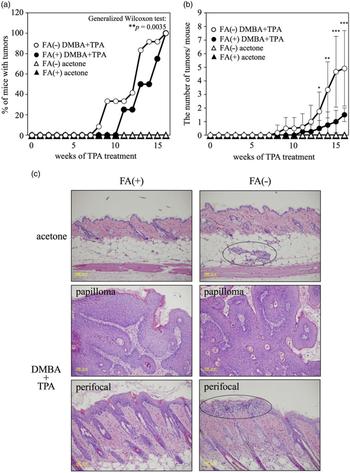
The sensitivity for skin tumorigenesis in the offspring of normal (FA(+)) and FA-depleted (FA(−)) dams was examined using a two-stage mouse skin tumorigenesis protocol, in which DMBA and TPA served as the initiator and promoter, respectively. All the offspring, from both FA(+) and FA(−) dams, treated with DMBA/TPA developed multiple skin papillomas, whereas none of the offspring treated with acetone developed any papillomas (Fig. 2a, 2b). Notably, papillomas developed more rapidly (3 weeks earlier) in FA(−) offspring than FA(+) offspring, and there was a significant difference in papilloma incidence between them (**p = 0.0035, Generalized Wilcoxon test) (Fig. 2a). In addition, the number of papillomas per mouse was also higher in FA(−) than FA(+) offspring, concretely there was a statistically significant difference between them after 13 weeks of TPA treatment (Fig. 2b). Histopathological analysis of the tumor lesions in each group revealed no differences in invasion or intravascular transition of neoplastic cells (Fig. 2c), and the status of proliferation and mitosis in the basal cell layer, hyperplasia, and hypertrophy also showed no significant differences between FA(−) and FA(+) offspring treated with DMBA/TPA or acetone (Fig. 2c, Table 1). However, inflammatory-cell infiltration was higher in FA(−) mice treated with DMBA/TPA than in FA(+) mice exposed to the treatment (Fig. 2c, Table 1). Moreover, inflammatory-cell infiltration was detected in the hypodermis in some of the surgical sections from FA(−) mice treated with acetone, whereas no reaction toward acetone was evident in the FA(+) mice (Fig. 2c, Table 1).
Skin tumors induced in mice by local application of DMBA/TPA. (a) Tumor incidence plotted against time. The data shown are mean values from animals in each group (n = 14–17/group). **p = 0.0035. (b) Number of tumors per mouse plotted against time. Values in each group are presented as mean ± SD (n = 14–17/group). The groups FA(−) DMBA/TPA and FA(+) DMBA/TPA were compared. *p < 0.05, **p < 0.01, ***p < 0.001. (c) Hematoxylin and eosin (HE) staining of mouse skin tissues in the indicated groups after DMBA and TPA treatment for 16 weeks. There was no difference in invasion or intravascular transition of neoplastic cells, and the status of proliferation and mitosis in the basal cell layer, hyperplasia, and hypertrophy also showed no significant differences between FA(−) and FA(+) offspring treated with DMBA/TPA or acetone. However, inflammatory-cell infiltration (surrounded area by a circle) was higher in FA(−) mice treated with DMBA/TPA than in FA(+) mice exposed to the treatment, and it was detected in the hypodermis of FA(−) mice treated with acetone, whereas no reaction toward acetone was evident in the FA(+) mice. Scale bar: 100 μm.

Pathological profiles of skin neoplasia of mice formed by local application of DMBA/TPA

The evaluation was defined as follows: −, unchanged; ±, very slightly changed; +, slightly changed; ++, moderately changed; +++, extremely changed.
Tongue papillomagenesis induction by 4NQO treatment in male offspring from FA(+) and FA(−) dams
We next examined the effect of maternal FA intake on 4NQO-induced tongue papilloma formation in offspring. After 16-week 4NQO administration at the endpoint of the carcinogen treatment, hyperplasia was detected in all the offspring, from both FA(+) and FA(−) dams; however, papillomas were observed only in FA(−) offspring (100% of FA(−) mice, 2.64 ± 0.74 papillomas per FA(−) mouse, and 0% of FA(+) mice) (Fig. 3, Table 2), and hypertrophy in perifocal areas was induced to a greater extent in FA(−) offspring than FA(+) offspring (Fig. 3, Table 2). The status of proliferation and mitosis in the basal cell layer, hyperplasia, inflammatory cell infiltration, and invasion showed no significant differences between FA(−) and FA(+) offspring exposed to 4NQO or control treatment (Fig. 3, Table 2).
HE staining of mouse tongue tissues in the indicated groups after 4NQO treatment for 16 weeks. The status of proliferation and mitosis in the basal cell layer, hyperplasia, inflammatory cell infiltration, and invasion showed no significant differences between FA(−) and FA(+) offspring exposed to 4NQO or control treatment. Hyperplasia was detected in all offspring from both FA(+) and FA(−) dams, whereas papilloma development was observed only in FA(−) offspring (100% of FA(−) mice, 2.64 ± 0.74 papillomas per FA(−) mouse, and 0% of FA(+) mice). In addition, hypertrophy in perifocal areas (the bottom images) was induced to a greater extent in FA(−) offspring than FA(+) offspring. Scale bar: 100 μm.

Pathological profiles of tongue neoplasia of mice formed by 4NQO

The evaluation was defined as follows: −, unchanged; ±, very slightly changed; +, slightly changed; ++, moderately changed; +++, extremely changed.
Maternal FA depletion reduced cyld expression in skin but not tongue of offspring
Maternal FA depletion during pregnancy can potentially alter the methylation of multiple gene promoters in the liver, placenta, and brain in a highly organ-specific manner;Reference McKay, Adriaens and Evelo11–Reference McKay, Xie and Adriaens14, Reference McKay, Williams and Mathers16 thus, the depletion could adversely affect normal fetal development not only in these organs, but also in skin and tongue. A previous genome-wide gene-expression study revealed that maternal FA deficiency affected the expression level in the offspring of Cyld, which encodes a deubiquitinating enzyme.Reference McKay, Adriaens and Evelo11 Cyld was reported to present the genetic attributes of a tumor-suppressor gene,Reference Bignell, Warren and Seal20 and Cyld regulates keratinocyte differentiation and skin-cancer progression in human and mouse;Reference Alameda, Fernández-Aceñero and Moreno-Maldonado24–Reference Jin, Wang and Cho26 notably, in chemical-induced skin-tumor models developed using DMBA/TPA, Cyld-deficient mice were found to be susceptible to papilloma formation due to the acceleration of the NFκB signaling pathway.Reference Massoumi, Chmielarska and Hennecke25, Reference Jin, Wang and Cho26 Therefore, we examined Cyld expression at the mRNA and protein levels in the skin and tongue tissues of FA(+) and FA(−) offspring: At P2, Cyld expression was approximately 38% and 60% lower in the skin of FA(−) offspring than FA(+) offspring at mRNA and protein level, respectively (Fig. 4a, 4b). To verify that this reduced Cyld expression results in inadequate function of the protein, we analyzed the K63-Ub status of the Cyld substrate TRAF6:Reference Massoumi, Chmielarska and Hennecke25, Reference Jin, Wang and Cho26 TRAF6-K63-Ub level was markedly higher in the skin of FA(−) offspring than FA(+) offspring (Fig. 4c), which is consistent with diminished catalytic activation of Cyld in FA(−) offspring skin. This Cyld substrate associates with NFκB signaling and enhances inflammation and sensitivity to papilloma induction through promoter activation of target genes, such as the gene encoding cyclin D1.Reference Massoumi, Chmielarska and Hennecke25, Reference Jin, Wang and Cho26 Our data obtained using tissue homogenates revealed that the levels of phospho-IκB, which is stimulated by NFκB signaling,Reference Thanos and Maniatis30 and cyclin D1 were significantly higher in the skin of FA(−) offspring than FA(+) offspring (Fig. 4b). Furthermore, histochemical analysis of the skin after 16-week DMBA/TPA treatment revealed that Cyld expression was significantly downregulated in the skin of FA(−) offspring, particularly in the outer layer of the skin in papillomas, relative to the level in the FA(+) control (Fig. 5a). Accordingly, increased expression of cyclin D1 and Ki-67 was observed in FA(−) offspring skin, especially in the basal layer (Fig. 5a). On the other hand, the skin of control offspring after 16-week acetone treatment scarcely showed any change in the immunohistochemical analyses between FA(+) and FA(−) (Fig. 5a).
Analysis of Cyld role in skin or tongue tumor formation. (a) qPCR analysis of Cyld expression in skin or tongue tissues of P2 mice from each group. Data were normalized by the amount of β-actin mRNA. Values in each group are presented as mean ± SD (n = 8/group). **p < 0.01. (b) Immunoblotting analysis of Cyld-related protein expression in skin or tongue tissues of P2 mice from each group; β-actin was used as a loading control. Quantification of each target expression normalized to that of β-actin is shown in lower panels. Each experiment was repeated four times. Data represent mean ± SD. *p < 0.05, **p < 0.01 and ***p < 0.001. (c) Immunoprecipitation was performed using skin or tongue tissue extracts of P2 mice and an anti-TRAF6 antibody, and the immunoprecipitates were immunoblotted with antibodies against K63-ubiquitin (K63-Ub) or TRAF6. The experiment was repeated three times.

(a) HE staining and immunolabeling (with anti-Cyld, anti-cyclin D1, and anti-Ki-67) of skin sections of mice from the indicated groups after DMBA and TPA treatment for 16 weeks. Cyld expression was significantly downregulated in the skin of FA(−) offspring, particularly in the outer layer of the skin in papillomas, relative to the level in the FA(+) control. Accordingly, increased expression of cyclin D1 and Ki-67 was observed in FA(−) offspring skin, especially in the basal layer. On the other hand, the skin of control offspring after 16-week acetone treatment scarcely showed any change in the immunohistochemical analyses between FA(+) and FA(−). (b) HE staining and immunolabeling (with anti-Cyld, anti-cyclin D1, and anti-Ki-67) of tongue sections of mice from the indicated groups after 4NQO treatment for 16 weeks. Cyld expression level in tongue tissues showed no significant differences between FA(+) and FA(−) offspring and between the offspring in the control and 4NQO-treatment groups, though expression pattern was different, diffuse staining appearance in outer layer of 4NQO-treated tongue and circumscribed staining appearance in lingual papilla of control tongue. In addition, no differences in the expression levels of cyclin D1 and Ki-67 and localization of cyclin D1-positive or Ki-67-positive cells in the tongue of the offspring in the control and 4NQO-treatment groups. Scale bar: 100 μm.

The reduction in Cyld expression in offspring caused by maternal FA depletion is considered to occur due to methylation of the Cyld promoter region.Reference Langie, Achterfeldt and Gorniak13 Cyld expression was reported to be regulated by serum through the activation of serum response factor, a member of the MADS-box family of transcription factors that bind to a specific promoter sequence (CArG box) frequently located in serum response element (SRE).Reference Liang, Ahlqvist and Pannem31 Thus, we examined the status of the sole CpG methylation site in the SRE located in the Cyld promoter region (chr 8: 88, 704, 172–88, 704, 181) by using P2 skin tissues and performing bisulfite analysis. Our results showed that the methylated-cytosine level in the SRE was 13% ± 2.02% higher in the skin tissue of FA(−) offspring than FA(+) offspring; although this difference between the groups was not very large, it was statistically significant (p < 0.01).
Conversely, Cyld expression level in tongue tissues showed no significant differences between FA(+) and FA(−) offspring at P2 (Fig. 4a, 4b) and between the offspring in the control and 4NQO-treatment groups, though expression pattern was different, diffuse staining appearance in outer layer of 4NQO-treated tongue and circumscribed staining appearance in lingual papilla of control tongue (Fig. 5b). Accordingly, the levels of IκB, phospho-IκB, cyclin D1, and TRAF6-K63-Ub in the tongue did not differ between FA(+) and FA(−) offspring at P2 (Fig. 4b, 4c), and histochemical examination revealed no differences in the expression levels of cyclin D1 and Ki-67 and localization of cyclin D1-positive or Ki-67-positive cells in the tongue of the offspring in the control and 4NQO-treatment groups (Fig. 5b).
Discussion
Main finding
Our study revealed that adequate maternal FA intake exerts suppressive effects on tumor formation not only in the skin but also in the tongue, presumably because of folate shortage in the offspring originating from diminished maternal FA intake. Especially in the skin, maternal FA depletion during early pregnancy decreased Cyld expression in the offspring, which heightened their sensitivity toward chemical tumorigenesis and inflammatory-cell infiltration. Increased sensitivity toward papilloma formation was also observed in our tongue-tumor model; however, we detected no differences between FA(+) and FA(−) offspring in the extent of inflammatory-cell infiltration and Cyld expression or activity. These results suggested that the increased sensitivity toward papilloma formation in the tongue of FA(−) offspring might be induced by epigenetic change(s) in another gene(s), although further analysis is necessary to elucidate the underlying mechanism.
Similar studies
FA insufficiency could induce hypomethylation because FA is a nutrient essential for methylation. However, the relationship between FA insufficiency and methylation in vivo involves other components derived from the substrates of one-carbon metabolism, and thus, maternal FA consumption cannot be sweepingly defined as being linearly associated with an increase in DNA methylation in the offspring.Reference Crider, Yang and Berry32 Accordingly, at least one gene was found to be differentially expressed in each examined organ of the offspring in response to maternal FA depletion.Reference McKay, Xie and Adriaens12
In our skin-tumor model, maternal FA depletion induced a downregulation of Cyld expression and subsequently increased sensitivity toward papilloma formation coupled with inflammatory-cell infiltration. This result agrees with those of previous studies reporting that Cyld is a critical negative regulator of cancer and inflammation.Reference Massoumi, Kuphal and Hellerbrand18, Reference Annunziata, Davis and Demchenko19, Reference Hellerbrand, Bumes and Bataille21–Reference Jin, Wang and Cho26, Reference Liang, Ahlqvist and Pannem31, Reference Lim, Jono and Koga33 DMBA/TPA-induced papillomas typically exhibit enhanced activation of the cyclin D1 promoter as a result of the antagonism of NFκB signaling by CyldReference Massoumi, Chmielarska and Hennecke25 and show elevated expression of proliferation markers such as proliferating cell nuclear antigen and Ki-67.Reference Arora, Bansal and Koul34 Therefore, the increased sensitivity for skin tumors in FA(−) offspring in our study could be induced by the activation of NFκB signaling associated with the Cyld downregulation related to in utero FA shortage. Moreover, the diminished Cyld expression and activity were induced by DNA methylation of the SRE in the Cyld promoter region, although it remains possible that another CpG site in the promoter region also contributes to maternal FA-related regulation of Cyld.
Regarding our tongue-tumor model, the relation between maternal FA depletion and tongue tumor in the offspring has not been clarified. However, maternal FA depletion causes congenital abnormalities of the tongue (aglossia and microglossia) at 10% prevalence in the offspring,Reference Maldonado, López-Gordillo and Partearroyo15 which implies that adequate maternal FA intake is essential for normal tongue development and homeostasis. Thus, tongue papilloma formation could be accelerated here by maternal FA depletion during early pregnancy probably through a different, Cyld-independent mechanism.
Different studies
Correlation between FA intake and cancer risk has been controversial.Reference Pieroth, Paver and Day35 For example, higher FA intake is associated with an increased overall risk of skin cancer,Reference Donnenfeld, Deschasaux and Latino-Martel36 while it is associated with reduced risk of head and neck cancer, including oral cancer.Reference Galeone, Edefonti and Parpinel37 In addition, some experimental reports suggest that excess FA may stimulate cancer progression,Reference Kim38, Reference Ulrich and Potter39 and a recent cross-sectional study reported that serum FA level negatively correlated with natural killer cell cytotoxicity; thus, FA might impair cancer immune defense.Reference Wright, Dainty and Finglas40, Reference Troen, Mitchell and Sorensen41 From these reports, not only shortage but also excess of FA intake could increase the risk of cancer progression, and sufficient and adequate FA intake is necessary for cancer suppression. Although the above reports have different perspectives from our study, they highlight differences between human and mouse, among organs, and their influences across generations.
Limitations
There are four limitations to the study. The first limitation of our study is that we could not verify whether tumorigenesis sensitivity in the offspring resulted from maternal FA intake per se or from the maternal changes that were induced by FA depletion. However, maternal folate is directly transported to offspring through the placenta,Reference Solanky, Requena Jimenez and D’Souza42 and DNA methylation in the offspring is highly sensitive to maternal FA intake.Reference McKay, Adriaens and Evelo11–Reference Langie, Achterfeldt and Gorniak13, Reference McKay, Williams and Mathers16 These findings indicate that maternal FA directly caused methylation changes in the offspring.
The second limitation is the serum FA level. In our study, serum FA level of the dams fed a FA-deficient diet for the early 7 gestational days was 33.6 ± 3.9 ng/mL, which was 40% lower than the control. A value of 33.6 ± 3.9 ng/mL is much higher than human serum FA level, which, in humans, enable unmetabolized folic acid (UMFA) appearance and metabolic turnover in one-carbon metabolism.Reference Plumptre, Masih and Ly43 The level of serum FA in mice is approximately 10-fold higher than that in human,Reference Leamon, Reddy and Dorton44 and normal serum FA level of C57Bl/6 mice is 40−50 ng/mL.Reference Salojin, Cabrera and Sun45 In addition, we examined serum FA measurement in the mothers, which were fed a FA-deficient diet during the whole gestational period. However, serum FA concentration of those mothers (32.1 ± 2.9 ng/mL) was not substantially reduced as compared with that of mice fed a FA-deficient diet for the early 7 gestational days. Hence, it would be challenging to reduce serum FA concentration in C57BL/6 mice only by diet any further. For this reason, our mouse FA(−) mouse could be defined as a “dietary” FA-deficient model. However, at least, Cyld methylation status in skin tissue of FA(−) offspring was changed by maternal FA depletion with such serum FA concentration level in our mouse model. From these considerations, it will be required to define the serum FA concentration level in mouse models, and compare it with human, and to examine similar studies under more strict FA depletion, taking into account the differences of intestinal bacterial flora and other methyl donor-related metabolic pathways between human and mice.
The third limitation is the change over time in mouse tongue. In general, it is anatomically impossible to assess the exact tongue disease solely on the basis of tongue chronologically using living mice. Thus, evaluation of neoplasm on tongue (for example, assessment of hyperplasia or neoplasia) in the individual mouse could not be recorded accurately over time,Reference Suzuki, Kohno and Suzui46 and we evaluated tongue tumor only at the endpoint. In our experiment, the evaluation of the frequency of papilloma in tongue at the end point was clear at all (0% of FA(+) and 100% of FA(−) mice with tumor(s). However, we could not have information when papilloma occurred in FA(−) mice, so it may be necessary to examine this point with larger animals than mice, for example, rats.
The fourth limitation is sex difference toward tumor susceptibility. There could be gender difference in susceptibility to developing tumors or diseases due to intrauterine environment. In human, it is known that the tumor incidence of male is about twice as high as that of female both in skin squamous cell carcinomaReference Diepgen and Mahler47 and oral squamous carcinoma,Reference Jemal, Thomas and Murray48 though it depends on race differences. However, since this frequency cannot be divided by onset cause (for example, due to physical stimulation or due to chemical stimulation), the gender difference of carcinogenic susceptibility due to chemical substances, like DMBA, TPA, and 4NQO, is unknown even in human. In our study, we chose female offspring for skin cancer experiment to avoid the effect of fighting, and used male offspring for tongue cancer analysis, assuming that the tumor susceptibility is equivalent to that of male and female because there has been no molecular basis evidence of sex difference in similar experiments with mice. At least, we could prove that maternal folate intake situation can change the susceptibility to inflammation-related skin cancer development of (female) offspring through DNA methylation change of Cyld in offspring. This is the most important finding in our study. However, we should evaluate whether this mechanism will also be established in the case of male offspring by making skin cancer experiment using male offspring in our future experiments. Furthermore, we should also examine molecular mechanism of tumorigenesis in tongue cancer, perform tongue cancer experiment using female offspring, and verify the gender difference in tongue cancer susceptibility.
Conclusion
Folate deficiency is mainly caused by inadequate intake, although it also occurs due to other factors such as chronic or long-term alcohol exposure, smoking, inflammatory bowel diseases, and drug use.Reference Bailey, Stover and McNulty49 During pregnancy, in particular, folate is required at higher than usual levels to satisfy the requirements for rapid cell replication and normal differentiation and development in multiple tissues of the fetus, placenta, and mother, and thus folate deficiency can readily develop. Smoking and chronic or long-term alcohol exposure during gestation further cause disorders in folate transport to the fetus.Reference Stark, Pawlosky and Sokol50, Reference Hutson, Stade and Lehotay51 Conversely, more than normal levels of folate are also required in cancer and inflammation microenvironment because cell division and metabolism are accelerated,Reference Leamon, Reddy and Dorton44 and thus the folate supply can again be readily exhausted. These findings corroborate the outcome presented here that maternal FA depletion during early gestation accelerated abnormal differentiation and tumor development in the offspring. This study has clarified, for the first time, that adequate maternal FA intake plays a critical role in preventing tumor progression in squamous tissues. All females of childbearing age capable of becoming pregnant are currently recommended a daily FA dose of 400 μg for preventing neural tube defects,Reference Leamon, Reddy and Dorton44 and our study has identified an additional beneficial effect of adequate FA intake during pregnancy on the future health of the offspring.
Acknowledgments
The authors thank Prof. Dr. Masato Hirata from Fukuoka Dental College for his help in interpreting the significance of the results of this study and valuable discussion.
Financial Support
This work was supported by the Japan Society for the Promotion of Science (KAKENHI grant nos. 17H01603 to S.N., 16K20585 and 19K10269 to A.Y., and 16K11496 and 19K10052 to T.K-Y.), the Central Research Institute of Fukuoka University (grant no. 187103 to T.K-Y. and M.H.), the Ichiro Kanehara Foundation (grant no. 16KI059 to T.K-Y.), and by grants from the Shin-Nihon of Advanced Medical Research (to T.K-Y.), the TANITA Healthy Weight Community Trust (to T.K-Y.), the Danone Institute of Japan Foundation (T.K-Y.), and Takeda Science Foundation (to T.K-Y.).
Conflicts of Interest
The authors declare no conflict of interest. The sponsors played no role in the design of the study; in the collection, analyses, or interpretation of data; in the writing of the manuscript, and in the decision to publish the results.
Author Contributions
T. Kawakubo-Yasukochi designed research. T. Kawakubo-Yasukochi and M. Morioka performed research. M. Morioka analyzed data. T. Kawakubo-Yasukochi wrote the original draft. K. Ohe, A. Yasukochi, Y. Ozaki, M. Hazekawa, T. Nishinakagawa, K. Ono, S. Nakamura, and M. Nakashima wrote, reviewed, and edited the paper.