Introduction
The subfamily Tillinae (Coleoptera: Cleridae) is a cosmopolitan group composed of generalist predators of various groups of insects. In the New World, the subfamily is represented by 12 genera classified in roughly 150 species (Burke et al. Reference Burke, Leavengood and Zolnerowich2015a). Much of the confusion regarding the systematics of the New World Tillinae comes from the diverse Cymatodera Gray. The genus is the most speciose within the Tillinae, with approximately 130 described species (Burke et al. Reference Burke, Leavengood and Zolnerowich2015a).
Cymatodera is widely distributed in the New World, extending from southern Canada to Bolivia; however, they are absent from the West Indies (Burke and Zolnerowich Reference Burke and Zolnerowich2017). The genus is particularly species-rich in arid and semi-arid environments with xeric scrublands and thorny forests. Temperate and sub-temperate, mid-elevation and high-elevation mountainous environments with coniferous forests and mixed Pinus Linnaeus (Pinaceae)-broadleaved forests are habitats that also support moderately high concentrations of Cymatodera species. Rifkind (Reference Rifkind2015) has mentioned that Cymatodera diversity is particularly high in southern Mexico, and certain subregions in the country appear to be hotspots of speciation and endemism. A number of species have a widespread distribution throughout much of the New World, while others are endemic to isolated and remote areas (Burke et al. Reference Burke, Leavengood and Zolnerowich2015a). The highest diversity of Cymatodera species is found in North American (southwestern United States of America and north-central Mexico) semi-arid temperate and sub-temperate zones. Specific diversity gradually diminishes southward, with the fewest number of Cymatodera species found in South America.
Cymatodera species appear to have primarily nocturnal activity and are commonly attracted to light sources. Little is known about the natural history of these checkered beetles, but overall their predatory activity is commonly associated with wooded environments. Some examples of the predatory preferences of Cymatodera are the following: Cymatodera bicolor (Say) has been observed to prey on Chyptophorus verrucosus (Olivier) (Coleoptera: Cerambycidae) feeding on Cornus florida Linnaeus (Cornaceae) (Opitz Reference Opitz2010); a number of Cymatodera species are known to prey on economically important insect pests, such as Amyelois transitella Walker (Lepidoptera: Pyralidae) in Juglans regia Linnaeus (Juglandaceae) (Michelbacher and Davis Reference Michelbacher and Davis1961), and the parasitoids of galls of Disholcaspis mamma Kinsey (Hymenoptera: Cynipidae) found on several species of Quercus Linnaeus (Fagaceae) (Balduf Reference Balduf1926). Burke et al. (Reference Burke, Cibrián-Tovar, Llanderal-Cázares, Plascencia-Gonzáles and López-Pérez2011) identified a number of Cymatodera species attracted to bark beetle aggregation pheromones and/or other volatiles emitted by the host tree in forest stands of central and southern Mexico affected by Dendroctonus Erichson and Ips De Geer (Coleoptera: Curculionidae: Scolytinae).
This paper is part of an ongoing effort to describe and catalogue the Tillinae fauna of the New World. Recent descriptive works have been published by Rifkind (Reference Rifkind1993, Reference Rifkind2014, Reference Rifkind2015), Rifkind et al. (Reference Rifkind, Toledo-Hernandez and Corona-López2010), Burke (Reference Burke2013), Burke and Zolnerowich (Reference Burke and Zolnerowich2014), and Burke et al. (Reference Burke, Rifkind and Zolnerowich2015b, Reference Burke and Zolnerowich2017); however, several species remain undescribed. Here, we describe four new Cymatodera species from Mexico, El Salvador, Honduras, and Colombia. In some instances, species descriptions are accompanied by remarks on the distribution and morphology of these species. Further research on the group should focus on the study of the biogeography of Cymatodera and allied groups by means of molecular, climatic, and paleontological data, as this information will undoubtedly broaden our understanding about the centre of origin, patterns of distribution, and the interspecific affinities of these checkered beetles.
Material and methods
Morphological terminology, and genitalia extraction and dissection techniques follow Ekis (Reference Ekis1977) and Opitz (Reference Opitz2010). Images were taken, measured, and stacked using a Leica stereomicroscope (model M165C) and a Leica camera (model DMC-2900; Leica, Wetzlar, Germany). Total number of paratypes are given in parentheses after the paratype heading for each taxon.
Type material was borrowed from and/or is deposited in the following collections:
CNIC – Colección Nacional de Insectos, Instituto de Biología, Universidad Nacional Autónoma de México, Mexico City, Mexico.
IAVH – Instituto de Investigaciones de Recursos Biológicos “Alexander von Humboldt,” Bogota, Colombia.
LACM – Los Angeles County Museum of Natural History, Los Angeles, California, United States of America.
RBINS – Royal Belgian Institute of Natural Sciences, Brussels, Belgium.
RHTC – Robert H. Turnbow Jr. Collection, Enterprise, Alabama, United States of America.
JNRC – Jacques Rifkind Collection, Valley Village, California, United States of America.
Cymatodera acuminata Burke, new species
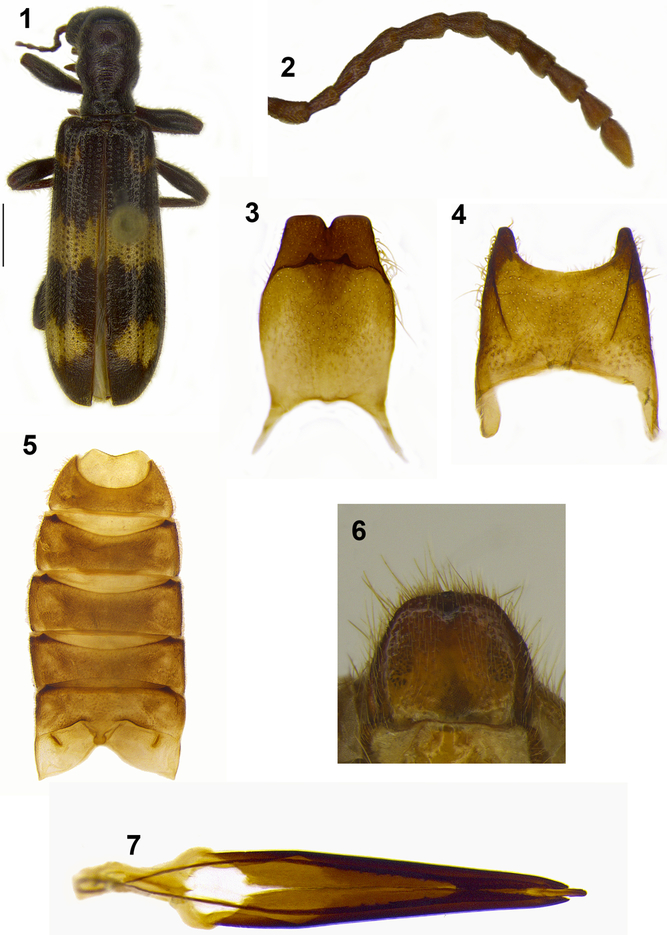
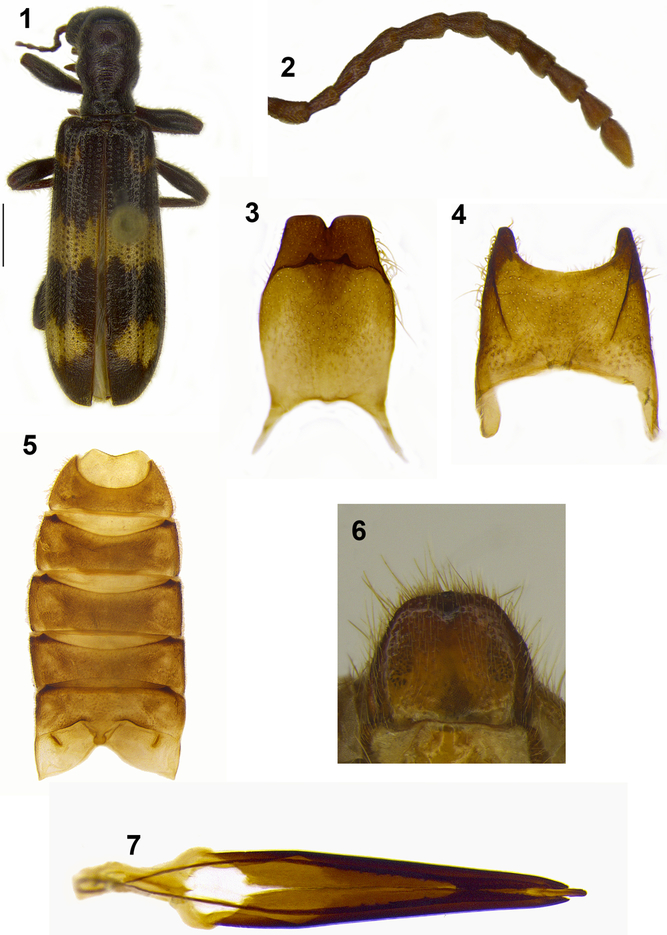
Cymatodera acuminata characters. 1, Habitus (holotype male); 2, antenna; 3, male sixth tergite; 4, male sixth ventrite; 5, male abdomen; 6, female sixth tergite; 7, aedeagus.
http://zoobank.org/urn:lsid:zoobank.org:act:1FF736EB-DB8C-46C5-8806-EA65D52CED97.
Type material. Holotype: red labelled, male: Mexico, Guerrero, Chilpancingo, 29.v.1986, E. Barrera (CNIC). Paratypes (2): one female: Mexico, Puebla, 4 km SW of Tequixquitla, 17.ii.1994, G. Ortega and E. Barrare (CNIC); one female: Mexico, Queretaro, 6.3 miles N Queretaro, 26.vii.1976, Peigler, Gruetzmacher, Rand, Murray, and Schaffner (LACM).
Diagnosis. The new species is similar in habitus to Cymatodera bellamyi Rifkind from Oaxaca, Mexico; C. tortuosa Burke from Hidalgo and Tamaulipas, Mexico; C. lorenae Burke from Morelos, Mexico; and C. sinuosa Burke from Honduras and El Salvador. Males of C. acuminata can be distinguished from these species based on the body shape, the unique form of the pygidium (Figs. 3–4), and the shape of the aedeagus (Fig. 7). Cymatodera acuminata appears to be more robust (Fig. 1) than similar species. Furthermore, among the aforementioned species, only C. acuminata has the sixth abdominal ventrite subquadrate, elongate, slightly longer than broad, with a pair of well-defined, median, longitudinal carinae that extend from the median region of this segment to the posterolateral angles, and the posterior margin broadly, deeply emarginate (Fig. 4). Additionally, the sixth tergite is subquadrate, with the lateral margins oblique, and the posterior margin feebly, triangularly emarginate (Fig. 3). In addition to differences in the pygidium, the phallus is unique in shape, being conspicuously triangular, slender, elongate, with the copulatory piece acuminate posteriorly and a row of fine denticles that extend to the base of the phallus (Fig. 7). Females of the new species are slightly more difficult to distinguish from congeners in the absence of associated males. From C. sinuosa, it can be separated by the presence of fully developed wings and the metatergite longer than wide (in females of C. sinuosa the posterior wings are reduced and the metatergite is as long as wide); in addition, the anterior margin of the elytra is not constricted (females of C. sinuosa have the anterior margin constricted). From C. bellamyi, C. lorenae, and C. tortuosa, it can be separable by the more robust body shape (see Rifkind Reference Rifkind2014; Burke et al. Reference Burke, Rifkind and Zolnerowich2015b; Burke et al. Reference Burke, Sole, Toledo-Hernández and Scholtz2017).
Description. Holotype male. Form elongate, cylindrical, somewhat robust; metathoracic wings present, fully developed. Total length: 12.68 mm. Colour: integument testaceous to brown; mouthparts, antennae, mesoventrite, and tarsi paler. Elytral surface with two testaceous, transverse, irregular fasciae: the first, near humeri, very faint; the second pair wide, sinuate, initiating on the elytral suture and reaching the epipleural fold; and a pair of large, testaceous maculae on the posterior third (Fig. 1).
Head: length = 2.52 mm, maximum width = 2.45 mm. Distance across eyes wider than pronotum; surface profusely punctate; punctures narrow, shallow; frons not bi-impressed; clothed with short, fine, recumbent setae mingled with few, scattered, long, thick, erect setae. Eyes relatively small, ovoid, separated by approximately 1.88 eye widths, feebly bulging laterally. Antennae slender, extending slightly beyond anterior margin of elytra; third antennomere about 1.5 times the length of second antennomere; antennomeres 3–4 about equal in length; fifth antennomere approximately 1.5 times the length of fourth antennomere; antennomeres 5–10 subequal in length; eleventh antennomere ovoid, slightly shorter than tenth antennomere. Antennomeres 2–3 cylindrical, antennomeres 4–10 serrate; serration gradually increases distally (Fig. 2).
Thorax: pronotal length = 3.4 mm, maximum pronotal width = 2.11 mm. Pronotum elongate, widest at middle; sides constricted laterally, more strongly constricted behind middle; disc flat, moderately impressed in front of middle; subbasal tumescence pronounced; surface rugose, punctures narrow and shallow; vested with short, pale, recumbent setae intermixed with few long, erect, pale setae. Prosternum wider than long; surface shiny, longitudinally rugose; very scarcely punctate; glabrous. Mesoventrite subquadrate; surface shiny, rather punctate; punctures shallow, narrow; scarcely vested with some erect setae. Metaventrite strongly convex; surface rugulose; feebly, shallowly punctate; vested with some semi-recumbent setae.
Legs: femora rugulose; surface finely, shallowly punctate; clothed with short, pale, recumbent setae intermingled with erect setae. Tibiae longitudinally rugulose; vested with short, recumbent setae mixed with some scattered, erect setae.
Elytra: length = 9.12 mm, maximum width = 3.82 mm. Anterior margin not constricted; wider than widest portion of pronotum; sides inconspicuously arcuate; widest on posterior fourth; disc convex; apex subtriangular, very feebly dehiscent; elytral sculpturing arranged in regular, shallow striae; punctures abundant on first half of elytral disc, then gradually diminishing in size and number behind middle, disappearing on posterior fourth; punctures less abundant near elytral suture; punctures at elytral base moderately coarse and deep; interstices about three times the diameter of punctures at elytral base; surface shiny, rugulose, clothed with short, pale, fine, recumbent setae interspersed with less numerous, long, pale, erect setae.
Abdomen: ventrites 1–5 shiny, finely punctate; sparsely clothed with short, pale, fine, recumbent setae. Ventrites 1–4 convex, subquadrate; each ventrite with a feebly elevated, longitudinal, dark carina that does not reach posterolateral angles and a pair of shallow, glabrous, shiny impressions near sides (Fig. 5). Fifth ventrite subquadrate in shape; surface rugulose, shallowly, finely punctate; lateral margins oblique, somewhat arcuate; posterior margin broadly, deeply emarginate (Fig. 5). Sixth ventrite subquadrate, elongate, slightly longer than broad, with a pair of well-defined median, longitudinal carinae that extend from the median region of this segment to the posterolateral angles; lateral margins oblique; posterior margin broadly, deeply U-shaped emarginate; posterolateral angles rounded, gibbous, blunt (Fig. 4). Fifth tergite vested with fine, recumbent, pale setae; posterior margin bisinuate laterally, broadly, V-shaped emarginate posteriorly. Sixth tergite narrower than sixth ventrite; longer than broad; subrectangular in shape; surface finely rugulose; vested with semi-recumbent, pale setae; sides oblique, arcuate; posterior margin truncate, with a narrow, shallow, V-shaped emargination (Fig. 3). Posterolateral angles of sixth ventrite extend beyond lateral and posterior margin of sixth tergite.
Aedeagus: length = 2.07 mm. Sclerotised; ratio of length of paramere to whole tegmen 0.12:1.00; tegmen partially covering phallus; parameres developed, conspicuously pointed at apex; phallobase wide; phallus with copulatory piece tapered at apex; phallic plate with a row of moderately developed denticles that almost reach the base of tegmen; phallobasic apodeme long, robust distally; endophallic struts slender throughout their length (Fig. 7).
Variation. Members of the type series have some slight variations in integument colour, ranging from testaceous to dark brown; the elytral fasciae range in size and width; and the length of the two females in the type series is 13.2 and 13.9 mm, respectively. The remaining characters are constant.
Females. The antennae of the two females in the type series are somewhat more coarsely serrate than the male antennae. In addition, females are generally slightly more robust than the only male in the type series; ventrites 1–4 of females do not possess the elevated, longitudinal carina observed in males (Fig. 5); the posterior margin of the sixth tergite is shallowly, narrowly notched (Fig. 6); and the sixth ventrite is broadly rounded.
Etymology. The specific epithet “acuminata” comes from the Latin word acuminatum, meaning pointed or tapered, an allusion to the shape of the sexual organ of the male.
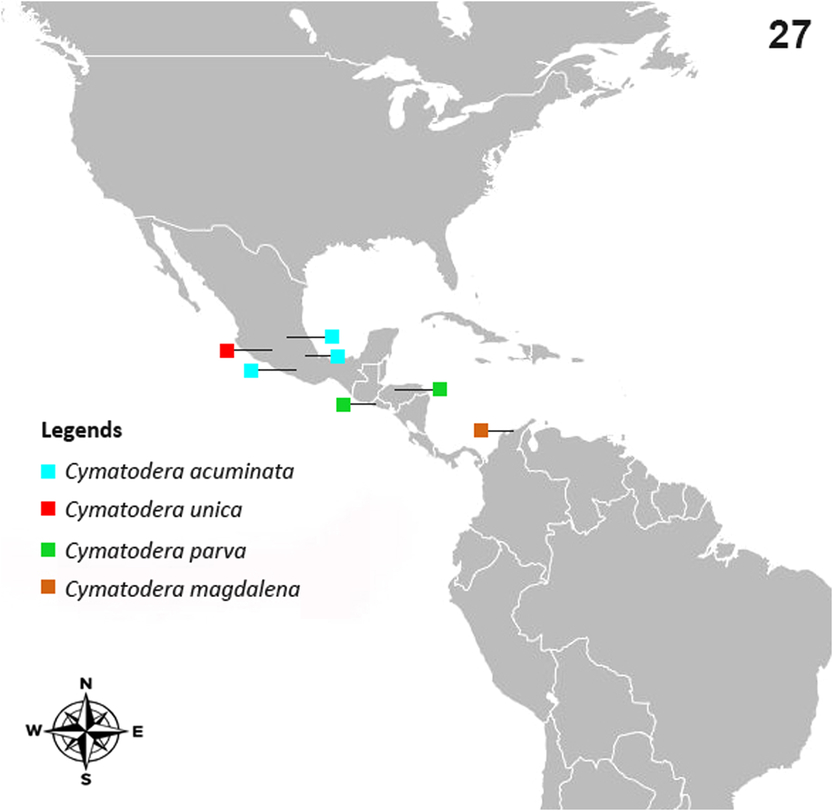
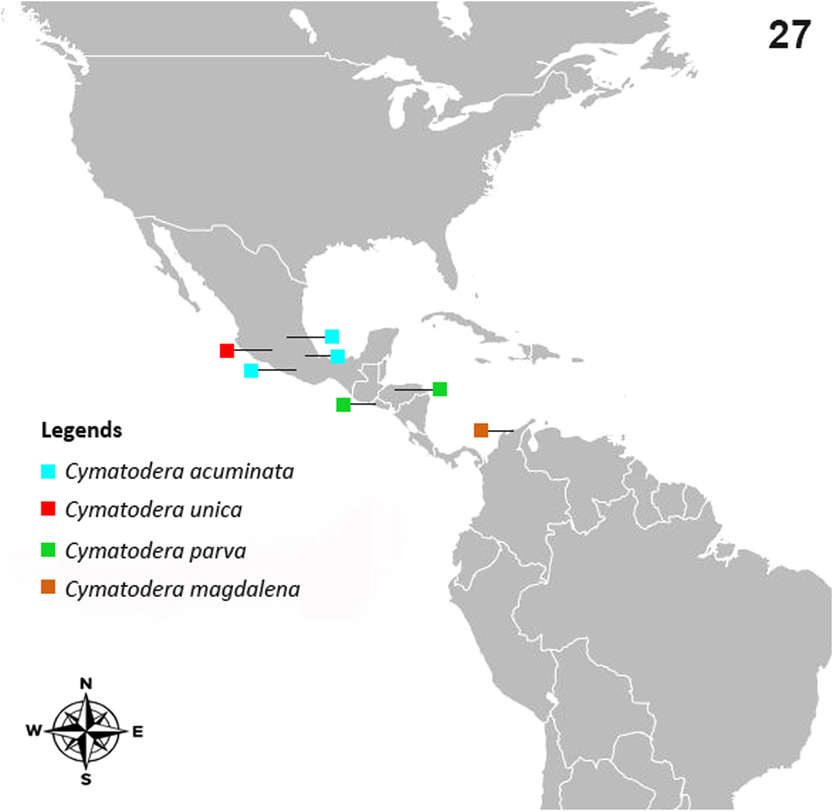
Distribution. The type material was collected from the Mexican states of Puebla, Oaxaca, and Queretaro (Fig. 27). The habitat of the male holotype is represented by a mountainous area covered with subtropical dry broadleaf forests mixed with various cactus (Cactaceae) species.
Cymatodera unica Burke, new species
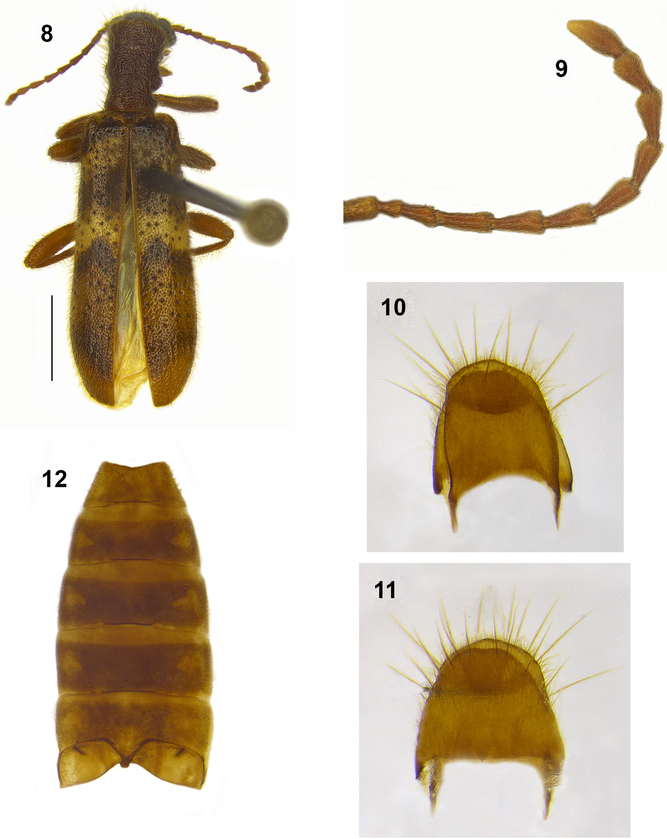
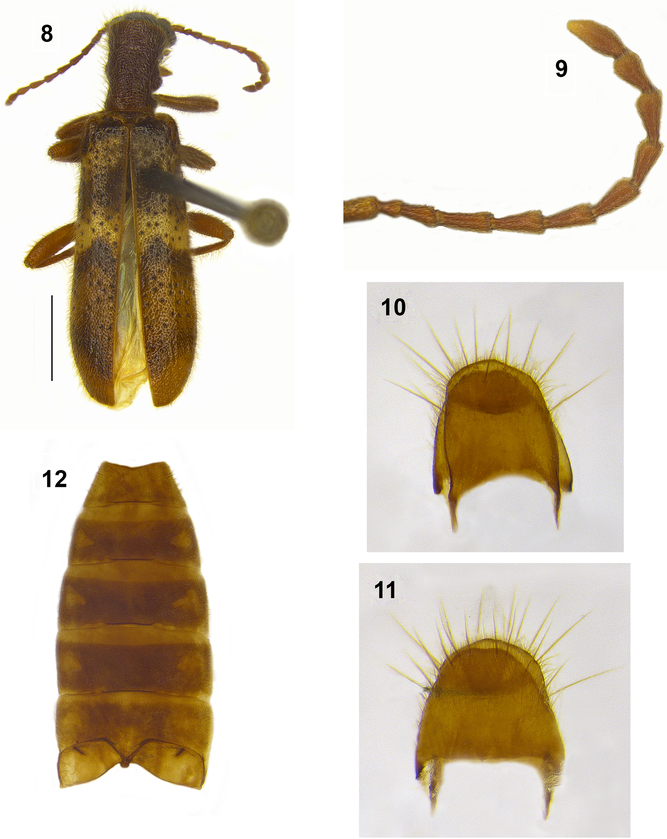
Cymatodera unica characters. 8, Habitus (holotype female); 9, antenna; 10, female sixth tergite; 11, female sixth ventrite; 12, female abdomen.
http://zoobank.org/urn:lsid:zoobank.org:act:1A1AF693-503D-4B3E-89C9-0786BC35777C
Type material. Holotype: red labelled, female: Mexico, Michoacan, 5 km N Paracho, 29.v.2007, Quercus-Pinus forest, funnel trap, D. Cibrian and A. Plasencia (CNIC).
Diagnosis. Separable from other species of Cymatodera by the unique band patterning and irregularly arranged punctures on the elytral disc. The new species has the first half of the elytral disc pale testaceous, while the second half is light brown; the disc is adorned with four infuscate, irregular, transverse fasciae; and the elytral punctures are irregularly arranged and scattered throughout three quarters of the elytral disc; these punctures abruptly disappear on posterior fourth (Fig. 8). This combination of characters is not observed in any other Cymatodera species.
Description. Holotype female. Form elongate, cylindrical, slender; metathoracic wings present, fully developed. Total length: 9.41 mm. Colour: head, pronotum, prosternum, mesotergite, metatergite, and abdomen with a brown luster; mouthparts and legs testaceous; first half of elytral disc pale testaceous, second half testaceous. Elytra adorned with four piceous, irregular, transverse fasciae: the first located on the anterior margin of the elytral disc, the second slightly behind the first band, the third on the median region of the elytral disc, the fourth in front of the elytral declivity (Fig. 8).
Head: length = 1.90 mm, maximum width = 1.68 mm. Distance across eyes wider than pronotum; surface rugose, shiny, punctures wide, shallow; frons bi-impressed; clothed with short, fine, recumbent setae and few, long, erect setae. Eyes moderately large, subovoid, separated by approximately 1.75 eye widths, bulging laterally. Antennae slender, extending slightly beyond anterior margin of elytra; second antennomere small; third antennomere approximately two times the length of second antennomere; fourth antennomere 1.5 times longer than the length of third; antennomeres 4–10 gradually reduce in length distally; eleventh antennomere ovoid, approximately the same length of tenth antennomere. Antennomeres 2–4 cylindrical, antennomeres 5–10 serrate; serration gradually increasing towards distal end (Fig. 9).
Thorax: pronotal length = 2.25 mm, maximum pronotal width = 1.39 mm. Pronotum elongate, widest at middle; sides constricted laterally, more strongly constricted behind middle; disc flat, feebly impressed in front of middle; subbasal tumescence absent; surface rugose, shiny, punctures wide and shallow; vested with short, pale, recumbent setae intermixed with few long, erect, pale setae. Prosternum wider than long; shiny; rugose; shallowly punctate; vested with some scattered, semi-erect setae. Mesoventrite subquadrate; surface smooth, coarsely punctate; punctures wide, deep; vested with some erect setae. Metaventrite longer than wide; convex; surface rugulose, shallowly punctate; scarcely vested with semi-recumbent setae.
Legs: femora rugulose; moderately, shallowly punctate; clothed with short, pale, recumbent setae interspersed with few erect setae. Tibiae rugulose; shiny; vested with short, recumbent setae intermixed with long, erect setae.
Elytra: length = 6.91 mm, maximum width = 2.93 mm. Anterior margin not constricted; wider than widest portion of pronotum; sides subparallel; widest on posterior third; disc convex; apex subtriangular, inconspicuously dehiscent; elytral sculpturing consisting on irregular, shallow, wide punctures, these punctures more abundant on first half of elytral disc, then becoming more scattered towards posterior end, and abruptly disappearing on posterior fourth; punctures at elytral base coarse, deep; interstices about 2.5 times the diameter of punctures at elytral base; surface shiny, rugulose, clothed with short, pale, fine, semi-recumbent setae interspersed with long, pale, erect setae.
Abdomen: ventrites 1–5 shiny, finely punctate; clothed with short, pale, fine, recumbent setae interspersed with some scattered, long, erect setae. Ventrites 1–4 convex, subquadrate; each ventrite with a pair of pale, shallow, glabrous impressions near sides (Fig. 12). Fifth ventrite subquadrate in shape; surface rugulose, shallowly, finely punctate; lateral margins subparallel, arcuate; posterior margin broadly, shallowly emarginate (Fig. 12). Sixth abdominal ventrite subquadrate, as broad as wide; lateral margins feebly oblique; posterior margin broadly rounded (Fig. 11). Fifth tergite subquadrate; lateral margins parallel; posterior margin broadly truncate. Sixth tergite longer than broad; subrectangular in shape; surface finely rugulose; sides oblique, arcuate; posterior margin broadly rounded (Fig. 10). Posterolateral angles of sixth ventrite do not extend beyond lateral and posterior margins of sixth tergite (Fig. 10).
Male. Unknown.
Etymology. The specific epithet unica derives from the Latin word “unicus,” meaning unique or singular, an allusion to the rareness of this new species. During all the years the first author has studied this genus of checkered beetles; he has not encountered, collected, or examined another specimen of this attractive species.
Distribution. The holotype of this new species was collected near the town of Paracho, in the northern part of the state of Michoacan, Mexico (Fig. 27). The habitat of the holotype is a temperate mountainous region covered by subtropical coniferous forests and some patches of Quercus-Pinus forests.
Cymatodera parva Burke, new species
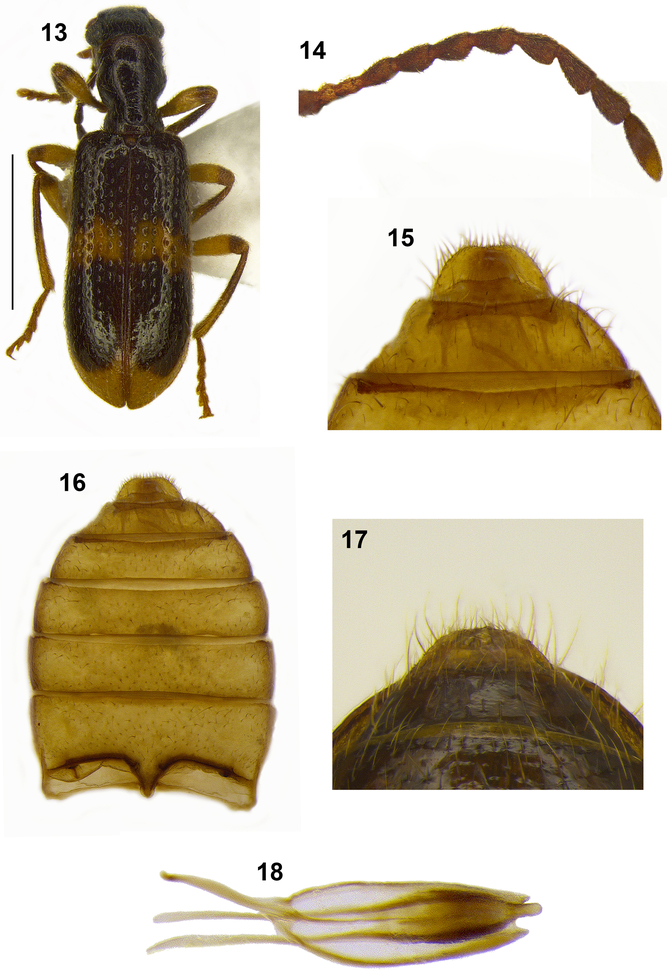
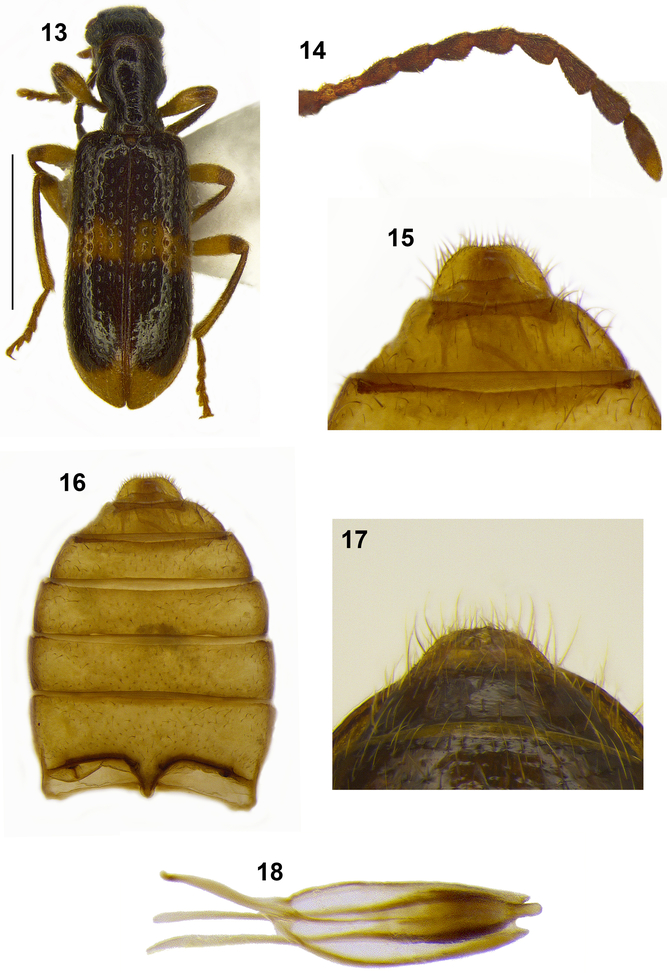
Cymatodera parva characters. 13, Habitus (holotype male); 14, antenna; 15, male sixth ventrite; 16, male abdomen; 17, female sixth ventrite; 18, aedeagus.
http://zoobank.org/urn:lsid:zoobank.org:act:E412CB09-ECC4-425C-AA4E-9714DC4AF270
Type material. Holotype: red labelled, male: El Salvador, Cerro Verde, Santa Ana, 15.ii.1960, J. Bechyne (CNIC). Paratypes (9): one male, four females with the same data as the holotype (RBINS); one male, one female: Honduras, Yoro, Parque Nacional Pico Pijol, mercury vapour and blacklight, 2.vi.2003, R. Turnbow (RHTC); two males: Honduras, Yoro, Parque Nacional Pico Pijol, mercury vapour and blacklight, 23.vii.2001, R. Turnbow (JNRC and RHTC).
Diagnosis. Cymatodera parva appears to be most similar to the Mexican species Cymatodera ignava Rifkind, Toledo, and Corona. These species share a similar body form and size, integument colour pattern, and a simple male pygidium. This new species differs from C. ignava, however, by having the second and third antennomeres short and slender (Fig. 14); the body shape is somewhat narrower; the integument colour is darker, in a piceous to almost black tone, with two testaceous fasciae on the elytral disc; and the elytral punctures are wider, separated from one another by slightly more than three times the width of a puncture on the elytral base (Fig. 13). Cymatodera ignava has the antennomeres 2–4 reduced and slender; the body shape is more robust and oval; the body integument is generally lighter, with two stramineous bands on the elytral disc; and the elytral punctures are narrower and closer to one another. The distribution of these species will further help to distinguish them. The type material of C. parva was collected from the Central American countries of El Salvador and Honduras, while C. ignava appears to be restricted to south-central Mexico.
Description. Holotype male. Form small, somewhat slender; cylindrical; metathoracic wings present, fully developed. Total length: 5.23 mm. Colour: head, antennae, pronotum, prosternum, mesotergite, metatergite, and elytra piceous; mouthparts, legs, and abdomen testaceous; elytral surface with two testaceous, transverse fasciae, the first band is located on the median region of the elytral disc, the second is found on the elytral declivity; distal portion of tibiae and proximal half of femora with a piceous hue (Fig. 13).
Head: length = 1.21 mm, maximum width = 1.09 mm. Distance across eyes wider than pronotum; surface smooth, shiny, feebly punctate; punctures narrow, shallow; frons not bi-impressed; clothed with short, fine, pale recumbent setae and few scattered long, pale, erect setae. Eyes large, rounded, separated by approximately 1.71 eye widths, bulging laterally. Antennae robust, extending beyond anterior margin of elytra; antennomeres 2–3 small, slender; fourth antennomere more robust and 1.5 times longer than third antennomere; antennomeres 4–10 subequal in length; eleventh antennomere ovoid, approximately 1.5 times longer than tenth antennomere. Antennomeres 2–3 cylindrical, antennomeres 4–10 serrate; serration becomes more apparent towards distal end (Fig. 14).
Thorax: pronotal length = 1.36 mm, maximum pronotal width = 0.94 mm. Pronotum elongate, widest at middle; sides constricted laterally, more strongly constricted behind middle; disc flat, feebly impressed in front of middle; subbasal tumescence absent; surface shiny, smooth; punctures narrow and shallow; weakly vested with short, pale, recumbent setae mixed with few, scattered, long, erect, pale setae. Prosternum wider than long; surface shiny, smooth; moderately punctate; glabrous. Mesoventrite subquadrate; surface smooth; punctures shallow, narrow; scarcely vested with some erect setae. Metaventrite strongly convex; surface rugulose, smooth, shallowly punctate; scarcely vested with some pale, fine, semi-erect setae.
Legs: femora rugose, shiny; shallowly punctate; punctures wide, shallow; clothed with short, pale, recumbent setae intermixed with few erect setae. Tibiae longitudinally rugulose; vested with short, recumbent setae and few scattered, erect setae.
Elytra: length = 3.73 mm, maximum width = 1.81 mm. Anterior margin not constricted; arcuately emarginate; wider than widest portion of pronotum; widest on posterior third; disc convex; elytral apices subtriangular, feebly dehiscent; elytral sculpturing arranged in regular striae; punctures rather abundant on first half of elytral disc, then gradually diminishing in size and number towards elytral apices, disappearing on posterior quarter; punctures less abundant near elytral suture; interstices about three times the diameter of punctures at elytral base; surface shiny, smooth, vested with short, pale, fine, recumbent setae intermingled with few, long, pale, erect setae.
Abdomen: ventrites 1–5 shiny, finely punctate; sparsely clothed with short, pale, fine, recumbent setae. Ventrites 1–4 subquadrate. Fifth ventrite subtriangular, smaller than fourth ventrite, lateral margins oblique, posterior margin truncate (Figs. 15–16). Sixth ventrite small; subquadrate; wider than long; lateral margins oblique; posterior margin broadly, shallowly emarginate (Fig. 15). Fifth tergite with posterior margin truncate. Sixth tergite subquadrate in shape; convex; broader than long; surface finely rugulose; vested with pale, semi-recumbent, long and short setae; sides oblique, arcuate; posterior margin narrowly, shallowly emarginate. Sixth tergite completely covering sixth ventrite in dorsal view (Fig. 15).
Aedeagus: length = 1.02 mm. Feebly sclerotised; ratio of length of parameres to whole tegmen 0.15:1.00; tegmen partially covering phallus; parameres scarcely developed, pointed at apex; phallobase narrow; phallus with copulatory piece rounded at apex; phallic plate devoid of denticles; phallobasic apodeme long, slender distally; endophallic struts robust throughout the length (Fig. 18).
Variation. One paratype collected in Honduras has a conspicuously paler integument colour. This individual may be teneral. The colour of the elytral banding in the type series can vary slightly, ranging from infuscate to stramineous. The remaining characters are constant.
Female. Females in the type series have the sixth ventrite and the sixth tergite broadly rounded, producing a semicircle (Fig. 17), rather than broadly, shallowly emarginate, as observed in the males (Figs. 15–16).
Etymology. The specific epithet parva comes from the Latin word parvus (= small), a noun that refers to the small size of this new species.
Distribution. The type material of this new species was collected from two localities: Cerro Verde in El Salvador and Pico Pijol in Honduras (Fig. 27). These localities are mountainous regions predominantly characterised by sub-temperate and temperate evergreen forests intermixed with some patches of cloud forest.
Geographic distribution map of the new species of Cymatodera in the Neotropics.
Remarks. Cymatodera parva belongs to a group of species morphologically characterised by the following combination of characters: a small to moderately small size and robust body (Fig. 13); feebly sclerotised aedeagus, with the parameres crenulate, and poorly developed rows of fine denticles or completely devoid thereof (Fig. 17); and a simple male pygidium (Figs. 15–16). Males are difficult to separate from females within this group of Cymatodera species due to the limited to almost non-existent morphological differences observed between them. In some instances, the extraction of the genitalia is the only reliable method to distinguish the sex. The group is well represented in semi-arid regions of southwestern United States of America and northern Mexico, with some species extending to central Mexico and Central America. Examples of species in the group are C. aegra Wolcott, C. decipiens Fall, C. pallida Schaeffer, and C. werneri Barr from the southwestern United States of America and northern Mexico; C. cylindricollis Chevrolat and C. ignava from central Mexico; and the new species, C. parva, from El Salvador and Honduras. The generation of morphology-based and molecular-based phylogenies of Cymatodera and related genera, coupled with a thorough examination of all male pygidial forms encountered in the genus, will help us to better understand the relationships between this group of species and other taxa exhibiting an elaborated male pygidium (Figs. 22–23) and a conspicuously sclerotised aedeagus with well-developed rows of denticles (Fig. 7).
Cymatodera magdalena Burke, new species
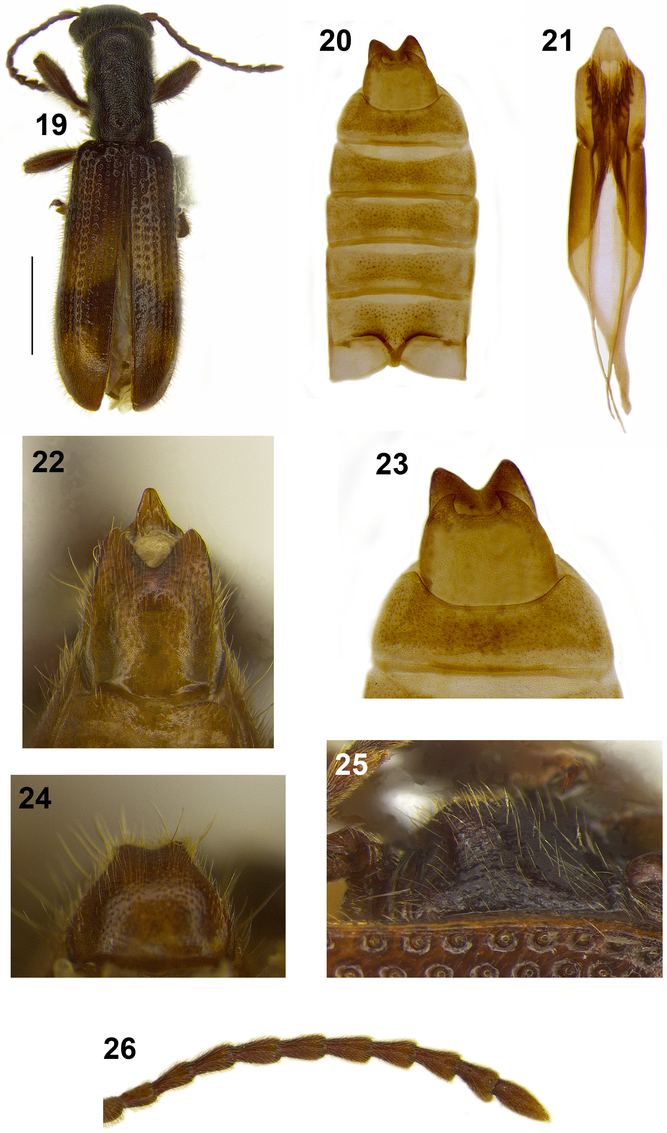
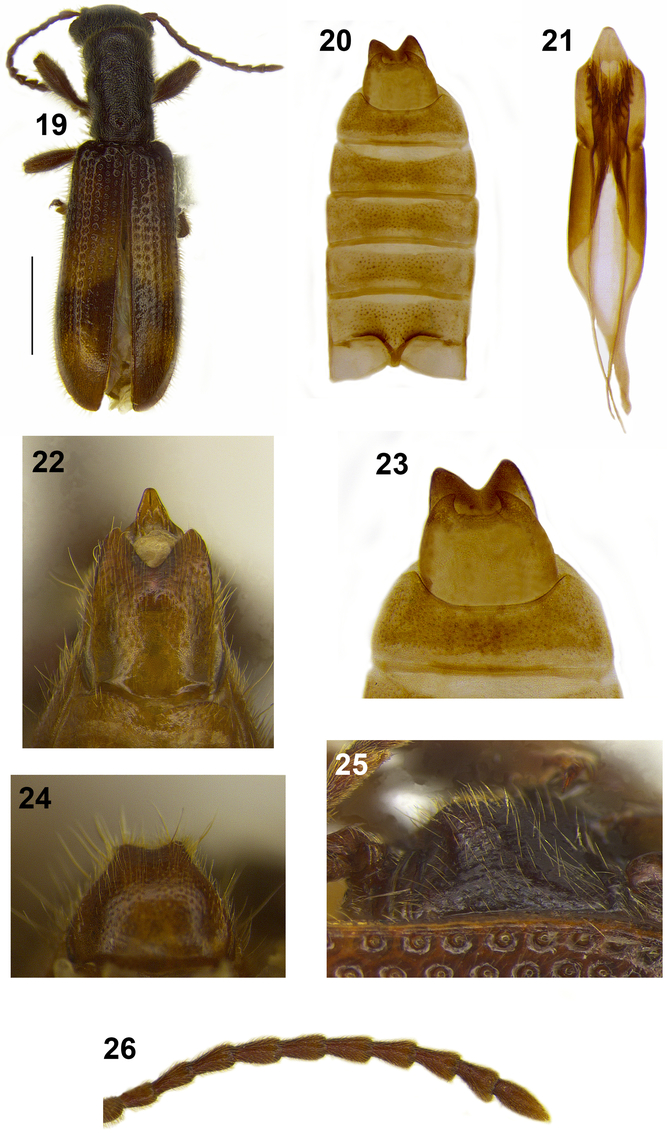
Cymatodera magdalena characters. 19, Habitus (holotype male); 20, male abdomen; 21, aedeagus; 22, male sixth tergite; 23, male sixth ventrite; 24, female sixth tergite; 25, male metatergite; 26, antenna.
http://zoobank.org/urn:lsid:zoobank.org:act:7DAB86EE-5350-4534-B53A-B948945B94B5
Type material. Holotype: red labelled, male: Colombia, Magdalena, Parque Nacional Natural Tayrona, Pueblito, 225 m, 11°20′N, 74°2′W, specimen #M1348, R. Henriquez, 13–16.i.2003 (CNIC). Paratypes (1): one female: Colombia, Magdalena, Parque Nacional Natural Tayrona, Palangana, 30 m, 30.ix–11.x.2001, 11°20′N, 74°2′W, specimen #M2754, R. Henriquez (IAVH).
Diagnosis. Cymatodera magdalena can be differentiated from congeners by the following combination of characters: shape of the pronotum (Fig. 19), metatergite (Fig. 25), male pygidium (Figs. 22–23), aedeagus (Figs. 21), and elytral disc pattern (Fig. 19). Cymatodera magdalena has a close affinity with the Central American species Cymatodera vittata Burke. The new species can be separated from the latter by differences in the shape of the pronotum, the male pygidium and aedeagus, and the integument colour. In C. magdalena, the pronotum is robust and moderately sinuate laterally (Fig. 19); the sixth ventrite is feebly convex, not excavated (Fig. 23); the male aedeagus is slender, subparallel laterally, with the parameres and copulatory piece rounded posteriorly (Fig. 21); and the integument colour ranges from piceous on the head and pronotum to almost infuscate on the elytral disc (Fig. 19). In C. vittata, the pronotum is narrow and more strongly sinuate laterally; the sixth ventrite is conspicuously concave and excavated; the male aedeagus is more robust basally, with the parameres and copulatory piece more rounded posteriorly; and the integument colour of the head and pronotum is ferrugineous, while the elytral disc colour can range from testaceous to pale testaceous.
Description. Holotype male. Form elongate, moderately slender; metathoracic wings present. Total body length = 8.93 mm. Colour: Head, pronotum, prosternum, mesoventrite, and metaventrite piceous; mouthparts, antennae, elytra, abdomen, and legs dark testaceous; elytra with two sets of irregular, piceous markings, the first X-shaped, located on anterior half, the second behind middle of elytral disc (Fig. 19).
Head: length = 1.80 mm, maximum width = 1.85 mm. Measured across eyes wider than pronotum; surface finely punctate; frons bi-impressed, clothed with short, fine, recumbent setae mixed with some long, erect setae. Eyes of moderate size, subsinuate, ovoid, separated by approximately 2.42 eye widths, feebly bulging laterally. Antennae slender, extending beyond anterior margin of elytra; second antennomere slightly shorter than third antennomere; antennomeres 3–10 approximately equal in length; eleventh antennomere ovoid, approximately equal in length to tenth antennomere. Antennomeres 2–4 cylindrical, antennomeres 5–10 moderately serrate; serration gradually increasing distally (Fig. 26).
Thorax: pronotal length = 2.98 mm, maximum pronotal width = 1.6 mm. Pronotum elongate, widest at anterior margin; sides constricted laterally, more strongly constricted behind middle; disc flat, impressed in front of middle; subbasal tumescence pronounced; surface rugulose, punctures deep, narrow; vested with short, pale, recumbent setae intermingled with few, long, erect setae, the latter more numerous laterally. Prosternum wider than long; concave; surface shiny, smooth, shallowly, scarcely punctate, glabrous. Mesoventrite subquadrate; shiny; smooth; vested with scattered, pale, long, recumbent setae. Metaventrite convex; surface rugose; as long as wide; shallowly punctate; clothed with fine, pale, recumbent setae interspersed with some scattered semi-erect setae; median region conspicuously elevated, bearing a tuft of pale, semi-erect setae (Fig. 25).
Legs: femora rugulose, finely punctate; clothed with short, pale, semi-recumbent setae and some erect setae. Tibiae rugulose; broadly, shallowly punctate; vested with short, semi-recumbent setae mixed with some long, erect setae.
Elytra: length = 5.9 mm, maximum width = 2.72 mm. Anterior margin not constricted; wider than widest portion of pronotum; sides subparallel, widest on posterior third; disc convex; apex subtriangular, feebly dehiscent; elytral disc punctate; elytral sculpturing arranged in regular striae, punctures less abundant on middle third, then disappear on posterior third. Elytral punctures less abundant near elytral suture; interstices about 2.3 times the diameter of punctures at elytral base; surface of elytral disc rugulose, shiny, vested with short, pale, semi-recumbent setae intermingled with less numerous, scattered, long, erect setae.
Abdomen: ventrites 1–4 subquadrate, rugulose, finely, narrowly punctate; clothed with short, pale, recumbent setae; each segment with an elevated, longitudinal, pale carina that does not attain posterolateral angles (Fig. 20). Fifth ventrite convex; subtriangular in shape; surface rugulose, shallowly, finely punctate; lateral margins oblique, arcuate; posterior margin broadly, deeply emarginate (Fig. 23). Sixth ventrite subquadrate in shape; as broad as long; surface convex; finely punctate; lateral margins arcuate; posterior margin deeply U-shaped emarginate; posterolateral angles pointed distally (Fig. 23). Fifth tergite rugulose; lateral margins oblique; posterior margin shallowly V-shaped emarginate. Sixth tergite subquadrate; rugulose; longer than broad; surface convex; posterior half ventrally recurved; lateral margins subparallel, becoming feebly oblique on second half; posterior margin broadly, deeply V-shaped emarginate; posterolateral angles pointed distally, gibbous, ventrally folded (Fig. 22). Sixth tergite extending beyond posterior margin of sixth ventrite (Figs. 22–23).
Aedeagus: length = 1.48 mm long, rather robust; ratio of length of paramere to whole tegmen 0.37:1; parameres well developed, broad, subtriangular; obtuse distally, phallobase wide; phallus with copulatory piece acuminate at apex; phallic plate with a reduced number of long denticles along dorsal margin; phallobasic apodeme slender distally; endophallic struts slender (Fig. 21).
Variation. The only paratype in the type series, a female, is slightly longer (9.31 mm) and somewhat more robust than the male holotype. It also has the banding pattern on the elytral disc slightly darker than the male holotype. The remaining characters are constant in these two individuals.
Females. The female has the sixth ventrite subtriangular in shape; the lateral margins are oblique and arcuate; the posterior margin is broadly, very shallowly emarginate; and the posterolateral angles are rounded; the sixth tergite is subtriangular; the lateral margins are oblique; the posterior margin is feebly notched; and the hind angles are rounded (Fig. 24). In addition, the female lacks the setiferous patch seen on the metatergal region of the male holotype (Fig. 25).
Etymology. The specific epithet magdalena is derived from the Colombian Department where the new species was collected.
Distribution. The type material was collected from the Tayrona National Natural Park, located in the Sierra de Santa Marta, Department of Magdalena. This park is located in northeastern Colombia (Fig. 27) and is represented by tropical dry forests at lower elevations, and tropical evergreen and cloud forests at medium and high elevations.
Remarks. The genus Cymatodera is poorly represented in South America. Thus far, we have records of three species extending their distribution to this region: C. conflagrata (Klug) found in Colombia and Venezuela, C. championi Gorham distributed in Colombia and Bolivia, and C. prolixa (Klug) from Venezuela (Burke et al. Reference Burke, Leavengood and Zolnerowich2015a). These species, however, are not restricted to South America, but they can also be found in Central America and southern Mexico. Cymatodera magdalena represents a new species from South America, and very likely the first one restricted to this continent. Morphological similarities between C. magdalena and the Panamanian species C. vitatta suggest a close affinity between these two species. Particularly interesting is the presences of a protruding metaventrite bearing a sensory area consisting of rather dense, short, and semi-erect setae in these two species (Fig. 25). The first author has extensively examined Cymatodera material collected from the Central American countries of Costa Rica and Panama, but has never encountered samples of C. magdalena among these specimens. He has also examined one specimen that corresponds to a new species collected in Peru. The Peruvian specimen, as well as C. magdalena, should serve as conclusive evidence that more species of this checkered beetle group remain unknown to science in this vast continent; yet it is very likely that species richness in this region is not on par with the one seen at northern latitudes.
Acknowledgements
We are grateful to the three anonymous reviewers for their valuable corrections and suggestions to the manuscript. The first author is thankful to the following persons and institutions for the loan of specimens: Jacques Rifkind, Robert H. Turnbow, Jr., Weston Opitz, the California Academy of Sciences Collection, the Royal Belgian Institute of Natural Sciences, and the National Insect Collection at the Universidad Nacional Autónoma de Mexico. The first author is also thankful to The Claude Leon Foundation for the economic support provided to carry out research in South Africa.