


Introduction
Parkinson's disease (PD) is a neurodegenerative illness, with motor symptoms such as tremors, rigidity, abnormal posture and bradykinesia. The disease is, however, associated with a number of non-motor symptoms. In particular, PD has been associated with an increased risk of depression. Becker et al. (Reference Becker, Brobert, Johansson, Jick and Meier2011) estimate that in the UK, those with PD are twice as likely to have depression as those of the same age without the illness. Studies have shown that more than half of all PD patients have clinical levels of depression (Oguru et al. Reference Oguru, Tachibana, Toda, Okuda and Oka2010). Cognitive behaviour therapy (CBT) with components including problem solving, behavioural activation, sleep hygiene, thought monitoring and challenging and relaxation techniques, has been shown to lead to improvements in depression, anxiety, PD symptom severity and quality of life (Cole & Vaughan, Reference Cole and Vaughan2005a; Dobkin et al. Reference Dobkin, Allen and Menza2007, Reference Dobkin, Menza, Allen, Gara, Mark, Tiu and Friedman2011)
Depression in this population appears to be more likely when there are impaired activities of daily living (Tandberg et al. Reference Tandberg, Larsen, Aarsland, Laake and Cummings1997), more severe PD symptoms (Riedel et al. Reference Riedel, Heuser, Klotsche, Dodel and Wittchen2010), and pain (Ehrt et al. Reference Ehrt, Larsen and Aarsland2009). Thus, those who are in the more advanced stages of the illness may be in greater need of psychological interventions for depression. However, previous research has mainly been conducted with those who are younger. This group may therefore be in the early stages of PD, when physical symptoms are less severe. Dobkin et al. (Reference Dobkin, Menza, Allen, Gara, Mark, Tiu and Friedman2011) included those up to the age of 85 years in their trial, but the mean age was 63 years. Mohlman et al. (Reference Mohlman, Reel, Chazin, Ong, Georgescu, Tiu and Dobkin2010) report on the use of CBT for anxiety with someone with PD and problems with memory and attention; however, the participant was aged 74 years. Similarly Cole & Vaughan (Reference Cole and Vaughan2005b) suggest that CBT techniques should be used to address uncertainty about prognosis, implying use with those in the early stages of disease.
Therefore whether CBT is effective with clients who are older and in the more advanced stages is unclear at present. This paper presents a case study to illustrate how CBT can be adapted for use with PD patients who are older and have more severe symptoms, and the considerations and challenges of doing so.
Presenting problem
Bob (not his real name), an 84-year-old man was referred for psychological therapy for symptoms of depression. When presenting, his mood had started to deteriorate. As a result he was lacking in motivation and not taking part in activities in his nursing home.
Medical history
Bob had experienced depression a few years previously and had an inpatient stay at the time. He had also received psychological therapy in the past which had led to improvements; however, it was concluded that his mood was likely to worsen with further physical deterioration. He had a history of strokes and right-sided hemiplegia and had limited movement in his arms and legs. Bob was diagnosed with PD 7 years earlier, and was now in the advanced stages of the disease. He had a resting tremor and limited use of his hands, with slowness of movement (bradykinesia). Bob found it hard to walk and in recent times rarely got out of his wheelchair. Rigidity also affected his facial expressions so that Bob sometimes found it hard to smile, and he often experienced freezing during movements and speech. He needed significant help with personal care, and was showered by staff and lifted onto the toilet using a hoist.
Assessment
The following standardized measures were used for assessment and to assess outcomes.
Hospital Anxiety and Depression Scale (HADS; Zigmond & Snaith, Reference Zigmond and Snaith1983)
This was initially designed to assess depression and anxiety symptoms in hospital settings. It has been shown to have good psychometric properties when used to detect depression in PD (Mondolo et al. Reference Mondolo, Jahanshahi, Grana, Biasutti, Cacciatoria and Di Benedetto2006).
Clinical Outcomes Routine Evaluation Scale, 10-item version (CORE-10; Connell, Reference Connell2007)
This scale is used to assess global mental health in order to aid the evaluation of therapeutic work. The full version of the CORE has been shown to be reliable when used with older adults (Barkham et al. Reference Barkham, Culverwell, Spindler and Twigg2005), although the psychometric properties of the 10-item version with this age group or clinical population are unknown.
Geriatric Depression Scale – Short Form (GDS-SF; Sheikh & Yesavage, Reference Sheikh, Yesavage and Brink1986)
This scale was developed to measure depression in older adults specifically. A score of ≥5 out of 15 has been shown to detect depression in PD with a sensitivity of 0.88 and a specificity of 0.85 (Weintraub et al. Reference Weintraub, Oehlberg, Katz and Stern2006).
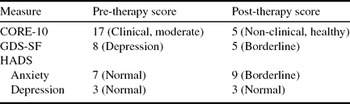
Prior to the start of therapy Bob scored 17 on the CORE-10, which is above the clinical cut-off and within the moderate range. On the HADS Bob scored 3 for depression and 7 for anxiety which were both in the normal range. Finally he scored 8 on the GDS-SF, which was above the cut-off for depression. Bob did not report any suicidal ideation; the CORE-10 item ‘I have made plans to end my life’ was answered as ‘Not at all’. A recent psychiatric assessment had noted no psychotic symptoms which is important as they are present in more than a quarter of PD cases (Mack et al. Reference Mack, Rabins, Anderson, Goldstein, Grill, Hirsch and Marsh2011).
Cognitive functioning
Bob had not been diagnosed with dementia or any cognitive impairment. However, his initial psychiatric assessment suggested his cognitive functioning should be assessed once his mood had improved. Moreover, cognitive impairment is common in PD (Mamikonyan et al. Reference Mamikonyan, Moberj, Siderow, Duda, Ten Have, Hurtig and Weintraub2009), so is important to take this into account. However, a full neuropsychological assessment is not always needed as depression may impair cognition, thus a brief assessment of ability to engage in therapy is required (Laidlaw, Reference Laidlaw, Laidlaw and Knight2008). The Addenbrooke's Cognitive Examination Revised (ACE-R; Mioshi et al. Reference Mioshi, Dawson, Mitchell, Arnold and Hodges2006) was used to assess Bob's cognitive functioning. This demonstrated some mild impairment on attention, concentration and memory, although the full test was not completed as Bob reported feeling too tired. However, as verbal comprehension was intact Bob was deemed able to engage in psychological therapy.
Formulation
A longitudinal formulation based on CBT was used to help plan intervention components. A simplified version of this was also developed and shown to Bob to illustrate his problem. The formulation was based on Laidlaw et al.'s (Reference Laidlaw, Thompson and Gallagher-Thompson2004) conceptual framework for CBT with older people, and includes cohort beliefs, sociocultural context and roles in transition investment which were relevant in the current case. Figure 1 shows the final full formulation.
Longitudinal formulation (based on Laidlaw et al. Reference Laidlaw, Thompson and Gallagher-Thompson2004).

Adaptations made for PD
A CBT framework was adopted. Relevant booklets (Beck, Reference Beck2000), reviews (Cole & Vaughan, Reference Cole and Vaughan2005b; Charidimou et al. Reference Charidimou, Seamons, Selai and Schrag2011), book chapters (Laidlaw, Reference Laidlaw, Laidlaw and Knight2008) and intervention manuals from previous research (Dobkin et al. Reference Dobkin, Menza, Allen, Gara, Mark, Tiu and Friedman2011) were consulted. However, these interventions were aimed at those in the early stages of the disease, and so many of the ideas were not appropriate for Bob.
Sessions were taken at a slow pace, with only one main topic covered in a session and regular recaps and summaries. Sessions took place at the nursing home where he was resident, in the mornings when Bob reported he was most awake. Sessions were kept short at around half an hour each to avoid fatigue. Bob was encouraged to cancel or end sessions early if he did not feel well which he did so on three occasions. A total of seven sessions were conducted. Handouts were used during sessions, these were kept simple with large font text and graphics for illustration. At the end of the therapy, Bob was provided with a printed summary and poster to keep.
Previous interventions in the area (Dobkin et al. Reference Dobkin, Menza, Allen, Gara, Mark, Tiu and Friedman2011) have involved patients completing worksheets. However this was not possible as Bob had limited use of his hands, so handouts were completed with him in session and then typed out. Less emphasis was placed on written homework for this reason, and because it may be more difficult for patients with PD to understand homework tasks (Charidimou et al. Reference Charidimou, Seamons, Selai and Schrag2011). Bob was asked to think about or try to notice certain things over the week, rather than keeping a written record. Previous interventions have had sessions for caregivers (Dobkin et al. Reference Dobkin, Menza, Allen, Gara, Mark, Tiu and Friedman2011), so nursing home staff were involved in the intervention by keeping a record of his activity participation, and being informed and encouraged to reinforce the ideas Bob had learned in therapy
Intervention
An emphasis was placed on behavioural activation in line with Bob's goals and previous trials in the area (Dobkin et al. Reference Dobkin, Allen and Menza2007, Reference Dobkin, Menza, Allen, Gara, Mark, Tiu and Friedman2011). Bob reported that he wanted to take part in activities but did not feel confident and sometimes had little motivation. The activities which Bob enjoyed in particular were discussed and this was fed back to the staff. For a number of sessions homework was set to try to record thoughts when asked to take part in an activity. The idea of anticipatory anxiety was also discussed, i.e. thinking about taking part may have been more anxiety-provoking than actually doing so. The idea of vicious cycles and a self-fulfilling prophecy was discussed in relation to this: the thought ‘It's too difficult’ led to emotions of feeling ‘down’ and ‘stupid’ in Bob's words, the resulting behaviour was not to take part in the activity, which then reinforced the thought that it was too hard.
Work on negative thoughts about Bob's illness focused on the meaning of his symptoms, as has been done in previous interventions (Dobkin et al. Reference Dobkin, Allen and Menza2007, Reference Dobkin, Menza, Allen, Gara, Mark, Tiu and Friedman2011). Bob was educated on the effect of thoughts on emotions and behaviour via discussion of the formulation, and also through a simplified ABC model (Situation–Thought–Result). This was applied to being helped in the shower which Bob found particularly upsetting; thinking, in Bob's words, ‘I'm a bloody idiot’ led to him being worried, frustrated, embarrassed and wanting to shout. Thinking instead ‘It's embarrassing but it does me good’ or ‘It's not my fault – it's because of the PD’ would lead to him feeling less worried and less embarrassed.
The idea of cognitive distortions and biases were simplified and referred to as ‘thinking traps’. A handout was given which simplified these and included images for illustration. For example ‘selective abstraction’ was referred to as ‘sad glasses’. In session these were rank-ordered in terms of how often Bob felt he did them, and examples were given. For example for ‘mind reader’, Bob's most common thinking trap, was the thought that he was a burden to the staff. For ‘blaming yourself’ Bob felt it was his fault when he received helped in the shower and for ‘rubbishing our successes’, when Bob did well in an activity, he often thought it was simply because he was lucky.
A simplified thought record was used in session to introduce how to weigh up and challenge negative thoughts. This was done for the example of being asked to take part in a game of skittles. The negative thought was ‘It's too hard – no point trying’. Evidence for this thought was ‘not much movements in hands’, whereas evidence against was ‘came second place in the past’ and ‘staff will help’. Bob then came up with an alternative thought ‘It's worth a go – I've done it before’. During the sessions these ideas were applied to a number of negative automatic thoughts. For example ‘I miss providing for my children’ was changed to ‘I still provide in other ways – emotional support, being a good grandfather’, and ‘I'm burden to my family, I stress out my daughter’ to ‘My family care about me – they don't think I'm a burden’. Some simple relaxation techniques of deep breathing and guided imagery were briefly discussed with Bob. Muscle relaxation has previously been used in research in this area (Dobkin et al. Reference Dobkin, Allen and Menza2007); however, this was not used due to Bob's physical disability.
With Bob's permission his primary nurse was seen on two occasions to inform her about the content of the sessions. Staff were encouraged to reinforce the alternative thoughts he had developed, for example when he was being helped in the shower or toilet saying to him ‘I know it's embarrassing but it's for the best’. Similarly they were asked to encourage him to take part in activities by offering to help. The concept of thinking traps was introduced to staff and they were encouraged to use these ideas for example by asking him ‘Are you being a mind reader?’
Outcomes
Table 1 displays the scores on the standardized measures before and after therapy. There was no change on the HADS in terms of depression, and a small increase in anxiety. There was an improvement on the GDS-SF and a substantial drop in the CORE-10. Changes on specific responses to the GDS-SF indicated that Bob no longer felt bored or that life was empty. He was also no longer afraid that something bad would happen and did not feel helpless or worried about his memory. On the CORE-10 marked changes were evident on feeling able to turn to someone for support, being better able to cope when things go wrong, and feeling less unhappy.
Changes in standardized measure scores

CORE-10, Clinical Outcomes Routine Evaluation Scale, 10-item version; GDS-SF, Geriatric Depression Scale – Short Form; HADS, Hospital Anxiety and Depression Scale.
By the fourth session Bob reported that his mood had improved. He also reported feeling more confident and that he was now taking part in ‘everything’ at the home. An activities log showed that in the week after the fifth session Bob had taken part in all but one activity which was offered to him. After the final session the nurse who had been involved reported that he seemed less depressed and was much keener to take part in activities. Another nurse said they had not noticed much change but they had been away recently. The nurse who had been involved believed Bob was more confident and was speaking more – he had spoken in a recent residents’ meeting when usually he would remain quiet. Similarly Bob had started to ask for his special cutlery for meals; prior to therapy he had simply used his hands if given the wrong cutlery. The nurse also believed he was less embarrassed when being helped in the shower or toilet.
Discussion
Depression is common is PD (Becker et al. Reference Becker, Brobert, Johansson, Jick and Meier2011), and is more likely to occur with more severe PD symptoms (Riedel et al. Reference Riedel, Heuser, Klotsche, Dodel and Wittchen2010). However, there is little research on the use of CBT in the more advanced stages of the illness. Although the duration of PD appears not to be directly related to depression severity (Riedel et al. Reference Riedel, Heuser, Klotsche, Dodel and Wittchen2010), those who have had the illness for longer are more likely to have limited physical functioning which presents a number of challenges to clinicians. The case study described here demonstrates that adaptations can be made even when there is severe physical disability. A focus on behavioural activation and challenging thoughts about what the physical symptoms mean to them as a person appears to be warranted. However, the above case study also illustrates the complexities of such an intervention, such as sessions often being cancelled, and an inability to complete handouts due to physical disability. Similarly the physical disability of the patient limited the amount of homework tasks that could be set. This might have limited the application of therapy techniques into everyday life, but the use of staff to remind him of ideas was a useful solution to this problem. Perhaps the most important consideration is that when working with a neurodegenerative condition such as PD, physical abilities are likely to decline throughout the course of therapy, which will have an impact on subsequent mood.
It is also important to note that the effects of the intervention were somewhat limited, with changes on the CORE-10 and GDS-SF, but not HADS. This highlights the differences between CBT for depression in this instance compared to randomized controlled trials which tend to use those who are younger and may therefore be in the earlier stages of the disease (Dobkin et al. Reference Dobkin, Menza, Allen, Gara, Mark, Tiu and Friedman2011). The impressive improvements noted in these trials may be hard to replicate in older clients with more severe physical symptoms. However the scores on the HADS were low to begin with and therefore there was little room for change. It is possible that Bob was underreporting his symptoms on this measure, as there was a discrepancy between pre-therapy scores on the HADS Depression scale and GDS-SF. Given the rapid deterioration in his physical functioning a moderate amount of change is perhaps to be expected; at the end of therapy an additional problem arose about having to be helped to eat which was a new source of considerable anxiety. Perhaps in the advanced stages of the illness it may be more realistic for CBT to aim for minor improvements or improved quality of life, or even simply prevent further deterioration in mood in the face of increasing disability. As suggested in the formulation, many clinicians’ may have the view that the clients’ negative thoughts about their situation are realistic, and therefore CBT may be limited in efficacy. Clinicians’ should be aware of their own attitudes towards working with clients with PD and other serious illnesses. By accounting for physical limitations adaptations can be made which can address beliefs about the implications of poor physical health, and increase the extent to which remaining physical abilities are used for meaningful occupation.
Additional questionnaires such as the PD quality of life questionnaire (Peto et al. Reference Peto, Jenkinson and Fitzpatrick1998) may have been useful with the above case and a more comprehensive assessment of memory may have been helpful. An older adult-specific measure of anxiety such as the Geriatric Anxiety Inventory (Pachana et al. Reference Pachana, Byrne, Siddle, Koloski, Harley and Arnold2007) may have also been more sensitive to change. However, the HADS has a similar evidence base for use in PD compared to other measures (Leentjens et al. Reference Leentjens, Dujardin, Marsh, Martinez-Martin, Richard, Starkstein and Goetz2008), and this measure was used as it was a routine outcome measure for the service.
There was also no follow-up so the long-term outcomes are unknown. Although Bob had a history of strokes this was not directly considered in planning the intervention. There is little evidence at present for CBT for post-stroke depression, although tailored interventions have recently been designed (Broomfield et al. Reference Broomfield, Laidlaw, Hickabottom, Murray, Pendrey, Whittick and Gillespie2011). The complexity of conducting CBT in this population requires further research in order to determine its effectiveness, and to identify the specific adaptations which are required.
Summary
Depression is common in PD, but CBT needs to be adapted carefully when used with individuals in the later stages of the illness. This paper presented a case which demonstrated that although adaptations can be made, improvements in depression may be limited due to increasing physical disability in this degenerative condition.
Acknowledgements
The authors thank the nursing home staff who helped with the intervention. Thanks are also due to ‘Bob’ for his hard work and for giving permission for this paper to be published.
Declaration of Interest
None.
Learning objectives
(1) To outline the adaptations needed for using CBT with those with Parkinson's disease.
(2) To highlight the complexity of therapeutic work in those with more severe physical symptoms and disability.
(3) To discuss the goals and potential targets of CBT in Parkinson's disease.




Comments
No Comments have been published for this article.