Introduction
To reduce the impact of tobacco use on health worldwide, tobacco users have been urged to quit for decades. Although the majority of smokers are aware of deleterious health effects of smoking, and over 46% make an active attempt to quit each year, only 2.3% achieve sustained abstinence (Silagy et al. Reference Silagy, Lancaster, Stead, Mant and Fowler2004). An improved understanding of the factors, or combinations of factors, associated with smoking cessation is needed to develop more effective intervention strategies to achieve maximum reductions in death and disease from tobacco use.
A substantial amount of research has consistently identified individual factors associated with smoking cessation using different study designs in various populations, such as male gender, higher education and lower nicotine dependence score (Hyland et al. Reference Hyland, Li, Bauer, Giovino, Steger and Cummings2004). A tobacco-related variable that has received recent attention as a potential harm reduction product is Swedish snus, a moist smokeless tobacco product that contains lower concentrations of cancer-causing tobacco-specific nitrosamines than found in other smokeless tobacco products and cigarettes (Curvall et al. Reference Curvall, Romert, Norlen and Enzell1987; Foulds et al. Reference Foulds, Ramstrom, Burke and Fagerstrom2003; Osterdahl et al. Reference Osterdahl, Jansson and Paccou2004). Snus appears to be important in decreasing the prevalence of cigarette smoking in Sweden (Ramstrom, Reference Ramstrom and Ferrence2000, Reference Ramstrom2003a, Reference Ramstromb; Rodu et al. Reference Rodu, Stegmayr, Nasic and Asplund2002, Reference Rodu, Stegmayr, Nasic, Cole and Asplund2003; Foulds et al. Reference Foulds, Ramstrom, Burke and Fagerstrom2003; Gilljam & Galanti, Reference Gilljam and Galanti2003; Furberg et al. Reference Furberg, Bulik, Lerman, Lichtenstein, Pedersen and Sullivan2005, Reference Furberg, Bulik, Lichtenstein, Pedersen and Sullivan2006; Stegmayr et al. Reference Stegmayr, Eliasson and Rodu2005; Ramstrom & Foulds, Reference Ramstrom and Foulds2006), as it delivers similar levels of nicotine as cigarettes but carries substantially lower risks of cancer than cigarettes (Lewin et al. Reference Lewin, Norell, Johansson, Gustavsson, Wennerberg, Biorklund and Rutqvist1998; Schildt et al. Reference Schildt, Eriksson, Hardell and Magnuson1998; Ye et al. Reference Ye, Ekstrom, Hansson, Bergstrom and Nyren1999; Lagergren et al. Reference Lagergren, Bergstrom, Lindgren and Nyren2000; Accortt et al. Reference Accortt, Waterbor, Beall and Howard2002; Rodu & Jansson, Reference Rodu and Jansson2004; Luo et al. Reference Luo, Ye, Zendehdel, Adami, Adami, Boffetta and Nyren2007). Snus is available in Sweden and Norway but it is banned in the rest of the European Union. The recent introduction of Swedish snus into the American market by RJ Reynolds and Phillip Morris has forced the debate over the potential of snus as a harm-reduction product from the tobacco control community (Fagerstrom & Schildt, Reference Fagerstrom and Schildt2003; Gilljam & Galanti, Reference Gilljam and Galanti2003) to the international health community (Lambe, Reference Lambe2004, Reference Lambe2007; Gray, Reference Gray2005; Savitz et al. Reference Savitz, Meyer, Tanzer, Mirvish and Lewin2006; Foulds & Kozlowski, Reference Foulds and Kozlowski2007; Gartner et al. Reference Gartner, Hall, Chapman and Freeman2007; McKee & Gilmore, Reference McKee and Gilmore2007).
Only one study has evaluated Swedish snus together with other characteristics as a potential predictor of smoking cessation (Lindstrom & Isacsson, Reference Lindstrom and Isacsson2002), and this study requires replication. Other prior studies on predictors of smoking cessation are problematic because of the small, clinically based samples of participants, a focus on a limited set of individual variables, and the omission of a test of interactions between variables. Failure to examine interactions between factors disguises potentially important associations and may yield a distorted picture of smoking cessation. In the study presented here, we rigorously investigated the correlates of smoking cessation by evaluating 12 variables and their 66 two-way interactions in a large, population-based sample of male and female regular smokers in Sweden (n=14 715).
Method
Swedish Twin Registry (STR)
The STR is the largest population-based registry of twin births in the world (Lichtenstein et al. Reference Lichtenstein, De Faire, Floderus, Svartengren, Svedberg and Pedersen2002; Pedersen et al. Reference Pedersen, Lichtenstein and Svedberg2002). The STR contains data on current vital status, marital status, address, and place of birth for >99% of all ~170 000 Swedish twins (ages 0–103 years). The data collection procedures were reviewed and approved by the Regional Ethics Committee of the Karolinska Institutet. All subjects provided verbal informed consent during the telephone interview, which was later confirmed by postcard.
Assessment of smoking cessation
Over a 4-year period ending in December 2002, all living, contactable, interviewable, and consenting twins in the STR born 1 January 1935 to 31 December 1958 were screened for a range of disorders that included tobacco use (Lichtenstein et al. Reference Lichtenstein, Sullivan, Cnattingius, Gatz, Johansson, Carlstrom, Bjork, Svartengren, Wolk, Klareskog, de Faire, Schalling, Palmgren and Pedersen2006). Detailed tobacco use information from a telephone interview was available on 31 213 participants aged 42–64 years. Less than 1% of the twins interviewed did not contribute tobacco use information (n=212, 0.7%) and they were more likely to be male and older (mean and standard deviation of age of those lacking tobacco use information 55.9±5.7 v. 53.7±5.8, p<0.001). Participants answered questions regarding the types of tobacco they used during their lifetime (cigarettes and/or snus), age of initiation for each type of tobacco use, and whether they used tobacco at interview. In addition, participants provided information on the type of cigarette user they considered themselves to be; they could describe themselves either as a regular smoker, someone who smokes now and then, someone who smokes at parties, or someone who has never even tried cigarettes.
Our analytic interest in this report was to determine robust correlates of smoking cessation, which necessitated restricting analyses to participants who reported having ever been a regular smoker (n=15 956, 51.1%). The outcome measure in this analysis was smoking cessation, and we compared former to current smokers. Lifetime regular smokers who did not use cigarettes in the past month were considered former smokers; all other regular smokers were classified as current smokers.
Candidate independent variables
We examined 12 dichotomous variables from three domains as possible correlates of smoking cessation. Sociodemographic factors included sex (male versus female), marital status (married or cohabitating versus divorced, separated or widowed), education level (>11 years versus ⩽11 years) and socio-economic status (SES; white-collar versus blue-collar SES). SES was assessed using the Swedish socio-economic classification of occupational categories (Statistics Sweden, Reference Statistics1983). Occupations requiring manual labor, such as construction workers, were grouped into blue-collar SES, whereas non-manual workers, such as office managers, were considered white-collar SES (Novak et al. Reference Novak, Ahlgren and Hammarstrom2006).
Tobacco use variables included the age each participant began smoking cigarettes (dichotomized at median; >16 years versus ⩽16 years), whether they ever used snus in their lifetime (yes versus no), and their Fagerstrom Test of Nicotine Dependence (FTND) score at the time in their lives of maximum cigarette use (FTND score ⩽5 versus >5) (Fagerstrom & Schneider, Reference Fagerstrom and Schneider1989; Heatherton et al. Reference Heatherton, Kozlowski, Frecker and Fagerstrom1991; Radzius et al. Reference Radzius, Gallo, Epstein, Gorelick, Cadet, Uhl and Moolchan2003). FTND score was dichotomized based on prior literature where higher FTND score reflects greater nicotine dependence (Breslau & Johnson, Reference Breslau and Johnson2000; Breslau et al. Reference Breslau, Johnson, Hiripi and Kessler2001).
Medical history variables of relevance to smoking cessation included self-reported lifetime history of alcohol abuse or dependence (APA, 1994), lifetime history of major depression (APA, 1994), and lifetime history of significant airway disease (SAD) (all yes versus no). Participants who reported a lifetime history of asthma, chronic bronchitis or emphysema were classified as having SAD. In addition, current body mass index (BMI) was calculated from self-reported height and weight at the time of interview and categorized into overweight (25–30 kg/m2) or obese (>30 kg/m2) versus non-overweight (<25 kg/m2) (WHO, 1998). Finally, participants reported their current self-perceived health status by answering, ‘Do you think that your health status prevents you from doing things that you want to do?’ (no versus yes).
To be included in these analyses, all regular smokers had to have contributed a non-missing value for all independent variables. Of the 15 956 regular smokers, 1241 (7.7%) participants had at least one missing value for any independent variable and were excluded from the analyses. The final sample size of this analysis was n=14 715. Compared to participants included in the analyses, participants excluded from the analyses were more likely to be former smokers, unmarried, have <11 years of education, be classified as blue-collar SES, and report a later age at onset of cigarette smoking (p<0.01). We speculate on the impact of these exclusions on the generalizability of our findings in the Discussion.
Statistical analyses
Analyses were conducted with SAS version 9.1.3 (SAS Institute, 2004). Because of the large number of main effects and two-way interactions, we used a two-stage analytic design to help ensure that factors and interactions confirmed as significant correlates were not unreliable estimates due to the initial association overestimating the true effect size (Harrell et al. Reference Harrell, Lee, Matchar and Reichert1985, Reference Harrell, Lee and Mark1996; Hastie et al. Reference Hastie, Tibshiranti and Friedman2001). We randomly assigned regular smokers from the STR (n=14 715) into two groups: the test set (n=7357) and the validation set (n=7358). As expected, slight differences in proportions of variables were observed between the test and validation sets because we divided the sample at random. To verify that the randomization was successful, we confirmed that all associations between the independent variables and set status were not significant (all p>0.15; data not shown).
First, in the test set, we evaluated the associations between smoking cessation and 12 independent variables and all 66 two-way interactions between these variables. Cox proportional hazards (CPH) models (Cox & Oakes, Reference Cox and Oakes1984) accounted for the length of time an individual had been a smoker and produced hazard ratios (HRs) and 95% confidence intervals (CIs) that describe the hazard that an individual is a former smoker versus current smoker at the time of interview (Allison, Reference Allison1995). Models containing all main effects and interactions were evaluated using stepwise selection (Shtatland et al. Reference Shtatland, Cain and Barton2001).
Second, in the validation set, we attempted to verify which of the associations from the testing set could be confirmed in the second half of the sample. Variables identified as significant main effects or interactions (p<0.05) in the testing set were examined in the validation set using a CPH model with no model selection. In the validation set, we applied a Bonferroni correction to account for multiple testing (Bonferroni, Reference Bonferroni1936). To meet criteria for statistical significance in the validation set, the α level was 0.0006 [0.05 divided by 78 tests (12 main effects and 66 interactions)]. Interactions were interpreted in terms of a departure from the multiplicative scale (Rothman & Greenland, Reference Rothman and Greenland1998).
Addressing the twin structure of the data
In the test set, there were 937 complete twin pair sets (n=1874; 25.5%), and in the validation set there were 864 complete twin pair sets (n=1728, 23.5%). As twin pairs may contribute correlated data that can influence the standard errors of the parameter estimates (Liang & Zeger, Reference Liang and Zeger1986), we dropped one twin from each pair at random from each set and reran the analyses. Excluding these individuals did not substantially alter the results. The same main effects and interactions were confirmed as significant in the validation set. The only consistent difference we observed between the results was the wider CIs of the non-twin subset, probably due to the diminished sample size. Therefore, the findings presented in this paper were derived from the complete dataset containing all twins.
Results
Description of study sample and creation of test and validation sets
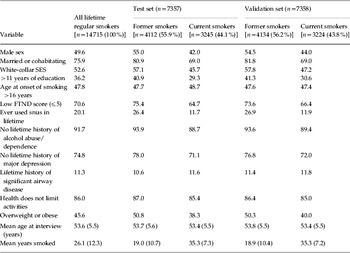
Of the entire sample screened (n=31 213), about half reported having smoked regularly at some point in their lives (n=15 947, 51.1%). The second column of Table 1 presents the distributions of participant characteristics of lifetime regular smokers included in this analysis (after excluding subjects with missing data, n=14 715, 47.1%). Fifty-six per cent of the regular smokers were former smokers and 44.0% were current smokers at the time of interview.
Distributions of potential correlates of smoking cessation among regular smokers in the Swedish Twin Registry

SES, Socio-economic status; FTND, Fagerstrom Test of Nicotine Dependence; s.d., standard deviation.
Values are % or mean (s.d).
In the first part of our two-stage analytic design, we randomly split the sample of lifetime regular smokers into a test set (n=7357) and a validation set (n=7358). Table 1 also stratifies the test and validation sets by former and current smoking status. Inspection of these proportions shows that there were profound differences between former and current smokers (e.g. male sex or snus use). Moreover, these differences are similar between the test and validation sets. The mean total number of years smoked was ~19 years for former smokers and ~35 years for current smokers in both sets, underscoring the need to use HRs in our analytic approach.
Screening correlates of smoking cessation in the test set
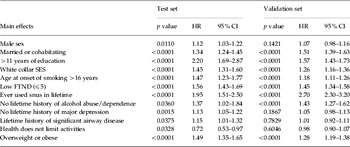
Within the test set, we evaluated the statistical significance of 12 independent variables and all 66 two-way interactions in relation to smoking cessation (α<0.05). Table 2 presents the adjusted HRs and 95% CIs of smoking cessation from each set. In the test set, all of the variables were significantly associated with smoking cessation as main effects. Of the 66 interaction terms examined in relation to smoking cessation in the test set, nine interactions were found to be statistically significant (data not shown).
Hazard ratios (HRs) and 95% confidence intervals (CIs) for smoking cessation and 12 potential correlates

SES, Socio-economic status; FTND, Fagerstrom Test of Nicotine Dependence.
HRs describe the association between each variable and former versus current smoking status after adjustment for all main effects and interactions.
Confirmation of correlates of smoking cessation in the validation set
In the second part of our two-stage analytic design, all variables that were significant main effects or interactions in the test set were re-examined in the validation set (Table 2). Of the 12 main effects identified as significant correlates of smoking cessation in the test set, eight were confirmed as significant correlates of smoking cessation in the validation set after Bonferroni correction for multiple comparisons (p<0.0006). In the validation set, a lifetime history of snus use exhibited the highest HR for smoking cessation. Participants who had ever used snus were nearly three times as likely to be former smokers than those who had never used snus (HR 2.7, 95% CI 2.30–3.20). Other factors significantly associated with smoking cessation included being married/cohabitating, higher education, white-collar SES, later age at onset of smoking, lower FTND score, no lifetime history of alcohol abuse or dependence, and higher BMI.
Interactions with snus use
Of the nine interactions identified as significant in the test set, none were regarded as statistically significant after Bonferroni correction in the validation set (all p<0.0006; data not shown). However, as this is the only study, to our knowledge, that has examined interactions between variables with respect to smoking cessation, we interpreted several interactions as suggestive. Three of the four suggestive interactions involved snus use. A lifetime history of snus use modified the associations between smoking cessation and FTND score, SES and BMI. Among people who had never used snus, lower FTND score, white-collar SES and higher BMI remained significant correlates of smoking cessation. However, among people who had used snus, the HRs for these variables and smoking cessation were attenuated, suggesting that these factors are not associated with smoking cessation among snus users.
Interaction with sex
The association between education and smoking cessation differed slightly between women and men. Higher education level was more strongly associated with smoking cessation among women (HR 1.58, 95% CI 1.43–1.75) than men (HR 1.23, 95% CI 1.11–1.35).
Conclusions
Based on the magnitude of the HRs, lifetime history of snus use was the strongest individual correlate of smoking cessation. Although not statistically significant after Bonferroni correction, several suggestive interactions were observed. Snus use appeared to modify associations between several variables and smoking cessation, such that lower FTND score, white-collar SES and higher BMI were only associated with smoking cessation among people who had never used snus. A higher proportion of men than women were former smokers, but sex was not confirmed as a significant independent correlate of smoking cessation in this analysis. Instead, sex modified the association between smoking cessation and education.
Disentangling the effects of snus on smoking cessation
Only one previous study has evaluated the impact of Swedish snus together with other participant characteristics as predictors of smoking cessation, and their findings are consistent with this report. Lindstrom & Isacsson (Reference Lindstrom and Isacsson2002) examined predictors of smoking cessation in a longitudinal study of daily smokers aged 45–69 years in Sweden and found that baseline daily smokers who became intermittent smokers at 1-year follow-up reported higher snus consumption, particularly among men.
Snus use modified the associations between smoking cessation and three variables: FTND score, SES and BMI. Lower nicotine dependence, higher SES and higher BMI have been consistently associated with a greater likelihood of cessation in previous studies (Kaprio & Koskenvuo, Reference Kaprio and Koskenvuo1988; Osler et al. Reference Osler, Prescott, Godtfredsen, Hein and Schnohr1999; Fernandez et al. Reference Fernandez, Garcia, Schiaffino, Borras, Nebot and Segura2001; Broms et al. Reference Broms, Silventoinen, Lahelma, Koskenvuo and Kaprio2004; Hyland et al. Reference Hyland, Li, Bauer, Giovino, Steger and Cummings2004; Janzon et al. Reference Janzon, Engstrom, Lindstrom, Berglund, Hedblad and Janzon2005; van Loon et al. Reference van Loon, Tijhuis, Surtees and Ormel2005). We observed these patterns only among people who had never used snus. Among those who had used snus, the effects of these factors were diminished or eliminated, suggesting that the effects of these factors on smoking cessation were less important in the presence of snus use.
It is reasonable to speculate that FTND score was a less important correlate of smoking cessation among snus users because snus contains similar levels of nicotine as cigarettes (Holm et al. Reference Holm, Jarvis, Russell and Feyerabend1992; Lunell & Lunell, Reference Lunell and Lunell2005), perhaps helping all people quit smoking regardless of their physiological dependence on cigarettes. It is possible that white-collar SES was not a significant correlate of smoking cessation among snus users because snus is widely available in Sweden and relatively inexpensive. In our sample, the proportion of ever lifetime snus use among participants classified as white-collar or blue-collar SES was similar (50.2% and 49.8% respectively).
The finding that higher BMI was not associated with smoking cessation among people who used snus deserves further attention. Our data are cross-sectional and we did not have information about the timing of weight gain or body size in relation to smoking cessation. However, it is possible that higher BMI was not associated with smoking cessation among snus users because the nicotine in snus could inhibit weight gain through appetite suppression or an increase in metabolism (Audrain et al. Reference Audrain, Klesges and Klesges1995; Li et al. Reference Li, Kane and Konu2003). Consistent with this hypothesis, Rodu et al. (Reference Rodu, Stegmayr, Nasic, Cole and Asplund2004) reported that although cessation of either cigarettes or snus led to increased weight gain in Swedish males, smokers who switched to snus gained significantly less weight.
Swedes appear to be using snus as a form of nicotine replacement therapy (NRT) despite a lack of clinical trials data to support its use as a smoking cessation aid. Ramström & Foulds (Reference Ramstrom and Foulds2006) reported that, among Swedish men trying to quit smoking, 24% of them used snus on their latest quit attempt. They also found that both men and women using snus as a cessation aid were significantly more likely to quit smoking successfully than those using nicotine patches or nicotine gum. These estimates are similar to another Swedish study that found 29% of male former smokers had used snus to quit smoking (Gilljam & Galanti, Reference Gilljam and Galanti2003).
Formal clinical trials are needed to test and compare the efficacy and side-effects of Swedish snus with existing NRT products. In the USA, the Food and Drug Administration (FDA) has approved five NRT products (transdermal patch, chewing gum, nasal spray, lozenge and inhaler) and two non-nicotine pharmacotherapies (burpropion and varenicline) for the treatment of nicotine dependence (Foulds et al. Reference Foulds, Steinberg, Williams and Ziedonis2006; Schnoll & Lerman, Reference Schnoll and Lerman2006). Approved NRT products are generally equally effective in aiding long-term cessation, roughly doubling the odds of quitting as compared with placebo (Silagy et al. Reference Silagy, Lancaster, Stead, Mant and Fowler2004). However, even with effective NRTs, only one-quarter to one-third of smokers are able to quit smoking in the long term (Silagy et al. Reference Silagy, Lancaster, Stead, Mant and Fowler2004). Snus may be an effective NRT product because it delivers approximately double the nicotine dose contained in approved NRT products, a level comparable to that obtained by cigarettes (Holm et al. Reference Holm, Jarvis, Russell and Feyerabend1992; Lunell & Lunell, Reference Lunell and Lunell2005). Furthermore, unlike approved NRT products that are intended for short-term use, snus is often used long term (Ramstrom & Foulds, Reference Ramstrom and Foulds2006).
Data on the health consequences of long-term snus use at the individual level and population level are accumulating. Among Swedish males followed up for 20 years, snus use was associated with increased pancreatic cancer, but not with oral or lung cancer (Luo et al. Reference Luo, Ye, Zendehdel, Adami, Adami, Boffetta and Nyren2007). The high levels of nicotine in snus may contribute to the increased risks in metabolic syndrome (Norberg et al. Reference Norberg, Stenlund, Lindahl, Boman and Weinehall2006) and type II diabetes (Persson et al. Reference Persson, Carlsson, Svanstrom, Ostenson, Efendic and Grill2000), but not all studies support this hypothesis (Eliasson et al. Reference Eliasson, Asplund, Nasic and Rodu2004). Data on the risk of circulatory disease, including cardiovascular disease and stroke, with snus use are conflicting (Huhtasaari et al. Reference Huhtasaari, Asplund, Lundberg, Stegmayr and Wester1992, Reference Huhtasaari, Lundberg, Eliasson, Janlert and Asplund1999; Bolinder et al. Reference Bolinder, Alfredsson, Englund and de Faire1994; Asplund, Reference Asplund2003; Asplund et al. Reference Asplund, Nasic, Janlert and Stegmayr2003; Hergens et al. Reference Hergens, Ahlbom, Andersson and Pershagen2005; Johansson et al. Reference Johansson, Sundquist, Qvist and Sundquist2005; Haglund et al. Reference Haglund, Eliasson, Stenbeck and Rosen2007; Lee, Reference Lee2007). As nicotine is a neuroteratogen, nicotine-containing products, including snus, should be avoided during pregnancy (Ginzel et al. Reference Ginzel, Maritz, Marks, Neuberger, Pauly, Polito, Schulte-Hermann and Slotkin2007).
At the population level, Gartner et al. (Reference Gartner, Hall, Chapman and Freeman2007) assessed the potential population health effects of Swedish snus across different patterns of use in Australia and found a net benefit to health if adult smokers switched to snus. Similarly, in an assessment of a potential harm reduction policy by introducing low-nitrosamine smokeless tobacco (such as Swedish snus) under strict regulations in the USA, Levy et al. (Reference Levy, Mumford, Cummings, Gilpin, Giovino, Hyland, Sweanor, Warner and Compton2006) reported that it would probably yield substantial health benefits.
Disentangling the effects of sex on smoking cessation
Consistent with previous research, a higher proportion of men than women were former smokers in our study (Hyland et al. Reference Hyland, Li, Bauer, Giovino, Steger and Cummings2004). However, this difference became non-significant in the adjusted analysis. Instead, sex was a potential modifier of the association between education and smoking cessation. Higher education was a stronger correlate of smoking cessation among women than men in our study. The suggestive interaction that we observed between sex and education on smoking cessation has been reported previously by Osler et al. (Reference Osler, Prescott, Godtfredsen, Hein and Schnohr1999), who speculated that poorly educated women may continue smoking because of the stress from additional caring responsibilities and restricted access to material resources. Another possible explanation of our finding is that women are more accurate at acknowledging health risks than men; this may be particularly true for highly educated women (Perrin et al. Reference Perrin, Flower and Ammerman2005).
Study limitations and strengths
We acknowledge the cross-sectional design of this study and assert that the associations observed are not necessarily causal. For several of the medical history variables, temporality was not clear; we did not know whether the medical condition prompted the participant to quit smoking or vice versa. This may explain why we did not observe strong associations between some of these variables and smoking cessation (e.g. history of SAD).
Selection bias may have threatened the validity of our results, and nearly 8% of the regular smokers were excluded from the analysis as they contributed a missing value on any of the potential correlates of smoking cessation. To address this issue, we examined associations between correlates of smoking cessation among those excluded from the analysis because they had partial data. Patterns among those excluded were identical to those in this report (data not shown), thereby alleviating our concern of selection bias.
The strengths of this study include its population-based design, the detailed assessment of cigarette and snus use, the diverse set of variables that were evaluated as correlates of smoking cessation as main effects and interactions and, most notably, the efficient two-stage analysis design within a large sample that enabled us to validate factors associated with smoking cessation in one data source. There is compelling evidence that data from twin registries are generalizable to the population at large and are a sound resource for epidemiologic investigations, despite twins having higher morbidity and mortality during the first year of life than singletons and comprising only 1–2% of the adult population (Lichtenstein et al. Reference Lichtenstein, De Faire, Floderus, Svartengren, Svedberg and Pedersen2002). Evans & Martin (Reference Evans and Martin2000) concluded that twins are representative of the general population with respect to most health and behavioral outcomes because twins exhibit similar means, frequencies and prevalences as singeltons for many traits and adult diseases.
Research ethics
Presenting these data for publication poses an ethical dilemma for a biomedical researcher mindful of the business practices used by the tobacco industry. On the one hand, our data suggest the potential importance of snus in smoking cessation. Clearly, eliminating all forms of tobacco use would have the greatest benefit on world health; however, many smokers are unable to achieve lasting smoking cessation. From a harm reduction perspective, if snus demonstrates: (a) superior efficacy as a smoking cessation aid in randomized clinical trials (conducted by investigators independent of the tobacco industry and including fair comparisons with the best smoking cessation regimens currently available) and (b) far lower health consequences, then there may be a role for its use in public health interventions for smoking cessation.
On the other hand, given the historical corruption of the scientific method by the tobacco industry, we are aware that publishing data that support the use of one addictive tobacco industry product (snus) to diminish the harm from another (cigarettes) is controversial and opens the possibility for misuse of our findings. On balance, we have chosen to publish these findings. We stress that substantial positive evidence should be required prior to any incorporation of snus use into public health policy.
Summary
Our findings underscore the importance of snus use in relation to smoking cessation in Sweden, and highlight the need to consider interactions between several variables and smoking cessation. Snus use was a strong independent correlate of smoking cessation and, as a part of a suggestive interaction, appeared to overshadow the independent effects of FTND score, SES and BMI on smoking cessation. Future research should evaluate prospectively the ramifications of snus use, with special emphasis on overall tobacco cessation rates among snus users and the health effects of long-term snus use.
Acknowledgments
This work was supported by CA085739 from the US National Cancer Institute of the National Institutes of Health to P.F.S., and CA118412 to H.F.
Declaration of Interest
None.