1. Introduction
There is a long history of Laplace transforms and
 $\mathcal{Z}$
-transforms in applied probability. Most of the previously developed ‘transform analysis’ framework requires the explicit expressions of the characteristic functions, e.g. the class of affine processes [Reference Duffie, Pan and Singleton11], time-changed Lévy processes [Reference Geman, Madan and Yor18], and polynomial processes [Reference Cuchiero, Keller-Ressel and Teichmann6]. Furthermore, previous discussions have mostly centered on the continuous additive functionals, e.g. integrals of stochastic processes, and there is relatively little discussion of the transform analysis for discrete additive functionals of the underlying stochastic process. Recently, there has been a strand of literature developing efficient computational approaches for problems related to Markov processes. The main idea is to utilize a continuous-time Markov chain (CTMC) to approximate and mimic the behavior of the underlying Markov process. Closed-form expressions can be derived, which facilitate the computations of key quantities central to those applications. We refer the reader to [Reference Cui, Kirkby and Nguyen7] for a survey and the references therein.
The aim of this paper is to contribute to the literature by developing a theoretical and computational framework (via CTMC approximations) for carrying out the transform analysis of general one-dimensional Markov processes. Our framework incorporates both continuous/discrete additive functionals, and also the terminal value of the underlying state variable.
The contributions of the paper are threefold.
-
(i) We derive a novel duality result linking the double transforms of non-decreasing continuous/discrete stochastic processes and their right inverses. We demonstrate the results through several applications, e.g. in Hawkes processes, option pricing, and renewal theory.
-
(ii) From a theoretical perspective, we develop a transform analysis framework for additive functionals of one-dimensional Markov processes in continuous/discrete time and their inverses through an operator-based approach, i.e. through the infinitesimal generator of the Markov process. The advantage is that the infinitesimal generator can be explicitly specified for a wide family of Markov processes and one can bypass knowledge of the conditional characteristic function of the underlying process.
-
(iii) From a computational perspective, we establish closed-form single transform formulas under the CTMC setting. The availability of such closed-form expressions facilitates computations of quantities of interest, because an underlying general Markov process can be well approximated by a CTMC. The closed-form expressions are in terms of matrices, and are shown to be accurate and efficient through numerical experiments.
The remainder of the paper is organized as follows. Section 2 presents a novel duality relationship between the continuous/discrete non-decreasing functionals of general stochastic processes and their right inverses, and offers its potential applications. Section 3 establishes the general transform analysis for additive functionals and inverse additive functionals of Markov processes, and also the closed-form transform formulas when we approximate the underlying Markov process by a CTMC. Section 4 presents numerical evidence of the transform analysis using examples of the valuation of occupation-time related options. Section 5 concludes the paper. All the proofs are provided in the Appendix.
2. Link between non-decreasing processes and their inverses
We derive an intriguing link between the double transforms of non-decreasing stochastic processes
 $\{A_t\}_{t\geq0}$
,
 $\{B_n\}_{n\geq0}$
, and their right inverses. We demonstrate its applications through several examples. Our general transform analysis involves the following objects.
-
• The continuously observed case. Consider an
 $\mathbb R$
-valued stochastic process
$\{A_t\}_{t\geq0}$
and assume it is non-decreasing and càdlàg (i.e. right continuous with left limits) in
$t\in \mathbb{R}^+$
and
$A_0$
is fixed. For
$a\geq0$
, define its right inverse as Assume also that for any complex
\[\tau_a\,:\!=\, \inf\lbrace u\geq 0\colon A_u-A_0 \geq a \rbrace.\]
$\alpha$
and
$\beta$
such that
$\mathit{Re}(\alpha)> 0$
and
$\mathit{Re}(\beta)> 0$
, where
$\mathit{Re}(\!\cdot\!)$
stands for the real part, the following double transforms of
$A_t$
and
$\tau_a$
are well-defined:
\[\int_0^{\infty} \,{\mathrm{e}}^{-\alpha t} \mathbb{E}[{\mathrm{e}}^{-\beta (A_t-A_0)}] \,{\mathrm{d}} t, \quad \int_0^{\infty} \,{\mathrm{e}}^{-\beta a} \mathbb{E}[{\mathrm{e}}^{-\alpha \tau_a}] \,{\mathrm{d}} a.\]
-
• The discretely observed case. Consider an
$\mathbb R$
-valued stochastic process
$\{B_n\}_{n\geq0}$
and assume it is non-decreasing in n and
$B_0$
is fixed. For
$b> 0$
, define its right inverse as Assume also that for any complex
\[m_b\,:\!=\, \min \lbrace n\geq0\colon B_n-B_0\geq b \rbrace.\]
$\eta$
and z such that
$\mathit{Re}(\eta)> 0$
and
$|z|<1$
, the following double transforms of
$B_n$
and
$m_b$
are well-defined: Here we use the term double transform to refer to the composition of a Laplace transform and a
\[\sum_{n=0}^{\infty} z^n \mathbb{E}[{\mathrm{e}}^{-\eta (B_n-B_0)}], \quad \sum_{n=0}^{\infty} z^n \biggl( \int_0^{\infty} \,{\mathrm{e}}^{-\eta b} \mathbb{P}(m_b=n) \,{\mathrm{d}} b\biggr).\]
$\mathcal{Z}$
-transform. For any sequence
$(x_{n})_{n=0}^{\infty}$
, its
$\mathcal{Z}$
-transform is defined as
$\sum_{n=0}^{\infty}x_{n}z^{n}$
for any complex z such that
$|z|<R$
for some
$R>0$
.


Theorem 2.1. (Links between double transforms.)
-
(i) For any
$\mathit{Re}(\alpha)> 0$
and
$\mathit{Re}(\beta)> 0$
, we have (2.1)
\begin{align}\alpha \int_0^{\infty} \,{\mathrm{e}}^{-\alpha u} \mathbb{E}[{\mathrm{e}}^{-\beta (A_u-A_0)}] \,{\mathrm{d}} u +\beta \int_0^{\infty} \,{\mathrm{e}}^{-\beta a} \mathbb{E}[{\mathrm{e}}^{-\alpha \tau_a}] \,{\mathrm{d}} a&=1.\end{align}
-
(ii) For any
$\mathit{Re}(\eta)> 0$
and
$|z|<1$
, we have (2.2)Furthermore, we can explicitly invert the
\begin{align}(1-z)\sum_{n=0}^{\infty} z^n \mathbb{E}[{\mathrm{e}}^{-\eta (B_n-B_0)}]+\eta z \sum_{n=0}^{\infty} z^n \biggl( \int_0^{\infty} \,{\mathrm{e}}^{-\eta b} \mathbb{P}(m_b=n) \,{\mathrm{d}} b\biggr)&=1.\end{align}
$\mathcal{Z}$
-transform above and obtain (2.3)where
\begin{align}\mathbb{P}(m_{\mathcal{E}_{\eta}}=n )&=\mathbb{E}[{\mathrm{e}}^{-\eta (B_n-B_0)}]-\mathbb{E}[{\mathrm{e}}^{-\eta (B_{n+1}-B_0)}],\end{align}
$\mathcal{E}_{\eta}$
is an exponential random variable with rate
$\eta$
independent of the
$\{B_{n}\}$
process.


Remark 2.1. The duality relations are pathwise identities and they work for any non-decreasing stochastic processes, and not restricted to Markov processes. That is, for (2.1) we have the pathwise version
 \begin{equation} \alpha \int_0^{\infty} \,{\mathrm{e}}^{-\alpha u} \,{\mathrm{e}}^{-\beta (A_u-A_0)} \,{\mathrm{d}} u=1-\beta \int_0^{\infty} \,{\mathrm{e}}^{-\beta a} \,{\mathrm{e}}^{-\alpha \tau_a} \,{\mathrm{d}} a,\end{equation}
and for (2.2) we have the pathwise version
 \begin{align}(1-z)\sum_{n=0}^{\infty} z^n \,{\mathrm{e}}^{-\eta (B_n-B_0)}+\eta z \sum_{n=0}^{\infty} z^n \biggl( \int_0^{\infty} \,{\mathrm{e}}^{-\eta b} {1}(m_b=n) \,{\mathrm{d}} b\biggr)=1.\end{align}
The pathwise duality identities (2.4) and (2.5) can be obtained by conditioning on the processes
 $(A_{u})_{u\geq 0}$
and
 $(B_{n})_{n=0}^{\infty}$
in the proof of Theorem 2.1; see Remark A.1 for details.
Remark 2.2. In some cases, both
 $\mathbb{E}[{\mathrm{e}}^{-\beta A_{u}}]$
and
 $\mathbb{E}[{\mathrm{e}}^{-\alpha\tau_{a}}]$
can be found explicitly, while in other cases, only either
 $\mathbb{E}[{\mathrm{e}}^{-\beta A_{u}}]$
or
 $\mathbb{E}[{\mathrm{e}}^{-\alpha\tau_{a}}]$
is known in the literature. For the latter cases, we can obtain the expression of one quantity from the known expression of the other through the above duality relationship.
Example 2.1. Consider
 $A_{t}=N_{t}$
, where
 $\{N_{t}\}$
is a standard Poisson process with intensity
 $\nu>0$
. Then we have
 \begin{equation*}\alpha\int_{0}^{\infty}\,{\mathrm{e}}^{-\alpha u}\mathbb{E}[{\mathrm{e}}^{-\beta A_{u}}]\,{\mathrm{d}} u=\alpha\int_{0}^{\infty}\,{\mathrm{e}}^{-\alpha u}\,{\mathrm{e}}^{\nu({\mathrm{e}}^{-\beta}-1)u}\,{\mathrm{d}} u=\dfrac{\alpha}{\alpha-\nu({\mathrm{e}}^{-\beta}-1)}\end{equation*}
and
 \begin{align*}\beta\int_{0}^{\infty}\,{\mathrm{e}}^{-\beta a}\mathbb{E}[{\mathrm{e}}^{-\alpha\tau_{a}}] \,{\mathrm{d}} a&=\beta\sum_{k=1}^{\infty}\mathbb{E}[{\mathrm{e}}^{-\alpha\tau_{k}}]\int_{k-1}^{k}\,{\mathrm{e}}^{-\beta a} \,{\mathrm{d}} a\\&=\sum_{k=1}^{\infty}(\mathbb{E}[{\mathrm{e}}^{-\alpha\tau_{1}}])^{k}\bigl({\mathrm{e}}^{-\beta(k-1)}-{\mathrm{e}}^{-\beta k}\bigr)\nonumber\\&=\sum_{k=1}^{\infty}\biggl(\dfrac{\nu}{\alpha+\nu}\biggr)^{k}\bigl({\mathrm{e}}^{-\beta(k-1)}-{\mathrm{e}}^{-\beta k}\bigr)\nonumber\\&=\dfrac{\nu}{\alpha+\nu}(1-{\mathrm{e}}^{-\beta})\dfrac{1}{1-\frac{\nu}{\alpha+\nu}\,{\mathrm{e}}^{-\beta}}\\&=\dfrac{\nu(1-{\mathrm{e}}^{-\beta})}{\alpha-\nu({\mathrm{e}}^{-\beta}-1)},\nonumber\end{align*}
where we have used the fact that
 $\{\tau_{k+1}-\tau_{k}\}$
are i.i.d. distributed as exponential random variables with rate
 $\nu>0$
. Therefore we have verified that the duality identity (2.1) holds in this special example.
Example 2.2. Consider
 $A_{t}=N_{t}$
, where
 $\{N_{t}\}$
is a pure-birth process, that is, a simple point process with intensity
 $\nu+N_{t-}$
at time t for some
 $\nu>0$
. Then
 $\{\tau_{k+1}-\tau_{k}\}$
are independently distributed as exponential random variables with parameter k. We can compute
 \begin{align*}\beta\int_{0}^{\infty}\,{\mathrm{e}}^{-\beta a}\mathbb{E}[{\mathrm{e}}^{-\alpha\tau_{a}}] \,{\mathrm{d}} a&=\beta\sum_{k=1}^{\infty}\mathbb{E}[{\mathrm{e}}^{-\alpha\tau_{k}}]\int_{k-1}^{k}\,{\mathrm{e}}^{-\beta a} \,{\mathrm{d}} a\\&=\sum_{k=1}^{\infty}\prod_{i=0}^{k-1}\dfrac{\nu+i}{\alpha+\nu+i}\bigl({\mathrm{e}}^{-\beta(k-1)}-{\mathrm{e}}^{-\beta k}\bigr),\nonumber\end{align*}
which, by (2.1), implies
 \[\alpha \int_0^{\infty} \,{\mathrm{e}}^{-\alpha u} \mathbb{E}[{\mathrm{e}}^{-\beta A_u}] \,{\mathrm{d}} u = 1- \sum_{k=1}^{\infty}\prod_{i=0}^{k-1}\frac{\nu+i}{\alpha+\nu+i}\bigl({\mathrm{e}}^{-\beta(k-1)}-{\mathrm{e}}^{-\beta k}\bigr).\]
Example 2.3. Consider
 $A_{t}=N_{t}$
, where
 $\{N_{t}\}$
is a Hawkes process (see [Reference Hawkes19]) with an exponential kernel function. That is, we assume that
 $\{N_{t}\}$
is a simple point process with intensity
 $\nu+Z_{t-}$
, where
 \begin{equation*}{\mathrm{d}} Z_{t}=-bZ_{t}\,{\mathrm{d}} t+a \,{\mathrm{d}} N_{t},\quad Z_{0}=z > 0,\end{equation*}
and the process
 $\{Z_{t}\}$
has an infinitesimal generator
 $\mathcal{A}$
such that
 \begin{equation*}\mathcal{A}f(z)=-bz\dfrac{\partial f}{\partial z}+(\nu+z)[\,f(z+a)-f(z)].\end{equation*}
In this case,
 $\{Z_{t}\}$
is Markovian and so is the pair
 $(N_{t},Z_{t})$
. By its affine structure (see e.g. [Reference Errais, Giesecke and Goldberg12]), we can compute that for
 $\mathit{Re}(\alpha)>0$
,
 \begin{equation*}\mathbb{E}_{Z_{0}=z}[{\mathrm{e}}^{-\alpha N_{t}}]={\mathrm{e}}^{(C(t)+{\alpha}/{a})z+D(t)},\end{equation*}
where C(t) and D(t) are the solutions of the ordinary differential equation (ODE)
 \begin{align*}&C'(t)=-bC(t)+{\mathrm{e}}^{C(t)a}-1-{\beta b}/{a},\\&D'(t)=\nu({\mathrm{e}}^{D(t)a}-1),\end{align*}
with the initial condition
 $C(0)=-{\beta}/{a}$
and
 $D(0)=0$
. From (2.1), we conclude
 \begin{align*} \beta \int_0^{\infty} \,{\mathrm{e}}^{-\beta a} \mathbb{E}[{\mathrm{e}}^{-\alpha \tau_a}] \,{\mathrm{d}} a&=1-\alpha\int_{0}^{\infty} \,{\mathrm{e}}^{-\alpha u+(C(u)+{\alpha}/{a})z+D(u)} \,{\mathrm{d}} u.\end{align*}
Example 2.4. Consider
 $A_{t}=\int_{0}^{t}X_{s} \,{\mathrm{d}} s$
, where
 $\{X_{t}\}$
is a non-negative affine process so that
 \begin{equation*}\alpha\int_{0}^{\infty}\,{\mathrm{e}}^{-\alpha u}\mathbb{E}[{\mathrm{e}}^{-\beta A_{u}}]\,{\mathrm{d}} u=\alpha\int_{0}^{\infty}\,{\mathrm{e}}^{-\alpha u+C(u)u+D(u)}\,{\mathrm{d}} u,\end{equation*}
for some functions C(t) and D(t). For instance,
 $\{X_{t}\}$
can be a Cox–Ingersoll–Ross process or the intensity process of a Markovian Hawkes process (see [Reference Hawkes19]). More generally, we can consider
 $\{X_t\}$
to be a Cox–Ingersoll–Ross process with Hawkes jumps, i.e. an affine point process (see [Reference Dassios and Zhao8–Reference Dassios and Zhao10]) with dynamics
 \begin{equation*}{\mathrm{d}} X_{t}=\theta(\mu-X_{t})\,{\mathrm{d}} t+\sigma\sqrt{X_{t}}\,{\mathrm{d}} W_{t}+a \,{\mathrm{d}} N_{t},\end{equation*}
where
 $\{N_{t}\}$
is a simple point process with intensity
 $\nu+X_{t-}$
. Then C(t) and D(t) can be found as the solutions of the ODE (see e.g. [Reference Zhu28])
 \begin{align*}&C'(t)=-\theta C(t)+\dfrac{1}{2}\sigma^{2}C(t)^{2}+({\mathrm{e}}^{aC(t)}-1)-\beta,\\&D'(t)=\theta\mu C(t)+\nu({\mathrm{e}}^{aC(t)}-1),\end{align*}
with the initial condition
 $C(0)=0$
and
 $D(0)=0$
. Again, from (2.1), we conclude
 \begin{align*} \beta \int_0^{\infty} \,{\mathrm{e}}^{-\beta a} \mathbb{E}[{\mathrm{e}}^{-\alpha \tau_a}] \,{\mathrm{d}} a&=1-\alpha\int_{0}^{\infty}\,{\mathrm{e}}^{-\alpha u+C(u)u+D(u)}\,{\mathrm{d}} u.\end{align*}
Example 2.5. Consider a subordinator
 $\{A_t\}_{t\geq0}$
, i.e. a one-dimensional Lévy process (
 $A_0=0$
a.s.) such that
 $t\mapsto A_t$
is non-decreasing. It follows that for all
 $t,\beta\geq0$
,
 $\mathbb{E}[{\mathrm{e}}^{-\beta A_t}]={\mathrm{e}}^{-t\psi(\beta)}$
, where the function
 $\psi(\!\cdot\!)$
is called the Laplace exponent of the subordinator
 $\{A_t\}$
. It is straightforward to obtain
 \[\alpha \int_0^{\infty} \,{\mathrm{e}}^{-\alpha u} \mathbb{E}[{\mathrm{e}}^{-\beta A_u}] \,{\mathrm{d}} u= \alpha/(\alpha+\psi(\beta)).\]
From the duality link (2.1) in Theorem 2.1, the double transform for the first hitting time
 $\tau_a$
is then
 $\psi(\beta)/(\alpha+\psi(\beta))$
. This coincides with the known result on the first passage time for the subordinators; see e.g. Exercise 5.7(ii) in [Reference Kyprianou21]. The following are known for explicit Laplace exponents
 $\psi(\!\cdot\!)$
.
-
• For a compound Poisson process of the form
$A_t=\sum_{i=1}^{N(t)}Y_i$
, where the increments
$\{Y_i\}$
are i.i.d., independent of the Poisson process
$\{N_t\}$
of rate
$\lambda>0$
, the process
$\{A_t\}$
has a Laplace exponent
$\psi(\beta)= \lambda(1-\mathbb{E}[{\mathrm{e}}^{-\beta Y_1}])$
. -
• For a Gamma process (i.e. having independent Gamma-distributed increments) with a shape parameter
$a>0$
and a rate parameter
$b>0$
, the Laplace exponent is given by
$\psi(\beta) = a \log(1 + \beta/b)$
. -
• For a standard stable subordinator with index
$\alpha \in (0, 1)$
, its Laplace exponent is given by
$\psi(\beta)=\beta^\alpha$
.








Example 2.6. Consider a spectrally negative Lévy process (SNLP)
 $\{X_t\}_{t\geq0}$
, i.e. a Lévy process with no positive jumps. Denoting its running maximum process by
 $\overline{X}_t\,:\!=\, \sup_{0\leq s\leq t} X_s$
, it is evident that
 $t\rightarrow \overline{X}_t$
is non-decreasing. For any
 $b\in\mathbb{R}^+$
, define the first passage time as
 $\tau_b^+\,:\!=\, \inf\{t\geq 0, X_t >b\}$
, and it is straightforward to verify that
 $\tau_b^+=\inf\{t\geq 0, \overline{X}_t >b\}$
. It is well known (see p. 232 of [Reference Kyprianou21]) that
 $\mathbb{E}[{\mathrm{e}}^{-q \tau_b^+}{1}_{\{\tau_b^+<\infty\}}]={\mathrm{e}}^{-\Phi(q)b}$
, where
 $\Phi(\!\cdot\!)$
is the Laplace exponent of the SNLP. From the duality link (2.1) in Theorem 2.1, we have
 \[\alpha \int_0^{\infty} \,{\mathrm{e}}^{-\alpha u}\mathbb{E}[{\mathrm{e}}^{-\beta \overline{X}_u}]\,{\mathrm{d}} u={\Phi(\alpha)}/{(\beta+\Phi(\alpha))}.\]
Note that we can rewrite this identity equivalently as
 $\mathbb{E}[{\mathrm{e}}^{-\beta \overline{X}_{\textbf{e}_{\alpha}}}]={\Phi(\alpha)}/{(\beta+\Phi(\alpha))}$
, where
 $\textbf{e}_{\alpha}$
is an exponential random variable with rate
 $\alpha$
, independent of X. We observe that this identity is precisely a consequence of the Wiener–Hopf factorization; see Theorem 6.15(ii) of [Reference Kyprianou21]. This means that we have established a bridge between these two results, and we can prove one result by knowing the other.
Applying Theorem 2.1, we are able to derive expressions for the transforms for the polynomial moments of
 $\tau_{f^{-1}(a)}$
,
 $f(A_{t})$
, and
 $f(B_{n})$
.
Corollary 2.1.
-
(i) Assume that for any
$\mathit{Re}(\alpha)>0$
, the series are convergent. Then, for any
\[\sum_{k=0}^{\infty}\frac{(-1)^{k}\alpha^{k}}{k!}\int_{0}^{\infty}u^{k}\mathbb{E}[{\mathrm{e}}^{-\beta f(A_{u})}]\,{\mathrm{d}} u\quad\textit{and}\quad\sum_{k=0}^{\infty}\frac{(-1)^{k}\alpha^{k}}{k!}\int_{0}^{\infty}\,{\mathrm{e}}^{-\beta a}\mathbb{E}\bigl[\bigl(\tau_{f^{-1}(a)}\bigr)^{k}\bigr] \,{\mathrm{d}} a\]
$\mathit{Re}(\beta)>0$
, and for any
\begin{equation*}\int_{0}^{\infty}\,{\mathrm{e}}^{-\beta a}\mathbb{E}\bigl[\bigl(\tau_{f^{-1}(a)}\bigr)^{k}\bigr] \,{\mathrm{d}} a=\dfrac{k}{\beta}\int_{0}^{\infty}u^{k-1}\mathbb{E}[{\mathrm{e}}^{-\beta f(A_{u})}]\,{\mathrm{d}} u,\quad k=1,2,3,\ldots,\end{equation*}
$\mathit{Re}(\alpha)>0$
,
\begin{equation*}\int_{0}^{\infty}\,{\mathrm{e}}^{-\alpha u}\mathbb{E}[(\,f(A_{u}))^{k}]\,{\mathrm{d}} u=\dfrac{k}{\alpha}\int_{0}^{\infty}a^{k-1}\mathbb{E}[{\mathrm{e}}^{-\alpha\tau_{f^{-1}(a)}}] \,{\mathrm{d}} a,\quad k=1,2,3,\ldots.\end{equation*}
-
(ii) Assume that for any
$|z|<1$
and
$\mathit{Re}(\eta)>0$
, the series are convergent. Then, for any
\[\sum_{n=1}^{\infty}z^{n}\sum_{k=0}^{\infty}\frac{(-1)^{k}\eta^{k}}{k!}\mathbb{E}[(\,f(B_{n}))^{k}]\quad\textit{and}\quad\sum_{n=0}^{\infty}z^{n}\int_{0}^{\infty}\sum_{k=0}^{\infty}\frac{(-1)^{k}\eta^{k}}{k!}b^{k}\mathbb{P}(m_{f^{-1}(b)}=n)\,{\mathrm{d}} b\]
$|z|<1$
,
$k=1,2,3,\ldots,$
and for any
\begin{equation*}\sum_{n=1}^{\infty}z^{n}\mathbb{E}[(\,f(B_{n}))^{k}]=\dfrac{z}{1-z}\sum_{n=0}^{\infty}z^{n}\int_{0}^{\infty}kb^{k-1}\mathbb{P}(m_{f^{-1}(b)}=n)\,{\mathrm{d}} b,\end{equation*}
$\mathit{Re}(\eta)>0$
,
$n=1,2,3,\ldots,$
\begin{equation*}(\mathbb{E}[{\mathrm{e}}^{-\eta f(B_{n})}]-\mathbb{E}[{\mathrm{e}}^{-\eta f(B_{n-1})}])+\eta\int_{0}^{\infty}\,{\mathrm{e}}^{-\eta b}\mathbb{P}(m_{f^{-1}(b)}=n-1)\,{\mathrm{d}} b=0.\end{equation*}







Remark 2.3. The above results present interesting characterizations of the
 $\mathcal{Z}$
-transforms of the moments of discrete functionals and Laplace transforms of the moments of continuous functionals. These links may prove useful when carrying out generalized method of moments (GMM) analysis for additive functionals and their inverses.
Henceforth, we further explore applications of Theorem 2.1 under various contexts.
2.1. Moments of exponentially stopped Markov processes
We develop a method to calculate the moments of a general monotonic functional of the affine occupation time and its inverse. The starting point of our discussion is the following probability identity in equation (5) of [Reference Shiryaev and Yor27]: for any non-negative random variable
 $\xi$
, we can write
 $\xi=\int_0^{\infty} 1_{\{a<\xi\}} \,{\mathrm{d}} a$
. This is particularly relevant to our setting since both
 $A_t$
and
 $B_n$
are non-negative random variables for a fixed t or n. If we denote
 $X_t$
as the stock price, then its running maximum
 $\overline{X}_t\,:\!=\, \sup_{0\leq s\leq t} X_s$
and running minimum
 $\underline{X}_t\,:\!=\, \inf_{0\leq s\leq t} X_s$
are both non-negative. Consider a first example as follows. Taking
 $\xi=\overline{X}_T$
and defining
 $\tau_a\,:\!=\, \inf\{u\geq 0\colon \overline{X}_u \geq a\}$
, we have
 \begin{align*}\overline{X}_T&=\int_0^{\infty} 1_{\{a < \overline{X}_T\}} \,{\mathrm{d}} a=\int_0^{\infty} 1_{\{\tau_a < T\}} \,{\mathrm{d}} a.\end{align*}
Introducing an exponential random variable
 $\mathcal{E}_{\mu}\sim \mathrm{Exp}(\mu)$
for some
 $\mu>0$
independent of the
 $\{X_t\}$
process, we obtain
 \begin{align*}\mathbb{E}\bigl[\overline{X}_{\mathcal{E}_{\mu}}\bigr]&=\int_0^{\infty} \mathbb{P}(\tau_a <\mathcal{E}_{\mu}) \,{\mathrm{d}} a= \int_0^{\infty} \mathbb{E}[{\mathrm{e}}^{-\mu \tau_a}] \,{\mathrm{d}} a.\end{align*}
Similarly, we can derive related results for
 $\underline{X}_t$
and
 $\tau_a$
when we randomize the time t or the level a using an independent exponential random variable. A close look at the above proof reveals that we can actually generalize it to any monotonic function of
 $\overline{X}_{\mathcal{E}_{\mu}}$
.
Next, take
 $\xi=f(A_{\mathcal{E}_{\mu}})$
for some function
 $f(\!\cdot\!)$
that is increasing, whose inverse function
 $f^{-1}(\!\cdot\!)$
exists. Then we have
 \begin{align*}\mathbb{E}[\,f(A_{\mathcal{E}_{\mu}})]&=\int_0^{\infty} \mathbb{P}\bigl(\tau_{f^{-1}(a)}< \mathcal{E}_{\mu}\bigr) \,{\mathrm{d}} a=\int_0^{\infty} \mathbb{E}[{\mathrm{e}}^{-\mu \tau_{f^{-1}(a)}}] \,{\mathrm{d}} a.\end{align*}
Under the CTMC approximation setting to be developed later, we can substitute the closed-form formula for
 $\mathbb{E}[{\mathrm{e}}^{-\mu \tau_{f^{-1}(a)}}]$
into the above and obtain the closed-form formula for
 $\mathbb{E}[\,f(A_{\mathcal{E}_{\mu}})]$
for any monotonically increasing
 $f(\!\cdot\!)$
. Note that we do not require
 $f(\!\cdot\!)$
to be differentiable, and an interesting example is the price of the Canadized fixed strike Asian option. That is, take
 $f(x)\,:\!=\, (x-K)^+$
and note that
 $f(\!\cdot\!)$
is an increasing function.
Further, by expanding both sides of (2.1) in Theorem 2.1(i) with respect to either
 $\alpha$
or
 $\beta$
and matching the moments, we can obtain the links between moments of
 $\tau_{\mathcal{E}_{\mu}}$
with the Laplace transform of
 $A_u$
or vice versa.
Proposition 2.1. For an exponential random variable
 $\mathcal{E}_{\mu}\sim \mathrm{Exp}(\mu)$
independent of the
 $\{A_t\}$
process and any
 $\mathit{Re}(\alpha)>0$
, assuming that the series
 \[\sum_{n=0}^{\infty}\frac{1}{n!}(-1)^{n}\alpha^{n}\int_{0}^{\infty}u^{n}\mathbb{E}[{\mathrm{e}}^{-\mu(A_{u}-A_{0})}]\,{\mathrm{d}} u\quad\textit{and}\quad\sum_{n=0}^{\infty}\frac{1}{n!}(-1)^{n}\alpha^{n}\mathbb{E}[(\tau_{\mathcal{E}_{\mu}})^{n}]\]
are convergent, we have that for every
 $n\in\mathbb{N}^+$
 \begin{align*}\mathbb{E}[( \tau_{\mathcal{E}_{\mu}})^n]&=n\int_0^{\infty} u^{n-1} \mathbb{E}[ {\mathrm{e}}^{-\mu(A_{u}-A_{0})} ] \,{\mathrm{d}} u.\end{align*}
The following is a corresponding result for the exponentially stopped moments of the process
 $\{A_u\}$
utilizing the duality result.
Proposition 2.2. For an exponential random variable
 $\mathcal{E}_{\mu}\sim \mathrm{Exp}(\mu)$
independent of the
 $\{A_t\}$
process and any
 $\mathit{Re}(\beta)>0$
, assuming that the series
 \[\sum_{n=0}^{\infty}\frac{(-1)^{n}\beta^{n}}{n!}\mathbb{E}[( A_{\mathcal{E}_{\mu}}-A_{0})^n]\quad\textit{and}\quad\sum_{n=0}^{\infty}\frac{(-1)^{n}\beta^{n}}{n!}\int_{0}^{\infty}u^{n} \mathbb{E}[{\mathrm{e}}^{-\mu \tau_u}] \,{\mathrm{d}} u\]
are convergent, we have that for every
 $n\in\mathbb{N}^+$
 \begin{align*}\mathbb{E}[( A_{\mathcal{E}_{\mu}}-A_{0})^n]&=n\int_0^{\infty} u^{n-1} \mathbb{E}[ {\mathrm{e}}^{-\mu \tau_u} ] \,{\mathrm{d}} u.\end{align*}
2.2. Pricing options on discrete additive functional of stochastic processes
We apply Theorem 2.1 to derive a formula for the valuation of options whose underlying is the discrete functional of the asset price. Recall that
 \begin{align}\mathbb{E}[(X-K)^+]&=\int_K^{\infty}\mathbb{P}(X\geq y) \,{\mathrm{d}} y.\end{align}
Consider the problem of computing
 $\mathbb{E}[(\,f(B_n)-K)^+]$
, where
 $f(\!\cdot\!)$
is assumed to be increasing. From the identity in (2.6), we apply the
 $\mathcal{Z}$
-transform to the desired quantity
 $\mathbb{E}[(\,f(B_n)-K)^+]$
, and assume that
 $\sum_{n=1}^{\infty} z^n \mathbb{E}[(\,f(B_n)-K)^+]$
is convergent for any
 $|z|<R$
for some
 $R>0$
. Then, for any
 $|z|<R$
, we have
 \begin{align*}\sum_{n=1}^{\infty} z^n \mathbb{E}[(\,f(B_n)-K)^+]&=\sum_{n=1}^{\infty} z^n \int_K^{\infty} \mathbb{P}(\,f(B_n)\geq y) \,{\mathrm{d}} y \nonumber \\&=\sum_{n=1}^{\infty} z^n \int_K^{\infty} \mathbb{P}(B_n\geq f^{-1}(y)) \,{\mathrm{d}} y\nonumber\\&=\sum_{n=1}^{\infty} z^n \int_K^{\infty} \mathbb{P}(m_{f^{-1}(y)}\leq n) \,{\mathrm{d}} y \nonumber\\&= \int_K^{\infty} \Biggl( \sum_{n=1}^{\infty} z^n \mathbb{P}(m_{f^{-1}(y)}\leq n)\Biggr) \,{\mathrm{d}} y\nonumber\\&= \int_K^{\infty} \Biggl( \sum_{n=1}^{\infty} z^n \mathbb{E}\bigl[1_{\{m_{f^{-1}(y)}\leq n\}}\bigr]\Biggr) \,{\mathrm{d}} y \end{align*}
 \begin{align}&= \int_K^{\infty} \Biggl(\mathbb{E}\Biggl[\sum_{n=1}^{\infty} z^n 1_{\{m_{f^{-1}(y)}\leq n\}}\Biggr]\Biggr) \,{\mathrm{d}} y\nonumber\\&= \int_K^{\infty} \!\left(\rule{0pt}{18pt}\right.\! \mathbb{E}\!\left[\rule{0pt}{18pt}\right.\! \sum_{n=m_{f^{-1}(y)}}^{\infty} z^n \!\left.\rule{0pt}{18pt}\right]\!\!\left.\rule{0pt}{18pt}\right)\! \,{\mathrm{d}} y \nonumber\\&= \int_K^{\infty} \biggl(\dfrac{1}{1-z}\mathbb{E}[ z^{m_{f^{-1}(y)}} ]\biggr) \,{\mathrm{d}} y\nonumber\\&=\dfrac{1}{1-z}\int_K^{\infty} \mathbb{E}[ z^{m_{f^{-1}(y)}} ] \,{\mathrm{d}} y \nonumber\\&=\dfrac{1}{1-z}\int_K^{\infty} \mathbb{E}[\!\exp( (\ln z) \cdot m_{f^{-1}(y)} )] \,{\mathrm{d}} y,\end{align}
where in several places above, we have utilized the Fubini theorem to exchange the order of summation and integration. Note that here
 $\mathit{Re}(\ln z)<0$
because we assume that
 $|z|<1$
. Thus the assumption of Theorem 2.1(ii) is satisfied and we can utilize, for example, equation (2.3) to obtain the expression
 $\mathbb{E}[\!\exp( (\ln z) \cdot m_{f^{-1}(y)} )]$
in the last line of (2.7). From the result in (2.7), we conclude that in order to obtain the
 $\mathcal{Z}$
-transform of the option price whose underlying is a functional of
 $B_n$
, it is sufficient to have the Laplace transform of
 $m_{f^{-1}(y)}$
. This leads to a possible way to price options whose underlyings are discrete functionals of stochastic processes.
2.3. Applications to renewal theory
Additive functionals often appear in the modeling of queues, and also in the study of renewal theory. Consider a classical cumulative sum process
 $S_n\,:\!=\, \sum_{i=1}^n Y_i$
, where
 $Y_i$
are i.i.d. positive random variables. Define its Laplace transform as
 $M(\eta)\,:\!=\, \mathbb{E}[{\mathrm{e}}^{-\eta Y}]$
,
 $\eta>0$
, which is well-defined for Y being a positive random variable. Due to independence, it is easy to see that
 $\mathbb{E}[{\mathrm{e}}^{-\eta S_n}]=(M(\eta))^n$
. The renewal process is defined as
 $N(t)\,:\!=\, \max\{n\geq1\colon S_n \leq t\}$
and recall the relationship
 $\{N(t)\leq n\}=\{S_n\geq t\}$
.
Proposition 2.3. The renewal process
 $\{N(t)\}$
stopped at an independent exponential random time
 $\mathcal{E}(\eta)\sim \mathrm{Exp}(\eta)$
follows a geometric distribution with the parameter
 $1-M(\eta)$
, where
 $M(\eta)\,:\!=\, \mathbb{E}[{\mathrm{e}}^{-\eta Y}]$
is the Laplace transform of Y. Equivalently, we have
 $N(\mathcal{E}_{\eta}) \sim{Geo}(1-M(\eta))$
.
From Proposition 2.3 and the property of the geometric distribution, we can easily establish the following result.
Corollary 2.2. The Laplace transform of the renewal function
 $m(t)\,:\!=\, \mathbb{E}[N(t)]$
is given by
 \begin{align*}\int_0^{\infty} \,{\mathrm{e}}^{-\eta t} m(t) \,{\mathrm{d}} t&=\dfrac{M(\eta)}{(1-M(\eta))\eta}.\end{align*}
Note that we can also obtain the Laplace transform of higher-order cumulants of the renewal process. Define
 $\kappa_n(t)$
,
 $n=1,2,\ldots$
as the nth cumulant of the renewal process; then we have the following result.
Corollary 2.3. Let
 \[\mu\,:\!=\, \frac{M(\eta)}{1-M(\eta)}.\]
Then the Laplace transform of the higher-order cumulant of the renewal process is given by
 \begin{align*}\int_0^{\infty} \,{\mathrm{e}}^{-\eta t} \kappa_n(t) \,{\mathrm{d}} t&=\dfrac{K_n(\eta)}{\eta},\end{align*}
where the sequence
 $K_n$
is defined via the recursive relation
 \begin{align*}K_1=\mu, \quad K_{n+1}&=\mu(\mu+1)\dfrac{{\mathrm{d}} K_n}{{\mathrm{d}} \mu}, \quad n\geq 1.\end{align*}
Remark 2.4. Note that in particular we have
 \begin{align*}\int_0^{\infty} \,{\mathrm{e}}^{-\eta t} \mathbb{E}[N^2(t)] \,{\mathrm{d}} t&=\dfrac{M(\eta)}{\eta(1-M(\eta))^2},\end{align*}
and we can similarly obtain the Laplace transform of the higher-order moments of the renewal process through the link between moments and cumulants. To the best of the authors’ knowledge, these results related to higher-order moments are new. The duality relationship provides a unified treatment.
3. Transform analysis of additive functionals of Markov processes and their inverses
In this section we shall develop general transform analysis for continuous/discrete additive functionals of Markov processes. Consider a one-dimensional time-homogeneous Markov process
 $\{X_t\}_{t\geq0}$
defined under the filtered probability space
 $(\Omega, \mathcal{F}, \{\mathcal{F}_{t}\}_{t\geq 0}, \mathbb{P})$
. By convention, we denote
 $\mathbb{E}^{x}[\cdot]=\mathbb{E}^{\mathbb{P}}[\cdot|X_0=x]$
. Assume that
 $\lbrace X_t\rbrace_{t\geq 0}$
has càdlàg sample paths and the infinitesimal generator G.
-
(i) The additive functionals
$\{A_T\},\{B_n\}$
are defined by for any non-negative measurable function
\begin{equation*}A_T\,:\!=\, \int_0^T h(X_u)\,{\mathrm{d}} u, \quad T\geq0, \quad B_n\,:\!=\, \sum_{i=0}^{n} h(X_{t_i}), \quad n\geq0 ,\end{equation*}
$h(\!\cdot\!)$
. Recall that in Theorem 2.1 we used
$\{A_T\}, \{B_n\}$
to denote general non-decreasing stochastic processes. Here, with an abuse of notation, they denote additive functionals of Markov processes (certainly they exhibit non-decreasing sample paths). For
$\{B_n\}$
, the last observation time instant is
$t_{n}\,:\!=\, T=n\Delta$
and
$t_i\,:\!=\, i\Delta$
, hence we assume equally spaced (
$\Delta>0$
) discrete-time observations.
-
(ii) The right inverses of
$\{A_T\}$
and
$\{B_n\}$
are given as follows. For
$a\geq0$
and
$b>0$
,
\[\tau_a\,:\!=\, \inf\lbrace T\geq 0\colon A_T\geq a \rbrace, \quad m_b\,:\!=\, \min \lbrace n\geq0\colon B_n\geq b \rbrace.\]


We also assume that
 $g(\!\cdot\!)$
satisfies the following assumption on the growth rate: there exist
 $\delta\geq0$
and a constant
 $A>0$
such that
 \begin{equation}\mathbb{E}^{x}[g(X_t)]\leq A \,{\mathrm{e}}^{\delta t}\quad \text{for any $t>0$.}\end{equation}
Consider the joint double transforms
 \begin{align}m(\mu; x)&\,:\!=\, \int_0^{\infty} \,{\mathrm{e}}^{-\mu t} \mathbb{E}^{x} [{\mathrm{e}}^{-A_t}g(X_t)]\,{\mathrm{d}} t, \end{align}
and
 \begin{align}l(z; x)&\,:\!=\, \sum_{n=0}^{\infty} z^n \mathbb{E}^{x} [{\mathrm{e}}^{-B_n}g(X_{t_n})], \end{align}
which are well-defined for
 $\mathit{Re}(\mu)>\delta$
and
 $|z|<{\mathrm{e}}^{-\delta\Delta}$
due to the assumption (3.1).
Remark 3.1. Note that the joint transforms in (3.2) and (3.3) are very general in their forms and embrace those considered in [Reference Cai, Song and Kou3] as special cases. More specifically, if
 $h(x)=x$
and
 $g(x)=1$
, then (3.2) and (3.3), respectively, are reduced to the double transforms corresponding to continuous and discrete Asian options treated in [Reference Cai, Song and Kou3].
We shall make the following two assumptions in order to apply the continuous-time Feynman–Kac theorem for our Markov process setup in the proof of the following Theorem 3.1 part (ii).
Assumption 3.1. The Cauchy problem for
 $u(t,x)$
,
 \[\dfrac{\partial u(t,x)}{\partial t}=Gu(t,x)-h(x)u(t,x), \quad u(0,x)=g(x),\]
has a classical solution.
Assumption 3.2. Let
 $\upsilon_n\,:\!=\, \inf\{ s\geq 0\colon |X_s| \geq n\}$
,
 $n\in \mathbb{N}^+$
. Then, for any fixed
 $T>0$
,
 $\mathbb{E}[u(\upsilon_{n},X_{\upsilon_{n}})1_{\{\upsilon_n\leq T\}}]\rightarrow 0$
as
 $n\rightarrow\infty$
.
Theorem 3.1. (Double transforms for
 $(A_t)$
and
 $(B_n)$
for Markov processes.)
-
(i) Assume that Assumptions 3.1 and 3.2 hold. For any complex
$\mu$
such that
$\mathit{Re}(\mu)>\delta$
,
$f(x)=m(\mu; x)$
is a solution to the functional equation (3.4)
\begin{align}&(h(x)+\mu-G)f(x)=g(x).\end{align}
-
(ii) Given
$\Delta>0$
and for any complex z such that
$|z|<{\mathrm{e}}^{-\delta \Delta}$
,
$f(x)=l(z; x)$
is a solution to the functional equation
\begin{align*}&\exp(h(x))\cdot f(x) -z \mathbb{E}^{x}[\,f(X_{\Delta})]=g(x).\end{align*}


Remark 3.2. If
 $\{X_t\}$
is a diffusion process, the above functional equation (3.4) boils down to a class of second-order ODEs, because the associated generator G is a second-order differential operator.
Remark 3.3. For the discrete time case, note that we do not impose any condition other than the moment condition in (3.1), which ensures the transform
 $l(z;x)$
in (3.3) is well-defined. Sufficient conditions under which Assumption 3.1 holds are known. Indeed, the existence, uniqueness, and regularity of the solution to the Cauchy problem has been studied under a wide range of assumptions (such as ellipticity) associated with the generator G; see e.g. Section 2.2 of [Reference Lorenzi and Bertoldi25].
In the following, we shall consider the transform analysis for right-continuous inverses of additive functionals of Markov processes. By combining Theorems 2.1 and 3.1, we obtain the following main result on the joint double transforms of inverse additive functionals for Markov processes.
Theorem 3.2. (Double transforms of
 $\tau_a$
and
 $m_b$
for Markov processes.)
-
(i) Assume that Assumptions 3.1 and 3.2 hold. For
$\mathit{Re}(\alpha)>0$
and
$\mathit{Re}(\beta)> 0$
, define the double transform of
$\tau_a$
as Then
\begin{align*}p(\alpha,\beta; x)&\,:\!=\, \int_0^{\infty} \,{\mathrm{e}}^{-\beta a} \mathbb{E}^{x}[{\mathrm{e}}^{-\alpha \tau_a}] \,{\mathrm{d}} a.\end{align*}
where
\begin{align*}p(\alpha,\beta; x)&=\dfrac{1-\alpha\cdot m(\alpha, \beta; x)}{\beta},\end{align*}
$f(x)=m(\alpha,\beta;x)$
is a solution of the functional equation (3.5)
\begin{align}&(\beta \cdot h(x) +\alpha-G)f(x) =1.\end{align}
-
(ii) For
$\mathit{Re}(\eta)>0$
, define the double transform of
$m_b$
as Then
\begin{align*}k(z, \eta; x)&\,:\!=\, \sum_{n=0}^{\infty} z^n \biggl( \int_0^{\infty} \,{\mathrm{e}}^{-\eta b} \mathbb{P}^{x}(m_b=n) \,{\mathrm{d}} b\biggr).\end{align*}
(3.6)where
\begin{align}k(z, \eta; x)&=\dfrac{1-(1-z) \cdot l(z; x)\,{\mathrm{e}}^{\eta h(x)}}{\eta},\end{align}
$f(x)=l(z;x)$
is a solution to the functional equation (3.7)From (3.6) and (3.7), we can represent
\begin{align}&\exp(\eta\cdot h(x))\cdot f(x) -z \mathbb{E}^{x}[\,f(X_{\Delta})]=1.\end{align}
(3.8)
\begin{align}k(z, \eta; x)&=\dfrac{z+(z^2-z) \cdot P_{\Delta}f(x)}{\eta}.\end{align}





3.1. General computational framework through CTMC
In the following, we shall illustrate the joint transform results in Theorems 3.1 and 3.2 for the case of a special family of Markov processes, the continuous-time Markov chain (CTMC). The CTMC has proved to be an effective tool to approximate the behavior and dynamics of a Markov process. It has the property that the state space is discretized while preserving the continuity in time.
Consider a non-negative CTMC
 $\lbrace X_t, t\geq 0 \rbrace$
with finite state space
 $\lbrace x_1,\ldots,x_N\rbrace$
, whose transition probability matrix is
 $\textbf{P}(t)=(p_{ij}(t))_{N\times N}$
and its transition rate matrix is
 $\textbf{ G}=(q_{ij})_{N\times N}$
, where
 $p_{ij}(t)=\mathbb{P}(X_{t+u}=x_j \mid X_u=x_i)$
and
 $q_{ij}=p_{ij}^{\prime}(0),$
 $1\leq i,j\leq N, t, u\geq 0$
. Define
 $\textbf{x}=(x_1,\ldots,x_N)^{\top}$
, and by convention,
 $\textbf{I}$
is the identity matrix and
 $\textbf{1}$
is an
 $N\times 1$
column vector with all entries equal to 1. In the following, we assume that
 $\textbf{D}=(d_{ij})_{N\times N}$
is a diagonal matrix with
 $d_{jj}=h(x_j)$
,
 $j=1,\ldots,N$
. For two matrices
 $\textbf{A}$
and
 $\textbf{B}$
, we use
 $\textbf{AB}$
to represent the usual matrix multiplication. For the case of CTMC, it turns out that we are able to obtain explicit expressions for the single transforms.
Proposition 3.1. (Single transform in the CTMC setting.)
-
(i) Let
$g_c(t; \textbf{x})\,:\!=\, \mathbb{E}^{\textbf{x}} [{\mathrm{e}}^{-A_t}g(X_t)]$
. Then
\begin{align*}g_c(t; \textbf{x})&={\mathrm{e}}^{ (\textbf{G}- \textbf{D}) t } g(\textbf{x}). \end{align*}
-
(ii) Let
$g_d(n; \textbf{x})\,:\!=\, \mathbb{E}^{\textbf{x}} [{\mathrm{e}}^{-B_n}g(X_{t_n})]$
with
$t_{n}\,:\!=\, n\Delta$
. Then
\begin{align*}g_d(n; \textbf{x})&=({\mathrm{e}}^{ -\textbf{D}}\textbf{P}(\Delta))^n \,{\mathrm{e}}^{ -\textbf{D}} g(\textbf{x}). \end{align*}





We can also establish the following explicit expressions for the inverse additive functionals in both discrete- and continuous-time cases.
Proposition 3.2. (Single transform of inverse functional in the CTMC setting.)
-
(i) Let
$p_c(a,\alpha; \textbf{x})\,:\!=\, \mathbb{E}^\textbf{x} [{\mathrm{e}}^{-\alpha \tau_a}]$
. For
$a>0$
and
$\mathit{Re}(\alpha)>0$
,
\begin{align*}p_c(a, \alpha; \textbf{x})&=\textbf{1}-\alpha (\textbf{G}-\alpha)^{-1}\textbf{D} \bigl({\mathrm{e}}^{\textbf{D}^{-1} (\textbf{ G}-\alpha) a} -\textbf{I} \bigr) \textbf{D}^{-1}\textbf{1}. \end{align*}
-
(ii) Let
For
\[p_d(n, \eta; \textbf{x})\,:\!=\, \int_0^{\infty} \,{\mathrm{e}}^{-\eta b} \mathbb{P}^\textbf{x} (m_b=n) \,{\mathrm{d}} b.\]
$n\geq1$
and
$\mathit{Re}(\eta)>0$
,
\begin{align*}p_d(n, \eta; \textbf{x})&=\dfrac{1}{\eta} \bigl(\textbf{P}(\Delta)({\mathrm{e}}^{ -\boldsymbol{\eta}\textbf{D}}\textbf{P}(\Delta))^{n-2} \,{\mathrm{e}}^{ -\boldsymbol{\eta}\textbf{D}} \textbf{1}-\textbf{P}(\Delta)\bigl({\mathrm{e}}^{ -\boldsymbol{\eta}\textbf{D}}\textbf{P}(\Delta)\bigr)^{n-1} \,{\mathrm{e}}^{ -\boldsymbol{\eta}\textbf{D}} \textbf{1}\bigr). \end{align*}



4. Applications to occupation-time related options
There are several methods to evaluate arithmetic Asian options based on specific stochastic models (see [Reference Ballotta, Gerrard and Kyriakou1], [Reference Čern&ygrave; and Kyriakou4], [Reference Corsaro, Kyriakou, Marazzina and Marino5], [Reference Fusai and Kyriakou15], [Reference Fusai and Meucci16], [Reference Phelan, Marazzina, Fusai and Germano26], and references therein). The general transform analysis in this paper can be applied, in cases where the underlying asset follows general Markov processes, to the valuation of arithmetic Asian options, and also occupation time derivatives such as step options. In particular, Linetsky [Reference Linetsky24] considers the case of geometric Brownian motion (GBM) and Cai et al. [Reference Cai, Chen and Wan2] consider the case of double exponential jump diffusions (DEJD), while our framework can accommodate pricing step options for general Markov processes. Note that the framework in [Reference Cai, Song and Kou3] does not directly apply to the valuation of step options, nor to the valuation of occupation time derivatives in general.
In this section we shall illustrate the numerical performance of the proposed computational framework using a representative example: the valuation of step options and corridor options. More specifically, we provide an example in option pricing where the underlying involves the occupation time of the stock below a fixed level. Here we illustrate the application of our transform analysis to the pricing of the proportional geometric step option [Reference Linetsky24], and demonstrate the efficiency of our method. The occupation time of a spectrally negative Lévy process has been studied in [Reference Landriault, Renaud and Zhou22]. We can explore the application of the one-dimensional Laplace transform to the pricing of quantile options, which is also closely related to the occupation time. For time-homogeneous diffusions, it has been studied in [Reference Li and Zhou23]. Here our discussion is focused on the comparison of our results to those of Cai et al. [Reference Cai, Chen and Wan2], who consider the case of DEJD.
4.1. Step options
The payoff of a proportional step call option [Reference Linetsky24] at maturity T is given by
 \[{\mathrm{e}}^{-\rho \tau_T(h)}(S_0 \,{\mathrm{e}}^{X_T}-K)^+,\]
where
 \[\tau_T(h)\,:\!=\, \int_0^T 1_{\lbrace X_u\leq h\rbrace}\,{\mathrm{d}} u\]
is the occupation time, and
 $X_T$
is the log return satisfying the DEJD process. Here
 $\rho$
is the non-negative knock-out rate,
 $S_0$
is the initial underlying stock price, h is a pre-specified upper barrier level, and K is the strike price. For a risk-free interest rate
 $r>0$
, the price of the proportional step call option is given by (see (3.1) in [Reference Linetsky24])
 \begin{align*}C_1(K,T)&\,:\!=\, {\mathrm{e}}^{-rT}\mathbb{E}\bigl[{\mathrm{e}}^{-\rho \tau_{T}(h)}\bigl(S_0 \,{\mathrm{e}}^{X_T}-K\bigr)^+ \mid S_0\bigr].\end{align*}
From Proposition 3.1, we can derive the following closed-form CTMC approximation:
 \begin{align*} C_1(K,T)\approx {\mathrm{e}}^{(\textbf{G}- \rho\textbf{D}-r)T}(S_0 \,{\mathrm{e}}^{\textbf{x}}-K)^+,\end{align*}
where
 $\textbf{D}=(d_{ij})_{N\times N}$
is a diagonal matrix with
 $d_{jj}= 1_{\lbrace x_j\leq h\rbrace}$
,
 $j=1,\ldots,N$
.
We numerically test the formula above based on the same setup as considered in
 $[{\rm{\S}}]$
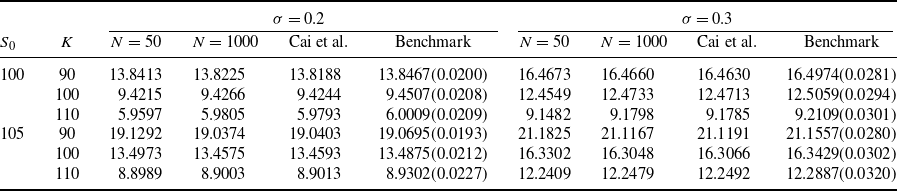
5.1 of [Reference Cai, Chen and Wan2]. All numerical experiments were conducted using MATLAB R2014b on a laptop equipped with an Intel Core 2 i7-4510U CPU @ 2.00 GHz 2.60 GHZ and 8 GB of RAM. Results are collected in Table 1. Note that our method produces the accurate approximations to the benchmarks based on extensive simulations.
Pricing proportional geometric step options under the DEJD model via our single transform CTMC approximation with
 $N=50$
and
 $N=1000$
. The parameter settings are the same as those in
 ${\rm{\S}}$
5.1 of [Reference Cai, Chen and Wan2]. The columns ‘Benchmark’ are option prices based on Monte Carlo simulation and are directly taken from the column ‘MC value’ in Table 1 of [Reference Cai, Chen and Wan2]. The columns ‘Cai et al.’ are taken from the column ‘EI price’ in Table 1 of [Reference Cai, Chen and Wan2].

In order to compute one price via our method, the CPU time is about 0.009 seconds on average. In contrast, the double inversion method proposed in [Reference Cai, Chen and Wan2] typically costs about 1.2 seconds on the same computer carrying out the experiments and with the same configurations. We report the prices from the CTMC method with
 $N=50$
and
 $N=1000$
grid points, reported respectively in the ‘
 $N=50$
’ and ‘
 $N=1000$
’ column. Note that the accuracy improves for some cases but it is generally negligible considering the margin of error for the benchmark simulations.
4.2. Corridor options
Next we consider a corridor call option, which is a derivative written on the occupation time, i.e. the payoff at maturity is given by
 $(\tau_T(h)-K,0)^+$
, where
 \[\tau_T(h)\,:\!=\, \int_0^T {1}_{\lbrace X_u\leq h\rbrace}\,{\mathrm{d}} u\]
is the occupation time. This derivative product has appeared in [Reference Fusai14, Reference Fusai and Tagliani17], for example. The price of the corridor call option is given by
 \begin{align*} C_2(K,T)\,:\!=\, {\mathrm{e}}^{-rT}\mathbb{E}[(\tau_{T}(h)-K)^+ \mid S_0].\end{align*}
From Proposition 3.1, we have
 \begin{align*} \mathbb{E}[{\mathrm{e}}^{-\rho \tau_T(h)}]&\approx {\mathrm{e}}^{(\textbf{G}- \rho\textbf{D})T},\end{align*}
and we can analytically extend the above Laplace transform to determine the characteristic function as follows:
 \begin{align} \mathbb{E}[{\mathrm{e}}^{i \phi \tau_T(h)}]&\approx {\mathrm{e}}^{(\textbf{G}+i \phi\textbf{D})T}.\end{align}
We adopt the Fourier-cosine (COS) method [Reference Fang and Oosterlee13] to evaluate the corridor option. Recall that for a real-valued function
 $f(\!\cdot\!)$
defined on a finite interval [a, b], i.e. bounded support, there is the Fourier-cosine series expansion representation
 \begin{equation*}f(x)=\sum_{m=0}^{\infty\prime} A_{m} \cdot \cos \biggl(m \pi \dfrac{x-a}{b-a}\biggr),\end{equation*}
where the prime indicates that the first term in the summation is halved, and the coefficient is given by
 \begin{equation*}A_{m}=\dfrac{2}{b-a} \int_{a}^{b} f(u) \cos \biggl(m \pi \dfrac{u-a}{b-a}\biggr) \,{\mathrm{d}} u.\end{equation*}
Note that the occupation time
 $\tau_T(h)\in [0,T]$
has bounded support for
 $T>0$
; then we can expand its probability density function using the Fourier-cosine series onto
 $[a,b]\,:\!=\, [0,T]$
,
 \begin{align*} f(y)&= \sum_{m=0}^{\infty\prime} A_{m} \cdot \cos \biggl(m \pi \dfrac{y}{T}\biggr),\end{align*}
where
 \begin{equation*}A_{m}\,:\!=\, \dfrac{2}{T} \int_{0}^{T} f(u) \cos \biggl(m \pi \dfrac{u}{T}\biggr) \,{\mathrm{d}} u=\dfrac{2}{T}\mathit{Re}\bigl(\mathbb{E}\bigl[{\mathrm{e}}^{i \frac{m\pi}{T}\tau_H(T)} \bigr]\bigr)\approx \dfrac{2}{T}\mathit{Re}\bigl({\mathrm{e}}^{(\textbf{G}+i \frac{m\pi}{T}\textbf{D})T}\bigr)\end{equation*}
from (4.1).
Then the corridor call option can be evaluated as
 \begin{align*} C_2(K,T) ={\mathrm{e}}^{-rT}\int_0^T (y-K)^+ f(y) \,{\mathrm{d}} y={\mathrm{e}}^{-rT}\sum_{m=0}^{\infty\prime} A_{m} \cdot V_m,\end{align*}
where
 \begin{align*} V_m&\,:\!=\, \int_K^T (y-K) \cos \biggl(m \pi \dfrac{y}{T}\biggr) \,{\mathrm{d}} y\nonumber\\* &= \begin{cases}\dfrac{{T\bigl( {T\cos ( {m\pi } ) - T\cos ( {{{{Km\pi }}/{T}}} ) + m\pi ( { T- K} )\sin ( {m\pi } )} \bigr)}}{{{m^2}{\pi ^2}}}, & m \ne 1,\\*\dfrac{1}{2}{{( {K - T} )}^2}, & m = 1.\end{cases}\end{align*}
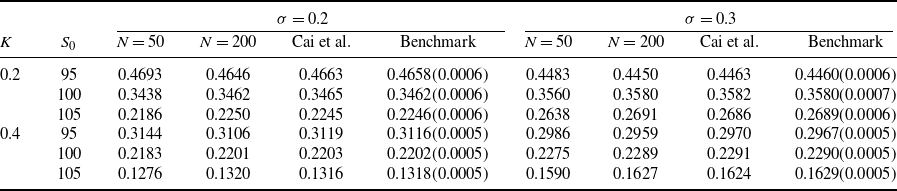
The numerical results are reported in Table 2.
Corridor options under the DEJD model via our single transform CTMC approximation with
 $N=50$
and
 $N=200$
. The parameter settings are the same as those in
 ${\rm{\S}}$
5.2 of [Reference Cai, Chen and Wan2]. The columns ‘Benchmark’ are option prices based on Monte Carlo simulation and are directly taken from the column ‘MC value’ in Table 3 of [Reference Cai, Chen and Wan2]. The columns ‘Cai et al.’ are taken from the column ‘EI price’ in Table 3 of [Reference Cai, Chen and Wan2]. The number of terms to include in the COS series is set as 256.

5. Conclusion
In this paper we lay out a general theoretical and computational transform analysis framework for general one-dimensional Markov processes. We derive a new duality relationship between additive functionals of stochastic processes and their right inverses. Based on this duality relation, we recover some classical results in various applications in finance and renewal theory. We also characterize the joint double transforms of additive functionals of Markov processes and their inverses, and obtain explicit single transforms in the case of CTMC.
Appendix A. Technical proofs
A.1. Proof of Theorem 2.1
For part (i), it is a straightforward verification:
 \begin{align*}\alpha \int_0^{\infty} \,{\mathrm{e}}^{-\alpha u} \mathbb{E}[{\mathrm{e}}^{-\beta (A_u-A_0)}] \,{\mathrm{d}} u&=\mathbb{E}[{\mathrm{e}}^{-\beta (A_{\mathcal{E}_{\alpha}}-A_0)}]\nonumber\\&=\mathbb{P}\bigl(A_{\mathcal{E}_{\alpha}}-A_0\leq \mathcal{E}^{\prime}_{\beta}\bigr)\nonumber\\&=\mathbb{P}\bigl(\tau_{\mathcal{E}^{\prime}_{\beta}}\geq \mathcal{E}_{\alpha}\bigr)\nonumber \\&=1-\mathbb{P}\bigl(\tau_{\mathcal{E}^{\prime}_{\beta}}< \mathcal{E}_{\alpha}\bigr)\nonumber\\&=1-\mathbb{E}\bigl[{\mathrm{e}}^{-\alpha \tau_{\mathcal{E}^{\prime}_{\beta}}}\bigr]\nonumber \\&=1-\beta \int_0^{\infty} \,{\mathrm{e}}^{-\beta a} \mathbb{E}[{\mathrm{e}}^{-\alpha \tau_a}] \,{\mathrm{d}} a, \end{align*}
where
 $\mathcal{E}_{\alpha}$
and
 $\mathcal{E}^{\prime}_{\beta}$
are two independent exponential random variables with rates
 $\alpha$
and
 $\beta$
, and they are also independent of
 $\{A_t\}$
and
 $\tau$
. The second equality uses the tower property and the fact that for an exponential random variable
 $\mathcal{E}'_{\beta}$
with rate
 $\beta$
, the right tail probability is given by
 $\mathbb{P}(\mathcal{E}'_{\beta}\geq x)={\mathrm{e}}^{-\beta x}$
for any
 $x\geq 0$
. This completes the proof of part (i).
For part (ii), recall the following equivalence of events:
 $\lbrace m_b\leq n \rbrace=\lbrace B_n-B_0 \geq b \rbrace$
. Then
 \begin{align}\mathbb{E}[{\mathrm{e}}^{-\eta (B_n-B_0)}]&=\mathbb{P}(B_n-B_0\leq \mathcal{E}_{\eta})=\mathbb{P}(m_{\mathcal{E}_{\eta}}\geq n)=\eta \int_0^{\infty} \,{\mathrm{e}}^{-\eta b} \mathbb{P}(m_b \geq n)\,{\mathrm{d}} b, \end{align}
where
 $\mathcal{E}_{\eta}$
is an independent exponential random variable with rate
 $\eta$
. Applying the
 $\mathcal{Z}$
-transform to both sides of (A.1) and from Fubini’s theorem, we have
 \begin{align*}\sum_{n=0}^{\infty} z^n \mathbb{E}[{\mathrm{e}}^{-\eta (B_n-B_0)}]& =\sum_{n=0}^{\infty} z^n \eta \int_0^{\infty} \,{\mathrm{e}}^{-\eta b} \mathbb{P}(m_b \geq n)\,{\mathrm{d}} b\nonumber \\&=\eta \int_0^{\infty} \,{\mathrm{e}}^{-\eta b} \Biggl( \sum_{n=0}^{\infty} z^n \mathbb{P}(m_b \geq n) \Biggr) \,{\mathrm{d}} b\nonumber\\& =\eta \int_0^{\infty} \,{\mathrm{e}}^{-\eta b} \Biggl( \sum_{n=0}^{\infty} z^n \mathbb{E}[1_{\{m_b \geq n}] \Biggr) \,{\mathrm{d}} b\nonumber \\&=\eta \int_0^{\infty} \,{\mathrm{e}}^{-\eta b} \Biggl( \mathbb{E}\Biggl[\sum_{n=0}^{\infty} z^n 1_{\{m_b \geq n\}}\Biggr] \Biggr) \,{\mathrm{d}} b\nonumber\\& =\eta \int_0^{\infty} \,{\mathrm{e}}^{-\eta b} \Biggl( \mathbb{E}\Biggl[\sum_{n=0}^{m_b} z^n\Biggr] \Biggr) \,{\mathrm{d}} b\nonumber \\&=\eta \int_0^{\infty} \,{\mathrm{e}}^{-\eta b} \biggl( \dfrac{1}{1-z}-\dfrac{1}{1-z} \mathbb{E}[z^{m_b+1}] \biggr) \,{\mathrm{d}} b\nonumber\\& =\eta \int_0^{\infty} \,{\mathrm{e}}^{-\eta b} \dfrac{1}{1-z} \,{\mathrm{d}} b- \eta \int_0^{\infty} \,{\mathrm{e}}^{-\eta b} \dfrac{z}{1-z} \mathbb{E}[z^{m_b}] \,{\mathrm{d}} b\nonumber\\&=\dfrac{1}{1-z}- \dfrac{\eta z }{1-z}\int_0^{\infty} \,{\mathrm{e}}^{-\eta b} \mathbb{E}[z^{m_b}] \,{\mathrm{d}} b\nonumber \\ \end{align*}
 \begin{align*}&=\dfrac{1}{1-z}- \dfrac{\eta z}{1-z}\int_0^{\infty} \,{\mathrm{e}}^{-\eta b} \sum_{n=0}^{\infty} z^n \mathbb{P}(m_b=n) \,{\mathrm{d}} b\nonumber\\& =\dfrac{1}{1-z}- \dfrac{\eta z}{1-z}\sum_{n=0}^{\infty} z^n \biggl( \int_0^{\infty} \,{\mathrm{e}}^{-\eta b} \mathbb{P}(m_b=n) \,{\mathrm{d}} b\biggr). \end{align*}
Then we have
 \begin{align*} \sum_{n=0}^{\infty} z^{n+1} \biggl( \int_0^{\infty} \eta \,{\mathrm{e}}^{-\eta b} \mathbb{P}(m_b=n) \,{\mathrm{d}} b\biggr)&=1-\sum_{n=0}^{\infty} z^n \mathbb{E}[{\mathrm{e}}^{-\eta (B_n-B_0)}]+\sum_{n=0}^{\infty} z^{n+1} \mathbb{E}[{\mathrm{e}}^{-\eta (B_n-B_0)}]\nonumber\\&=-\sum_{n=1}^{\infty} z^n \mathbb{E}[{\mathrm{e}}^{-\eta (B_n-B_0)}]+\sum_{n=0}^{\infty} z^{n+1} \mathbb{E}[{\mathrm{e}}^{-\eta (B_n-B_0)}]\nonumber\\&=\sum_{n=0}^{\infty} z^{n+1} \bigl(\mathbb{E}[{\mathrm{e}}^{-\eta (B_n-B_0)}]- \mathbb{E}[{\mathrm{e}}^{-\eta (B_{n+1}-B_0)}]\bigr),\end{align*}
and from the uniqueness of the
 $\mathcal{Z}$
-transform, we have the desired result. This completes the proof of part (ii).
Remark A.1. In the proof of Theorem 2.1, for part (i), conditioning on
 $(A_{u})_{u\geq 0}$
, we have
 \begin{align*}\alpha \int_0^{\infty} \,{\mathrm{e}}^{-\alpha u} \,{\mathrm{e}}^{-\beta (A_u-A_0)} \,{\mathrm{d}} u&=\mathbb{E}_{\mathcal{E}_{\alpha}}[{\mathrm{e}}^{-\beta (A_{\mathcal{E}_{\alpha}}-A_0)}]\nonumber\\&=\mathbb{P}_{\mathcal{E}_{\alpha},\mathcal{E}^{\prime}_{\beta}}\bigl(A_{\mathcal{E}_{\alpha}}-A_0\leq \mathcal{E}^{\prime}_{\beta}\bigr)\nonumber\\&=\mathbb{P}_{\mathcal{E}_{\alpha},\mathcal{E}^{\prime}_{\beta}}(\tau_{\mathcal{E}^{\prime}_{\beta}}\geq \mathcal{E}_{\alpha})\nonumber \\&=1-\mathbb{P}_{\mathcal{E}_{\alpha},\mathcal{E}^{\prime}_{\beta}}(\tau_{\mathcal{E}^{\prime}_{\beta}}< \mathcal{E}_{\alpha})\nonumber\\&=1-\mathbb{E}_{\mathcal{E}^{\prime}_{\beta}}\bigl[{\mathrm{e}}^{-\alpha \tau_{\mathcal{E}^{\prime}_{\beta}}}\bigr]\nonumber \\&=1-\beta \int_0^{\infty} \,{\mathrm{e}}^{-\beta a} \,{\mathrm{e}}^{-\alpha \tau_a} \,{\mathrm{d}} a,\end{align*}
where
 $\mathbb{E}_{\mathcal{E}_{\alpha}}$
denotes the expectation that is taken over
 $\mathcal{E}_{\alpha}$
only, etc. Thus we obtain
 \begin{equation*} \alpha \int_0^{\infty} \,{\mathrm{e}}^{-\alpha u} \,{\mathrm{e}}^{-\beta (A_u-A_0)} \,{\mathrm{d}} u=1-\beta \int_0^{\infty} \,{\mathrm{e}}^{-\beta a} \,{\mathrm{e}}^{-\alpha \tau_a} \,{\mathrm{d}} a,\end{equation*}
which establishes (2.4). Similarly, in the proof of Theorem 2.1, for part (ii), conditioning on
 $(B_{n})_{n=0}^{\infty}$
, we have
 \begin{align}{\mathrm{e}}^{-\eta (B_n-B_0)}&=\mathbb{P}_{\mathcal{E}_{\eta}}(B_n-B_0\leq \mathcal{E}_{\eta})=\mathbb{P}_{\mathcal{E}_{\eta}}(m_{\mathcal{E}_{\eta}}\geq n)=\eta \int_0^{\infty} \,{\mathrm{e}}^{-\eta b} 1(m_b \geq n)\,{\mathrm{d}} b, \end{align}
where
 $\mathbb{P}_{\mathcal{E}_{\eta}}$
denotes the probability measure with respect to
 $\mathcal{E}_{\eta}$
only. Applying the
 $\mathcal{Z}$
-transform to both sides of (A.2) and from Fubini’s theorem, we have
 \begin{align*}\sum_{n=0}^{\infty} z^n\,{\mathrm{e}}^{-\eta (B_n-B_0)}=\dfrac{1}{1-z}- \dfrac{\eta z}{1-z}\sum_{n=0}^{\infty} z^n \biggl( \int_0^{\infty} \,{\mathrm{e}}^{-\eta b} 1(m_b=n) \,{\mathrm{d}} b\biggr),\end{align*}
which establishes (2.5).
A.2. Proof of Corollary 2.1
(i) We have shown that
 \begin{equation*}\alpha\int_{0}^{\infty}\,{\mathrm{e}}^{-\alpha u}\mathbb{E}[{\mathrm{e}}^{-\beta f(A_{u})}]\,{\mathrm{d}} u+\beta\int_{0}^{\infty}\,{\mathrm{e}}^{-\beta a}\mathbb{E}[{\mathrm{e}}^{-\alpha\tau_{f^{-1}(a)}}] \,{\mathrm{d}} a=1.\end{equation*}
Under our assumption, for any
 $\mathit{Re}(\alpha)>0$
the series
 \[\sum_{k=0}^{\infty}\frac{(-1)^{k}\alpha^{k}}{k!}\int_{0}^{\infty}u^{k}\mathbb{E}[{\mathrm{e}}^{-\beta f(A_{u})}]\,{\mathrm{d}} u\quad\text{and}\quad\sum_{k=0}^{\infty}\frac{(-1)^{k}\alpha^{k}}{k!}\int_{0}^{\infty}\,{\mathrm{e}}^{-\beta a}\mathbb{E}\bigl[\bigl(\tau_{f^{-1}(a)}\bigr)^{k}\bigr] \,{\mathrm{d}} a\]
are convergent. If we take a Taylor expansion in terms of
 $\alpha$
, then we get
 \begin{equation*}\alpha\sum_{k=0}^{\infty}\dfrac{(-1)^{k}\alpha^{k}}{k!}\int_{0}^{\infty}u^{k}\mathbb{E}[{\mathrm{e}}^{-\beta f(A_{u})}]\,{\mathrm{d}} u+\beta\int_{0}^{\infty}\,{\mathrm{e}}^{-\beta a}\sum_{k=0}^{\infty}\dfrac{(-1)^{k}\alpha^{k}}{k!}\mathbb{E}\bigl[\bigl(\tau_{f^{-1}(a)}\bigr)^{k}\bigr] \,{\mathrm{d}} a=1,\end{equation*}
which is equivalent to
 \begin{equation*}\sum_{k=1}^{\infty}\dfrac{(-1)^{k-1}\alpha^{k}}{(k-1)!}\int_{0}^{\infty}u^{k-1}\mathbb{E}[{\mathrm{e}}^{-\beta f(A_{u})}]\,{\mathrm{d}} u+\beta\sum_{k=0}^{\infty}\dfrac{(-1)^{k}\alpha^{k}}{k!}\int_{0}^{\infty}\,{\mathrm{e}}^{-\beta a}\mathbb{E}\bigl[\bigl(\tau_{f^{-1}(a)}\bigr)^{k}\bigr] \,{\mathrm{d}} a=1,\end{equation*}
and this implies that
 \begin{equation*}\beta\int_{0}^{\infty}\,{\mathrm{e}}^{-\beta a}\mathbb{E}\bigl[\bigl(\tau_{f^{-1}(a)}\bigr)^{k}\bigr] \,{\mathrm{d}} a=k\int_{0}^{\infty}u^{k-1}\mathbb{E}[{\mathrm{e}}^{-\beta f(A_{u})}]\,{\mathrm{d}} u,\quad k=1,2,3,\ldots .\end{equation*}
Similarly, we have
 \begin{equation*}\alpha\int_{0}^{\infty}\,{\mathrm{e}}^{-\alpha u}\mathbb{E}[(\,f(A_{u}))^{k}]\,{\mathrm{d}} u=k\int_{0}^{\infty}a^{k-1}\mathbb{E}[{\mathrm{e}}^{-\alpha\tau_{f^{-1}(a)}}] \,{\mathrm{d}} a,\quad k=1,2,3,\ldots .\end{equation*}
(ii) We have shown that
 \begin{equation}(1-z)\sum_{n=1}^{\infty}z^{n}\mathbb{E}[{\mathrm{e}}^{-\eta f(B_{n})}]+\eta z\sum_{n=0}^{\infty}z^{n}\int_{0}^{\infty}\,{\mathrm{e}}^{-\eta b}\mathbb{P}(m_{f^{-1}(b)}=n)\,{\mathrm{d}} b=z.\end{equation}
Under our assumption, for any
 $|z|<1$
and
 $\mathit{Re}(\eta)>0$
, the series
 \[\sum_{n=1}^{\infty}z^{n}\sum_{k=0}^{\infty}\frac{(-1)^{k}\eta^{k}}{k!}\mathbb{E}[(\,f(B_{n}))^{k}]\quad\text{and}\quad\sum_{n=0}^{\infty}z^{n}\int_{0}^{\infty}\sum_{k=0}^{\infty}\frac{(-1)^{k}\eta^{k}}{k!}b^{k}\mathbb{P}(m_{f^{-1}(b)}=n)\,{\mathrm{d}} b\]
are convergent. If we take a Taylor expansion in terms of
 $\eta$
on both sides of the equation, then we get
 \begin{equation*}(1-z)\sum_{n=1}^{\infty}z^{n}\sum_{k=0}^{\infty}\dfrac{(-1)^{k}\eta^{k}}{k!}\mathbb{E}[(\,f(B_{n}))^{k}]+\eta z\sum_{n=0}^{\infty}z^{n}\int_{0}^{\infty}\sum_{k=0}^{\infty}\dfrac{(-1)^{k}\eta^{k}}{k!}b^{k}\mathbb{P}(m_{f^{-1}(b)}=n)\,{\mathrm{d}} b=z,\end{equation*}
which is equivalent to
 \begin{equation*}(1-z)\sum_{n=1}^{\infty}z^{n}\sum_{k=1}^{\infty}\dfrac{(-1)^{k}\eta^{k}}{k!}\mathbb{E}[(\,f(B_{n}))^{k}]+\eta z\sum_{n=0}^{\infty}z^{n}\int_{0}^{\infty}\sum_{k=0}^{\infty}\dfrac{(-1)^{k}\eta^{k}}{k!}b^{k}\mathbb{P}(m_{f^{-1}(b)}=n)\,{\mathrm{d}} b=0,\end{equation*}
and it leads to
 \begin{align*}&(1-z)\sum_{n=1}^{\infty}z^{n}\sum_{k=1}^{\infty}\dfrac{(-1)^{k}\eta^{k}}{k!}\mathbb{E}[(\,f(B_{n}))^{k}]\\&\quad +\sum_{n=0}^{\infty}z^{n+1}\int_{0}^{\infty}\sum_{k=1}^{\infty}\dfrac{(-1)^{k-1}\eta^{k}}{(k-1)!}b^{k-1}\mathbb{P}(m_{f^{-1}(b)}=n)\,{\mathrm{d}} b=0,\end{align*}
which implies that, for any
 $k=1,2,3,\ldots,$
 \begin{equation*}(1-z)\sum_{n=1}^{\infty}z^{n}\mathbb{E}[(\,f(B_{n}))^{k}]=\sum_{n=0}^{\infty}z^{n+1}\int_{0}^{\infty}kb^{k-1}\mathbb{P}(m_{f^{-1}(b)}=n)\,{\mathrm{d}} b.\end{equation*}
On the other hand, using the fact that
 $B_{0}=0$
and
 $f(0)=0$
, we can rewrite the identity (A.3) as
 \begin{equation*}\sum_{n=1}^{\infty}z^{n}(\mathbb{E}[{\mathrm{e}}^{-\eta f(B_{n})}]-\mathbb{E}[{\mathrm{e}}^{-\eta f(B_{n-1})}])+\eta\sum_{n=1}^{\infty}z^{n}\int_{0}^{\infty}\,{\mathrm{e}}^{-\eta b}\mathbb{P}(m_{f^{-1}(b)}=n-1)\,{\mathrm{d}} b=0,\end{equation*}
which implies that, for any
 $n=1,2,\ldots,$
 \begin{equation*}(\mathbb{E}[{\mathrm{e}}^{-\eta f(B_{n})}]-\mathbb{E}[{\mathrm{e}}^{-\eta f(B_{n-1})}])+\eta\int_{0}^{\infty}\,{\mathrm{e}}^{-\eta b}\mathbb{P}(m_{f^{-1}(b)}=n-1)\,{\mathrm{d}} b=0,\end{equation*}
and this is the desired result. This completes the proof.
A.3. Proof of Proposition 2.1
By letting
 $\beta=\mu$
in (2.1) and using the definition of
 $\mathcal{E}_{\mu}$
, we get
 \begin{equation*}\alpha\int_{0}^{\infty}\,{\mathrm{e}}^{-\alpha u}\mathbb{E}[{\mathrm{e}}^{-\mu(A_{u}-A_{0})}]\,{\mathrm{d}} u+\mathbb{E}[{\mathrm{e}}^{-\alpha\tau_{\mathcal{E}_{\mu}}}]=1.\end{equation*}
Under our assumption, for any
 $\mathit{Re}(\alpha)>0$
, the series
 \[\sum_{n=0}^{\infty}\frac{1}{n!}(-1)^{n}\alpha^{n}\int_{0}^{\infty}u^{n}\mathbb{E}[{\mathrm{e}}^{-\mu(A_{u}-A_{0})}]\,{\mathrm{d}} u\quad\text{and}\quad\sum_{n=0}^{\infty}\frac{1}{n!}(-1)^{n}\alpha^{n}\mathbb{E}\bigl[\bigl(\tau_{\mathcal{E}_{\mu}}\bigr)^{n}\bigr]\]
are convergent. By taking a Taylor expansion in
 $\alpha$
in the above equation, we get
 \begin{equation*}\alpha\int_{0}^{\infty}\sum_{n=0}^{\infty}\dfrac{1}{n!}(-1)^{n}\alpha^{n}u^{n}\mathbb{E}[{\mathrm{e}}^{-\mu(A_{u}-A_{0})}]\,{\mathrm{d}} u+\sum_{n=0}^{\infty}\dfrac{1}{n!}(-1)^{n}\alpha^{n}\mathbb{E}\bigl[\bigl(\tau_{\mathcal{E}_{\mu}}\bigr)^{n}\bigr]=1.\end{equation*}
The coefficient of
 $\alpha^{n}$
on the left-hand side in the above equation must be equal to zero for every
 $n\in\mathbb{N}^{+}$
, which implies that
 \begin{equation*}\dfrac{1}{(n-1)!}(-1)^{n-1}\int_{0}^{\infty}u^{n-1}\mathbb{E}[{\mathrm{e}}^{-\mu(A_{u}-A_{0})}]\,{\mathrm{d}} u+\dfrac{1}{n!}(-1)^{n}\mathbb{E}\bigl[\bigl(\tau_{\mathcal{E}_{\mu}}\bigr)^{n}\bigr]=0,\end{equation*}
which yields the desired result. This completes the proof.
A.4. Proof of Proposition 2.2
By letting
 $\alpha=\mu$
in (2.1) and using the definition of
 $\mathcal{E}_{\mu}$
, we get
 \begin{equation*}\mathbb{E}[{\mathrm{e}}^{-\beta (A_{\mathcal{E}_{\mu}}-A_0)}]+\beta \int_0^{\infty} \,{\mathrm{e}}^{-\beta u} \mathbb{E}[{\mathrm{e}}^{-\mu \tau_u}] \,{\mathrm{d}} u=1.\end{equation*}
Similar to the proof of Proposition 2.1, we can do a Taylor expansion in
 $\beta$
and the coefficient of the
 $\beta^{n}$
term is zero, which completes the proof.
A.5. Proof of Proposition 2.3
We apply the discrete time duality result in Theorem 2.1(ii), from which we have the following derivation:
 \begin{align}\sum_{n=0}^{\infty} z^{n+1} \biggl( \int_0^{\infty} \,{\mathrm{e}}^{-\eta t} \mathbb{P}(N(t)=n) \,{\mathrm{d}} t\biggr)&=\dfrac{1-(1-z)\sum_{n=0}^{\infty} z^n \mathbb{E}[{\mathrm{e}}^{-\eta S_n}]}{\eta}\nonumber\\&=\dfrac{1-(1-z)\sum_{n=0}^{\infty} (zM(\eta))^n }{\eta}\nonumber \\&=\dfrac{1-(1-z)\frac{1}{1-zM(\eta)} }{\eta}\nonumber\\&=\dfrac{1-M(\eta)}{\eta} \dfrac{z}{1-M(\eta) z}\nonumber \\&=\dfrac{1-M(\eta)}{\eta} z \sum_{n=0}^{\infty} (M(\eta) z)^n \nonumber\\&=\dfrac{1-M(\eta)}{\eta} \sum_{n=0}^{\infty} z^{n+1}(M(\eta))^{n}.\end{align}
By matching the coefficients on both sides of (A.4), and the uniqueness of the
 $\mathcal{Z}$
-transform, we have the following identity:
 \begin{align*}\int_0^{\infty}\eta \,{\mathrm{e}}^{-\eta t} \mathbb{P}(N(t)=n) \,{\mathrm{d}} t&=(1-M(\eta))(M(\eta))^{n}, \quad n=0,1,2,\ldots .\end{align*}
An equivalent way of writing the above identity is as follows:
 \begin{align*} \mathbb{P}(N(\mathcal{E}_{\eta})=n) &=(1-M(\eta))(M(\eta))^{n}, \quad n=0,1,2,\ldots . \end{align*}
We recognize that the right-hand side of the above corresponds to the probability mass function of the geometric distribution with parameter
 $1-M(\eta)$
. This completes the proof.
A.6. Proof of Corollary 2.3
The result follows from Proposition 2.3 and the properties of the cumulants of the geometric distribution. This completes the proof.
A.7. Proof of Theorem 3.1
(i) Let us define
 $u(t,x)\,:\!=\, \mathbb{E}^{x}[{\mathrm{e}}^{-A_{t}}g(X_{t})]$
. First of all, note that the Feynman–Kac formula (Theorem 5.7.6 of [Reference Karatzas and Shreve20, p. 366]) can be extended from diffusion processes to Markov processes given that Assumptions 3.1 and 3.2 are satisfied. More specifically, we can construct a martingale similar to that in their proof from Itô’s formula for Markov processes thanks to Assumption 3.1. With Assumption 3.2, one can bypass the polynomial growth condition (7.14) of [Reference Karatzas and Shreve20]. Note that the backward setting used in [Reference Karatzas and Shreve20] is equivalent to our setting by making a transform
 $t\mapsto T-t$
.
Then, from this extended Feynman–Kac formula for Markov processes, we have
 \begin{equation}\dfrac{\partial u(t,x)}{\partial t}=Gu(t,x)-h(x)u(t,x),\quad u(0,x)=g(x).\end{equation}
Recall that
 $m(\mu;\,x)=\int_{0}^{\infty}\,{\mathrm{e}}^{-\mu t}u(t,x)\,{\mathrm{d}} t$
is the Laplace transform of u(t,x) with respect to t. Note that the Laplace transform is well-defined from the assumption (3.1). By taking the Laplace transform with respect to t in equation (A.5), we get
 \begin{equation*}\mu \cdot m(\mu;\,x)-u(0,x)=\mu \cdot m(\mu;\,x)-g(x)=(G-h(x))m(\mu;\,x),\end{equation*}
which implies that
 $m(\mu;\,x)$
satisfies the equation
 \begin{equation*}(h(x)+\mu-G)m(\mu;\,x)=g(x).\end{equation*}
This completes the proof of part (i).
(ii) Let us define
 $u(i\Delta,x)\,:\!=\, \mathbb{E}^{x}[{\mathrm{e}}^{-B_{i}}g(X_{t_{i}})]$
. Then, from the tower property of conditional expectation and the Markov property,
 $u(i\Delta,x)$
satisfies
 \begin{equation}u((i+1)\Delta,x)-u(i\Delta,x)=({\mathrm{e}}^{-h(x)}P_\Delta-\mathbb{I})u(i\Delta,x),\quad u(0,x)={\mathrm{e}}^{-h(x)}g(x),\end{equation}
where P is the semigroup operator of
 $\{X_t\}$
and
 $\mathbb{I}$
is the identity operator. Recall that
 $l(z;x)=\sum_{i=0}^{\infty}z^{i}u(i\Delta,x)$
, which converges due to the assumption (3.1). Multiplying (A.6) by
 $z^{i}$
and summing from
 $i=0$
to
 $\infty$
, we see that
 $f(x)=l(z;x)$
satisfies
 \begin{equation*}\dfrac{1}{z}[\,f(x)-{\mathrm{e}}^{-h(x)}g(x)]={\mathrm{e}}^{-h(x)}\mathbb{E}^{x}[\,f(X_{\Delta})],\end{equation*}
which implies
 \begin{equation*}{\mathrm{e}}^{h(x)}f(x)-z\mathbb{E}^{x}[\,f(X_{\Delta})]=g(x).\end{equation*}
This completes the proof of part (ii).
Remark A.2. We replace h(x) with its scaled version
 $\Delta h(x)$
. As the step size
 $\Delta>0$
converges to zero:
-
(a) The Riemann sum
$B_{n}$
converges to the Riemann integral
$A_{t}$
a.s., and also notice that
$X_{t_{n}}=X_{T}$
and that
$B_{n},A_{T}\geq 0$
. By the dominated convergence theorem, the discrete-time joint transform
$\mathbb{E}^{x} [{\mathrm{e}}^{-B_n}g(X_{t_n})]$
converges to the continuous-time joint transform
$\mathbb{E}^{x} [{\mathrm{e}}^{-A_T}g(X_T)]$
. -
(b) By considering
$z=1-\mu\Delta$
, and recalling that
$T=n\Delta$
, we can show that
$(1-z)l(z; x)$
converges to
$\mu m(\mu;\,x)$
.






Remark A.3. We point out that as the step size
 $\Delta>0$
converges to zero, the solution of the functional equation (A.6) converges to that of the equation (A.5). We begin by replacing h(x) with its scaled version
 $\Delta h(x)$
. We rewrite the above equation (A.6) as
 \begin{align*}u(i\Delta, x)-u((i-1)\Delta, x)&={\mathrm{e}}^{-\Delta h(x)}( P_{\Delta}-{\mathrm{e}}^{\Delta h(x)})u((i-1)\Delta, x), \quad u(0,x)={\mathrm{e}}^{-\Delta h(x)}g(x).\end{align*}
This can be further rewritten as
 \begin{align*}u(i\Delta, x)-u((i-1)\Delta, x)&={\mathrm{e}}^{-\Delta h(x)}(P_{\Delta}-\mathbb{I})u((i-1)\Delta, x)-(1-{\mathrm{e}}^{-\Delta h(x)})u((i-1)\Delta, x).\end{align*}
Dividing both sides by
 $\Delta$
and taking limits
 $\Delta\rightarrow 0$
, we have
 \begin{align*}&\lim_{\Delta\rightarrow 0} \dfrac{u(i\Delta, x)-u((i-1)\Delta, x)}{\Delta}\\&\quad =\lim_{\Delta\rightarrow 0} \,{\mathrm{e}}^{-\Delta h(x)}\dfrac{P_{\Delta}-\mathbb{I}}{\Delta}u((i-1)\Delta, x)-\lim_{\Delta\rightarrow 0} \dfrac{1-{\mathrm{e}}^{-\Delta h(x)}}{\Delta}u((i-1)\Delta, x).\end{align*}
In the limit, we have
 \begin{align*}\dfrac{\partial u(t,x)}{\partial t}&= G u(t,x) - h(x) u(t,x), \quad u(0,x)=g(x).\end{align*}
A.8. Proof of Proposition 3.1
(i) In the continuous-time case,
 $g_c(t; \textbf{x})\,:\!=\, \mathbb{E}^{\textbf{x}} [{\mathrm{e}}^{-A_t} g(X_t)]$
satisfies the following Feynman–Kac formula:
 \begin{equation*}\dfrac{\partial g_c(t; \textbf{x})}{\partial t}=(\mathbf{G}-\mathbf{D})g_c(t; \textbf{x}),\quad g_c(0; \textbf{ x})=g(\mathbf{x}),\end{equation*}
which yields that
 \begin{equation*}g_c(t; \textbf{x})={\mathrm{e}}^{(\mathbf{G}-\mathbf{D})t}g(\mathbf{x}).\end{equation*}
This completes the proof of part (i).
(ii) From the tower property of conditional expectation and the Markov property,
 $g_d(n; \textbf{x})$
satisfies
 \begin{equation*} g_d(n+1; \textbf{x})-g_d(n; \textbf{x})=({\mathrm{e}}^{ -\textbf{D}}\textbf{P}(\Delta)-\mathbf{I})g_d(n; \textbf{x}),\quad g_d(0; \textbf{x})={\mathrm{e}}^{ -\textbf{D}}g(\textbf{x}),\end{equation*}
where
 $\mathbf{P}(\!\cdot\!)$
is the transition probability matrix of
 $\{X_t\}$
and
 $\mathbf{I}$
is the identity matrix. This completes the proof of part (ii).
A.9. Proof of Proposition 3.2
(i) In the continuous-time case, we can similarly check that
 $\beta \textbf{D} +\alpha \textbf{I}-\textbf{G}$
is invertible and the functional equation (3.5) has the following solution:
 \begin{equation*}\textbf{g}=(\beta \textbf{D} +\alpha \textbf{I}-\textbf{G})^{-1} \textbf{1}.\end{equation*}
From Theorem 3.2 part (i), we have
 \begin{equation}\int_0^{\infty}\,{\mathrm{e}}^{-\beta a} p_c(a, \alpha; \textbf{x}) \,{\mathrm{d}} a=\dfrac{\textbf{1}-\alpha\cdot (\beta \textbf{D} +\alpha-\textbf{G})^{-1} \textbf{1}}{\beta}.\end{equation}
We carry out series expansion of the right-hand side of (A.7) with respect to
 $\beta$
:
 \begin{align}&(\beta \textbf{D} +\alpha \textbf{I}-\textbf{G})^{-1} \textbf{1}\nonumber \\&\quad =\biggl(\beta \textbf{D} \biggl( \textbf{ I}-\dfrac{ \textbf{D}^{-1} \textbf{G}-\alpha \textbf{D}^{-1} }{\beta} \biggr)\biggr)^{-1} \textbf{1}\nonumber\\&\quad=\dfrac{1}{\beta}\biggl( \textbf{I}-\dfrac{ \textbf{D}^{-1} (\textbf{G}-\alpha) }{\beta} \biggr)^{-1} \textbf{D}^{-1}\textbf{ 1}\nonumber\\&\quad=\dfrac{1}{\beta}\biggl( \textbf{I}+ \dfrac{ \textbf{D}^{-1} (\textbf{G}-\alpha) }{\beta} +\biggl(\dfrac{ \textbf{D}^{-1} (\textbf{G}-\alpha) }{\beta} \biggr)^2+\cdots+\biggl(\dfrac{ \textbf{D}^{-1} (\textbf{G}-\alpha) }{\beta} \biggr)^n+\cdots\biggr) \textbf{D}^{-1}\textbf{1}\nonumber\\&\quad=\dfrac{\textbf{D}^{-1}\textbf{1}}{\beta}+ \dfrac{ \textbf{D}^{-1} (\textbf{G}-\alpha)\textbf{D}^{-1}\textbf{1} }{\beta^2} +\dfrac{ (\textbf{D}^{-1} (\textbf{G}-\alpha))^2\textbf{D}^{-1}\textbf{1} }{\beta^3}+\cdots+\dfrac{( \textbf{D}^{-1} (\textbf{G}-\alpha) )^n \textbf{D}^{-1}\textbf{1} }{\beta^{n+1}}+\cdots\,.\nonumber\end{align}
Thus (A.7) becomes
 \begin{align}&\int_0^{\infty}\,{\mathrm{e}}^{-\beta a} p_c(a, \alpha; \textbf{x}) \,{\mathrm{d}} a\nonumber\\&\quad =\dfrac{\textbf{1}}{\beta}-\dfrac{\alpha\textbf{D}^{-1}\textbf{1}}{\beta^2}- \dfrac{\alpha \textbf{D}^{-1} (\textbf{ G}-\alpha)\textbf{D}^{-1}\textbf{1} }{\beta^3} -\cdots-\dfrac{\alpha( \textbf{D}^{-1} (\textbf{G}-\alpha) )^n \textbf{D}^{-1}\textbf{1} }{\beta^{n+2}}-\cdots.\end{align}
Lastly, we invert the right-hand side of (A.8) with respect to
 $\beta$
:
 \begin{align}& p_c(a, \alpha; \textbf{x})\nonumber\\&\quad =\textbf{1}-\alpha\textbf{D}^{-1}\textbf{1}a- \dfrac{\alpha \textbf{D}^{-1} (\textbf{G}-\alpha)\textbf{D}^{-1}\textbf{1} a^2}{2!} -\cdots-\dfrac{\alpha( \textbf{D}^{-1} (\textbf{G}-\alpha) )^n \textbf{D}^{-1}\textbf{1} a^{n+1}}{(n+1)!}-\cdots\nonumber\\&\quad =\textbf{1}-\alpha (\textbf{D}^{-1} (\textbf{G}-\alpha))^{-1} \Biggl( \sum_{i=0}^{\infty}\dfrac{(\textbf{D}^{-1} (\textbf{G}-\alpha))^i a^i}{i!} -\textbf{I} \Biggr) \textbf{D}^{-1}\textbf{1}\nonumber\\&\quad =\textbf{1}-\alpha (\textbf{G}-\alpha)^{-1}\textbf{D} \bigl({\mathrm{e}}^{\textbf{D}^{-1} (\textbf{G}-\alpha) a} -\textbf{I} \bigr) \textbf{D}^{-1}\textbf{1}.\nonumber\end{align}
This completes the proof of part (i).
(ii) We can check that
 ${\mathrm{e}}^{\boldsymbol{\eta}}\textbf{D}-z \textbf{P}(\Delta)$
is invertible when the transform variable satisfies
 \begin{equation*}|z|<\min\biggl\{1, \dfrac{1}{\Vert ({\mathrm{e}}^{\eta \textbf{D}})^{-1}\textbf{P}(\Delta) \Vert}\biggr\},\end{equation*}
and the functional equation (3.7) has the following solution:
 \begin{align}\textbf{f}&=({\mathrm{e}}^{\boldsymbol{\eta}}\textbf{D}-z \textbf{P}(\Delta))^{-1} \textbf{1}.\nonumber\end{align}
Notice the following series expansion with respect to z:
 \begin{align*}({\mathrm{e}}^{\boldsymbol{\eta}}\textbf{D}-z \textbf{P}(\Delta))^{-1} \textbf{1}&={\mathrm{e}}^{ -\boldsymbol{\eta}\textbf{D}} \textbf{1} +z \,{\mathrm{e}}^{ -\boldsymbol{\eta}\textbf{D}}\textbf{P}(\Delta)\,{\mathrm{e}}^{ -\boldsymbol{\eta}\textbf{D}} \textbf{1}+\cdots+z^n ({\mathrm{e}}^{ -\boldsymbol{\eta}\textbf{D}}\textbf{P}(\Delta))^n \,{\mathrm{e}}^{ -\boldsymbol{\eta}\textbf{D}} \textbf{1}+\cdots. \end{align*}
Thus, from Theorem 3.2 part (ii), and in particular (3.8), we obtain
 \begin{align}&\eta \sum_{n=0}^{\infty} z^n p_d(n, \eta; \textbf{x}) = z+(z^2-z)\textbf{P}(\Delta)\textbf{f}\nonumber\\&\quad =z+(z^2-z)\textbf{P}(\Delta)({\mathrm{e}}^{\boldsymbol{\eta}}\textbf{D}-z \textbf{P}(\Delta))^{-1} \textbf{1}\nonumber\\&\quad =z+(z^2-z)\textbf{P}(\Delta)( {\mathrm{e}}^{ -\boldsymbol{\eta}\textbf{D}} \textbf{1} +z \,{\mathrm{e}}^{ -\boldsymbol{\eta}\textbf{D}}\textbf{P}(\Delta)\,{\mathrm{e}}^{ - \boldsymbol{\eta}\textbf{D}} \textbf{1}+\cdots+z^n ({\mathrm{e}}^{ -\boldsymbol{\eta}\textbf{D}}\textbf{P}(\Delta))^n \,{\mathrm{e}}^{ -\boldsymbol{\eta}\textbf{D}} \textbf{ 1}+\cdots ). \end{align}
By matching the coefficients of
 $z^{n}$
on both sides of (A.9), we obtain the desired result. This completes the proof of part (ii).
Acknowledgements
We would like to thank two anonymous referees and the editor, whose comments and suggestions have greatly improved the quality of the paper. We also thank Yuhang Yao and Cai Wu for their excellent research assistance.
Funding information
Yanchu Liu is partially supported by National Natural Science Foundation of China under grant nos. 72271249 and 72432005. Lingjiong Zhu is partially supported by NSF grants DMS-2053454 and DMS-2208303.
Competing interests
There were no competing interests to declare which arose during the preparation or publication process of this article.