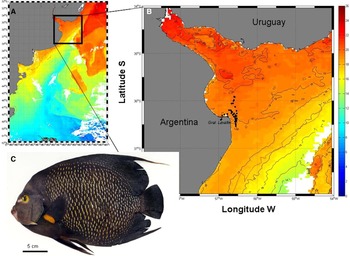
On 24 April 2013 a French angelfish Pomacanthus paru (Bloch, 1787) was found in the coastal waters of the Buenos Aires province, Argentina. The specimen was caught by the Yguá/Betty trawlers fishing vessels operating in the Río de la Plata River, Argentina (36°13′S 56°33′W) at 10 m of depth in a sandy sediment area (Figure 1). The fish was found during the routine sampling fish programme in landing ports; a total length of 295 mm and a total weight of 855.3 g were recorded. Macroscopic analysis of the gonad indicates the specimen was an adult male in maturity stage 2 (resting).
(A) Sea surface temperature (composite from 20 to 23 April 2013) maps from the south-west Atlantic Ocean; (B) enlargement of location where Pomacanthus paru was caught in the Río de la Plata mouth, Buenos Aires Province, Argentina. Black dots indicate the fishing hauls performed during the fishing trip in which the specimen was caught; (C) P. paru (total length = 295 mm; total weight = 855.3 g; INIDEP fish collection No. 840).

Few species of pomacanthid fish are found in the Atlantic Ocean, of which seven species have been reported off oceanic islands and only four species in open oceanic waters (Floeter & Gasparini, Reference Floeter and Gasparini2000; Floeter et al., Reference Floeter, Rocha, Robertson, Joyeux, Smith-Vaniz, Wirtz, Edwards, Barreiros, Ferreira, Gasparini, Brito, Falcón, Bowen and Bernardi2008). Reported distribution of Pomacanthus paru in the western Atlantic is restricted to tropical waters from Florida (USA) to the south of Brazil, including the Gulf of Mexico, the Bahamas and the Caribbean Sea (Burgess, Reference Burgess and Carpenter2002). The current southern limit for this species is known to be 28°S in Santa Catarina (Brazil) (Uyeno et al., Reference Uyeno, Matsuura and Fujii1983; Carvalho-Filho, Reference Carvalho-Filho1999; Hostim-Silva et al., Reference Hostim-Silva, Andrade, Machado, Gerhardinger, Daros, Barreiros and Godoy2006). However, the individual found in this study extends the previously reported distribution by around 1200 km southwards. Pomacanthus paru is usually reported in shallow coral or rocky reef environments, growing up to 50 cm in length and as yet no migrations have been reported (Froese & Pauly, Reference Froese and Pauly2013). External morphological characteristics make this species easily identifiable by doing a rapid comparison with published pictures or photographs (Uyeno et al., Reference Uyeno, Matsuura and Fujii1983; Froese & Pauly, Reference Froese and Pauly2013). In addition, detailed dichotomous classification keys are also available (Burgess, Reference Burgess and Carpenter2002). In this paper, we used both these methods to identify this fish at the species level. Analysis of the stomach content revealed this specimen was full, with the stomach weighing 7.3 g. Several different food items were found, including hydrozoans, sponges, algae, bryozoans, crustaceans and fish remains. Unfortunately, due to the high degree of digestion it was not possible to identify these prey items to a lower taxonomic level. A full stomach containing a variety of prey items suggests the fish was feeding when it was found and thus, has adapted to the local environment.
We analysed also the sea surface temperatures (SST, Aqua MODIS 4 km spatial resolution from: http//oceancolor.gsfc.nasa.gov), in the days previous to when the fish was caught. The SST showed waters higher than 20°C, suggesting warm water flows coming from the Brazilian coast. This oceanographic process is known as warm coastal drift (Balech, Reference Balech1986; Balech & Erlich, Reference Balech and Ehrlich2008) and it is common in Argentine waters at the end of the austral summer and during the autumn when winds coming from the north and north-east become stronger (Martos & Piccolo, Reference Martos and Piccolo1988; Guerrero et al., Reference Guerrero, Acha, Framiñan and Lasta1997; Palma et al., Reference Palma, Matano and Piola2008). The flowing of warm waters with southward direction permits the arrival of subtropical and tropical fish to the Río de la Plata (Solari et al., Reference Solari, García and Jaureguizar2010) and even further south off Mar del Plata, 38°S (Menni & García, Reference Menni and García1982; Cousseau & Figueroa, Reference Cousseau and Figueroa1989; Izzo et al., Reference Izzo, Milessi, Ortega and Segura2010; Milessi et al., Reference Milessi, Colonello, Cortés, Lasta, Waessle and Allega2012). This first report of P. paru in Argentine coastal waters is another piece of information supporting the hypothesis that the warm coastal drift allows changes in tropical and subtropical fish distribution. The specimen was deposited in the Instituto Nacional de Investigación y Desarrollo Pesquero (INIDEP fish collection No. 840).
ACKNOWLEDGEMENTS
We are grateful to the fishermen from the FVs ‘Yguá’ and ‘Betty’ who captured the specimen; A. Bianca and C. Nivoletus for providing us with the fish; Marcela Tobio who took the photographs; J. Waessle for the literature provided; L. Shejter for the identification of some prey items of stomach content; and S. Barbini for curating the material deposited in the fish collection of INIDEP No. 840. R. Wiff was funded by CONICYT/FONDECYT Post-doc Project No. 3130425. Two anonymous referees improved the paper. This is INIDEP contribution No. 1825.