Introduction
Through the extended process of evolution, thousands of chemical sensory units known as sensilla are distributed across the insect body surface, particularly on their antennae (Shanbhag et al., Reference Shanbhag, Muller and Steinbrecht1999), which enables insects to detect volatile odours through the recognition of olfactory signals by sensilla (Hansson and Stensmyr, Reference Hansson and Stensmyr2011; Williams et al., Reference Williams, Verhulst and Haverkamp2022). Sensilla requires a complex interaction of multiple proteins for the recognition of chemical signals. These proteins encompass two types of transport proteins, chemosensory proteins (CSPs) and odorant-binding proteins (OBPs); as well as three types of receptors, olfactory receptors (ORs), gustatory receptors (GRs), ionotropic receptors, sensory neuron membrane proteins (SNMPs) and odorant degrading enzymes (Kaupp, Reference Kaupp2010; Leal, Reference Leal2013; Pelosi et al., Reference Pelosi, Iovinella, Zhu, Wang and Dani2018). In recent years, there has been growing acknowledgement of the role of SNMPs in the olfactory systems of insects. The first SNMP protein was identified in Antheraea polyphemus (Lepidoptera: Saturniidae), where researchers discovered a novel protein abundant in the dendritic membrane of olfactory sensory neurons (OSNs) and named it SNMP (Rogers et al., Reference Rogers, Sun, Lerner and Vogt1997). Furthermore, homologous protein of SNMP1, named SNMP2, have been discovered in various species, such as Drosophila melanogaster (Diptera: Drosophilidae), Aedes aegypti (Diptera: Culicidae), Apis mellifera (Hymenoptera: Apidae) and Tribolium castaneum (Coleoptera: Ostomatidae) (Forstner et al., Reference Forstner, Gohl, Gondesen, Raming, Breer and Krieger2008; Nichols and Vogt, Reference Nichols and Vogt2008; Rogers et al., Reference Rogers, Steinbrecht and Vogt2001a). Recently, a novel subfamily known as the third SNMP type (SNMP3) has been identified, showing specific expression in the larval midguts of various Lepidoptera species and implicated in the immune response of Bombyx mori (Lepidoptera: Bombycidae) (Xu et al., Reference Xu, Zhang, Liao and Papanicolaou2021; Zhang et al., Reference Zhang, Xu, Chen, Sun, Anderson, Xia and Papanicolaou2020). Another set of SNMPs, SNMP4, was found in the Scarabaeidae family, although their specific functions remain unclear (Zhao et al., Reference Zhao, Li, Zhu and Liu2020). SNMP in aphids has not yet been reported.
Numerous studies have demonstrated the co-expression of SNMP1 with ORs in OSNs (Zielonka et al., Reference Zielonka, Gehrke, Badeke, Sachse, Breer and Krieger2016). Subsequent research has highlighted that SNMP1 play a crucial role in the identification and localisation of pheromones (Gomez-Diaz et al., Reference Gomez-Diaz, Bargeton, Abuin, Bukar, Reina, Bartoi, Graf, Ong, Ulbrich, Masson and Benton2016; Jiang et al., Reference Jiang, Pregitzer, Grosse-Wilde, Breer and Krieger2016). For instance, knock-down of SNMP1 in D. melanogaster significantly reduced the pheromones-evoked response of ONS (Benton et al., Reference Benton, Vannice and Vosshall2007). In the Blattella germanica (Blattaria: Blattidae), two male-enriched SNMP genes, BgerSNMP1e and BgerSNMP1d, are key factors mediating the response of males to CSP stimuli (Feng et al., Reference Feng, Zhao, Yang, Zhou, Gong, Zhang, Ma, Hull, Dewer, Zhang, Smagghe, He and He2025). In Heliothis virescens (Lepidoptera: Noctuidae), SNMP1/ORs combinations have been shown to enhance sensitivity to pheromones compared to ORs alone (Zielonka et al., Reference Zielonka, Gehrke, Badeke, Sachse, Breer and Krieger2016). Despite their importance, research on SNMPs in insects, particularly in the context of host plant searching, remains limited.
The bird cherry-oat aphid, Rhopalosiphum padi (L.) (Hemiptera: Aphididae), is a global pest that damages on various crops including wheat (Triticum aestivum), oats (Avena sativa), barley (Hordeum vulgare), and maize (Zea mays). R. padi not only feeds on plant sap and nutrients but also transmits viruses like barley yellow dwarf virus, causing substantial agricultural losses globally. (Duan et al., Reference Duan, Wang, Su, Tian, Li and Chen2017a; Peng et al., Reference Peng, Liu, Huang, Wang, Li, Chen, Simon, Qu and Chen2021a). The ability to locate host plant is critical aspect for survival of R. padi. Studies have shown that three wheat volatile organic compounds (VOCs): (E)-2-hexenol, linalool, and octanal play a role in attracting R. padi, highlighting the importance of olfactory cues in the host searching process (Bruce et al., Reference Bruce, Wadhams and Woodcock2005; Peng et al., Reference Peng, Wang, Huang, Su and Chen2021b). Despite the importance of SNMPs in insect olfaction, their role in the host plant searching process of R. padi remains unexplored.
In this study, we cloned and identified the RpadSNMP1 from R. padi. The phylogenetic tree indicated that RpadSNMP1 belongs to the SNMP1 subfamily. The expression patterns of RpadSNMP1 were investigated in different tissues, wing forms and starvation treatments. The Y-tube assays were used to confirm the role of RpadSNMP1 in odour recognition. (E)-2-hexenol, linalool, and octanal were selected to further explore the function of SNMP in host plant searching using a four-arm olfactometer. Molecular docking was utilised to predict the binding interactions between the SNMP protein and these compounds. Our study aimed to elucidate the function of SNMP in the host plant searching of R. padi, with the goal of enhancing our understanding of the molecular mechanisms of aphid olfactory responses to host plants.
Materials and methods
Aphids and host plant
For our experiments, we utilised a colony of R. padi that was initially collected from wheat in Yangling, Shaanxi Province, China, in May 2016. This colony was subsequently cultivated on wheat seedlings. The strain was maintained for multiple generations in climate chambers at 23°C with 70 ± 10% relative humidity and a 16:8 (L:D) hour photoperiod. Wheat seeds were sourced from a commercial supplier (Jindao Company, Yangling, China). Wheat seeds were sown in plastic pots (10 cm in diameter), containing nutrient-rich medium and sterile soil. Seedlings were nurtured until they reached the two- or three-leaf stage (BBCH-scale 12–13).
Identification and phylogenetic analysis of SNMP from R. padi
We identified the SNMP gene through the genome and transcriptome sequences (Duan et al., Reference Duan, Peng, Qiao and Chen2017b; Thorpe et al., Reference Thorpe, Escudero-Martinez, Cock, Eves-van den Akker and Bos2018) of R. padi. The primers for this SNMP gene (table S1) were designed using Primer Premier 6 software (PREMIER Biosoft International, Palo Alto, CA, USA). Total RNA was extracted by Trizol reagent (GenStar, Beijing, China). 1 μl of total RNA was reversed transcription to complementary DNA (cDNA) by HiScript II Q RT SuperMix (Vazyme, Nanjing, China).
Nucleotide and protein sequence similarities were confirmed through NCBI BLAST analysis (https://blast.ncbi.nlm.nih.gov/Blast.cgi). To determine the open reading frame (ORF) for the SNMP gene, we utilised the ORF Finder tool (https://www.ncbi.nlm.nih.gov/orffinder/). The transmembrane domains of proteins were predicted by TMHMM (http://www.cbs.dtu.dk/services/TMHMM-2.0/). Sequences alignments of SNMP proteins from other species were downloaded from the NCBI database. The amino acid sequence of the SNMP was aligned with model insects SNMP1 and SNMP2 using MEGA and Espript 3.0 (Robert and Gouet, Reference Robert and Gouet2014). Phylogenetic analysis was conducted in MEGA v11 using the maximum likelihood algorithm, and the tree branches were generated through 1000 bootstrap replications (Tamura et al., Reference Tamura, Stecher and Kumar2021).
Expression patterns of SNMP gene in R. padi
To investigate the expression levels of the SNMP gene in different morphs of R. padi, we extracted RNA from the newly-emerged winged and wingless parthenogenetic female adults using Trizol reagent (GenStar, Beijing, China). We conducted reverse transcription using HiScript II Q RT SuperMix (Vazyme, Nanjing, China) to obtain cDNA. To estimate SNMP gene abundance, quantitative real-time PCR (qRT-PCR) was performed. The cDNA was diluted to a concentration of 200 ng/μl for the qRT-PCR reactions. The LightCycler 480 Real-Time PCR System (Roche, Shanghai, China) was used for qRT-PCR, involving an initial cycle at 95°C for 30 s, followed by 45 cycles at 95°C for 10 s, 58°C for 30 s, and 72°C for 30 s. β-actin and EF-1α (elongation factor 1α) served as reference genes for normalisation (Kang et al., Reference Kang, Zhang, Wang, Qiao and Chen2016; Zhang et al., Reference Zhang, Xu, Chen, Sun, Anderson, Xia and Papanicolaou2020). Quantitative primers for the SNMP from R. padi, listed in table S1, were designed using Primer Premier 6.0. Each qRT-PCR sample consisted of three technical replicates and three biological replicates. Relative gene expression analysis followed the 2-ΔΔCt method.
To assess the SNMP gene expression in different tissues of R. apdi, RNA was extracted from specific body parts of aphids (including the thorax without leg, leg, head without antenna, antennae and leg), qRT-PCR was carried out following the previously described methodology.
Effects of starvation and refeeding on expression patterns of SNMP in R. padi
Previous studies have demonstrated that starvation can significantly impact the olfactory responses of insects to their host plants (Pelosi et al., Reference Pelosi, Mastrogiacomo, Iovinella, Tuccori and Persaud2014; Reisenman et al., Reference Reisenman, Lee, Gregory and Guerenstein2013). The SNMP gene may play a crucial role in the olfactory sensitivity of insects. Therefore, we inferred that the expression levels of the SNMP gene would be altered in response to starvation and refeeding in R. padi. To examine this hypothesis, we subjected aphids to different treatments: 24-h starvation (S1), 24-h starvation followed by 24-h feeding (S1F1), 48-h starvation (S2), and 48-h starvation followed by 24-h feeding (S2F1). Wingless adults without experience starvation were employed as control subjects. Each treatment consisted of 60 aphids, with three biological replicates conducted. Surviving aphids were frozen in liquid nitrogen to facilitate RNA extraction and qRT-PCR analysis.
Determination of the efficiency of RNA interference (RNAi)
The cDNA fragments of SNMP and green fluorescent protein (GFP) were amplified using gene-specific primers included a 20-base T7 RNA polymerase promoter sequence (table S1). The final dsRNA products are 579 bp and 419 bp in length (dsGFP and dsSNMP). dsRNA was synthesised using the T7 RiboMAX Express RNAi System (Promega, Madison, WI, USA). The quality of dsRNA was determined by 1% agarose gel electrophoresis. RNAi methods refer to our previous research (Peng et al., Reference Peng, Liu, Huang, Wang, Li, Chen, Simon, Qu and Chen2021a). Wingless adults were injected with dsSNMP, dsGFP as control (injection concentration: 10.27 μg/μL, volume: 44 nL). Surviving adults were collected at 24-h, 48-h, and 72-h intervals post-injection for qRT-PCR analysis. Each treatment included 10-aphids, with three biological replicates conducted.
Effects of RNAi targeting the SNMP gene on host plant searching
The host plant searching process was simulated by Y-tube olfactometer bioassay (Wilberts et al., Reference Wilberts, Vuts, Caulfield, Thomas, Birkett, Herrera-Malaver, Verstrepen, Sobhy, Jacquemyn and Lievens2022). According to our previous findings, the Y-tube olfactometer and both of its arms are 10.0 cm in length, oriented at a 60-degree angle, with an inner diameter of 2.0 cm fig. 6A. To eliminate the effect of lighting bias on aphids’ selection preferences, cool white fluorescent lamps were installed at the top of the observation chamber (Peng et al., Reference Peng, Wang, Huang, Su and Chen2021b). At the end of each arm, we placed glass containers with 2.5 L volume. One container contained a whole wheat plant, while the other remained empty and was used as the control. Charcoal-filtered air flowed through each arm of the Y-tube olfactometer, originating from both glass containers, at a rate of 150 mL/min.
We positioned a wingless adult R. padi at the entrance of the stem tube and initiated the timer. If the aphid walked into the one of arms and reached at least 5 cm depth and remained there for 1 min, this behaviour was considered as indicative of a choice. If the aphid did not enter any arm within 3 min, we considered this behaviour as ‘no choice’. After 10 individuals had been observed, we replaced a new clean tube and renewed the wheat. Every individual was used only once.
Behavioural responses of R. padi to synthetic compounds
Reagents used in this study include (E)-2-hexenol, linalool, and octanal (CAS number: 6728-26-3, 78-70-6 and 124-13-0). All chemicals were sourced from Sigma-Aldrich (St. Louis, MO, USA) with purities exceeding 98%. These compounds were individually dissolved in n-hexane at 0.05 µg/µL. This concentration was selected based on prior evidence demonstrating its attractiveness to R. padi (Schröder et al., Reference Schröder, Glinwood, Webster, Ignell and Kruger2015).
Adult aphids were injected with dsGFP or dsSNMP for choice experiment using a Perspex four-arm olfactometer (Pettersson, Reference Pettersson1970). Before every experiment, plexiglass chambers were cleaned with ethanol, and baked at 180°C overnight after drying. To briefly describe the experimental process, we positioned a 1 cm × 1 cm filter paper at the base of the small glass tube. In two opposing arms, we applied 20 µL of the compound to the filter paper, the remaining two arms were received an equal volume of n-hexane solution used as control. At the beginning of the experiment, an aphid was cantered within the chamber, and the timer was started. We recorded the stay time of R. padi within 15 min in each arms. If an individual failed to enter any arm within 3 min, we abandoned it and replaced a new one. After observing the respond of each aphid, we replaced the filter paper and clockwise rotated the entire device 90° on a horizontal plane. Each compound was repeated 30 times.
Molecular modelling and docking
We used Swiss-model software (https://swissmodel.expasy.org/) to build the three-dimensional (3D) structure of the SNMP from R. padi via homology modelling methods. The protein model selection criteria included a low E-value, a high sequence identity (>30%), and query coverage. The 3D structures of ligands (linalool, (E)-2-hexenol and octanal) were downloaded from PubChem (https://pubchem.ncbi.nlm.nih.gov/). The binding modes of SNMP and the ligands were determined by AutoDockTools-1.5.6 (Scripps, San Diego, USA). We defined the binding pocket as search grids based on the model protein (Feng et al., Reference Feng, Zhao, Yang, Zhou, Gong, Zhang, Ma, Hull, Dewer, Zhang, Smagghe, He and He2025; Gomez-Diaz et al., Reference Gomez-Diaz, Bargeton, Abuin, Bukar, Reina, Bartoi, Graf, Ong, Ulbrich, Masson and Benton2016). The binding method was Lamarckian genetic algorithm and the maximal number of energy evaluations set at 25000000. The optimal conformation was selected by energy score. The surface electrostatic potential of SNMP, binding pose and hydrogen bonds were displayed by PyMOL software (http://www.pymol.org/).
Statistical analysis
For the assessment of the SNMP gene expression across various treatments, we employed the one-way analysis of variance (ANOVA) to discern statistically significant differences (P < 0.05). The assessment of the SNMP gene expression across different wing morphs was used the two-tailed Student’s t-test. To compare host choice behaviour in a Y-tube olfactometer after dsRNA treatment, the Chi-squared (Χ 2) test was utilised (H0: P = 50%). To compare response of R. padi on synthetic VOCs (octanal, (E)-2-hexenol, linalool), Tukey’s honestly significant difference (HSD) test was utilised, setting the significance threshold at P < 0.05. All statistical procedures were conducted using the SPSS software, version 20 (IBM-SPSS, Armonk, NY, USA).
Results
Characteristics of the SNMP gene
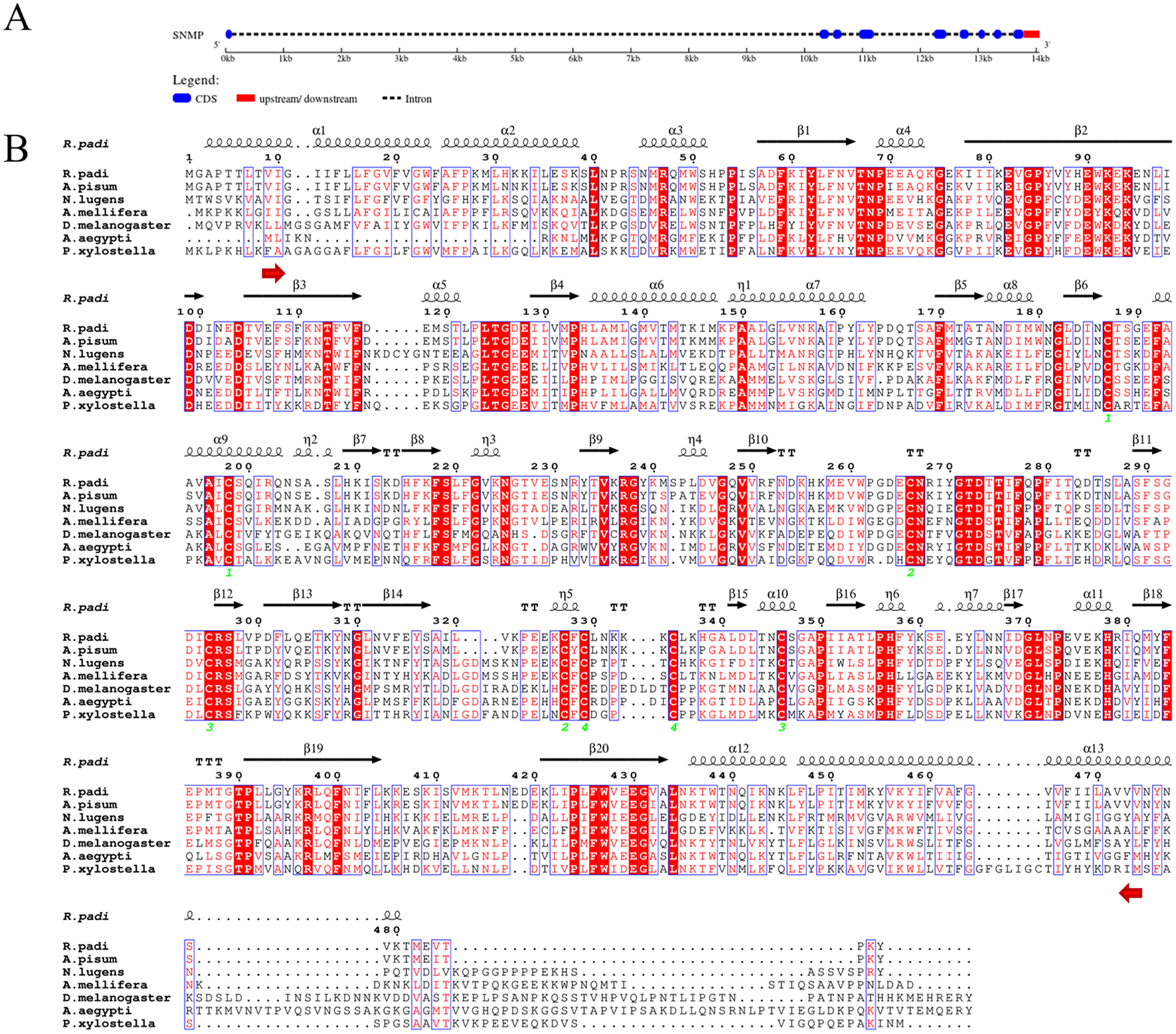
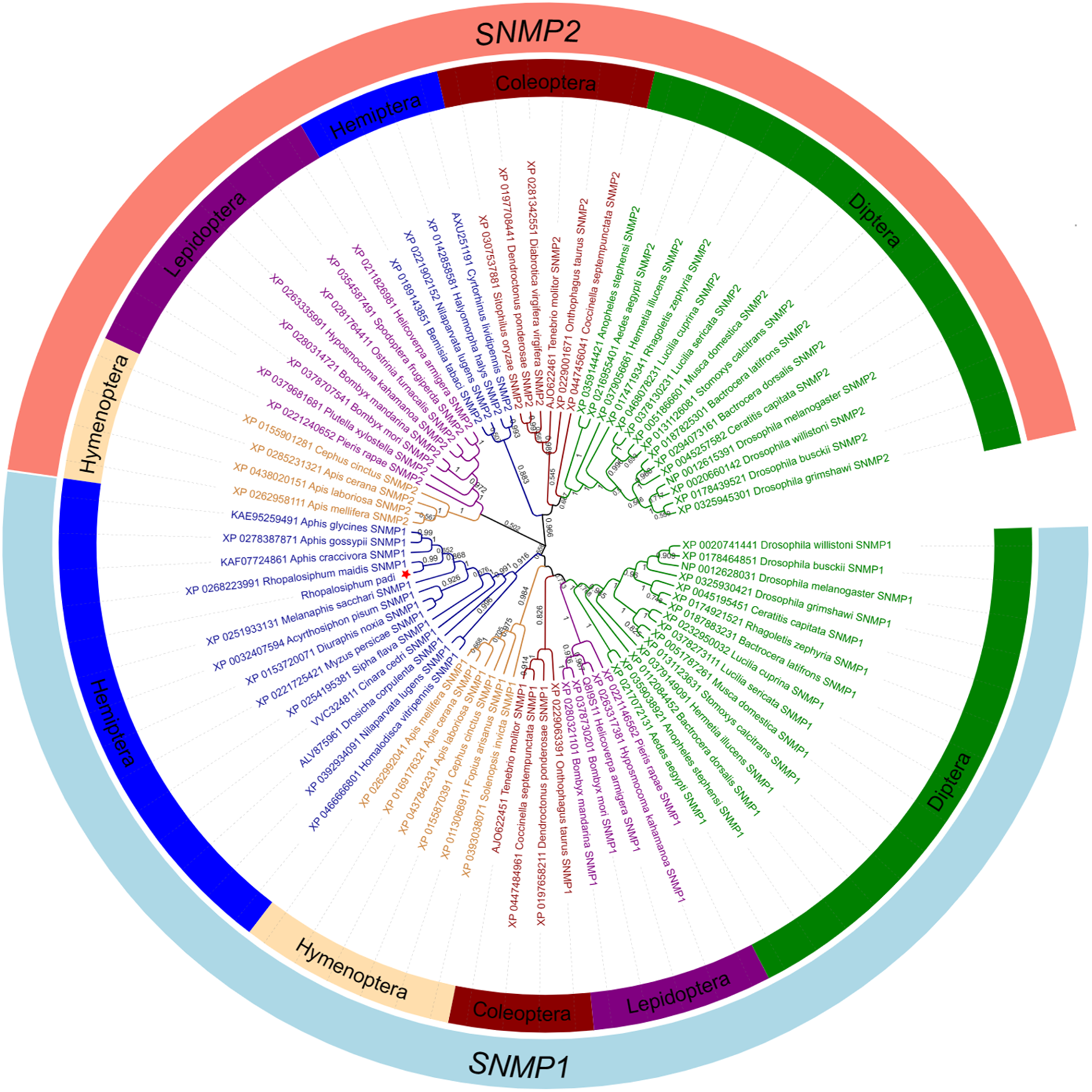
The identification result showed that only one SNMP gene existing in R. padi. Through genomic screening of eight aphid species (Hemiptera: Aphididae) including Acyrthosiphon pisum (GCF_005508785.2), Metopolophium dirhodum (GCF_019925205.1), Aphis gossypii (GCF_020184175.1) Myzus persicae (GCF_001856785.1), R. padi (GCF_020882245.1), Sipha flava (GCF_003268045.1), Rhopalosiphum maidis (GCF_003676215.2) and Diuraphis noxia (GCF_001186385.1), we found that only one SNMP gene in the genome of this aphid species. Figure 2 We name this gene from R. padi as RpadSNMP1 (Genbank number: NC_083600.1). RpadSNMP1 comprises nine exons, and its ORF encodes a protein of 488 amino acids (fig. 1A). The theoretical isoelectric point (pI) and molecular weight (MW) of RpadSNMP1 were calculated to be 8.21 and 55.69 kDa, respectively. Predictions from TMHMM indicate that RpadSNMP1 contains two transmembrane helices at the C- and N-termini. Analysis of structural domains reveals the presence of a CD36 domain in RpadSNMP1 (fig. 1B). A comparative analysis of amino acid sequences between RpadSNMP1 and the model insect SNMP1 shows conserved amino acids shared between the two, highlighted in red. (fig. 1B). RpadSNMP1 shows high sequence similarity with other insects SNMP proteins: 90.57% with A. pisum, 40.89% with Nilaparvata lugens (Hemiptera: Delphacidae), and 38.86% with A. mellifera. Phylogenetic analysis indicates that SNMPs can be classified into two distinct subfamilies, SNMP1 and SNMP2 (fig. 2). Members within these subfamilies consistently group together based on their order. RpadSNMP1 shows a close relationship with SNMP1 from aphid species, suggesting an orthologous connection (fig. 2).
Gene structure analysis and amino acid sequence alignment of RpadSNMP1. A, The RpadSNMP1 gene structure. Showing exons (represented by boxes) and introns (lines between boxes); B, Multiple sequence alignment of the RpadSNMP1 protein with SNMP1 proteins from various species. Conserved amino acids are highlighted in red, indicating a high degree of conservation across different species. The sequence between the red arrows is the conserved domain of the CD36 family. Specific regions of secondary structure, such as alpha-helices (α) and beta-sheets (β), are annotated above the sequences.

Phylogenetic analysis of insect SNMPs. SNMP of Rhopalosiphum padi is highlighted with a red star. The tree is constructed by MEGA11 using maximum likelihood method based on 1,000 bootstrap replicates. The LG + G + I model was used, bootstrap values N50% are shown on each node of the tree.

Expression profiles of RpadSNMP1
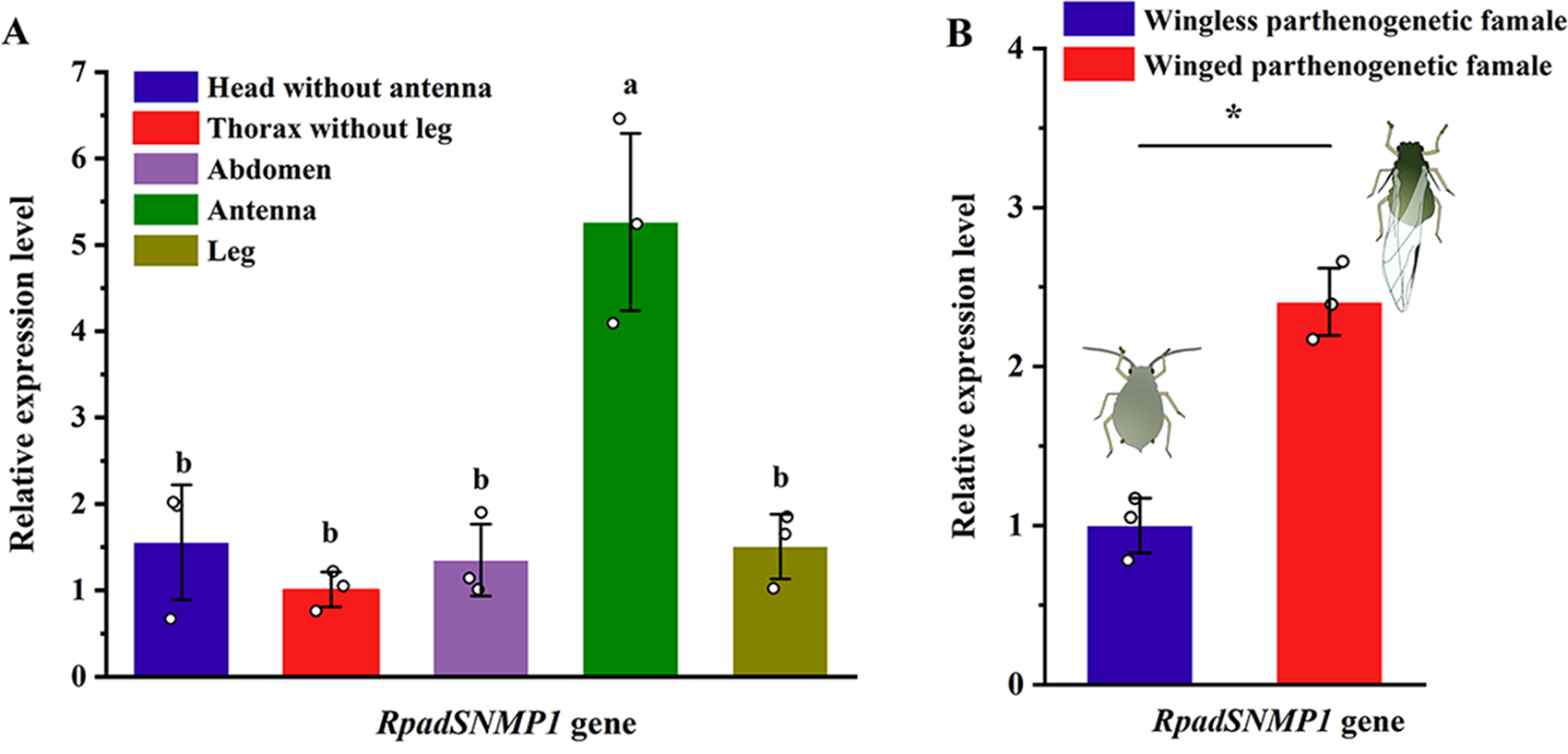
We investigated the expression levels of RpadSNMP1 gene in different tissues and morphs. RpadSNMP1 expression was observed broadly in various tissues, including the thorax without leg, leg, head without antennae, antennae and leg, with significantly higher expression in the antennae compared to other tissues (P < 0.05, fig. 3A). RpadSNMP1 expression levels in winged parthenogenetic females were significantly higher than wingless parthenogenetic females (P < 0.05, fig. 3B).
RpadSNMP1 expression profiles. A, Expression profiles of RpadSNMP1 transcripts in different tissue. Significant differences between tissues were assayed by Tukey’s honestly significant difference (HSD) test using a threshold P-value <0.05; B, Expression levels of SNMP in different wing type. Significant differences between two groups were assayed by t-test using a threshold P-value <0.05.

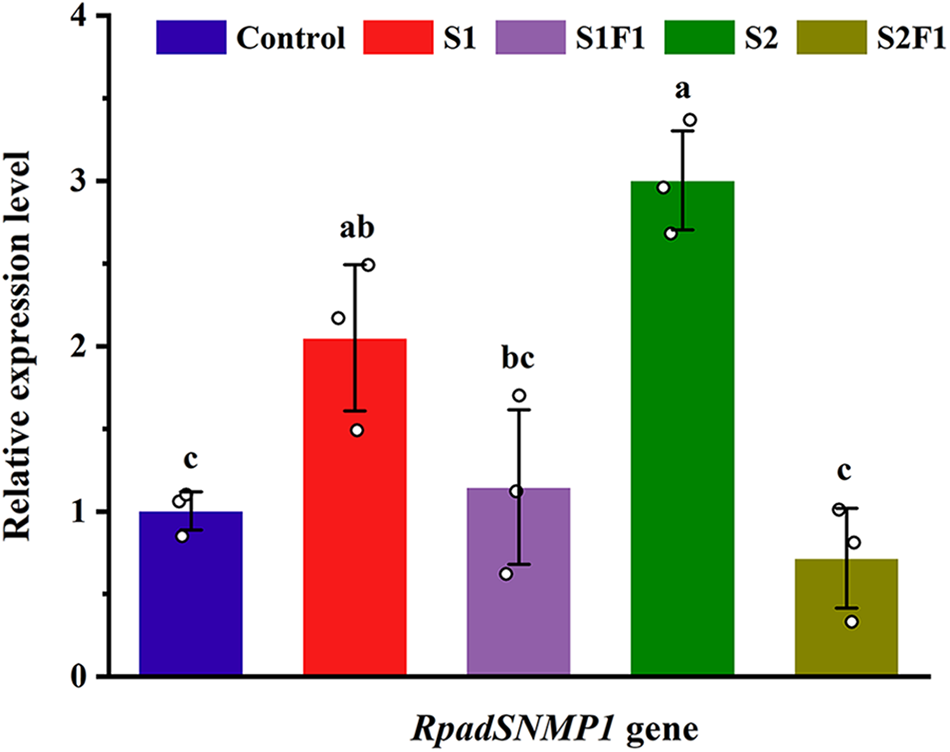
We studied the effect of starvation and refeeding on RpadSNMP1 expression. In wingless adults, RpadSNMP1 expression levels rose significantly after 24 h of starvation compared to non-starved counterparts, returning to normal levels following 24 h of refeeding. A comparable trend emerged in adults subjected to 48 h of starvation, expression levels of RpadSNMP1 were significantly increased (P < 0.05, fig. 4).
The impact of starvation and subsequent refeeding on the relative expression levels of the RpadSNMP1 gene in Rhopalosiphum padi adults. Control (non-starved), S1 (starvation for 24 h), S1F1 (starvation for 24 h followed by refeeding for 24 h), S2 (starvation for 48 h), and S2F1 (starvation for 48 h followed by refeeding for 24 h). Different letters on the bars indicate significant differences (P < 0.05, Tukey’s honestly significant difference [HSD] test, means ± SEM, n = 3 biologically independent samples for each bar, each biological sample contains 10 individuals).

Role of RpadSNMP1 in the search for host plants
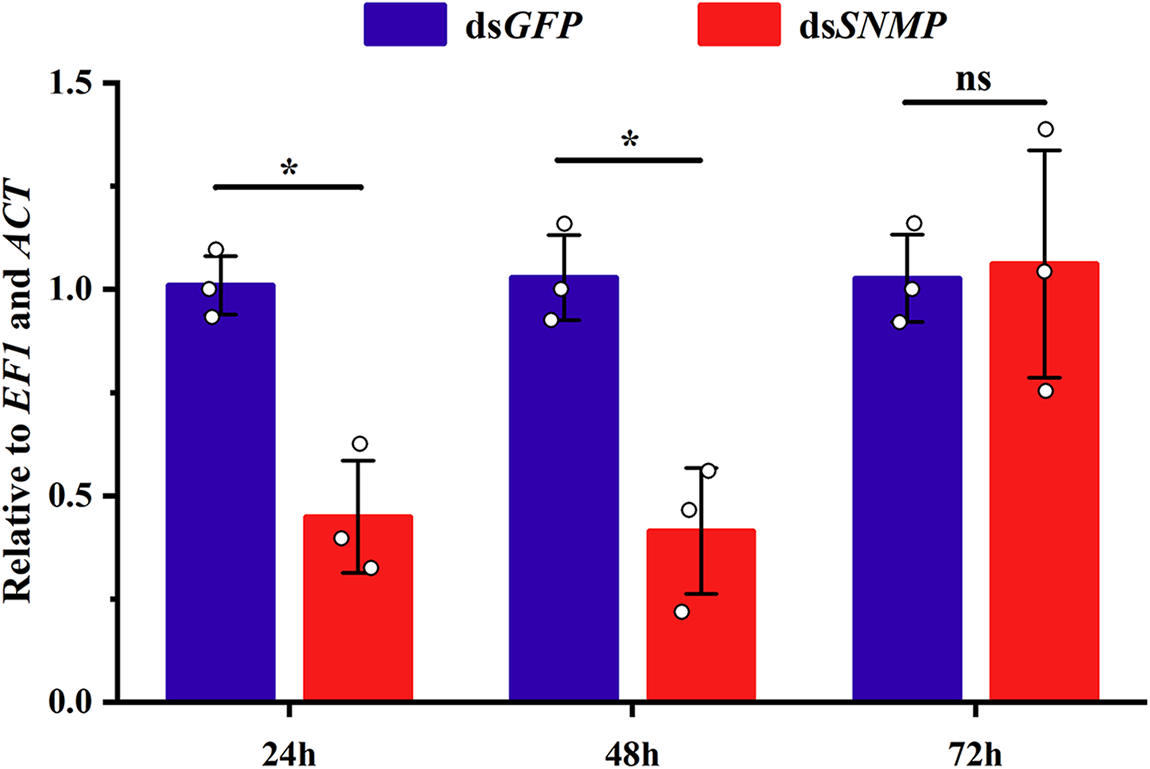
To gain insight into the regulation of host plant searching by RpadSNMP1, we injected dsRNA to knock down the expression of RpadSNMP1. Following this intervention, the relative expression levels of RpadSNMP1 were decreased significantly (44.92% and 41.48% reduction after 24 and 48 h), compared to the injection of dsGFP (P < 0.05, fig. 5).
Time-course changes in RpadSNMP1 expression levels following dsRNA injection. (*P < 0.05; t-test, means ± SEM, n = 3 biologically independent samples for each bar, each biological sample contains 10 individuals).

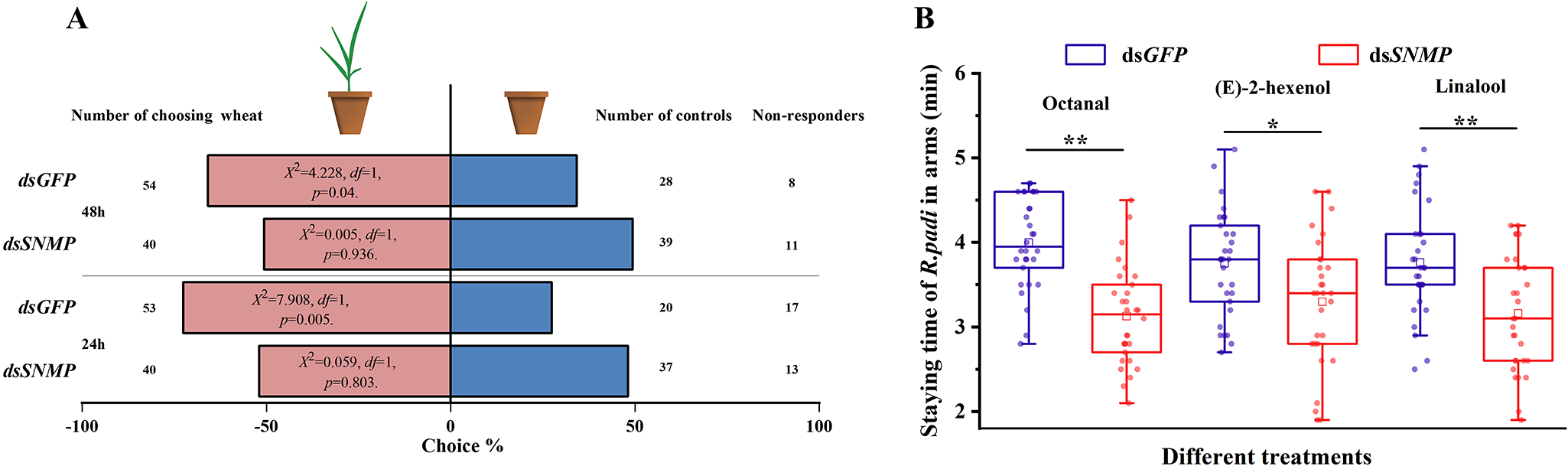
To determine whether R. padi could effectively locate host plants after interfering with RpadSNMP1, we simulated the host plan searching process by using Y-tube olfactometer bioassay. At 24 h post-injection, the dsGFP group exhibited a significantly stronger preference for wheat compared to the dsSNMP group. In contrast, dsSNMP group cannot locate host plant (fig. 6A). After 48 h post-injection, the experiment showed a same phenomenon, dsSNMP group did not show any significant behavioural tendency toward wheat (fig. 6A). Subsequent experiments assessed changes in the duration of R. padi staying on volatiles from the host plant following RpadSNMP1 knockdown. The dsSNMP group demonstrated a significantly reduced stay in the presence of octanal (P < 0.001), (E)-2-hexenol (P < 0.05), and linalool (P < 0.001) compared to the dsGFP group (fig. 5B).
Effects of RNAi-mediated knockdown of RpadSNMP1 on host plant searching behavior. (A) Host choice behavior in a Y-tube olfactometer after dsRNA treatment. (χ 2 test, H0: P = 50%); (B) Response of Rhopalosiphum padi on synthetic VOCs (octanal, (E)-2-hexenol, linalool) 48 h post dsRNA treatment evaluated by four-arm olfactometer. (*P < 0.05; **P < 0.01; t-test, n = 30 biologically independent samples for each box).

Homology modelling and molecular docking
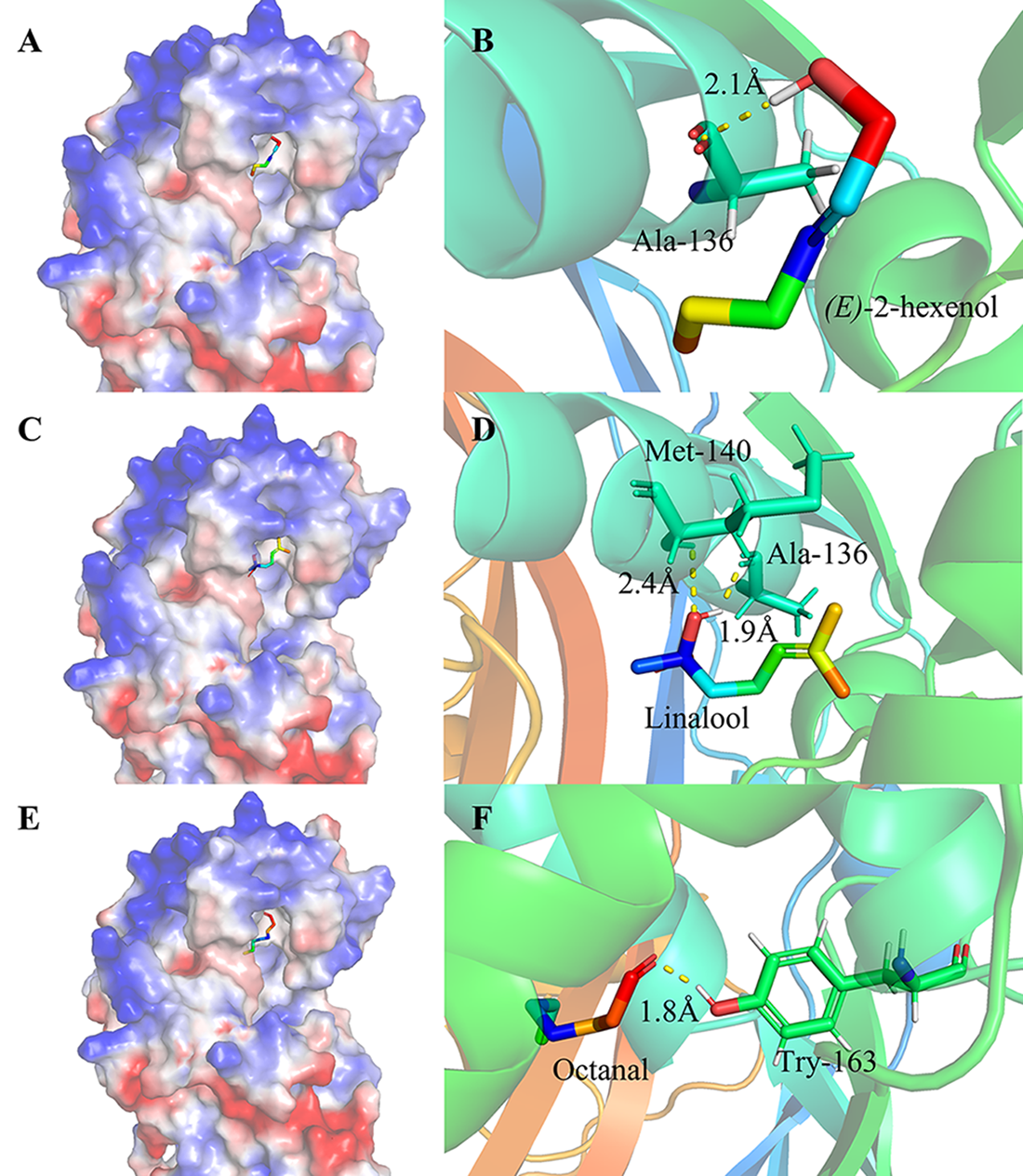
To understand the interaction between SNMP and host plant volatiles, a 3D homology model of SNMP was constructed, and the binding postures of SNMP-octanal, SNMP-(E)-2-hexenol, and SNMP-linalool complexes were analysed. The sequence identity between the SNMP protein and its homologous protein template was 93.24%, with the Global Model Quality Estimation values for the SNMP protein being 0.94. In the 3D conformer structure, the binding sites for (E)-2-hexenol, linalool, and octanal were located in the ectodomain tunnel of SNMP. The surface electrostatic potential of SNMP was color-coded, with blue indicating positive regions and red indicating negative regions (fig. 7). Hydrogen bonds were observed between Ala136 of SNMP and (E)-2-hexenol, with a bond distance of 2.1 Å (fig. 7B); linalool forms two hydrogen bonds with Lal136 and Met140, which with the bond distance 1.9 Å and 2.4 Å, respectively (fig. 7D); octanal forms one hydrogen bonds with Try163, at distances of 1.8 Å (fig. 7F).
Molecular interactions between RpadSNMP1 protein and VOCs. A and B, Molecular docking of (E)-2-hexenol with RpadSNMP1; C and D, Docking interaction of linalool with RpadSNMP1; E and F, Binding of octanal to RpadSNMP1. The surface electrostatic potential of RpadSNMP1 is color-coded, with blue indicating positive regions and red indicating negative regions. The interaction sites are highlighted on the surface representation of the RpadSNMP1 protein, demonstrating the potential binding cavity.

Discussion
The diversity of SNMP proteins in insects varies, with some species possessing two SNMP proteins (SNMP1 and SNMP2) while others, such as Heliconius melpomene (Lepidoptera: Nymphalidae), B. mori, and Danaus plexippus (Lepidoptera: Nymphalidae), having three (SNMP1, SNMP2, and SNMP3) (Jiang et al., Reference Jiang, Pregitzer, Grosse-Wilde, Breer and Krieger2016; Nichols and Vogt, Reference Nichols and Vogt2008; Xu et al., Reference Xu, Zhang, Liao and Papanicolaou2021; Zhang et al., Reference Zhang, Xu, Chen, Sun, Anderson, Xia and Papanicolaou2020). In our study, only one SNMP was identified in R. padi. Structural analysis revealed it contains a CD36 domain typical of SNMPs, conserved across many insect orders. Current genomic evidence suggests that Aphididae species appear to maintain a single SNMP gene. SNMP1 proteins have been found to play a significant role in the identification and localisation of pheromones (Gomez-Diaz et al., Reference Gomez-Diaz, Bargeton, Abuin, Bukar, Reina, Bartoi, Graf, Ong, Ulbrich, Masson and Benton2016; Jiang et al., Reference Jiang, Pregitzer, Grosse-Wilde, Breer and Krieger2016). Recent studies have shown that SNMP2 may be involved in odour removal and deactivation in B. mori (Cassau and Krieger, Reference Cassau and Krieger2024). Phylogenetic analysis indicated that aphid SNMPs were categorised as SNMP1. This distinctive presence in insects of Aphididae family suggests a potentially broader function of SNMP1, possibly adapted to their ecological niches and olfactory requirements.
Antennae serve as vital olfactory organs in insects, capable of detecting a wide array of volatiles and playing a crucial role in chemical detection (Peng et al., Reference Peng, Wang, Huang, Su and Chen2021b; Wicher and Miazzi, Reference Wicher and Miazzi2021). Our study revealed significantly elevated expression of SNMP in the antennae compared to other tissues, suggesting notable involvement of SNMP in chemoreception. This heightened expression pattern of SNMP in antennae has been observed across various species, such as Lepidoptera, Diptera, and Coleoptera (Bin et al., Reference Bin, Qu, Pu, Wu and Lin2017; Rogers et al., Reference Rogers, Krieger and Vogt2001b; Zhang et al., Reference Zhang, Xu, Chen, Sun, Anderson, Xia and Papanicolaou2020). We also found a significant difference in SNMP expression levels between winged and wingless individuals of aphids, with the former exhibiting significantly higher levels. The development of winged aphids in response to unfavourable environmental factors, such as high population density and scarcity of food resources, enhances their capacity to locate host plants compared to their wingless counterparts (Braendle et al., Reference Braendle, Davis, Brisson and Stern2006). On the other hand, our findings suggest that starvation and refeeding significantly impact on the expression of the SNMP gene, with expression levels increasing following starvation and returning to baseline upon refeeding. These results indicate a potential role for SNMP in the host plant searching behaviour of aphids. The regulation of SNMP expression may be crucial for maintaining the sensitivity and adaptability of the olfactory system in aphids.
RNAi experiments were conducted to further investigate the importance of the RpadSNMP1 gene in host plant searching. Following the administration of dsSNMP, the capacity of R. padi to locate its host plant was diminished, resulting in an increased number of individuals failing to accurately locate wheat. This suggests that SNMP plays a crucial role in the host plant search behaviour of R. padi. Previous study has shown that SNMP1 functions as a co-receptor, aiding in the interaction with a range of OBPs and ORs in the detection of odours, thereby facilitating the transport of pheromone molecules to and from the OR ligand-binding site (Gomez-Diaz et al., Reference Gomez-Diaz, Bargeton, Abuin, Bukar, Reina, Bartoi, Graf, Ong, Ulbrich, Masson and Benton2016). Three OBPs in the rice planthopper exhibited binding affinities to certain rice plant VOCs and RNAi targeting the mRNA expression of these three OBPs resulted in partial olfactory dysfunction in OBP-deficient planthoppers, impairing their ability to locate rice plants effectively (He et al., Reference He, Chen, Li, Wang, Ma, Pan and He2019). This conceptual framework highlights the significance of RpadSNMP1 in the olfactory recognition process.
To further investigate the impact of SNMP protein on the host search behaviour of R. padi, we conducted an experiment to measure the residence time of aphids in wheat VOCs after interference with SNMP. After injection with SNMP, the residence time of R. padi in wheat volatile substances significantly decreased. Molecular docking was employed to predict the binding of SNMP proteins to these compounds. Results indicated that SNMP protein could potentially bind to (E)-2-hexenol, linalool or octanol. Although direct binding of SNMP to chemical volatile compounds has not been confirmed, studies on the interaction of ligands with the ectodomain of SNMP1-related mammalian CD36 protein immobilised on a self-assembled monolayer, using surface plasmon resonance, have shown its ability to bind farnesol and insect pheromones (cVA, (Z)-11-hexadecenal) (Gomez-Diaz et al., Reference Gomez-Diaz, Bargeton, Abuin, Bukar, Reina, Bartoi, Graf, Ong, Ulbrich, Masson and Benton2016). We speculate that SNMP genes may play an important role in host plant searching by binding VOCs such as (E)-2-hexenol, linalool, and octanal. However, more direct evidence, such as detecting the binding of SNMP proteins to VOCs, requires further investigation.
SNMP1, a crucial protein implicated in the olfactory behaviour of insects, was initially identified for its co-expression with ORs two decades ago and subsequently linked to pheromone response (Benton et al., Reference Benton, Vannice and Vosshall2007). In our study, the localisation ability of R. padi to wheat was analysed after interference with RpadSNMP1, and the residence time of R. padi in VOCs was measured. Our findings demonstrate that the RpadSNMP1 gene is involved in the host plant search behaviour, potentially through SNMP’s interaction with VOCs. These results reveal the role of SNMP in host plant searching behaviour in R. padi. Future investigations should focus on elucidating the intricate molecular mechanisms underlying SNMP’s role in odour perception and the organism’s response to environmental stimuli. Such endeavours could yield valuable insights for developing pest control strategies targeting the olfactory pathways in aphids.
Supplementary material
The supplementary material for this article can be found at https://doi.org/10.1017/S0007485325000173.
Acknowledgements
We thank to the support of the funds from the National Natural Science Foundation of China (Grant Nos. 32272541 and 32172407) and the National Key R&D Program of China (grant nos. 2022YFD1400900 and 2023YFD1600800).
Author contributions
MC and XP conceived the study. LX and MG designed the experiments. LX, MG, XY, and ZX performed the experiments. LX and WH analysed data. LX wrote the manuscript. LX, XP, and MC contributed with and revised the manuscript. All authors read and approved the final manuscript. LX and MG contributed equally to this work.
Competing interests
The authors declare that they have no conflicts of interest.