Chop Suey: A dish whose ingredients can vary—indeed, its very nature is that this should be so. (Davidson Reference Davidson1999: 182)
Since the time of its founding, the leaders of the Social Science History Association (SSHA) have recognized the importance—and difficulty—of setting aside, if only briefly, discipline-based language and habits of thinking for a glimpse of the wider world. Lee Benson argued for the legitimacy of such efforts: “[S]ocial scientists can appropriately use radically different methods when they deal with different types of subject matter or. . . source materials” (Benson Reference Benson1978: 439). Deirdre McCloskey argued for their necessity. Disciplinary conventions notwithstanding, she insisted that the full rhetorical tetrad—fact, logic, metaphor, and story—produces the most persuasive arguments (McCloskey Reference McCloskey1990). Eric Monkkonen called the SSHA's “lack of foundational clarity. . . a virtue, not a vice” (Monkkonen Reference Monkkonen1994: 166). Harvey Graff celebrated the SSHA's “democratic inclusiveness” (Graff Reference Graff2001: 506). Andrew Abbott rejoiced in what he called a “glorious confusion about the whole enterprise. We were all talking different languages but shared a common fascination with understanding old things in new ways” (Abbott Reference Abbott1999: 483). Emboldened by these assessments I propose a culinary metaphor. Like chop suey, our conference ingredients vary from year to year, yet each conference is instantly recognizable as SSHA. Inclusiveness defines the dish. Variation generates the excitement.
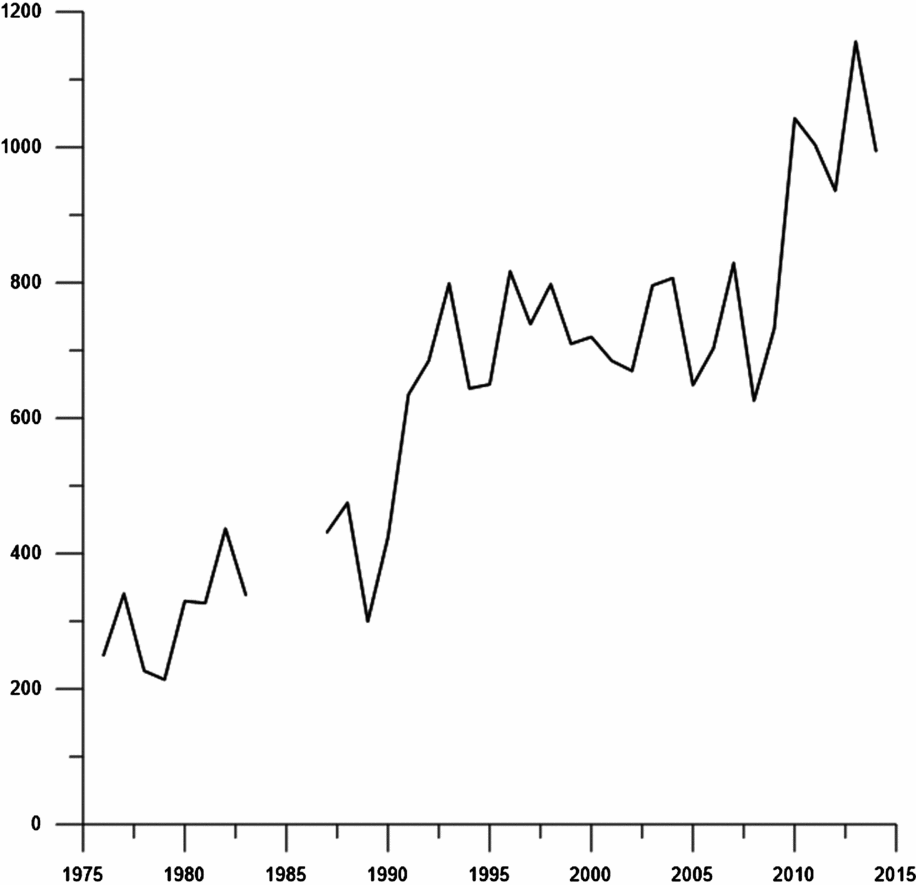
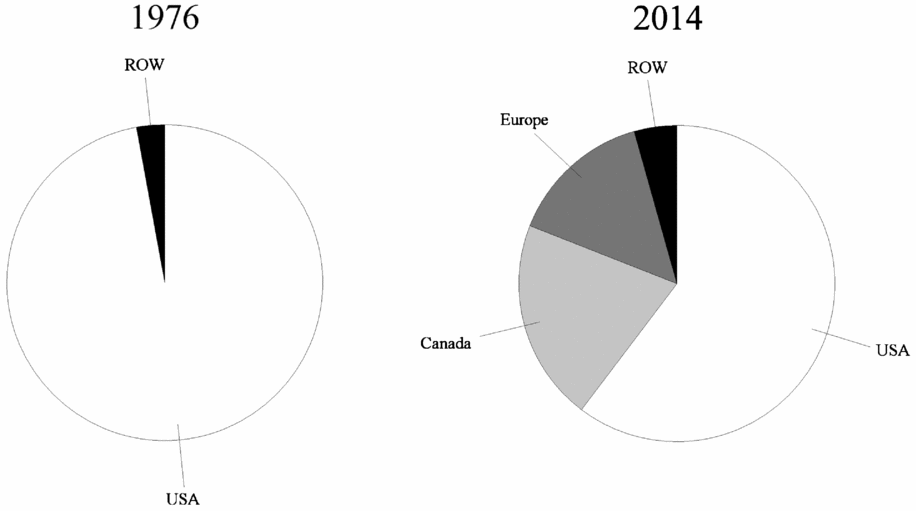
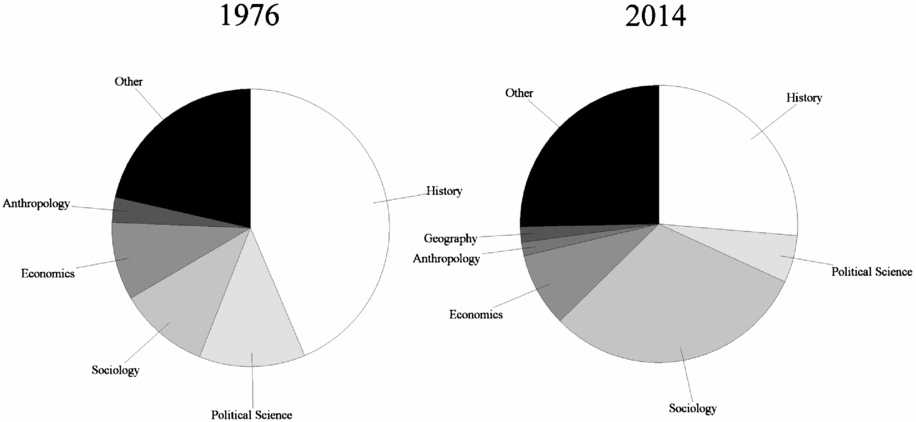
By many measures our meetings today are more inclusive and varied than ever before. The number of participants has grown to about 950, up from an average of about 300 in our early years (figure 1). Participants come from an increasingly diverse set of disciplinary backgrounds and academic affiliations. At our first meeting in 1976 more than 40 percent of attendees came from history departments and another third from political science, sociology, and economics. Participants now come from law, photography, English, pediatrics, gerontology, library science, public health, communications, religion, art, public policy, statistics, and earth sciences. Others come from multidisciplinary programs focusing on race, ethnicity, and gender; culture, language, and religion; or geographic region (figure 2). We are now a decidedly international organization with almost 40 percent of participants coming from outside the United States (Steckel Reference Steckel, Graff, Moch and McMichael2005; see figure 3).
Paid Registrations, SSHA Conferences,1976–2014.
Source: Social Science History Association archives.

Country or Continent of Residence, SSHA Conference Participants, 1976 and 2014.
Source: Steckel Reference Steckel, Graff, Moch and McMichael2005.

Participants by Department, SSHA Conferences, 1976 and 2014.
Source: Steckel Reference Steckel, Graff, Moch and McMichael2005.

Our organization's growing size and diversity is a consequence of our success in featuring new social historical questions, methods, and data whose very novelty can generate resistance in discipline-based academic organizations. Our democratically inclusive association helps foster innovation.
An early focus at SSHA was the New Social History. Responding to the civil rights, women's rights, antiwar, and youth movements of the 1960s, the New Social History began investigating the lives of minorities, women, children, youth, old people, laborers, slaves, peasants, farmers, and immigrants and writing history from their points of view. The stories of these heretofore-neglected groups were so engaging they gave rise to entirely new subdisciplines, including the new labor history, urban history, family and women's history, black history, and rural history, all of which came to sponsor networks at our meetings (Hareven Reference Hareven1996). Much of the new work was previewed at the SSHA precisely because “different dimensions” have a natural home in our multidisciplinary organization.
New methods arise in response to changing questions and changing technologies. When computer-based mapping software was first coming into use, Humphrey Southall organized a number of sessions at the SSHA meetings bringing together for the first time social historians using the new method. “Half of the participants in those sessions had never before attended an SSHA meeting,” wrote Anne Knowles (Reference Knowles2000: 453). Most had been largely unaware of one another's work. Today Historical GIS has a network of its own and regularly sponsors many lively sessions.
Scholars’ efforts to engage these new questions and methods often lead to new data. Richard Steckel's discussion of “Big Social Science History”—big, collaborative data-collection projects—illustrates why the products of these efforts are featured so prominently in these meetings. “One important contribution of each [Big Social Science History] endeavor was to harmonize the categories in ways that facilitate comparative study.” Large samples make possible the study of diversity, “creating opportunities to undertake new kinds of research” (Steckel Reference Steckel2007: 10).
I am proud to have worked on one of those Big Social Science History projects, Historical Statistics of the United States, Millennial Edition (Carter et al. Reference Carter, Gartner, Haines, Olmstead, Sutch and Wright2006). I know I speak for all who were involved when I say that the SSHA helped make this project possible. It was through the association that we identified many of the 83 contributors and 289 consultants who ultimately worked on this project. The 1999 SSHA conference previewed many of the chapters and generated valuable feedback.
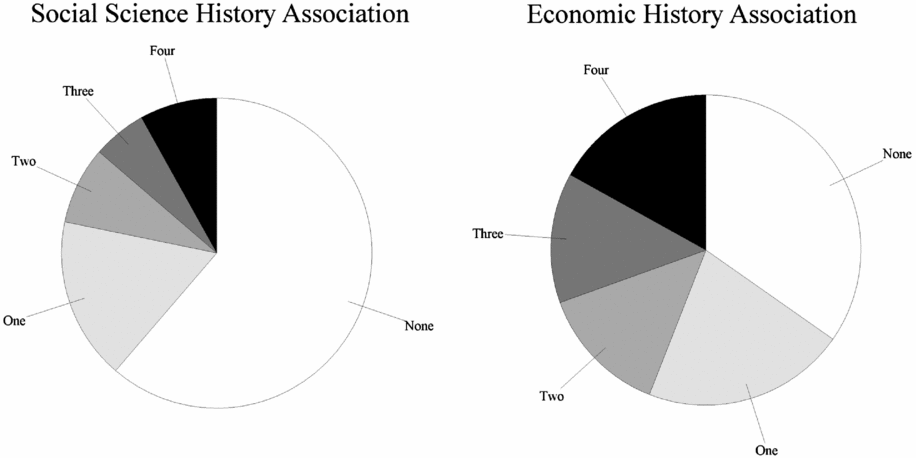
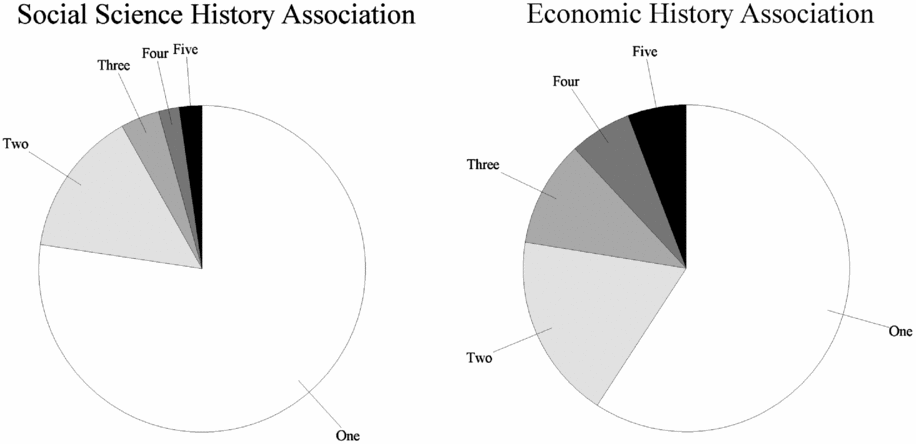
While its openness to new questions, methods, and data make SSHA meetings exciting to attend, it also makes them difficult to organize. At the 2014 meetings of the SSHA 61 percent of attendees were attending for the first time. The comparable share of new participants at the Economic History Association, another multidisciplinary organization, though one with a somewhat narrower focus, was a little more than a third (figure 4). At SSHA only 8 percent of those who attended at least once in five years attended three or more meetings (figure 5). At any one meeting only a minority of participants will be aware of the unique lore and practice that keep our organization healthy and energetic. In such a fluid environment, our core institutional values bear frequent repetition.
Meetings Attended Over Previous Four Years, 2014 Meeting Participants.
Sources: Indiana University Conference Board, Social Science History Association meetings, all paid registrants and Economic History Association, pre-registrants.

Number of Times Attended Over Five Years, 2010–2014 Meetings.
Sources: Indiana University Conference Board, Social Science History Association meetings, all paid registrants and Economic History Association, pre-registrants.

One bit of SSHA practice I wish to emulate is for the president to share some of her own research. My objective is not simply to present another paper employing a multidisciplinary approach—there are many excellent papers like that here this week in Baltimore—but also to provide in some way as a demonstration of the association's openness to new questions, perspectives, and sources. Recently I have been experimenting with combining culinary history with social science history in an attempt to shed some new light on a neglected group of immigrants and a regrettably neglected episode in American racial history. I want to share the story of chop suey, that savory Chinese restaurant staple. The story is interesting in itself, but it also illustrates the importance of democratically inclusive institutions in fostering innovation, and thus it can serve on this occasion to celebrate SSHA's democratic inclusiveness. Chop suey, the dish, not only achieves its success through the combination of a variety of tastes and textures, but chop suey, the story, showcases the rewards to principles like civility, openness, and respect that are central to SSHA lore and practice. As a bonus, I will suggest that the story of chop suey overturns the conventional wisdom about the Chinese American experience during the era of the Chinese Exclusion Act (1882–1943).
Chop Suey Comes to Oshkosh
Chop suey first came to Oshkosh, Wisconsin, in 1903 when Moy Toy Ni (1861–1955), known locally as Charley Toy, opened the Hong Kong Low. Toy was one of only 18 Chinese in that city of 28,000, so the patronage of the non-Chinese community was essential to his success. Toy was not concerned. He had selected his site well and had prepared the way.
Oshkosh residents already knew what they would find inside a Chinese restaurant. “The air would be filled with the scent of incense, mixed with the appetizing odor of chop suey, bird's nest soup, rice and many other mysterious dishes prepared and served by the expert cooks of the almond eyed race.” The décor would dazzle. Fiery dragons and celestial colors would ornament the walls. Chinese lanterns would dangle on brassy chains. Odd imported plates, cups, and bowls would adorn the tables (ODN December 11, 1902).Footnote 1
Oshkosh Daily Northwestern newspaper editor John Hicks regularly reported on such matters, so Oshkosh residents knew that Sam Wing had opened a Chinese restaurant in nearby Fond du Lac and that Toy had catered a private dinner celebrating the marriage of a socially prominent Oshkosh couple in the Chinese style. Toy decorated the bride's home with Chinese draperies, flags, and lanterns. “It was as if the residence had been suddenly transplanted to the celestial empire,” a guest wrote. Toy festooned the host in “the bright silk draperies of the Chinese nobleman with cap to match” and dressed the remainder of the company “in Chinese costume as well.” His menu included such delicacies as “bird's nests, chop suey, Chinese rice, Chinese teas, [and] Chinese wafers and biscuits. Some of these, like the rice, were to be eaten with chopsticks” (ODN August 12, November 24, 1902). Toy's guests swooned. Once the new Chinese restaurant opened, the whole town could partake of such delicacies.
The tale of Toy's Chinese restaurant, and of the thousands of other Chinese restaurants like it in cities and towns across the country, upends the standard account of America's embrace of ethnic food. At the turn of the twentieth century, according to the standard account, ethnic food—food identified with an ethnic group other than one's own—was largely confined to ethnic enclaves.Footnote 2 It wasn't until the 1920s, 1930s, and 1940s that corporations such as Chef Boyardee (1938), Old El Paso (1938), Le Choy (1922), and Chun King (1947) began mass producing canned spaghetti and meatballs, enchilada sauce, chow mein noodles, and chop suey for home consumption (Coe Reference Coe2009: 192–94; Gabaccia Reference Gabaccia1998: 151; Liu Reference Liu2015: 64; Pilcher Reference Pilcher2012: 145). According to this view, ethnic restaurants did not emerge from ethnic enclaves until after World War II.
The Chinese story is said to have fit this standard pattern. In this view, racial violence—which was terrifyingly real (Pfaelzer Reference Pfaelzer2007)—confined the Chinese to Chinatowns in the late nineteenth and early twentieth centuries (Lyman Reference Lyman1974: 73, 80). “Anti-Chinese forces” allegedly “cleansed Chinese settlements from the open space of small-town America.” After they had been “safely contained in the confines of a few urban blocks in major cities,” the Chinese community became a “tourist destination for those eager and curious to see and taste the Orient” (Chen Reference Chen2014: 95–96). In this story, those curious outsiders were an unusual mix, all drawn from the margins of society. Some were “slummers,” “adventurous and rebellious city youths” who patronized Chinese restaurants precisely because their parents’ abhorred them. Others were African Americans who valued the affordable prices and welcoming atmosphere. A third group were Jewish immigrants from Eastern Europe. They appreciated the Sunday and Christmas service and the absence of Christian iconography and anti-Semitic antagonism (Chen Reference Chen2014: 95–96, 105–7).
This portrayal is wrong in detail and misleading in overview. The historical descriptions of the Americanization of Chinese food are also misleading.
Following the practice of other immigrant groups, according to food historians, enterprising Chinatown restaurateurs sought to expand their businesses by crossing culinary boundaries and inventing new dishes (Gabaccia Reference Gabaccia1998: 94, 120). Their traditional chow chop suey was “a mixture of chicken's livers and gizzards, fungi, bamboo buds, pig's tripe, and bean sprouts stewed with spices.” Clever cooks replaced the intestines with cubes of pork, beef, and chicken and made celery, onions, and bean sprouts their major vegetable ingredients. They added canned mushrooms, a newly available and widely enjoyed ingredient dubbed “the cranberry sauce to the turkey” (Liu Reference Liu2015: 50–54). Later the more inventive among them created such unlikely concoctions as the hot chow mein sandwich—fried chow mein pressed between hamburger buns and ladled with gravy—and the St. Paul—tomato, iceberg lettuce, and an egg foo young patty lathered with mayonnaise and sandwiched between two slices of white bread (Liu Reference Liu2015: 65–66). This supposed culinary leveling stereotypes the food as much as late-nineteenth-century cartoonists stereotyped the Chinese with unflattering portrayals.
Other historians took the opposite tack and denied any such culinary assimilation. Distinguished food historians Waverly Root and Richard de Rochemont wrote in 1976:
For good or ill, the United States was perhaps a political melting pot, perhaps a cultural melting pot, perhaps an ethnical melting pot, but it is not a culinary melting pot. Its capacity for digesting esoteric gastronomic contributions is narrowly limited. (Root and de Rochemont Reference Root and Rochemont1976: 276)
Geographer Wilbur Zelinsky, writing in the early 1980s, called the ethnic restaurants he found in “all the larger urban places” and “to a lesser extent” in nonmetropolitan areas a “recent phenomenon” (Zelinsky Reference Zelinsky1985: 69). These writers obviously hadn't heard of Charley Toy.
Toy was in the vanguard of Chinese who moved out of the American West after the Chinese Exclusion Act of 1882 brought immigration from Asia to a virtual halt. Racial violence and oppressive regulations caused West Coast Chinatowns to decline, not expand with refugees from the countryside. Many residents of those enclaves returned to their former homes in China. Some moved to the newer Chinatowns emerging in New York, Boston, Chicago, and New Orleans; others, like Toy, moved to Milwaukee and Oshkosh, Providence and Worcester, Scranton and Rochester, and Norfolk and Paducah—cities that would never develop Chinatowns. Still others established residences in rural and suburban areas, presaging by a full century the recent tendency of immigrants to settle in nongateway destinations (Donato et al. Reference Donato, Tolbert, Nucci, Kawano and Massey2008). The Chinese dispersal was so great that despite a sharp reduction in their total numbers—by 1920 they represented only 5 per 10,000 of the total population—more than third of all counties had at least one Chinese resident. Many were the only Chinese person in their entire region.
At first the Chinese worked as laundrymen, but beginning about 1900, as chop suey became increasingly popular, many became restaurateurs. In cities and even small towns non-Chinese were eating Chinese food prepared by Chinese chefs. This was well before the onset of World War I, not, as in the usual story, after World War II. And the food served was generally following traditional Chinese recipes with, as much as possible, traditional ingredients.
Toy's tale illustrates many of the forces that propelled this remarkable development.Footnote 3 Toy was not “confined to Chinatown.” He took his food to a small city in the Upper-Midwest more than 170 miles from the nearest Chinatown in Chicago. His clientele was in no sense “marginal.” It included many of the most prominent members of the Oshkosh community including the mayor, the postmaster, the newspaper editor, and later the governor of Wisconsin. In the perilous legal and political environment of those unsettled times, Toy and his colleagues succeeded through innovation.
Chinese Innovation
Toy arrived in the United States just prior to the passage of the Chinese Exclusion Act when anti-Chinese agitation was at its height. After a brief stay in Portland, Oregon, he left for Chicago and then for Appleton, Wisconsin, where a family member, Sam Wah Kee, ran a laundry and a Chinese import shop. Toy joined the family firm (ODN July 17, 1884, January 6, 1955; Toy Reference Toy1956; US Census Office 1882).
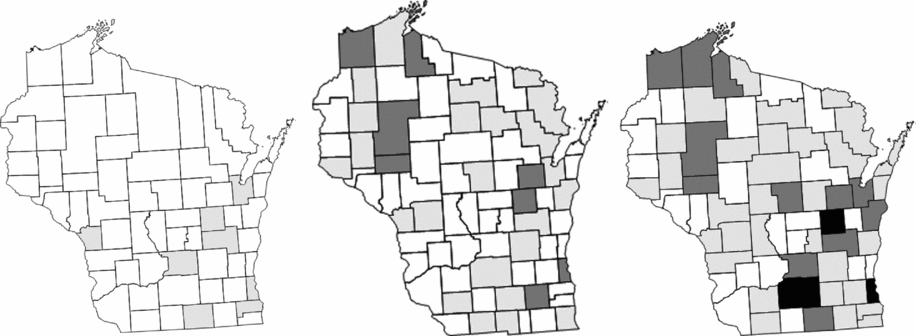
Kinsman Kee had arrived in Wisconsin sometime in the 1870s as one of the first Chinese to settle in the state. The 1880 Census recorded only nine Chinese residents in Wisconsin although newspaper accounts suggest there may have been more (Holmes and Yuan Reference Holmes and Yuan2008: 11). Over the next 20 years the Chinese population grew from nine to 212 yet in 1900 no Wisconsin county had more than 23 Chinese residents (US Census Office 1901). Outside Milwaukee, the largest number were in the prosperous Lake Superior ports of Ashland and Duluth and in the booming lumber towns of Oshkosh, Eau Claire, and Appleton (figure 6). There the Chinese supported themselves by supplying laundry services to the single young men employed in the physically strenuous industries of those cities. A few ran retail shops selling Asian imports. Attending to their customers in these far-flung communities and avoiding competition with one another kept the Chinese geographically dispersed but family, business, and ethnic ties kept them closely connected.
Chinese by County, Wisconsin, 1880, 1890, and 1900.
Sources: 1860–1890: Haines and ICPSR 2010; 1900–1950: Hand-transcribed from published census reports. County boundary shape files from: Ruggles et al. 2015. Categories are 1–5, 6–15, and 16–23.

Family ties were important in China, and they remained important among Chinese immigrants to the United States. In addition to Sam Wah Kee, many of Toy's business partners were family members. About 1888 Moy Hee, a cousin or perhaps a brother, partnered with Toy and established businessman Sam Wing in the Mee Lee Yuen Chinese and Japanese import company. In the 1890s, Moy and Wing bought Toy's share of the business and Toy started his own import business a few blocks to the north. Moy S. James, one of Moy's employees, was another cousin (Bunn and Philippi Reference Bunn and Philippi1889; Fuller Reference Fuller2000–1: 164; Toy Reference Toy1956).
Business ties provided additional connections. Most Chinese businesses, including the laundries, had multiple investors. The multiplicity of investors helped raise capital and finance larger, more profitable enterprises. They also facilitated the transnational lives most Chinese Americans led. As immigration laws became ever more restrictive, these business investments became valuable evidence of the merchant status required for reentry into the United States (Kwong and Miščević Reference Kwong and Miščević2005: 144–46).
Perhaps most unusual were the large networks of casual acquaintances the Chinese created through their regular social interactions. Nearly all Chinese Americans at the time had come from Taishan County, Guangdong Province in the Pearl River delta of Southeast China, an area about the size of the state of Rhode Island. Everyone knew or knew of the family of nearly everyone else. On weekends and holidays those living in more distant places traveled to the larger Chinese communities to replenish their supplies of rice, dried vegetables, sauces, and other ethnic foods as well as the tickets, detergent, bleach, and starch they used in their laundries.
They gathered to celebrate the Chinese New Year with parades, social visits, feasts, and firecrackers. In 1903 about 30 Chinese from cities throughout Wisconsin came to Oshkosh as guests of Toy, Moy, and Wing. Toy reconfigured his import store to host a sumptuous dinner including Chinese dishes made with expensive foods rarely seen outside of China. He entertained his company with music on a phonograph, the selections fresh from some of the leading theaters of China. He followed this with live performances on Chinese violins, mandolins, drums, and cymbals (ODN February 2, 1903). The next year another large Chinese New Year celebration was held in Appleton (ODN February 15, 1904).
The threat of racial violence reinforced Chinese connectedness. Racial violence was not confined to Western mining camps but was very much present even in Wisconsin. In Kaukauna, Wing Lee was sitting quietly at his laundry when someone threw a stone through his window. The stone upset the stove, broke Lee's lamp, and ignited a blaze that set the laundry on fire. Lee was forced to flee for his life and lost almost $1,500 in bills, equipment, and structure (WW March 23, 1889). In Green Bay, a stranger came into Sam Wing's laundry, swept clothing onto the floor, overturned the starch pail, knocked down the stove, and crashed a chair down over Wing's head, leaving him bloodied and dazed (ODN March 30, 1890).
The most notorious incident of anti-Chinese violence in Wisconsin occurred in Milwaukee in 1889. After police arrested two laundrymen, Hah Ding and Sam Yip Ya, charging them with sexual misconduct involving young white women, the Milwaukee Sentinel labeled the defendants “Chinese Daemons.” It reported the story under the headline, “Children Enticed into Laundry Dens and Then Ruined.” The next morning the paper detailed allegations of an elaborate, multistate alliance in which Milwaukee Chinese abducted white girls and sold them as brides to their Chicago brethren. Altogether, the paper reported, 22 children had made confessions “of such a horrifying nature as to be almost incredible” (ODN March 8, 1889).
The news ignited an anti-Chinese firestorm. As the suspects were taken from jail to the courthouse, a crowd of about 350 people assembled, jostling one another to get a glimpse of Ding and Ya and making threatening statements against all Chinese. By 10 o'clock the mob had swollen to a thousand men and boys who shouted “Hang them!” and “String them up!” The next day 2,000 assembled in front of the courthouse where they were disappointed to learn that police had already transferred the suspects from the jail in a secret nighttime maneuver. Frustrated, one man after another took to a soapbox and harangued the throng with anti-Chinese rants. No longer able to contain its rage, the crowd marched, as a body, down to Grand Avenue and then proceeded eastward, hurling rocks and smashing windows at the laundries of Sam Lee, Sun Chong, Mon Wing, and Sun Sing. From there they headed up Second Street and destroyed Wing Sam's place. Then it was on to Third Street where they vandalized the laundries of Sam Quong and John Ching. On and on it went until virtually every Chinese laundry in Milwaukee and the surrounding suburbs had been attacked (Jew Reference Jew and Cassel2002; ODN March 7, March 8, March 9, March 11, 1889).
The Chinese ambassador was outraged. He demanded that the United States make restitution for the carnage and asked Sam Ring Kee to make an estimate of the damages. When Kee attempted to comply, however, he found that many of his terrorized countrymen had fled the city (SFC March 16, 1889). Almost overnight, the number of Chinese laundries dropped from 31 to 13 (Holmes and Yuan Reference Holmes and Yuan2008: 20). Kee left not long after, following a police raid on his laundry and a $30 fine for alleged opium sales (CDT September 9, 1890).Footnote 4
Tightening enforcement of American immigration law—and Chinese efforts to evade it—brought another type of risk. In 1899 immigration authorities charged Sam Wing, Toy's former partner, with assisting in the illegal importation of 78 Chinese workers. Legal counsel arranged through the Chinese community in Chicago helped Wing fight the charge (CET December 2, 1899).
These large networks of casual acquaintances created the “weak ties” whose importance was highlighted by Mark Granovetter (Reference Granovetter1973). At their many family, business, community, and fraternal gatherings, the Chinese did more than just relax. They exchanged information about developments within the laundry and restaurant industries. They compared notes on pricing, suppliers, customers’ tastes, and employee relations. They gave and received advice on how to take over existing businesses and start new ones. They kept abreast of the rapidly changing legal and political environments in which they operated (Kerr and Mandorff Reference Kerr and Mandorff2015). Their “weak ties” were national and even international in scope.
The strong “weak ties” of the Chinese helped them stay abreast of new business opportunities. As Jennifer 8. Lee said of today's Fuzhounese community, “[S]omeone always knows of someone who was just working at a restaurant and heard about another restaurant being put up for sale” (Lee Reference Lee2008: 181). When Moy Hee moved to St. Paul in 1901 and opened a new restaurant he told reporters that it would be conducted “exactly like the Chinese restaurants of New York, Boston and other Eastern cities” (SPG July 20, 1901). There is no evidence that Hee had visited any of those places. Still, he knew all about them.
Hee may have been thinking of the Chinese Tuxedo Restaurant. When it opened in New York's Chinatown in 1897, it joined the Port Arthur and Chinese Delmonico's in serving exotic Chinese and American food in luxurious surroundings to an upper-class, largely white clientele. The Chinese Tuxedo sported an intricately carved teakwood balcony designed to attract the attention of trolley riders on the Third Avenue El. A colossal Chinese-style awning crowned with a carved Chinese dragon and decorated with multicolored stained glass protected its entrance. A great water fountain balanced atop another dragon and surrounded by potted palms occupied the main dining room. Elaborate chandeliers swung from the ceiling. Sinuous wooden panels divided rooms. Inlaid marble topped tables. Patterned tiles covered floors. A large selection of Chinese and American dishes graced the menu (Ostrow Reference Ostrow2008: 59–64). A live orchestra serenaded diners and dancers. The King Yen Lo, the King Joy Lo Mandarin, and the Guey Sam, all done up in a similar style, opened in Chicago not long afterward (Ling Reference Ling2012: 70–72). More than just places to eat; these restaurants were miniature outposts of a foreign land.
Hee fashioned his new St. Paul restaurant to rank with the best. He polished his marble, mother-of-pearl inlay-topped tables “until they shown with the luster of diamonds.” He draped his finely carved banquet chairs with gay silken cushions. He adorned his walls with heavy silken tapestries embroidered with peach blossoms and cranes. Hee's restaurant was unlike anything Saint Paul had ever seen.Footnote 5
The Chinese community's intimate, up-to-date knowledge of local business, political, and social conditions helps explain why Toy came to Oshkosh. Oshkosh enjoyed a solid and growing economy. During the 1880s its population grew by almost half, from 16,000 to nearly 23,000; during the 1890s it would add 5,000 more. Its society was “delightful,” a local guide observed. A “bonhomie pervades the very atmosphere” (Bunn and Philippi Reference Bunn and Philippi1889: 6). The community supported 25 churches and 74 organizations ranging in type from the Ancient Order of Hibernians, an Irish-Catholic fraternal order; the Modern Woodman of America, a benevolent society; the Knights of Labor; and the Young Women's Christian Temperance Union. The Arion Band; the Canoe Club; the Turners, a German American gymnastics group; and the Scat Club (Scat was a German card game) promoted relaxation and fun (Bunn and Philippi Reference Bunn and Philippi1889: 16–32).
Oshkosh was Republican—nineteenth-century Republican, Lincoln Republican. It had a long tradition of supporting civil rights and inclusive suffrage. In the 1830s and 1840s free African Americans, attracted by the state's liberal politics, founded the towns of Freedom and Stantonville (now Chilton). In 1850 when the US Congress passed the Fugitive Slave Act, Wisconsin officials refused to allow slave-catchers to seize its African American residents. The Wisconsin Supreme Court later declared the act unconstitutional (Cooper Reference Cooper1977). In 1865 it ruled that African American residents had been eligible to vote ever since an 1849 suffrage referendum (Holzhueter Reference Holzhueter1977). After the Civil War some African Americans fled the South and settled in communities around the state (Schwalm Reference Schwalm2004). Oshkosh had 60 African American residents at the time of the 1880 Census, their varied birthplaces bearing witness to their migrations. George Washington and family were typical. Washington, 46, was born in Alabama; his wife Rebecca, 48, in Arkansas. Their 19-year-old son Louis was also born in Arkansas, their 17-year-old daughter Esther in Illinois, and their three youngest, Bertha, 14, Addie, 12, and George Jr., 6, in Wisconsin. George Sr. and Louis worked in a sawmill, Esther helped her mother at home, and the younger children attended school (see Records from Ancestry.com).
As anti-Chinese violence escalated in the 1870s and 1880s, Oshkosh residents voiced their opposition. “It is getting to be a serious question whether this is a civilized country,” wrote Oshkosh Daily Northwestern editor Hicks.
The poor Chinaman must suffer the persecution meted out to the Jews by the professed Christians of the old world. . . . “The Chinese must go” for no crime but their willingness to win an honest living. (ODN February 26, 1880)
Toy and his Chinese colleagues cultivated the friendship of men and women who embraced such views.
How Toy Won Hearts
Oshkosh residents rejected racism on principle, but Toy knew it might take some effort to convince them to accept a Chinaman as neighbor. Memories of the recent anti-Chinese mob in Milwaukee a few years earlier must surely have been on his mind. As a merchant as well as a launderer, Toy appealed to his neighbors’ fascination with the exotic goods he imported from the Orient, showed respect for their sensibilities, and proudly shared the treasures of his own culture.Footnote 6
Toy filled his bazaar, floor to ceiling, with hundreds upon hundreds of the most astonishing objects. He stocked teas, spices, rice, dried mushrooms and seafood, barrels of salted fish, and bottles of sauces and spirits. Inexpensive trinkets, lanterns, and firecrackers sat next to costly and exotic hand-carved ivory elephants and figurines, beautifully wrought porcelain bowls and tea sets, and elaborately decorated lacquer ware. In a corner, silk fabric, clothing, and tableware were neatly folded and stacked. Not an inch of either shelf or floor space was wasted and yet there was barely room for three or four visitors at a time.
Toy sat behind a narrow little counter, next to a pot of tea and a stack of little cups. He greeted his visitors politely, offered them tea, and displayed his latest treasures. When they made their selections, he ran up the sums on his abacus, used his camel's hair brush and pot of ink to enter the transaction into his account books, and gracefully weighed the tea, spices, and opium on his ivory and thread balance. Customers never questioned the accuracy of his scale. Toy and the other Chinese merchants were known for their honesty.Footnote 7
Toy cultivated the friendship of newspaperman Hicks. Sensing a good story, Hicks wrote of Toy's foreign but charming ways. He reported on the Christmas gifts Toy selected from among his imports—candy for the children, firecrackers for the older boys, and tea and lily bulbs for the ladies. One year, a recipient mistook Toy's gift of a Chinese lily bulb for a cocktail onion and was preparing to boil it and serve it with butter before Toy gently dissuaded her (ODN December 24, 1897).Footnote 8 The flower bulb, like many articles from Toy's shop, required explanation. After learning that he was a prominent member of a Chinese band, Toy's neighbors invited him to perform upon the Chinese flute at a public concert. He “contrasted so strangely” with the other performers, a reviewer wrote, that it “afforded much amusement to the audience” (ODN March 6, 1898). When Toy became one of the first Oshkosh residents to purchase a bicycle—a flashy maroon one no less—Hicks had his reporter cover the story. The reporter caught up to Toy as he was touring the city, calling out greetings to his neighbors. “Everybody looked at him, for a Chinese bicyclist is not an everyday spectacle.” The story continued using language that expressed affection for Toy and his colorful personality.
It is true that he has not reached that stage of proficiency where he can salute friends on the sidewalks without endangering his equilibrium, and it is hardly probable that, even were it his custom, he could raise his hat to a lady without immediately disgracing himself by tumbling off his “bike.” Nevertheless,. . . he is a very presentable rider and can adroitly find his way in and out among the teams on the rough pavement of Main street. (ODN May 5, 1897)
Toy spoke a different language and followed different customs, but he engaged with the community. Democratically inclusive Oshkosh society embraced him.
As the legal and bureaucratic processes regulating Chinese immigration became increasingly restrictive, Toy needed that goodwill. The Geary Act of 1892 renewed Exclusion for another 10 years and required Chinese living in the United States to get residency certificates. The next year, regulations were further tightened to require Chinese merchants wishing to visit China and then return to the United States to obtain affidavits from credible white witnesses before their departure (Daniels Reference Daniels2005: 22). Observing the new rule, Toy secured backing from some of Oshkosh's most prominent citizens, including Mayor William Dichmann, City Clerk Dan Witzel, City Treasurer R. A. Spink, furniture manufacturer William Spikes, and Northwestern editor and recently retired US minister to Peru Colonel John Hicks (NARA 1894).
Restrictions on the Chinese continued to tighten. In 1897, after a hard-fought election, President William McKinley hoped to win the support of organized labor by appointing Terrance Powderly, former head of the Knights of Labor, as US Commissioner-General of Immigration. Powderly was “one of the most vitriolic and vituperative of the labor movement's Sinophobes” (Lyman 2000: n.p.). Once in office, he lost no time in devising new hurdles to Chinese entry. He based administrative policy on the most anti-Chinese of the various court decisions emerging from litigation in order to claim court endorsement. He authorized illegal enforcement when he judged the rules too lax. He rewarded zealots. James R. Dunn, head of the San Francisco Immigration office, became a Powderly favorite. Dunn used delay, expense, incarceration, and gratuitous investigations to make Chinese entry as difficult and expensive as possible. Even Chinese merchants with good credentials were increasingly refused the right to land (BG January 14, 1901; Li Reference Li2007; McKee Reference McKee1977).
News of his first wife's death prompted Toy to return to China despite the risk. If he were to have a chance of bringing his family to America, now was the time to act. Arriving in China, he visited his mother and children, married a second time, and selected a large stock of goods for export to his Oshkosh store (ODN November 29, 1898). Toy and his family then proceeded to the American Consulate in Hong Kong to make arrangements for their entry into the United States. Unexpectedly and without explanation, the consul summarily rejected Toy's marriage and paternity documents and denied his family US entry. Though his Oshkosh supporters protested on his behalf, Toy was forced to return alone (NYT September 10, 1899).
More trouble awaited Toy upon his arrival in San Francisco. There immigration agents found fault with his documents and threw him into the Pacific Mail's detention shed to await further investigation. That one-story building, not much bigger than an ordinary cottage, held 357 persons on the day a local reporter visited (Barde Reference Barde2008: 62–63; Rose-Soley Reference Rose-Soley1898). Many detainees remained for weeks on end. One man's imprisonment lasted more than half a year. Toy was finally set free a month after landing when a strongly worded letter from Oshkosh Mayor James H. Merrill and Wisconsin Congressman James O. Davidson persuaded Immigration officials to free him (ODN September 11, 1899). A few years later, after he had risen within the ranks of the Republican Party and while serving as Envoy Extraordinary and Minister Plenipotentiary to Chile, Colonel John Hicks used his influence to gain admission for Toy's wife and children (ODN October 19, 1905; January 6, 1955).
Oshkosh's Democratic Inclusiveness Essential to Toy's Success
Despite their determined efforts, innovative entrepreneurs like Toy didn't thrive everywhere. Paralleling the history of the SSHA, Toy's tale also demonstrates the importance of democratic and inclusive institutions in nurturing innovation. Some in Oshkosh harbored racist stereotypes. For example, in 1900, when China's Boxer Rebellion prompted many Chinese Americans to return home to their families, the Oshkosh Daily Northwestern cheered. “As a rule,” it opined, “[the Chinese] constitute an undesirable class of citizens. [F]our-fifths of the Chinese in this country could ‘vamosse’ and never be missed.” But it did allow for some exceptions, “our own Charley Toy being a good example” (ODN July 28, 1900).
Elsewhere, in communities that defined the Chinese in exclusively racist terms, Toy's evident character and contributions counted for nothing. Politicians like Powderly and eugenicists like David Starr Jordan, president of Stanford and tireless advocate of the idea that “the blood of the nation” determines its history, portrayed the Chinese—all Chinese—as a mortal threat to the nation's survival. “[A] Jew is a Jew in all ages and climes, and his deeds everywhere bear the stamp of Jewish individuality. . . a Chinaman remains a Chinaman” lectured Jordan (Jordan Reference Jordan1906: 9–10). “Chinese and American civilizations are antagonistic,” railed Powderly. “[T]hey cannot live and thrive and both survive on the same soil. One or the other must perish” (Powderly Reference Powderly1901: 7). Such views were widespread in late-nineteenth- and early-twentieth-century America.
About the time Charley Toy arrived in Oshkosh, Soo Hoo Doo (a.k.a. Mon Yuen Soo, 1865–1914) arrived in Scranton, Pennsylvania, then a thriving metropolis, known internationally as the “Electric City.” Boosters boasted that the city had more horsepower per square mile and produced more tons of coal and more steel rails than anywhere else on earth. More than 75,000 city residents; more than 300,000 in the region!Footnote 9 Only four Chinese (Haines and ICPSR Reference Haines2010). Like Toy, Doo established a laundry and a popular import bazar, both of which catered to non-Chinese customers. A few years later Doo brought his Chinese wife and began raising a family.
Some Scranton Chinese, like Yot Sing, ran afoul of white sensibilities. When three young women visited his laundry late one evening for a puff on his opium pipe, Yot Sing was publicly reprimanded in the local press. Sing had done nothing illegal, yet that did not stop the editor from opining, “There are good and bad Chinamen. . . . There are reputable sons of the Celestial Empire in this city, but Yot Sing is not one of them” (SR December 24, December 25, 1891). Not long after, Sing left town. Doo appeared to have mastered the complexities of living as a minority in an alien and often hostile culture.
Then, in the Great Anthracite Coal Strike of 1902 (Cornell Reference Cornell1957), when union leaders sought to strengthen working-class solidarity by vilifying the Chinese, Doo became a target. Doo was arrested repeatedly on false charges. Time and again he successfully defended himself. The stress took a toll. Doo removed his wife and children to China and returned alone to manage his American businesses and his growing real estate holdings. The arrests continued. Doo redoubled his defense. Twice he was convicted of operating a disorderly house. Twice he appealed. After his third trial ended in a hung jury, the prosecutor finally dropped the case. Doo left Scranton but died a few years later at the age of 49. Newspaper accounts of Doo's passing mentioned his arrests, the “abundance of litigation,” and his having served time in the county jail. Not one mentioned his acquittal (Carter Reference Carter2017).
On the West Coast, about the same time as Charley Toy arrived in Oshkosh and Soo Hoo Doo in Scranton, Pon Fang (1863–1922) reached Santa Cruz, California. Unlike either Oshkosh or Scranton, Santa Cruz was home to a sizeable community of Chinese, nearly all “bachelors,” either single or with wife and children in China. Most worked as laundrymen, cooks, or domestic servants catering to the well-off and to the many tourists who flocked to Santa Cruz's beaches, boardwalk, restaurants, and hotels. Other Chinese cultivated truck gardens from which they supplied nearly all of the larger community's fresh fruits and vegetables. They spent their mornings in tilling and their afternoons crisscrossing the town with huge baskets balanced at the ends of their long shoulder poles peddling their produce door to door (Otto Reference Otto1955).
Fang had been recruited by the city's Congregational Church to run its Chinese Mission. By day Fang worked as housekeeper and chef at the home of physician Pierce B. Fagan. Evenings he conducted classes in English reading and writing. Sundays he dressed in his tailored Prince Albert coat and “taught, sang, preached and was everything but an ordained minister” (Otto Reference Otto1953, 1954). In his spare time Fang worked as an interpreter for the courts and gave frequent talks on Chinese culture and politics at the local YMCA (SCS February 17, October 30, 1889; August 1, 1891; May 16, 1896; June 23, 1897; June 9, 1900). In 1899 he brought his wife to the United States. When children arrived he gave them biblical names—Samuel, Joseph, Ruth, Esther, and Daniel. Samuel would attend UC Berkeley and graduate with an engineering degree (SCS May 10, 1932). Ruth would become the pipe organist at the Chinese Congregational Church in San Francisco and marry the manager of a Sacramento-San Joaquin River delta cannery (SCS July 1, 1939). Esther would marry a Berkeley student who took up farming (SCS August 20, 1939).
About 1900 Fang and his brother Pon Hong opened an import store on Pacific Avenue in the Santa Cruz downtown. Unlike similar stores in Oshkosh and Scranton, Fang and Hong's store attracted few white customers. Whites came only at the Chinese New Year when merchants offered free candy to the children, firecrackers to the older boys, and Chinese lily bulbs to the women (Lydon Reference Lydon1985: 246; Otto Reference Otto1955).
The anti-Chinese Workingman's Party was a powerful presence in Santa Cruz, its views given frequent public expression by Duncan McPherson, the long-serving editor of the Santa Cruz Sentinel and widely known as “the voice of Santa Cruz” (Krassow and Krassow, nd). In 1882 McPherson wrote with pride: “There are but a few Chinese in Santa Cruz, because our people hate them, dread them, despise them” (quoted in Dunn, nd). Chinese employment bans were already far-reaching, but McPherson favored their extension. He supported a sidewalk ban on persons who “carry a basket or baskets, bag or bags, suspended from or attached to poles across or upon the shoulders” (Lydon Reference Lydon1985: 222). When he observed the Chinese dampening laundry with spray from their mouths he was aghast. “Ulcerated tonsils and throats are common among Chinese laundrymen,” he lectured. “[T]he water squirted is often impregnated with germs of diseases, which are ironed onto the clothes and thus scattered universally into all classes of society.” The remedy was clear, in McPherson's view. “Either the squirting or the patronage given to the Chinese laundries should be stopped” (SCS April 29, 1882; quoted in Lydon Reference Lydon1985: 243).
McPherson was relentless. He derided the Reverend Pond for his support of the Chinese Mission School. Mr. Pond is “one of the most unacceptable preachers visiting Santa Cruz,” McPherson editorialized and then urged the speedy banishment of the Chinese along with “Mr. Pond and all other worshippers of Celestials” (SCS April 26, 1884; quoted in Lydon Reference Lydon1985: 276). McPherson blamed what he believed were “frequent violations of the Chinese Exclusion law” on Americans like Pond whose opposition to the law gave the Chinese reason to believe they would be welcome (SCS September 2, 1892).
Understandably frustrated by these attitudes, many Chinese left. Between 1880 and 1920 the Santa Cruz County Chinese population declined from 785 to 215 (Haines and ICPSR Reference Haines2010; US Census Office 1921). Fang moved with his family to San Francisco about 1914 to work as an interpreter at the US Immigration Service facility on Angel Island (SCS December 31, 1917). It wasn't until the 1930s that growing Chinese American families began to reverse the population decline.
Toy's success in maintaining his transnational connections and in escaping the most onerous effects of the Exclusion law was made possible, in part, by his success in engaging with progressive elements within the inclusive Oshkosh community. In communities like Scranton and Santa Cruz, where the Chinese were viewed as “other,” innovations like Toy's did not take root.
“‛Chop Suey’ Mad”
In the late 1890s, amidst the xenophobic hysteria and against all odds, fashionable New Yorkers began considering it “quite the thing” to order chop suey for supper (WW November 4, 1899). News of the fad went viral. In what Andrew Coe called “one of the greatest cultural shifts in American culinary history,” New Yorkers began “flocking to Mott Street to eat Chinese food” (Coe Reference Coe2009: 148). In 1900 the New York Times declared that city “‘chop suey’ mad” (NYT January 29, 1900).
In the 1870s and 1880s, repulsive images of Chinese as consumers of rats and dogs had helped fuel rioting and restrictions. Big-city journalists looking for sensational news stories began visiting the Chinese restaurants of New York and Chicago. What might it be like to have a meal at one of those places? The adventurous among them gave it a try. Many were charmed.
They declared the complimentary tea “most delicious” served in tiny, handleless cups with neither milk nor sugar. Dinner “came in a jiffy,” served on “ornamental blue china,” accompanied by “two bits of black wood about as big round as a lead pencil and twice as long.” The waiter offered “polite” instruction in their use. The food was quite unlike anything they had ever had. “No bread is served with a Chinese dinner. . . . [I]t's place is taken by boiled rice,. . . and such rice! Each grain is thoroughly cooked yet separate” (Forman Reference Forman1886). They were fascinated by what they called the “disguise element” in Chinese food. “‛Tem sum,’” one wrote, is “a curious little dumpling. . . shaped exactly like a fishing creel. It is made of rice flour [topped with] a delicate figure in cochineal. . . to ‘make it look pretty,. . .’ [and] stuffed with an utterly unfathomable compound of ham, lobster, roast beef, [and] boiled duck. . . . [It comes with] shallow plates, like artists’ color cups [filled with a] highly seasoned, spicy sauce, not unlike Worcestershire” (TDC March 23, 1892). Even recognizable foods intrigued them with their unusual presentations. Lychee nuts, served raw and preserved, reminded one diner of scallops. Another praised a dish of squab meat, Chinese mushrooms, and sprouts steamed inside a hollowed-out watermelon. “Nothing more delicious can be imagined” (CCT September 16, 1897).
The Scranton Republican reported the fashion with evident bewilderment under the headline, “Some Americans Enjoy [Chop Suey],” but it provided a recipe for an Americanized version of the dish (SR September 27, 1903). The next year Sue Fong Low opened a chop suey restaurant to instant success. Not only did Low serve those who came to his crowded restaurant, he had take-out delivered to the countless families who wanted to try Chinese food but were hesitant to set foot inside a Chinese establishment. Scranton residents startled to the sight of messenger boys delivering covered trays of chop suey and other Chinese delicacies to homes around town (STr September 28, 1904). Low's success did not last. While Scrantonians made chop suey at home and served chop suey at their socials they were reluctant to eat chop suey in a Chinese establishment (SR June 7, 1904; December 27, 1907). After just a year, Low closed his Scranton restaurant and moved on.
In nearby Wilkes-Barre, Simon Buttner had introduced chop suey in his Broadway Garden in the late 1890s. When Buttner was sent to prison, the Silverman Brothers remodeled their Eating House and Saloon, hired a Chinese cook, and added chop suey to their menu of mostly German dishes (WBN February 10, 1899; October 19, October 25, October 30, 1901). Doo sensed an opportunity. He moved to Wilkes-Barre, bought a building on South State Street in the red-light district and opened a Chinese restaurant of his own. Patrons arrived in carriages and cabs after the theaters closed. Some were “wives of prominent men” in the company of “parties other than their husbands” (PG September 16, 1908; STr September 16, 1908; WBTL February 1, 1906, September 15, 1908). Politicians’ objections to such behavior eventually contributed to Doo's downfall.
In Santa Cruz the chop suey craze went largely unnoticed except in the bodice-rippers of the day that were serialized in the Santa Cruz Evening News.
“Don't pose!” Mrs. Graybill said as she looked at Craighead sternly. “Don't think that I want a beautiful lesson in everything, [as] if I have been a minister's wife. Tell me of Mr. De Land and—and Sadie Brown and the chop suey and—and that life. Tell me, Mr. Craighead!” (Quick Reference Quick1909, serialized in SCEN July 20, 1910)
A 1910 community cookbook compiled by the ladies of the same Congregational Church that supported the Chinese Mission School featured recipes straight out of Fanny Farmer's Boston Cooking-School Cook Book (1896 [1974]). Mrs. J. L. Everts, a 76-year-old New York-born widow, made veal loaf by combining two pounds of veal, two thin slices of pork fat, three eggs, sage, and salt and pepper into a loaf, topping it with crushed soda crackers, and baking it in a hot oven for two hours while basting frequently with butter and water. Louise Bias, 60, the New York-born wife of a county clerk, made turkey dressing with stale bread, onion, butter, sage, thyme, parsley, celery salt, and salt and pepper. Emma Watter, 47, the Iowa-born wife of a fruit grower, baked her dressed, jointed young chicken in sweet milk and cream, salt, pepper, butter, and a little flour until the cream was “almost cooked away.” “Young chickens cooked this way are delicious,” she assured her readers. “There will be just enough cream left to put over mashed potatoes as gravy” (Federal Census 1910; SCS January 1, 1910). These second- and third-generation Americans, migrants from the East and Midwest, referenced American, not European, food traditions (Bower Reference Bower1997). The church cookbook did not include a recipe for chop suey.
Josephine McCrackin, Santa Cruz resident and a noted author of the era, celebrated the area's agricultural bounty. “As for fruits and vegetables,” she wrote, “I say, ‘Santa Cruz against the world.’” Figs and grapes, peaches and pomelos, apples, plums, pears, limes, cherry plums, some late mountain cherries, Japanese bloods, apricots, mirabelles, musk-melons, watermelons, and a great variety of berries, “all raised within our county.” She reserved special praise for the red loganberry, “[T]here is no berry so aromatically flavored, so meltingly delicious” (McCrackin Reference McCrackin1910). Had she been writing in another season she would have mentioned artichokes, brussels sprouts, okra, peas, lettuce, and all sorts of nuts. Nowhere does she credit the Chinese and Japanese truck gardeners who were largely responsible for growing and distributing this bounty. Several hundred Chinese lived in Santa Cruz, yet it wasn't until 1924 that Lam Pom opened the city's first Chinese restaurant. Trying to allay racial stereotypes he called it The Sanitary. Somewhat apologetically he asked residents to visit for “A Different Meal” (SCEN March 8, 1924).
Oshkosh Dining Transformed
When Charley Toy arrived in Oshkosh that prosperous community of 23,000 ate the foods of their New England, German, and Scandinavian ancestors. The details of their cuisine are on display in a cookbook compiled and sold by the local chapter of the Ladies of the Charity Circle (1891) to raise money for their good works.Footnote 10 Experienced housekeepers contributed recipes; editors guaranteed them “reliable.”
The cookbook describes a diet heavy in starches and sweets. Bread, cake, and cookie recipes, all rich with butter and cream, occupy 81 pages of text; frostings, puddings, pies, jellies and jams, ice creams, and confections another 57 pages. The fancier recipes call for currents, ginger, cloves, and candied lemon peel. For extra tenderness, lard replaces some of the butter in the “Oshkosh Rolls.” They stretched their meat, poultry, and fish with flour and cream to make croquets and with potatoes and rice to make dumplings they finished in bubbling lard. Vegetables are mostly pickled or preserved as catsups and chili condiments. Except for black pepper, a few drops of Tabasco, and a small quantity of turmeric used to color the pickles, savory spices are nowhere to be found. Soy-based foods were unknown.
The recipes made use of locally available ingredients. The Ladies of the Charity Circle explain how whitefish and Mackinaw trout might be baked, boiled, and battered and fried. Although not local, fresh Chesapeake oysters, packed in enormous, ice-filled barrels and shipped in refrigerated rail cars direct from Baltimore were inexpensive and widely available (Nichol Reference Nichol1937). Ten different recipes offer options for scalloping, creaming, stewing, and frying them. Another describes how to wrap them in bacon, fry them, and serve them on toast.
As was generally the case in this era, Oshkosh restaurants reflected the cuisine residents ate at home (Zelinsky Reference Zelinsky1985: 53). In months with an “R” in their names, the oysters at Pelton's Blue Pine were fresh enough to eat raw on the half-shell or in a cocktail glass topped with a sauce of horseradish, tomato catsup, vinegar, lemon juice, and Tabasco (ODN November 20, 1897). They were also good in patties, made by frying the oysters in butter with a little onion and hot pepper, stirring in a roux-thickened liquor, and serving them on pastry shells. Pelton's made its own pastry shells fresh each day and bragged that its recipe was the “best in the world” (ODN December 17, 1898).
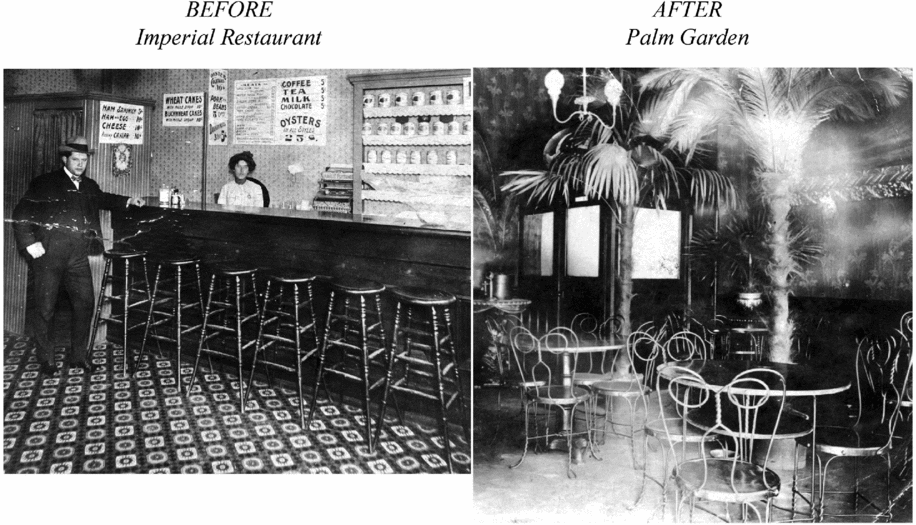
The Golden Eagle, located in a handsome, high-ceilinged building in the downtown, was the place to go for steaks and chops to order, home-style baking, and ice cream. At Christmastime, it added Continental specialties such as consommé and duck with jelly to its festive roast turkey with cranberry sauce and prime rib roast with gravy. Apple pie with cheddar cheese, a Wisconsin favorite, was a featured dessert (ODN December 24, 1902). The Chicago Bakery offered cream puffs, Ferris wheels, peanut cookies, Tennessee squares, and other sweet treats (ODN October 21, 1902). For a quick lunch or supper Pueppke's Imperial served ham sandwiches, pork and beans, coffee, tea, milk, and pie—all at five cents a serving (Oshkosh Public Museum Reference Museum2015a).
For eating out, Oshkosh's sample rooms were most popular of all. “Sample room” originally described a space, often in a hotel, where traveling salesmen displayed their products and took their orders. In the Midwest, where beer-loving Germans sometimes clashed with their neighbors over community alcohol policy, the term became a euphemism for “saloon” (DeVore Reference DeVore1872). Oshkosh had 137 sample rooms—one on practically every corner (Bunn Reference Bunn1903).
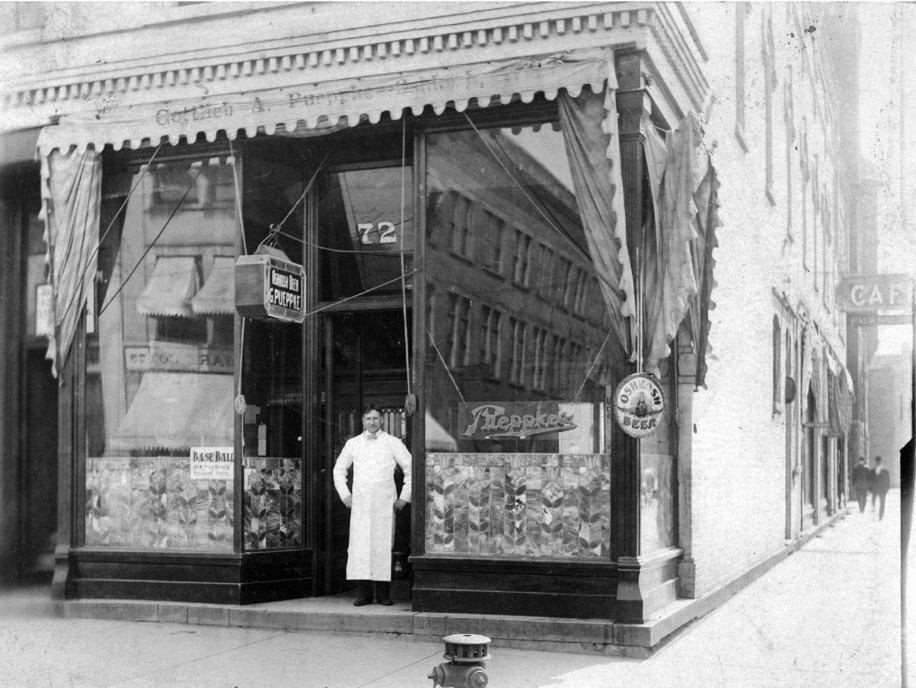
Gottleib Pueppke's Sample Room (figure 7), located on the ground floor of a solid corner building at the intersection of Main and Otter, was typical. A heavy wooden bar ran the length of one wall. Behind it sat barrels of Oshkosh Select, the local brew, and bottles of spirits, wine, and more beer. An enormous mirror reflected humidors filled with cigars and a giant cash register. Oversized beer mugs sat below the bar, cuspidors appeared around the room's perimeter, and a potbelly stove sat at the back (Oshkosh Public Museum Reference Museum2015b). As the bar filled, drinkers clinked glasses and offered one another cheery “Prosts!” Tall windows afforded passersby a glimpse of the gaiety within.
Gottleib Pueppke's Sample Room c. 1903.
Source: Oshkosh Public Museum, Item P2001.48.3, 1999.20. Used with permission.

When more than 10,000 delegates to the German Catholic Benevolent Societies’ state convention came to town, Pueppke and the other saloon men festooned their storefronts with bunting, evergreens, and electric lights. They positioned “Welcome” signs over their doorways (ODN May 16, 1902). For a convention of the Fraternal Order of Eagles (FOE), they flew flags featuring the FOE's distinctive bald eagle crest. Proprietors competed for conventioneers’ business by offering free food. Pueppke's standard fare—“Hot soup and the biggest hot lunch in the City at all Hours” —was probably a “perpetual stew,” reinforced each morning with leftovers from his Imperial Restaurant around the corner (ODN April 21, 1906; Thielen Reference Thielen2013: 70). On special occasions, he served turtle, chili con carne, roast possum, or baked lake trout (ODN February 24, June 14, 1906). The nearby Badger featured “Raccoon, Rabbit, and Squirrel” as a special Christmas bill of fare (ODN December 24, 1902).
In April 1904, Toy, in collaboration with cousin Moy Hee, bought out the Delmonico on Main Street, hired an expert cook with San Francisco experience, and opened the Hong Kong Low (ODN March 16, 1903). “Fried Chicken, Turkey, Roast Boef, Chicken Mushroom Soup” headed the bill of fare. The Chinese dishes must have been popular, though, because several weeks later Toy moved the “special Chinese dishes” and “Chinese Chop Suey” to the place of prominence at the top of the menu (ODN April 4, May 22, 1903). But when fire destroyed most of his equipment only a few months later, Toy sold the remains “cheap, for cash or auction” and relocated to Milwaukee (ODN October 8, 1903; May 5, 1904). With his wife and children newly arrived from China it was an auspicious time for bold action.
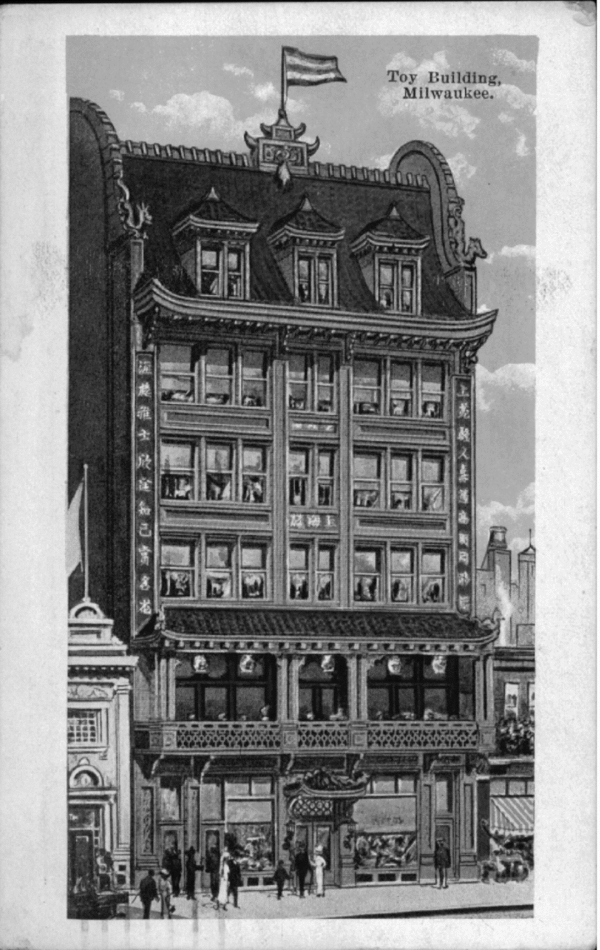
In Milwaukee, Toy followed Moy Hee's example and opened an elaborate fine-dining establishment in the Chinese style. It was quite unlike anything the city had ever seen (figure 8). Toy housed his restaurant in a specially built six-story structure. He enclosed it in green stone and topped it with a red gabled roof whose sweeping curvature rose at the corners. The first story was more than 12 feet high; its entrance protected by an awning adorned with the same red gabled covering as the roof. The second story was also high and included an elaborately decorated balcony supported by cannonades and topped with yet another sweeping, curving, red gabled roof, this one bedecked with stone dragons. The second and third floors housed the luxurious Shanghai Chinese Restaurant (Toy Reference Toy1956: 2–3). Its interior was decorated with expensive tables of ebony with marble and mother-of-pearl inlay; large, painted porcelain vases; beautifully woven rugs; and other costly objects. The building and the restaurant quickly gained a reputation as one of the unique sights of Milwaukee (Holmes and Yuan Reference Holmes and Yuan2008: 34–36; ODN December 6, 1905).
Toy Building, Milwaukee, Wisconsin c 1920.
Source: Author's collection.

Pueppke's Restaurant, 5 Otter Street, Oshkosh, Wisconsin, 1903 and 1912.
Source: Oshkosh Public Museum Items P2001.48.30, 1999.20 and P2001.48.7. Used with permission.

Toy extended the finest Chinese style to his food. Visitors declared that “[t]he craft of his cooks was equally apparent in the appearance and the toothsomeness of the odd dishes served” (ODN September 14, 1908). Among the delicacies were kai, young bird's nest soup, steamed duck, whole sub gum fish, ting lan chicken, long ha deon lobster, turkey, all Chinese style, and squab, fried in peanut oil. “All the bones had been carefully removed from the fish, fowl, and birds, after which they were put back into their original shape, making a perfect deception.” Guests declared the food “fully up to the standard of high class refreshments made in America and France” (ODN December 6, 1906).
As he had done in Oshkosh, Toy cultivated the friendship and patronage of Milwaukee's elite. Shortly after the restaurant opened he hosted a special celebration with a guest list that included a judge, the president of the state normal school, the collector of customs, a court commissioner, an assistant district attorney, and a large contingent of Milwaukee newspapermen (ODN December 6, 1905).Footnote 11 A few years later, when his former Oshkosh patron James O. Davidson became Wisconsin's governor, Toy invited him to the Shanghai. The next morning the Oshkosh Daily Northwestern proclaimed, “Governor Eats Chop Suey” (ODN September 14, 1908).
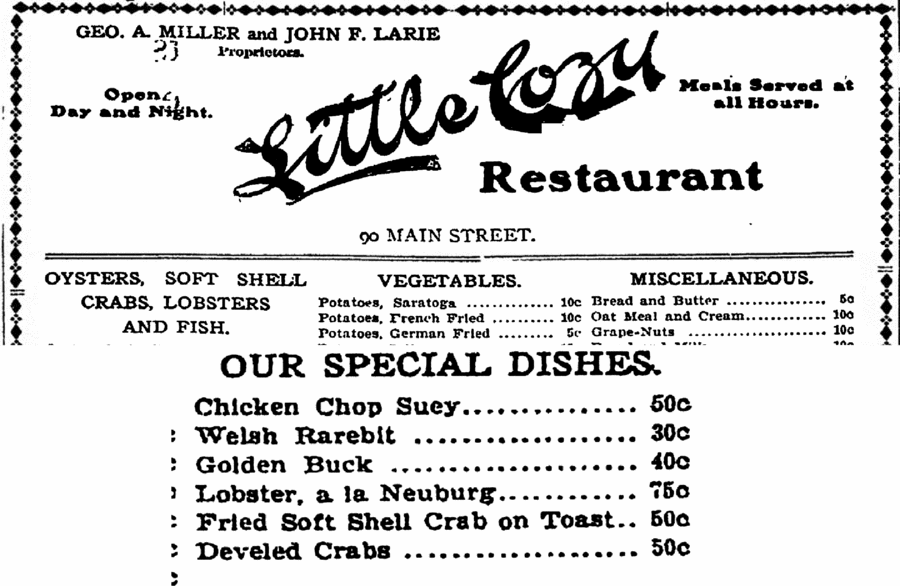
Toy had not forgotten his friends in Oshkosh. Once the Shanghai was running smoothly, he partnered with a Chinese associate to launch a more modest Chinese American restaurant in that city. Not only was it popular, its influence rippled throughout the community. The Pueppkes remodeled their Imperial Restaurant with palm trees and ceiling fans, updated the menu, and renamed it the Palm Garden (ODN March 8, 1912; Oshkosh Public Museum 2015c).Footnote 12 The Little Cozy added chicken chop suey to its list of “Special Dishes,” placing it ahead of the Welsh rarebit and the golden buck (ODN October 28, 1905) (figure 10).Footnote 13 Oshkosh diners were on their way to becoming the pluralistic culinary omnivores they are today.
Ad, Little Cozy Restaurant, 90 Main St., Oshkosh.
Source: ODN October 28, 1905.

Acknowledgments
The SSHA meetings have been the high point of my academic career. Heartfelt thanks to the many scholars I have met and worked with at SSHA over the long years I have been involved in this wonderful organization. Special thanks to Sandra Batie, Sean Carter, Alice Kasakoff, Anne McCants, Elyce Rotella, and Simone Wegge for their many helpful comments on early drafts. Richard Sutch has provided unfailing insight and support at every stage of this long project. Thank you, Richard!
Abbreviations
BG: Boston Globe; CCT: Cambridge City (IN) Tribune; CDT: Chicago Daily Tribune; CET: Centralia (WI) Enterprise and Tribune; ECA: Elk County Advocate (Ridgway, PA); ODN: Oshkosh Daily Northwestern; MJ: Minneapolis (MN) Journal; NYS: New York Sun; NYT: New York Times; RF: Republican-Freeman (Waukesha, WI): SCS: Santa Cruz (CA) Sentinel; SFC: San Francisco Chronicle; SPG: The Saint Paul (MN) Globe; SR: Scranton (PA) Republican; STr: Scranton (PA) Truth; TDC: Topeka (KS) Daily Capital, WBN: Wilkes-Barre (PA) News; WBTL: Wilkes-Barre (PA) Times Leader; WW: Weekly (Milwaukee) Wisconsin.