The impact of early experience on development is a central theme in the field of developmental psychopathology. Its role in canalizing behavior patterns was highlighted in the last Special Issue on “Neural Plasticity, Sensitive Periods, and Psychopathology” in 1994 (Cicchetti & Tucker, Reference Cicchetti and Tucker1994a, Reference Cicchetti and Tucker1994b; Courchesne, Chisum, & Townsend, Reference Courchesne, Chisum and Townsend1994; Fox, Calkins, & Bell, Reference Fox, Calkins and Bell1994). In the intervening two decades, there has been increasing recognition that the prenatal environment is a potent influence on adaptive and maladaptive behavior patterns (Glover, O'Connor, & O'Donnell, Reference Glover, O'Connor and O'Donnell2010; Schuetze, Eiden, Colder, Gray, & Huestis, Reference Schuetze, Eiden, Colder, Gray and Huestis2011). One prenatal influence with documented long-term effects on children's health is smoking during pregnancy (DiFranza, Aligne, & Weitzman, Reference DiFranza, Aligne and Weitzman2004). Although there is now general awareness of the risks of smoking during pregnancy, prenatal tobacco exposure (PTE) is still common. In 2010, 23.2% of women in the United States smoked cigarettes immediately prior to or during pregnancy, and 10.7% of women smoked throughout pregnancy (Tong et al., Reference Tong, Dietz, Morrow, D'Angelo, Farr and Rockhill2013). Rates are even higher in some groups, particularly among pregnant women who are younger, more financially disadvantaged, less educated, and White or Native American.
PTE has been linked to higher levels of externalizing behavior across developmental periods, including atypical externalizing trajectories in early childhood (Wakschlag, Leventhal, Pine, Pickett, & Carter, Reference Wakschlag, Leventhal, Pine, Pickett and Carter2006), and clinical patterns of disruptive behavior (i.e., oppositional defiant disorder [ODD] and conduct disorder [CD]; Cornelius, Goldschmidt, DeGenna, & Day, Reference Cornelius, Goldschmidt, DeGenna and Day2007; Huijbregts, Warren, de Sonneville, & Swaab-Barneveld, Reference Huijbregts, Warren, de Sonneville and Swaab-Barneveld2008; Monuteaux, Blacker, Biederman, Fitzmaurice, & Buka, Reference Monuteaux, Blacker, Biederman, Fitzmaurice and Buka2006; Orlebeke, Knol, & Verhulst, Reference Orlebeke, Knol and Verhulst1999; Robinson et al., Reference Robinson, McLean, Oddy, Mattes, Bulsara and Li2010; Wakschlag & Hans, Reference Wakschlag and Hans2002; Wakschlag et al., Reference Wakschlag, Henry, Blair, Dukic, Burns and Pickett2011). There is also mixed support for an association between PTE and attention-deficit/hyperactivity disorder (ADHD). Some studies found an association (Cornelius et al., Reference Cornelius, Goldschmidt, DeGenna and Day2007; Froehlich et al., Reference Froehlich, Lanphear, Auinger, Hornung, Epstein and Braun2009; Keyes, Davey Smith, & Susser, Reference Keyes, Davey Smith and Susser2014; Kotimaa et al., Reference Kotimaa, Moilanen, Taanila, Ebeling, Smalley and McGough2003; Nomura, Marks, & Halperin, Reference Nomura, Marks and Halperin2010; Orlebeke et al., Reference Orlebeke, Knol and Verhulst1999; Robinson et al., Reference Robinson, McLean, Oddy, Mattes, Bulsara and Li2010) and others did not (Ball et al., Reference Ball, Gilman, Mick, Fitzmaurice, Ganz and Seidman2010; Day, Richardson, Goldschmidt, & Cornelius, Reference Day, Richardson, Goldschmidt and Cornelius2000; Huijbregts, Séguin, Zoccolillo, Boivin, & Tremblay, Reference Huijbregts, Séguin, Zoccolillo, Boivin and Tremblay2007), or they found associations only in children with comorbid ODD (Wakschlag, Pickett, Kasza, & Loeber, Reference Wakschlag, Pickett, Kasza and Loeber2006) or dopaminergic risk alleles (Becker, El-Faddagh, Schmidt, Esser, & Laucht, Reference Becker, El-Faddagh, Schmidt, Esser and Laucht2008; Neuman et al., Reference Neuman, Lobos, Reich, Henderson, Sun and Todd2007).
However, the underlying neurodevelopmental mechanisms that drive these behavioral problems are as yet unclear. Nigg and Casey (Reference Nigg and Casey2005) suggested that the common thread among externalizing behavior disorders is impaired self-regulation, reflecting dysfunction in neural circuits, including the frontal cortex and striatum; other theories have similarly emphasized the role of early self-regulatory difficulties in the etiology of ADHD (Barkley, Reference Barkley1997; Castellanos, Sonuga-Barke, Milham, & Tannock, Reference Castellanos, Sonuga-Barke, Milham and Tannock2006), ODD (Matthys, Vanderschuren, & Schutter, Reference Matthys, Vanderschuren and Schutter2013), and antisocial behavior (Moffitt, Reference Moffitt1993). The goal of the present study was to examine the construct of self-regulation in young children with PTE, as a potential marker of a developmental trajectory at risk for elevated externalizing behavior. In light of sex differences in vulnerability to pre- and perinatal risk factors (Elsmén, Steen, & Hellström-Westas, Reference Elsmén, Steen and Hellström-Westas2004) and in risk for externalizing behavior (Card, Stucky, Sawalani, & Little, Reference Card, Stucky, Sawalani and Little2008; Gershon, Reference Gershon2002), we explored sex as a moderator.
The Emergence of Self-Regulation
The last two decades have been marked by substantial theoretical and methodological advances in our understanding of the early development of self-regulation (Carlson, Reference Carlson2005; Espy, Kaufmann, Glisky, & McDiarmid, Reference Espy, Kaufmann, Glisky and McDiarmid2001; Garon, Bryson, & Smith, Reference Garon, Bryson and Smith2008; Wiebe et al., Reference Wiebe, Sheffield, Nelson, Clark, Chevalier and Espy2011; Willoughby, Blair, Wirth, Greenberg, & Family Life Project Investigators, Reference Willoughby, Blair, Wirth and Greenberg2010). Unfolding self-regulation in infancy and early childhood can be characterized as a gradual shift from exogenous to endogenous control of behavior. In infancy, behavior is largely driven by environmental stimuli, where external stimuli capture the infant's attention and elicit prepotent responses (e.g., approach or distress). Children become increasingly capable of volitional action in the environment, for example, choosing to direct their attention to less salient stimuli or select alternative responses to a situation (e.g., delaying gratification or shifting attention from a stressor), and thereby develop the capacity to adhere to caregiver demands and social norms (Kopp, Reference Kopp1982). This exogenous–endogenous transition is supported by changes in prefrontal circuitry, in particular refinement of long-range connections between the prefrontal cortex and other cortical and subcortical areas (Huttenlocher & Dabholkar, Reference Huttenlocher and Dabholkar1997; Thatcher, Reference Thatcher1994).
Recent models of self-regulation include cognitive, emotional, and motivational processes as mutually interactive and reciprocal (e.g., Bell & Deater-Deckard, Reference Bell and Deater-Deckard2007; Gross & Thompson, Reference Gross, Thompson and Gross2007; Posner & Rothbart, Reference Posner and Rothbart2000). There is evidence for a meaningful distinction between contexts that primarily tax children's self-regulation capabilities due to cognitive load (e.g., holding information in mind or overcoming automatic responses; often termed “cool EF”) relative to motivational load (e.g., regulating responses to a salient reward or distressing situation; “hot EF”; Hongwanishkul, Happaney, Lee, & Zelazo, Reference Hongwanishkul, Happaney, Lee and Zelazo2005; Willoughby, Kupersmidt, Voegler-Lee, & Bryant, Reference Willoughby, Kupersmidt, Voegler-Lee and Bryant2011). Neurologically, the ability to self-regulate in the face of cognitive load appears to be based in the dorsolateral prefrontal cortex, whereas motivationally loaded tasks place demands on the orbitofrontal cortex (Zelazo, Carlson, & Kesek, Reference Zelazo, Carlson, Kesek, Nelson and Luciana2008).
Theoretical links between childhood self-regulation and externalizing outcomes, mentioned earlier, are supported by empirical evidence. There are group differences between children with ADHD and typically developing controls in response inhibition (Berlin, Bohlin, Nyberg, & Janols, Reference Berlin, Bohlin, Nyberg and Janols2004; Oosterlaan, Logan, & Sergeant, Reference Oosterlaan, Logan and Sergeant1998; Schoemaker et al., Reference Schoemaker, Bunte, Wiebe, Espy, Deković and Matthys2012; Schoemaker, Mulder, Deković, & Matthys, Reference Schoemaker, Mulder, Deković and Matthys2013) and delay tolerance (Bitsakou, Psychogiou, Thompson, & Sonuga-Barke, Reference Bitsakou, Psychogiou, Thompson and Sonuga-Barke2009); the former construct is encompassed by cognitive self-regulation, whereas the latter falls within the rubric of motivational self-regulation. Aggressive and disruptive behavior is also associated with self-regulation problems (Raaijmakers et al., Reference Raaijmakers, Smidts, Sergeant, Maassen, Posthumus and van Engeland2008; Schoemaker et al., Reference Schoemaker, Bunte, Wiebe, Espy, Deković and Matthys2012). In community samples, cognitive self-regulation difficulties have likewise been found to predict higher levels of externalizing behavior (Berlin & Bohlin, Reference Berlin and Bohlin2002; Riggs, Blair, & Greenberg, Reference Riggs, Blair and Greenberg2003). In one of the few studies to directly compare cognitive and motivational self-regulation, Willoughby et al. (Reference Willoughby, Kupersmidt, Voegler-Lee and Bryant2011) found that motivational self-regulation uniquely predicted inattentive and hyperactive behavior, whereas cognitive self-regulation uniquely predicted academic outcomes. Examining distinct cognitive and motivational components of self-regulation in a PTE sample at risk for externalizing behavior problems may allow for more precise specification of the neurodevelopmental basis of these difficulties.
PTE and Emergent Self-Regulation
Based on evidence from animal studies, in which exposure can be experimentally manipulated, PTE is believed to impact dopaminergic, serotonergic, and noradrenergic systems (Dwyer, McQuown, & Leslie, Reference Dwyer, McQuown and Leslie2009; Slotkin, Pinkerton, Tate, & Seidler, Reference Slotkin, Pinkerton, Tate and Seidler2006). These systems in turn support the networks involved in adaptive control of cognition, emotion, and behavioral responses, including the anterior cingulate and specific regions in the ventrolateral, dorsolateral, and orbitofrontal cortex (Nigg & Casey, Reference Nigg and Casey2005; Zelazo & Carlson, Reference Zelazo and Carlson2012). Neuroimaging findings in humans likewise show that PTE is related to abnormalities in neural systems involved in self-regulation, including the anterior cingulate regions involved in response inhibition and the orbitofrontal regions involved in motivational self-regulation (El Marroun et al., Reference El Marroun, Schmidt, Franken, Jaddoe, Hofman and van der Lugt2014; Liu et al., Reference Liu, Lester, Neyzi, Sheinkopf, Gracia and Kekatpure2013; Lotfipour et al., Reference Lotfipour, Ferguson, Leonard, Perron, Pike and Richer2009). Therefore, a causal pathway linking PTE, disordered self-regulation, and externalizing behavior is plausible.
PTE is associated with neurobehavioral deficits in infancy, but it is unclear to what extent these deficits reflect problems with self-regulation. Although neonates and infants with PTE show problems with attention and distractibility (Espy et al., Reference Espy, Fang, Johnson, Stopp, Wiebe and Respass2011; Richardson, Day, & Taylor, Reference Richardson, Day and Taylor1989; Wiebe, Fang, Johnson, James, & Espy, Reference Wiebe, Fang, Johnson, James and Espy2014), these differences likely reflect bottom-up rather than top-down processes based on the developmental timeline of the emergence of top-down control. In previous work with the present sample, for example, we found no relation between PTE and working memory or information processing at 6 months (Wiebe et al., Reference Wiebe, Fang, Johnson, James and Espy2014). PTE neonates also show heightened irritability and difficulty soothing (Jacobson, Fein, Jacobson, Schwartz, & Dowler, Reference Jacobson, Fein, Jacobson, Schwartz and Dowler1984; Stroud et al., Reference Stroud, Paster, Goodwin, Shenassa, Buka and Niaura2009). PTE-related differences in irritability persist through the first year (Schuetze & Eiden, Reference Schuetze and Eiden2007; Wiebe et al., Reference Wiebe, Fang, Johnson, James and Espy2014). In two studies that incorporated physiological measurement tapping self-regulation during presentation of a stressor, PTE infants showed greater peak cortisol response at 7 months (Schuetze, Lopez, Granger, & Eiden, Reference Schuetze, Lopez, Granger and Eiden2008) and maladaptive patterns of autonomic activity at 9 months (Schuetze, Eiden, Colder, Gray, & Huestis, Reference Schuetze, Eiden, Colder, Gray and Huestis2013), indicating problems with emotion regulation late in the first year of life.
In early and middle childhood, measurement of self-regulation is more straightforward, and studies have found associations between PTE and poorer performance on tasks requiring the control of attention and inhibition of prepotent responses (Cornelius, Ryan, Day, Goldschmidt, & Willford, Reference Cornelius, Ryan, Day, Goldschmidt and Willford2001; Mezzacappa, Buckner, & Earls, Reference Mezzacappa, Buckner and Earls2011; Noland et al., Reference Noland, Singer, Short, Minnes, Arendt and Kirchner2005; Wiebe et al., Reference Wiebe, Espy, Stopp, Respass, Stewart and Jameson2009; for exceptions see Derauf et al., Reference Derauf, Lester, Neyzi, Kekatpure, Gracia and Davis2012; Huijbregts et al., Reference Huijbregts, Warren, de Sonneville and Swaab-Barneveld2008). Fewer studies have examined effects of PTE on self-regulation under emotional or motivational load, but the limited evidence supports a connection. One study found that at age 3, PTE children were less likely to wait for a delayed reward, although these differences were no longer significant by the time children were 5 (Kelsey, Hoffman, Wiebe, James, & Espy, Reference Kelsey, Hoffman, Wiebe, James and Espy2014). In another study conducted with school-aged children, those with PTE evidenced greater difficulty in coping with frustration while playing a computer game with randomly interposed delays, relative to their nonexposed peers (Huijbregts et al., Reference Huijbregts, Warren, de Sonneville and Swaab-Barneveld2008). Taken together, these studies highlight disturbances in self-regulation among children with PTE, although it is less clear whether motivational and cognitive aspects of self-regulation are differentially vulnerable and to what extent these aspects may portend different dimensions of externalizing behavior.
Taken together with the evidence linking PTE with externalizing behavior, correlations between PTE and key behavioral outcomes are well established. However, a straightforward causal interpretation of these associations is not warranted. Studies using genetically informed designs have suggested that putative teratologic effects may be a marker for genetic risk for problem behavior (D'Onofrio et al., Reference D'Onofrio, Van Hulle, Waldman, Rodgers, Harden and Rathouz2008; D'Onofrio, Van Hulle, Goodnight, Rathouz, & Lahey, Reference D'Onofrio, Van Hulle, Goodnight, Rathouz and Lahey2012; Maughan, Taylor, Caspi, & Moffitt, Reference Maughan, Taylor, Caspi and Moffitt2004; Silberg et al., Reference Silberg, Parr, Neale, Rutter, Angold and Eaves2003), as smoking during pregnancy is in itself a maternal problem behavior (Eiden et al., Reference Eiden, Leonard, Colder, Homish, Schuetze and Gray2011; McGrath et al., Reference McGrath, Mustanski, Metzger, Pine, Kistner-Griffin and Cook2012). One shortcoming of these studies is their relatively crude exposure measurement, which has often been retrospective, brief, and has relied solely on maternal self-report, which is subject to biases and nondisclosure. These studies have also typically lacked a developmental framework. An alternative approach to addressing potential confounding has been the development of statistical methods that can deal with these potential biases and confounding risks. One approach that is gaining in popularity is propensity scores (McCaffrey, Ridgeway, & Morral, Reference McCaffrey, Ridgeway and Morral2004; Rosenbaum & Rubin, Reference Rosenbaum and Rubin1984). To estimate propensity scores, risk factors related to selection bias in observational studies are identified and combined into a single metric using logistic regression or generalized boosted models better suited for nonnormally distributed variables. In the case of PTE, propensity scores are then incorporated into statistical models to adjust exposure differences via matching or as a covariate (Ellis, Berg-Nielsen, Lydersen, & Wichstrøm, Reference Ellis, Berg-Nielsen, Lydersen and Wichstrøm2012; Fang et al., Reference Fang, Johnson, Chevalier, Stopp, Wiebe and Wakschlag2010; Willoughby, Greenberg, Blair, Stifter, & Family Life Investigative Group, Reference Willoughby, Greenberg, Blair and Stifter2007). Using these more rigorous control methods, these studies have typically found that exposure effects on externalizing behavior persist (Ellis et al., Reference Ellis, Berg-Nielsen, Lydersen and Wichstrøm2012; Keyes et al., Reference Keyes, Davey Smith and Susser2014; Paradis, Fitzmaurice, Koenen, & Buka, Reference Paradis, Fitzmaurice, Koenen and Buka2011). Thus, whether PTE has direct teratologic effects is as yet unclear: rigorous prospective, multimethod assessment of exposure and modeling of unfolding brain: behavior relations to PTE is key to advancing understanding of this issue.
Sex Differences in PTE Vulnerability
It is well documented that boys are more vulnerable to risk factors before and at birth (e.g., boys are more likely to be born preterm or low birth weight, and preterm-born males face greater health risks than their female counterparts; Elsmén et al., Reference Elsmén, Steen and Hellström-Westas2004; Moe & Slinning, Reference Moe and Slinning2001). As such, it makes sense to consider potential sex differences in vulnerability to PTE. There is some evidence that boys are more vulnerable: PTE's effect on birthweight is greater in boys than girls (Tayie & Powell, Reference Tayie and Powell2012), and sex has been found to moderate PTE's effects on attention and irritability in infancy (Pickett et al., Reference Pickett, Wood, Adamson, D'Souza, Desouza and Wakschlag2008; Schuetze et al., Reference Schuetze, Lopez, Granger and Eiden2008, Reference Schuetze, Eiden, Colder, Gray and Huestis2013; Willoughby et al., Reference Willoughby, Greenberg, Blair and Stifter2007; but for an exception, see Wiebe et al., Reference Wiebe, Fang, Johnson, James and Espy2014). Several studies have found that PTE is more strongly associated with externalizing behavior in boys, in independent samples assessed in early childhood and preadolescence (Hutchinson, Pickett, Green, & Wakschlag, Reference Hutchinson, Pickett, Green and Wakschlag2010; Wakschlag & Hans, Reference Wakschlag and Hans2002). Unfortunately, many studies have not analyzed or reported differences in PTE effects, disregarding or simply controlling for sex in their analyses.
Research in developmental psychopathology also highlights the importance of examining sex differences in pathways to externalizing behavior. There are large sex differences in the prevalence of externalizing behavior. For ADHD, boys outnumber girls 9:1 in clinically referred samples, and 3:1 in community samples (Gershon, Reference Gershon2002). For ODD, one large study estimated prevalence was 2.4 times more common in boys than in girls (Maughan, Rowe, Messer, Goodman, & Meltzer, Reference Maughan, Rowe, Messer, Goodman and Meltzer2004).
There are also indications that risk factors and trajectories leading to externalizing behavior differ between boys and girls. Keenan and Shaw (Reference Keenan and Shaw1997) proposed that girls' trajectories show greater discontinuity because they face greater expectations to suppress externalizing behavior, and because of their earlier development of language and prosocial skills, they are more responsive to these socialization pressures. Consistent with this hypothesis, in a longitudinal study that used behavior problems in preschool and the transition to school to predict later externalizing behavior problems, Mesman, Bongers, and Koot (Reference Mesman, Bongers and Koot2001) found greater continuity in boys' developmental trajectories, where behavior problems in preschool emerged as stronger predictors of externalizing problems in preadolescence for boys than for girls. In a study examining moderated mediation, Chang, Olson, Sameroff, and Sexton (Reference Chang, Olson, Sameroff and Sexton2011) found that for boys, hostile parenting in early childhood contributed to externalizing behavior at age 6 via self-regulation problems assessed at age 3, whereas for girls relations between parenting and externalizing behavior were not mediated by self-regulation. This evidence supports the importance of considering sex as a moderator of developmental trajectories related to PTE.
The Present Study
The overarching goal of the present study was to study the link between PTE and self-regulation in early childhood, to gain insight into how PTE confers increased risk for externalizing behavior. We addressed this question within the Midwestern Infant Development Study cohort. This cohort was enrolled to examine the effects of PTE; as such, participants were selected to oversample women who smoked and enroll nonsmokers from similar backgrounds (Espy et al., Reference Espy, Fang, Johnson, Stopp, Wiebe and Respass2011). Prospective, repeated measurement of smoking during pregnancy was used to minimize recall bias, and maternal self-report of smoking was integrated with biomarkers (i.e., assessing levels of cotinine, a by-product of nicotine, in biospecimens) to generate a best estimate indicator of PTE and avoid misclassification because of underreporting of smoking.
Self-regulation was assessed at age 3 years, adapting a battery of tasks previously used with this age group (Wiebe et al., Reference Wiebe, Sheffield, Nelson, Clark, Chevalier and Espy2011) to include measures of both cognitive and motivational self-regulation. Individual tasks were used as indicators of latent factors in structural equation modeling (SEM). Individual self-regulation tasks are often unreliable measures of self-regulation because performance reflects not only variation in regulatory capacity but also variation in the basic abilities required to complete the task (e.g., motor abilities and naming), known as the task impurity problem (Miyake et al., Reference Miyake, Friedman, Emerson, Witzki, Howerter and Wager2000). SEM parses the common, self-regulatory variability shared across tasks from unique, task-specific variability.
We hypothesized that PTE would be related to poorer self-regulation in early childhood, and based on previous research, we expected differences to be evident across cognitive and motivational domains. We also tested the hypothesis that boys would show greater vulnerability to PTE. Finally, we tested whether relations between PTE and self-regulation could be accounted for by confounding risk factors related to maternal risk for smoking during pregnancy, using a propensity score approach.
Method
Participants
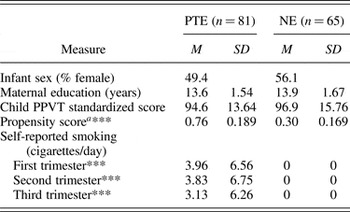
Mother–child dyads included in the present study (N = 151 children; 72 girls, 79 boys) were recruited during pregnancy to study the effects of PTE on neonatal attention and irritability (Espy et al., Reference Espy, Fang, Johnson, Stopp, Wiebe and Respass2011) and participated in a follow-up study when children were 3 years old (M = 3 years, 7 days, SD = 22 days). Mothers reported that their children's racial or ethnic background was European American (52%), African American (24%), Hispanic or Latino (20%), Native American (1.3%), or more than one race (3.3%). Demographic information is summarized in Table 1.
Descriptive statistics for demographic and exposure variables

Note: PTE, Prenatally tobacco exposed; NE, nonexposed; PPVT, Peabody Picture Vocabulary Test.
aEstimated propensity to smoke during pregnancy (0–1).
***p < .001.
The initial cohort included 369 mother–child dyads at two Midwestern study sites, a small city in Nebraska and a rural tricounty area in Illinois. Because cigarette smoking is associated with lower socioeconomic status, stratified enrollment procedures were used to minimize potentially confounding demographic differences between the smoking and nonsmoking groups. Exclusionary criteria for mothers included binge drinking and illegal drug use, with the exception of occasional marijuana use. Exclusionary criteria for infants were preterm birth (<35 weeks) and birth complications known to affect developmental outcome (e.g., neonatal seizures). Due to funding constraints that made a multisite follow-up untenable, the 3-year follow-up was limited to the Nebraska site (n = 198). Of this sample, 14 dyads were not eligible to participate at the 3-year follow-up because the mother no longer had custody (n = 5), their families had moved internationally (n = 3), the mother or child had died (n = 1), the child had been diagnosed with a neurological/medical condition (n = 1), or the mother had requested not to be contacted for follow-up studies (n = 4). Twenty dyads did not participate because they declined to participate (n = 4), could not be located (n = 9), or could not be enrolled within the time window (n = 7). Of the 164 dyads (89%) who participated in the 3-year wave, 13 were excluded from the present analyses because they completed questionnaires and interviews but were unable to visit the lab and so did not provide self-regulation data (n = 11) or because propensity scores could not be calculated due to missing data on key predictor variables (n = 2). Thus, the analytic sample for the present study included 151 dyads. Dyads included in the final sample did not differ significantly from those not followed up or excluded in their prenatal exposure status, maternal education, race or ethnicity, or child sex.
Procedures
Prenatal recruitment has been described in detail elsewhere (Espy et al., Reference Espy, Fang, Johnson, Stopp, Wiebe and Respass2011; Fang et al., Reference Fang, Johnson, Chevalier, Stopp, Wiebe and Wakschlag2010), and so only a brief overview is presented here. Women were recruited during pregnancy and provided written, informed consent. At 14 and 28 weeks and immediately after delivery, women completed a set of interviews and questionnaires regarding their smoking behavior and use of other substances, physical and mental health, stress levels, and social supports. Urine samples from the mother (and, after birth, the infant) were obtained at each visit to verify self-reported smoking data.
At the 3-year follow-up, each child was tested individually in a developmental laboratory setting by a trained research assistant who was blind to prenatal exposure status. A battery of tasks that included measures of self-regulation was administered in three sessions, in a fixed order to ensure that any potential carryover effects would be comparable, as is typical in individual differences research; tasks selected for the present analyses are described below. Adherence to experimental protocols was maintained by regular team meetings and reviews of session videorecordings. Upon completion of each follow-up wave, children received a small toy and mothers received a gift card as compensation.
Measures
PTE
At 14 and 28 weeks gestation and at delivery, mothers provided a month-by-month report of the number of cigarettes smoked per day using a modified timeline-followback interview (Espy et al., Reference Espy, Fang, Johnson, Stopp, Wiebe and Respass2011). Maternal urine samples and infant meconium were tested for cotinine, a metabolite of nicotine, by US Drug Testing Laboratories. Infants were classified as exposed if mothers endorsed smoking and/or if they had cotinine values over 50 ng/mL at any time during the pre- or perinatal period. In total, 56% of infants in the present sample were classified as exposed. Mean levels of exposure across pregnancy are summarized in Table 1.
Propensity scores
Propensity scores were used to statistically control for selection bias by adjusting for potentially confounding risk factors that may differ between women who do and do not smoke during pregnancy. Propensity scores reflect the estimated likelihood that a participant will smoke during pregnancy derived statistically from maternal background variables. As previously reported in detail by Fang et al. (Reference Fang, Johnson, Chevalier, Stopp, Wiebe and Wakschlag2010), maternal mental and physical health and demographic background variables were used to estimate the propensity scores. Propensity scores were estimated using a generalized boosted model, a nonparametric approach that is robust to situations where covariates may be nonnormally distributed, their effects may be nonlinear and nonadditive, and multicollinearity or missing values may be present (Friedman, Reference Friedman2001; Imbens, Reference Imbens2003; McCaffrey et al., Reference McCaffrey, Ridgeway and Morral2004). A generalized boosted model was implemented using the “twang” package in R 2.8.1 (R Foundation for Statistical Computing, Vienna, Austria). All 42 variables used in propensity score estimation are reported in Fang et al. (Reference Fang, Johnson, Chevalier, Stopp, Wiebe and Wakschlag2010). The variables that contributed most strongly to propensity score computation (and proportion of variance in propensity scores explained) included drinking in the first month of pregnancy (14.9%), education (9.8%), drinking at the last menstrual period (8.6%), age (7.7%), IQ (6.4%), and history of hyperactivity (5.8%).
3-Year self-regulation
Tasks in the self-regulation battery placed demands on children's ability to hold information in mind and inhibit a prepotent response (for a detailed description of the battery, see Wiebe et al., Reference Wiebe, Sheffield, Nelson, Clark, Chevalier and Espy2011). The Big–Little Stroop task measured children's inhibitory control of distractor interference. Stimuli were line drawings of everyday objects containing smaller embedded pictures that either matched or conflicted in identity with the larger object. The dependent measure was accuracy on conflict trials. The preschool go/no-go task assessed children's ability to inhibit a prepotent motor response. Pictures of fish were displayed on a computer screen, and children were instructed to “catch” them by responding within 1500 ms on a button box. On less frequent no-go trials (25% of trials), a shark appeared and children were instructed to “let it go” by withholding their response. The dependent measure was d-prime, or the standardized difference between the hit and false alarm rates (Stanislaw & Todorov, Reference Stanislaw and Todorov1999). Response inhibition was also assessed with a computerized version of the shape school. Children viewed red and blue cartoon shape characters and were instructed to name their colors only when characters had happy faces and to inhibit naming those with sad faces. The dependent measure was accuracy on inhibit task trials. The delayed alternation task required children to hold previously rewarded locations in working memory. The hiding location of a food reward alternated between left and right sides after each correct retrieval, and trials were separated by a 10-s filled delay. The dependent measure was the proportion of correct responses. Finally, in the Nebraska barnyard task, children had to remember a sequence of animal names and press corresponding colored buttons on a touch screen in the corresponding order; this task was simplified from the version in Wiebe et al. (Reference Wiebe, Sheffield, Nelson, Clark, Chevalier and Espy2011) to include only four colored buttons to speed administration, because in previous studies 3-year-old children seldom advanced beyond two-item sequences. The dependent measure was a composite score reflecting the summed proportion correct responses at each span length.
Two tasks required children to regulate their behavior under conditions where reward was highly salient. Children's ability to wait for a delayed food reward was assessed in the snack delay task, in which children were instructed to stand still with their hands on a placemat marked with two handprints, without moving or talking, in front of a handful of M&M candies under a transparent cup during a 4-min delay. Performance was indexed by (a) a score indicating whether children ate the snack during the delay, and (b) a summary score reflecting children's compliance with task rules, where children's behavior was scored in each 5-s epoch (up to 3 points for standing still, keeping their hands on the mat, and remaining silent) summed across all epochs prior to children eating the snack or until the task ended at 240 s. Children's ability to comply with a directive in the face of temptation was assessed using the goody shelf task, administered as part of the Disruptive Behavior Diagnostic Observation Schedule (Wakschlag et al., Reference Wakschlag, Hill, Carter, Danis, Egger and Keenan2008). The examiner instructed the child to sit at a small table and then unveiled an appealing set of toys (e.g., flashing wand and jelly bean dispenser) on a small shelf, instructing the child that the toys were only for looking at. During the 5-min delay, the child was given three crayons and paper with which to draw, and the examiner sat in the corner of the room. If children touched the toys, then the examiner provided a series of increasingly supportive prompts (e.g., verbal reminders or moving the shelf). Each instance of touching the toys was coded for intensity (brief touches = 1, sustained touches = 2, sustained touches where child was resistant to examiner prompts = 3). The dependent measure was the total score.
For all self-regulation tasks except the preschool go/no-go (which required a button-press response), a randomly selected subset of sessions (≥20%) were independently scored by a second coder. Interrater reliability was high (M = 91%–100% for all tasks).
Statistical methods
Descriptive statistics were calculated in SAS 9.2 (SAS Institute, Cary, NC). SEM was conducted in Mplus 7.11 (Muthén & Muthén, Reference Muthén and Muthén2012), using full-information maximum likelihood estimation to handle missing data. Model fit to the data was assessed using the chi-square (χ2) statistic, where a nonsignificant χ2 value signifies good fit. Because the χ2 test is sensitive to small deviations from perfect fit, additional indices used for model evaluation included the root mean square error of approximation (RMSEA), where values less than 0.06 indicate good fit and values between 0.06 and 0.08 indicate acceptable fit; and the comparative fit index (CFI), where values between 0.95 and 1.00 indicate good fit (Hu & Bentler, Reference Hu and Bentler1999; Kline, Reference Kline2011).
SEM was used to test substantive hypotheses about PTE and self-regulation, and to assess gender as a moderator. The best fitting model of self-regulation was determined using confirmatory factor analysis. Then, the relationship between PTE and self-regulation was assessed. Additional models were tested to explore the effect of gender as a moderator by constraining paths to equality across boys and girls and to examine whether associations were robust to confounding risk factors by adding propensity scores as a covariate.
Results
Descriptive statistics
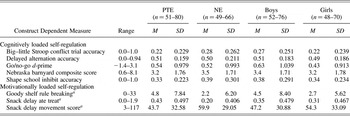
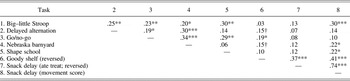
Children's performance on the self-regulation battery is summarized in Table 2, presented separately by prenatal exposure status and by sex. For all measures of self-regulation under motivational load, children with PTE performed significantly worse than their nonexposed peers. No measures of self-regulation under cognitive load differed between exposure groups (all ps > .10), and there were no significant sex differences in performance on individual self-regulation tasks (all ps > .10). Table 3 presents correlations among the self-regulation measures. Correlations among tasks indexing self-regulation under cognitive load were generally significant but tended to be small in magnitude. In contrast, correlations among tasks indexing self-regulation under motivational load were significant and moderate to large. Most correlations across domains of self-regulation were nonsignificant.
Descriptive statistics for measures of child self-regulation, by prenatal tobacco exposure status and child sex
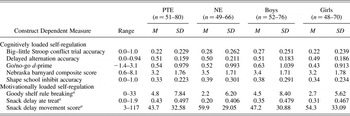
Note: PTE, Prenatally tobacco exposed; NE, nonexposed
aSignificant difference between exposure groups (p < .05).
Correlations among self-regulation measures

Note: To ease interpretation, scores were transformed if necessary so that higher scores represented better self-regulation for all measures.
†p < .10. *p < .05. **p < .01. ***p < .001.
Data reduction
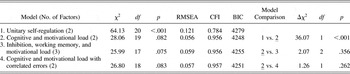
Before conducting SEM analyses, several dependent measures (goody shelf and snack delay movement scores) were standardized to minimize the range of variance across indicators (Kline, Reference Kline2011), and if necessary, scores were reflected so that a higher score always represented better self-regulation. Next, the factor structure of the self-regulation battery was evaluated using confirmatory factor analysis; indices of model fit and model comparisons are summarized in Table 4. It was not surprising that given the observed pattern of correlations among tasks, the best fitting model had two factors reflecting latent self-regulation under conditions of cognitive relative to motivational load. All factor loadings were statistically significant, and standardized factor loadings ranged from .41 to .56 for the cognitive load factor and .44 to .95 for the motivational load factor. Tests of measurement invariance supported invariance by sex and exposure at the configural, metric, and scalar levels. In analyses of invariance by sex, it was necessary to constrain the residual variance for the snack delay summary score indicator to zero in boys for model identification purposes. If metric and scalar invariance are supported, then one can validly compare the means of latent variables across groups (Kline, Reference Kline2011; Vandenberg & Lance, Reference Vandenberg and Lance2000).
Model fit indices for alternative confirmatory factor analysis models of self-regulation
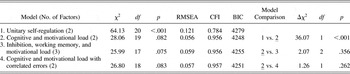
Note: For model comparisons, the preferred model is underlined. Where two nested models showed equivalent fit to the data, the more parsimonious model was preferred.
Does PTE predict self-regulation in early childhood?
When self-regulation was regressed on PTE, children with PTE showed significantly poorer self-regulation under motivational load relative to nonexposed children (b = –0.60, SE = 0.19, p = .001), but the groups did not differ in self-regulatory performance on tasks tapping cognitive load (b = –0.21, SE = 0.21, p = .33). Latent variables are scaled in standard deviation units, so children with PTE performed over 0.5 SD below their nonexposed peers. This model showed good fit to the data, χ2 (25) = 31.90, p = .16, RMSEA = 0.043, CFI = 0.967. The pattern of significant results was unchanged when propensity scores were added to the model as a covariate. Model fit remained adequate with the exception of a significant model χ2 test, χ2 (31) = 45.94, p = .04, RMSEA = 0.056, CFI = 0.933.
Does sex moderate the effect of PTE?
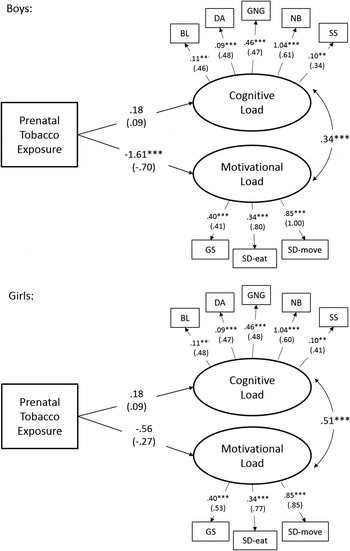
Multiple-group models were tested to examine whether PTE's relation to self-regulation differed between boys and girls. Based on measurement invariance testing, the residual variance for the snack delay summary score indicator was fixed to zero for boys in all models. PTE was a significant predictor of self-regulation under motivational load in boys (b = –0.95, SE = 0.22, p < .001) and in girls (b = –0.44, SE = 0.22, p = .045); PTE's effect was significantly greater in boys, χ2 (1) = 5.49, p = .02. PTE's effect on self-regulation under cognitive load was nonsignificant (b = –016, SE = 0.22, p = .46) and equivalent in boys and girls, χ2 (1) = 0.52, p = .47. A model in which PTE's effect on cognitively loaded self-regulation was constrained to be equal across sexes and its effect on motivationally loaded self-regulation was free to vary showed good fit to the data, χ2 (68) = 78.46, p = .18, RMSEA = 0.045, CFI = 0.954. When the propensity score covariate was added to this model, the pattern of findings changed, as depicted in Figure 1. For boys, PTE's effect on motivationally loaded self-regulation was robust (b = –1.61, SE = 0.39, p < .001), such that PTE boys performed over 1.5 SD below nonexposed boys after confounding risks were controlled. In girls, this effect was no longer significant (b = –0.56, SE = 0.43, p = .19). PTE's effect on cognitively loaded self-regulation remained insignificant (b = 0.18, SE = 0.36, p = .61). For this model, fit statistics indicated marginally acceptable fit to the data, χ2 (80) = 103.48, p = .04, RMSEA = 0.062, CFI = 0.903.
Path diagram illustrating the effect of prenatal tobacco exposure on self-regulation in (top) boys and (bottom) girls. Unstandardized (standardized) parameters are presented; error variances and the propensity score covariate are not shown. **p < .01. ***p < .001.

Discussion
In this study, we examined whether smoking during pregnancy was related to self-regulation in early childhood. We predicted that children with PTE would show lower levels of self-regulation in both cognitive and motivational domains; this prediction was only partially supported, because PTE-related differences were present only in the motivational domain. We also predicted that the relation between PTE and self-regulation would be stronger in boys than in girls. This hypothesis was supported, because PTE's impact on motivational self-regulation was significantly greater for boys than for girls. Furthermore, when propensity scores were added as a covariate to determine whether these results could be explained by other risk factors that were confounded with smoking during pregnancy, PTE no longer significantly predicted motivational self-regulation in girls, whereas the effect in boys was unchanged.
Our finding that motivational but not cognitive self-regulation was related to PTE was unexpected, but it is consistent with a previous study by Huijbregts et al. (Reference Huijbregts, Warren, de Sonneville and Swaab-Barneveld2008). Their study had a relatively small sample, assessed exposure via maternal retrospective self-report, and included only a single task indexing cognitive and motivational self-regulation; however, as in the present study, they found that PTE was related to problems with motivational self-regulation (in their study, a computerized measure of delay aversion) but not cognitive self-regulation, assessed via a sustained attention task. The present study replicates these earlier findings in a larger, prospective sample, with more sophisticated measurement of both prenatal exposure and childhood self-regulation, and controlling for confounding risks.
The dissociation between cognitive and emotional self-regulation observed in the present study may also contribute to our understanding of the pattern of associations between PTE and externalizing disorders in the literature. As reviewed earlier, research has found that PTE has a robust association with disruptive behavior disorders such as ODD and CD, but inconsistent relations with ADHD. For example, Nigg and Breslau (Reference Nigg and Breslau2007) found that PTE directly predicted ODD, which in turn accounted for PTE's relation with CD. In contrast, PTE's relation with ADHD was confounded by other risk factors such as maternal psychopathology and socioeconomic status, and was also mediated by birth weight. The motivational underpinnings of disruptive behavior disorders are well established (Matthys et al., Reference Matthys, Vanderschuren and Schutter2013; White et al., Reference White, Pope, Sinclair, Fowler, Brislin and Williams2013, Reference White, Clanton, Brislin, Meffert, Hwang and Sinclair2014). For ADHD, motivational and emotional factors are less recognized as a core deficit, but they are implicated in a subset of individuals with the disorder. Of note, 25%–45% of children with ADHD exhibit emotion dysregulation as well (Shaw, Stringaris, Nigg, & Leibenluft, Reference Shaw, Stringaris, Nigg and Leibenluft2014). In Sonuga-Barke's dual-pathway model of ADHD (e.g., Castellanos et al., Reference Castellanos, Sonuga-Barke, Milham and Tannock2006; Sonuga-Barke, Auerbach, Campbell, Daley, & Thompson, Reference Sonuga-Barke, Auerbach, Campbell, Daley and Thompson2005), it is proposed that subgroups of children with ADHD are typified by different neurocognitive risk factors. Within this model, executive dysfunction (or disordered cognitive self-regulation) is a risk factor for inattentive symptoms, whereas problems with delay aversion (or disordered motivational self-regulation) are a risk factor for hyperactive symptoms. If, as the findings of the present study and that of Huijbregts et al. (Reference Huijbregts, Warren, de Sonneville and Swaab-Barneveld2008) suggest, PTE has a selective effect on motivational self-regulation, then heterogeneity within the ADHD population may contribute to the inconsistency of findings with respect to the association between PTE and ADHD; however, further research is needed to test this hypothesis.
The specific relation between PTE and motivational self-regulation implicates brain networks involved in processing emotion and reward, including the orbitofrontal cortex, anterior cingulate cortex, amygdala, and dopamine neurons in the striatum and midbrain. Although no studies to date have examined neural correlates of PTE in early childhood, studies in adolescence have revealed structural differences in these regions (Lotfipour et al., Reference Lotfipour, Ferguson, Leonard, Perron, Pike and Richer2009; Toro et al., Reference Toro, Leonard, Lerner, Lerner, Perron and Pike2008). In animal models of PTE, researchers have found differences in neurodevelopment and gene expression of dopaminergic systems (Muneoka, Nakatsu, Fuji, Ogawa, & Takigawa, Reference Muneoka, Nakatsu, Fuji, Ogawa and Takigawa1999; Richardson & Tizabi, Reference Richardson and Tizabi1994; see Dwyer et al., Reference Dwyer, McQuown and Leslie2009, for a review). Functionally, PTE is associated with a decreased neural response to reward in adolescent humans (Müller et al., Reference Müller, Mennigen, Ripke, Banaschewski, Barker and Büchel2013) and rats (Franke, Park, Belluzzi, & Leslie, Reference Franke, Park, Belluzzi and Leslie2008). This profile of reduced reward sensitivity has been proposed to result in increased reward seeking, as individuals strive to reach an optimal level of arousal, thereby increasing risk for externalizing behavior (Matthys et al., Reference Matthys, Vanderschuren and Schutter2013; Shaw et al., Reference Shaw, Stringaris, Nigg and Leibenluft2014).
It is important to consider the present results within a developmental context. Children in the present study were assessed in a period of early childhood marked by rapid growth in self-regulation. In tests of self-regulation, between their third and fourth birthdays, children become less likely to respond impulsively and inaccurately (Lemmon & Moore, Reference Lemmon and Moore2007; Wiebe, Sheffield, & Espy, Reference Wiebe, Sheffield and Espy2012; Zelazo et al., Reference Zelazo, Carlson, Kesek, Nelson and Luciana2008). Because perseveration and impulsive responding are prevalent in the age range of the present study, it is possible that PTE effects on cognitive self-regulation may have been masked but could become apparent with development, as trajectories of exposed and nonexposed children diverge. Such a pattern of findings was observed for externalizing behavior in the second year (Wakschlag, Leventhal, et al., Reference Wakschlag, Leventhal, Pine, Pickett and Carter2006). It is also possible that the relation between PTE and motivational self-regulation may change with development, as observed in another recent study (Kelsey et al., Reference Kelsey, Hoffman, Wiebe, James and Espy2014). Longitudinal follow-up of the present sample later in development will help to clarify relations between PTE and self-regulation early in the preschool years and outcomes in later childhood.
Our ability to detect relations between PTE and self-regulation likely benefited from our strong measurement of self-regulation. We adopted a latent variable approach that resulted in a model with good fit to the data, separating regulatory contributors to task performance from extraneous task-specific contributors. Our self-regulation battery included a broad array of tasks tapping cognitive self-regulation, across differing presentation and response formats. However, our three measures of motivational self-regulation were drawn from only two tasks that differed in appetitive stimulus (food vs. appealing toys) but were similar in other respects (requirement to delay gratification, suppress approach, and engage in a less appealing alternative behavior). Thus far there is a paucity of research on the factor structure of motivational self-regulation in early childhood. However, one study that was able to capture the distinction between cognitive and motivational processes measured motivational self-regulation using tasks that, like ours, required that children wait for a reward, and that study found that only the motivational factor predicted externalizing behavior (Willoughby et al., Reference Willoughby, Kupersmidt, Voegler-Lee and Bryant2011). Another study assessed motivational self-regulation using tasks that involved a salient reward but not delay, and found that cognitive and motivational measures converged to a single factor with modest relations to externalizing behavior (Allan & Lonigan, Reference Allan and Lonigan2011). More work is needed in this domain, both to parse the relative contributions of reward, delay, and emotion to motivational self-regulation requirements and to specify relations between facets of self-regulation and key predictors and outcomes.
We explored sex as a potential moderator of PTE risk. Consistent with our predictions and with previous studies examining a variety of pre- and perinatal risk factors (Elsmén et al., Reference Elsmén, Steen and Hellström-Westas2004; Moe & Slinning, Reference Moe and Slinning2001), boys emerged as more vulnerable to PTE-related deficits. Prenatally exposed boys had significantly more difficulty coping with a delay in which they were prohibited from eating a desired treat or playing with highly salient toys. It is important to note that in the sample as a whole, girls and boys were equally likely to eat the treat prematurely or approach the forbidden toys, but in girls, these behaviors were less strongly related to PTE, and when confounding risks were controlled by covarying the propensity score, no significant relation between PTE and motivational self-regulation in girls remained. This finding may suggest that the determinants of self-regulation differ between boys and girls; it is possible that, for PTE girls, other factors such as parenting, home environment characteristics, or genetic risk factors play a larger role that overshadows the risk conferred by prenatal exposure.
Beyond the limitations already discussed, several other limitations of the present study warrant mention. The present follow-up was only able to include a subset of the original Midwestern Infant Development Study cohort; if the full cohort had been included, then the study would have had more power to detect more complex interactions. In addition, although extensive background information was collected on participating women and used in calculation of the propensity scores, there may remain unmeasured confounding that was not accounted for.
The present study builds on previous research and raises questions that need to be followed up in future studies. Our finding of a selective association between PTE and motivational self-regulation in boys should be revisited in a larger sample, so that additional questions such as the role of parenting can be addressed. It will be important to examine a broader range of outcomes to understand whether girls are developmentally “immune” from PTE impact or whether they are affected but in other ways. The inclusion of genetic information (e.g., measured genotype and genetically informed designs) would be beneficial to further advance understanding of putative teratologic effects. In the present sample, further follow-up assessments are under way and will make it possible to examine whether motivational self-regulation at age 3 mediates the pathway from PTE to later disruptive behavior.
The relation between PTE and motivational self-regulation in boys was independent of a host of confounding factors, rigorously controlled using propensity score methods. The present findings advance the current state of knowledge via methodologic rigor in assessment of both prenatal exposures and potential confounds, and in the developmental framing. Of course, the definitive answer to the question of whether PTE causes disruptions in self-regulation requires experimental investigation. D'Onofrio, Thapar, and their colleagues have done pioneering work in the use of quasi-experimental designs for this purpose (D'Onofrio et al., Reference D'Onofrio, Van Hulle, Waldman, Rodgers, Harden and Rathouz2008, Reference D'Onofrio, Van Hulle, Goodnight, Rathouz and Lahey2012; Rice et al., Reference Rice, Harold, Boivin, Hay, van den Bree and Thapar2009). Combining such methods with high-quality exposure measurement and nuanced examination of multilevel pathways is the crucial next step for bringing clarity to the ongoing debate about the putative behavioral teratologic effects of PTE.
PTE may be a particularly salient example of an experience that canalizes developmental trajectories by altering the ontogeny of neurophysiological systems during a sensitive period of development. In keeping with the hierarchical nature of development, these early disruptions then appear to be recapitulated as children face new developmental challenges, such as the need to acquire basic self-regulation of behavioral responses during early childhood. The present findings clearly demonstrate that self-regulatory difficulties are detectable in children with PTE as early as age 3 years.
However, this pathological progression is not inevitable, considering that each child's developmental trajectory is influenced by a complex system comprised of multiple interacting risk and protective factors. One goal of the field of developmental psychopathology is to promote protective factors (e.g., environmental enrichment) to compensate for genetic or environmental risk factors (see Cicchetti & Curtis, Reference Cicchetti, Curtis, Cicchetti and Cohen2006, for further discussion). Some have argued that early childhood is a sensitive period in the development of neural structures supporting self-regulation, marked by enhanced sensitivity to environmental influences (Center on the Developing Child, 2011; Zelazo & Carlson, Reference Zelazo and Carlson2012), although of course neural plasticity is present to varying degrees throughout the lifespan (Cicchetti & Tucker, Reference Cicchetti and Tucker1994a; Kramer, Bherer, Colcombe, Dong, & Greenough, Reference Kramer, Bherer, Colcombe, Dong and Greenough2004). Recent studies have demonstrated that self-regulatory abilities are enhanced in children at sociodemographic risk when they have access to enriched home environments (Nelson et al., Reference Nelson, Choi, Clark, James, Fang and Wiebe2014) or classroom contexts (Diamond, Barnett, Thomas, & Munro, Reference Diamond, Barnett, Thomas and Munro2007). Leveraging the enhanced plasticity of self-regulation conferred by this sensitive period by implementing interventions that target self-regulatory skills may be key to altering trajectories toward antisocial behavior in children with PTE.