

Introduction
In the early times agricultural operations were grounded on the farmers’ experience and intuition. Later, information and communication technologies were used in the agricultural production. The technologies helped to solve a variety of problems and formed the basis of the precision agriculture. Introduction of the Global Position System was an important turnaround. The system identifies each field site by receiving signals from satellites navigation system, which allows yield to be assigned to a particular field location. The introduction of the Geographic Information System was another important milestone. This system contained different maps that were important for precision agriculture. These maps graphically illustrated the change in production on the field and allowed farmers to take the right decisions. Usage of proximal and remote sensors was essential. In the publication the focus is on precision farming, which includes different technologies. Purpose of the investigation: to study, to estimate, to clarify and to analyze the trend, results and problems existing in the field of researh and practice.
Materials and methods
Based on the references, investigations, conferences materials, interview and practical observations, there are carried out studies and analysis of the current situation, activities, solutions, problems and trends in the precision agriculture concept and the state of matters in Latvia.
Results
Latvia farmers are using various branches of the precision agriculture: precision crop farming, precision livestock farming, precision fruit growing, precision bee keeping, precision farming greenhouse and precision growing berries. In this publication the focus is on precision crop farming, which includes different technologies.
Precision crop farming
Precision crop farming begins with crop planning, and it includes tillage, soil fertilizing, planting, application of chemicals, harvesting and post-harvest processing of crops. Precision crop farming is becoming popular in the whole world, however in Latvia this system is new and less known. The establishment of the system Soil – Yield in Latvia could be considered as the beginning of precision farming. The system development was based on a large data base which was accumulated and used during the 1970–80s with the available technologies (Daiga et al., Reference Daiga, Ozola, Vēvers and Zaķe1990). In order to get the system functioning, three automated databases were set: History, Regulations, and Agro. Database History stored data on the rural history. This database included information on the yields of fore-crops and the fertilizer given to every working compartment. Distinguishing mark of the working compartment was the municipality code, code of the holding and working compartment code. Database Regulations included information in the form of the factors and functional relationship, the experimental data, scientific knowledge and expert evaluations on the crop influencing factors. Agro was a database where the results of all the soil chemical studies were entered.
Data processing by the mainframe computer developed a fundamentally new soil agrochemical research methodology. The following indicators were entered: the number of the area, the size of the area, soil type, soil composition, field technological properties (humidity conditions, stoniness, topography, erosion degree, condition of the meliorated lands) and all laboratory defined soil analysis: pH, organic matter, phosphorus and potassium content. Additional indicators were shown for defined areas: the cation exchange of magnesium and calcium, sulfur, trace elements (copper, boron and molybdenum), amount of exchange base and hydrolytic acidity, as well as soil saturation with bases. From 1976–1990 Agro was the main regulatory basis of the soil properties.
The farms used the information system to set recommendations for fertilizer for field crops, taking into account the soil nutrient content, pre-crop fertilizer regime and the target harvest. However only a small part of the system options was used in real life and practice. It was intended to develop and improve the system but in the early 1990s, when management system was changing in the countryside, the work on the mainframe system development did not succeed. Instead, in the 1980s farmers started to use personal computers (PC) and these replaced the mainframe computers. The new technologies proved that computers were much easier to use. Personal Work Stations were created in the collective farms. The 1990s was a new period in the development of information technologies and it was characterized by the family farms, which were founded in Latvia as a result of the Land reform. The farmers purchased personal computers for different computing works such as book–keeping and planning of agricultural production. The farm became a computer-based information system. The PC was a powerful tool for data processing and also a problem – solving tool. The farmer as a modern computer user was becoming more and more directly involved in the production of information through the PC (Gailums, 2004).
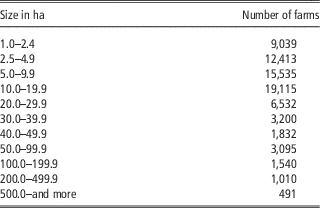
In the 1990s, farms developed on the inherited land. There were thousands of requests for land received. By November 1, 1990, 72% of the land in rural areas had already been awarded to 7,296 farms in the total area of 151,888 hectares. The responsiveness to the land reform was great. Without going into its technological problems, it should only be mentioned that, according to the data of the State Land Service, in 1999 already 101,167 farms were organized and 147,048 household plots were created (Boruks, Reference Boruks2003). Table 1 shows the structure of agricultural land by farm size groups. It can be seen that small scale farms in area of 10–19.9 hectares constitute the highest share (Lauku saimniecību grupējums 2016).
Grouping of farms by utilized agricultural area (2013)

The fields in Latvia reveal great heterogeneity of spatial soil properties and yield variability. The precision crop farming technologies were introduced mainly in large scale farms in Latvia, with more than one thousand hectares. Unpredictable weather conditions and variability have great influence on spatial yields. Looking at the precision crop farming from fertilization point of view, for the most appropriate decision the agronomist takes into account various aspects. The most important of them are yield mapping and soil analysis. In the territory of Latvia there are only a few areas that are rich in phosphorus and potassium. More worries for Latvia farmers are created by the elements that block the wholesome nutrition of the plant, such as calcium (Ca) and magnesium (Mg), especially in Zemgale (middle part of Latvia) and Kurzeme (west part of Latvia) regions. For the soils with low soil pH it is dangerous if aluminum (Al) and iron (Fe) ion exposure on plant nutrients, especially on phosphorus. Then in the result of the reaction aluminum phosphate is created. (Freimanis, Reference Freimanis2016).
Traditional methods – fertilizing with nitrogen at a constant dose – do not provide the ability to fertilize the plants in a controlled and efficient way. For this reason, already 20 years ago the first nitrogen sensor system’s development was implemented. For the sensor user – the farmer – the aim is to use the system for removing the faults that cannot be removed by traditional method of plant fertilization, i.e. to apply the correct dose of fertilizer in the right time in each area. When using the nitrogen sensors fully the farmer can increase the efficiency of nitrogen fertilizer. The efficiency has also additional benefits: reduced agricultural production cost, more profit from each hectare, reduced raw material consumption, improved crop resistance against the rain, reduced harvest costs, reduced GHG emissions, decreased inadequately intensive farming devastating impact on the environment, increased yield and quality (Bērziņš, Reference Bērziņš2016). Within the research there were two farms surveyed: Vilcini 1 and Riekstini that were among the first ones in Latvia to be engaged in the precision agriculture and these are presented as case studies.
Vilcini 1
The farm Vilcini 1 was founded in 1992 on 74 ha of inherited land. In 2013, it managed 2,184 ha of agricultural land of which 1500 ha are owned while the rest are leased. The farm has 80 fields; the farthest ones are located 90 km away. From farm-sown area there are approximately 1,500 hectares of winter wheat, 450 hectares of winter rape, 80 hectares of fodder beans, 55 hectares of peas and the rest is fallow. The farm has 18 workers full-time employees, but during the high season an additional four employees are hired.
The farm has modernized grain storage towers, grain dryers, grain pre-processing and owns 11 tractors, eight of which are John Deere (USA, distributor DOJUS Latvia). For more than 20 years, Vilcini 1 farm has successfully engaged in agricultural production, and launched the use of precision farming technology in 2003. Different prescription maps allow the site specific administering of nitrogen, phosphorus and potassium. Nitrogen fertilization is done with an AO Greenseeker (FarmFacts, Germany) sensor that determines fertilizer rate, so that the plant receives exactly as much as it needs. Spraying machines are equipped with a nozzle automatic disconnection function that electronically regulates the required dose. The fertilizer spreaders provide automatic dose adjustment. In order to provide continuous meteorological data preservation and comparison, the farm has installed its own meteorological stations of air temperature, wind speed and direction, rainfall, atmospheric pressure, soil and humidity measurements. The meteorological station enables the current weather conditions to be accessed at anytime and anywhere as data are automatically entered into a computer and are accessible via the Internet.
Most of the operational equipment is equipped with GPS devices: sowing and soil tillage is managed with GPS –enabled automatic steering. The automatic and parallel driving systems reduce soil compaction and shorten operations, as well as being more precise and economical. As a result, the farmer consumes less time for work, saves the fuel and plant protection products. Harvest is by one Claas Lexion (Harsewinkel, Germany) combine and three John Deere combines (USA, distributor DOJUS Latvia) that also provide the harvest records. All the necessary information is stored on the software AO Agrar Office AgroWin (FarmFacts, Germany) through which the obtained information is easy to manage, to save and to analyze. The software was introduced in 2010. The tasks are created for the fertilizer spreaders to ensure accurate fertilizer distribution, also the orthophoto maps, topographic maps, and drainage maps and combine harvester cards are stored. The farm cooperates with the company AgTech Ltd (Latvia) that provides services in the precision agriculture. The company has more than 25 years of experience in precision field management and in product development, marketing and service. Thus, farms are able to purchase the software, precision fertilizer equipment, carry out soil analysis and obtain meteorological stations data (Burmistris and Cēsniece, Reference Burmistris and Cēsniece2014).
Riekstini
The Riekstini farm can be considered the leader in agri-technologies on the eastern side of Latvia. The farm was founded in 1992, on the grandfather’s legacy of land of 5 hectares, but now totals 2,300 ha and employs 30 staff. They started to work with the precision farming technology in 2010. The first digital soil analysis maps were used in collaboration with the German company Agricon Ltd (Latvia). They used the soil maps for the first liming works. In spring 2011 an additional fertilization of winter wheat and spring wheat was performed by Yara N- sensor (Yara, Oslo, Norway, distributor Baltic AgroLatvia). Monitoring by Yara N- tester was used in each field every other day to determine the amount of chlorophyll in leaves. Monitoring must be carried out in order to know how many plants require N, as it is affected by temperature and moisture conditions.
In the beginning of summer 2016 there was a prolonged drought in the north east of Latvia. Due to the dry weather, the applied granular fertilizer could not dissolve, there was a decision taken to work with liquid fertilizers. On the farm, pre-sowing granulated phosphorus and potassium fertilizers are spread according to soil maps and the tractors are equipped with two fertilizer spreaders – one is located at the rear of the tractor, the other – at the front. Since autumn 2016, harvest mapping has been implemented. Winter months are used for analysis, yield maps are compared to the soil fertility tests. The fertilization plans are drawn up according to the results of past 5 years. The agrochemical analyses will be repeated in the successive five years. All the fields on the farm have prescription maps that are made according to the soil composition and crop requirements and fertilizers are distributed in accordance with these digital maps, using GPS system. Nowadays, an agronomist is also familiar with electronics, mechanics, and meteorology (Brauna, Reference Brauna2013).
The scientific research in precision farming in arable fields in Latvia
Since 2004, the usage of GPS, GIS, sensors and other state of art technologies are an integral part of the work of the Department of Soil Management of the Institute of Soil and Plant Sciences. The main objective of the scientific work of the Department of Soil Management has been assessing technologies in areas with uneven soil fertility indicators. It was established that the organic matter content in soil, the thickness of A horizon (humus layer) and the values characterising the relief are playing an essential role in the decision making system for soil tillage difference in the winter wheat yields. In the field studies with stationary GPS observation points in moraine hills it was confirmed that there are effects on soil heterogenity and differences in the relief on winter wheat (Triticum aesativum) yield.
The studies of the Institute of Soil and Plant Sciences, including Division of Field Management, continued in stationary GPS points that were created in the time period from 2004 to 2007 to gather observations and analysis of the results in areas with moraine hills typical in Latvia. During 2010–2013, the studies and publications focused on the characteristics of relief and subsoil, as well as on the weed in festation in the formation of difference between the yields of winter wheat and winter rape (Lapiņš, Reference Lapiņš2013).
In 2003 the researchers of the Ulbroka Research Centre (now called the Research Institute of Agricultural Machinery ) started investigations into precision agriculture, and were joined by in 2004 research agronomists from the Institute of Soil and Plant Sciences (Vilde et al., Reference Vilde, Lapiņš, Dinaburga, Cesnieks and Valainis2012). The investigations were done in several directions: yield and weed monitoring, environmentally friendly drying grain, plough parameters impact on efficiency of the plowing, soil moisture impact on the energy consumption in the plowing process. Research was performed at the farm Vecauce of the Latvia University of Agriculture.
Precision dairy farming
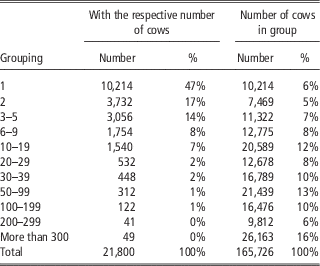
The dairy industry in Latvia remains fragmented: in 2015, small farms with just 1–5 cows were 77% of all the farms (Table 2). The average number of cows in the herd in 2015 was 8.1 (Table 2). Each year the number of small farms is decreasing. Overall, in 2015 1,722 dairy farms ceased operation and there were 46.4% of the cows that were kept in farms with at least 50 cows – such holdings constitute only 2.7% of the total number of farms (Lauksaimniecības gada ziņojums 2016).
Distribution of holdings by number of dairy cows on 01/01/2015

Nowadays, thanks to the achievements in the field of electronics and computer engineering there are possibilities to implement the precision livestock farming. In Latvia herd and calf management systems are being introduced. These are installed both in farms with only 20 cows and in bigger farms with as many as 600 cows (Laurs, Reference Laurs2016). In 2006, the company DeLaval (Tumba, Sweden) installed the very first milking robots in Latvia. Those were installed in the farm Diamonds, located in Blome parish, and in the teaching and research farm Vecauce. The Latvia representative of the company Lely (Netherlands, distributor Center Riga ProCeva Ltd) installed their first milking robot in 2012 in the farm Muižgaļi located in the Varves parish Ventspils region. The company GEA Farm Technologies (Germany, branch office Ozolnieki, Latvia) in 2013 installed their double milking robot in the farm Tauriņi located in Asaru parish in Aknīste district. Currently, there are 55 milking robots installed in 21 holdings in Latvia (Laurs, Reference Laurs2016).
Precision beekeeping
Beekeeping is one of the branches in agriculture where precision agriculture methods can be applied successfully. One of the monitoring objectives of precision agriculture is to develop real time on-line tools with automatic solution for continuous monitoring of bees during their life and production, thus avoiding exposure of the bees to additional stress or unproductive activities. In the passive winter period it is important to recognize automatically such events as the death of the bee colony and have up to date information about the state of the brood rearing and food consumption process. Latvia University of Agriculture performed the research on how to control the bees hibernation during winter by using temperature sensors in the bees hives (Zacepins et al., Reference Zacepins, Stalidzans and Meitalovs2012).
Initially, the precision farming was beneficial only for the large farms due to the high initial investment costs for the electronic equipment. In recent years, monitoring of external environment has become the most important component of precision farming. Currently, external environment monitoring in large areas takes place in real time, which allows making the decisions on certain activities in the field quickly.
During the period 2010–2013 the scientists of the Latvia University, Institute of Electronic and Computer science, Latvia University of Agriculture in collaboration with cranberry growers conducted research in the computational field in agriculture – how to protect cranberries from spring frosts. As a result, the long-range autonomous power wireless sensor networks (WSN) technology was created. It is important that the precision farming using WSN support is especially efficient in small farms, such as cranberry fields, orchards or apiaries (Tikuma, Reference Tikuma2013).
Conclusion
The establishment of the system Soil – Yield that occured in Latvia during 1970–80s could be considered the beginning of the precision farming with available technologies. In the 1990s, as a result of the Land reform, family farms were founded in Latvia. The newly established farms began to purchase necessary agricultural machinery. The precision farming technology in Latvia appeared in the 2000s, mainly in the large-scale farms with the area of over 1,000 ha. First, farmers focused on soil analysis and yield mapping, but in subsequent years, fertilizer maps and variable rate technologies have been applied. In perspective there is an intendent to develop precision farming technologies in small- and medium-sized farms. Also farms started using field robots and drones. In Latvia in the last years precision livestock farming, precision beekeeping, precision cranberries growing are used. Since 2004 there have been active precision farming research aactivities in Latvia.