Introduction
Low-diversity cropping systems and short crop rotations dominate intensive arable farming. Globally, 18.8% of the arable land is dedicated to pulses, soybean and groundnuts (FAOSTAT, 2022). In Europe, on the other hand, cereals occupy 43% of arable land, and only about 4% is allocated to soybean and pulses. This imbalance leads to frequent cereal–cereal rotations, which have been shown to negatively impact crop productivity and soil health (Chauhan et al., Reference Chauhan, Mahajan, Sardana, Timsina, Jat and Sparks2012), while continuous cereal cropping promotes weed infestation (Woźniak, Reference Woźniak2020). Therefore, diversification practices are essential to ensure the sustainability of agricultural systems.
The temporal enhancement of agrobiodiversity in cropping systems through crop rotation offers numerous benefits to ecosystems. Legume-based rotation improve the nitrogen (N) cycle in the soil-plant system due to legume residues and biological N fixation, providing a long-term supply to subsequent crops (Peoples et al., Reference Peoples, Brockwell, Herridge, Rochester, Alves, Urquiaga, Boddey, Dakora, Bhattarai, Maskey, Sampet, Rerkasem, Khan, Hauggaard-Nielsen and Jensen2009), also increases soil carbon (C) levels (Drinkwater et al., Reference Drinkwater, Wagoner and Sarrantonio1998; Li et al., Reference Li, Tang, Hou, Li, Xie, Lu, Zhang, Liao and Wen2023). Global consumption of synthetic nitrogen (N) fertilisers increased from 85 to 118 million tons in the 21st century (FAOSTAT, 2022). However, the average use efficiency of N-fertilisers in wheat has been estimated to be only 42% on a global level (Yu et al., Reference Yu, Keitel, Zhang, Wangeci and Dijkstra2022); besides, N lost from agriculture has several negative environmental effects. On the other hand, a modelling approach showed that many negative environmental impacts of intensive application of mineral N fertilisers (like emission of greenhouse gases and eutrophication of waters) can be reduced if a legume is included in cereal rotation (Weiner et al., Reference Weiner, Moakes, Raya-Sereno and Cooper2024). With the EU Green Deal’s Farm to Fork Strategy (European Commission, 2020) aiming to reduce fertiliser use and nutrient losses, there is a growing need for evidence-based strategies that promote sustainable nutrient management. In European cropping systems, grain legumes have been shown to increase the yield of a subsequent cereal crop by 0.5 to 1.6 t/ha in comparison to a cereal pre-crops (Preissel et al., Reference Preissel, Reckling, Schläfke and Zander2015). Recent studies have also provided valuable insights into the diverse effects of legumes as preceding crop in cropping systems in Europe (for reviews see Ditzler et al., Reference Ditzler, van Apeldoorn, Pellegrini, Antichi, Bàrberi and Rossing2021; Notz et al., Reference Notz, Topp, Schuler, Alves, Gallardo, Dauber, Haase, Hargreaves, Hennessy, Iantcheva, Jeanneret, Kay, Recknagel, Rittler, Vasiljević, Watson and Reckling2023; Tzemi et al., Reference Tzemi, Rämö, Palosuo, Peltonen-Sainio, Wejberg and Lehtonen2024). A global systematic review by Zhao et al. (Reference Zhao, Chen, Beillouin, Lambers, Yang, Smith, Zeng, Olesen and Zang2022) suggests that legume-based rotations are a critical pathway for enhancing global crop production, especially when integrated into low-input and low-diversity farming systems.
In addition to yield increases, the soil N benefits provided by legumes may also contribute to improvements in cereal grain quality. However, the effects of preceding crops on grain mineral concentrations have been rarely reported (Chen et al., Reference Chen, Zhang, Tong, Xue, Liu, Zhang, Deng, Meng, Yue, Yan, Cui, Shi, Guo, Sun, Ye, Wang, Jia, Ma, He, Zhang, Kou, Li, Tan, Cakmak, Zhang and Zou2017). A recent study by Xia et al. (Reference Xia, Li, Qiao, Xue, Yan, Ma, Zhao, Kong, Xue, Cui and van der Werf2023) suggests that appropriate N fertilisation combined with crop rotation can achieve high wheat yields while mitigating the dilution of grain zinc (Zn) density. Increased N levels and improved N-nutritional status in wheat plants are associated with enhanced accumulation of Zn, iron (Fe) or copper (Cu) in grains (Shi et al., Reference Shi, Zhang, Chen, Sun, Zhang, Römheld and Zou2010; Cakmak et al., Reference Cakmak, Pfeiffer and McClafferty2010). Moreover, research indicates that remobilisation of Zn, Fe and N from leaves, and their translocation into the grain, is linked to leaf senescence and regulated by similar genetic mechanisms (Uauy et al., Reference Uauy, Distelfeld, Fahima, Blechl and Dubcovsky2006; Econopouly et al., Reference Econopouly, Van Veldhuizen, Lyon, Killilea, Zhang and Jones2019). Protein and Zn staining studies have also revealed co-localisation of Zn and protein within durum wheat grain, particularly in the embryo and aleurone layer (Kutman et al., Reference Kutman, Yildiz, Ozturk and Cakmak2010). Achieving sustainable wheat production with enhanced grain micronutrient density requires a deeper understanding of the benefits of including legumes in crop rotations, especially in low-input cropping systems.
Soybean is the dominant grain legume globally in terms of biological N2 fixation, accounting for about 60% of total N fixed in the Americas, whereas Europe and Oceania combined contribute only 4% (Herridge et al., Reference Herridge, Giller, Jensen and Peoples2022). The effects of soybean as a pre-crop on subsequent cereals have been well documented (Karlen et al., Reference Karlen, Kovar, Cambardella and Colvin2013; Munkholm et al., Reference Munkholm, Heck and Deen2013; Yang et al., Reference Yang, Xiong, Du, Ju, Gan, Li, Xia, Shen, Pacenka, Steenhuis, Siddique, Kang and Butterbach-Bahl2024). Global meta-analyses suggest that cereal yields without N fertilisation are, on average, 30% higher when preceded by soybean compared to cereal–cereal systems, with some cases showing even greater increase, though only two European sites were included (Cernay et al., Reference Cernay, Makowski and Pelzer2018). This knowledge gap is especially critical given the context of soil degradation, climate change and evolving cereal genotypes, which demand localised studies under varying pedoclimatic conditions. Furthermore, there is limited information regarding the impact of soybean on micronutrient concentrations in wheat grain within low-input cropping systems.
The aim of our study was to assess the magnitude of soybean pre-crop effect on both winter wheat grain yield and micronutrients density without fertiliser inputs. This study is part of a long-term crop rotation systems study evaluating wheat productivity in cereal-cereal and soybean-based rotation. In the vast majority of the published work on soybean inclusion in rotation, the experimental design did include some fertilisation and irrigation regime, such as trials conducted in Spain by Simon-Miquel et al. (Reference Simon-Miquel, Reckling, Lampurlanés and Plaza-Bonilla2023). On the contrary, this work isolates the pure effect of soybean based rotation, since the trials have not been fertilised over long period of time. To the best of our knowledge, no published studies in Europe have assessed the long-term impact of inclusion of soybean in maize-winter wheat rotation on wheat yield and micronutrient accumulation in grains under unfertilised Chernozem conditions.
Materials and methods
Experimental site and crop rotation treatments
The field experiment was conducted at the research station of the Institute of Field and Vegetable Crops, located in Rimski Šančevi, near the city of Novi Sad, in Vojvodina Province, Serbia (45°21′ N, 19°50′ E, 84 m a.s.l.). Vojvodina Province is part of Pannonian basin. The soil at the site is characterised as calcareous Chernozem, CH-cc-ai.lo.ph (IUSS Working Group WRB, 2022). The climate of the region continental, with an annual precipitation of approximately 640 mm, and mean annual temperature of around 12°C. Weather data for five growing seasons and 10-year average are given in Figure 1.
Mean air temperatures and rainfall for five consecutive wheat growing seasons from 2018-2019 to 2022-2023 and the 10-year average at Rimski Šančevi, Serbia.

The results presented in this manuscript were collected over five consecutive winter wheat growing seasons (2018 to 2023) as a part of long-term crop rotation trials established in 1946, with a low-input cropping system without fertilisation. The experimental design included two rotation systems with common wheat (Triticum aestivum L.): maize-winter wheat (M-W) and maize-soybean-winter wheat (M-S-W) (Figure 2). All crops in rotations were grown every year. The experiment was established with aim to test the agroecosystem capacity for crop production; therefore, all plots in both rotation systems have not received any fertilisation since the beginning of the trial. Each crop in both rotation systems was grown on 20 m × 40 m plot. Maize and soybean were sown in spring; soybean was harvested early September, and maize was harvested late September or early October. After harvesting the preceding crops in the rotations, conventional tillage practices included incorporation of crop residues into soil by moldboard plowing, followed by disc harrowing and seedbed preparation each year. Plowing depth was 25–30 cm. Common winter wheat cv. Zvezdana developed by the Institute of Field and Vegetable Crops, Serbia, was planted in late October each season, at a sowing rate of 500 seeds/m2, and harvested in late June or early July. The experiment was conducted under rainfed conditions.
Gantt chart of two long-term crop rotation trials: maize-winter wheat (M-W) and maize-soybean-winter wheat (M-S-W). Trials started in 1946, but details on the timing of plant and soil sampling are shown only during this study period (2018-2023). Letters indicate months of the year.

Analytical approach for wheat grain yield under pseudo-replication
In this long-term field experiment, treatments (rotation systems) are assigned to fixed plots without full spatial randomisation or multiple independent spatial replicates. As a result, the design lacks true spatial replication and is therefore classified as pseudo-replicated (Hurlbert, Reference Hurlbert1984). This limitation is common in many historical long-term experiments, including the well-known Broadbalk Wheat Experiment at Rothamsted, where logistical and historical constraints have similarly prevented full spatial randomisation (Macholdt et al., Reference Macholdt, Piepho, Honermeier, Perryman, Macdonald and Poulton2020).
To address the limitations of pseudo-replication, the analysis relies on temporal replication: multiple years of observations provide repeated sampling of the same treatment contrasts (treatment × year), enabling inference about treatment effects through joint (multi-year) analysis. Each year of data collection offers a new observation of treatment performance. Accordingly, the statistical design was represented analytically by modelling treatment as a fixed factor and year (along with the treatment × year interaction) as random effects in a linear mixed model. Serial dependence between repeated observations on the same plots was accounted for using a first-order autoregressive covariance structure (AR(1)).
Soil sampling and analyses
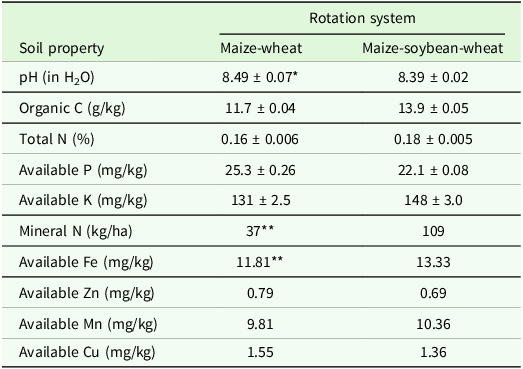
A composite soil sample was obtained by collecting multiple individual soil cores 0–30 cm and mixed them into a single, representative sample. Samples were taken in all plots in two rotations after harvest of crops in 2018. Air-dried soil samples were sieved through a 2-mm sieve. The concentration of total N was determined by direct combustion of the dried soil samples using CHNS analyser, and soil organic C was measured using oxidation method according to Tyurin (Reference Тюрин1931). Plant available phosphorus (P) and potassium (K) fractions were determined following the procedure involving ammonium acetate-ammonium lactate, pH 3.7 extraction (Egner et al., Reference Egner, Riehm and Domingo1960), and their concentrations were measured by the colorimetric molybdenum blue method and by using flame photometer, respectively. The concentrations of plant available micronutrients (Fe, Zn, Mn, Cu) in soil were determined based on soil samples collected only in wheat plots before sowing in 2022, extracted by DTPA-TEA solution (buffered at pH 7.3), with the soil: solution ratio of 1:2 (Lindsay and Norvell, Reference Lindsay and Norvell1978). At the end of February 2023, additional soil samples were taken only in wheat plots at three depths (0–30 cm, 30–60 cm, and 60–90 cm) to measure mineral N, following the method of Scharpf and Wehrmann (Reference Scharpf and Wehrmann1975), calculated as the total amount of mineral N per hectare at 0–90 cm. Selected soil characteristics are presented in Table 1. Mean value of the total N and organic C levels for two plots in M-W rotation were 0.16% and 11.7 g/kg, whereas mean for three plots in M-S-W was higher for both 0.18% and 13.9 g/kg, respectively. In addition, mineral N in M-S-W was three times higher than in M-W. Both experimental soils were low in available P (22.7 and 19.2 mg/kg). The concentrations of plant available micronutrient in soil were adequate in both rotations.
Selected properties of soils in maize-wheat (M-W) and maize-soybean-wheat (M-S-W) rotations

* For measurement of pH, organic C, total N and available P and K soil samples were taken in all plots at the beginning of 5-y trial after harvest of each crop in 2019. Values are means±SE for 2 plots in M-W rotation and for 3 plots in M-S-W rotation.
** For measurements of micronutrients and mineral N (amount at 0–90 cm depth) soil samples were taken only in the wheat plots before sowing wheat in 2022 and in spring of 2023, respectively.
Wheat yield components
Winter wheat experimental plots (20 m × 40 m each) were divided into three pseudo-replicates; from each pseudo-replicate 15 m2 was harvested using a small plot combine harvester Wintersteiger Delta (Wintersteiger AG, Austria), and wheat grain yield (at 13% moisture) was determined for five growing seasons. At harvest in 2023, plant samples were taken from each pseudo-replicate, and following yield components were determined: number of spikes/m2, thousand-grain weight (TGW), number of grains per spike, grain weight per spike, and harvest index was measured as the ratio of grain yield to the total aboveground biomass. For spike and stem measurements ten uniform plants were used.
Grain analyses
Grain micronutrient concentrations and protein content were measured in two growing seasons, 2021-2022 and 2022-2023, in samples taken from three pseudo-replicates, and micronutrient yields were calculated. For measurement of micronutrients in grain, samples were rinsed with distilled water, dried at 70°C and ground using knife mill (WZ-1, SWANTECH, France). Grain samples (0.2 g) were digested with a 3 ml of concentrated HNO3 and 2 ml of H2O2 in a microwave oven (Ethos Easy, Milestone Srl, Sorisole, Italy). After preparation of grain and soil samples, the microelement concentrations were measured by inductively coupled plasma optical emission spectrometry (ICP-OES; SpectroGenesis EOP II, Spectro Analytical Instruments GmbH, Kleve, Germany). Grain protein content (at 13% moisture basis) was determined using near-infrared spectroscopy (Instalab 600 NIR Analyzer, Dickey John, USA).
Weather conditions during the study period
The weather conditions, particularly precipitation, differed between five growing seasons (Figure 1). In comparison to 10-y average, precipitation sum for winter wheat growing seasons (from October to June) 2019-2020 and 2022-2023 were similar and slightly lower in 2018-2019. In contrast, much lower precipitation was recorded in 2020-2021, while in 2021-2022 it was three-fold lower than 10-y average. Additionally, severe symptoms of leaf rust were recorded in 2022-2023 season, due to very high precipitation in May.
Statistical analyses
Analyses of winter wheat grain yield were conducted using linear mixed models fitted by restricted maximum likelihood (REML) to account for the lack of classical spatial replication and the presence of repeated measurements on permanent plots. Treatment (M–W, M–S–W) was modelled as a fixed effect, while Year and the Year × Treatment interaction were modelled as random effects to capture temporal variability and treatment-specific interannual responses. Serial correlation among repeated observations on the same plots was modelled using a first-order autoregressive covariance structure (AR(1)). Models were fitted in GenStat 12 (VSN International) using the REML procedure.
Reported outputs include fixed-effect estimates (estimate ± SE, test statistic and P value), variance components for the random terms (Year, Year × Treatment and residual) and the AR(1) parameter (ρ). Pairwise comparisons of treatment least-squares means were performed using Tukey’s adjustment at P < 0.05. Diagnostic checks (standardised residuals, Q–Q plots and residuals vs. fitted values) revealed no major departures from model assumptions. Results of the analysis are provided in a separate file (Supplementary Material).
The effects of crop rotation on grain micronutrients and protein content, and other reported traits were evaluated by one-way ANOVA, and means were compared by Tukey’s test at P < 0.05, using STATISTICA 6 software package.
Results
Grain yield and yield components
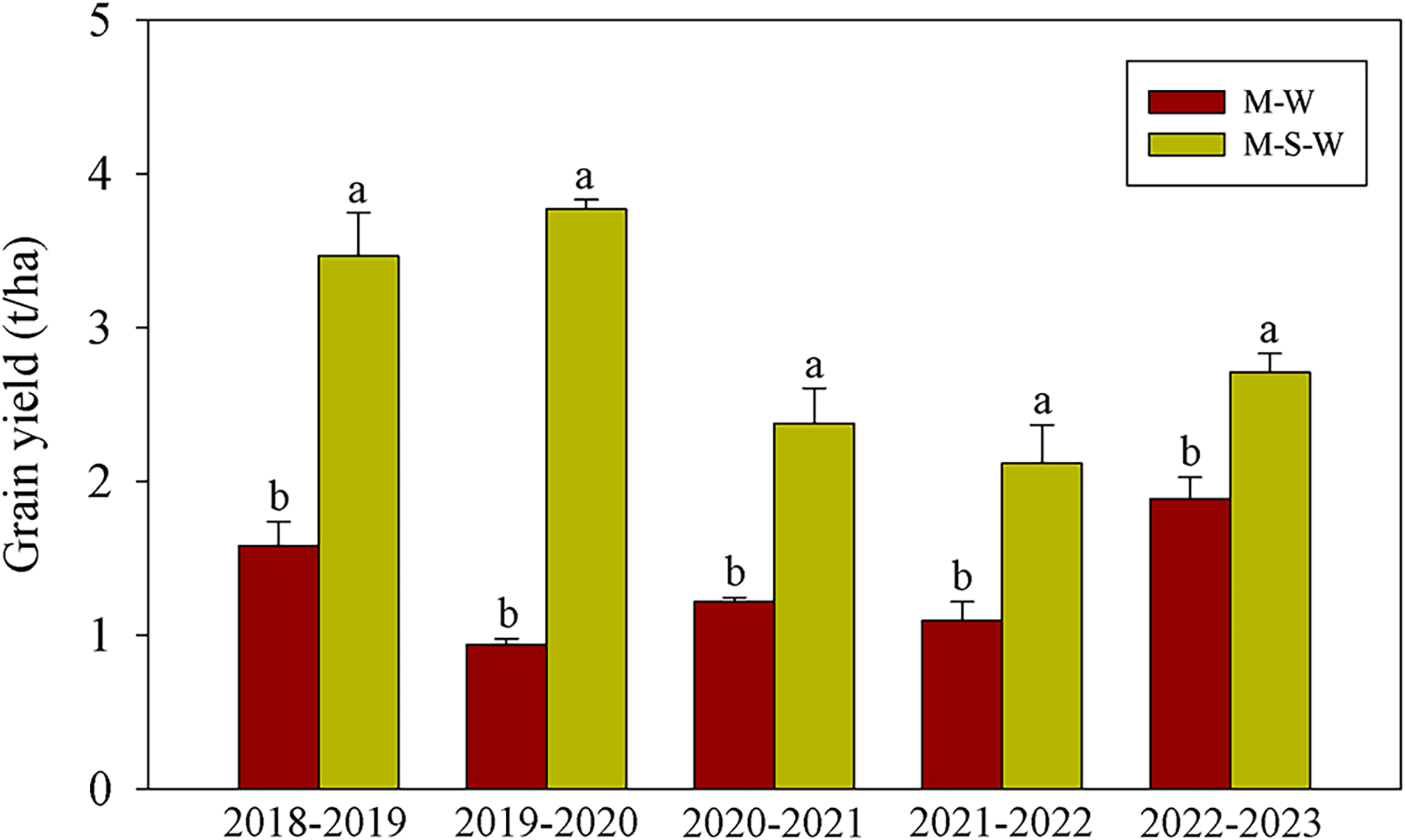
The REML mixed model revealed a highly significant effect of soybean as the preceding crop on winter wheat grain yield. Estimated marginal means were 2.890 ± 0.054 t/ha for the M–S–W rotation and 1.344 ± 0.383 t/ha for the M–W rotation (Supplementary Tables S1 and S3). Variance component estimates indicated a Year variance of 0.088 t2/ha2 (i.e., SD = 0.297 t/ha), a Year × Treatment variance of approximately 0.162 t2/ha2 (SD = 0.402 t/ha), and a residual variance of approximately 0.162 t2/ha2 (SD = 0.402 t/ha). The AR(1) parameter was ρ = 0.324, indicating moderate serial correlation between consecutive years (Supplementary Table S2). Diagnostic plots (Supplementary Figures S1–S3) support the adequacy of model assumptions. Wheat grain yield in M-S-W was consistently and significantly higher than in M-W across all seasons (Figure 3). From the first through the fifth season, yields in M-S-W exceeded those in M-W by 119%, 301%, 95%, 93% and 43%, respectively.
Grain yield of winter wheat in maize-wheat rotation (M-W) and maize-soybean-wheat rotation (M-S-W) in five consecutive growing seasons, from 2018-2019 to 2022-3023. Means followed by different letters are significantly different according to Tukey test (P < 0.05). Error bars indicate SE.

The results on yield components obtained in 2022-2023 season (Table 2) indicated that the higher grain yield in M-S-W was linked to a significantly greater number of grains per spike and higher grain weight per spike compared to M-W Although the number of spikes/m2 was slightly higher in M-S-W than in M-W, the differences was not statistically significant, nor were differences observed for TGW or harvest index.
Number of spikes/m2, number of grains per spike, grain weight per spike, thousand-grain weight (TGW) and harvest index of winter wheat in maize-wheat rotation (M-W) and maize-soybean-wheat rotation (M-S-W) in season 2022-2023

Values represent mean ± SE. Means followed by different letters within the same column are significantly different according to Tukey test (P < 0.05).
Zn, Fe, Cu and Mn concentrations in grain
The concentrations of micronutrients in wheat grain were significantly affected by crop rotation system (Figure 4). In the 2021-2022 growing season, grain Zn in M-S-W was significantly higher than in M-W (24.8 mg/kg and 20.6 mg/kg, respectively), and also in 2022-2023 (34.4 mg/kg and 29.2 mg/kg, respectively). The M-S-W rotation also resulted in significantly higher grain Cu in comparison to M-W in both 2021-2022 (4.6 and 4.1 mg/kg, respectively), and 2022-2023 growing season (4.4 and 3.4 mg/kg, respectively). In contrast, grain Mn concentration was slightly, but significantly lower in M-S-W than in M-W in 2021-2022 season, as was grain Fe concentration in 2022-2023. On the other hand, yield of all tested microelements in M-S-W was significantly higher than in W-M, due to higher grain yield in M-S-W.
Grain concentration and yield of Fe, Zn, Mn and Cu of wheat grown in M-W (maize-wheat) and M-S-W (maize-soybean-wheat) rotation in 2021-2022 and 2022-2023. Means followed by different letters are significantly different according to Tukey test (P < 0.05). Error bars indicate SE.

Protein content in grain
In the 2021-2022 season, the grain protein content of 10.8% in wheat grown in M-S-W was significantly higher than the 9.7% observed in M-W (Figure 5). Similar results were obtained in 2022-2023 season, when grain protein content of 10.7% in M-S-W was significantly higher than 9% obtained in M-W.
Effect of M-W (maize-wheat) and M-S-W (maize-soybean-wheat) rotation on grain protein content and protein yield in 2021-2022 and 2022-2023. Means followed by different letters are significantly different according to Tukey test (P < 0.05). Error bars indicate SE.

Discussion
This long-term field experiment, maintained without any fertilisation over seven decades, offers an exceptionally valuable context to examine the intrinsic effects of crop rotation on soil fertility and crop performance in the absence of external nutrient inputs. Within this setting, we were able to clearly evaluate the contribution of soybean as a preceding crop to wheat performance on Chernozem soils, independent of fertilisation-related confounding factors. While the experimental design didn’t include spatial randomisation or true replication of crop-rotation plots, the exceptional duration and consistency of the study provided valuable and reliable data. Our findings demonstrate a consistent and significant soybean pre-crop effect on both wheat grain yield and micronutrient concentrations in an unfertilised cropping system.
Although much of the N2 fixed by legumes is exported with the protein-rich grain, the below-ground nitrogen pool remains an important source of N for subsequent crops (Peoples et al., Reference Peoples, Brockwell, Herridge, Rochester, Alves, Urquiaga, Boddey, Dakora, Bhattarai, Maskey, Sampet, Rerkasem, Khan, Hauggaard-Nielsen and Jensen2009). It is well-established that external N fertilisation suppresses symbiotic N2 fixation in legumes, for example, in common bean (Reinprecht et al., Reference Reinprecht, Schram, Marsolais, Smith, Hill and Pauls2020) and soybean (Cordeiro and Echer, Reference Cordeiro and Echer2019). Soybean N2 fixation typically ranges from 60–150 kg N/ha in conventional farming systems (Barbieri et al., Reference Barbieri, Starck, Voisin and Nesme2023), but it can reach 290 kg N/ha under unfertilised conditions, with this potential declining as soil inorganic N increases at sowing (Guinet et al., Reference Guinet, Nicolardot, Revellin, Durey, Carlsson and Voisin2018). The marked difference in soil mineral N between the M-S-W and M-W systems in our study (Table 1) highlights the N benefit conferred by soybean in low-input systems. Remarkably, the 109 kg/ha of soil mineral N recorded in M-S-W exceeded even the 83 kg/ha obtained in a maize–wheat rotation trial at the same site that received N fertilisation (unpublished data), emphasising the N-enriching effect of soybean. In addition, our results also indicate that long-term soybean inclusion benefits soil organic C stocks, which is consistent with findings from soybean–maize rotation in China (Luo et al., Reference Luo, Zhou, Yao, Wang, Guillaume, Yuan, Han, Bilyera, Wang, Zhao, Yang, Zeng and Zang2024).
In recent studies conducted in Europe, variable results on soybean’s pre-crop effect on wheat grain yield have been reported. Thus, wheat yield grown after soybean was inconsistent over two seasons in an organic system in Lithuania (Toleikienė et al., Reference Toleikienė, Brophy, Arlauskienė, Rasmussen, Gecaitė and Kadžiulienė2019), whereas in Poland, wheat yields were 9.6% higher after soybean than after oilseed rape under NPK fertilisation (Gawęda and Haliniarz, Reference Gawęda and Haliniarz2021). Our five-year dataset derived from a long-term rotation trial, provides clearer insight into the magnitude and stability of the soybean pre-crop effect under conditions without fertilisation. The consistently higher wheat yields with soybean inclusion underscore the role of legumes in sustainable cereal production. Seasonal variability in wheat yield responses can be attributed to differences in precipitation differences and disease pressure (e.g. leaf rust). Similar beneficial effects of legumes were found in Cyprus, where durum wheat grown after vetch, chickpea and broad bean yielded more than wheat grown after wheat under non-fertilised conditions (Dalias, Reference Dalias2014). However, under dry conditions, wheat yield in a soybean–wheat rotation was reduced relative to maize–wheat, regardless of N fertilisation (Nie et al., Reference Nie, Zhou, Zhao, Wang, Liu, Wang, Wang, Yang, Zang, Harrison, Yang and Zeng2022). Additionally, the number of tillers and nitrogen concentration in the grain were reduced when winter wheat followed soybean, compared to when it followed either spring wheat or an oat–pea mixture (Anderson, Reference Anderson2008). In our study, however, the threefold increase in soil mineral N in M-S-W contributed to enhanced spike development and grain set, leading to higher grain weight per spike. A moderate increase in number of spikes/m2 suggests improved tillering under elevated soil N. A similar pattern of yield component improvement in wheat grown without mineral N inputs after legumes was reported by Mesfin et al. (Reference Mesfin, Gebresamuel, Haile and Zenebe2023).
Producing wheat grains enhanced with Zn and Fe is relevant for human health; low levels of these micronutrients in wheat have been reported globally, including in Serbia (Nikolic et al., Reference Nikolic, Nikolic, Lj, Pavlovic, Bosnic, Stevic, Savic and Hristov2016). Micronutrient accumulation during grain filling depends on phloem mobility and capacity for long distance translocation in plants. Zinc, for example, is efficiently remobilized from leaves, whereas Mn shows much poorer mobility (Pearson and Rengel, Reference Pearson and Rengel1994). Previous research also demonstrated very low remobilisation of Fe to wheat grains (Hocking, Reference Hocking1994), also lower in comparison to Zn, based on the changes in their concentrations in the phloem observed from 1-2 to 9–12 days after anthesis (Palmer et al., Reference Palmer, Palmer, Rutzke, Graham and Stangoulis2014). Wheat’s N status also influences Zn uptake xylem transport, remobilisation via phloem and its accumulation in grain (Erenoglu et al., Reference Erenoglu, Kutman, Ceylan, Yildiz and Cakmak2011). Many studies have shown that applying N fertilisers, either soil-applied or foliar, can improve Zn and Fe accumulation in wheat grain as part of biofortification strategies (Kutman et al., Reference Kutman, Yildiz and Cakmak2011; Aciksoz et al., Reference Aciksoz, Yazici, Ozturk and Cakmak2011; Zhang et al., Reference Zhang, Chen, Wang, Ma, Lü, Liu and Guo2021). However, in micronutrient-limited soils, N fertilisation alone does not always enhance grain micronutrient concentration (Kutman et al., Reference Kutman, Yildiz, Ozturk and Cakmak2010; Hamnér et al., Reference Hamnér, Weih, Eriksson and Kirchmann2017). In the U.S. Central Great Plains, where soil Zn availability is low, both Zn and Fe concentrations in wheat grain declined as yields increased with N fertilisation (Miner et al., Reference Miner, Delgado, Ippolito, Johnson, Kluth and Stewart2022). Similarly, Yang et al. (Reference Yang, Wang, Gao, Zhao, Li, Li and Malhi2014) observed decreased grain Zn in wheat grown after soybean green manure on Zn-deficient soils, attributing it to the Zn dilution as a result of yield increase.
In our study, wheat grown in the M-S-W rotation had significantly higher grain Zn and Cu concentrations in both seasons examined, despite yield increases of 93% and 43% over M-W (Figs. 3 and 4). This suggests that, under adequate soil micronutrient supply, the inclusion of soybean supports both wheat yield and nutritional quality. However, a slight but significant reduction in grain Fe and Mn in one season may reflect dilution effects associated with increased yield. This is consistent with previous findings indicating that grains from distal spike positions have lower nutrient concentrations, contributing to a negative correlation between yield and micronutrient content even when soil supply is sufficient (Calderini and Ortiz-Monasterio, Reference Calderini and Ortiz-Monasterio2003; McDonald et al., Reference McDonald, Genc and Graham2008). While this study does not discuss the potential effects of other soil properties, such as low phosphorus levels, on plant growth and micronutrient uptake, we note that soil pH, micronutrients and P availability were similar in wheat plots in both rotations.
Nitrogen fertilisation is known to significantly influence N accumulation in common and durum wheat vegetative tissue and grains (Ehdaie and Waines, Reference Ehdaie and Waines2001; Dordas, Reference Dordas2009). Positive correlation between Fe and Zn, and protein content in grains have been reported in 25 spring wheat genotypes (Morgounov et al., Reference Morgounov, Gomez-Becerra, Abugalieva, Dzhunusova, Yessimbekova, Muminjanov, Zelenskiy, Ozturk and Cakmak2007), and in 175 lines of different wheat species (Zhao et al., Reference Zhao, Su, Dunham, Rakszegi, Bedo, McGrath and Shewry2009). Significantly higher both Zn and protein content in the grains of wheat grown after soybean obtained in this work aligns also with findings linking increased Zn accumulation to enhanced protein synthesis during early grain development (Martre et al., Reference Martre, Porter, Jamieson and Triboï2003; Ozturk et al., Reference Ozturk, Yazici, Yucel, Torun, Cekic, Bagci, Ozkan, Braun, Sayers and Cakmak2006). Similar results were reported by Bezabeh et al. (Reference Bezabeh, Haile, Sogn and Eich-Greatorex2022), who found higher Zn and N in wheat grain following faba bean without fertilisation. Yet, our results showed a decrease in Fe concentration in grain in M-S-W despite higher protein and soil N, differing from results by Shi et al. (Reference Shi, Zhang, Chen, Sun, Zhang, Römheld and Zou2010) who reported increased Fe with N fertilisation. However, increased Cu accumulation in grain in M-S-W supports previous findings that Cu was remobilized from senescing leaves into grains in conjunction with N (Hill et al., Reference Hill, Robson and Loneragan1979).
Conclusion
The results from long-term crop rotation trials conducted on Chernozem soil clearly demonstrate the significant soybean pre-crop benefits for winter wheat grown without fertilisation in European environment. Incorporating soybean into a maize-wheat rotation on soil with adequate micronutrients supply has improved overall soil N status, resulting in substantial increase in winter wheat yield and concentrations of Zn, Cu and protein in the grain. These findings are important from an environmental perspective, as long-term soybean-based rotation with no confounding effect of fertilisation help carbon sequestration in soil and N fertility, also providing a viable solution for winter wheat production in low-input cropping systems, particularly in Eastern and Southeast Europe where Chernozem soils dominate and soybean is an increasingly important crop, as well as for organic farming which typically have low soil mineral N supply.
Supplementary material
The supplementary material for this article can be found at https://doi.org/10.1017/S0021859625100452
Acknowledgements
We are grateful to our colleagues at the Institute of Field and Vegetable Crops, Novi Sad - The National Institute of the Republic of Serbia, for their contribution in maintaining the experiments in past years.
Author contributions
JS and VA conceived and designed the study. VA, MM, SM and SŠ, conducted data gathering. JS, VA and GJ performed statistical analyses. SM, JP and MR performed laboratory analyses. JS, VA and SŠ wrote the article.
Funding statement
This work was supported by the Ministry of Science, Technological Development and Innovation of the Republic of Serbia, contracts: 451-03-137/2025-03/200116, 451-03-136/2025-03/200032, 451-03-137/2025-03/200117, 451-03-136/2025-03/200053 and by APV long-term project ‘Winter wheat nitrogen use efficiency improvement in Vojvodina’ grant number: 003069979 2024 09418 003 000 000 001/1.
Competing interests
The authors declare there are no conflicts of interest.
Ethical standards
Not applicable.