Long-term survival of patients with congenital heart defects has improved dramatically during the recent decades,Reference Nieminen, Jokinen and Sairanen 1 , Reference Khairy, Ionescu-Ittu, Mackie, Abrahamowicz, Pilote and Marelli 2 and many grown-ups with congenital heart defects now live to face potential long-term complications.Reference Opotowsky, Siddiqi and Webb 3 Cancer risk is a concern in the congenital heart defect population, owing to the potential radiation exposure from cardiac catheterisation.Reference Andreassi 4 Furthermore, congenital heart defects are associated with cancer-linked genetic factors such as Noonan syndrome,Reference Jongmans, van der Burgt and Hoogerbrugge 5 Fanconi anaemia,Reference Alter 6 and most importantly Down's syndrome.Reference Hasle, Clemmensen and Mikkelsen 7
Before the introduction of echocardiography in the 1980s, cardiac catheterisation was used to examine most children with suspected haemodynamically significant congenital heart defect, and today cardiac catheterisation is used primarily and increasingly for therapeutic purposes.Reference Bacher, Bogaert, Lapere, De Wolf and Thierens 8 In addition to the radiation from catheter-based procedures, patients with congenital heart defects are often exposed to radiation from chest X-ray and computed tomography.Reference Hoffmann, Engelfriet and Mulder 9 A recent case–control study indicates an association between radiation early in life and increased risk of childhood cancer.Reference Rajaraman, Simpson and Neta 10 Furthermore, studies have found increased levels of biomarkers of DNA damage following paediatric catheterisation, indicating an increased cancer risk.Reference Beels, Bacher, De Wolf, Werbrouck and Thierens 11 However, few studies exist on long-term cancer risk following cardiac catheterisation,Reference Modan, Keinan, Blumstein and Sadetzki 12 , Reference McLaughlin, Kreiger, Sloan, Benson, Hilditch and Clarke 13 and their interpretation is hampered by incomplete follow-up.
The complete follow-up for up to more than 30 years, in the Danish nationwide health-care registries, enables assessment of the long-term cancer risk in congenital heart defect patients compared with the risk in the general population. Owing to the fact that detailed information on cardiac catheterisation and radiation dosage is not available in these registries, our ability for causal inference in this regard is limited. Nevertheless, more knowledge on cancer risk in the congenital heart defect population, with and without Down's syndrome, will provide important additional prognostic insight.
Methods
The National Patient Registry was established in 1977, and 99.4% of all discharges from Danish medical hospitals are recorded there. Recorded information includes the civil registration number, which is unique to every Danish citizen, the dates of hospital admission and discharge, the surgical or other therapeutic procedures performed, and up to 20 discharge diagnoses, classified according to the International Classification of Diseases, 8th Revision (ICD-8) before 1 January, 1994 and later version 10 (ICD-10). It is possible to obtain the full discharge history of a patient by linking discharge records to the civil registration number. All persons born from 1 January, 1977 to 31 December, 2008 and registered in the National Patient Registry during the same period with a congenital heart defect diagnosis following hospitalisation or outpatient clinic visit were included in the study. To minimise misclassification of congenital heart defects, we excluded patients with, for example, unspecific congenital heart defect diagnoses (n = 2566), according to the current criteria of the Danish Registry of Congenital Heart Disease.Reference Olsen, Videbæk and Johnsen 14 The criteria are based on record review and consensus-based decisions of a board of paediatric cardiologists and cardiac surgeons. Please see online Appendix for specific International Classification of Diseases codes. Using the National Patient Registry, we identified patients with Down's syndrome and also the less prevalent Fanconi anaemia, both known to be associated with congenital heart defect and haematological cancers.Reference Alter 6 , Reference Hasle 15 Detailed data on catheter-based investigations and following radiation dosage were not available. However, we were able to identify the patients who underwent therapeutic cardiac interventions. These patients were more likely exposed to radiation during diagnostic examinations and clinical follow-up than patients who did not undergo cardiac interventions. Until 1987, all operated patients underwent at least one heart catheterisation. From 1987, some patent ductus arteriosus/Atrial septal defect/ventricular septal defect/pulmonary stenosis patients were operated on the basis of echocardiographic examinations alone, but some were catheterised. Catheter-based therapeutic cardiac interventions were introduced in the early 1990s and also exposed the patients to radiation.
All members of the study cohort were linked through their civil registration numbers to the Cancer Registry, which has kept records of all incident cases of cancer in Denmark (population ∼5.5 million) since 1943, including benign brain tumours. Follow-up for cancer started on 1 January, 1978, because diagnoses in the Cancer Registry have been converted to the International Classification of Diseases version 10 from this date. The inclusion of benign brain tumours is in accordance with other cancer registries, and depending on localisation benign and malignant brain tumours may have similar symptoms and outcomes. 16 Furthermore, benign brain tumours have been associated with radiation in terms of, for example, radiotherapy for tinea capitis – ringworm of the scalp – Reference Ron, Modan and Boice 17 and computed tomography scans of the brain.Reference Pearce, Salotti and Little 18 Cancers are classified according to the International Classification of Diseases version 10 and diagnoses of pre-cancerous lesions were ignored in the present study, including carcinoma in situ of the breast, dysplasia of cervix uteri, and carcinoma in situ of cervix (International Classification of Diseases version 10 codes: D05, N87, D06, O01, D39.2, D45.9, D46, D47.1, D47.3). The registration is based on notification forms that are filled in by hospital departments, including departments of pathology and forensic medicine, and practising physicians. Registration takes place whenever a case of cancer is diagnosed or found at autopsy and whenever there are changes in an initial diagnosis. The cases recorded manually are supplemented by unreported cases revealed by computerised linkages to the death certificate file and the National Patient Registry. Ambiguous or contradictory information, either within a notification form or between forms, leads to queries in ∼10% of the notifications received. Comprehensive evaluation has shown that the Cancer Registry is 95–98% complete and valid.Reference Storm, Michelsen, Clemmensen and Pihl 19
Statistical analyses
Each patient was followed up for the occurrence of cancer from the date of the first hospitalisation or outpatient clinic visit with congenital heart defect until the date of death or 31 December, 2008, whichever came first. In analyses restricted to patients undergoing therapeutic procedures, follow-up started on the date of the first procedure. We excluded patients if a cancer was diagnosed before the congenital heart defect. We used the Civil Registration System to identify dates of death or emigration, and used the national incidence rates obtained from the Cancer Registry, combined with the Civil Registration System, to compute the expected number of cancers in the congenital heart defect cohort according to sex, age, and calendar period in 1-year intervals. We computed the standardised incidence ratio as the ratio of observed to expected cases. Analyses were repeated after exclusion of patients with Down's syndrome or Fanconi anaemia, and after restriction to congenital heart defect patients undergoing therapeutic cardiac interventions, in terms of surgery or catheter-based intervention. Analyses were performed using SAS v.9.
Results
Characteristics
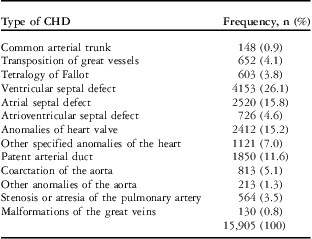
We identified 15,905 congenital heart defect patients (Table 1), of whom 796 had associated Down's syndrome and five had Fanconi anaemia, including 51% male patients. The median age at congenital heart defect diagnosis was 4 months, and 6148 (39%) underwent one or more therapeutic cardiac procedures at some point during follow-up.
Frequency of major congenital heart defect types in the overall study population (15,905 patients).

CHD = congenital heart defect
Standardised incidence ratio of cancer
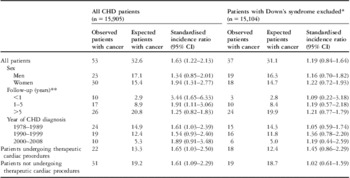
The overall standardised incidence ratio was 1.63 (95% confidence interval: 1.22–2.13), based on 53 observed and 32.6 expected cancers, after a total of 151,172 person-years at risk – 31 years maximum follow-up and 8 years median follow-up (Table 2). After exclusion of patients with Down's syndrome, the standardised incidence ratio was 1.19 (95% confidence interval: 0.84–1.64), and after further restriction to patients who underwent therapeutic cardiac procedures (n = 5660) it was 1.45 (95% confidence interval: 0.86–2.29), based on 18 observed cancers. These 18 patients with cancer had the following congenital heart defects: four cases of ventricular septal defects, four cases of atrial septal defects, three cases of coarctation of the aorta, three cases of transposition of the great arteries, one case of tetralogy of Fallot, one case of patent arterial duct, one case of pulmonary valve stenosis, and one case of malformation of the aortic valve.
Standardised incidence ratios for cancer among patients with congenital heart defect, with and without exclusion of patients with Down's syndrome.

CHD = congenital heart defect
*Five patients with Fanconi anaemia were also excluded
**Years from diagnosis of congenital heart defect
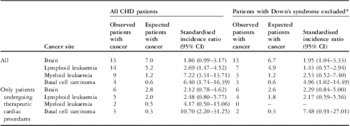
Table 3 shows the standardised incidence ratios of specific cancers with more than three observed cancer cases in the overall cohort. The cancers were all associated with congenital heart defects and included 13 cases of brain tumours, 14 cases of lymphoid leukaemia, nine cases of myeloid leukaemia, and four cases of basal cell carcinoma. The brain tumours comprised four cases of benign neoplasms – two of the pituitary gland – four neoplasms of uncertain or unknown behaviour, and five malignant neoplasms. After exclusion of patients with Down's syndrome, the standardised incidence ratio was 1.43 (95% confidence interval: 0.57–2.94) for lymphoid leukaemia and 2.53 (95% confidence interval: 0.52–7.40) for myeloid leukaemia. We did not find an increased incidence of thyroid cancer.
Standardised incidence ratios for specific cancers.

CHD = congenital heart defect
Only cancer sites with more than three cancers recorded, in the overall CHD cohort, are presented
*Five patients with Fanconi anaemia were also excluded
Discussion
To the best of our knowledge, this is the largest study to examine the cancer risk in children and young adults with congenital heart defects. We found an increased risk of cancer for the overall cohort, including patients with Down's syndrome. However, when Down's syndrome patients were excluded, our data did not support an association between congenital heart defects and increased cancer risk during the median follow-up of 8 years.
A few previous studies have focused on long-term cancer risk in patients undergoing cardiac catheterisation. An Israeli studyReference Modan, Keinan, Blumstein and Sadetzki 12 of 674 children undergoing catheterisation between 1950 and 1970 and a mean follow-up time of 28.6 years reported a total of 11 cancers observed among male patients versus 4.75 expected (male-specific standardised incidence ratio = 2.3, 95% confidence interval: 1.2–4.1). In all, six of these cancers were diagnosed after 30 years of follow-up from the first catheterisation. No cancers were observed among female congenital heart defect patients. The most frequent cancers were lymphoma, in four male patients, and melanoma, in three male patients. A larger Canadian studyReference McLaughlin, Kreiger, Sloan, Benson, Hilditch and Clarke 13 of 3915 children undergoing catheterisation between 1950 and 1965 and a median follow-up time of 21.7 years found an overall standardised incidence ratio of 0.75 (90% confidence interval: 0.44–1.20) on the basis of 13 observed cancers; 10 of these cancers were diagnosed 15 years after the first catheterisation. Of the 13 cancers, there were three cases of leukaemia, which was 1.6-fold (90% confidence interval: 0.43–4.14) the expected number.
Our results cannot be readily compared with these studies’ results, as we did not have detailed information on cardiac catheterisation. However, a substantial proportion of the congenital heart defect patients are known to have undergone either therapeutic or diagnostic cardiac catheterisation in our subcohorts who underwent cardiac therapeutic interventions (Table 2).
Direct comparison is also hampered by the incomplete follow-up and lack of data on Down's syndrome in both the Israeli and the Canadian study. This may also have contributed to the inconsistency between the results of the two studies. The exclusion of patients with Down's syndrome from our study population attenuated the association between congenital heart defect and cancer, mainly owing to a decreased number of leukaemia cases. This is in line with the previously reported overall increased risk of leukaemia in patients with Down's syndromeReference Hasle, Clemmensen and Mikkelsen 7 .
Organs around the heart are the most exposed to radiation from cardiac catheterisation, and high radiation doses have been measured in the lungs, followed by bone surface, oesophagus, liver, and red bone marrow – thoracic vertebra.Reference Seguchi, Aoyama, Koyama, Kawaura and Fujii 20 In an exploratory analysis regarding specific cancer sites, there was an association between congenital heart defects and brain tumours (standardised incidence ratio: 1.95; 95% confidence interval: 1.04–3.33), as well as congenital heart defects and basal cell carcinomas (standardised incidence ratio: 4.96; 95% confidence interval: 1.02–14.49) in our subcohort of congenital heart defect patients without Down's syndrome or Fanconi anaemia. These cancer sites have been associated with radiation, 16 , Reference Ron, Modan and Boice 17 but on the other hand we did not observe an increased risk of, for example, thyroid cancer, which has also been associated with radiation.Reference Kleinerman 21 Furthermore, the brain will receive very little radiation during cardiac catheterisation.Reference Seguchi, Aoyama, Koyama, Kawaura and Fujii 20 The cancer risk associated with low-dose radiation exposure has been estimated on the basis of a linear extrapolation of high-dose data from, for example, atomic bomb survivors, the so-called linear-no-threshold model.Reference Beels, Bacher, De Wolf, Werbrouck and Thierens 11 However, according to Beels et al,Reference Beels, Bacher, De Wolf, Werbrouck and Thierens 11 this model potentially underestimates the risk associated with very low-dose radiation on the basis of biomarker measurement indicating a hypersensitivity to radiation at low doses.
We do not know whether radiation from cardiac catheterisation played a role in the observed excess risk of these specific cancers, given the reports of DNA damage closely after cardiac catheterisationReference Ait-Ali, Andreassi, Foffa, Spadoni, Vano and Picano 22 and the possible association between diagnostic radiation and childhood cancer.Reference Rajaraman, Simpson and Neta 10 In any respect, the absolute number of excess cancers was small, and the overall estimate in the cohort without Down's syndrome who underwent therapeutic cardiac procedures was not statistically significant (standardised incidence ratio: 1.45; 95% confidence interval: 0.86–2.29). Leukaemia is the type of cancer most strongly associated with radiation, with a reported peak incidence in Russian nuclear workers 3–5 years after initial radiation exposure.Reference Shilnikova, Preston and Ron 23 According to this, the median follow-up of 8 years in the current study is judged sufficient to detect at least some cases of radiation-linked leukaemia.
Strengths and limitations
The main strengths of this study include the use of population-based data on congenital heart defect and cancer, the virtually complete long-term follow-up, the large sample size, and the ability to identify patients with Down's syndrome.
The main limitation of our study was the lack of detailed data on radiation exposure from cardiac catheterisations, which limited our ability to examine a potential causal link between radiation exposure during catheterisation and cancer development. We were able to identify the patients with procedure codes for invasive cardiac procedures in the National Patient Registry, namely, heart surgery or catheter-based therapeutic interventions. However, the procedure codes did not allow distinction between the two treatment modalities. We would, however, expect that all patients who underwent surgery, in the time before the introduction of echocardiography during the 1980s, also underwent catheter-based examination. Later, and particularly since the mid-1990s, an increasing proportion of congenital heart defect patients underwent catheter-based therapeutic interventions for, for example, atrial septal defects and patent arterial duct. Since the 1990s, we expect the patient radiation doses during paediatric cardiac catheterisation to have been comparable with that reported in the 1997 study by Boothroyd et al,Reference Boothroyd, McDonald, Moores, Sluming and Carty 24 from the United Kingdom. We thus expect catheterised patients during this period to have received a mean dose of ∼30 Gycm2 per procedure, varying substantially from ∼1 Gycm2 up to 200 Gycm2. Earlier, the radiation doses were likely to be higher, owing to, for example, less sophisticated equipment.Reference Waldman, Rummerfield, Gilpin and Kirkpatrick 25
We did not have information about computed tomography scans either, but this imaging modality was not part of the standard clinical work-up before cardiac interventions for congenital heart disease. We identified the congenital heart defect patients using administrative databases, with a reported positive predictive value regarding overall presence of congenital heart defect of 89%.Reference Jepsen, Jepsen, Johnsen, Espersen and Sørensen 26 Although the majority of misclassified congenital heart defect patients were excluded, based on extensive record review and expert knowledge on the medical doctors’ coding practices,Reference Olsen, Videbæk and Johnsen 14 some misclassification of congenital heart defect status was probably present. We therefore confirmed the congenital heart defects of the 53 patients with cancer through record review, and any inclusion of individuals without congenital heart defect in the remaining congenital heart defect cohort would most likely render our estimates conservative.
The validity of the Cancer Registry data is reported to be highReference Storm, Michelsen, Clemmensen and Pihl 19 and the registry is extensively used for research purposes.Reference Sørensen, Mellemkjær and Skriver 27 The decreased number of leukaemia patients observed after exclusion of Down's syndrome was expectedReference Hasle, Clemmensen and Mikkelsen 7 and further emphasise the validity of our data.
If congenital heart defect patients were diagnosed with cancer at an earlier stage than the general population, as a result of medical follow-up in childhood, we would have overestimated the relative risk of cancer in the congenital heart defect cohort in the period shortly after diagnosis. However, in the cohort without Down's syndrome the risk of brain tumours was increased more than 5 years after congenital heart defect diagnosis (standardised incidence ratio: 2.44; 95% confidence interval: 1.17–4.50) compared with the general population, indicating that this potential bias does not explain these results. Small numbers did not allow analysis according to follow-up time with regard to basal cell carcinomas, but two were diagnosed after 1 year of follow-up and one after 5 years of follow-up.
We did not have information on social status, but the population-based design combined with the public Danish health-care system, with access free of charge, 28 limit the possibility of confounding from social factors. The standardised estimates were controlled for age, gender, and calendar time.
The follow-up of this cohort continues, and it will thus be possible to study longer term cancer risk in the years to come. At present, there are no readily available nationwide databases on diagnostic and therapeutic radiation exposure. However, a nested case–control study, for example, based on exposure information abstracted from medical records of congenital heart disease patients with and without cancer would be possible.
Conclusion
The overall cancer risk was not statistically significantly elevated among congenital heart defect patients without Down's syndrome or Fanconi anaemia when compared with the general population. The risk of cancer was elevated in the overall congenital heart defect population when compared with the general population, but the absolute number of cancers among congenital heart defect patients up to 32 years of age was low. Studies with longer follow-up and more information on radiation doses are needed to further examine a potential cancer risk associated with diagnostic radiation exposure.
Acknowledgement
This study was financially supported by grants from the Danish Children's Heart Foundation. The work was independent of the funder.