As long ago as 1972, Rutter emphasized the importance and pervasiveness of individual differences in children's responses to stress and adversity. More recently, Rutter (Reference Rutter2006) noted that such differences applied to physical hazards, such as malnutrition, infections and irradiation, just as much as to adverse psychosocial experiences. Moreover, the phenomenon has been studied experimentally as well as naturalistically. For example, Cohen and Williamson (Reference Cohen and Williamson1991) inoculated volunteers with a cold virus, finding substantial individual variation in response, with psychosocial stress preceding inoculation associated with an increased rate of infection. In addition, as the Singer and Ryff committee (National Research Council, 2001) pointed out, even with identified Mendelian genes for specific cancers, there is marked heterogeneity in disease outcomes. It might be expected that individual differences would be less with respect to psychosocial adversity if the psychological deprivation was exceptionally severe and prolonged; however, the evidence from the English and Romanian Adoptee (ERA) study showed that this was not the case (Rutter, Kreppner, O'Connor, & ERA Study Team, Reference Rutter, Kreppner and O'Connor2001). It is perhaps surprising that there was no reduction in heterogeneity with more prolonged institutional care involving pervasive privation.
As Cicchetti (Reference Cicchetti2010) pointed out, over the last several decades the research focus has shifted from identifying protective factors to a search for the mechanisms underlying resilience. It is in that tradition that our Greek Metera Babies Centre study was designed. Our thinking, and therefore our planning of the study, has been based on a recognition of the importance of six key concepts. First, we appreciate that resilience is not an individual trait; rather, it reflects a dynamic developmental process (Luthar, Cicchetti, & Becker, Reference Luthar, Cicchetti and Becker2000; Masten, Reference Masten2014). Second, we accept the need to examine multiple possible mechanisms. These may reflect multifinality (any single feature may have multiple outcomes) and equifinality leading to resilience (meaning that a number of separate routes may lead to the same outcome; see Cicchetti & Rogosch, Reference Cicchetti and Rogosch1996). Third, it is crucial to consider the possibility that children may either increase or decrease in vulnerability as they grow older because of both sensitive period effects and also cascade effects by which what happens at one age may shape what happens later (Masten & Cicchetti, Reference Masten and Cicchetti2010). Fourth, in our seeking to identify the possible mechanisms underlying individual differences in vulnerability and resilience, two key methodological issues concern assessment of whether the differences in outcome reflect either differences in risk exposure or an inadequate coverage of possible ways in which outcome is affected (see Masten, Reference Masten2014; Rutter, Reference Rutter2012, Reference Rutter2013). Fifth, multiple-informant, multiple-measure assessment will be required and, despite the diversity of features to be considered, it will often be useful to construct more global indices (Cicchetti, Rogosch, Lynch, & Holt, Reference Cicchetti, Rogosch, Lynch and Holt1993; Vaillant, Reference Vaillant2013). This also implies that effects on positive or negative functioning and on different individual outcome measures may need to be differentiated in case they are not the same. Sixth, in examining features associated with individual differences in outcome, developmental considerations mean that those features should span the periods in Metera and post adoption (Cicchetti et al., Reference Cicchetti, Rogosch, Lynch and Holt1993, Cicchetti & Toth, Reference Cicchetti and Toth2009).
The starting point for our study was a focus on the later consequences of early rearing in the Metera Babies Centre, which constituted rearing in a setting that lacked individualized personal care but which otherwise did not involve either pervasive privation or subnutrition (Vorria, Ntouma, Vairami, & Rutter, Reference Vorria, Ntouma, Vairami and Rutter2015; Vorria et al., Reference Vorria, Papaligoura, Dunn, van IJzendoorn, Steele and Kontopoulou2003). Each caregiver was allocated an individual child about the age of 6 months for whom they had special responsibility and who was expected to treat them as “mother.” Staff turnover was low, but shifts meant that the effective number of children per caregiver at any one time was usually about four to six. Detailed measures using the reliable Parent/Caregiver Involvement Scale (PCIS; Farran, Kasari, Comfort, & Jay, Reference Farran, Kasari, Comfort and Jay1986) provided an individualized assessment of each child's actual institutional experience on overall amount, appropriateness, and quality of interaction, as well as caregiver sensitivity.
Most reviews of the effects of institutional care (Julian, Reference Julian2013; van IJzendoorn et al., Reference van IJzendoorn, Palacios, Sonuga-Barke, Gunnar, Vorria and McCall2011) have not subdivided institutions according to the presence or absence of general pervasive deprivation and/or subnutrition as well as a serious lack of personalized caregiving. This is particularly unfortunate because it has been known for a long time (Tizard, Sinclair, & Clarke, Reference Tizard, Sinclair and Clarke1975) that group-living institutions vary in the extent to which childcare is child oriented or task oriented and that this matters with respect to the children (St. Petersburg–USA Orphanage Research Team, 2008). It cannot be expected that all forms of institutional care will have the same effects. Nevertheless, it is important that this broader literature be used to derive leads on what might be relevant. The evidence from the Romanian study (Kumsta, Rutter, Stevens, & Sonuga-Barke, Reference Kumsta, Rutter, Stevens and Sonuga-Barke2010; Nelson, Fox, & Zeanah, Reference Nelson, Fox and Zeanah2014) indicates that Gene × Environment interactions could well be influential. The Greek study does not include DNA data, meaning that we cannot examine the matter; however, it is a reminder that individual differences in institutional care experiences are likely to reflect child characteristics as well as institutional features. The Romanian study (Nelson et al., Reference Nelson, Fox and Zeanah2014), as well as Julian's (Reference Julian2013) broader review, also indicated that there was often a stepwise increase in ill effects (although studies varied somewhat as to whether this occurred as early as 6 months or as late as 2 years). Beyond that step, neither the overall duration of institutional care (at least up to 3.5 years) nor the duration of adoptive (or foster) care made a major difference. The implication is that there is some form of sensitive period, but the evidence suggests that its timing may vary somewhat according to the developmental function being considered. Possible sleeper effects (meaning later emerging consequences of earlier experiences) might also be operating, although the evidence so far is inconclusive. The St. Petersburg study (McCall, Reference McCall2013) also showed that institutional care varied in quality, that it could be altered, and that the children benefitted from appropriate institutional changes. It was crucial that the quality of care in Metera be assessed in terms of individual differences in the quality of care experienced. Finally, the Romanian study by Nelson et al. (Reference Nelson, Fox and Zeanah2014) suggested that boys were less responsive to beneficial interventions than were girls, although the ERA study (Rutter et al., Reference Rutter, Sonuga-Barke, Beckett, Castle, Kreppner and Kumsta2010) did not find a sex difference. All studies have shown great heterogeneity in outcomes, and the determination of the influences making resilience more or less likely constitutes a key challenge.
Aims
1. To determine the extent of individual differences in outcomes at age 13 years for adopted individuals who experienced an early institutional rearing when multiple different indices of outcome were combined.
2. To determine whether individual differences in outcomes were best accounted for by circumstances prior to admission to Metera, by institutional experiences, or by experiences postadoption.
Method
Participants
There were 86 infants living in the Metera Babies Centre who provided the starting point. Nineteen of these were not adopted (14 because they were returned to their biological parents, 3 because they were fostered, and 2 because they were still in Metera) at the time of the first follow-up at age 4 years (Vorria et al., Reference Vorria, Papaligoura, Sarafidou, Kopakaki, Dunn and van IJzendoorn2006). Six adopted children declined to participate in the follow-up, meaning that the operative sample was 61. Seven of these 61 declined to participate in our second follow-up 9 years later, and 2 could not be traced; this makes an effective sample of 52 (with an 85% participation rate from the first follow-up study to the second follow-up study).
The comparison group comprised 41 infants attending a day nursery who were living with both biological parents. Five declined participation (2 in the first follow-up and 3 in the second), so there was an effective sample of 36 adolescents with a participation rate of 92% from the first follow-up study to the second follow-up study.
The two groups were closely compatible in age at follow-up (mean = 13.1 years, SD = 0.5 years in the adoptive group, and mean = 13 years, SD = 0.5 years for the comparison group). In both groups there was an approximately equal sex ratio.
Adoption took place at a mean age of 1 year, 8 months (SD = 0.7, range = 11 months to 3 years, 5 months), and by the time of follow-up they had been with their adoptive family for a mean duration of 11 years, 2 months (SD = 0.83, range = 9 years, 4 months to 12 years, 5 months).
Measure of quality of institutional care
This was assessed by using the main scales of the PCIS. Relatively good experiences were coded if the individual scored in the better half of the PCIS on three or four out of four scales. Relatively poor experiences were coded if the scores were in the worse half on at least three out of the four scales.
Measures in adolescence
Adolescents' measures
Attachment
Attachment in adolescence was assessed using the Child Attachment Interview (CAI; Target, Fonagy, & Shmueli-Goetz, Reference Target, Fonagy and Shmueli-Goetz2003). The CAI is a 19-question, semistructured interview that assesses the child's mental representations of attachment figures. Each adolescent's interview was videotaped and then transcribed. The CAI is coded using eight different scales: emotional openness, balance of positive/negative references to attachment figures, use of examples, preoccupied anger, idealization, dismissing/avoidance, resolution of conflicts, and overall coherence. Each dimension is rated on a 9-point scale from 1 for a low score to 9 for a high score. Scores in the eight scales guide us to classify each child in one of the four main attachment classifications: secure, dismissing, preoccupied, and disorganized.
The CAI was administered and rated by M.N., who had been trained on scoring by Yael Shmueli-Goetz at the Anna Freud Centre. A second rater, Maria Vairami, who had also been trained by Shmueli-Goetz, independently coded 20 (23%) of the cases randomly. The agreement between the coders on security/insecurity was κ = 0.89. Intraclass correlations were also conducted in order to check the agreement between the two coders on the CAI scales. Intraclass correlation coefficients were found satisfactory in all of the CAI scales, ranging from 0.72 to 0.95.
Cognitive development
Adolescents' cognitive development was assessed using a Greek short version of Wechsler Intelligence Scale for Children (Greek WISC-III; Georgas, Paraskevopoulos, Bezevegis, & Giannitsas, Reference Georgas, Paraskevopoulos, Bezevegis and Giannitsas1997) including four subscales of the WISC-III: two nonverbal/practical scales (block design and picture completion) and two verbal scales (vocabulary and similarities). WISC-III is the last version of WISC that has been standardized in Greek populations. These four subscales were selected to provide a good estimate of full-scale IQ (reliability coefficient = 0.94; Sattler, Reference Sattler1992). The Cronbach coefficient α values were 0.66 for picture completion, 0.89 for block design, 0.80 for information, 0.84 for vocabulary, and 0.90 for the total IQ score.
Behavioral problems
The Strengths and Difficulties Questionnaire for Children (SDQ) was used in order to assess behavioral problems (Goodman, Reference Goodman1994). The SDQ consists of 25 items that are divided into five subscales of five items each: emotional symptoms, conduct problems, hyperactivity, problems with peers, and prosocial subscale. The Greek version of the questionnaire was used (Bibou-Nakou, Kiosseoglou, & Stogiannidou, Reference Bibou-Nakou, Kiosseoglou, Stogiannidou and Roussou2002). The questionnaire was completed by the adolescents themselves, their mothers, and their teachers. The Cronbach α values for the total scores were 0.59 for the adolescent SDQ, 0.76 for the mother SDQ, and 0.78 for the teacher SDQ.
Qualities of adoptive home
Maternal questionnaires
Maternal stress
Mothers were asked to complete the Stress Index for Parents of Adolescents (Sheras, Abidin, & Konold, Reference Sheras, Abidin and Konold1998) that assesses the relationships of the parenting stress to adolescent characteristics, parent characteristics, the quality of the adolescent–parent interactions, and stressful life circumstances. The Cronbach α for the Total Stress Scale was 0.96.
Maternal general health
Maternal general health was assessed by the General Health Questionnaire—28 (Goldberg & Williams, Reference Goldberg and Williams1988). In the General Health Questionnaire each mother was asked to compare her recent psychological state with her usual state. The Cronbach α for the total score was 0.90.
Parental education
Ten (21%) of the adoptive mothers and 38 (79%) of the adoptive fathers had primary education only. Thirty-eight (79%) of the adoptive mothers and 38 (79%) of the adoptive fathers had secondary or tertiary education.
Stressful events in the lives of the adolescents
Death of a parent
Two adopted boys lost their mothers (one lost his mother 1 year before our visit and the other 6 years before). One adopted boy lost his father 4 years before. One comparison boy lost his father 8 years before.
Parental divorce
Five (10%) adopted adolescents and five (14%) comparison adolescents experienced parental divorce.
Serious health problems of the adolescents
Two adopted girls and one comparison girl had serious health problems.
Serious health problems of the parent(s)
Four adoptive parents had cancer during the previous 5 years and one comparison father had a heart attack 10 years before.
Moving
Fourteen (33%) adopted and 17 (47%) comparison adolescents moved out of a house (χ2 = 3.84, p = .069). Five (10%) adopted and 3 (8%) comparison adolescents moved away from a town (χ2 = 0.04, p = 1.000).
Biological mother circumstances
Reason for admission to the institution
Half of the adopted adolescents (n = 26, 50%) were left in the institution for socioeconomic reasons, whereas the rest were placed in the institution because of maternal mental retardation, mental illness, epilepsy, or drug addiction.
Education of the biological mothers of the adopted children
One biological mother (3%) was illiterate and 14 biological mothers (47%) had primary education only. Fifteen (50%) biological mothers had finished secondary school or had technological education. None had tertiary education. No information was available on the education of 22 (42%) of the 52 biological mothers.
Data collection procedures
All families were contacted by phone by P.V., who was the main investigator in the previous stages of the study and was known to the families. Parents were informed about the purpose of the present study and the data collection procedures. Parents and adolescents who agreed to participate were visited at their homes; the appointment time was set by the parents. Parents and adolescents who participated in the study signed a consent form that specified the participants' right to withdraw from the study at any time without adverse consequences. Ethical approval was obtained from the Research Committee of the Aristotle University of Thessaloniki, in order to ensure that the research conformed to ethical principles and standards.
Families who moved house were traced through the telephone directory. In seven (13%) cases that could not be traced, the families were contacted by the social workers of Metera Babies Centre, after which they agreed to participate in the study.
The families were visited by the two investigators (P.V. and M.N.); M.N. was unaware which group each adolescent belonged to and gathered the data from the adolescents. Adolescents' mothers completed three questionnaires. Each home visit lasted 2–3 hr.
Research Plan
In common with all studies of any kind of adversity, there were substantial individual differences in outcome among children who were adopted. Rather than focus on individual outcome variables, in order to study the possible predictors of this heterogeneity, and in particular the predictors of resilience, four developmental outcomes in adolescence were taken into account and combined: first, the quality of attachment as reflected in both emotional openness and security of attachment; second, cognitive performance (including IQ and school performance as reported by teachers); third, hyperactivity as rated in a composite score using multiple sources of ratings; and fourth, a request for psychological help or psychiatric treatment.
The scores in the four outcome factors were summed, giving rise to a total composite score outcome ranging from 0 to 4, with high scores indicating more negative developmental outcomes. A good developmental outcome was designated by positive scores on at least three out of the four predictors, a bad outcome by those who had no positive outcomes or a positive outcome on only one of the four factors, and in the middle were those who scored positively on two out of the four. Scored in this way, 18 adoptees showed good outcomes, 17 were in the middle, and 13 had poor outcomes.
The predictive variables comprised three domains. In the first there were the biological mother's circumstances, comprising the reasons for the child's admission to the institution and the educational level of the biological mother. The second domain of institutional features concerned whether the child left the institution for adoption after the age of 2 years and whether there was disorganized attachment in the quality of institutional rearing as experienced at an individual level while in Metera. The third set of features concerned various aspects of the qualities of the adoptive home. This included first, maternal health in adolescence; second, maternal education; third, paternal education; and fourth, the presence of stressful events in the adolescent's life, such as illness of the parents or the adolescent, parental divorce, or death of a parent. Each of these features was treated as a dimension and given a score.
Results
All previous studies of stress or adversity have shown marked heterogeneity in outcomes (Rutter, Reference Rutter2006). The findings on attachment relationships, cognition, and behavior (Vorria, Ntouma, & Rutter, Reference Vorria, Ntouma and Rutter2014a, Reference Vorria, Ntouma and Rutter2014b; Vorria et al., Reference Vorria, Ntouma, Vairami and Rutter2015) showed substantial heterogeneity in outcomes with respect to individual variables, but that does not mean that the same would be found for an overall outcome putting together all the key individual variables. Associations across these variables were quite modest. Thus, individuals doing well on attachment did not necessarily do well on cognitive functioning or hyperactivity. It was therefore quite possible that a good outcome on one variable might be counterbalanced by a poor outcome on a different variable, resulting in little overall variation when variables were combined.
Overall outcomes
In order to test that possibility, the four key outcomes were selected, in each case using multiple sources of measurement when available. Thus, the quality of attachment was measured by both emotional openness and security of attachment; cognitive performance by measured IQ and school performance reported by teachers; hyperactivity as a composite score based on child, parent, and teacher ratings; and request for either psychological help or psychiatric treatment. The scores on these four domains were treated as either 0 (no poor outcome on an indicator in that domain) or 1 (any poor outcome in that domain). The scores in the four domains were then summed, giving rise to a total composite score ranging from 0 to 4, with high scores representing more negative outcomes (note that the means and the standard deviations were generally comparable for the four domains).
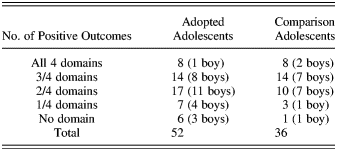
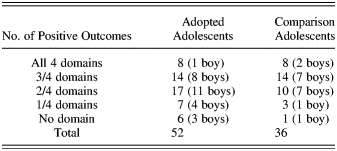
Table 1 shows the number of positive outcomes in the two groups. The mean of 1.83 (SD = 0.81) in the adopted group was marginally higher (meaning worse) than the mean of 1.50 (SD = 0.70) in the comparison group, the difference falling just short of statistical significance at the 5% level, t (86) = 1.97; p = .052. However, there was a rather larger difference at the extremes (pooling the two extreme categories in each case). Thus, twice as many adoptees had a positive outcome on no more than one domain (25.0% vs. 11.1%) and fewer had a positive outcome on three or four domains (42.3% vs. 66.1%). Nevertheless, both comparisons were statistically nonsignificant, as shown by Fisher's exact test (p = .128 and .169, respectively). In addition, there was not a significant difference between the positive outcomes for boys and girls.
Positive outcomes in the two groups
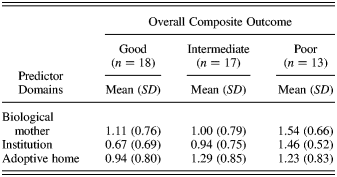
Following on Table 1 and Table 2, a good overall outcome was defined as a positive (good) score on at least three of the four domains, an intermediate outcome as two out of the four, and a poor outcome as zero or one out of the four. Because 13 adolescents (4 adopted, 9 comparisons) were unclassified in the Strange Situation procedure, Table 2 deals only with the 48 adoptees and 27 of the comparison group with complete data. The mean scores for the three domain predictors are shown for the three levels of overall outcome. There were no differences with respect to good outcomes with respect to either the biological mother's circumstances t (46) = –0.53, p = .596, or the qualities of the adoptive home, t (46) = 11.32, p = .193. By contrast, there was a significant effect of the institutional domain predictors. The adoptees with a good outcome (n = 18) had a significantly lower mean score (mean = 0.67, SD = 0.69) compared with the rest (n = 30; mean = 1.17, SD = 0.70). The t value (46) of 2.42 was statistically significant at the 2% level. The individually measured institutional experiences showed that the 27 subjects with relatively good experiences had a mean score of 1.63 on the total outcome versus 2.11 for those with relatively poor experiences (a high score representing a more negative outcome), but this difference was not statistically significant: F (1, 44) = 1.79, p = .188.
The mean scores of the three levels of overall outcome for the three domain predictors
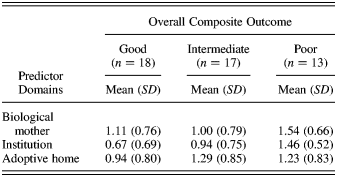
The predictors of a poor outcome were then examined in the same way. Once more, the outcome groups did not differ on the qualities of the adoptive home, t (46) = –0.43, p = .668. There was a trend that fell just below the 5% level of significance for adoptees with a poor outcome to have a higher (i.e., more negative) score on the biological mother predictors (n = 13, mean = 1.54, SD = 0.66) as compared with the rest (n = 35, mean = 1.06, SD = 0.77), with a t (46) of –2.00, giving rise to a p value of .051. However, once more, the biggest effect came from the institutional predictors, where those with poor outcomes (n = 13, mean = 1.46, SD = 0.75) had a significantly higher score than the rest (n = 35, mean = 0.80, SD = 0.77, with a t (46) of –3.03, giving rise to a p value of .004.
The point of examining the predictors of a good outcome separately from those of a poor outcome was to check whether there might be features associated with resilience that played no role in vulnerability. However, there was no evidence that that was the case. The variables that predicted good outcomes were much the same as those that predicted poor ones.
It was then checked whether the main institutional effect derived from disorganization of attachment or the length of time in the institution. The latter proved to make a unique statistically significant contribution, b = 0.78; t (2, 47) = 2.24, p = .03. Thus, more than 2 years in the institution predicted a negative overall outcome in adolescence. Disorganized attachment, by contrast, did not have a significant effect once time in the institution had been taken into account, b = 0.65; t (2, 47) = 1.88, p = .066. In contrast, when a regression analysis was undertaken for the combined overall outcome, it was found that there was not a significant effect of length of time in the institution in the absence of disorganized attachment. Conversely, there was no effect of disorganized attachment in either the group in institutional care that lasted less than 2 years or in the group that were in institutional care for more than 2 years. That is, the two variables were too closely associated for their relative effects to be compared through this form of analysis.
Specific outcomes
For the most part, the predictors of individual differences in specific outcomes closely mirrored those of the overall composite outcome. Here, the focus is on the four instances in which there were possible differences. The only differences with respect to the quality of attachment is that disorganization of attachment in infancy did have a just-significant effect (at the 5% level) on increasing the likelihood of insecurity of attachment in adolescence (B = 1.24, Wald = 3.91, p = .048), and an age of 2 years or more at the time of adoption predicted a worse score on emotional openness. There was an F (2, 49) of 5.22 (p = .009). The 20 children adopted at over the age of 24 months had a mean score of 4.35 (SD = 2.21), the 15 adopted between 17 and 24 months had a mean score of 6.30 (SD = 1.58), and the 17 adopted below the age of 17 months had a mean score of 5.88 (SD = 1.79).
The reason for admission had no effect on the Bayley mental scale in infancy, a significant effect on the McCarthy General Cognition index at age 4 years, and an effect on the WISC IQ in adolescence (mean = 109 vs. 102) that fell just short of statistical significance at 5% level. The problem with the interpretation of this finding is that the admission of the child because of maternal mental disorder combines a heterogeneous mixture of disorders, some of which may well have involved mainly environmental mediation (as would be the case with maternal alcoholism or drug addiction), whereas others may have mainly reflected some type of genetic influence.
The adopted mother's educational level was significantly associated with the children's cognitive outcome. The 10 adolescents reared by mothers who had only primary education had a significantly lower mean IQ of 97.10 (SD = 17.72) than those reared by a mother with secondary or tertiary education, for whom the mean was 107.76 (SD = 12.75), giving rise to a t (49) of 2.19 and a p value of .033. However, there was no effect of the educational level of the biological mother, t (35) = –1.56, p = .127. It is striking that this was so, despite there being a degree of selective placement.
There were no significant predictors of hyperactivity in adolescence, but the length of time in institutional care (i.e., 2 years or more) did have a significant effect on increasing the likelihood of referral to psychological and psychiatric services in adolescence (B = 1.50, Wald = 5.43, p = .02).
In summary, it is clear that the findings on the predictors of individual differences in the composite overall outcome were not driven or distorted by an effect on any individual specific outcome.
What provides the risk?
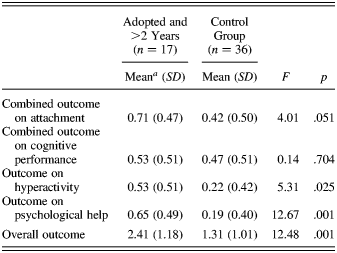
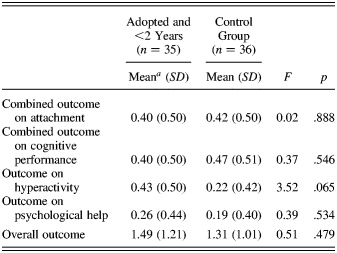
Up to this point, the overall experience of early institutional rearing has been treated as the source of risk, in line with all previous research. However, the finding on the predictive importance of duration of institutional care raised the question as to whether it would make more sense to treat the risk as applying only to institutional care lasting longer than 2 years. In order to examine this possibility, it was necessary to turn to case-control comparisons as shown in Tables 3 and 4. Those adoptees who remained in Metera for more than 2 years (n = 17) differed markedly and significantly on the overall outcome measure (as well as on seeking psychological help; see Table 3). In sharp contrast, there were no significant differences in outcome for those whose stay in Metera lasted less than 2 years (see Table 4). The logic, therefore, was to redefine the risk as deriving from institutional care exceeding 2 years.
Differences on outcomes between the adopted adolescents living in the institution more than 2 years and the control group
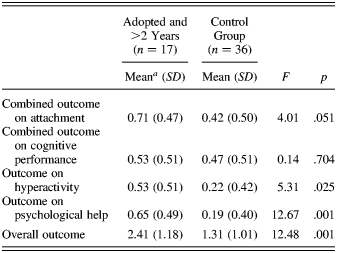
aThe higher the score, the more negative the outcome.
Differences on outcomes between the adopted adolescents living in the institution less than 2 years and the control group
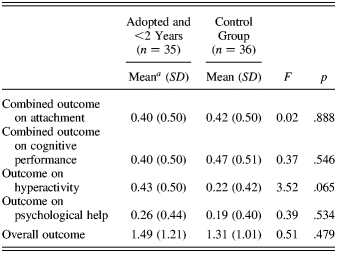
aThe higher the score, the more negative the outcome.
The question then is what variables predicted individual differences within the subsample of 17 who remained in institutional care beyond the age of 2 years. It is obvious, unfortunately, that this subsample was far too small for statistical analyses. However, the analyses were undertaken in order to consider possible leads on effects that had not been evident in the original total sample. The only suggestions found were that the educational level of the biological mother might have an effect on the cognitive outcome and that disorganized attachment might have an effect on attachment features. However, in view of the inevitable uncertainty of findings based on such a small subsample, no details are given here. They are mentioned only as features to be considered in other studies with a larger sample.
Discussion
Six main findings stand out. First, as hypothesized, there was substantial heterogeneity in outcome; some adopted adolescents were functioning very well, but a few were showing relatively poor functioning. Second, although there were a few differences between the adoptees and the comparison group on individual aspects of outcome, there was no significant difference in the overall outcome (as assessed from a composite measure combining different aspects of functioning), although the overall outcome for the adoptees was not quite as good. The finding emphasizes the value of assessing outcome in a multifaceted fashion. Third, variations in the postadoption rearing experience (at least as measured) did not account for individual differences in overall outcome. There is every reason to suppose that adoption brought real and worthwhile benefits, but there was a limited range of variation in the adoptive homes, and the small variations within that range did not seem to account for the heterogeneity of outcome. Fourth, variations in the biological background seemed to have only a relatively small effect, but this conclusion needs to be tempered by an appreciation that our data on this feature were less than ideal. Fifth, far and away the strongest predictor of individual differences in overall outcome concerned institutional experiences that lasted beyond the age of 2 years. The outcome in adolescence for individuals who remained in Metera that long was markedly and significantly worse than that for those in day-care comparison group. The power of this variable more than a decade after adoption was striking. By contrast, no between-group differences in outcome were evident for those whose institutional care lasted less than 2 years. Sixth, there were substantial individual variations in the quality of institutional care experienced, but these had only a nonsignificant effect on outcome.
Our finding is in line with the Romanian study (Nelson et al., Reference Nelson, Fox and Zeanah2014) finding of a stepwise increase in ill effects at about 2 years of age. It appears that the risks associated with early institutional care that does not continue after 2 years have been overestimated in the past. Of course, that is not to say that early institutional care does not matter if it ceases by age 2 years. Attachment disorganization in the institution still had some modest predictive power beyond that found for duration of institutional care (Vorria et al., Reference Vorria, Ntouma, Vairami and Rutter2015). We continue to argue that every effort should be made to place children in adoptive homes as soon as possible after the necessary checks have been made. On the other hand, the risks associated with early institutional care should not be exaggerated. We conclude that it would be worthwhile to explore further the role of individual differences in the ways in which institutional care impinged on individual children, but a better instrument than the PCIS will be needed to do this.
Strengths and Limitations
The study has five major strengths. First, it focuses on the outcome of adopted children who had experienced an early institutional rearing that lacked individualized care but which did not involve either pervasive general abuse/neglect or subnutrition. Second, the study was distinctive (probably unique) in involving a prospective longitudinal study that began in infancy while the children were in the institution (Metera) and continued postadoption, initially at age 4 years and then at 13 years. There was a comparison group of children who did not experience institutional care and who were studied in the same way but the prospective nature of the design meant that within-individual change could be measured, as well as between-group comparisons. Third, there was a standardized measurement of institutional rearing as it impinged on each child, allowing analysis of the effects of individual differences in the quality of institutional care. Fourth, both outcome and mediators of outcome were measured using multiple methods. Fifth, outcome was assessed on the basis of four domains of outcome allowing determination of effects on positive as well as negative outcomes and possible differences in the predictors of different outcome features.
However, there were limitations. First, outcome measures extended only up to 13 years, leaving uncertainty regarding the extent to which the situation might change when the child is older. A further follow-up is planned to deal with that question. Second, whereas there was reasonably good measurement of the duration and quality of institutional care, there was very little known about the children's biological background or about possible genetic influences. Third, there was limited variation in the qualities of the adoptive home. The conclusions regarding the importance of institutional influences are reasonably solid, but those on the lesser importance of biological background and experiences postadoption are less so.
Conclusions
There are several policy/practice implications that stem from the findings of this follow-up study. The young people's outcomes in adolescence were highly variable. Such variability was not a function of individual differences in the quality of the adoptive home, at least as far as it was possible to assess it. We presume that that finding is contingent on an adequate screening of prospective adoptive parents in order to rule out those likely to present a high environmental risk to the child. In other words, our finding on the lack of effect of variations among adoptive families should not be interpreted as meaning that an appropriately based screening is not needed. The strongest predictor of a poor overall outcome was adoption after the age of 2 years. Currently, in European countries too many adoptions are delayed for years in order to obtain a “perfect match,” and our findings suggest that this is a policy likely to provide risks for the children if placement is not obtained before the age of 2 years. Good empirical evidence on the benefits of matching is largely lacking. Infants being placed for adoption have a right to expect placement in a good, loving family, but it is not in their interest that the placement process drag on with the infants' remaining in the institution.