INTRODUCTION
An inscribed and decorated block from the Venizeleion burial ground that formed part of the North Cemetery of Knossos (Fig. 1) raises the question: who were some of the Roman colonial families at Knossos? The evidence presented in Table 1 – to be cited by numbers in bold – catalogues the names of individuals named at Knossos or Knossians named on Crete though not at the port of Herakleion, nor elsewhere in the Roman world, where non-Knossian factors might obscure the issue. After presenting this block with its inscription naming Caelia Q.l. Chia, and its intriguing decorative motif, we can show how her case meets multiple criteria for identifying her as a member of a colonial family at Roman Knossos: (1) the relatively early date that can be assigned to inscriptions that appear to preserve the names of members of colonial families; (2) the Latin language utilised in inscriptions naming them (Rousaki et al. Reference Rousaki, Brokalakis, Triantaphyllidi, Chrysanthakopoulou and Pilarinou2019a, 4); (3) burial in Italian-style monuments (Rousaki et al. Reference Rousaki, Brokalakis, Triantaphyllidi, Chrysanthakopoulou and Pilarinou2019a, 4); (4) the bearing of Roman nomina that suggest migration to the colony in the imperial period, perhaps when Colonia Iulia Nobilis Cnosus was formally founded or not long thereafter; and (5) the use of onomastic formulae consistent with Roman ways of naming. Individuals who meet at least one or two criteria, and preferably multiple criteria, can be considered for membership in or descent from colonial families at Roman Knossos.
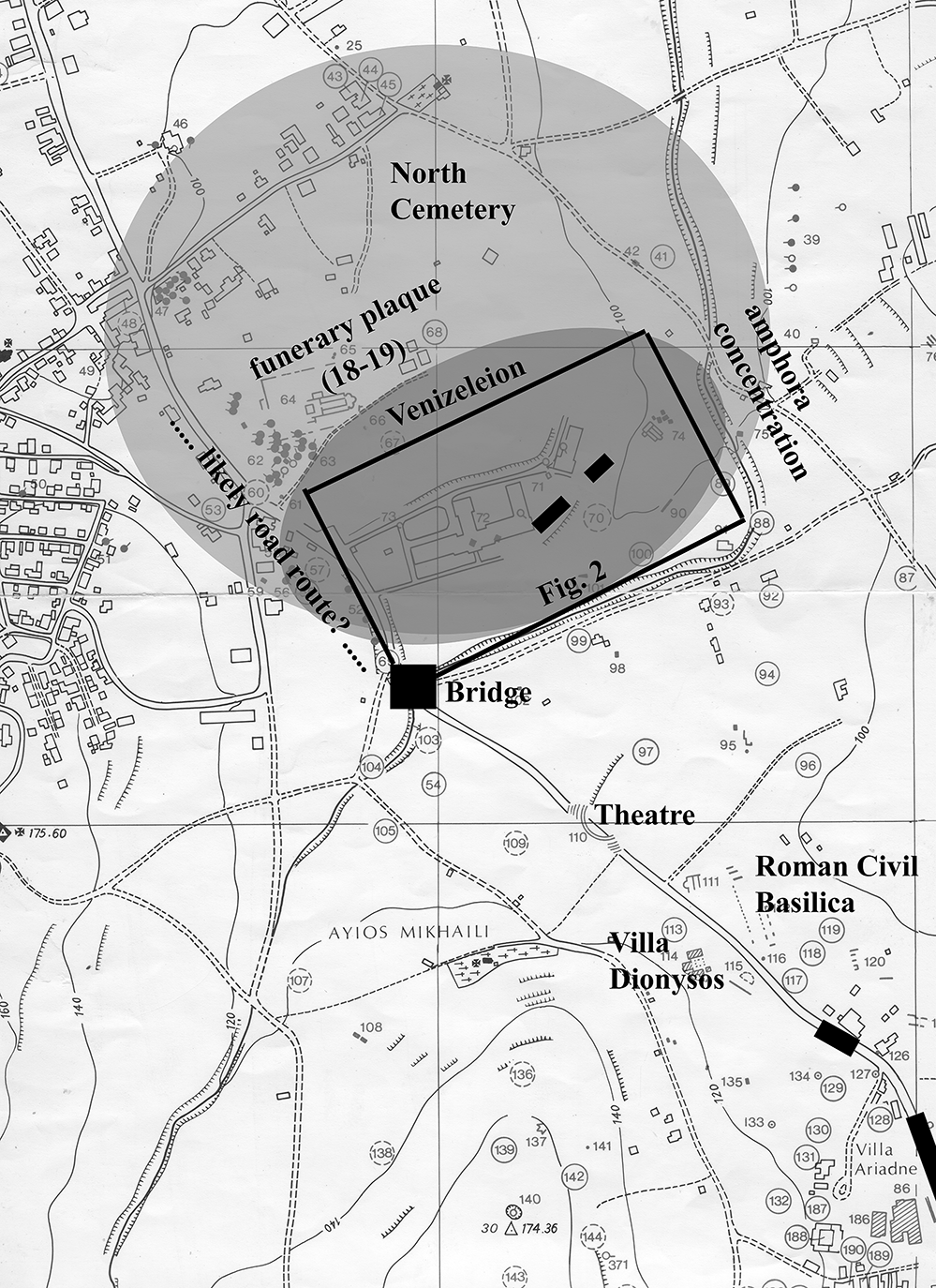
Knossos: location of the North Cemetery, Venizeleion and select sections of Roman road, modified from Hood and Smyth Reference Hood and Smyth1981, in light of more recent discoveries (Fig. 2 in rectangle; numbers in parentheses refer to Table 1).

A NEW LATIN INSCRIPTION FROM THE VENIZELEION
Discovery
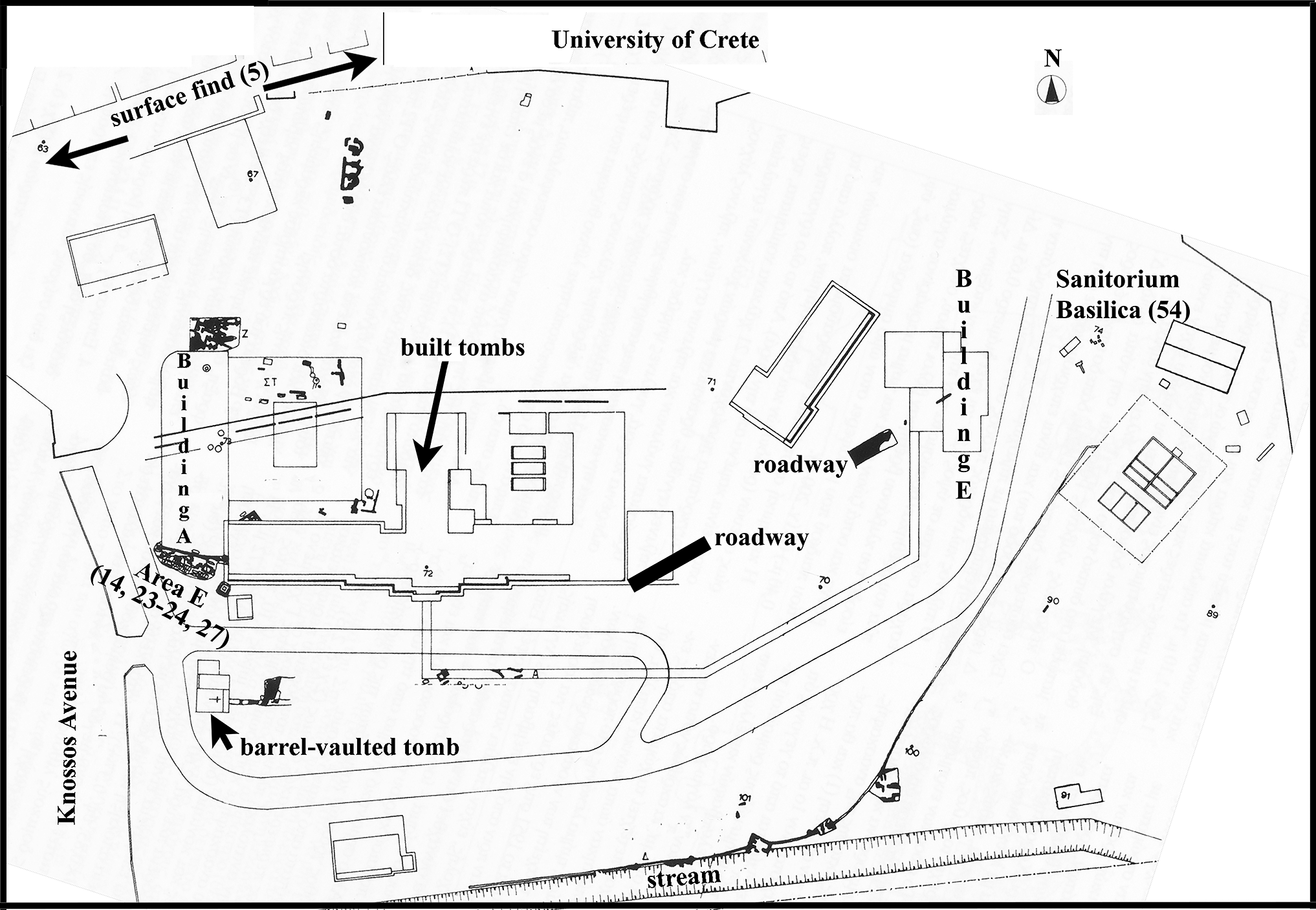
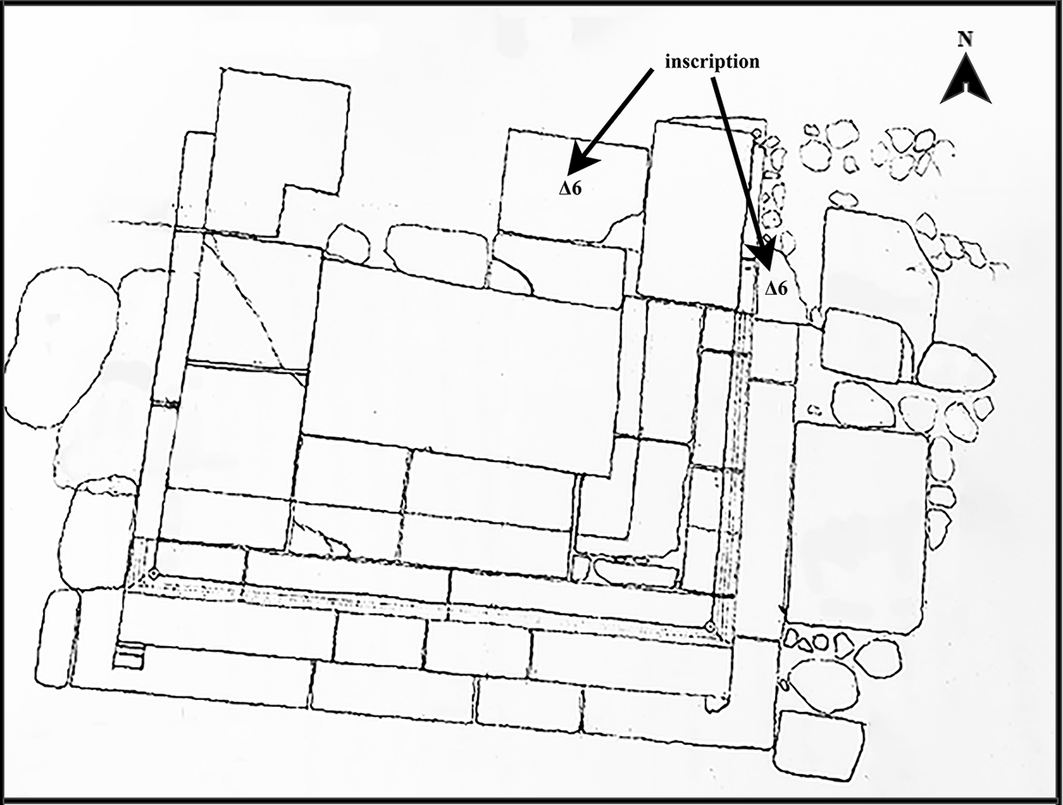
First, we must take account of where the inscribed block that names Caelia Q.l. Chia was found. It was discovered in two fragments (both numbered Δ6), one on 2 August 1996 and the other on 26 August 1996; both fragments were located beneath the perimeter of Grammatikaki’s Tomb 36 in Area E of the Venizeleion burial ground (Fig. 2), as it was being dismantled for transfer and restoration at another site before the construction of a new building (Building A) during an extension of the Venizeleion hospital complex. One fragment was found lying upside down to the east of the entrance to Tomb 36, the other lying upside down along its east side (Fig. 3). Both were found in second use below a row of stones around the tomb’s perimeter, at the level of its interior floor; one fragment lay at a depth of 3.05 m, the other at a depth of 2.95 m. Two built graves located inside the crypt below Tomb 36 (graves 36/1 and 36/2) contained coins of the Augustan to Neronian periods – between 27 BCE and 60 (all dates are CE unless otherwise indicated) – and ceramics of the first century (Grammatikaki Reference Grammatikaki, Cadogan, Hatzaki and Vasilakis2004, 467). Contemporary ceramics found inside Tomb 36 itself suggest a terminus post quem of the mid-first century for Tomb 36, which therefore supports a terminus ante quem of the mid-first century for the inscribed fragments re-used below and around it (E. Grammatikaki, pers. comm.). Our inscribed stone ought to have originally been part of an otherwise unpreserved monument, to judge from the cuttings visible on the top surface. Yet when Tomb 36 was dismantled and transferred to another location for preservation and display, there was no evidence of an earlier burial below or immediately around it (E. Grammatikaki, pers. comm.). The block is now in the Epigraphical Collection of the Archaeological Museum of Heraklion, without an inventory number.
Overview of the Venizeleion Hospital area, modified from Grammatikaki Reference Grammatikaki1996, 625, fig. 1 (numbers in parentheses refer to Table 1).

Plan of Tomb 36, modified from E. Grammatikaki, unpublished excavation diary for 1996, with Grammatikaki’s permission.

Archaeological context
Next, we should consider the archaeological context in which this inscribed block was found. It comes from a particular location, a burial ground in the area of the modern Venizeleion hospital complex – known in early bibliography as the Sanatorium – where monumental tombs were built for Latin-speakers of some means (Grammatikaki Reference Grammatikaki, Cadogan, Hatzaki and Vasilakis2004, 465, cf. Sweetman Reference Sweetman2010, 356). The Venizeleion burial ground was intensively used for burials in the Roman period (Grammatikaki Reference Grammatikaki1996, 624; Rousaki et al. Reference Rousaki, Brokalakis, Triantaphyllidi, Chrysanthakopoulou and Pilarinou2019a, 17). It has been excavated over the course of seven decades, from the 1950s (Cook Reference Cook1952, 107; Reference Cook1953, 126; Platon Reference Platon1953, 487–8; École Française Reference Française1953, 233–4; Frend Reference Frend1962) to the 1970s (Catling et al. Reference Catling, Ridley, Carington Smith, Smyth and Dunn1982, 59), 1980s (Grammatikaki Reference Grammatikaki1996, 624, 628–9), 1990s (Grammatikaki Reference Grammatikaki1994; Reference Grammatikaki1996; Reference Grammatikaki1997; Reference Grammatikaki, Cadogan, Hatzaki and Vasilakis2004) and 2010s (Rousaki et al. Reference Rousaki, Brokalakis, Triantaphyllidi, Chrysanthakopoulou and Pilarinou2019a, 4; Reference Rousaki, Triantaphyllidi, Brokalakis, Chrysanthokopoulou, Kountouri and Gkadolou2019b, 505; Reference Rousaki, Triantaphyllidi, Phygetaki, Dellios, Psaroudaki, Pitalidiou and Katsikaforthcoming; Rousaki, Triantaphyllidi and Brokalakis Reference Rousaki, Triantaphyllidi, Brokalakis, Tzachili, Andrianakis and Varthalitou2020, 281–2), as the Venizeleion hospital complex was constructed and then expanded.
This burial ground, and the whole North Cemetery, lay on the northern boundary of Knossos, not far from a point where the road from Knossos’ port at Herakleion entered the inland city (Trainor Reference Trainor2019, 9). Antoniadis’ study of the relationship between tomb placement and roads at Knossos focuses on the Early Iron Age but still yields valuable information for the most likely route of the road between Knossos and Herakleion, one that passed through the North Cemetery – specifically the Venizeleion burial ground – on the way to Herakleion (Antoniadis Reference Antoniadis2024, 114). He suggests that on the western boundary of the Venizeleion the most likely path for this road diverges somewhat from today’s Knossos Avenue, to lie 30–40 m to its west (Antoniadis Reference Antoniadis2024, 118). A bridge across the seasonal Silamopotamos stream provides a south-east anchor point for this segment of the route (Hood and Smyth Reference Hood and Smyth1981, 39, no. 69, tentatively identified as a Minoan road; T. Whitelaw, pers. comm., citing MacKenzie’s 1925 Daybook, 39L–44L, with details that could support a Roman date; see Fig. 1), while the narrow gap between the Fortetsa and Medical Facility hills – especially at the fork between the modern Fortetsa and Knossos roads (cf. Hood and Smyth Reference Hood and Smyth1981, 38, nos 53 and 60) – suggests a north-west anchor point (T. Whitelaw, pers. comm.). From the Early Iron Age onward tombs could have flanked this road, including the Roman rock-cut chamber, concrete, and built tombs found west of today’s Knossos Avenue (Hood and Smyth Reference Hood and Smyth1981, 38, nos 52, 58–9).
In the Roman period this burial ground may have been organised not in and among the structures of the Venizeleion hospital complex – as plans of rescue excavations necessarily show – but near the intersection of two roads, the main north–south route that connected Knossos with the port at Herakleion, discussed above, and a west–east route that branched off from it to lead into if not through the Venizeleion burial ground. Three stretches of this west–east road have been discovered in British and Greek excavations of the Venizeleion burial ground, paralleling the original line of the stream. In 1978 Catling and his colleagues found a small part of a roadway that traversed the southern part of their excavations, at the south-east corner of the Venizeleion; it could be dated to the first century given the pottery found below the road surface and a Caligulan coin found where one of the carefully placed kerbstones was missing (Catling et al. Reference Catling, Ridley, Carington Smith, Smyth and Dunn1982, 61–2; see Figs 1 and 2). In 1996 Grammatikaki found another part of a paved roadway of Roman date in the eastern reaches of her excavations at the Venizeleion hospital complex (Grammatikaki Reference Grammatikaki1996, 626–7; see Figs 1 and 2). In 2014–15, a roadway that substantially extends the bit of road Catling and his colleagues had found – variously dated between the first–second centuries and the Late Antique period – was found, one that leads toward the roadway Grammatikaki had found (see Figs 1 and 2; Rousaki et al. Reference Rousaki, Brokalakis, Triantaphyllidi, Chrysanthakopoulou and Pilarinou2019a, 4; Reference Rousaki, Triantaphyllidi, Brokalakis, Chrysanthokopoulou, Kountouri and Gkadolou2019b, 539; Reference Rousaki, Triantaphyllidi, Phygetaki, Dellios, Psaroudaki, Pitalidiou and Katsikaforthcoming; Rousaki, Triantaphyllidi and Brokalakis Reference Rousaki, Triantaphyllidi, Brokalakis, Tzachili, Andrianakis and Varthalitou2020, 285).
Together these stretches of roadway appear to preserve the line of a branch road that departed from the main north–south road in the vicinity of the southern limit of the modern hospital and followed the edge of the scarp overlooking the Silamopotamos streambed to the east (Hood and Smyth Reference Hood and Smyth1981, 40, no. 74; Catling et al. Reference Catling, Ridley, Carington Smith, Smyth and Dunn1982, 64). Even farther to the east an amphora concentration – containing mostly imported amphoras, goods that arrived at Knossos from the port at Herakleion and were warehoused and distributed there – lay in the valley immediately west of the Classical–Hellenistic tower, and east of the Venizeleion burial ground, on the eastern side of the Silamopotamos stream that delineates the eastern and southern boundaries of the North Cemetery (see Fig. 1; Trainor Reference Trainor2019, 9; cf. Hood and Smyth Reference Hood and Smyth1981, 20, 36–7, no. 37 for the Classical–Hellenistic tower).
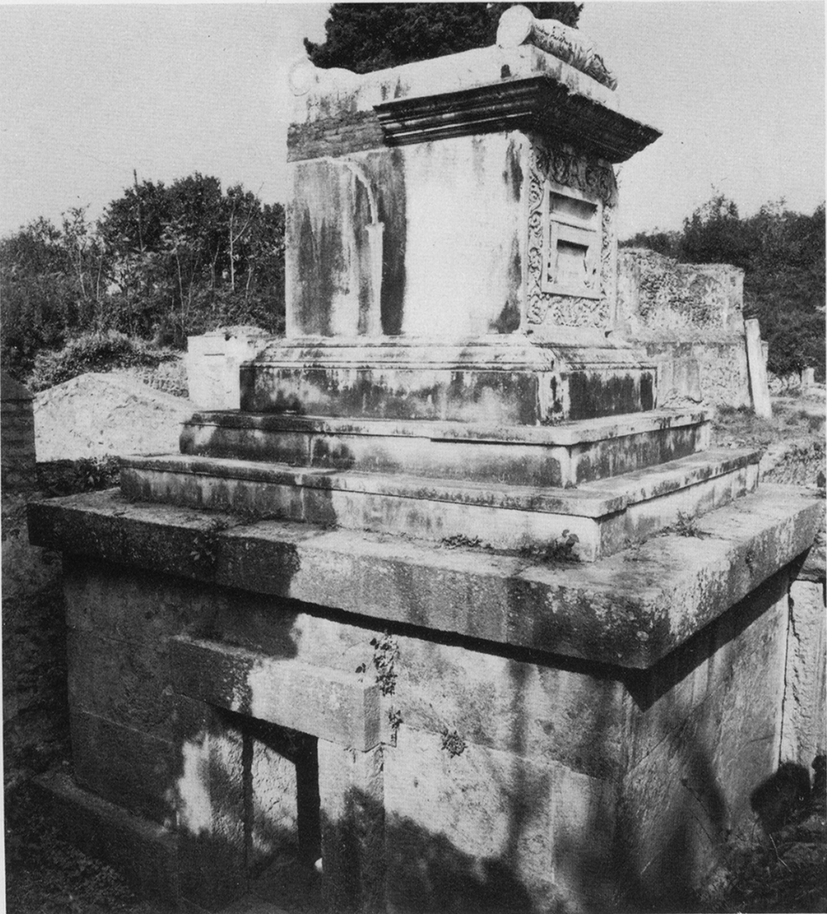
To date, as many as 15 Italian-style monuments have been found in the Venizeleion burial ground. In the 1950s, burial chambers from two intact vaulted tombs and five built tombs that were looted but architecturally in reasonable condition were found under the centre of the Venizeleion, a little to the east of the three distinctive burial chambers later found in Area E (Hood and Smyth Reference Hood and Smyth1981, 39–40, no. 72; T. Whitelaw, pers. comm.; see Fig. 2). In 1978, three to four more built tombs were discovered west of the North Cemetery Basilica (Catling Reference Catling1978–9, 52, 56–7; see now Moles Reference Moles2019, 502–3 for Tomb 33, 504–5 for Tomb 58, 505–6 for Tomb 124, 507–8 for Tomb 239). In 1996 a barrel-vaulted mausoleum-tomb, dated to the first century BCE to first century, was discovered in the Venizeleion, just south of Grammatikaki’s Area E (Grammatikaki Reference Grammatikaki1996, 624; see Fig. 2). Of the three mausolea found in Area E in 1996–7 – all dated to the first century – only the stepped krepis of Grammatikaki’s Tomb 34 survives (Grammatikaki Reference Grammatikaki, Cadogan, Hatzaki and Vasilakis2004, 465, 466, fig. 42:1); this mausoleum and two more can be compared with an altar tomb from Pompeii’s Porta di Ercolano necropolis, a tomb type that featured stelai or altars placed on the stepped krepis (Fig. 4; Grammatikaki Reference Grammatikaki, Cadogan, Hatzaki and Vasilakis2004, 465, citing Kockel Reference Kockel1983, 100–9, pls 26–7 esp. 26ab and 27b, for South 22). Another of these three Knossian mausolea, Grammatikaki’s Tomb 36, preserves the undecorated blocks of an altar atop a stepped krepis (Grammatikaki Reference Grammatikaki, Cadogan, Hatzaki and Vasilakis2004, 465, 466 fig. 42:3). Yet another, Grammatikaki’s Tomb 52, is preserved to a greater height, with a stepped krepis supporting an altar and moulding above it; the uppermost course has not survived (Grammatikaki Reference Grammatikaki, Cadogan, Hatzaki and Vasilakis2004, 466, 469, fig. 42:7).
Pompeii, Porta di Ercolano, South 22, modified from Kockel Reference Kockel1983, pl. 27b.

Over the long course of these excavations, inscriptions recording the Roman names of six Knossians – all in Latin – have been found in this burial ground, first in a sixth-century basilica built above Roman and early Christian graves – now called the Sanatorium Basilica – and then in the 1995–7 excavations at the Venizeleion hospital complex. The slab naming [---]itia (54) was found in the fill of a Byzantine tomb that was part of the foundation of the south wall of the nave of the Sanatorium Basilica (Frend Reference Frend1962; Hood and Smyth Reference Hood and Smyth1981, 40, no. 74). A broken stone found on the surface north-east of what was then the opening of a north peripheral road – now a drive within the hospital grounds (see Fig. 2) – preserves the name of [P?] Anc[harius?] Col. V[---] (5, with the possible praenomen Publius, given re-examination of photos of the inscription); discovery in the midst of the North Cemetery makes association with a tomb quite likely. An inscription on the façade of Grammatikaki’s Tomb 52 records the names of two men, Cluatius C.f. Co[l? ---]achus (23) and his son or brother Cluatius C.f. Coninus (24). A bronze strigil found in Grammatikaki’s Tomb 14 is stamped with the name Felix (27), which should be the name of the strigil’s maker rather than an athlete-occupant of the tomb. Caelia Q.l. Chia (14) is the newest of the Knossians known to us, named in Latin and buried in this part of the North Cemetery of Colonia Iulia Nobilis Cnosus.
AN INSCRIBED BURIAL MONUMENT FOR CAELIA Q.L. CHIA
The inscribed block
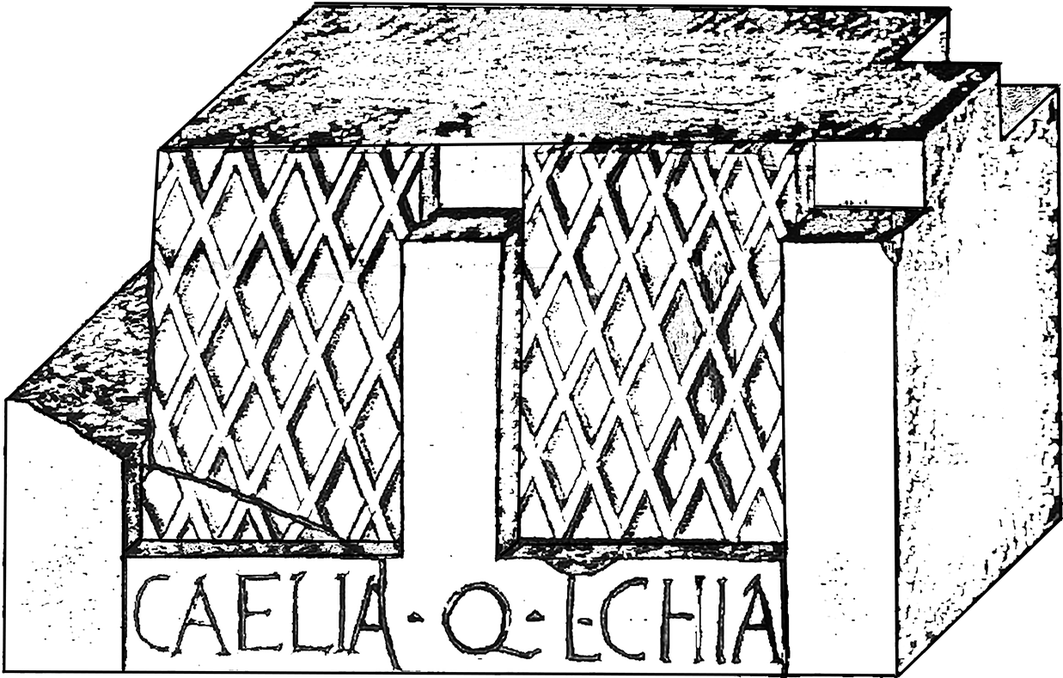
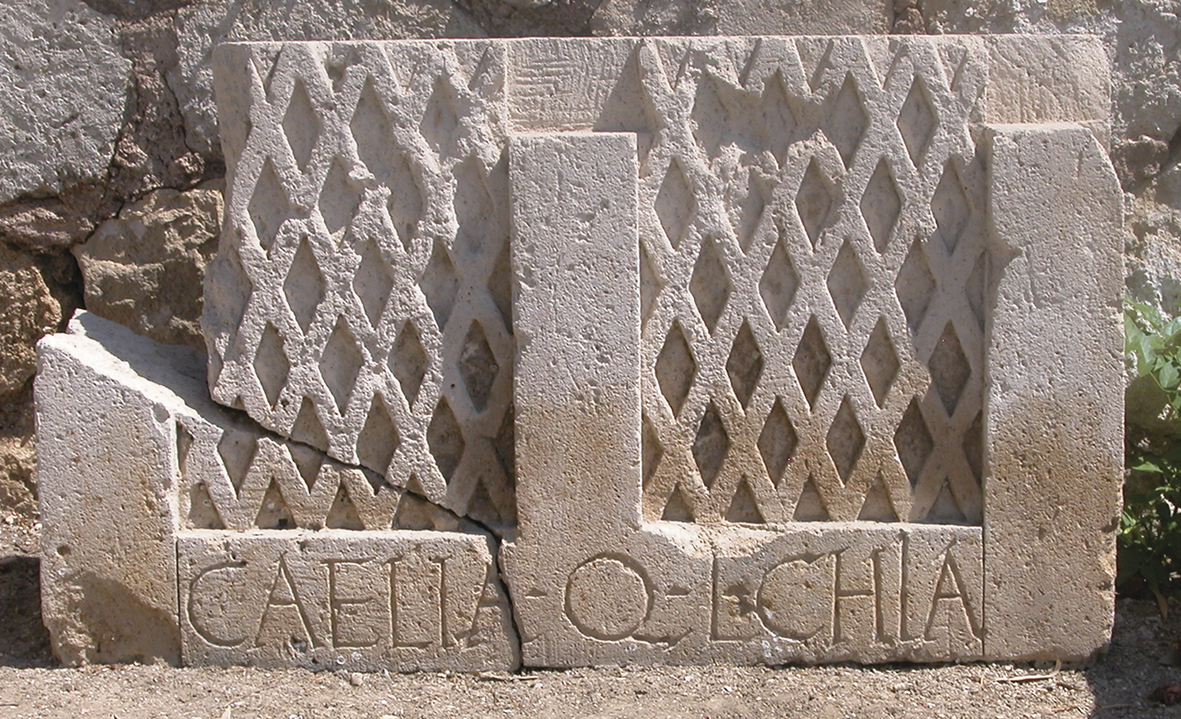
This inscribed block bears a text of one line, carved on limestone (porolithos) below two latticework panels separated by a smooth vertical panel, with smooth vertical panels to the left and right as well (Fig. 5). A line of breakage extends from mid-left diagonally downward to the lower right corner of the left latticework panel and along the right diagonal of the second A in the inscription. The stone is light grey (M7.5YR 7/1). The upper surface is almost intact albeit with some damage. The front surface is cut down for 8 cm from the upper surface, above the central smooth panel. The left side is broken off 30 cm from the top. The right side is not broken but its upper surface is shaped, cut down 8–11 cm from the top (8 cm in front, 11 cm in back). The back is roughly worked. The overall height is 58 cm; the width, 101 cm; and the depth, 25 cm on the left, 30 cm on the right.
Drawing of the inscribed stone, modified from E. Grammatikaki, unpublished excavation diary for 1996, with Grammatikaki’s permission.

The inscribed field and text
The field of inscription (Fig. 6) is 13 cm high and 75 cm wide, between vertical lines that extend from the left of the left latticework panel to the right of the right panel. The inscription fills the field from left to right and is centred vertically. The letters are carefully cut, all well-preserved except the upper hasta of the second L, where the stone is chipped. The letter height is 8 cm except for a tall I, which is 10 cm in height. The letters have light apices and are slightly cursive, especially the L; apices cross above the final A; Q is very round with a pronounced tail; triangular punctuation points in different directions, between A and Q, Q and L, and L and C.
Inscribed face of inscription. Photo by the author.

The inscription clearly reads CAELIA>Q>L<CHIA, to record the name of Caelia Q(uinti) l(iberta) Chia, i.e., Caelia Chia freedwoman of Quintus. The tall I in Chia suggests a date in the first century BCE to first century (Sandys Reference Sandys1927, 50); a date in the last quarter of the first century BCE and first half of the first century would work well for an inscribed block that predates the clay and glass vessels as well as the coins found in the two built graves inside the crypt beneath Tomb 36 (Grammatikaki Reference Grammatikaki1996, 630; Reference Grammatikaki, Cadogan, Hatzaki and Vasilakis2004, 467).
The decorative motif
This Knossian block is not only inscribed but decorated with pilasters and a balustrade featuring latticework, an open work system of bars crossing each other to make a pattern of elongated diamonds. Comparanda for the latticework on our Knossian block are preserved in architectural contexts at Pompeii and Herculaneum, in window openings, doors or doorways, and between columns or pilasters. At Pompeii the Schola (Armaturarum) Iuventutis Pompeianae (III.3.6) had a wide doorway closed by a low wooden wall of lattice-like construction, between pilasters (Richardson Reference Richardson1988, 270, 290–2). Latticework could also appear in domestic architecture, like the lattice grille between columns that is wrapped around an open gallery overlooking the atrium of the second-century BCE Samnite House (V.1) at Herculaneum (Maiuri Reference Maiuri1958, 202–4, figs 157–9, pl. XVIII; Wallace-Hadrill Reference Wallace-Hadrill2011, 198, 202–6, esp. 203–4). The first-century House of the Bicentenary (V.15) at Herculaneum featured a wooden sliding gate constructed in a lattice pattern to separate the west ala from the atrium (Maiuri Reference Maiuri1958, 226, fig. 177, 229, fig. 179). Latticework could also appear in workshops, dividing front areas from back ones while allowing light into and a line of sight out of the back. In the first-century House of Neptune and Amphitrite (V.7) at Herculaneum, a latticework panel atop solid wooden panels divided the front area of a workshop from the rear (Maiuri Reference Maiuri1958, 402, fig. 338, pls XXXIII–XXXIV; Wallace-Hadrill Reference Wallace-Hadrill2011, 80–1). Double lattice leaves filled an interior doorway in Herculaneum’s Insula Orientalis II (Adam Reference Adam1994, 608, fig. 676); this lattice-leaved door can be identified with one from a workshop along Cardo V, possibly the shop of an artisan (Ins. Or. II.16) that appears to have been substantially modified and restricted – thus bringing its interior door to the exterior – during the extension of the Palaestra and the construction of its block of shops and apartments, perhaps under Claudius (Maiuri Reference Maiuri1958, 465, fig. 424, 466, pl. XL; Wallace-Hadrill Reference Wallace-Hadrill2011, 175, 274–5).
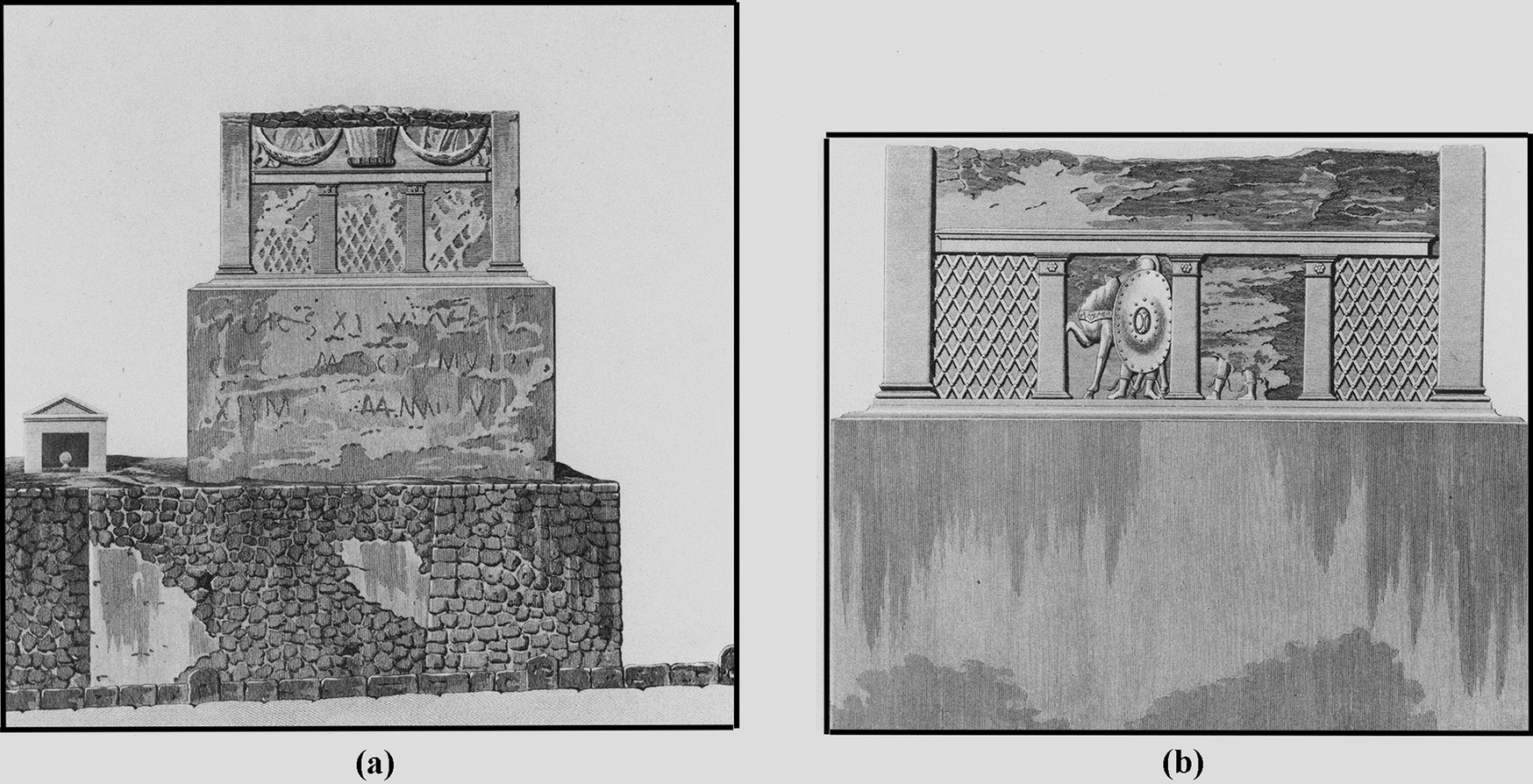
In a funerary context, the balustrade on our Knossian block is likely to represent a window shutter with an imaginary open space behind it (M. Heinzelmann, pers. comm.). A remarkably close parallel for the decorative motif on our Knossian block comes from a late first-century BCE aedicula tomb on Via dei Sepolcri in Pompeii’s Porta di Ercolano necropolis (Fig. 7); it featured decoration in stucco, in the form of an imitation balustrade between pilasters (Kockel Reference Kockel1983, 173–6, Nord 38; Richardson Reference Richardson1988, 247–8; Campbell Reference Campbell2015, 182, PE20). The south and east sides of this Pompeiian tomb show a balustrade composed of latticework panels – three on the south side and two on the east – between pilasters topped by capitals (Kockel Reference Kockel1983, 100–9, pl. 64). A less suitable comparison, even though attributed to a funerary context, comes from Ostia, where double marble doors – with lattice windows between the upper and lower panels of each half-door – probably came from a second–third-century temple tomb in the Porta Romana necropolis (Heinzelmann Reference Heinzelmann2000, 187, n. 258; M. Heinzelmann, pers. comm.).
Pompeii, Porta di Ercolano, North 38: (a) south side and (b) east side, modified from Kockel Reference Kockel1983, pl. 64cd.

The close parallel provided by the aedicula tomb in Pompeii’s Porta di Ercolano necropolis suggests that our Knossian block was originally part of a large monument made of massive stone blocks and decorated on at least one side – this time in stone – with an imitation balustrade between pilasters, perhaps topped with capitals that filled the space created by cuttings on the central upper surface and left side of the block. Our block may well have been topped by another; there could also have been other decorated blocks to the left and right. Like the comparably decorated tomb found in Pompeii’s Porta di Ercolano necropolis, it may have been a family grave monument (Kockel Reference Kockel1983, 176) with tomb chambers below a base that supported one or more inscribed and decorated blocks, surmounted in turn by another course. It was found in a part of the Venizeleion burial ground where three distinctive Italian-style mausolea were discovered in 1996–7; these mausolea – including the one that covered our block – were built above crypts, a tomb type different from that already known at Knossos and one that Roman colonists brought to Knossos.Footnote 1 Comparing our decorated block with the first-century BCE parallel from Pompeii – and taking account of a likely date before the mid-first century, a date derived from the re-use of the block in the construction of a mausoleum built around the mid-first century as well as the tall I employed in the inscribed text – encourages us to think of it as evidence for one of the earliest Italian-style funerary monuments built in the Venizeleion cemetery, one where a member of an early colonial family was buried. On Crete such an early date may be rendered more plausible by comparison with the ‘great Mausoleum’ at Gortyn, which featured a temple-like structure containing a subterranean chamber tomb, built in the second half of the first century BCE (Sassu et al. Reference Sassu, Kiorpe, Mkrtchiyan and Vanucci2023, 678).
COLONIAL FAMILIES AT ROMAN KNOSSOS
Inscriptions of early date
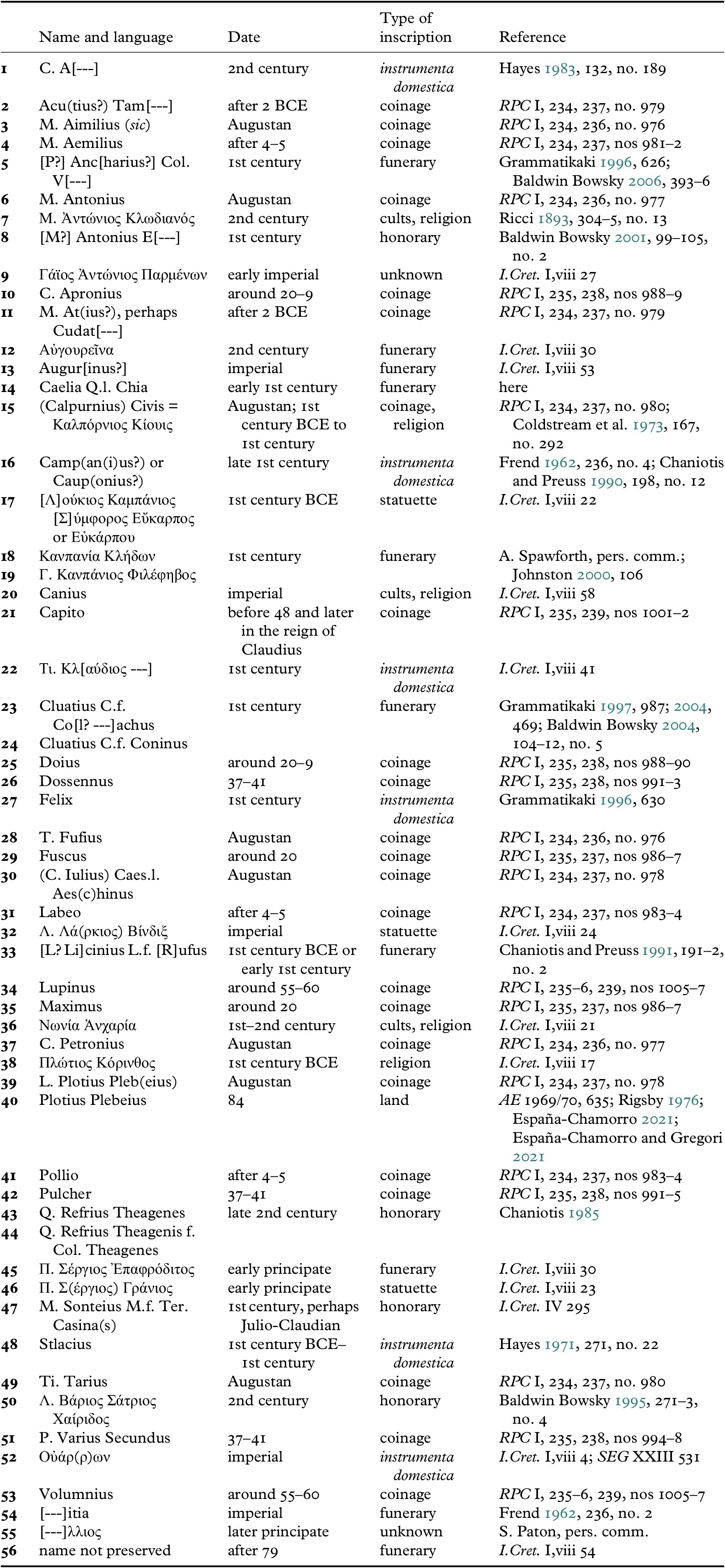
The first criterion for identifying members of Roman colonial families at Knossos is that they be named in inscriptions of early date. The multiple, overlapping criteria for identifying individuals as members of colonial families – beginning with inscriptions of early date – are presented in Table 1. The inscription commemorating Caelia Q.l. Chia (14) joins Knossian inscriptions on various materials that can be dated between the first century BCE and the first century. Here we will discuss this group of documents in chronological groups; in each period we will proceed from public texts that name colonial elites (coin legends and honorary inscriptions, as well as some other texts when internal evidence refers to elites) to texts that name members of the propertied segment of society or individuals of some means (land ownership, instrumenta domestica and statue[tte]s) and private texts that name individuals of undetermined status (funerary inscriptions); some inscriptions must always remain of unknown type (Baldwin Bowsky Reference Baldwin Bowsky, Salmeri, Raggi and Baroni2004, 95; Reference Baldwin Bowsky and Brélaz2017, 293–4). Inscriptions relating to cult and religion provide particularly valuable information about the language choices made by members of colonial families (Baldwin Bowsky Reference Baldwin Bowsky, Salmeri, Raggi and Baroni2004, 95; Reference Baldwin Bowsky and Brélaz2017, 293–4). The data for this discussion is included in Table 1.
Criteria for identifying members and descendants of colonial families at Roman Knossos.

The earliest inscriptions that record Roman names at Knossos have been attributed to the first century BCE. These four men are surely the earliest members of Knossian colonial families that we can identify. Coinage bears the names of two magistrates who are certainly members of colonial families, the duumviri M. Aimilius (3) and T. Fufius (28). Plotius Corinthus (38) – apparently a member of another duumviral family known from Augustan coinage (see 39) – is named in a religious dedication. L. Campanius Symphoros (17) – whose family name and Greek personal name suggest libertine status – is named on the base of a statuette, which might suggest he was a man of some means in Knossian society.
In the first century BCE to first century, inscriptions that name members of colonial families heavily favour those in the elite, who are named on Augustan coinage. Six pairs of duumviri – listed in approximate chronological order (RPC I, 234) – are named in Latin coin legends of the Augustan period: C. Petronius (37) and M. Antonius (6); (C. Iulius) Caes.l. Aeschinus (30) and L. Plotius Pleb(eius) (39); M. At(t)ius, perhaps Cudat[---] (11) and Acu(tius) Tam[---] (2); (Calpurnius) Civis (15, also named in a religious dedication in Greek rather than Latin, where his nomen is given) and Ti. Tarius (49); M. Aemilius (4) and Labeo (31) twice; Pollio (41) and Labeo again (31). An amphora dated to the first century BCE to first century bears the nomen of Stlacius (48) – who should have belonged to the propertied segment of Knossian society – and a contemporary funerary text records the tria nomina of [L? Li]cinius L.f. Rufus (33), whose status must remain undetermined.
In the first century, texts that name members of colonial families still favour those in the elite but begin to reveal to us more individuals of potentially subelite status. Colonial coinage preserves the names of six more pairs of duumviri: Fuscus (29) and Maximus (35); C. Apronius (10) and Doius (25); Dossenus (26) and Pulcher (42); Pulcher again (42) and P. Varius Secundus (51); Capito (21, with a colleague who bears a Greek personal name, Cytherus); Volumnius (53) and Lupinus (34). Honorary inscriptions from Gortyn name two members of the Knossian colonial elite, [M?] Antonius E[---] (8, a duumvir) and M. Sonteius M.f. Ter. Casina(s) (47, a duumvir and holder of two priesthoods at the colony). Funerary texts name [P?] Anc[harius?] Col. V[---] (5); Caelia Q.l. Chia (14); Campania Kledo and C. Campanius Philephebos (18–19); Cluatius C.f. Co[l? ---]achus and Cluatius C.f. Coninus (23–24); and a man whose name is not preserved (56, an aedituus, flamen, duumvir and patronus coloniae). We will see below that five of these men and women were buried in Italian-style structures and so were likely members of the colonial elite. It is a shame the name of 56 – who was named in an inscription built into a metochi at modern Ag. Ioannis, in the environs of the North Cemetery – remains unpreserved. Texts that appear to refer to members of the propertied segment of society or individuals of some means name Plotius Plebeius (40) in a land arbitration, while instrumenta domestica bear the names of Camp(an(i)us) (16), Ti. Cl[audius] (22, in Greek), and Felix (27).
Inscriptions in Latin, earlier and later
The second criterion for identifying members or descendants of colonial families at Knossos is that the inscriptions naming them be in Latin, the language of the Italian peninsula rather than the Eastern Mediterranean (see Table 1). The inscription naming Caelia Q.l. Chia (14) joins other Latin inscriptions from Knossos, not only those of early date – presented above – but five more of second century or imperial date. In these later or imperial texts, another six apparent members of colonial families are named in texts that appear to name elites, members of the propertied segment of society or individuals of some means, and individuals of undetermined status. Colonial elites are named in an honorary inscription for Q. Refrius Theagenis f. Col. Theagenes (44, a quaestor, aedile, and duumvir), dedicated by his father Q. Refrius Theagenes (43), and a religious dedication – perhaps public rather than private – made by Canius (20, an aed[ituus]). The partial name of C. A[---] (1) appears on instrumenta domestica, perhaps for a member of the propertied segment of Knossian society. Funerary inscriptions name individuals of undetermined status: Augur[inus?] (13, the only veteran attested in Knossian inscriptions) and a woman known to us only as [---]itia (54).
Burial in Italian-style monuments
The third criterion for identifying members of colonial families is burial in an Italian-style monument (see Table 1). Two of the distinctive Knossian mausolea in the Venizeleion burial ground – including one, Grammatikaki’s Tomb 52, that is preserved above its stepped krepis – are known to have displayed Latin inscriptions that name members of Roman colonial families who were buried in this area of the Venizeleion necropolis, with its prestigious memorial monuments. We have already seen that the name of Caelia Q.l. Chia (14) – featuring a cognomen and a rare Latin formula that specifies her status as a freedwoman – is inscribed on a block that was found in second use beneath Grammatikaki’s Tomb 36. Tomb 52 bore, across the blocks of its altar’s façade, a Latin inscription recording the names of the Cluatii – including one cognomen, Latin-style filiation and a possible voting tribe – as two men identified as members of a colonial family (23–24). It may well be that a broken block preserving the name of [P?] Anc[harius?] Col. V[---] (5) also came from another monumental memorial in the Venizeleion burial ground, given its discovery there (see Fig. 2), the depth of the block and the height of its letters.
Two more likely members of a colonial family, Campania Kledo and C. Campanius Philephebos (18–19), are named in Greek rather than Latin, on a funerary plaque that was found in the midst of Knossos’ North Cemetery, not in situ nor in context but in a pile of large squared limestone blocks found north of the Venizeleion Hospital (see Fig. 1); the inscription was recognised when a bull-dozer moved the blocks (Hood and Smyth Reference Hood and Smyth1981, 39, no. 65; Johnston Reference Johnston and Huxley2000, 186; T. Whitelaw, pers. comm., citing J. Carington Smith, Knossos Medical Faculty excavation notebook 21, 102, 23 June 1978). The original setting may have been architectural, most likely a rock-cut chamber tomb or else a free-standing architectural tomb (A. Spawforth, pers. comm.). The square rock-cut chamber tombs at Knossos, Ag. Thomas and near Prinias may be a type introduced to Crete from Italy by Roman colonists and immigrants.Footnote 2
Nomina that suggest migration to the colony at Knossos
The fourth criterion for identifying members of Roman colonial families at Knossos is the bearing of a nomen attested in the Italian peninsula but not on Delos or among traders active in the Eastern Mediterranean (see Table 1). Nomina that are attested on Delos and among traders in the Eastern Mediterranean could signal the presence not of colonists but of negotiatores, who are more difficult to identify as members of colonial families at Roman Knossos. So far we have identified 22 nomina that appear to have been borne by members of colonial families: Acutius (2), Aemilius (3–4), Anc[harius?] (5), Antonius (6, 8), Apronius (10), At(t)ius (11), Caelia (14), Calpurnius (15), Campanius (16–17), Canius (20), Cluatius (23–24), Doius (25), Fufius (28), Licinius (33), Petronius (37), Plotius (38–40), Refrius (43–44), Sonteius (47), Stlacius (48), Tarius (49), Varius (51), and Volumnius (53). Thirteen of these are not attested on Delos or among traders active in the Eastern Mediterranean, and so are more likely to have been borne by members of colonial families at Knossos: Anc[harius?] (5), Apronius (10), At(t)ius (11), Caelia (14), Campanius (16–19), Canius (20), Doius (25), Fufius (28), Plotius (38–40), Refrius (43–44), Sonteius (47), Tarius (49), and Volumnius (53).
The family name of Caelia Q.l. Chia (14) is a case in point, a nomen that can tell us something about the possible Italian origins or connections of this colonial family and the distribution of its members in the Eastern Mediterranean. In the Italian peninsula in particular, non-imperial nomina can be categorised as attested throughout the peninsula, widely documented, well documented, not uncommon, or uncommon and even rare. Seven regions or cities of the Italian peninsula are covered by volumes of CIL: northern Italy, including Cisalpine Gaul, Venetia and Istria (V); Etruria together with Umbria and Aemilia (XI); Latium (XIV) and Rome in particular (VI); Campania – including Pompeii (IV) – and southern Italy together with the provinces of Sicily and Sardinia (X); and south-eastern Italy and Picenum (IX). Nomina can be characterised as attested throughout the Italian peninsula when they appear in seven or eight regions or cities; widely documented when they appear in five or six; well documented when they appear in four; not uncommon when they appear in three; uncommon when they appear in two; and rare when they appear in one (O. Salomies, pers. comm.; Baldwin Bowsky Reference Baldwin Bowskyforthcoming). We can further take account of praenomina shared between Knossos and the Italian peninsula, in order to strengthen the case for origins or connections.
In the Italian peninsula, Caelii with the praenomen Quintus – borne by Chia’s former master – are widely documented in volumes of CIL devoted to Cisalpine Gaul (V); Etruria, Umbria and Aemilia (XI); Rome (VI); Campania and south-western Italy together with Sicily and Sardinia (X). Regional and other studies trace Q. Caelii in Campania at Neapolis (Leiwo Reference Leiwo1994, 175) and Puteoli (Camodeca Reference Camodeca2018, 459) and in southern Italy at Canusium (Silvestrini Reference Silvestrini2005, 83). Two Q. Caelii, whose Italian domus has not been identified, were junior members of the Roman senate in 44 BCE and at an unknown date (Broughton Reference Broughton1952, 322–3, 468). In the Eastern Mediterranean, where praenomina are not necessarily recorded, regional studies trace this nomen at Athens (Byrne Reference Byrne2003, 94–5, with the praenomen Quintus) and Ephesos (Kirbihler Reference Kirbihler2016, 288), and for a mercator on first-century BCE Melos (Hatzfeld Reference Hatzfeld1919, 88; Mendoni and Zoumbaki Reference Mendoni and Zoumbaki2008, 128–9, no. 7). At Corinth, Spawforth (Reference Spawforth and Rizakis1996, 172) sees Caelius as a gentilicium that illustrates the links between leading families and the milieu of the negotiatores, even though the family name is thus far unattested on Delos and among traders active in the Eastern Mediterranean. Further to the east and south, beyond Ephesos, Caelii are attested at Ionian Erythrae (I.Erythrai Klazomenai 104) and Miletos (SEG XXVI 1294; I.Milet VI,3 1242); Mysian Aisepos (Munro Reference Munro1897, 293, no. 74) and Apollonia ad Rhyndacum (Munro Reference Munro1897, 269, no. 5); Paphlagonian Amastris (SEG XXXV 1341, from Amisos); Pisidian Pogla (SEG XIX 835); and Egyptian Thebes (I.Syringes 836).
To the names attested in early and Latin inscriptions we might now add those attested in Greek after the first century, when they appear to name members of colonial families whose language choice suggests they had integrated into the Greek society of Knossos even while the onomastic formulae that preserve their names continue to conform to Roman ways of naming. It is somewhat less likely that these names belong to members of Knossian colonial families, as all but one are attested elsewhere on Crete, except that they also bear names that utilise onomastic formulae consistent with Roman ways of naming, further discussed below. Cognomina are recorded for M. Antonius Clodianus (7; cf. 6 and 8 with the same nomen), Augurina (12; cf. 13 with the same cognomen), L. La(rcius) Vindex (32; cf. AE 1950, 90 for a Larcius born at Knossos) and Var(r)o (52, a landowner in the territory of Knossos). Second nomina rather than cognomina – perhaps due to intermarriage within colonial or Cretan society – are attested for P. S(ergius) Granius (46; cf. 45 with the same nomen) and Nonia Ancharia (36; cf. 5 probably with the same nomen); L. Varius Satrius, son of Chairis (50; cf. 51 with the same nomen), also bore a second nomen even while recording the Greek personal name of his father. Praenomina, together with nomina and Greek personal names, were borne by two men, M. Antonius Parmenon (9; cf. 6 and 8 with the same nomen) and P. Sergius Epaphroditos (45; cf. 46 with the same nomen). The most difficult case to support on the evidence available is that for [---]llius (55), who is known only by a fragmentary nomen.
Adding the names of individuals attested in Greek after the first century would allow us to recognise both nomina already examined – a pattern that encourages identifying their bearers as members of colonial families – and additional ones. Certain nomina apparently persisted in the colonial population, even as their bearers were integrated into the Greek society of Knossos: Antonius (7 and 9; cf. 6 and 8), Ancharia (36; cf. 5), Campanius (18–19; cf. 16–17), and Varius (50; cf. 51). We might also consider the Italian parallels for six more nomina, all but one attested elsewhere in Crete (Baldwin Bowsky Reference Baldwin Bowskyforthcoming): Clodius (cf. the cognomen borne by 7), Granius (46), Larcius (32), Nonia (36), Satrius (50, not attested elsewhere on Crete), and Sergius (45–46).
At Knossos the gens Caelia is one of 28 attested in inscriptions, be they earlier or later, in Latin or in Greek; we will not take into account the imperial nomina Iulius (30) and Claudius (22), as they are attested throughout the Italian peninsula for their own particular reasons. Thirteen of these Knossian nomina are attested throughout the Italian peninsula: Acut(tius) (2), Anc[harius?] (5; cf. the second nomen of 36), Antonius (6–9), At(t)ius (11), Canius (20), Clodius (cf. 7, whose cognomen Clodianus is derived from Clodius), Licinius (33), Nonia (36), Plotius (38–40), Satrius (the second nomen of 50), Stlac(c)ius (48), Varius (50–51), and Volumnius (53). Eight more are widely documented there: Aemilius (3–4), Caelia (14), Calpurnius (15), Fufius (28), Granius (46), Larcius (32), Petronius (37), and Sergius (45–46). Three are well documented in the Italian peninsula: Apronius (10), Campanius (16–19, a nomen borne by freed public slaves of Capua), and Tarius (49). Another three are not uncommon in the Italian peninsula: Cluatius (23–24), Doius (25), and Refrius (43–44). One nomen, that of Sonteius (47), remains a rare one attested only in Latium.
We can suggest possible Italian origins or connections for colonial families at Knossos, by tracing (1) which nomina are more or less common in the Italian peninsula but attested with the same praenomina as at Knossos and (2) which nomina are attested in one region of the peninsula or in two including Rome, to and from which men and women migrated for a series of historical reasons (Baldwin Bowsky Reference Baldwin Bowskyforthcoming). Five Knossian nomina can be associated not just with Campania but also with Latium – including Rome – and Etruria together with Umbria and Aemilia. Q. Refrii (43–44) are attested at Campanian Pompeii (Baldwin Bowsky Reference Baldwin Bowskyforthcoming). Two nomina – together with the same praenomina as at Knossos – can be traced to two regions of the Italian peninsula: Cluatii with the praenomen Caius (cf. 23–24) to Campania and Rome, a city where this particular spelling of the nomen is uniquely paralleled; and T. Fufii (cf. 28), attested in Etruria together with Umbria and Aemilia and also in southern Italy (Baldwin Bowsky Reference Baldwin Bowskyforthcoming). Another nomen – Doius (cf. 25), not attested with a praenomen at Knossos – can be attributed to Etruria together with Umbria and Aemilia and also to Rome.Footnote 3 The rare nomen Sonteius (cf. 47) is paralleled in Latium, at the bearer’s apparent domus, Casinum (Baldwin Bowsky Reference Baldwin Bowskyforthcoming). We will see below that the Collina voting tribe – attested in the first century with the names of [P?] Anc[harius?] Col. V[---] (5) and Cluatius C.f. Co[l? ---]achus (23), and in the second century with the name of Q. Refrius Theagenis f. Col. Theagenes (44) – is particular to Rome, at least at the earlier date.
These nomina are in all likelihood echoes of an imperial wave of migration to the Eastern Mediterranean, including Crete and Knossos in particular. If we add names attested in Greek after the first century, 14 nomina can now be traced at Knossos and elsewhere in the Eastern Mediterranean, aside from those on Delos and among traders active in the region: the 13 given above and Larcius (32; Baldwin Bowsky Reference Baldwin Bowskyforthcoming). Two more nomina are attested only at Knossos, in all the Eastern Mediterranean: Campanius (16–19) and Sonteius (47) (Baldwin Bowsky Reference Baldwin Bowskyforthcoming).
Onomastic formulae consistent with Roman ways of naming
The fifth criterion for identifying members of colonial families at Roman Knossos is that their names feature onomastic elements consistent with Roman ways of naming, from cognomina or second nomina to Latin-style filiation, Roman voting tribes, and explicit indications of freed status (see Table 1); these elements sometimes appear together in a single name. Two-thirds of the personal names attested for members of colonial families are cognomina or second nomina rather than Greek personal names or names that could be either Latin or Greek: 23 individuals bore 21 different cognomina (7, 12–13, 14, 15, 21, 24, 26, 27, 29, 31, 32, 33, 34, 35, 38, 39–40, 41, 42, 47, 51, 52), while three more bore second nomina instead (36, 46, 50). By comparison, 10 possible or probable members of colonial families bore nine different Greek personal names (9, 11, 17, 18, 19, 23, 30, 43–44, 45) and three bore personal names that could be either Latin or Greek (2, 5, 8). At the same time, five likely members of colonial families are known by names that utilise Latin-style filiation, an unusual phenomenon in the Eastern Mediterranean (Camia Reference Camia and Parissaki2013, 180): Cluatius C.f. Co[l? ---]achus (23) and Cluatius C.f. Coninus (24); [L? Li]cinius L.f. [R]ufus (33); Q. Refrius Theagenis f. Col. Theagenes (44, son of a man with a Greek personal name rather than a cognomen); and M. Sonteius M.f. Ter. Casina(s) (47). Another phenomenon seldom specified in the Eastern Mediterranean is the recording of Roman voting tribes (Camia Reference Camia and Parissaki2013, 180); at Knossos the Collina and Terentina voting tribes are recorded for four members or descendants of colonial families. The Collina was the urban tribe of Rome to which freedmen were normally confined; it was also a tribe in which enfranchised provincials in the Eastern Mediterranean were later enrolled (Syme Reference Syme1964, 109; see [P?] Anc[harius?] Col. V[---] [5] and Cluatius C.f. Co[l? ---]achus [23] in the first century; Q. Refrius Theagenis f. Col. Theagenes [44] in the second century). The Terentina was the tribe in which Latin Casinum was enrolled (Taylor and Linderski Reference Taylor and Linderski2013, 275; see M. Sonteius M.f. Ter. Casina(s) [47]); Sonteius’ cognomen Casina(s) corroborates his origins there (Kajanto Reference Kajanto1965, 181). Two members of colonial families utilised abbreviations of the term liberta/libertus to record their freed status, yet another phenomenon rarely made explicit in the Eastern Mediterranean (Camia Reference Camia and Parissaki2013, 193): Caelia Q.l. Chia (14) and (C. Iulius) Caes.l. Aes(c)hinus (30).
Here we can pay particular attention to the fact that Caelia Q.l. Chia (14) was not only one of the Latin speakers for or by whom tombs were built in the Venizeleion burial ground, and a member of a colonial family who was buried there at an early date, but also a freedwoman and so part of a seldom-visible stratum of Knossian colonial society. In the Eastern Mediterranean, Roman citizens from the lower segments of society – even men and women of servile origin – can nevertheless be identified in a number of ways (Camia Reference Camia and Parissaki2013, 192–3). Freed status can be posited when a Greek personal name is borne by a recognisable Roman citizen at an early date; when geographical cognomina are borne by individuals together with a nomen; or when what are called servile cognomina are borne by individuals who were recognisable Roman citizens. At Knossos a Greek personal name – like that of (C. Iulius) Caes.l. Aeschinus (30) – may also have been borne by M. At(t)ius, whose personal name could have been Cudat[---] (11). L. Campanius Symphoros (17) bore not only a Greek personal name but a nomen indicative of freed status;Footnote 4 two more members of the gens Campania – also bearing Greek personal names – are of first century date (18–19). Libertine status or origins can also be suggested when geographical cognomina – like Chia, popular among the servile and libertine population of RomeFootnote 5 – are borne by individuals otherwise known to have been Roman citizens, like Plotius Corinthus (38). Cognomina characteristic of the lower segments of Roman society can further suggest the identification of freedpersons and their descendants, such as L. Plotius Pleb(eius) (39), who was duumvir together with (C. Iulius) Caes. l. Aeschinus (30) in the Augustan period; Plebeius’ descendant Plotius Plebeius, a landowner early in the reign of Domitian, still bore this cognomen (40). Two more duumviri of Colonia Iulia Nobilis Cnosus are known to us only by their servile cognomina, though as colonial magistrates they were certainly Roman citizens: Pollio in the Augustan period after 4–5 (41; cf. Kajanto Reference Kajanto1965, 37, 164) and Fuscus in the reign of Tiberius around 20 (29; cf. Kajanto Reference Kajanto1965, 65, 174, 228). The cognomen Felix, stamped on a bronze strigil found in a first-century grave in the Venizeleion burial ground, is another commonly but not exclusively given to slaves (27; cf. Kajanto Reference Kajanto1965, 29, 73, 272–3).
Colonial families at Roman Knossos
Individuals who meet more than one of the criteria proposed above are likely to have been members or descendants of colonial families at Roman Knossos. Caelia Q.l. Chia (14) is the strongest candidate of all, as she meets all five criteria; most of the men and women considered here meet more than one criterion for identification as members of colonial families at Roman Knossos, or they are at least plausible candidates when other related names are taken into account (see Table 1). Even those who meet a single criterion might be considered for membership in this group, depending on the strength of the criterion they satisfy or other confirming evidence, especially when they are named in inscriptions of early date (22, 34), Latin inscriptions (1), nomina that suggest migration to Knossos in the imperial period (45; cf. 46), and the use of Roman onomastic formulae (23; cf. 13 and 52, the latter a landowner). Only one man (55) is less than likely to have been a member or descendant of a colonial family.
The case of Caelia Q.l. Chia (14) contributes significantly to our knowledge of the colonial families at Roman Knossos. In the Venizeleion burial ground on the northern boundary of the colony, Caelia Q.l. Chia (14) – together with two Cluatii (23–24), Anc[harius?] (5), [---]itia (54) and two Campanii (18–19) – can be identified as a member of a Roman colonial family. They all, together with 49 other men and women, can or may be identified as members and descendants of colonial families, as they were named in inscriptions of early date and in Latin or occasionally in Greek, were buried in Italian-style mausolea, bore nomina attested in the Italian peninsula but not on Delos or among traders active in the Eastern Mediterranean, and are known by onomastic formulae consistent with Roman ways of naming. The burial ground at the Venizeleion hospital complex joins colonial coinage and other inscriptions on stone and ceramics as a source of evidence for identifying the Romans and Italians who may have come to Knossos to enjoy the legal, economic and social privileges available in the only Roman colony on the island.
ACKNOWLEDGEMENTS
Let me express my gratitude to Mrs Eva Grammatikaki, for permission to publish this inscription and both information and images from her excavation diary; the Ephorate of Antiquities in Heraklion, for facilitating study of this inscribed block; Dr Kostis Christakis, for locating the inscription that names 18–19 and copies of the Knossos Medical Faculty excavation notebooks; Prof. Todd Whitelaw of University College London, for sharing his extensive knowledge of the North Cemetery and road network of Roman Knossos as well as locating the inscription that names 18–19 in the Knossos Medical Faculty excavation notebooks; Prof. Michael Heinzelmann of the University of Cologne, for advising me on the significance of latticework ornamentation, and imitations thereof, and suggesting parallels for its use on our gravestone; Prof. Andrew Wallace-Hadrill, for sharing his knowledge of the antiquities of Herculaneum; Prof. Olli Salomies, for suggesting that I survey the volumes of CIL devoted to the Italian peninsula, in order to estimate the spread of a gentilicium in the Italian peninsula, even without incorporating publications since CIL; and the anonymous reviewers for BSA, whose comments and suggestions substantially strengthened and clarified this study.