In this article, I argue that at least six scribes contributed to the production of the Matrícula de Tributos and that one of them was responsible for producing the Codex Mendoza several decades later, continuing a line of analysis started in previous papers (Batalla Rosado Reference Batalla Rosado2002a, Reference Batalla Rosado2007a). I summarize the overall argument and offer several new interpretations on the dating and manner of production of the two tribute documents. It is remarkable that a scribe “employed” initially by the Mexica empire to produce an imperial tribute document could be employed again by the Spanish empire in the early Colonial period. To support these conclusions, I analyze graphic elements that appear in both documents, examine patterns that identify the different scribes, and make a comparative analysis of their style.
THE MATRÍCULA DE TRIBUTOS
Most scholars attribute the production of the Matrícula de Tributos to the pre-Hispanic period (Barlow Reference Barlow, Monjarás-Ruiz, Limón and de la Cruz Paillés1990; Berdan Reference Berdan, Berdan and Anawalt1992:I:64–65), although some disagree (Reyes García Reference Reyes García1997:17, 49). My analysis supports the former interpretation. The format of the document and the styles of the different scribes suggest a date prior to 1519. Originally, the Matrícula may have been a long document, rolled or folded, or it may have been composed of separate pages painted on one side and later glued together to conform artificially to the format of a European book. Significantly, the damage on back-to-back pages does not match (Batalla Rosado Reference Batalla Rosado1992:I:48–49; Mohar Reference Mohar, Smithers, Sosa and Baracs1997:72–80; Rojas Reference Rojas1997:34–35); this damage can be observed On folios 2, 3, 6, 7, 9, and others (Matrícula de Tributos Reference Berdan and de Durand-Forest1980).
The Matrícula de Tributos was apparently produced as a series of individual pages of amate paper (Berdan Reference Berdan, Berdan and de Durand-Forest1980a:9). Although Luz María Mohar (Reference Mohar, Smithers, Sosa and Baracs1997:74) disagrees with Frances Berdan's hypothesis, my observations support Berdan's view. The separate sheets make sense, given the function of the Matrícula as a list of tribute from individual imperial provinces (see Smith Reference Smith2003:147–171). As the individual towns, their tribute requirements, or the imperial status of the provinces changed over time, the document could be modified accordingly. It was possible to add, delete, or change the products paid by individual communities, correcting or replacing sheets as needed. New sheets could also be added if warranted by imperial conquests.
According to Robert Barlow (Reference Barlow, Monjarás-Ruiz, Limón and de la Cruz Paillés1990:142), the Matrícula was painted after 1511. This dating is supported by the inclusion in the document of provinces conquered shortly before the arrival of the Spanish (Rojas Reference Rojas1997:33). Nevertheless, we have to consider that, if the Matrícula was a register of tribute on separate sheets, it could have been produced over a period of many years. It is thus possible, as Berdan (Reference Berdan, Berdan and Anawalt1992:I:64–65) has remarked, that the Matrícula was composed throughout the last decade of Moctezuma's II government, and not in a single year. We may be able to trace the initial production of the document back to the beginning of the empire if we assume that each sheet, or each group of sheets, was painted separately during a different period, expanding the document over the years. Another observation supporting this hypothesis is the large number of scribes—at least six—responsible for the pages still preserved in the document, including a Mixtec scribe (or a scribe following the Mixtecan artistic tradition but working for the Mexica empire). For these reasons, I cannot agree with Luis Reyes García (Reference Reyes García1997:17, 49), who dates the work 10–20 years after the fall of Tenochtitlan to Cortés. Reyes García considers the Matrícula an incomplete copy of older documents.
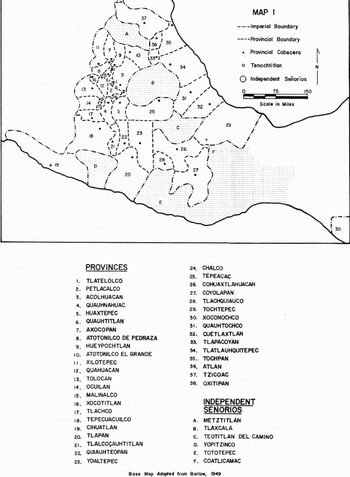
I will not discuss the content of the Matrícula de Tributos further in this work, although I agree with Pedro Carrasco's (Reference Carrasco1996:110–111) view that the document reveals the relationship between the provinces and Tenochtitlan. It is a key to the organization of the Mexica empire (Figure 1).Footnote 1
Map of the provinces subject to the Mexica empire (from Berdan Reference Berdan, Berdan and de Durand-Forest1980b:28).

The Matrícula de Tributos (Reference León-Portilla1974, Reference Berdan and de Durand-Forest1980, Reference León-Portilla, Teresa Sepúlveda and Castillo1991, Reference Reyes García1997, Reference León-Portilla, Teresa Sepúlveda and Castillo2003) is a large document whose pages measure 42 cm × 29 cm. It is composed of 32 folios of amate paper. The tribute roll that forms the second part of the Codex Mendoza is generally accepted as a copy of the Matrícula. However, the later document lists tribute from five provinces not included in the Matrícula. This suggests that around 1542, when the Codex Mendoza was painted, the Matrícula must have had at least five additional folios: two between folios 4v and 5r (the provinces of Axocapan and Atotonilco de Pedraza); two between folios 12v and 13r (Tlachquiauhco and Tochtepec); and one more at the end, where we would place the province of Oxitipan. This pattern suggests that the Matrícula was already in European form, with pages glued together, when the Codex Mendoza was copied. The four missing interior folios were each a recto–verso pair, and the final missing folio must have had only a single painted surface, because the Matrícula ended (or began) with Oxtitipan, depending on the direction in which the document is read (Rojas Reference Rojas1997:34).
Although not directly germane to the topic of this paper, my opinion is that the Matrícula de Tributos was an official document in Tenochtitlan's imperial administration and that, as such, it should be free of errors. Its purpose was to register and account for the tribute due to the Mexica empire.
Finally, I must point out that after the Conquest, the Matrícula de Tributos should have been annotated in both alphabetical Nahuatl and Castilian. Thus, we can differentiate the pre-Cortesian Libro Indígena (Native Book) from the colonial Libro Escrito Europeo (European Written Book) (see Batalla Rosado Reference Batalla Rosado2002b).
THE CODEX MENDOZA
The Codex Mendoza was painted in 1542 by a single scribe (see Codex Mendoza Reference Berdan and Anawalt1992:I). With further analysis, it may be possible to identify the presence of assistants or apprentices in copying the Matrícula de Tributos to produce the tribute section of the Codex Mendoza. The work of such assistants has been identified in other Colonial and pre-Colonial codices (see Batalla Rosado Reference Batalla Rosado1993, Reference Batalla Rosado1994, Reference Batalla Rosado2002b, Reference Batalla Rosado2002c).
Nevertheless, I argue that the scribe in charge of painting the Codex Mendoza must have been a master painter known for high-quality work. His employer was the highest official in the colonial system, the viceroy, and it is logical to assume that only an artist of renown, the best one available, would receive such an appointment. In agreement with the opinion of the encomendero Jerónimo López (around 1547), as recorded by Silvio Zavala (Reference Zavala1938:70), I believe that the Codex Mendoza was produced by a “master of the painters” named Francisco Gualpuyogualcal or Cuauhpoyouacatl (Reyes García Reference Reyes García1997:25):
It must have been about six years ago, more or less, that entering one day into the home of an Indian who was called Francisco Gualpuyogualcal, master of the painters, I saw in his possession a book with covers of parchment and asking [sic] him what it was. In secret he showed it to me and told me that he had made it by the command of His Lordship, in which he had to record all the land since the founding of the city of Mexico and the lords that had governed and ruled until the coming of the Spaniards and the battles and clashes that they had and the taking of this great city and all the provinces that it ruled and had made subject and the assignment of these towns and provinces that was made by Motezuma to the principal lords of this city and of the fee that each one of the knights gave him from the tributes of the towns that he had and the plan that he employed in the aforesaid assignment and how he sketched [?] the towns and provinces for it. (Zavala Reference Zavala1938:70, translated in Nicholson Reference Nicholson, Berdan and Anawalt1992:I:1–2)
I believe that the author of the Codex Mendoza did not feel it was necessary to be precise in recording the tribute because he was not creating an official economic document, like the Matrícula de Tributos. Instead, the purpose of the Codex Mendoza was to show a foreign ruler how the old system worked. In 1542, the former tribute and territorial divisions were no longer important. The Codex Mendoza was not a document produced by the new colonial administration to control new territories; it was, instead, a kind of “encyclopedia” to explain to the new masters how these people had lived. This helps explain why the Codex Mendoza is clearly divided thematically into historic, economic, and ethnographic sections.
THE TIME SPAN BETWEEN THE MATRÍCULA DE TRIBUTOS AND THE CODEX MENDOZA
The minimum interval between the production of the two codices is 21 years, assuming that some parts of the Matrícula were painted around the time of the Conquest. The interval could easily have been greater than 21 years, however. In my interpretation, folios 6r–11v of the Matrícula and the Codex Mendoza as a whole were painted by the same scribe. If folios 6r–11v were not the last pages of the Matrícula to be painted, then the length of time between the two works would be longer than the interval between the final pages of the document and the painting of the Codex Mendoza in 1542. Unfortunately, we have no information about the age of the scribe at the time that the Codex Mendoza was done, making it impossible to generate any hypothesis about the intervals between the works beyond inferences based on the life expectancy of an average person. This factor suggests that the time span between folios 6r–11v of the Matrícula and the Codex Mendoza could not be more than about 50 years.
THE SCRIBES OF THE MATRÍCULA DE TRIBUTOS
Establishing the number of painters who participated in the production of the Matrícula de Tributos is not easy, because iconographic and writing traits are subject to slight differences even in the work of a single artist. Nevertheless, it is possible to identify different “hands” that produced this document because their manners of painting and writing allow the identification of different styles. In fact, Berdan (Reference Berdan, Berdan and de Durand-Forest1980a:9, Note 5) notes this possibility, describing three styles in the Matrícula based on depictions of tribute mantas and warriors' costumes: “the first style includes láminas III–X [folios 1v–5v]; the second, XI–XXII [6r–11v]; the third, XXIII–XXXII [12v–16v].” She does not pursue this analysis, however. Similarly, Reyes García (Reference Reyes García1997:19) starts his research on the document by defending the presence of a single scribe, although later he recognizes two (Reyes García Reference Reyes García1997:97, 133)—one in folios 1r–5v and 11v–16v, and the second in the central section, folios 6r–11r—on the basis of iconographic changes in mantas, warriors' costumes, and shields. I show later that it is in fact possible to identify up to six scribes, whose work is distributed in a different way from those suggested by Berdan and Reyes García.
I begin by distinguishing the scribes in places that permit the establishment of clear and unquestionable differences, regardless of whether the original order of the Matrícula was the same as when it was copied for the Codex Mendoza and regardless of the number of folios that were lost after its initial production (at least five). The first clear stylistic incongruities are found in the central part of the document when it was converted into a European-style book. As noted earlier, Berdan (Reference Berdan, Berdan and de Durand-Forest1980a:9) and Reyes García (Reference Rojas1997:97, 133) established that the style of folios 6r–11v is different from that of the rest of the document. But another factor separates blocks of pages clearly between folios 5 and 6: the place where two pages have been lost. Following the order of provinces in the Codex Mendoza, the missing pages must have included the tribute from four provinces (numbers 7, 8, 28, and 29 in Figure 1).
The “Mixtecan-Style” Scribe
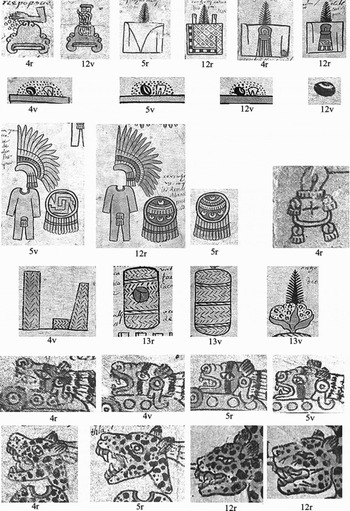
I argue that folios 4r–5v and 12r–13v (identified with provinces 5, 6, 9, 10, 26, 27, 30, and 31 in Figure 1) were painted by a Mixtec or, perhaps, “Mixtecan-style” scribe (Figure 2). A key element in making this judgment is the sign for tepetl (hill) used in toponyms. The sign is drawn using just two “scrolls” (tetl, ‘stone’) on folios 4r–5v and 12r–15v, a feature that is characteristic of pre-Columbian and Colonial documents of the Mixtecan culture (see Batalla, Reference Batalla Rosado and Jansen2007b). In central Mexican documents, by contrast, the tepetl element is depicted using three scrolls—or none at all. The three-scroll design is used throughout the Matrícula de Tributos, except on folios 4r–5v and 12r–13v.
Stylistic details of the “Mixtecan-style” scribe on folios 4r–5v, 12r–13v in the Matrícula de Tributos (Reference Berdan and de Durand-Forest1980).

The presence of the two-scroll tepetl sign on two different folio blocks might suggest the work of two scribes educated in the tradition of Mixtec manuscript painting. However, enough shared iconographic details are present to attribute all of the pages to a single hand. For example, the bundles of mantas are represented similarly, with straight lines, on folios 4r–5v and 12r–13v, although on folio 12r they form a square instead of a rectangle. The glyph for the number 400 is also similar on all of the folios, and the representation of beans and grains of maize, the maxtlatl (loincloth) in the two-piece warriors' costumes, the shape of the shields, the way in which the little lines are disposed to represent the petlatl (mat), and the heads of the god Xolotl and of the ocelotl in the costumes are identical on the relevant pages. Although there are clear differences in how the loads of maxtlatl are representated on folios 4r and 12r, the discrepancies could be intentional, to show differences in the quality of the loincloths. And although there is a discrepancy in how the heads of the ocelotl are represented on folios 12r and 4r and 5r, the ears are identical. The difference could be due to the fact that on folio 12r, the ocelotl represents the complete pelt of the animal, whereas on folios 4r and 5r, it is part of a warrior's suit.
As we will see later, these iconographic traits differentiate this artist from the rest of the painters, as do the glyph for xiquipilli (the number 8,000) and the form of depiction of cotton.
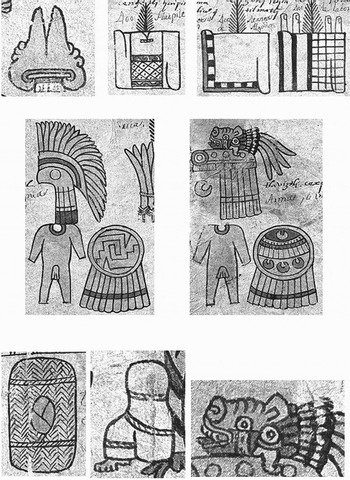
The “Mendocino-Style” Scribe
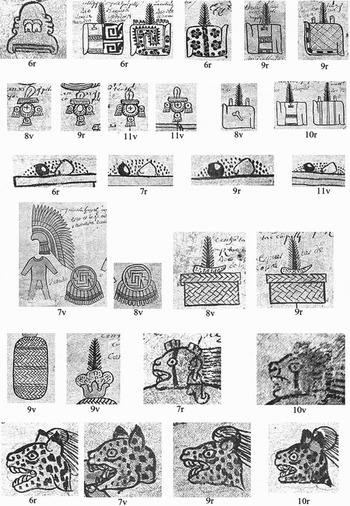
A second scribe who can be differentiated clearly in the Matrícula is the one in charge of folios 6r–11v (12 pages that correspond to provinces 11–25 in Figure 1). This scribe, whom I have called the “painter of the Mendocino” (Batalla Rosado, Reference Batalla Rosado2007a), shows a whole group of traits that are common to these folios and absent in others (Figure 3). They include loads of mantas (clothes) executed using a curvilinear design; the glyph for xiquipilli; the shape of the beans and grains of corn; the feather decoration on the shields, which is wide open and facing outward; the design of the petlatl in the loads; the manner of depicting cotton; and the rounded shape and decoration of the head of Xolotl and of he ocelotl. These elements are found only on folios 6r–11v of the Matrícula de Tributos.
Stylistic details of the “Mendocino-style” scribe on folios 6r–11v in the Matrícula de Tributos (Reference Berdan and de Durand-Forest1980).

The Scribe of Folios 1r–2r
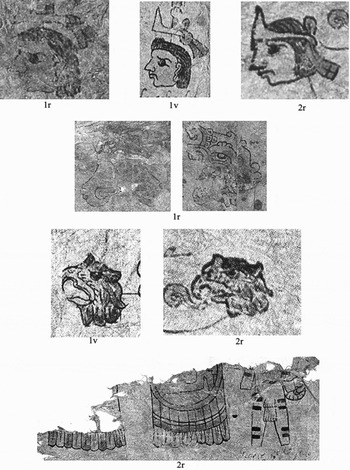
Despite the bad state of folios 1r–2r, I argue that they were painted by the same scribe (Figure 4). The depiction of the human eye is the same on all three pages, and the glyph consisting of an eagle head is the same on folios 1v and 2r. Also, there are similarities (and differences) in how the xiuhuitzolli, or royal crown, is represented. On all three folios, the red cloth attached to the crown does not fall in a straight line but curves toward the exterior, even when it has a knot to hold it to the crown. (The knot is present on folios 1r and 1v and absent on folio 2r). One must keep in mind, however, that the differences may again be intentional: on folios 1r and 1v, the xiuhuitzolli acts as one element in a glyph, whereas on folio 2r, its function is iconographic, fitting a person's head to indicate a ruler.
Stylistic details of the scribe on folios 1r–2r of the Matricula de Tributos (Reference Berdan and de Durand-Forest1980).

Three additional elements set this artist apart from the others. The three “scrolls” in tepetl and oztoc are in a different style from that of the Mixtecan scribe (cf. Figures 2, 3, and 4). The maxtlatl in the warriors' outfits is painted differently (cf. Figures 2 and 4). And the shape of the adornment on the shield, with the feathers falling in a straight line, indicates that the artist of folios 1r–2r is not the painter of the Mendocino (cf. Figures 3 and 4).
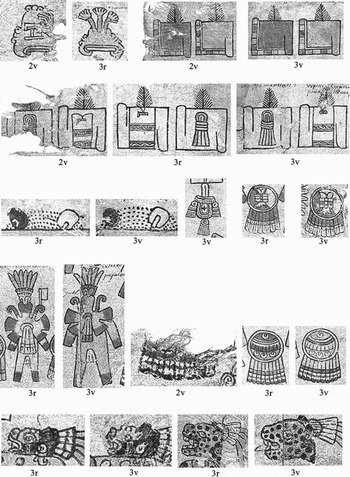
The Scribe of Folios 2v–3v
A number of inconographic elements on folios 2v–3v (provinces 2, 3, and 4 in Figure 1) indicate that the images were painted by a single hand (Figure 5). For example, the designs for loads of mantas are identical; the warriors' costumes (such as the papalotl) and shields are very similar; and Xolotl's head, as well as the beans and grains of corn, are the same. These elements, together with the icon for xiquipilli (8,000), the maxtlatl of the warriors' costumes, and the heads of ocelotl, set this artist apart from the three previously defined scribes (cf. Figures 2, 3, 4, and 5).
Stylistic details of the scribe on folios 2v–3v of the Matricula de Tributos (Reference Berdan and de Durand-Forest1980).

The Scribe of Folio 14r
Only one folio painted by this artist has survived (Figure 6). Although the design of the loads of mantas resembles those on the preceding and following pages, folio 14r is distinguished from them by a number of features: the loads of uipilli (indigenous woman's blouse); the glyph for the number 400; the execution of the Patzactli outfit; the shields; the iconography of the petlatl loads; the mummy bundle; and the head of Xolotl, which has a distinctive ear, facial decoration, and shape. This artist uses a different type of chimalli (shield) and maxtlatl from the artist of folios 1r–2r (cf. Figures 4 and 6) and draws the head for Xolotl with a distinctive ear, which is different from the head drawn by the artist of folios 2v–3v (cf. Figures 5 and 6). These elements also separate this artist clearly from the painters of the Mixtecan and Mendocino styles (cf. Figures 2, 3, and 6).
Stylistic details of the scribe on folio 14r of the Matrícula de Tributos (Reference Berdan and de Durand-Forest1980).

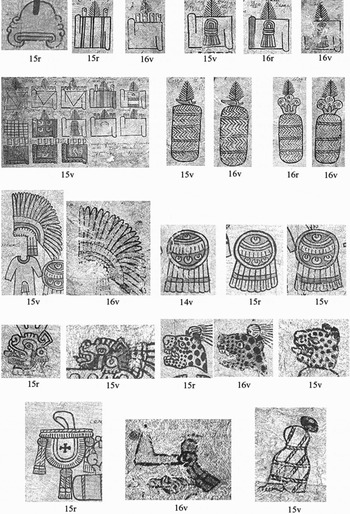
The Scribe of Folios 14v–16v
The following elements unite folios 14v–16v and differentiate them from the other folios in the document: the design of the loads of mantas; the warriors' suits (both the maxtlatl and the headdress in the Patzactl costume); the numeric glyphs; the loads of petlatl; and the heads of Xolotl and ocelotl (Figure 7). Although similar to the painter of folios 1r–2r in the execution of the xiuhuitzolli (cf. Figures 4 and 7), the work of this scribe differs in the decoration of the chimalli and in the manner of depicting the maxtlatl of the warriors' suits. Differences from the other artists (cf. Figures 2–7) can also be found in the way xiquipilli is drawn, in the iconography of cotton, and in the design of the heads of Xolotl and ocelotl. The work of this artist differs from the scribe of folio 14r in the forms of representation of the mortuary bundle and load of petlatl (cf. Figures 6 and 7).
Stylistic details of the scribe on folios 14v to 16v of the Matrícula de Tributos (Reference Berdan and de Durand-Forest1980).

Finally, Reyes García (1997:51) has noted a possible European reading order, from top to bottom, for the rows of loads of mantas on folio 15v—an order that is not found on the other pages of the Matrícula. The bottom line on folio 15v has only three loads of mantas, whereas the other folios have five (Figure 7). Reyes García believes that a downward reading order is the only way to explain the space left in the third row; however, I cannot agree with him. The loads in the bottom row all have glyphs for 20 (the flag, pantli), in contrast to the loads in the upper row, which all have the glyph for 400. The order of reading thus follows the pre-Columbian pattern of increasing quantities of objects from bottom to top. Therefore, even though an ascending reading order is found throughout the Matrícula, the descending reading order on folio 15v alone is insufficient to prove that the document is pre-Columbian, because other Colonial-era tributary codices, such as the Códice Tributos de Coyoacán (see Batalla Rosado Reference Batalla Rosado and facsimile2002d), preserve this characteristic.
Summary
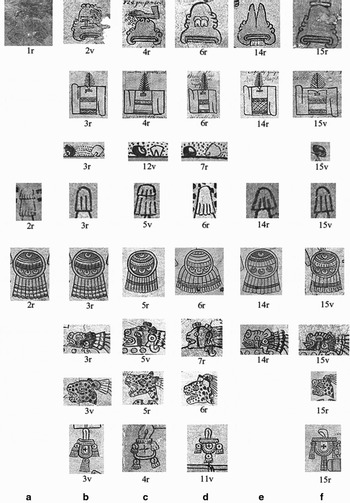
I thus conclude, based on the representation of various iconographic and writing elements, that it is possible to identify the work of at least six scribes in the production of the Matrícula de Tributos. In Figure 8, I assemble the icons that support the differentiation of these six scribes. The scribes are indicated in the columns following the order in which their work appears in the document. The glyph tepetl (hill), in the top row, separates the scribe of Mixtecan style from the others. The loads of mantas, in the second row, differentiate five of the scribes, and the design of the beans and maize kernels differentiate four. The maxtlatl in the warriors' costumes differentiate all six scribes, although some of them show similarities. The shields distinguish all six artists; the heads of Xolotl distinguish five; and the ocelotl and xiquippilli glyphs distinguish four. Numerous other details set each artist's work apart from that of the others, but these eight traits (Figure 8) should be sufficient to establish the presence of six scribes in producing the Matrícula de Tributos.
Stylistic details of the scribes of the Matrícula de Tributos (Reference Berdan and de Durand-Forest1980): (a) scribe of folios 1r–2r; (b) scribe of folios 2v–3v; (c) scribe of folios 4r–5v and 12r–13v; (d) scribe of folios 6r–11v; (e) scribe of folio 14r; (f) scribe of folios 14v–16r.

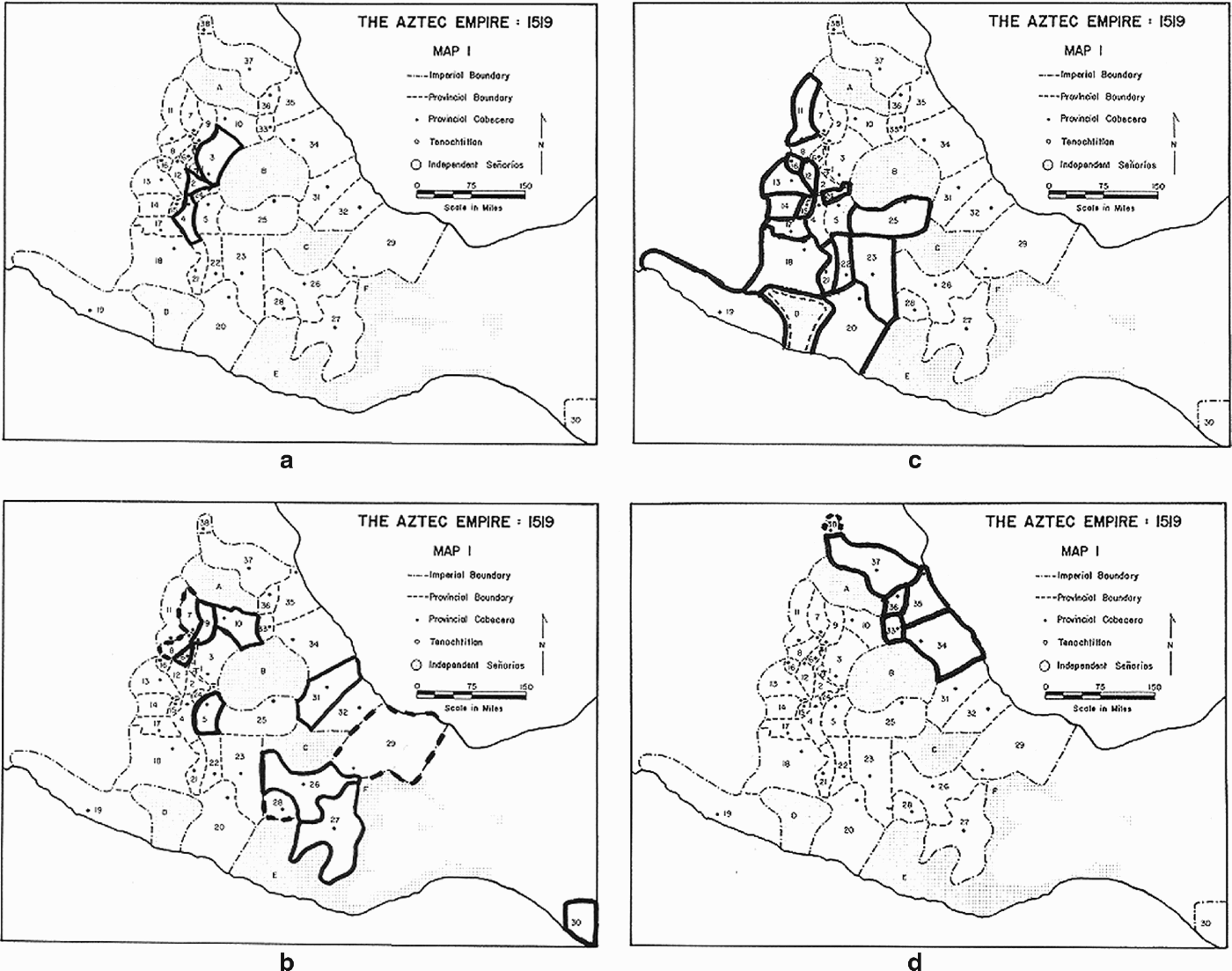
Geographic distribution of the provinces painted by two of the scribes of the Matrícula de Tributos: (a) scribe of folios 2v–3v; (b) Mixtecan-style scribe of folios 4r–5v and 12r–13v). The four missing provinces (numbers 6, 7, 28, and 29) are marked with broken lines (maps from Berdan Reference Berdan, Berdan and de Durand-Forest1980b:28); (c) Mendoxino-style scribe of folios 6r–11v; (d) scribe of folios 14v–16v. The missing province (number 38) is marked with a broken line (maps from Berdan Reference Berdan, Berdan and de Durand-Forest1980b:28).

It is also possible to analyze the geographic distribution of the provinces whose tribute was painted by the six scribes.
Folios 1r–2r
These pages describe the tribute of a province, probably Tlatelolco, and the posts of the imperial administration.
Folios 2v–3v
These pages include provinces in central Mexico (Figure 9a).
Folios 4r–5v and 12r–13v
These are the pages painted by the Mixtec or Mixtecan-style scribe. The provinces represented on these pages (numbers 5, 6, 9, 10, 26, 27, 30, and 31 on Figure 1) are grouped into two blocks, one of which covers the Mixtecan area (Figure 9b). The pages for provinces 7, 8, 28, and 29 (Figure 1) have disappeared. According to the sequence given in the Codex Mendoza, they should have fallen in the middle of the work done by the Mixtecan-style scribe; however, their placement also makes it possible that they were painted by the artist of the Mendocino. Unfortunately, we cannot draw further conclusions on this time.
Folios 6r–11v
These pages are the work of the Mendocino painter. The provinces that they depict (numbers 11–25 on Figure 1; see also Figure 9c) are located in the western part of the empire, between the Pacific coast and central Mexico.
Folio 14r
It is rare for an artist to have been given charge of documenting a single province (number 32 on Figure 1). This could be due to special historical circumstances. It is also possible, however, that the artist painted the folios for some of the “lost” provinces (numbers 7, 8, 28, and 29). At present, we cannot determine which ones, although province 29 borders province 32 and is not far from province 28 (see Figure 1), making both provinces possibilities. It is also possible that this scribe painted folios for provinces that are still unidentified, which would require extending the currently known borders of the Mexica empire.
Folios 14v–16r
These pages record the tribute of provinces in northern Mexico and the Gulf Coast (Figure 9d). Province 38 (Oxitipan), which is missing from the Matrícula, also could have been painted by this artist.
THE PAINTER OF FOLIOS 6R–11V OF THE MATRÍCULA DE TRIBUTOS AND THE WHOLE CODEX MENDOZA
Elsewhere, I compared folios 6r–11v of the Matrícula de Tributos and folios 31r–42r of the Codex Mendoza by focusing on the tribute paid by individual provinces as recorded in the two documents (Batalla Rosado Reference Batalla Rosado2007a). In this article, I expand the analysis to include the entire Codex Mendoza. It is my opinion that it is sufficient to compare particular iconographic elements to establish clearly that folios 6r–11v of the Matrícula and the entire Codex Mendoza were painted by the same person.
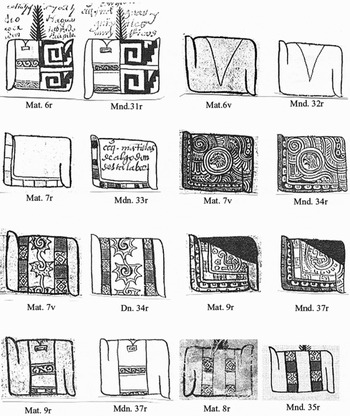
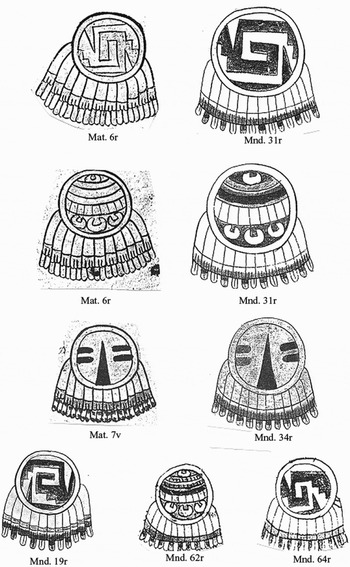
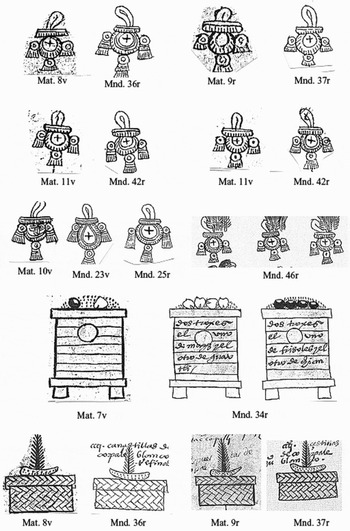
The icon that represents the loads of mantas in the two documents (see Batalla Rosado, Reference Batalla Rosado2007a:Figure 1) establishes that both works were executed by a single painter (Figure 10). Curving lines predominate; moreoever, there is no variation in the forms of representation, and there is great similarity in the specific content of each work. A consideration of the iconography of the shields (see Batalla Rosado, Reference Batalla Rosado2007a:Figure 2) leads to the same conclusion (Figure 11): the variations are minimal, and each individual representation shows the same design of feathers, which expand out in a curving fashion. Three additional elements support my hypothesis (see Figure 12; see also Batalla Rosado Reference Batalla Rosado2007a:Figure 3). First, the xiquipilli is depicted in the same manner in the common tributary folios (6r–11v of the Matrícula and 31r–42r of the Codex Mendoza), as well as in the other pages of the Codex Mendoza, except folio 10v. On that folio, however, the xiquipilli is a place name, and its interior design is adorned). Second, in the grain containers, the icon for beans is identical across all of the folios, and one finds only small differences in the grains of corn. Third, the boxes, incense, and number 400 are depicted identically in the baskets of copal, labeled “canastillas de copale blanco,” including the direction and orientation of the small lines that define the baskets.
Iconographic depiction of loads of blankets by the scribe of folios 6r–11v of the Matrícula de Tributos (Reference Berdan and de Durand-Forest1980) and the Codex Mendoza (Reference Berdan and Anawalt1992:Volume III).

Iconographic depiction of shields by the scribe of folios 6r–11v of the Matrícula de Tributos (Reference Berdan and de Durand-Forest1980) and the Codex Mendoza (Reference Berdan and Anawalt1992:Volume III).

Glyphs for the numeral 8,000 and iconographic depiction of the trojes (wooden bins) and baskets for copal by the scribe of folios 6r–11v of the Matrícula de Tributos (Reference Berdan and de Durand-Forest1980) and the Codex Mendoza (Reference Berdan and Anawalt1992:Volume III).

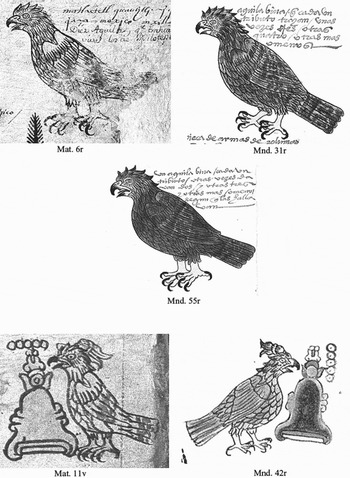
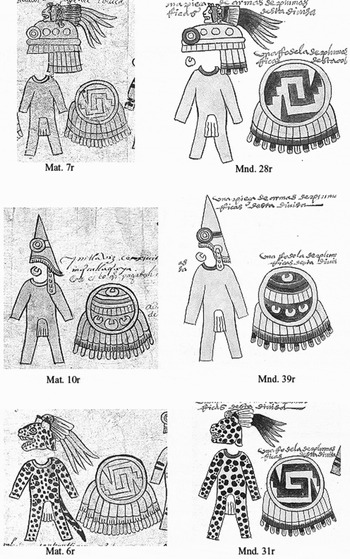
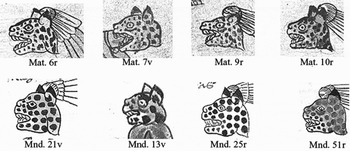
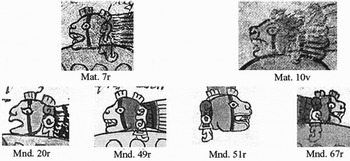
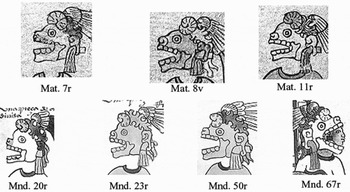
Other icons, such as the images of eagles painted on the different folios in this analysis (see Batalla Rosado Reference Batalla Rosado2007a:Figure 4), suggest the work of a single artist (Figure 13). The eagles are identical not only when they are depicted as tribute, but also when they are part of a glyph. The representation of the warriors' suits (Figure 14) leads one to the same conclusion (see Batalla Rosado Reference Batalla Rosado2007a:Figure 5). Also, the heads of ocelotl (Figure 15) and Xolotl (Figure 16) are represented the same way in both documents, even when they are part of the place names that occur throughout the Codex Mendoza. Finally, the similarity in Mictlantecuhtli's head as part of the Tzitzimitl suit (Figure 17) in folios 6r–11v of the Matrícula and in the Codex Mendoza leaves little doubt that these were all done by the same painter.
Depiction of an eagle by the scribe of folios 6r–11v of the Matrícula de Tributos (Reference Berdan and de Durand-Forest1980) and the Codex Mendoza (Reference Berdan and Anawalt1992:Volume III).

Iconographic depiction of warriors' suits by the scribe of folios 6r–11v of the Matrícula de Tributos (Reference Berdan and de Durand-Forest1980) and the Codex Mendoza (Reference Berdan and Anawalt1992:Volume III).

Iconographic depiction of heads of ocelotl by the scribe of folios 6r–11v of the Matrícula de Tributos (Reference Berdan and de Durand-Forest1980) and the Codex Mendoza (Reference Berdan and Anawalt1992:Volume III).

Iconographic depiction of Xolotl's head by the scribe of folios 6r–11v of the Matrícula de Tributos (Reference Berdan and de Durand-Forest1980) and the Codex Mendoza (Reference Berdan and Anawalt1992:Volume III).

Iconographic depiction of Mictlantecuhtli's head by the scribe of folios 6r–11v of the Matrícula de Tributos (Reference Berdan and de Durand-Forest1980) and the Codex Mendoza (Reference Berdan and Anawalt1992:Volume III).

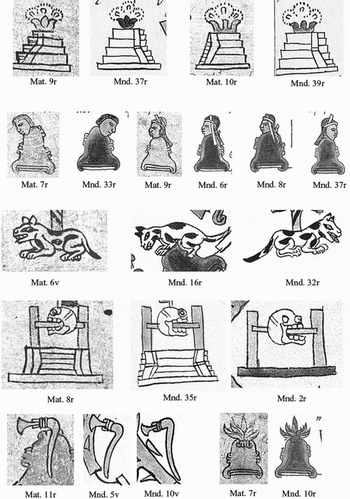
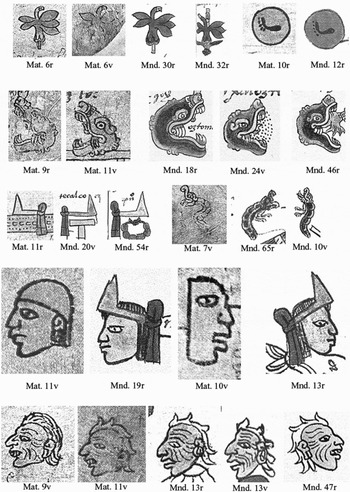
Finally, when one compares the place names (see Batalla Rosado Reference Batalla Rosado2007a:Figure 6) that occur in both documents (Figures 18 and 19), one sees again that they were painted by the same person. There are no differences between them, apart from very minor details. Also notable for their similarities are depictions of dogs, the two sinuous lines on the upper part of the human skulls mounted on skull racks, the joints between the blades and handles of axes, and the teeth in the sign for oztoc. This point is reinforced by a comparison of other iconographic elements, such as human faces (Figure 19, lower half), although there are small discrepancies within the same document (in the old men's heads). In the depictions of royal crowns (Figure 19, middle row), the red cloth that hangs in the back is divided by two lines, one horizontal and the other vertical, on folios 6r–11v of the Matrícula and in various pages of the Codex Mendoza.
Writing elements by the scribe of folios 6r–11v of the Matrícula de Tributos (Reference Berdan and de Durand-Forest1980) and the Codex Mendoza (Reference Berdan and Anawalt1992:Volume III).

Iconographic and writing elements depicted by the scribe of folios 6r–11v of the Matrícula de Tributos (Reference Berdan and de Durand-Forest1980) and the Codex Mendoza (Reference Berdan and Anawalt1992:Volume III).

All of these iconographic elements lead to a single conclusion: the scribe who produced folios 6r–11v of the Matrícula and the scribe who produced the Codex Mendoza were in fact the same person.
CONCLUSIONS
The evidence presented here supports the conclusion that the surviving pages of the Matrícula de Tributos were painted by at least six different, and distinct, scribes, grouped as follows: folios 1r–2r; folios 2v–3v; folios 4r–5v and 12r–13v (Mixtecan style); folios 6r–11v (Mendocino style); folio 14r; and folios 14v–16v. We know that at least five pages were lost over time, and it is impossible to assign them definitively to any of the painters. Nevertheless, the evidence suggests that four of the missing pages may have been done by the Mixtecan-style scribe and the other by the scribe who painted folios 14v–16v. It is strange that one of the scribes may have painted only a single folio (14r). The location of the province painted by this scribe (numer 32 in Figure 1) is clearly delimited geographically. The presence of so many scribes supports the interpretation that the Matrícula de Tributos is a pre-Columbian document and that in its original form, it consisted of separate sheets.
The evidence also suggests strongly that the scribe who was responsible for painting folios 6r–11v of the Matrícula de Tributos painted the Codex Mendoza at least 21 years later. In my opinion, the iconographic analysis confirms this interpretation, which leads logically to the conclusion that scribes from the late pre-Columbian era continued to work during the Colonial period. In the case described here, the scribe in question was already a master artist in pre-Columbian times, and that was probably the reason that both the Mexica administration and the viceroy selected him to paint the documents. Agents of these two empires must have commissioned codices from expert scribes for official documents of this sort, which needed to be free of errors.
A final question remains: how is it possible that an individual scribe's painting style was maintained for 20 years or more, even to the point of executing most iconographic elements identically? It is difficult to offer an adequate response when we know so little about how scribes learned and how they carried their work. This case is not unique, for it has been documented in several Colonial-period maps. Barbara Mundy (Reference Mundy1996:188–195) has demonstrated the presence of a single painter in the maps of the Relaciones Geográficas from Xalapa (1580), Actopan (1578), and Atezca (1587). The case of the painter of the Matrícula de Tributos and the Codex Mendoza, however, is the first documented example of a single person carrying out a work of such magnitude and so many years apart. Nevertheless, this should not be viewed as an extraordinary occurrence. It is only logical that Colonial documents such as the Codex Mendoza would have been assigned to painters of recognized prestige, and that some of the painters of other major Colonial codices would have been scribes who had been working since the pre-Hispanic epoch.
ACKNOWLEDGMENTS
The translation of this article was done by Carlos García Lahuerta, a Ph.D. candidate in the Department of American History II, Universidad Complutense de Madrid, and was checked in its final version by Dr. Michael E. Smith of Arizona State University.