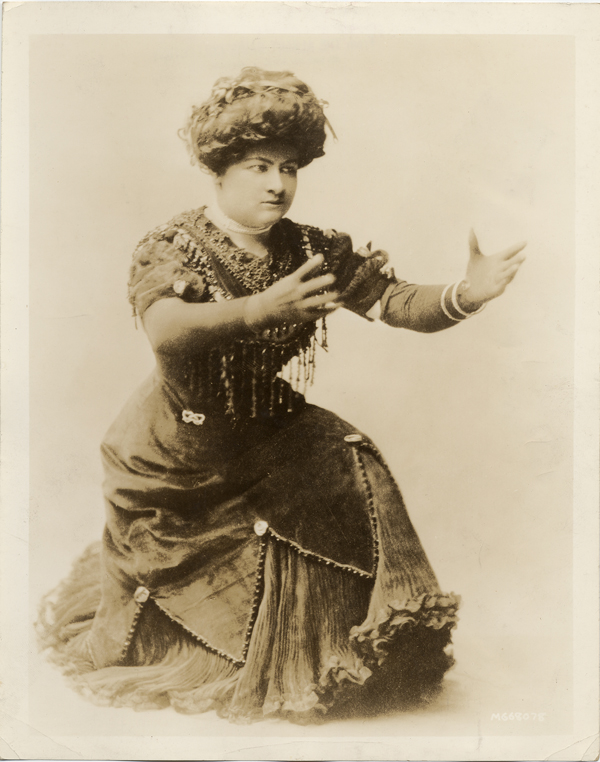
Sophie Tucker: ‘the Jewish girl with a colored voice’
‘The Mary Garden of Ragtime’, ‘The Queen of Jazz’, ‘The Last of the Red-Hot Mamas’, ‘The Jewish Girl with a Colored Voice’: Sophie Tucker's monikers remain cultural touchstones decades after her death and continue to remind us of the range of musical forms and racial signifiers that she explored as a variety singer in the early twentieth-century United States.Footnote 2 During her sixty-year-long career, Tucker proved herself a stylistic chameleon: changing her appearance and the tone of her act to mirror the fashion of the day, and regularly adapting her singing techniques to seamlessly fit into the musical genres that she helped to popularize. But perhaps most interestingly, Tucker's ‘refashionings’ encompassed an assortment of racial referents that coexisted onstage with a multiracial cast and – behind the scenes – with authors of diverse racial backgrounds.
Sophie Tucker got her start in vaudeville in 1906 with a blackface ‘Mammy’ character and stereotypical black southern dialect. The movement and tonal quality of her voice stood out for three typical features associated with black blues singing: the restriction and sudden expansion of the range, the switch from singing to speaking and back again, and a characteristic bass wavering note.Footnote 3 Eventually, Tucker's growing popularity gave her the freedom to leave the constraining black make-up behind, but her record buyers kept mistaking her for an African American singer based on the sound of her voice and the many references to black life in her lyrics. During the course of her career, Tucker explored a variety of musical styles originating from African American cultural forms: ‘ragtime, jazz, blues, swing, the hep-cat, jitterbug, and zoot-suit’, according to her own catalogue.Footnote 4 Lastly, her vaudeville acts became increasingly marked by their racial diversity in casting and contents. They included an all-Jewish jazz band, African American shimmy dancers, references to her Jewish immigrant background in banter and exchanges with the audience, and popular songs by Jewish or African American composers that she sang in a black southern accent, Yiddish, or a mix of both. For example, upon returning from a tour of England in 1922, she greeted her fans on the American vaudeville circuit with a programme featuring a Jewish piano player, a chorus of eleven African American dancers, and a wide musical repertoire.Footnote 5 Her songs were diverse in style, rhythm and temperament. Among them were a Blues number, ‘Do I, Bluebird Blues’, in part sung in the style of a Jewish Cantor; a ragtime tune performed in a black southern accent about ‘Lovin’ Sam Sheik of Alabam’, ‘a heart breakin’ man’ for whom ‘there ain't a high-brown gal in town who wouldn't throw her daddy down’; and a provocative jazz song, ‘Bad Little Boys Aren't Goody-Good to the Goody-Good Little Girls’, which she performed in English first and encored in Yiddish.Footnote 6 In a segregated America that passed exclusionary immigration laws and systematized its fast-growing cities into ethnic ghettoes, racial lines were among the most difficult to cross. Furthermore, at this particular historical juncture, conceptualizations of race and ethnicity were deeply influenced by theories of heredity and the newly founded science of eugenics. Racial and ethnic identities were commonly incorporated under the comprehensive notion of ‘the foreign’ and discriminated against blindly, while recent Jewish immigrants were perceived as ‘racial hybrids’ for escaping the black–white binary that structured US society and economics.Footnote 7 Yet it was in this political and intellectual landscape that Tucker's stage work challenged contemporaneous definitions of race and created opportunity for interracial relations.
This article focuses on Sophie Tucker's use of hybrid racial signifiers in the context of American vaudeville – in particular, their potential motivations and material effects. I am indebted to theatre and Jewish studies scholars who in the last decade have analysed Tucker's identity-performativity from a post-structuralist standpoint to emphasize its message of interracialism. In The White Negress, Lori Harrison-Kahan affirms that, by combining Jewishness and blackness in her act, ‘Tucker succeeded in subverting the sharp dichotomy between black and white as well as prevailing attitudes about gender and sexuality’.Footnote 8 As a consequence, Tucker was able to advance a pluralistic view of race that was not necessarily an escape from her own ethnicity, but rather a wilful destabilization of whiteness and femininity.Footnote 9 Similarly, Kathleen Casey argues that, ‘by experimenting with her image, environment, and sound, portraying herself at different moments as white, Jewish, black, manly, and womanly’, Tucker ‘managed to convince audiences that these identities coexist in one body’.Footnote 10 Lastly, according to Roberta Mock, Tucker's racially hybrid stage persona made explicit the ‘interstitial status of Jewish immigrants’ for her audience.Footnote 11 In other words, Jewishness was a hard-to-define ethnic status according to early twentieth-century understandings of race. Considering the concern aroused by disrupted racial classifications, Tucker's performance proved the uselessness of neat racial divisions and, in turn, eased anxieties from racial categorization.Footnote 12
To these invaluable analyses, I contribute an original materialist approach in order to highlight two practical aspects of Tucker's career in popular entertainment: first, how she navigated vaudeville business dynamics, and second, how she built relationships with her African American colleagues. I ask, how might her own framing of biographical events illuminate the reasons behind her iconic multiracial stage presentations? And how did her racially multi-layered performance contend with actual connections, both professional and personal, with African American artists? Tucker's strict attendance to vaudeville's demands and expectations – as a performance medium and as the first nationwide corporate entertainment industry – explains why she used a mix of racial referents in her vaudeville acts. Her racial combinations might have been the natural consequence of her ‘interstitial’ Jewish identity,Footnote 13 as Roberta Mock suggests, but they were also a studied tactic to ‘hit the big time’ in vaudeville.Footnote 14 In fact, by blurring the line between Jewishness and blackness, Tucker climbed the ladder of success in a show business that capitalized on the unexpected juxtaposition of racialized characters. Consequently, her black signifiers onstage fostered connections with the African American artists who inspired her work, were employed by her, or contributed their artistic creations to her vaudeville numbers. From historical records and personal accounts, it is clear that such contacts existed and thrived; however, what is more complex to determine is how Tucker's interracial relations contended with her brand of racialized performance. To propose one interpretation, the last section of the article analyses Tucker's memoirs as misleading performative act rather than trustworthy historical record. This methodology will expose Tucker's reparative efforts toward her exploitative approaches to black labour and creativity, thus advancing a more nuanced picture of the effects and motives behind her multiracial stage presentations.
Vaudeville, racial impersonation, and the ‘rule of novelty’
Between the 1880s and the 1920s, American vaudeville evolved from a more refined version of variety theatre into the first national entertainment industry. In the rhetoric of vaudeville impresarios, this was achieved by advertising their touring acts as free from lewdness, centrally supervised and consistently replicated across theatre circuits.Footnote 15 Such a national ‘homogenizing’ project, however, was not reflected in the distinct performances onstage. In fact, vaudeville acts were left entirely to the artists to design, and they took liberties especially when adjusting to the tastes of their racially and culturally diverse audiences. Subversions of stereotypical racial/ethnic representations were marked especially when the performers were immigrants faced with immigrant audiences. As a matter of fact, vaudeville thrived as a major entertainment form by and for immigrants at the same time as immigration from Europe steadily increased in the first two decades of the twentieth century.Footnote 16
As Tucker found out upon entering the vaudeville business, immigrants like her were a majority among the racial impersonators.Footnote 17 Initially the prerogative of white US-born artists, racial impersonation became a speciality of many white-looking Europeans as the practice transitioned from blackface minstrelsy into vaudeville and early film.Footnote 18 Irish and Jewish immigrants quickly learned how to get laughs by reproducing old minstrels’ blackface characters, or by impersonating their own ethnicity and an assortment of others: Jewish, Irish, Italian and Chinese, to name a few. Different techniques were put in service of a range of specialities, sometimes even within the same act. A traditional Irish clog dance, for instance, could be performed by an Irish ‘drunk’ character costumed in rags and a big red nose, or by a ‘modern-looking’ Irish couple in the standard tuxedo and evening gown of an elegant dance hall. Similarly, a Jewish singer could interpret a ragtime song about life on the ‘old plantation’ in blackface make-up and a southern accent, or in the stereotypical tattered derby hat and protruding nose of a Jewish ‘tramp’ character.Footnote 19
Theorists of racial impersonation overlap in describing the genre not just as denigrating for the portrayed groups, but also as problematically advantageous for the actors performing it.Footnote 20 Indeed, the stark contrast between the ‘racial mask’ and the white person behind it was meant to always highlight the positive traits of whiteness or, in the case of white-looking foreigners, to portray their ethnicity as whiteness. To paraphrase Eric Lott and Shannon Steen, blackface performance aided the cultural formation of a self-conscious, multinational white working class. Likewise, yellowface distanced a ‘savage and vicious’ Orient from a morally rigorous Occident that was strictly white and middle-class.Footnote 21 But how should one theorize racial impersonation when it was performed by recent immigrants who were themselves regarded as non-white by their US-born colleagues? This article does not redeem racial impersonation from its racism: even in the bodies of disenfranchized immigrants, racial impersonation was harmful for the subjects depicted while beneficial to its performers. Moreover, for recent white-looking immigrants, their alignment with a traditional US performance genre provided lucrative employment and the prospect of assimilating faster, oftentimes on the back of other underprivileged groups.Footnote 22 However, European immigrants may not have fully grasped the historical racism that racial impersonation, even in its least denigrating form, inherited from the blackface minstrel shows of only a few decades prior.
For her vaudeville debut, Sophie Tucker performed in blackface (Fig. 1). Looking back on that first amateur night in her autobiography, she described the event as a turning point for her life and career. As she was waiting for her turn to perform, she overheard the producer ordering an assistant, ‘This one's so big and ugly the crowd out front will razz her. Better get some cork and black her up. She'll kill them’.Footnote 23 Blackface was not an endeavour for attractive young women, as Tucker became aware on approaching the world of vaudeville for the first time. But rather than giving up the chance to get onstage, she put up with the insult and exploited the situation. Ultimately, as Lori Harrison-Kahan has stressed, blackface was just a ‘painful initiation rite’ for Tucker – in other words, a reminder that her plump body was not fit to play sexy or elegant feminine roles.Footnote 24 But as unpleasant as it may have been according to this interpretation, blackface performance opened the doors to white mainstream entertainment for Tucker, and she pragmatically took advantage of it, disregarding any possible moral qualms. In addition, blackface introduced Tucker to the benefits of identity transformation and racial pluralism in vaudeville. Diversity of performance genres, characters and racial/ethnic identities was very much valued in the process of assembling a successful vaudeville programme. Cognizant of this, Tucker eventually abandoned the black make-up, but continued to explore variants of racial and character impersonation through character songs and racial referents in her lyrics and music styles. ‘Ukulele Lady’ by Gus Kahan, ‘Vampin’ Sal, the Sheba of Georgia’ by Henry Creamer and Lew Pollack, and ‘My Yiddishe Momme’, also by Pollack, are only a few of the racialized characters that Tucker played in her songs and – not coincidentally – they were all written by Jewish (Kahan and Pollack) and African American (Creamer) composers.Footnote 25
Sophie Tucker, publicity photograph in blackface. According to Tucker's autobiography, the difficulty of keeping her clothes clean while performing in burnt cork was so great that she ‘soon changed to a high-yellow make-up and rented a black velvet dress which gave a contrast’ (Sophie Tucker, Some of These Days: The Autobiography of Sophie Tucker (Garden City: Doubleday, Doran and Company, Inc., 1946), p. 35). Published in various newspapers, this image suggests that Tucker was wearing the ‘high yellow’ make-up already in 1907, only one year after her vaudeville debut in blackface. Photographer unknown, Theatre Biography Collection, Box 409, Bio File Code T8354.3, Harry Ransom Center, the University of Texas at Austin.

Diversity, originality and surprise – or, in the jargon of the time, ‘novelty’ – were the ingredients for a winning vaudeville show. A typical vaudeville bill was made of eleven short acts comprising genres as varied as acrobatics, comedic skits and songs, dancing teams, freak acts, and short burlesques of contemporaneous Broadway shows. The acts’ order on the programme was attentively studied to shun repetition and enhance the striking alternation of tempos, moods and specialities.Footnote 26 For example, to avoid ‘racial redundancy’ on a white vaudeville bill, African American and white artists in blackface competed over the single spot reserved for the so-called ‘plantation’ or ‘coon’ act.Footnote 27 Due to its unexpected juxtaposition of characters, the most ‘novel’ of all vaudeville specialities – and the most recurrent one on a white vaudeville programme – was impersonation.Footnote 28 Close imitations of popular figures of the time, character songs and stereotypical depictions of genders, races, ethnicities and nationalities were all considered subgenres of impersonation.Footnote 29 The more identities on a programme, or even in a single act, the higher the level of ‘novelty’ and the chance of being appreciated by vaudeville audiences and booking agents. As Roberta Mock rightly notes, a generation of Jewish actresses had profited from the appeal of racially hybrid characters before Tucker. Mock discusses the ‘hint of “hybridity” in [the] presentation’ of Sarah Bernhardt and Anna Held, among others, and contrasts it with the almost grotesque explicitness of Tucker.Footnote 30 However, these artists were performing in the context of ‘legitimate’ theatre, where subdued racial hybridity could be a profitable option but not a mandate. In vaudeville, by contrast, amplified racial presentations were a requisite for Tucker, in order to highlight the ‘novelty’ potential of her act and thus secure a prime placement on the bill.
While vaudeville programming was governed by the theatre managers’ ‘rule of novelty’, bookings were dictated in great part by audiences’ predilections. As surviving correspondence testifies, reports on the duration of applause and volume of laughter were sent to advise bookings within a circuit, in order to avoid flops and increase gains for the whole enterprise.Footnote 31 The balance between satisfying the audience's demands and maintaining sufficient decency standards was often a hard one to strike for vaudeville businessmen; but for the artists, adjusting their presentations to the spectators’ sometimes whimsical preferences was a matter of survival. In Sophie Tucker's case, her deep understanding of vaudeville's inner workings translated into her special care to meet the expectations of vaudeville's mostly immigrant audiences. This realization came in 1913, when she introduced herself as a ‘white Jewish girl’ for the first time, and started ‘interpolating Jewish words in some of [her] songs, just to give the audience a kick’.Footnote 32 In fact, as black referents in music, language and dance multiplied in her acts, Tucker's Jewish identity also became more and more explicit. Eventually, her ‘introductions’ acquired an almost confessional tone, and became opportunities to expose a number of memories about her Jewish childhood: how she learned to sing at her parents’ kosher restaurant in Hartford, Connecticut; how she was not a trained singer, but a self-taught one who loved entertaining all sorts of Jewish clientele at the restaurant; and how her ‘Old World’ family did not approve of her going into a performing career.Footnote 33 As a result, Tucker's private narratives functioned as vehicles to connect with the immigrant and Jewish audiences on an experiential level. Indeed, only by laying bare her ‘real self’ and comparable experiences to the many immigrants in the auditorium was Tucker able to become an audience favourite. As she framed it in her autobiography, there was one thing that never changed over the course of her career: ‘That was the customers’ response to an entertainer who met them at their own level; who was one of them’.Footnote 34
To sum it up in the words of Tucker's long-time friend, Chicago theatre critic Amy Leslie, Tucker was a ‘sunny, brave, honest, industrious slave to the public’.Footnote 35 Her Yiddish interjections in the middle of her blackface act (or, later, jazz and blues songs), and her stories about being the daughter of immigrant, working-class Jewish parents, were predicated on acute observations of the vaudeville business – more specifically, its dependence on the ‘rule of novelty’, immigrant audiences’ predilections and the spectators’ need to feel closely connected to their favourite artists. In fact, we may even be able to pinpoint the context in which Tucker began to develop such stage tactics. It is plausible that she grasped the potentialities of a racially hybrid act during the 1912–13 theatre season, when she performed for thirty-five weeks in the Chicago production of Louisiana Lou, a musical comedy about a wealthy Jewish family in New Orleans. In accordance with the comedy's southern location, Tucker played a ‘ragtime-singing’ maid next to Alexander Carr in the part of the Jewish patriarch (Fig. 2).Footnote 36 Carr was the veteran Jewish impersonator who would play Barney Bernard's sidekick in the 1923 film version of the acclaimed Jewish comedy Potash and Perlmutter (Montague Glass and Charles Klein, George M. Cohan Theatre, 1913). Learning from his Jewish humour, and noticing the audience's appreciation of her own ‘black rags’, Tucker might have been convinced that the combination was an attractive one.Footnote 37 Not coincidentally, it was during her first vaudeville engagement right after Louisiana Lou in the Summer of 1913 – and suitably in Chicago, where regulars would have recognized her as Louisiana Lou’s ‘ragtime’ maid – that Tucker first presented herself as a Jewish girl. These first experiments with racial combinations did not go unnoticed; in fact, they provided Amy Leslie with an argument to raise Tucker's vaudeville act above Mary Garden's opera singing. As Leslie documented for the Chicago Daily News, ‘Mary never could dream of shouting a bearcat rag with the Yiddish fury of Tucker, nor fight the frog in her divine throat with the humorous abandon of the ragtime Sophie’.Footnote 38
Sophie Tucker and Alexander Carr in Louisiana Lou. To further complicate racial descriptors in this production, Tucker wore whitening make-up but sang ragtime songs such as ‘Now Am de Time’ in a black southern accent. New York Dramatic Mirror, 3 April 1912. Sophie Tucker Scrapbooks, Billy Rose Theatre Division, New York Public Library.

Sophie Tucker's relationships with African American artists: inspiration or appropriation?
Tucker's explicit references to her Jewish immigrant experience proved a successful tactic to connect with the recent immigrant members of the audience and secure regular bookings. Yiddish lyrics and stories about her Jewish childhood gradually proliferated but did not replace jazzy tunes or African American shimmy dancers; in fact, the alternation of Jewish and black referents served to emphasize the ‘novelty’ value of Tucker's vaudeville act. But this pursuit of novelty cannot alone explain Tucker's retention of black signifiers. As Jewish immigration from Eastern Europe and black migration from the rural South brought both groups to metropolitan centres in the northern United States, contact began to take place particularly in the realm of early twentieth-century popular culture.Footnote 39 Black referents in Tucker's music and dance were not simply a device to amplify diversity onstage, but rather the result of interracial artistic collaborations. Yet whether these associations also provided opportunity for equal exchange is a delicate matter of investigation. During a time when jazz music and dances such as the Charleston and the shimmy were popularized as ‘national’ pastimes despite being the original expressions of segregated African Americans, those white artists who signalled blackness through such forms were appreciated as stylish innovators by their white US-born and immigrant followers alike.Footnote 40 As Jayna Brown powerfully argues, white ‘New Women’ in particular embraced black expressive forms to redefine their own bodies as glamorously modern. On popular urban stages, white female artists and their audiences found models of feminist empowerment in black gestural vocabularies, yet black performers were seldom recognized as agents of these new expressive forms.Footnote 41
According to Brown, Tucker was the counterpoint to exploitative racialized performances by contemporaneous white US-born female artists such as Irene Castle, Isadora Duncan and Ruth St Denis. In Brown's articulation, ‘Tucker's case furnishes one of the strongest arguments for the historical precedent of cross-racial/interclass alliance, involving cooperation between a second-generation Eastern European woman vaudevillian and African American performers.’Footnote 42 But how can we ascertain whether Tucker's ‘cooperation’ with her African American colleagues facilitated an exchange on equal terms? To devise an answer, I apply contrasting methodologies to the reading of two different types of private account. On one hand, I treat Tucker's black colleagues’ memories as trustworthy historical record and, on the other, I examine Tucker's autobiography as a misleading performative act. A consideration of the intended audience and publication outputs for these sources justifies my approach. While African American oral accounts were spontaneous utterances made with no particular audience or goal for publication in mind, Tucker's autobiography was carefully crafted to resonate with specific readerships: her faithful fans, and the suspicious opponents of the American Federation of Actors (AFA), the labour union over which Tucker presided for a few years. In the last few pages of her autobiography, Tucker revealed that it was accusations of AFA's alleged fraudulent activities that led her to present her own version of the facts in the context of her life's narrative.Footnote 43 As a result, Tucker's self-defensive attitude transpires not only from the chronicles of her AFA leadership, but also from passages that she potentially fabricated or emphasized for no other obvious reason than to produce a clean image of herself for her reading public. In the latter part of what follows, I analyse two of such episodes as Tucker's ‘performances of guilt’ toward unacknowledged black labour and creativity. In doing so, I expose both Tucker's awareness of her racial privilege and her effort at compensating for it through her act of writing.
In White on Black: The Views of Twenty-Two White Americans on the Negro, Sophie Tucker reported to be ‘proud to have known and worked with Florence Mills, Bill Robinson, Duke Ellington, Miller and Lyles, Ethel Waters, Buck and Bubbles and many other fine performers of the Negro race’.Footnote 44 Beyond this list, Noble Sissle and Eubie Blake recalled with gratitude the times when they worked on Tucker's bill as the Dixie Duo, and how they ended up selling their first collaborative piece, ‘It's All Your Fault’, to Tucker.Footnote 45 Likewise, blues singer Alberta Hunter provided Tucker with original songs. The two met at the Dreamland Café, an integrated nightclub in Chicago where Hunter was the solo voice for the King Oliver's Creole Jazz Band. Recalling that Tucker ‘sent her maid, Belle, for me to come to her dressing room and teach her songs,’ Hunter refused Tucker's presumptuous request, but still allowed her piano player to ‘come over and listen and get everything down’.Footnote 46 This was only possible because, as blues historian Daphne Harrison claims, the two women went to see each other perform and drew from each other. Harrison writes, ‘Tucker sought the rhythms, emotional expressiveness, and Black dialect inflections, and Hunter learned stage presence and the use of sexy innuendoes from Tucker’.Footnote 47
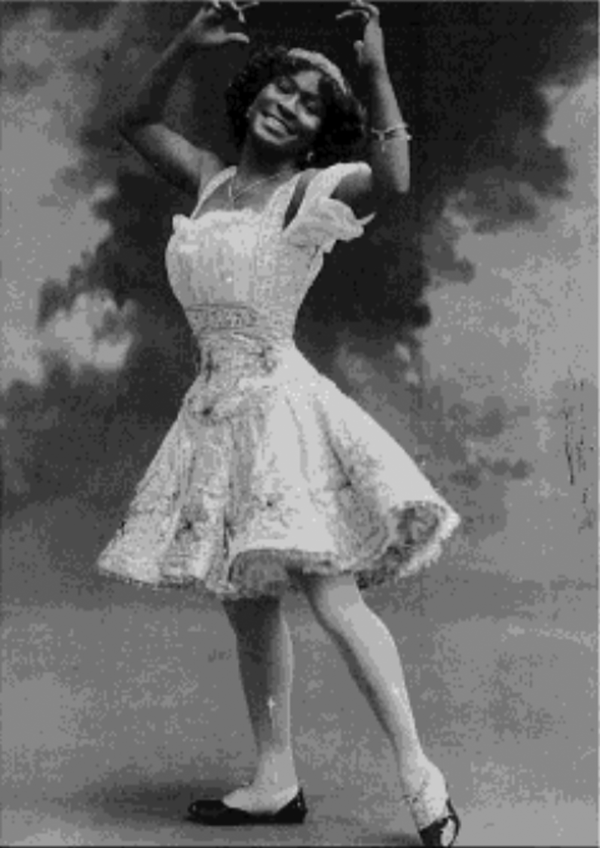
The case of dancer Ida Forsyne was less about a mutual and straightforward exchange, but it still supports a view of Tucker as fair employer of black labour. From 1922 to 1924 Forsyne toured with Tucker as her personal maid and shimmy dancer for Tucker's act. She had recently returned from a period in Russia studying Eastern European folk dance, but after experiencing difficulty finding a job back in the United States, she accepted the maid/dancer arrangement with Tucker. Her job included dancing at the end of Tucker's routine to whip up audience applause, and sometimes doing ‘the maid part on and off stage’, most likely as an Old Mammy character for the ballad ‘M-O-T-H-E-R, the Word that Means the World to Me’.Footnote 48 While Forsyne's African American colleagues ‘thought I was wrong not to be taking the bow because I was the one getting the applause at the finish’, she was never unhappy with her job.Footnote 49 On the contrary, she fondly remembered how Tucker defied theatre managers for her, sticking up for her right not to appear in blackface during their act.Footnote 50 In fact, despite having made a name for herself as a ‘Topsy’ role in blackface before leaving for Russia, Tucker went beyond that limiting stage stereotype and recognized Forsyne for her professional talent and dancing skills (Fig. 3).
Ida Forsyne as ‘Topsy’ with Abbie Mitchell's Tennessee Students. The article reported from London, ‘The London Daily Telegraph says that Abbie Mitchell and her Tennessee Students will soon be the talk of the town especially the dancing Miss Topsy (Ida Forsyne later of Hogan's Company) the little lady “who was not born but just grew”. During their appearance in Paris and London they have been taking audiences by storm’. Indianapolis Freeman, 28 January 1906.

While the example of Ida Forsyne makes a case for Tucker's respectful employment of an African American accomplished dancer, the same cannot be said of Mollie Elkins, the black dancer who preceded Forsyne by a decade in her personal service to Tucker. In fact, as she was struggling to build the blocks of her career in the 1910s, Tucker did not try to avoid stereotyping and unrecognized (possibly even unpaid) labour with Elkins. Elkins was never credited for her stage appearances during the more than ten years spent formally working as Tucker's maid, nor do theatre columns of the time ever mention her name next to Tucker's. Tucker does report one of Elkins's performances, but the diminishing and racist terms in which the episode is framed confirm that she never considered Elkins to be her equal onstage. Here I quote Tucker's words directly: ‘Out came Mollie, toddling as only colored people with their born sense of rhythm can. Toddling to her own humming, and grinning broadly … The audience began to laugh. “Here's yo’ chair, honey chile,” and off she toddled, to a roar of delighted laughter’.Footnote 51 In only a few short sentences, Tucker reproduced some of the most common and derogatory stereotypes attached to black people: with an ‘inborn sense of rhythm’, she gestured towards widespread ideas of primitivism; by describing Elkins's demeanour as a toddle she infantilized her; finally, with the expression ‘grinning broadly’ she reinscribed false assumptions about black people's natural disposition for silly laughter. Clearly, Elkins only functioned as a comic black prop for Tucker onstage – figuratively and literally, as she would be summoned out with a chair prop for Tucker to lean on while singing. In other words, while Tucker's belittling portrayal does not specify whether Elkins performed in blackface, it certainly ‘blackened’ Elkins so that she did not outshine Tucker's own talent or minimize her whiteness in comparison.
From Tucker's autobiographical writings, we know that Elkins not only performed for Tucker, but she also coached her in the inner workings of show business.Footnote 52 Elkins was a veteran of black vaudeville and a much more experienced performer than Tucker when they first met in 1909. When Tucker felt disoriented trying to make sense of vaudeville rules and dynamics, she had Elkins's ‘wisdom, her philosophy to lean on’.Footnote 53As Tucker framed it after a rough setback in her career,
What a wise Mollie! And what a lot I owe to her. She kept me from feeling resentful and bitter. She made me see that this was just one of the tough breaks that show business is full of. You have to learn to take them without flinching, without letting them turn you sour or making you want to get even.Footnote 54
Nevertheless, as there is no historical evidence of Elkins's stage performances, no public recognition of her crucial advice can be retraced either, or at least not until the publication of Tucker's memoirs fifteen years after Elkins's death in 1930. This is why Tucker's obliging appreciation of Elkins's guidance in her autobiography might have felt unexpected and even questionable for its contemporaneous readers, who had never even once heard of Mollie Elkins before 1945. But as the two episodes below will suggest, Tucker's made-up stories and exaggerations in her memoirs performed her remorse towards Elkins, while also washing her reputation clean with her reading public.
Tucker met Elkins during her first and only engagement with the Ziegfeld Follies in 1909. According to Tucker's own narrative, a few weeks later Nora Bayes – the company's female lead – had plotted Tucker's dismissal after realizing that the young singer's talent might have overshadowed her own. A difficult period of unemployment and depression followed for Tucker. At this point, Elkins barely knew Tucker, but she allegedly took care of her compromised mental health, paid her medical bills and living expenses, and even cooked for her.Footnote 55 Tucker related this moment in such vivid words that it is hard to believe that she likely fabricated the entire episode. But substantial evidence proves that she did; in fact, only one week after she was laid off from the Follies, vaudeville route lists report Tucker on a tour of William Morris's newly acquired theatre chain starting at the American Musical Hall in Rockaway Beach, Long Island.Footnote 56 Reviews from the New York Clipper and Chicago Daily News corroborate Tucker's engagement, with Amy Leslie designating Tucker the successor to May Irwin on this occasion. Moreover, financial records at the Shubert Archives show that right after this run, Tucker was hired for the Broadway production of Lulu's Husbands, a French farce in English translation.Footnote 57 Her Broadway debut should have deserved mention, yet Tucker did not reference it in her published autobiography, nor did she leave a trace of it in drafts of the book, likely not to minimize her heroic (but fake) depiction of Elkins ‘saving’ her from unemployment and despair.Footnote 58
Mollie Elkins's spot-on business advice went as far as connecting Tucker to an African American composer whom she sensed would have left an important mark on Tucker's art and career. Shelton Brooks, the author of Tucker's signature song ‘Some of These Days’, was then a talented but still unknown musician. While there is no solid evidence to suggest that the meeting between the two was another of Tucker's concoctions, Tucker's lively narration of the incident magnifies it for no other apparent reason than showing a retrospective appreciation for Elkins's foresight. ‘Some of These Days’ is one thing more I owe in a way to Mollie’, Tucker claimed to introduce the episode. Below I quote it in full:
One day Mollie came and stood in front of me, hands on hips, and a look in her eye that I knew meant she had her mad up. ‘See here, young lady,’ said she, ‘since when are you so important you can't hear a song by a colored writer? Here's this boy Shelton Brooks hanging around, waiting, like a dog with his tongue hanging out, for you to hear his song. And you running around, flapping your wings like a chicken with its head chopped off. That's no way for you to be going on, giving a nice boy like that the run around’.Footnote 59
The minute Tucker heard the song, she ‘could have kicked [herself] for almost losing it. A song like that!’Footnote 60 Thanks to Tucker's publicity, Brooks became popular for standards like ‘Darktown Strutters’ Ball’ and ‘Walkin’ the Dog’, but while the benefits of their association were mutual, Tucker admitted that the musician's race prevented him from achieving his due acknowledgement. To make up for the recognition that Brooks lacked, Tucker often displayed her carefully preserved original copy of ‘Some of These Days’ at her performances, and invited the composer as a guest of honour to her Golden Jubilee party in 1953 (Fig. 4).Footnote 61 Even the choice to title her memoirs after Brooks's song may have had a similar endorsing aim, in the hope that her phenomenal success would at least in part shine on the African American colleague who contributed to it. Considering the amount of pain that Tucker took to manifest her obligation towards Brooks, it is surprising that no similar public effort at crediting Elkins for her role in connecting the two was ever documented. Tucker showed immense gratitude towards Elkins, but only in writing and once Elkins had passed away. In fact, as it was distributed in book form for public consumption, such a powerful anecdote must have served to perform Tucker's remorse for her treatment of Elkins. In the quote above, this becomes especially evident in Elkins's shaming of Tucker for her supercilious attitude – a performative, self-humiliating passage with which Tucker likely ‘punished’ herself for all the uncredited stage appearances, crucial advice and networking assistance that Elkins provided while being officially just Tucker's personal servant.
Betty Hutton, Shelton Brooks and Sophie Tucker at Tucker's Golden Jubilee. Waldorf Astoria Hotel, New York City, 1953. In this shot the three artists were caught while singing together (possibly ‘Some of These Days’?), to publicize a film based on Tucker's life that Hutton had bought the rights for shortly before. Hutton was unable to raise the necessary funds to produce the film, but this image shows the endorsement that her project received from both Tucker and Brooks. Photographer unknown, Museum of the City of New York F2017.27.328.

Conclusion
Sophie Tucker's broad understanding of vaudeville business practices encouraged her deployment of racial, ethnic and character impersonation. More specifically, Tucker's shifts between black and Jewish referents, sometimes even within the same song, were predicated on her awareness of vaudeville's ‘rule of novelty’ and dependence on audience demands. In conclusion, Tucker's racial impersonations were a studied tactic to secure employment in white vaudeville, but also gave her a pretext to connect with African American artists. Accounts by some of Tucker's African American colleagues suggest that her use of black referents in performance was ‘fair’ for two reasons: she cited her sources and – as the case of Alberta Hunter implies – she made her own artistry available for others to learn from. Thanks to her collaborations with many black artists, Tucker's ‘transformations’ went beyond her stage persona to also affect her private self. She declared, ‘Working with countless Negro performers, great and small, in theatres and night clubs all over this country I acquired an appreciation of what the Negro has experienced in America as well as the importance of Negroes to our culture’.Footnote 62 But while Tucker's celebration of black culture clearly transpires from her musical work and retrospective writings, the case of her African American maid Mollie Elkins has highlighted the conditionality of her attempts to recognize black labour and expertise. In other words, Tucker's personal and professional relationship with Elkins might have shown her ‘the importance of Negroes to our culture’,Footnote 63 but still, she did not publicly credit Elkins's importance for the advancement of her career during Elkins's lifetime.
In order to underscore such discrepancies, I proposed to supplement a post-structuralist reading of Tucker's stage work with a materialist approach to the interracial relations that her vaudeville acts fostered but also contended with. Tucker's ambition to succeed in American vaudeville gave way to racially multi-layered stage images that critics have appreciated for advancing ‘a pluralistic view of race’ and showing audiences how different ‘identities coexist in one body’.Footnote 64 But Tucker's performances also occasioned actual relationships with African American mentors, collaborators and cast members, relationships that only a materialist take on Tucker's career can bring to the fore. Whether Tucker's associations with her African American colleagues were built on equal, respectful terms has been the driving question for my analysis of Tucker's autobiographical writings. When considered as a performative act rather than trustworthy historical record, Tucker's memoirs reveal a reparative effort toward her exploitative approach to black labour and artistic production, thus offering a more nuanced picture of the motives behind and effects of her multiracial stage presentations.