Introduction
As a primary food crop, rice (Oryza sativa L.) feeds nearly 50% of the world’s population (Singh et al. Reference Singh, Singh, Singh, Yadav, Sinha, Johnson and Mortimer2011). Weed infestations have the potential to result in 40% to 60% rice yield losses, and up to 94% to 96% losses if weeds are not controlled (Dass et al. Reference Dass, Shekhawat, Choudhary, Sepat, Rathore, Mahajan and Chauhan2017). At present, weeds are the prime source of biotic stress in rice production and pose a great threat to global food security. Ammannia multiflora Roxb. is an annual dicot weed in the Lythraceae family, and it is often found in wetlands or rice fields, mainly in southern China. In recent years, A. multiflora has become a serious problem in some rice fields in Jiangsu and Zhejiang provinces in China, and it has become a dominant weed in some localized areas, adversely affecting rice production.
Currently, there are at least 169 weed species with documented resistance to acetolactate synthase (ALS) inhibitors globally (Heap Reference Heap2022). Molecular resistance mechanisms causing ALS resistance have been well researched, and they can be grouped into target site–based resistance (TSR) and/or non–target site based resistance (NTSR) (Tranel and Wright Reference Tranel and Wright2002; Yu and Powles Reference Yu and Powles2014). TSR includes ALS gene mutations or the overexpression of their enzymes. ALS mutations cause conformational changes at the binding site of herbicides, resulting in a herbicide-insensitive target-site protein (Yu and Powles Reference Yu and Powles2014). So far, a total of 30 ALS mutation types have been established for ALS genes at the following codon positions Ala-122 (5), Pro-197 (11), Ala-205 (2), Asp-376 (1), Arg-377 (1), Trp-574 (4), Ser-653 (3), and Gly-654 (3) (numbers in brackets represent the numbers of distinct amino acid mutation substitutions) in weeds with field-evolved resistance (Cao et al. Reference Cao, Wei, Huang, Li, Zhang and Huang2021; Tranel et al. Reference Tranel, Wright and Heap2021). In contrast, a few studies have shown that ALS overexpression is related to ALS resistance (Sen et al. Reference Sen, Hamouzová, Mikulka, Bharati, Košnarová, Hamouz, Royc and Soukupa2021; Yu et al. Reference Yu, McCullough, McElroy, Jespersen and Shilling2020; Zhao et al. Reference Zhao, Yan, Wang, Bai, Wang, Liu and Wang2018). In the case of NTSR to ALS inhibitors, increased herbicide metabolism is most often demonstrated in resistant biotypes (Bai et al. Reference Bai, Liu, Wang, Zhao, Jia, Zou, Guo and Wang2018; Mei et al. Reference Mei, Si, Liu, Qiu and Zheng2017; Sen et al. Reference Sen, Hamouzová, Mikulka, Bharati, Košnarová, Hamouz, Royc and Soukupa2021 Yang et al. Reference Yang, Li, Shen, Xu, Liu, Deng, Li and Zheng2018; Zhao et al. Reference Zhao, Fu, Yu, Huang, Yan, Li, Shafi, Zhu, Wei and Ji2017). Moreover, both TSR and NTSR mechanisms can occur in resistant plants, not only within a population but also within individual plants, and the coexistence of multiple resistance mechanisms have been reported in ALS inhibitor–resistant weeds, including flixweed [Descurainia sophia (L.) Webb ex Prantl] (Yang et al. Reference Yang, Li, Shen, Xu, Liu, Deng, Li and Zheng2018), water starwort [Myosoton aquaticum (L.) Moench] (Bai et al. Reference Bai, Liu, Wang, Zhao, Jia, Zou, Guo and Wang2018), barnyardgrass [Echinochloa crus-galli (L.) P. Beauv.] (Fang et al. Reference Fang, Zhang, Liu, Yan, Li and Dong2019), shepherd’s-purse [Capsella bursa-pastoris (L.) Medik.] (Zhang et al. Reference Zhang, Wang, Bei, Wu, Zhang, Jia, Wang and Liu2021), Glebionis coronaria (L.) Cass. ex Spach (Hada et al. Reference Hada, Menchari, Rojano-Delgado, Torra, Menéndez, Palma-Bautista, De Prado and Souissi2021), green foxtail [Setaria viridis (L.) P. Beauv.] (Huang et al. Reference Huang, Lu, Huang, Li, Cao and Wei2021), and redroot pigweed (Amaranthus retroflexus L.) (Cao et al. Reference Cao, Wei, Huang, Li, Zhang and Huang2021).
ALS-inhibiting herbicides, represented by bensulfuron-methyl and penoxsulam in this study, are mainly used to control broadleaf weeds, including A. multiflora, in rice fields. Other ALS-inhibiting herbicides, pyrazosulfuron-ethyl and bispyribac-sodium, have also been widely used in rice fields. However, bensulfuron-methyl and penoxsulam have shown poor control of A. multiflora in some regions of China, which may be associated with the evolution of resistance in A. multiflora. Thus, we aimed to (1) determine the resistance levels of 10 A. multiflora populations to bensulfuron-methyl and penoxsulam in selected populations, (2) elucidate the potential TSR mechanisms of resistant populations, and (3) assess control of both the susceptible and resistant A. multiflora populations with alternative herbicides.
Materials and Methods
Plant Materials
Seeds of 10 A. multiflora populations were collected from rice fields in Jiangsu Province in 2018. The nine putatively resistant populations (JS2 to JS10) were harvested from rice fields where ALS inhibitors failed to control A. multiflora. The identified susceptible population (JS1) was harvested from roadside areas having no history of herbicide use and geographically close to the regions from which the resistant populations were taken. Seeds for each population were randomly collected from about 5 to 10 plants.
Dose Response to Bensulfuron-Methyl and Penoxsulam
Ammannia multiflora seeds were sown into 7-cm-diameter plastic pots. About 40 seeds were transplanted to pots with a brush, and the pots were kept in an artificial climate chamber (30/25, 14/10 h day/night) until treatment. Seedlings of A. multiflora were thinned to 15 to 20 plants of approximately equal size per pot. About a month later, when the A. multiflora plants grew to two to three pairs of true leaves, a series of different concentrations of bensulfuron-methyl or penoxsulam were applied using a sprayer delivering 400 L ha−1 at 0.20 MPa. The bensulfuron-methyl rates were 0, 1/256×, 1/64×, 1/16×, 1/4×, 1×, and 4× the recommended label rate (45 g ai ha−1), and the penoxsulam rates were 0, 1/256×, 1/64×, 1/16×, 1/4×, 1×, and 4× the recommended label rate (30 g ai ha−1). The pots were returned to the growth chamber until fresh weight of aboveground plants was sampled and weighed at 14 d after herbicide treatment (DAT). The experiment was conducted twice, and each herbicide treatment contained three replications.
ALS Gene Cloning and Sequencing
Surviving A. multiflora plants from dose–response assays were collected for subsequent ALS sequencing. Total RNA was isolated from each plant using Protocol-II of a Plant RNA Extraction Kit (TaKaRa, Beijing, China), and cDNA was obtained using the FastKing RT Kit with gDNase (Tiangen, Shanghai, China). The primer set (AmALS-F1/AmALS-R1 and AmALS-F2/AmALS-R2) was designed based on the ALS gene sequence from Ammannia arenaria Kunth to amplify the partial A. multiflora ALS genes spanning the known eight resistance-related mutation sites (Table 1). The PCR component and program were carried out using 2× Taq PCR MasterMix (Tiangen). The amplified products were then purified using the TIANgel Maxi Purification Kit (Tiangen) and directly sequenced with the forward and reverse primers by Sangon Biotech (Shanghai, China). Because multiple ALS genes were detected in A. multiflora, the purified PCR products were cloned into a pLB vector (Tiangen), and the identified insertions were sequenced with the sequencing primers of the pLB vector. At least 12 clones of each sample were sequenced to distinguish the different ALS gene copies.
Primers for amplification of Ammannia multiflora ALS genes.

Response to Alternative Herbicides
The single-dose assays were conducted to evaluate the control efficacy of other herbicides against the susceptible (JS1) and resistant (JS2, JS3, JS5, and JS10) A. multiflora populations. The cultivation of plants was conducted as described earlier. Four herbicides, MCPA (1,000 g ai ha−1), florpyrauxifen-benzyl (27 g ai ha−1), bentazon (1,200 g ai ha−1), and carfentrazone-ethyl (22.5 g ai ha−1), at their field recommended doses were sprayed on plants with two pairs of leaves (Table 2). The experiment was conducted twice, and each herbicide treatment contained three replications. The plant survival rates and aboveground fresh weight were recorded 21 DAT. The data were subjected to ANOVA and compared by Duncan test (P < 0.05).
Information on herbicides used in this research.

a ALS, acetolactate synthase; PPO, protoporphyrinogen oxidase; PSII, photosystem II.
b AS, aqueous solution; EC, emulsifiable concentrate; OD, oil dispersion; WP, wettable powder.
Statistical Analysis
The fresh weight per herbicide treatment from the whole-plant dose–response assays was converted into a percentage of control treatment. The herbicide rates causing a 50% plant growth inhibition (GR50) were calculated by the following three- or four-parameter equation using SigmaPlot v. 12.0 (Systat Software, San Jose, CA, USA) (Seefeldt et al. Reference Seefeldt, Jensen and Fuerst1995):
 $$y = C + (D-C)/\left[ {1 + {{\left( {x/G{R_{50}}} \right)}^b}} \right]$$
where y is the fresh weight response (percentage of the control) at rate x of herbicide, C is the lower limit, D is the upper limit, and b is the slope at GR50. The resistance index (RI) was expressed as the ratio of GR50 of the resistant A. multiflora population to that of the susceptible population (JS1).
Results and Discussion
Dose Response to Bensulfuron-Methyl and Penoxsulam
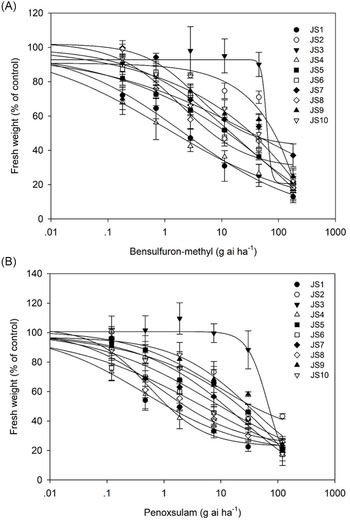
In this study, we investigated and characterized sensitivity of 10 A. multiflora populations in Jiangsu Province to bensulfuron-methyl and penoxsulam. The results showed that eight A. multiflora populations (JS2, JS3, JS5, JS6, JS7, JS8, JS9, and JS10) displayed different resistance levels to bensulfuron-methyl (Table 3; Figure 1A). The JS2 and JS3 populations were highly resistant to bensulfuron-methyl, and the RIs were 90. 9 and 58.4, respectively, compared with the JS1 population. In addition, four populations (JS5, JS7, JS9, and JS10) showed high resistance levels (16.0- to 42.0-fold), and two population (JS6 and JS8) showed moderate resistance levels (9.1- to 9.4-fold) to bensulfuron-methyl.
GR50 and resistance index (RI) values to bensulfuron-methyl and penoxsulam in Ammannia multiflora populations and target-site mutations in ALS genes of A. multiflora populations. a

a GR50 is the herbicide dose required to reduce fresh weight by 50%, b is the slope in GR50, and R is the coefficient of the curve.
Dose–response curves of 10 Ammannia multiflora populations to bensulfuron-methyl (A) and penoxsulam (B).

The results of penoxsulam sensitivity tests indicated that six A. multiflora populations (JS2, JS3, JS5, JS7, JS9, and JS10) exhibited high levels of resistance to penoxsulam, with 54.6-, 103.1-, 26.6-, 12.2-, 33.8-, and 51.9-fold resistance, respectively, and two populations (JS6 and JS8) displayed a low to moderate levels of resistance, with RIs ranging from 5.0 to 7.8 (Table 3; Figure 1B).
The results revealed that all but one of the nine tested A. multiflora populations were resistant to both bensulfuron-methyl and penoxsulam, suggesting the prevalence of ALS resistance in this weed species. According to the prediction of the E. crus-galli resistance evolution model developed by Bagavathiannan et al. (Reference Bagavathiannan, Norsworthy, Smith and Neve2014), when ALS inhibitors were used to control E. crus-galli three times a year, it was expected that there would be resistant biotypes within 4 yr and that 80% of E. crus-galli would be at risk of developing resistance after 30 yr of continuous use. The widespread occurrence of ALS herbicide resistance in A. multiflora is not surprising, because bensulfuron-methyl has been used for more than 30 yr since its registration in China in 1986, and penoxsulam for more than 10 yr after registration in 2008 in China. In addition, various paddy weeds in China, including A. arenaria (Wang et al. Reference Wang, Xu, Zhu, Liu, Wang, Liu, Lu and Wang2013; Zhang et al. Reference Zhang, Liu, Cai, Zhou, Wang, Lu, Zhou, Liu, Liang, Wang and Zhu2020), smallflower umbrella sedge (Cyperus difformis L.) (Li et al. Reference Li, Li, Chen, Peng, Wang and Cui2020), and Ludwigia prostrata Roxb. (Deng et al. Reference Deng, Yang, Duan, Peng, Xia and Yuan2021), have been demonstrated to evolve resistance to ALS inhibitors, especially to bensulfuron-methyl. This phenomenon was strongly associated with intensive and persistent use of herbicides with the same mechanism of action. Herbicides with a different site of action or an integrated weed management approach should be considered as alternative management options.
ALS Gene Sequencing
Partial ALS genes of A. multiflora were amplified from cDNA, and the direct sequencing results displayed a chromatogram of double or triple peaks in some sequence regions, indicating that there are multiple gene copies encoding ALS in A. multiflora (Figure 2). As expected, isolation of the PCR products by cloning revealed three copies of ALS gene sequences (named AmALS1, AmALS2, and AmALS3), and all were actively expressed in A. multiflora.
Sequence diagrams of ALS genes in Ammannia multiflora. All populations contain three ALS gene copies. (A) 197CCT(G/A) for Pro; (B) 197CCG(A) for Pro and TCT for Ser; (C) 197CCG(A) for Pro and GCT for Ala; (D) 197CCG(A) for Pro and CAT for His; (E) 197CCA for Pro, GCT for Ala, and TCG for Ser; (F) 197CCA for Pro, GCT for Ala, and CGG for Arg; (G) partial fragments of three ALS genes, and the boxed region represents the codon position 197 of ALS.

The alignment of each ALS gene sequence from the susceptible and resistant A. multiflora populations disclosed nucleotide mutations at the Pro-197 codon in one or two ALS genes. Four different mutation types were found at the Pro-197 site, namely, CCT to GCT (JS2 and JS3), CCT to TCT (JS5 and JS10) or CCG to TCG (JS2 and JS8), CCT to CAT (JS6, JS7, and JS9), and CCG to CGG (JS3), resulting in alanine (Ala), serine (Ser), histidine (His), and arginine (Arg) amino acid substitutions, respectively (Table 3). Interestingly, the identified Pro-197 mutations were exclusively observed in AmALS1 and AmALS2, and not in AmALS3. In addition, two mutated ALS genes in a single plant were also found in two populations that exhibited the strongest resistance. JS2 populations contained the Pro-197-Ala in AmALS1 and Pro-197-Ser in AmALS2 mutations, and JS3 populations contained the Pro-197-Ala in AmALS1 and Pro-197-Arg in AmALS2 mutations.
Multiple ALS gene copies have been frequently observed in weed species, such as rock bulrush [Schoenoplectus juncoides (Roxb.) Lye] (Uchino et al. Reference Uchino, Ogata, Kohara, Yoshida, Yoshioka and Watanabe2007), D. sophia (Deng et al. Reference Deng, Yang, Zhang, Jiao, Mei, Li and Zheng2017; Xu et al. Reference Xu, Liu, Chen, Li, Liu, Wang, Fan, Wang and Ni2015), C. bursa-pastoris (Wang et al. Reference Wang, Zhang, Li, Bai, Zhang, Wu, Liu and Wang2019), and Monochoria vaginalis (Burm. f.) C. Presl ex Kunth (Iwakami et al. Reference Iwakami, Tanigaki, Uchino, Ozawa, Tominaga and Wang2020). In our study, three partial ALS genes were cloned from all tested A. multiflora populations. This phenomenon was generally identical with results in previous studies (Uchino et al. Reference Uchino, Ogata, Kohara, Yoshida, Yoshioka and Watanabe2007; Xu et al. Reference Xu, Liu, Chen, Li, Liu, Wang, Fan, Wang and Ni2015). The reduced ALS enzyme sensitivity to herbicides resulted from amino acid changes at eight sites of the ALS gene, which endowed resistance to ALS herbicides. In the current study, four different Pro-197 mutations (Pro-197-Ala, Pro-197-Ser, Pro-197-His, and Pro-197-Arg) were found in eight resistant populations, indicating these mutations are mainly responsible for bensulfuron-methyl and penoxsulam resistance in the tested A. multiflora, although any potential additional NTSR mechanisms were not determined in these populations. No mutations at other sites of the ALS genes were detected in resistant A. multiflora populations. This is likely due to the major use of sulfonylurea herbicides, which is known to select for mutations at Pro-197 (Yu and Powles Reference Yu and Powles2014). As far as we know, our studies report for the first time the target-site mutations in A. multiflora, although these mutations have been found in other resistant weeds.
In our case, two mutated ALS genes were identified in two resistant populations, one each on separate copies, which conferred higher levels of resistance than in weeds carrying a single ALS gene mutation (Table 3). In recent years, high-level resistance endowed by double ALS mutations has been frequently documented in many resistant weeds. For instance, Wang et al. (Reference Wang, Zhang, Li, Bai, Zhang, Wu, Liu and Wang2019) reported a resistant a C. bursa-pastoris population with the Pro-197-Ser mutation in ALS1 and the Pro-197-His mutation in ALS2. Xu et al. (Reference Xu, Xu, Shen, Li and Zheng2021) found that a combination of two ALS mutations (Asp-376-Glu in ALS1 and Pro-197-Ala in ALS2) in D. sophia showed more than 10,000-fold resistance to tribenuron-methyl. Tanigaki et al. (Reference Tanigaki, Uchino, Okawa, Miura, Hamamura, Matsuo, Yoshino, Ueno, Toyama, Fukumi, Masuda, Shimono, Tominaga and Iwakami2021) reported a relatively rare resistant case in which the Pro-197-Ser and Asp-376-Glu mutations had occurred in a single ALS gene. In addition, double or triple mutations (Thr-102-Ile, Ala-103-Val, and Pro-106-Ser) have also been reported in glyphosate-resistant weeds (Perotti et al. Reference Perotti, Larran, Palmieri, Martinatto, Alvarez, Tuesca and Permingeat2018; Yu et al. Reference Yu, Jalaludin, Han, Chen, Sammons and Powles2015). Furthermore, the combinations of double ALS mutations have been incorporated in crop-breeding programs to improve tolerance to ALS inhibitors (Jiang et al. Reference Jiang, Chai, Lu, Han, Lin, Zhang, Zhou, Wang, Gao and Chen2020; Walter et al. Reference Walter, Strachan, Ferry, Albert, Castle and Sebastian2014). The accumulation of two mutations may be the consequence of herbicide-resistance evolution imposed by higher selection pressure. In our study, no ALS mutations were found in the AmALS3 copy. Tanigaki et al. (Reference Tanigaki, Uchino, Okawa, Miura, Hamamura, Matsuo, Yoshino, Ueno, Toyama, Fukumi, Masuda, Shimono, Tominaga and Iwakami2021) reported that amino acid substitutions were only observed in MvALS1 or MvALS3 in 60 resistant M. vaginalis populations and that high expression of two ALS genes is the driving force of resistance evolution in M. vaginalis. It is speculated that the three ALS genes may have different expression levels in A. multiflora, which requires further study.
Response to Alternative Herbicides
The susceptible and resistant populations of A. multiflora were completely controlled by field-recommended doses of MCPA, florpyrauxifen-benzyl, bentazon, and carfentrazone-ethyl (Table 4). The results indicated that control of ALS inhibitor–resistant A. multiflora is possible by rotating alternative herbicides with different sites of action. The four alternative herbicides are commonly used in rice fields to control broadleaf weeds. The resistant A. multiflora population has not yet evolved resistance to these herbicides of multiple modes of action. However, we should also pay attention to the type of herbicide when selecting herbicides to rotate to avoid the evolution of cross-resistance to the greatest extent possible. Hulme (Reference Hulme2022) reported that herbicides could be clustered into three groups, and the same groups tend to be more closely linked in terms of cross-resistance in weed species. One of three herbicide clusters includes ALS inhibitors, synthetic auxins, photosystem II (PSII) inhibitors, and 5-enolpyruvylshikimate-3-phosphate synthase inhibitors. Thus, from the point of view of developing cross-resistance, the protoporphyrinogen oxidase (PPO) inhibitor carfentrazone-ethyl may be a better option for management of resistant A. multiflora, rather than the synthetic auxins MCPA and florpyrauxifen-benzyl and the PSII inhibitor bentazon. In addition, utilizing herbicide mixtures or preemergence herbicides and integrated weed management programs should be encouraged to reduce the risk of resistance development in A. multiflora.
Control efficacy of MCPA, florpyrauxifen-benzyl, bentazon, and carfentrazone-ethyl at their field-recommended doses in the susceptible (JS1) and four resistant (JS2, JS3, JS5, and JS10) Ammannia multiflora populations. a

a Survivors or aboveground fresh weight followed by the same letters in rows indicates no significant difference (P < 0.05).
In conclusion, eight A. multiflora populations originating from rice fields where failure of ALS-inhibiting herbicides occurred have been shown to evolve resistance to bensulfuron-methyl and penoxsulam. Three ALS gene copies were observed in the collected A. multiflora populations, and AmALS1 (Pro-197Ser, Pro-197Ala, and Pro-197His) and AmALS2 (Pro-197Ser and Pro-197Arg) mutations or pairs of these mutations were found and appear to be the cause of resistance. Moreover, the alternative herbicides MCPA, florpyrauxifen-benzyl, bentazon, and carfentrazone-ethyl can be used to control both susceptible and resistant A. multiflora populations, but care should be taken to avoid evolution of further resistance.
Acknowledgments
This work was financially supported by the Agricultural Science and Technology Innovation Fund (CX (20) 3131), the Natural Science Foundation of the Jiangsu Higher Education Institutions of China (19KJB210005), and the National Natural Science Foundation of China (32001925). There are no conflicts of interest to declare.