Introduction: The Hawarden Woodcutter
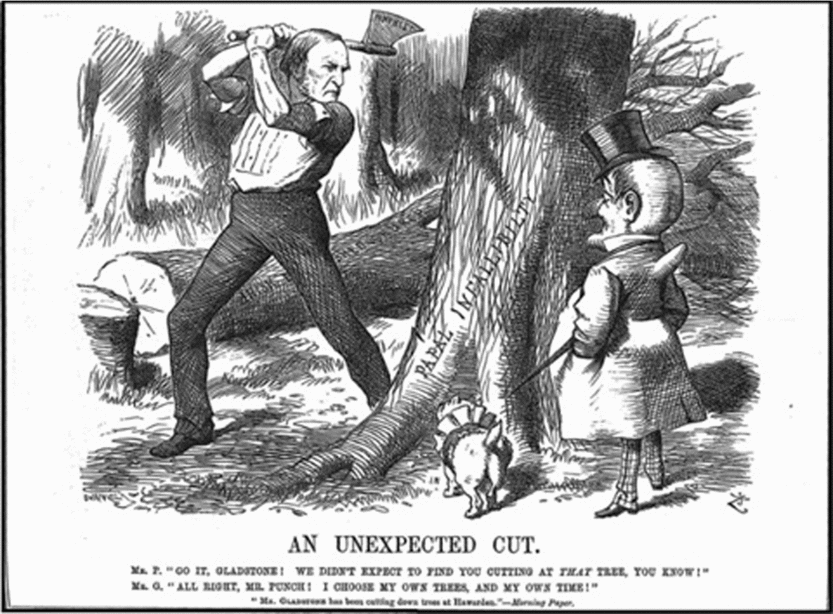
When W. E. Gladstone published in November 1874 his spirited pamphlet The Vatican Decrees in their Bearing on Civil Allegiance: A Political Expostulation, he seems to have taken many people by surprise. In its issue of the 21st of that month, Punch printed a cartoon, “An Unexpected Cut” (Figure 1) which portrayed the “Hawarden woodcutter” laying an axe to the stout trunk of a tree labelled “Papal Infallibility,” under the bemused gaze of Mr Punch. To the latter's remark “We didn't expect to find you cutting at that tree, you know,” the ex-Prime Minister dourly retorts: “All right, Mr Punch! I choose my own Trees, and my own Time!” In Gladstone's view, the time was ripe to take a stand against the recent pretensions of the Roman Catholic Church, under the leadership of its aging pontiff Pius IX, to exercise an absolute and unchallengeable authority over the consciences and actions of Catholics.
“An Unexpected Cut.” Engraving from Punch (21 Nov. 1874): 215.

Given Gladstone's well-known Anglican loyalties and his long-standing interest in religious politics, one may wonder why his Political Expostulation raised the eyebrows of Mr Punch. There are two plausible explanations. First, the declaration of papal infallibility at the Vatican Council on 18 July 1870 had, in four years, made little impact on British shores (unlike in Prussia, where the Kulturkampf had raged fiercely), and there was no particular reason to expect this situation to change. Second, Gladstone's record as a supporter of civil rights for Catholics, often in the teeth of fierce opposition both in and out of Parliament, made him an unlikely champion to engage in combat with the papacy (and in the process jeopardise the support of Catholics for the Liberal Party). His government's disestablishment of the Anglican Church of Ireland in July 1869 and his attempt, four years later, to set up non-denominational universities in Ireland to cater for students of all religious backgrounds showed plainly the irenic bent of a politician determined to tackle the injustices and bad feeling born of religious differences. Thus Gladstone's lambasting of the Vatican appeared to some of his contemporaries, including senior colleagues in the Liberal Party, to be an untimely and retrograde transformation from peace-making to peace-breaking. Why risk re-igniting confessional strife in Queen Victoria's Britain, when the country had long since ceased to confront an existential threat from the forces of Catholic Europe? It was all very well for Gladstone to write that “The Rome of the Middle Ages claimed universal monarchy. The modern Church of Rome has abandoned nothing, retracted nothing” (Vatican Decrees 11). Yet it was scarcely to be expected that Catholics in Britain would endanger their newly-gained political rights and social respectability by compromising their civil allegiance at the behest of the occupant of St Peter's chair. Still less likely was it that peace-loving English Catholics would heed any calls to join the Pope's legions to restore the papacy's fast-declining temporal power.
Why then did Gladstone think it necessary to swing the axe so vigorously against dangers that were presently hypothetical and never likely to materialise in any significant form? I shall argue that he was motivated much less by anxieties concerning the practical effects of the papal declarations on Catholics in Britain than by a lively indignation at papal effrontery in claiming to dictate how Catholics should think and act. This indignation reflected Gladstone's intense love of individual liberty and his hatred for all forms of oppression, political, social or intellectual. These traits he shared with the greatest liberal spokesman of the age, John Stuart Mill, whose On Liberty (1859) emphasised that there can be a tyranny over the mind as well as over the body, and that authorities that claim to be infallible in their judgements are dangerous. Even though, as we shall see, Gladstone confessed to being influenced principally in his opposition to papal infallibility by the writings of the Anglican Bishop Butler (1692–1752), the tenor of his anti-Vatican works has much more in common with Mill's On Liberty than appears generally to have been noticed. Or so I shall seek to show. That both men sounded a clarion call for freedom of conscience, belief and discussion was less regarded in the case of Gladstone because what chiefly struck his contemporaries was the political riskiness of his outburst. To many senior members of the Liberal Party from both Whig and radical wings, “Gladstone's effusion,” in the words of J.P. Parry, “appeared to them to be extremely stupid politics since it was bound to offend Catholics, to discourage them from voting Liberal, and to drive them into the hands of the ultramontanes” (Parry 425). Sir Charles Dilke considered that Gladstone was “in the sulks” (Crosby 148) after recent disappointments, including the defeat of the Irish University Bill engineered by the Irish Catholic episcopacy, and the defection to Rome of his close friend Lord Ripon. Describing Gladstone's response to ultramontanism as “the obsession of his quasi-retirement,” H.C.G. Matthew pinpoints what so much annoyed his party colleagues: Gladstone was, they thought, self-indulgently riding a hobby-horse at the expense of the Liberal Party (Matthew 183).
To Gladstone, these accusations must have seemed both petty and unfair. In his article “Ritualism and Ritual,” published weeks before The Vatican Decrees, he wrote that “no one can become [Rome's] convert without renouncing his moral and mental freedom, and placing his civil loyalty and duty at the mercy” of the pope (674). Although these words caused offence to many, they were far from being, as Crosby has characterised them, “a gratuitous insult to all Roman Catholics” (Crosby 147). Gladstone was not criticising Catholics but expressing his indignant sympathy with the intolerable situation they had been placed in by the Decrees of the Council. The point he emphasised was a logical one: if the pope insisted that such-and-such a proposition was the truth, then a Roman Catholic could not consistently maintain his loyalty to the magisterium while rejecting the proposition. This would be mental tyranny on the part of the pope, incompatible with the enquiring spirit of the age and – as Gladstone quite correctly noted – in principle capable of producing a conflict in civil loyalties. Yet this was precisely the position defended not just in conservative circles in the Vatican but even on home shores by Gladstone's former Anglican friend Henry Manning, now Roman Catholic Archbishop of Westminster. Manning, who, to Gladstone's intense irritation, had worked behind the scenes in Rome to promote acceptance of the article on infallibility, had recently presented to the Metaphysical Society a paper with the provocative title “That legitimate authority is an evidence of truth” (Bebbington 225). Far from driving Catholics into the arms of the ultramontanes, Gladstone hoped that his arguments would raise in Catholics a mood of opposition to that unworthy, unscriptural and unpatriotic doctrine.
To Gladstone, it was outrageous for the Pope to place Catholics in the invidious position of having to choose between two loyalties, even though the vast majority would reject any papal demands that conflicted with their allegiance to Queen and country. Significantly, Gladstone expressed no great concern even about the more fragile political loyalty of the Catholics of Ireland, where the energetic Cardinal Cullen was no mean assertor of Catholic rights. The gravamen of his complaint was that the papacy was acting ultra vires in asserting an absolute authority over individual action and belief, while scouting the privilege of states to have first call on their citizens' obedience. If the former offended Gladstone as a rational Christian and a thinking man, the latter appalled him as a statesman with his country's interests at heart. According to Gladstone's friend and biographer John Morley, the declaration of infallibility “made such a cruel dilemma for a large class of the subjects of the Queen; for the choice assigned to them by assuming stringent logic was between being bad citizens if they submitted to the decree of papal infallibility, and bad catholics if they did not” (Morley 2: 126). Morley records Gladstone's anger at the manoeuvrings in the Vatican and his frustration with a papacy that showed no interest in advancing Protestant-Catholic reconciliation.
Gladstone, however, was not quite a lone voice crying in the wilderness, although the fame of his Political Expostulation has tended to put other anti-Vatican writings in the shade. Robert Fitzsimons' detailed survey of the numerous post-Council speeches and articles by leading members of the Church of England has shown that Gladstone's pamphlet had many precursors (Fitzsimons). An editorial in the Anglo-Catholic Church Times published in July 1870 went so far as to denounce the Vatican decrees as the “consummation of a crime which the Ultramontane party [had] been plotting for more than half a century.” Two years later, Bishop Connop Thirlwall of St David's could write: “Papal infallibility implies a claim of absolute sovereignty over the whole range of human thought and action. . . . [T]he most extravagant pretensions of the medieval Popes, are now revived, re-affirmed, invested for ever with a divine authority” (qtd. in Fitzsimons 44).
One well-known non-clerical liberal, Gladstone's close friend and confidant the Catholic Lord Acton, had worked hard behind the scenes in Rome before the Council's opening to try to forestall the widely expected declaration of infallibility.Footnote 1 Both Acton and Gladstone were old friends of the theologian Dr Johann Joseph Ignaz von Döllinger, the most influential Continental critic of the idea of papal infallibility, and Acton, who had studied with Döllinger, felt a personal involvement in the unfolding events in Rome. Both men admired Döllinger's steadfast refusal to bow to pressure to withdraw his objections and conform to papal authority, and Gladstone's indignation at Döllinger's subsequent harsh treatment by his ecclesiastical superiors was undoubtedly a factor motivating his own protest against the Vatican's assault on free thought. At four years' distance from the Council, Gladstone had less need to proceed cautiously than had the discreet Acton in 1870. Like certain other prominent Catholic liberals (including John Henry Newman and Lord Granville), Acton was reluctant to state his criticisms of the Vatican too openly lest they be conflated with the stridently anti-Catholic sentiments that were increasingly frequent in the press.Footnote 2 Other liberals, both within and without the Catholic communion, may have thought the papal claims to infallibility and universal priesthood simply too preposterous to merit reasoned refutation. But no liberal thinker could accept the papacy's increasingly bullish attempts to silence dissent within the Church by reference to an authority purportedly derived from St Peter.
Although J.S. Mill, whose claim by the 1870s to be England's foremost liberal spokesman could have been contested only by Gladstone himself, did not publicly condemn the Vatican decrees, his writings, and especially On Liberty, mount a formidable theoretical challenge to the idea that authority is a substitute for evidence. Mill's rebuttal in On Liberty of all pretensions to infallibility is not explicitly directed against the claims of popes and prelates, but for contemporary readers the growing enthusiasm in Rome for declaring papal infallibility an article of faith would have seemed to be one obvious target.Footnote 3 As early as 1836, Mill had made scornful mention of “the pretended infallibility of popes and priesthoods” (“Guizot's Lectures” 393).Footnote 4 In Mill's view, any claim to know things with absolute certainty was an impediment to the discovery of truth, because people who thought they could not be wrong not only overestimated their own epistemic powers but put themselves beyond the reach of corrective argument. Mill may have judged that his paean to freedom of thought and expression in On Liberty in 1859 made it needless to rehearse the same arguments in 1870. Whatever the precise reasons for his silence, On Liberty, as we shall see, presents in their most systematic form a number of the arguments later deployed by Gladstone against the authoritarianism of Rome.
Gladstone's Target: Romanism, not Roman Catholics
Public interest inThe Vatican Decrees was gratifyingly large, and Morley reports that 145,000 copies of Gladstone's tract had been printed by the end of 1874. Whether the best-selling status of the work reflected widespread concern about the papal pretensions it attacked, or more the public keenness to see its illustrious author in the role of dragon-slayer was, and is, hard to say. Either way, within a few months over twenty replies had appeared that Gladstone thought significant enough to require a response, and a more substantial treatise, Vaticanism: An Answer to Reproofs and Replies, was written at speed and published in February 1875.
In the preface to the new work, Gladstone dismissed the charge that he was making a mountain out of a molehill. “If there has ever been, and there still be,” he wrote, “a question reaching far into the future, it is the question of Church Power, and of its monstrous exaggeration into papal Power, such as it has now for the first time been accepted by the Latin Church in its corporate capacity” (Vaticanism iii). Even if no pope would be so foolish as to urge Catholics in Britain to contest its laws or resist its government, or to expect their obedience if he did, the Vatican's affirmation of a right to direct the thoughts and actions of Catholics, backed by the pope's claim to infallibility whenever he pronounced ex cathedra on matters of faith and morals, posed a constitutional challenge that could not be ignored. If this constitutional challenge was in the forefront of the politician Gladstone's concerns, Gladstone the liberal thinker had long objected to the papal disdain for freedom of thought and conscience. Already in 1852 he had complained that ultramontanism exalted hierarchy while denigrating “the doctrine of inward freedom, the rights and responsibilities of individuality, the mixed and tempered organization of ecclesiastical government” (qtd. in Bebbington 120). Strongly resembling Mill in his high estimation of individuality and liberty of thought, Gladstone, according to Bebbington, had been schooled by Peel to recognise “freedom as essential to human welfare” (Bebbington 120). This is also a quintessentially Millian sentiment.
Gladstone scornfully rejected John Henry Newman's hopeful suggestion that exceptions were presumably intended to the precept of obedience, noting correctly that “this is just what the [Vatican] Council has not said” (Vaticanism 69). For Father Newman, as for Henry Manning, Gladstone's criticism of Catholicism appeared ill-timed because it threatened to revitalise traditional hatred and distrust of Catholics by English Protestants. Newman's own liberal brand of Catholicism had made him uneasy about the definition of infallibility, and he was particularly unhappy that it had been brought about by papal pressure and the underhand methods of the Pope's Jesuit advisers and other ultramontanist supporters (including Manning) rather than as a clear development of doctrine based on scriptural study and theological reflection.Footnote 5 Yet Newman thought it ironic that it was Gladstone who was leading the charge against the Vatican, when few politicians had done more than he to advance the social, political and educational emancipation of Catholics (most recently in the Irish Church Act of 1869 and the University Tests Act of 1871). In his public letter to the Duke of Norfolk, Newman wrote that it grieved him deeply “that Mr Gladstone has felt it his duty to speak with such extraordinary severity of our religion and of ourselves.” English Catholics, Newman admitted, had not always behaved impeccably; some in recent years had been too overbearing in asserting their rights and the superiority of their faith. Yet Newman felt it his duty to speak up “when such heavy charges had been made against the Catholics of England by so powerful and so earnest an adversary” (Newman 3).Footnote 6
In responding thus, however, Newman, like others, committed an ignoratio elenchi. For Gladstone laid no charges, heavy or light, against the Catholics of England. His firepower was directed wholly against Rome, the Pope and his advisors, and the Vatican Council that had proclaimed not only the infallibility of the pontiff but his status as universal bishop, with absolute powers to bind and loose. As Travis Crosby has noted, Gladstone “made a clear distinction between the body of the Roman Catholic Church and what he called Romanism” (149). He may have recalled the wise words of the Gospel: “No man can serve two masters: for either he will hate the one, and love the other; or else he will hold to the one, and despise the other” (Matthew 6.24). Recognising how invidious the position of Catholics would be if a pope were to command them to act in ways that broke the laws of the land, Gladstone saw them as living under a sword of Damocles so long as the Church asserted its right to meddle. In a letter to Döllinger written in November 1874, Gladstone explained that his pamphlet was intended as “a friendly challenge to my Roman Catholic fellow-countrymen, inviting them to exculpate the decrees, or, if they cannot do that, to renounce and repudiate the civil consequences” (Correspondence on Church 2: 59).
Some modern commentators have spoken in belittling terms, recalling Newman's, of Gladstone's apparent alarm that the Pope-led Catholics were unsound in their loyalty, liable to perform acts of civil disobedience or even take up arms if commanded to do so by Rome. According to Jeffrey von Arx, “It seems extraordinary to a later age that a man of Gladstone's intelligence and experience would actually believe that the leaders of the Catholic Church, especially in England, could contemplate, to say nothing of their being able to bring about, an European war in the interests of [restoring the Pope's] Temporal Power” (Von Arx 230). While Gladstone believed that the bitter disappointment felt by Pius IX at the loss of the Papal States, and his unwillingness to accept the new political status quo in the Italian peninsula, were shared by many traditionalist Catholics in parts of southern Europe, an isolated remark made in a letter to Lord Granville voicing a fear that Catholics could unite in “one vast conspiracy” to reassert the pope's rights, cannot sanely be interpreted as expressing a worry that English Catholics would rise en masse to fight for the pope (Gladstone, Political Correspondence 2: 458). But this unlikely interpretation has been pressed by Josef Altholz in two papers that represent Gladstone as suffering from an anxiety that amounted to neurosis (“Gladstone and the Vatican Decrees” and “The Vatican Decrees Controversy”). What really troubled Gladstone was not the prospect that Catholics would, at the pope's command, become literal crusaders for reactionary causes but that their integration into British society could never be complete so long as the Head of their Church demanded “a plenary obedience to whatever he may desire in relation not to faith but to morals, and not only to these, but to all that concerns the government and discipline of the Church” (Gladstone, Vatican Decrees 43).Footnote 7
The Papacy's “Mischievous Realities”
In Vaticanism, Gladstone forcefully restated the pith of his concern: for long the Roman Catholic hierarchy had been accustomed to make bold claims about its right to command but had not been much in the habit of exercising it; but through the decrees of 1870 “it was decided to bring mischievous abstractions into the realm of still more mischievous realities” (87). An embittered papacy, angry at the decline of its temporal power, was set, Gladstone believed, on the reassertion of its authority over the consciences of Catholics, to show that it was still a force to be reckoned with. We now know, with the benefit of hindsight, that the papacy after 1870 did not enforce its claims on Catholics in ways that tested their civil allegiance in the manner feared by Gladstone. The distraction of the Kulturkampf in Germany, where the Church could with some justice claim to be more sinned against than sinning, and the election of a more pacific pope, Leo XIII, in 1878, ensured that history unfolded differently. Yet a reference to the text of the decrees of the Vatican Council, together with those of the preceding Syllabus of Errors of 1864, shows that Gladstone was right to feel worried.
The Vatican Decrees quotes in their original Latin and glosses in English a number of propositions and condemnations published in the 1864 Syllabus and given the firm stamp of authority (albeit something of a rubber stamp) by the Council. More reminiscent of the sixteenth century than apt for the nineteenth, they represent a reactionary papacy's desperate attempt to keep modernity at bay. The first three condemnations target those who maintain (1) the liberty of the press, (2) the liberty of conscience and of worship, and (3) the liberty of speech. Other condemnations are of those who claim that the pope can be disobeyed without sin (4); that marriage, except where solemnised according to the Catholic rite, is binding (14); and – a remarkable catch-all formulation – that “the Roman Pontiff ought to come to terms with progress, liberalism, and modern civilization” (18). Of particular concern to Gladstone was (10) the still more egregious condemnation of those who assert that “in the conflict of laws civil and ecclesiastical, the civil law should prevail” (Gladstone, Vatican Decrees 16–18). Of course, the Pope had no more chance of stemming the tide of modernity than King Cnut had of holding back the waves of the sea. The irony is that this recognition within the Church was a major stimulus to the Council's definition of the dogma of papal infallibility, in its final session of 18 July 1870. If the faithful were slow to recognise that modern civilisation was travelling ever faster along the road to perdition, then they had to be made to do so by the weight of an authority that could not be wrong. Thus the Council crucially declared:
We teach and reveal as a divinely revealed dogma that when the Roman pontiff speaks ex cathedra, that is, when in the exercise of his office as shepherd and teacher of all Christians in virtue of his supreme apostolic authority, he defines a doctrine concerning faith or morals to be held by the whole Church, he possesses, by the divine authority promised to him in blessed Peter, that infallibility which the divine Redeemer willed his Church to enjoy in defining doctrine concerning faith or morals. (Tanner 816)
The precise meaning of the phrase “ex cathedra” was, perhaps deliberately, left vague, and it has remained so to the present day. But the consequent difficulty of determining – by anyone but the Pope himself – when a declaration was ex cathedra, rather than limiting the scope of the dogma as Newman claimed (Newman 3), made it harder – and to Catholic zealots less acceptable – to question any pronouncements of the sovereign pontiff.
Just how significant was the definition of papal infallibility in 1870? Was it truly the game-changing move that some, including Gladstone, thought, or did it merely give belated authority to an idea that had for centuries enjoyed a semi-official currency in the Roman Church? The very limited application of the infallibility tenet made by the Catholic Church subsequently may suggest that it was something of a paper tiger. But the fact that a pope in the late nineteenth century felt impelled to proclaim his own infallibility signified, as Gladstone rightly saw, a papacy at bay and prepared to bare its teeth at the threatening forces of change. And as the fractious debates in the Council preceding the formal declaration of infallibility plainly showed, it was not only outside the Church that people found the principle problematic: within it, too, many bishops were unconvinced of the adequacy of the alleged scriptural warrant (John 16.13; Acts 15.28) for specifically papal infallibility, or were fearful of the uses that a self-willed pontiff might make of the enhanced authority that its definition would give him. That the Holy Spirit might provide a generalised guiding light to the Church was, on basic Christian assumptions, a reasonable belief. But that the Holy Spirit would ensure that in certain declarations the pope could not be wrong was a far more contestable claim. Even if this were in fact true, the fundamental problem is the epistemological one of seeing how it could be known to be true. This problem of the warrant cannot be solved via an appeal to the pope's infallibility when he declares himself infallible, for such a bootstrap operation relies on the same principle for its proof that it seeks to establish. And so long as infallibility remains in doubt, that doubt is necessarily transmitted to any propositions asserted “infallibly.”
For Gladstone, claims to infallibility were not only arrogant but foolish, because they missed the profound truth advanced by Bishop Butler that “probability is the guide to life.” In a letter of 1850, Gladstone remarked that Butler was “the fountain of all my conceptions, such as they are,” on the subject of infallibility (Correspondence on Church 1: 111). Butler's Rolls Chapel sermon “Upon the Ignorance of Man” (1726) and more particularly his Analogy of Religion (1736) had taught Gladstone that in matters of abstract theology and religious speculation certainty was an unattainable goal, and that analogical and inductive reasoning was the soundest route to (probable) truth. In his Studies Subsidiary to Butler's Works, Gladstone spelled out the implications of Butler's method for theistic belief, emphasising its epistemic humility and its firm reliance on empirical evidence. Taking a side-swipe at Anglican apostates, he reminded his readers that “For the being of God, the basis of all religion, no demonstrative proof has been supplied, but the convert from (say) the Anglican Church to the Roman Church, as modelled by Pope Pius IX and his coadjutors, is taught to believe that he possesses one” (Studies Subsidiary 11). Later in the same work he praised Butler for his “strong, just, and humble sense of our limitations in capacity,” contrasting this favourably against “the daring and presumption of the claims set up by some” on behalf of the popes (106). Butler's feet-on-the-ground view of the evidences for Christian belief may, Gladstone admitted, have seemed disappointingly unadventurous – even “revolting to human pride” (11) – to some; but to claim, like Pius IX, to be the recipient of infallible divine inspiration was to demonstrate the ultimate in spiritual and intellectual hubris.Footnote 8
Epistemological objections to the infallibility claim were never likely to impede its acceptance by the generality of Catholic clergy and laity, accustomed as they were to take on trust the dicta of the Roman magisterium. For Gladstone, on the other hand, “the resistless, domineering action of a purely central power” had long been an objectionable feature of the Roman hierarchy, but in 1870 “its besetting sin has now become, as far as man can make it,. . . its undisguised, unchecked rule of action and law of life” (Vaticanism 5). The Pope had made it clear that he would brook no opposition from the Church's members.Footnote 9 Gladstone, here in his most Millian vein, accused the Pope of aiming “heavy, and as far as he can make them, deadly blows at the freedom of mankind,” aided and abetted by an ultramontanism that “has lost the habit, almost the idea, of equal laws in discussion” (111).
Mill on Fallibility and Freedom
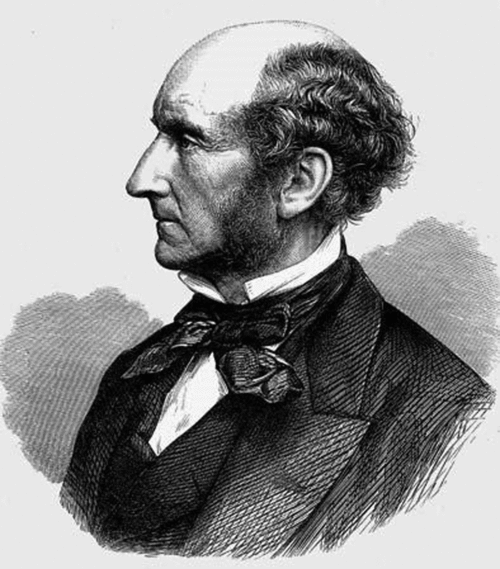
In condemning the Vatican's attempt to stifle independent thought and discussion amongst Catholics, Gladstone echoed, intentionally or not, Mill's passionate defence of the rights to these in the famous second chapter of On Liberty, “Of the liberty of thought and discussion” (Figure 2). Gladstone made no explicit reference to Mill in either of his anti-Roman tracts and, as we have seen, claimed Butler to have been the major inspiration for his views on the nature and grounding of religious belief. Yet his claim in 1850 that Butler was the “fountain” of all his views on infallibility was made nine years before the publication of On Liberty, and it is inconceivable that Mill's seminal work had no influence, consciously or subliminally, on Gladstone's later thinking; indeed, too many of Mill's pet themes appear in the Expostulation and its sequel for this to be simply a matter of coincidence. Moreover, while Butler never explicitly discussed papal pretensions to infallibility, leaving any views he might have had to be inferred from his general treatment of religious evidence, Mill, like Gladstone, wrote with polemical purpose against those who sought to impose their own certainties on others or sought to stifle free discussion. Morley records the high esteem in which Gladstone held Mill – whom he referred to as “the Saint of Rationalism” – for his “love of truth, his humanity [and] his passion for justice” (Morley 2: 152). “I always find this satisfaction in Mr. Mill,” wrote Gladstone to a correspondent, “that he is thorough and does not put up with makeshifts” (Correspondence on Church 2: 97). Notable among characteristically Millian themes rehearsed by Gladstone are the following: the rejection of any purported rights to prescribe to others what they should believe; the repudiation of attempts by the powerful to deter dissent by coercive methods or to outlaw free discussion or a free press; the dismissal of authority as a trustworthy source of truth; the defence of the liberty of the individual conscience; and the denial of all and any pretensions to infallibility.
John Stuart Mill. Undated wood engraving (circa 1865).
Liberal values similar to Mill's are apparent in many of Gladstone's speeches, writings and political initiatives. For example, in the heated controversy over ritualism in the Church of England, Gladstone, while admitting that he was not a ritualist himself (Bentley 72), passionately opposed the Conservative Government's attempt in 1874 to outlaw, on pain of criminal sanctions, the use of quasi-Roman Catholic ritual in Anglican church services; for Gladstone, this was a gross interference with the liberty of parish clergy and laity to decide for themselves what form of worship they wanted and an affront to the principle of a broad Church. The passage of the ill-starred and unpopular Public Worship Regulation Act in August 1874 could be considered to be one of the effects of the anti-Catholic reaction to the Vatican Council. In Gladstone's view it was not only an offence to liberty but a sledgehammer to crack a nut, the number of Anglican clergy who were “engaged in a Romanizing conspiracy” being “extremely, almost infinitesimally small” (Yates 239). Gladstone disliked imposed conformity in religious belief and worship and, though disfavouring the disestablishment of the Church of England, sought to make the Church as broad and inclusive as was compatible with its basic principles. Firmly anti-Erastian in his views on church-state relations, he sounds particularly Millian in his warning that where the state which controls the Church has become “the organ of the deliberate and ascertained will of the community,” the peace and life of civil society are endangered (“What some churchmen think” 1). The worry expressed here is strongly reminiscent of Mill's fear of the “tyranny of the majority” voiced in the first chapter of On Liberty.
If Gladstone did not mention Mill by name in the Expostulation, he scarcely needed to; by the mid-1870s On Liberty was established as the pre-eminent text of liberal political thought. This was not because all of its ideas were stunningly original, many of them (for example the freedom of the press and the toleration of dissentient opinions) having been influentially defended by earlier liberal writers, among them Milton and Locke. It was rather that Mill's precise and lapidary treatment of them conveyed “what oft was thought but ne'er so well expressed” – nor, one might add, so well or systematically argued. In an end-of-the-century retrospective, Frederick Harrison noted how On Liberty had “been read by hundreds of thousands, and, to some of the most vigorous and thoughtful spirits amongst us, it became a sort of gospel” (qtd. in Himmelfarb 295). When Gladstone – himself not the least vigorous and thoughtful spirit – wrote that in the “Churches subject to the Pope. . . all that nurtured freedom, and all that guaranteed it, have been harassed and denounced, cabined and confined, attenuated and starved” (Vaticanism 119–20), both the thought and the language are highly reminiscent of On Liberty.Footnote 10
When governments, churches or other holders of power attempt to suppress expression of a view that they dislike, they commit, charged Mill, a theft against the human race. For if the view in question is right, then people “are deprived of the opportunity of exchanging error for truth”; but, if it is wrong, “they lose, what is almost as great a benefit, the clearer perception and livelier impression of truth, produced by its collision with error” (On Liberty 229). Even the most perfect conviction that one has truth on one's side cannot warrant suppressing or censoring competing opinions. Those who suppose that “their certainty is the same thing as absolute certainty” are sadly confused (229), and they add moral to intellectual error when they seek to prevent the public expression of opposing views. Even the best of men (Mill's example is the emperor Marcus Aurelius) have sometimes mistaken good for evil and striven to suppress in the public interest opinions they have inadequately understood. (Marcus Aurelius, who persecuted Christianity, Mill wryly adds, was actually “a better Christian in all but the dogmatic sense of the word” than many later ostensibly Christian rulers [236]). The only way to avoid such errors is to allow the free expression and discussion of all views, so that the chaff may be winnowed from the wheat by a rational process that begs no questions. If Gladstone occasionally portrays Pius IX as a power-hungry despot who would feel at home in the world of 1984, both he and Mill were chiefly exercised by the potential for error of governments and other authorities that might be well-meaning but which were too convinced of their own rightness. The only circumstance in which speech could legitimately be silenced, thought Mill, was where a rabble-rousing street orator attempts to stir an excited mob to violence against individuals or property (On Liberty 260). Wherever the requirements of public order are not at stake, the golden rule is that, “If all mankind minus one were of one opinion, and only one person were of the contrary opinion, mankind would be no more justified in silencing that one person, than he, if he had the power, would be justified in silencing mankind” (229).Footnote 11
A person who breaks this rule pretends to be an infallible judge of opinion. “All silencing of discussion,” Mill asserted, “is an assumption of infallibility” which no one, however eminent his status, is entitled to make (229). To the anticipated plea that some views are too immoral or too dangerous to be allowed what Margaret Thatcher would later call “the oxygen of publicity,” Mill objected that none can be categorised as such a priori in advance of public discussion. Unless opinions are given an opportunity to be heard and defended, it remains an open question which are noxious and which are not (233). It is true that Mill's unwillingness ever to shut down debate on any opinions, where allowing them continued currency poses undoubted civic dangers, might be challenged even on liberal principles. Where, for instance, the liberty to voice racist sentiments threatens to undermine the civil rights of a certain section of the population, it might be considered an abuse of freedom that may licitly be prohibited in the name of freedom. But as twenty-first-century politicians know to their cost, striking the right balance between freedom of speech and public protection is a difficult task. Mill would emphasise the importance of free and open discussion of the balance-striking process itself, rejecting any suggestion that decisions about this are best left to governments. Yet even he would probably have agreed that expressions meant to instil hatred based on racial or religious differences are an abuse of the right to free speech that, like the street-orator's call for violence, are not entitled to the protection appropriate to statements of opinion accompanied by reasons. The case against suppressing an opinion that we believe to be wrong or pernicious is that it robs others of the chance to judge it for themselves, besides depriving ourselves of the opportunity to hear the arguments on the other side (On Liberty 234).
Mill offered a careful definition of what it means to “assume infallibility”:
But I must be permitted to observe, that it is not the feeling sure of a doctrine (be it what it may) which I call the assumption of infallibility. It is the undertaking to decide that question for others, without allowing them to hear what can be said on the contrary side. And I denounce and reprobate this pretension not the less, if put forth on the side of my most solemn convictions. (234)
One might cavil with this that someone who flatters herself that she cannot be wrong about logically contingent matters might quite reasonably be described as “assuming infallibility” in one sense, even if she never tries to constrain the belief of others. But this sense of “assuming infallibility” is not the one in which Mill is mainly interested. His concern is not with what goes on inside an individual's own head but with the bearing of her convictions on her behaviour to others. While a person who thinks he cannot be wrong is merely a fool, one who relies on that certainty as a basis for deciding what others must believe is a positive menace.Footnote 12 Mill cites the persecutions of the early Christians by the Roman state, as well as the long history of intolerance by Christians of other Christians, as evidence of the harm that has been done by people who are able to back up by force their overweening sense of their own rightness. Truth may not always triumph in the end, and Mill calls it “a piece of idle sentimentality that truth, merely as truth, has any inherent power denied to error of prevailing against the dungeon and the stake” (On Liberty 238).
The same worry about the “assumption of infallibility” exercised Gladstone's mind, the kinship of On Liberty and the anti-Vatican pamphlets here being particularly striking. Both Mill and Gladstone were well aware of Europe's sorry record of persecution of people for their religious beliefs, and neither was sanguine that such intolerance was a thing of the past. Let the pope believe whatever he likes about his own infallibility, but the real problems come when he inflicts his certainties on others. Papal infallibility “has been declared,” writes Gladstone, “to be an article of faith, binding on the conscience of every Christian”; the Pope's “claim to the obedience of his spiritual subjects has been declared in like manner without any practical limit or reserve; and his supremacy, without any reserve of civil rights, has been similarly affirmed to include everything which relates to the discipline and government of the Church throughout the world” (Vatican Decrees 32). Papal infallibility is a bludgeon intended to beat the life out of independent thought. Gladstone imagines the Pope saying, “That assertion of yours is simply your private judgement; and your private judgement is just what my infallibility is meant and appointed to put down. My word is the tradition of the Church. It is the nod of Zeus; it is the judgement of the Eternal” (Vaticanism 101). But as Mill had earlier pointed out, there are no judgements of Zeus; every opinion is in reality an individual, human judgement. Even when men act in good faith and suppress others' opinions because they sincerely believe them to be impious or immoral, “this is the case of all others in which it [the assumption of infallibility] is most fatal” (On Liberty 234).
That Mill did not comment explicitly on the declarations of the Council should not disguise the important relevance that his strictures on the “assumption of infallibility” have on them. By declaring the pope to be infallible when he speaks ex cathedra, the Council signalled with unprecedented bluntness its rejection of conventional epistemic standards when it came to the most solemn asseverations of the sovereign pontiff. The Holy Spirit, it was claimed, would not allow the pope to be mistaken when he pronounces in matters of such seriousness as the bodily Assumption of the Blessed Virgin Mary (a notion discussed at the Council and formally declared ex cathedra eighty years later in 1950). Even delegates who were initially sceptical about papal infallibility appear finally to have accepted it, largely on the strength of the parallel argument that the Holy Spirit, who looks after Councils as well as popes, could not have allowed the Council to commit such a gross error as falsely declaring the pope to be infallible. But since any claim to be divinely inspired is itself in need of validation, the attempt to defend divine inspiration of the pope when sitting in cathedra by appealing to the divine inspiration of bishops sitting in Council simply shifts the problem.
From a Millian perspective, claiming to know things via the direct inspiration of the Holy Spirit would be of little practical significance if popes or bishops in Council were content to retain their sense of certainty within their own breasts. But this they were not. While Gladstone the politician was especially worried that a Pope who was frightened by modernity and yearning for opportunities to reassert his authority over Catholics' bodies and souls would require from them responses that were incompatible with their loyalty to their countries, his deeper liberal objection to the Vatican's pretensions was the same as Mill's, namely that such pretensions disrespected the intellectual autonomy of the individual. The rights to think for oneself and to express one's own opinions without let or hindrance were precious possessions in mid-Victorian Britain, hard won as they had been over centuries of struggle. In the last analysis, no pope in Rome could actually compel an English Catholic to believe whatever he, the pope, wished, or force him to break the laws of England. Yet for the pope to assert a right to prescribe what Catholics should take for truth, or how they should think about issues of morality, politics or civic duty, was to deny what Mill called the “mental freedom” of thinking beings, and to seek to impose a “mental despotism” quite intolerable in an enlightened age.
Conclusion
The final word may be left with the Hawarden woodcutter. Gladstone was driven to intense indignation with the pretensions of the Vatican in the period between the issuing of the Syllabus Errorum in 1864 and the Council of 1870, and he acutely foresaw, and properly resented, the dilemma in which Catholics would be placed if the pope ever asserted in practice the authority claimed in theory. The outbreak of the Franco-Prussian War in the latter year and the continuing evaporation of the papacy's political influence in the following decades ensured that the challenges to the British state that Gladstone feared did not materialise. Even if they had done, Gladstone did not expect that Catholic men and women would place obedience to a foreign pontiff above their allegiance to the Queen. This was simply not the British way. Accordingly, for all his dissatisfaction with the Vatican shenanigans, Gladstone ended his Political Expostulation on a note of high confidence:
The inhabitants of these Islands, as a whole, are stable, though sometimes credulous and excitable; resolute, though sometimes boastful; and a strong-headed and soundhearted race will not be hindered, either by latent or by avowed discontents, due to the foreign influence of a caste, from the accomplishment of its mission in the world. (Vatican Decrees 66)