INTRODUCTION
Rice (Oryza sativa L.) production in Nigeria in 2006 was estimated at 2.10 million Mg, while consumption was 3.71 million Mg. The balance of 1.60 million Mg was met by importation (Africa Rice Center (WARDA), 2008a). Nigeria is the leading producer and importer of rice in the West Africa subregion (Africa Rice Center (WARDA), 2008a). Improving rice productivity in the existing farming systems in inland valleys would be an important step towards closing the gap between production and consumption. Land intensification via triple cropping, the growing of three crops on the same piece of land within a year without irrigation, is one option for resource-poor farmers to increase the inland valley productivity.
Inland valleys are low-lying areas near rivers that become flooded during the rainy season. They are valuable for grazing and crop production, and are important to international biodiversity as breeding grounds for migratory birds (World Bank, 2006). Wetlands in sub-Saharan Africa are estimated to cover 228 million ha (Bergkamp et al., Reference Bergkamp, Pirot and Hostettler2000; FAO (Food and Agriculture Organization of the United Nations), 1998). In rural West Africa, less than 10% of an estimated 55 million ha of wetlands are currently being used for agriculture (Thenkabail et al., Reference Thenkabail, Prasad and Nolte1995). Nigeria has eight inland valley areas or zones. These include the Sokoto Basin, Chad Basin, Middle Niger Basin, Benue Basin, Southwestern Zone, South-Central Zone, Southeastern and the Basement Complex (World Bank, 2006). The estimated 3 million ha of inland valleys in Nigeria with residual moisture in the dry season, offers attractive opportunities for farmers to grow off-season, high-value crops (Adigbo and Adigbo, Reference Adigbo and Adigbo2011; World Bank, 2001). The success recorded in the First National Fadama (inland valley) Project stimulated the interest of the World Bank, in partnership with the Global Environment Facility (GEF), to commit US$10 million grant to the Second National Fadama Project in 2006 to sustain it (World Bank, 2006). The involvement of the World Bank in the Second National Fadama Project has popularized the use of inland valleys in Nigeria.
Under the prevailing traditional farming systems in inland valleys, one crop of rice is grown per year because the swamps are not developed and water flow is not controlled (WARDA, 1993). In southwestern Nigeria, most farmers practise double cropping with lowland rice followed by vegetables or maize (Zea mays L.) in inland valleys. Lowland rice is planted in the main cropping season between April and May, when the rains have become steady, and harvested between August and September depending on the length of maturity of the variety. The inland valley is then allowed to drain until the land is no longer saturated and can support upland crops such as vegetables and maize during the dry season (lowland rice–fallow–vegetable sequence).
Considerable opportunities exist for growing a third crop between the main crop and the dry season crop. This niche has rarely been exploited in Nigeria because the period of soil moisture saturation is too short to accommodate a second lowland rice crop and the available moisture may not be sufficient to support it. An earlier study showed that three crops could be grown within a year without reducing the yield of lowland rice (Adigbo et al., Reference Adigbo, Okeleye and Adigbo2007). This suggested that early maturing upland rice was one crop that could be grown in this niche between lowland rice and dry season vegetables. However, the upland rice component in the sequence decreased the overall benefit/cost ratio of triple cropping rather than increasing it. For this particular three-crop sequence to be economically viable, the cost of production of the upland rice component would have to be reduced so as to increase economic returns and benefit/cost ratio (Adigbo et al., Reference Adigbo, Okeleye and Adigbo2007).
However, this period could accommodate a ratooned rice crop because it matures earlier and requires less water (Krishnamurthy, Reference Krishnamurthy, Smith and Kumble1988). Ratoon rice cropping improves farm productivity, increases farmers’ income, requires less input and labour and sustains crop production (Santos et al., Reference Santos, Fageria and Prabhu2003). Ratoon rice cropping could therefore fit into the existing niche in the inland valleys of Nigeria. Therefore, the objectives of this study were (1) to evaluate the performance of the main lowland New Rice for Africa (NERICA) varieties and (2) to evaluate the performance of ratooned lowland NERICA varieties in the niche between lowland rice and vegetables.
MATERIALS AND METHODS
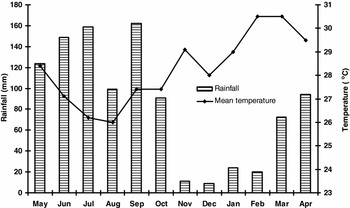
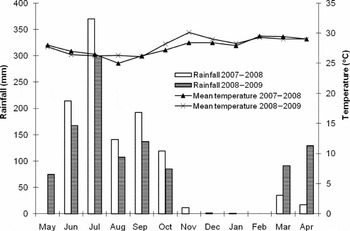
The experiments were conducted in the 2007–2008 and 2008–2009 cropping seasons at the bottom of the inland valley of the University of Agriculture, Abeokuta (7°20′ N, 3°23′ E), Nigeria. The top 1–20 cm soil layer had a pH (1:2, soil/water) of 6.6, 16.7 mg kg−1 K (extracted with 1 M ammonium acetate and measured using flame photometry), 1.32 g kg−1 total N (the macro-Kjedahl method) and 5.05 mg kg−1 Bray-extractable P. The textural class of the soil was loamy sand (784 g kg−1 sand, 164 g kg−1 silt and 52 g kg−1 clay). The soil series of the experimental site was Ikire, equivalent of Aquic Ustifluvents (Aiboni, Reference Aiboni2001). The rainfall and temperature data during the study period are shown in Figures 1 and 2.
Rainfall and mean temperature of the agricultural calendar for 1982–2008 at Abeokuta, Nigeria.

Rainfall and mean temperature for 2007–2008 and 2008–2009 cropping seasons at Abeokuta, Nigeria.

The experiment was laid out in a randomized complete block design (RCBD) with three replicates. Ten selected high-yielding lowland NERICA varieties, namely NERICA-L 19, NERICA-L 20, NERICA-L 22, NERICA-L 24, NERICA-L 25, NERICA-L 26, NERICA-L 41, NERICA-L 42, NERICA-L 44 and NERICA-L 47, were collected from the Africa Rice Center (WARDA) and planted in May 2007 when the rains became steady. However, the proneness of NERICA-L 25 to lodging, difficulty in harvesting of the grain, difficulty in determination of panicles per m2 and poor ratoonability prompted its substitution with a local variety, OFADA in the 2008–2009 cropping season. The plot size was 3 × 2 m. Rice was planted using the dry seeded dibbling method by sowing 4–6 seeds per hole at a spacing of 20 cm between and within rows. Missing stands were filled with transplants 14 days after planting (DAP) while thinning stands in excess of three plants. This gave a population of 250,000 stands ha−1. Fertilizer was applied as a split application according to fertilizer recommendations for lowland rice based on the soil test of southwestern Nigeria (Enwezor et al., Reference Enwezor, Udo, Usoroh, Ayotade, Adepetu, Chude and Udegbe2002). The first application of fertilizer for the main crop was 30 kg N ha−1, 15 kg P ha−1 and 15 K ha−1 in the form of compound fertilizer (NPK 20:10:10) at 21 DAP, while the second was 55 kg N ha−1 (urea) applied at 80 DAP. The level of N applied at 80 DAP (prior to heading) was intended to keep the culms green for ratooning after harvesting. Rice was harvested by cutting the rice culms at 5–10 cm above the soil when the rice grains had turned straw colour. After the harvest of lowland rice, the ratooned rice crop was treated with a single dose of 60 kg ha−1 fertilizer in the form of NPK 20:10:10 at 14 days after ratooning.
Emergence was counted 14 DAP. Number of days to 50% flowering, number of grains per panicle, plant height, panicle length, 1000-seed weight and grain yield, as harvested without further drying or adjustment for moisture content, were determined. Grain yield was determined by harvesting the brown panicles with a harvesting knife, sun-drying and threshing before weighing the grains, and was expressed as t ha−1. The number of tillers per plant was counted 14 days after ratooning. All the data collected from the two crops were subjected to analysis of variance and the means of variables were separated using the Duncan Multiple Range Test (DMRT).
The ratooned rice straw was cleared after harvesting and used as a mulch to conserve residual moisture and reduce weeds during dry season. Fluted pumpkin (Telfairia occidentalis Hook F.), a locally popular leaf vegetable, was planted without fertilizer in all the plots at a spacing of 50 × 50 cm (40,000 stands ha−1) in December 2007 and 2008 and harvested between February and April in 2008 and 2009. The young vine tips were harvested 28 days after emergence to break apical dominance and stimulate branching. Vines were subsequently harvested every 14 days using a table knife, leaving about 30 cm of stem to allow regrowth.
RESULTS AND DISCUSSION
The long-term climatic data (Figure 1) appeared to be more favourable to the ratooned rice crop in the new niche than the main lowland rice crop in the main cropping season. The life cycle of lowland rice stretched across the two peaks of rainfall with the associated cloudy weather, low light intensity and low temperature, which are below the optimum level for the performance of the rice plant. However, the life cycle of ratooned rice commenced at the peak of the second rainy season (September), and it matured in the dry season (December) when there is little or no rain but sufficient residual moisture for optimum growth (Adigbo et al., Reference Adigbo, Okeleye and Adigbo2007). The optimum temperature (29 oC) for rice according to Ichii (Reference Ichii1982) was observed in November in both long-term temperature data (Figure 1) and during the vegetative and reproductive stages of ratooned rice grown in 2007–2009 (Figure 2). According to Stangel (Reference Stangel and Rockwood1978), these climatic conditions strongly enhance rice grain yield. Consequently, the ratooned rice in this niche has a high potential, given the prevailing climatic conditions.
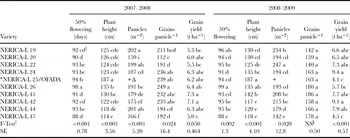
There were significant differences among the main rice crop varieties for all the parameters considered (Table 1). NERICA-L 26 had the highest number of days to flowering in both cropping seasons, while the varieties NERICA-L 19, 20, 41, 42 and 47 had the lowest in the 2007–2008 cropping season and NERICA-L 47 had the lowest number of days to flowering in 2008–2009. This suggested that the delay in flowering in NERICA-L 26 and earliness in flowering in NERICA-L 47 were inherent characters of these varieties. A significant lower number of days to 50% flowering observed in OFADA than in NERICA-L 19, 22, 26, 42 and 44 contradicted the report of Africa Rice Center (WARDA) (2008b), who reported that NERICA lines mature earlier than the local varieties. The plant height observed in the two cropping seasons showed a similar trend. NERICA–L 25 and OFADA had the tallest plants in the main crop in 2007–2008 and 2008–2009, respectively whereas NERICA-L 42, 44 and 47 consistently had the shortest plants. The plant height of all the NERICA lines except NERICA-L 25 and OFADA, which had 187.1 and 186.5 cm plant height, respectively, ranged between 114 and 135.1 cm. This range agrees with the findings of Okeleye et al. (Reference Okeleye, Oyekanmi, Ariyo and Tayo2002) who reported a range of 114–140 cm in their evaluation trial.
Agronomic performance of main rice crop of NERICA-L varieties in 2007–2008 and 2008–2009 cropping seasons.

* OFADA was used to replace NERICA-L 25 in 2008–2009.
† Significance (p-value).
‡ Values within columns with the same letter do not differ significantly.
§ NS: Not significant.
∆+ = Data was not collected because of lodging.
NERICA-L 47 variety had the fewest panicles per m2 in both cropping seasons, while the number was high in NERICA-L 19, 22 and 44 in 2007–2008, and NERICA-L 22 in 2008–2009 (Table 1). The number of grains per panicle observed in NERICA-L 20 in 2007–2008 was the lowest, while the NERICA-L 24, 25, 26, 41 and 42 had a high number of grains per panicle. In 2008–2009 there was no significant difference between varieties in the number of grains per panicle. The grain yield for seven of the nine varieties tested in both years was higher in 2008–2009 than in 2007–2008. The lower grain yield in 2007–2008 could be attributed to earlier harvest. The NERICA-L 47 line had the lowest grain yield in the 2007–2008 cropping season whereas in 2009–2009 six varieties had yields between 4.13 and 7.5 t ha−1, but which did not differ significantly. NERICA-L 20, 24, 25, 26, 41 and 44 had the highest yields of between 5.97 and 7.3 t ha−1 in 2007–2008, while NERICA-L 19, 20, 22, 24, 41, 42 and 44 with yields of 6.5–9.4 t ha−1 were the high yielding varieties in 2008–2009. The grain yield obtained from this evaluation was substantially higher than those reported by Okeleye et al. (Reference Okeleye, Oyekanmi, Ariyo and Tayo2002) who evaluated 33 genotypes from WARDA, International Rice Research Institute (IRRI) and National Cereal Research Institute (NCRI) based in Nigeria. The outstanding grain yield obtained from NERICA lines recommends them to be introduced to the farmers in Nigeria.
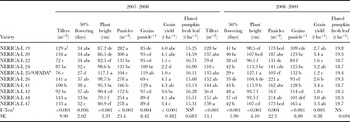
There were significant differences among the varieties in the ratooned rice crops for all the parameters considered (Table 2). NERICA-L 20, 26, 44 and 47 were among the varieties with the highest number of ratooned tillers per plant in both cropping seasons, while NERICA-L 22 and 42 had a consistently low number of tillers. The consistently higher tiller emergence observed in NERICA-L 20, 26, 44 and 47 of the ratooned crop in both cropping seasons suggests a varietal difference for this parameter.
Agronomic performance of ratooned crop of NERICA-L varieties and fresh leaf weight of fluted pumpkin in 2007–2008 and 2008–2009 cropping seasons.

* OFADA was used to replace NERICA-L 25 in 2008–2009.
† Significance (p-value).
‡ Values within columns with the same letter do not differ significantly.
§ NS: Not significant
In the ratooned crops, NERICA-L 25 in 2007–2008 and OFADA and NERICA-L 26 in 2008–2009 had the lowest number of days to 50% flowering, while NERICA-L 42 had a significantly higher number of days to flowering than all the other varieties in 2008–2009 (Table 2). The earlier maturity of the OFADA variety contradicts the report of Africa Rice Center (WARDA) (2008b) that the improved varieties mature earlier than the local varieties. Flowering occurred in 88 to 98 days in the main crop (Table 1) whereas it was 27 to 38 days in the ratooned crop (Table 2) in 2007–2008. The corresponding figures in 2008–2009 were 88 to 99 days in the main crop and 29 to 42 days in the ratooned crop. The number of days to 50% flowering in the main crop was 2.7 times higher than in the ratooned crop in 2007–2008 and 2.4 times higher in 2008–2009. This agrees with the findings of Oad et al. (Reference Oad, Ponpe, Memon, Oad and Hazzan2002), who noted that the ratooned crop matures earlier than the main crop. However, the number of days to 50% flowering in ratooned rice varied considerably between individual plants of the same variety, particularly for NERICA-L 24, 26 and 47. This uneven attainment of 50% flowering and maturity of ratooned rice was reported previously by Chauhan et al. (Reference Chauhan, Vergara and Lopez1985).
The ratooned crops of NERICA-L 25 and OFADA had the tallest plants in the 2007–2008 and 2008–2009 cropping seasons respectively (Table 2). NERICA-L 44 and 47 had the shortest plants in 2007–2008 whereas NERICA-L 19, 22, 42 and 44 had the shortest plants in 2008–2009. NERICA-19, 20, 26, 44 and 47, which had good ratoon tiller emergence in 2007–2008, had corresponding higher panicles m−2 than the other entries. A similar trend was observed in 2008–2009 except for OFADA, which could not translate the higher tiller emergence into panicles per m2. In 2007–2008, the numbers of panicles per m2 in the ratooned crop were much higher than in the main crop for each variety. However, the reverse was the case in 2008–2009. This could be attributed to late harvesting in 2008–2009. Early harvesting of the main rice crop has been reported to produce more ratoon tillers than the main crop (Oad et al., Reference Oad, Ponpe, Memon, Oad and Hazzan2002; Quddus, Reference Quddus1981; Samson, Reference Samson1980).
There were significant differences among the varieties in the number of grains per panicle in 2007–2008 and 2008–2009 (Table 2). Ratooned plants of NERICA-L 25 and 41 had the highest number of grains per panicle. However, in 2008–2009, NERICA-L 47 had the highest number of grains per panicle, while NERICA-L 22, 26 and 44 had the lowest number of grains per panicle. In the 2007–2008 ratooned crop, NERICA-L 19, 20, 26, 41 and 44 produced the highest grain yield ranging from 4.0 to 4.7 t ha−1. In 2008–2009 NERICA-L 19, 20, 24, 41, 44 and 47 all produced similar yields of 2.7–3.4 t ha−1.
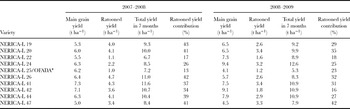
The grain yields observed in the main rice crop (5.0–7.3 t ha−1 in 2007–2008 and 4.1–9.4 t ha−1 in 2008–2009; Table 3) were similar to the range of 2–8 t ha−1 reported for lowland rice by Singh et al. (Reference Singh, Fagade, Ukwungwu, William, Jagtap, Oladimeji, Effisue and Okhidievbie1997). The ratooned crop yielded 1.0–4.3 t ha−1 in 2007–2008 and 1.2–3.4 t ha−1 in 2008–2009. Although some of the improved varieties have been released and are being grown in farmers’ fields in Burkina Faso, Cameroon, Mali, Niger, Sierra Leone and Togo (Africa Rice Center (WARDA), 2008b), none of them has been released in Nigeria. The grain yields obtained in this trial were much higher than those reported by Okeleye et al. (Reference Okeleye, Oyekanmi, Ariyo and Tayo2002), who evaluated several lowland rice varieties for grain yield performance. Based on the excellent grain yields of these lowland NERICA varieties compared with the local variety, they should be released to farmers for adoption in Nigeria.
Total grain yield and percentage yield contribution of ratooned rice.

* OFADA was used to replace NERICA-L 25 in 2008–2009.
The grain yields obtained from ratooned rice in the inland valley in this study were higher than those recorded by several researchers (1.5 t ha−1; IITA (International Institute of Tropical Agriculture), 1990, 1.2 t ha−1 (Adigbo et al., Reference Adigbo, Okeleye, Ariyo and Olowe2003) and 1.4 t ha−1 (Africa Rice Center (WARDA), 2008a)) in upland farms. The contribution of ratooned rice to the overall yield of lowland rice was 13–43% in 2007–2008 and 16–42% in 2008–2009 (Table 3). This agrees with the findings of Stansel (Reference Stansel1997) and Oad et al. (Reference Oad, Ponpe, Memon, Oad and Hazzan2002), who respectively reported that ratooned rice contributed 30% and 50% of the total yield. The total grain yields in seven months from the main and ratooned rice crops ranged from 5.3 to 12.6 t ha−1 compared with 4.1–9.4 t ha−1 when the inland valley is cropped only once per year with rice (Table 3).
The fresh leaf yields of fluted pumpkin ranged from 14.6 to 16.9 t ha−1 in 2007–2008 and from 18.3 to 19.8 t ha−1 in 2008–2009. Yields were similar to the 19.7 t ha−1 reported by Akanbi et al. (Reference Akanbi, Adebooye, Togun, Ogunrinde and Adeyeye2007) for fluted pumpkin grown during the rainy season on plots without fertilizer. The higher leaf yield in 2008–2009 than in 2007–2008 may have been due to higher rainfall in early 2009. Thus, it appears that lowland rice followed by ratooned rice did not suppress the performance of fluted pumpkin.
Further work is merited to determine the optimum management practices for the ratoon crop. In this study rice culms were cut 5–10 cm above the soil, which leaves a number of nodes available for tillering during the ratoon crop. However, Douthwaite et al. (Reference Douthwaite, Tado, Calendacion, Wade, Cassman and Quick1995) recommended cutting lower to get a more uniform ratoon crop for tiller appearance, flowering and maturity, where uneven ripening was a major problem for delayed harvest, weather damage and grain loss. Investigation of the best height to cut the culms in this particular agroecological niche and over several seasons is required. It should also be noted that there are risks associated with ratoon cropping and that these need to be assessed over several cropping cycles with management practices adjusted and optimized accordingly. For example, Douthwaite et al. (Reference Douthwaite, Tado, Calendacion, Wade, Cassman and Quick1995) demonstrated that a short period of waterlogging at ratoon tiller emergence could decimate plant stands and adversely affect ratoon crop yields. These authors also noted concerns with timely harvest, cutting height, nutrient management, water management, pests, diseases, weeds, rats, birds and too much or too little water early in ratoon tillering, all factors which should be borne in mind in integrating ratoon rice into this crop-production system.
However, this study strongly suggests that NERICA-L 24, 41, 42 and 44 gave the best overall performance in terms of the combined yield of main and rationed crops for the two years of the trial. Based on this evaluation, a ratooned crop appears to be a feasible technology that could fit into the existing niche and consequently improve the productivity of the inland valley, as well as increase farmers’ income and employment generation. This high productivity of inland valleys if managed well could serve as a means of bridging the gap between consumption and production of rice in Nigeria. Thus, the production of three crops within a year makes the inland valleys a high potential land resource not only in Nigeria but also more widely in a continent plagued by poor soils, drought and environmental destruction.