Introduction
Auditory verbal hallucinations (AVHs) are the phenomenon of hearing voices in the absence of external stimuli (McCarthy-Jones et al. Reference Mccarthy-Jones, Trauer, Mackinnon, Sims, Thomas and Copolov2014). AVHs, or voices, are a core symptom in psychiatry (Waters et al. Reference Waters, Allen, Aleman, Fernyhough, Woodward, Badcock, Barkus, Johns, Varese, Menon, Vercammen and Larøi2012) and have attracted much interest throughout history, with Jaspers, Bleuler and Kraepelin providing rich descriptions of the experience in literature dating back over a century (Oyebode, Reference Oyebode and SIMS2008). Certain types of AVH have traditionally been considered pathognomonic of psychotic disorders such as schizophrenia (Oyebode, Reference Oyebode and SIMS2008; Longden et al. Reference Longden, Madill and Waterman2012). However, there is increasing recognition that AVHs occur in non-psychosis populations. In fact, AVHs are included in the diagnostic criteria for over 50 conditions in the fourth edition of the Diagnostic Statistical Manual of Mental Disorders (Longden et al. Reference Longden, Madill and Waterman2012). Prevalence of AVH in ‘non-psychotic’ disorders is high, occurring in 40% of individuals with post-traumatic stress disorder (PTSD) (Choong et al. Reference Choong, Hunter and Woodruff2007) and 50% of individuals with emotionally unstable personality disorder (EUPD) (Merrett et al. Reference Merrett, Rossell and Castle2016). Both these conditions are common, life-limiting and with considerable personal and societal burden, but in spite of this, there has been little phenomenological investigation of ‘non-psychotic’ voices (Upthegrove et al. Reference Upthegrove, Ives, Broome, Caldwell, Wood and Oyebode2016) and no evidence-based understanding or treatment pathway. Prescribing of antipsychotic medication in EUPD is outside the licensed indication, but remains a common practice, although there are a few treatment trials demonstrating efficacy (Paton et al. Reference Paton, Crawford, Bhatti, Patel and Barnes2015).
Phenomenology as a research methodology in psychiatry is a primary investigation of subjectivity – asking the subject, about their experience, ‘what it is like?’ and ‘what does it mean?’ (Broome et al. Reference Broome, Owen and Stringers2012). In this context, a description of the phenomenology of AVH constitutes a description of the first-person experience of hearing voices. Research exploring the phenomenology of ‘non-psychotic’ AVH has predominantly used structured questionnaires, with items derived from primary research on AVH in psychotic disorders. For example, voices in PTSD and schizophrenia have been compared using the Psychotic Symptom Rating Scale (PSYRATS), finding similarities in the content of voices, such as of commands and derogatory comments (McCarthy-Jones & Longden, Reference Mccarthy-Jones and Longden2015). Indeed, a recent systematic review concluded that current phenomenological evidence, which uses such scales, finds little difference between AVH in schizophrenia and other psychiatric disorders, with 95% of characteristics being shared (Merrett et al. Reference Merrett, Rossell and Castle2016). Adopting interview techniques that do not privilege the psychotic experience (such as whether voices speak in the third person or give running commentary) may reveal other features of voices in these ‘non-psychotic’ patient groups. These may be more salient to the person experiencing AVH and may provide points of difference between psychotic and ‘non-psychotic’ voices (Merrett et al. Reference Merrett, Rossell and Castle2016), or provide potential targets for therapies.
Thus, there is a need for an in-depth exploration of ‘non-psychotic’ voices, unguided by questionnaires and scales validated in schizophrenia, or longstanding involvement with mental health professionals whose framework may influence the communication of such events. Understanding the naive phenomenology of ‘non-psychotic’ voices is important for both diagnosis and management of this complex and distressing symptom.
Aims of the study
To explore the phenomenology of auditory verbal hallucinations in young ‘non-psychotic’ participants at first presentation to mental health services.
Methods
A qualitative study to capture the subjective experience of AVH was conducted. Following previous methodology established by this research team (Upthegrove et al. Reference Upthegrove, Ives, Broome, Caldwell, Wood and Oyebode2016), interviews used ethnographic diaries and photo-elicitation to produce novel and in-depth accounts of voices. Interviews were an appropriate method because of the individual and personal nature of AVH. Interviews were unstructured, using the photographs and diaries produced by participants to guide discussion. This allowed participants to explore aspects of the experience that were personally meaningful to them, helping to meet the phenomenological aims of the study (Hislop et al. Reference Hislop, Arber, Meadows and Venn2005). The absence of an interview framework ensured the narrative was from the participants perspective, with questions asked in response to their story-telling, reducing interviewer bias (Moyle, Reference Moyle2002).
Walking interviews were conducted rather than face-to-face interviews, as the latter can be viewed as unhelpfully replicating clinical power dynamics, or being interrogative or intimidating (Anderson, Reference Anderson2004; Sandhu et al. Reference Sandhu, Ives, Birchwood and Upthegrove2013). It was intended that walking interviews would encourage a fresh discussion of AVH, rather than a reflection of a standard clinical encounter.
Participants and data collection
Participants were recruited from Forward Thinking Birmingham, a mental health service for young people in Birmingham. Sampling was ‘purposeful’ (Patton, Reference Patton1999). Inclusion criteria were (A) AVH at least every other day (to reduce recall bias); (B) age over 16 years and (C) capacity to consent. Exclusion criteria were (A) unacceptable safety risk during interview; (B) language barrier compromising the in-depth interview process and (C) diagnosis of psychotic disorder. Psychotic disorder was defined as International Classification of Disease-Tenth verision (ICD-10) codes F20-29, F30.2, F31, F32.3 or F33.3 (WHO, 1992). Diagnosis was determined by an experienced consultant psychiatrist (RU) using validated structured interview (Sheehan et al. Reference Sheehan, Lecrubier, Sheehan, Amorim, Janavs, Weiller, Hergueta, Baker and Dunbar1998) and interviewers were PD and SW.
Following informed consent, participants were given a disposable camera to take photographs of anything they felt represented their voices and a diary to record aspects of the experience, to use for one week prior to the interview. After one week, the cameras and diaries were collected and the photographs developed so that they could be used in the interview, which took place two to three days later.
The material created by the participant was used to generate discussion in the otherwise unstructured interview. Researchers were sensitive to their position as an individual who did not hear voices, adopting a reflexive approach which included keeping a detailed diary and study group meetings where discussions were held around the individuals potentially influential preconceived values interests (Patton, Reference Patton1999). The researcher who introduced the study and consented the participant led the interview, whilst the other researcher listened and supported. Interviews lasted a mean average of 38 minutes, ranging between 15 and 48 minutes, and were audio-recorded. Example starting questions included ‘Why did you take this photo?’ and ‘Tell me about that diary entry’. Follow-up questions included clarification of understanding and encouragement of expansion and elaboration of descriptions.
Analysis
Data were subjected to thematic analysis, informed by phenomenology, that sought to capture and articulate the essence of the AVH experience. To aid immersion in the data, interview audio was transcribed verbatim by one researcher, and the transcription checked by another researcher for accuracy. Transcripts were read and re-read, aiding immersion in the data. Next, interviews were coded independently by two researchers, using NVivo software for data management. Codes were unrefined and elaborate rather than succinct and aimed to capture particularly meaningful statements that described the essence of each individual’s experience. After each transcript had been coded independently, codes were reviewed in a process of analyst triangulation by RU, PD, SW and JI. Any disagreements were settled, adding rigour and credibility to findings (Patton, Reference Patton1999).
Following individual coding, the coded transcripts were re-examined in parallel, and essential themes from each transcript were highlighted (Van Manen, Reference Van Manen1997) and compared with essential themes from all other transcripts.
The relationships between essential themes from all transcripts were then considered, and themes which appeared common to describing the lived experience of voices throughout participants were explored using mind-maps and tree diagrams.
At this point, a second analyst triangulation took place with a consultant psychiatrist (RU) and a qualitative expert (JI). This lent credibility to the findings, as it ensured that the conclusions being drawn about the experience were not simply reinforcing or replicating the prior assumptions or interpretations of the two primary analysts (Silverman, Reference Silverman2011). This resulted in three superordinate themes on which all authors agreed.
Results
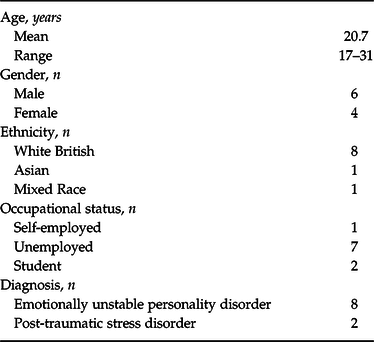
Thirteen participants meeting the inclusion criteria were recruited, with 10 participants completing the study. Two participants withdrew after deciding they no longer wanted to recount the experience of AVH in an interview. The remaining participant stopped responding to contact attempts without giving a reason. In the sample of 10 participants completing the research, eight participants had a diagnosis of EUPD, and two participants had a diagnosis of PTSD. Participant demographics are summarised in Table 1. Data were assessed for saturation (Patton, Reference Patton1999) after 10 interviews, and data collection ceased at that point as no new data had emerged in the final two interviews.
Participant demographics

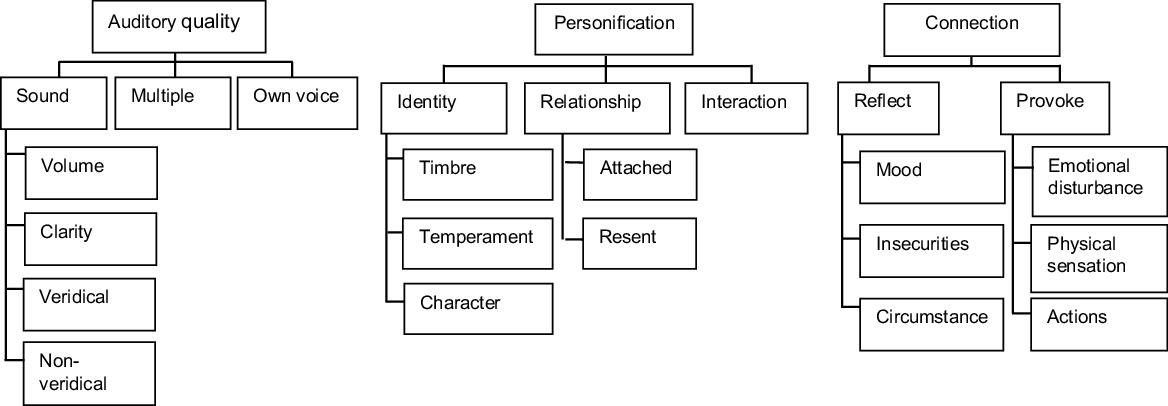
Three superordinate themes summarised the data: auditory quality, personification and connection. Each theme encompasses codes and sub-codes. Tree diagrams showing each theme with codes and sub-codes are shown in Fig. 1. Supporting quotes are included in the text, with participants named as P1–P10 to maintain anonymity. Further quotes are contained in summary tables for each theme, including the number of participants endorsing each code or sub-code, increasing transparency of the data (Maxwell, Reference Maxwell2010).
Tree diagrams to show each theme with its codes and sub-codes.

Theme 1. Auditory quality
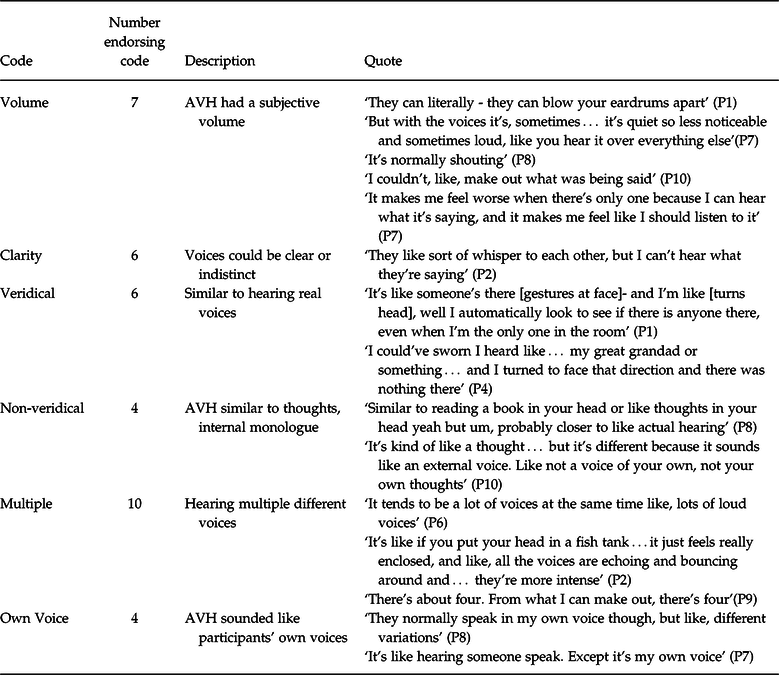
This theme includes all references to AVH being experienced as a heard sound with specific auditory qualities such as volume and clarity. For some participants, these qualities made the voices seem absolutely real; however, confusion between thoughts and voices existed for others. Some AVH sounded like the participants’ own voice and all participants heard multiple voices. The theme is summarised in Table 2.
Theme 1 – Auditory quality. Description of codes and sub-codes, with number of participants endorsing each code and further supporting quotes

Sound
Volume
For the majority of participants, the voice could be heard as both loud and quiet. Moreover, the voices could be heard as either shouting or whispering. Upon further questioning, it was revealed that volume was in fact related to attention:
Focusing on them makes them louder (P7)
Equally, voices were quiet or barely noticeable when the participant was distracted by external events or cues and often disappeared entirely.
Clarity
Over half of participants spoke of voice content being difficult to hear sometimes due to a lack of clarity:
I couldn’t quite make out exactly what it was saying… it was whispers… it weren’t a clear voice (P1)
As well as whispering, a lack of clarity was attributed to multiple voices speaking over each other. Hearing a clear voice and an unclear voice evoked different responses; some preferred it when they could not hear what the voice was saying; however, one participant found this incredibly frustrating.
Veridical
Six participants reported that voices seemed very real, as if coming from a real person:
Yeah it’s like, you know how we’re speaking so clearly now, it’s like someone’s actually there (P5)
This could lead to confusion, with over half of participants often having to look over their shoulder to check no one was there. Participants described shock at discovering nobody else could hear the voices, continually relying on others for confirmation that AVHs are not real.
Non-veridical
For four participants, confusion existed between thoughts and voices:
I wasn’t able to tell what was the difference between what I was thinking and what I could hear. Cos although I know they’re not real, they seem very real when it’s happening (P7)
This confusion suggests these AVH lacked the concrete reality of a true heard voice, as was described by other participants. Importantly, these participants still reported ‘hearing’ voices, demonstrating how the subjective experience of voices can differ between individuals.
Multiple
All ten participants described hearing multiple voices. These could be heard separately, however, often could be heard simultaneously. Two participants described similar experiences of hearing many voices echoing:
It did come to a stage where it was like, loads of people was talking in a tunnel… like just echoing and echoing like, it weren’t just one voice, it was a good few voices (P1)
Whilst this participant compared the experience to being in a tunnel, the other described it as if their head was in a fish tank. Both described this as a very intense and unpleasant experience.
Own voice
Participants often reported that their AVH sounded like their own voice. For some, it was their own voice but with a different tone, such as aggression or malevolence. For others, it was their own voice but with a different temperament which they did not recognise as their own.
It sounds like my voice but a much more like… more scarier version (P4)
Theme 2. Personification
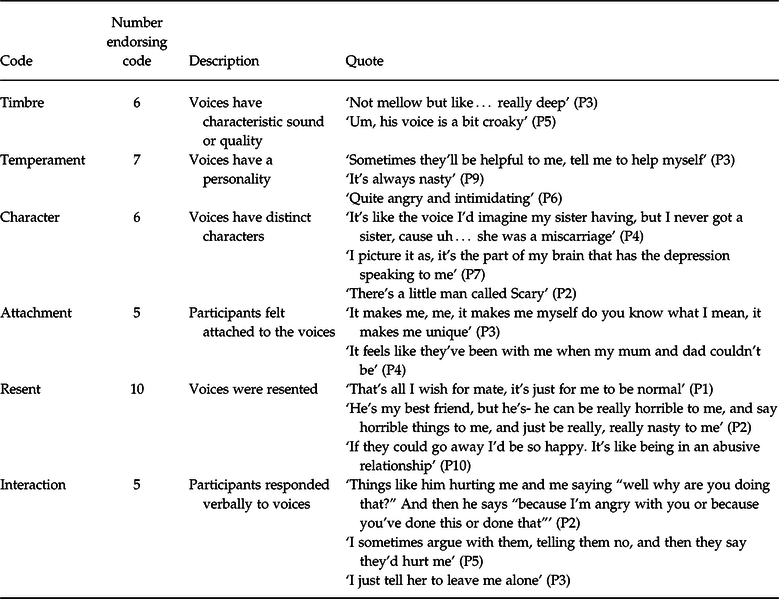
This theme represents all aspects of the voice being personified, as if belonging to an entity distinct from the voice-hearer. This includes voice identity, consisting of specific traits and temperaments. Personification in some cases allowed a relationship with the voice to form, with some participants verbally interacting with their voice. The theme is summarised in Table 3.
Theme 2 – Personification. Description of codes and sub-codes, with number of participants endorsing each code and further supporting quotes

Identity
Character
Over half of participants assigned their voices as distinct characters, giving them names such as ‘Little Girl’ or ‘Scary’. In some cases, AVHs were accompanied by visual hallucinations, so the voice belonged to a character with a specific appearance. Characters were viewed as distinct and separate from the participants.
The man in the wheelchair he just…shouts things at me, and tells me to do like, to hurt myself, and the woman, she’s the main character (P3)
Timbre
Voices had specific characteristics such as gender and age. In addition, voices could have particular sounds such as croaky or deep, further adding to the identity of the voice:
I hear two other male voices… one’s young, like he sounds young, and the other one… it’s not deep but it’s annoying, you know those annoying voices (P5)
Voice-specific traits enabled participants to distinguish different voices from each other when they were hearing them.
Temperament
Participants frequently described the voices having a personality. Usually the voices were exclusively ‘nasty’ and ‘horrible’, making only negative and abusive remarks. However, some participants infrequently heard a positive voice which they regarded as helpful, kind and encouraging. No participants heard exclusively positive voices.
There’s some female voices… they’re the ones that are kind to me. The male voices are the ones that are horrible and mean to me (P2)
Relationship
Attached
Participants reported feeling as if the voice was part of them, with one participant stating voices made her ‘unique’. Another participant described the sense of having grown up with the voice:
They were my friends, the only people I could rely on…I’ve sort of grown up with them, and told them everything (P5)
Resent
Half of participants exclusively resented their voices, expressing their wish for the voices to stop.
I wouldn’t wish it on my worst enemy… it’s horrible (P9)
One participant likened the experience of hearing voices to being in an ‘abusive relationship’. Interestingly, those attached to their voices could simultaneously resent them, expressing feelings of confusion and sadness at their ‘best friend’ being nasty to them.
Interaction
Some participants described interacting verbally with their voices. Whilst it was rare for participants to have mundane or free-flowing conversations with the voices, it was common for participants to respond to voices, questioning them, refusing to obey commands and telling voices ‘leave me alone’. In some cases, the voice would retaliate:
I disagreed with it… and it’ll just constantly keep coming back, like trying to get me to change my mind (P4)
Theme 3.Connection
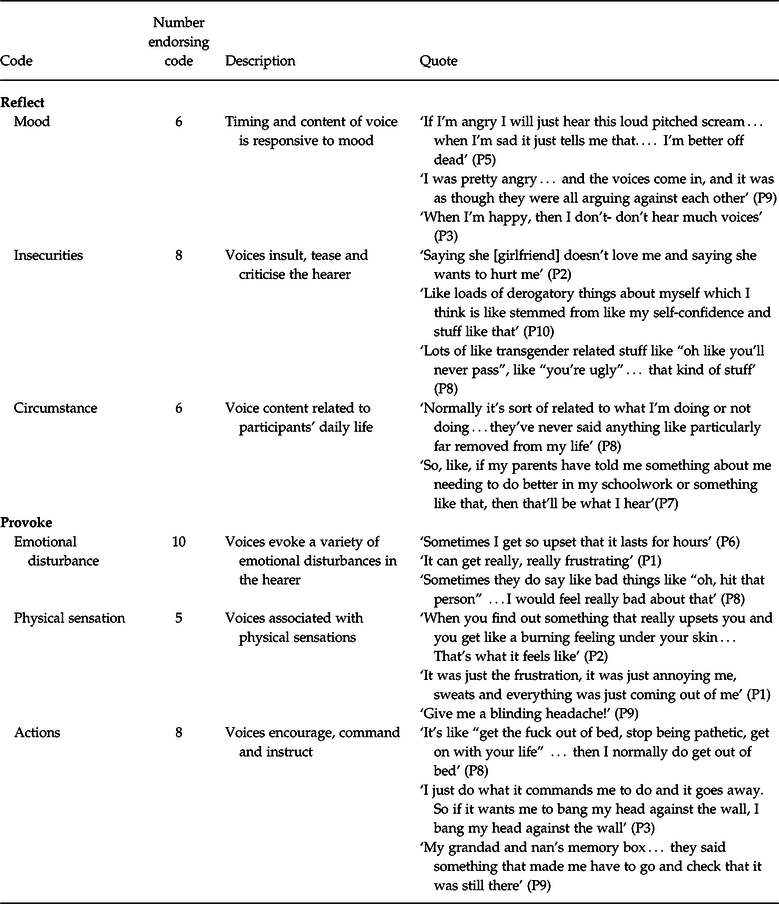
This theme encompasses the intimate and complex connection which was found to exist between participant and voice. There appeared to be a two-way, returned connection, demonstrated by the voices’ ability to react to a change in the participants’ mood and circumstance. Equally, the voice could cause such changes in mood and circumstance for the hearer, through emotional and physical disturbances. The theme is summarised in Table 4.
Theme 3 – Connection. Description of codes and sub-codes, with number of participants endorsing each code and further supporting quotes

Reflection of mood and experience
Mood
Participants reported that mood could influence timing of voices, with half of participants describing how voices could be entirely absent when they were happy. Similarly, participants described how voices tended to appear in times of stress or agitation:
If I’m happy, it tends not to happen as much. But if I’m sad, or just angry or agitated… it tends to set them off (P6)
Voice content was also responsive to mood, with sadness bringing about talks of suicide for one participant, and anger being accompanied by arguing voices for another.
Insecurities
For most participants, voices appeared to be insightful, seeming to have access to the participants’ private insecurities, using these to insult and criticise the participant regarding sensitive issues:
It just sort of plays off insecurities such as ……, which I guess quite a few of mine are (P8)
Additionally, in some cases, the voices were able to identify the people which mattered to the participant, using this information to upset and antagonise them.
Circumstance
For over half of participants, it was reported that voice content was reactive to what was going on in the participants’ life, appearing to both comment on and question what the hearer was doing. This was usually responsive to what the participant was currently finding difficult or challenging, with voices exacerbating the challenge:
Just things that are difficult at the time, the voices will like latch on to and make it more difficult… I think it’s just things that are going on day to day (P10)
Provoke
Emotional disturbance
This code was endorsed by all participants and refers to the emotional disturbances voices could provoke in them. A wide range of emotions were described:
Sometimes it makes me feel scared, sometimes it makes me feel annoyed, and irritated (P3)
The emotional disturbances could be complex, including feelings of guilt and heartbreak.
Physical disturbance
A range of participants described how voices could be followed by physical responses such as sweating, headaches and nausea. One profound example was a participant with a history of self-harm describing pains when the voice issued commands:
I sometimes get pains in my wrists, or… if they’re telling me to do something my neck would hurt (P5)
Another participant likened the experience of hearing voices to receiving upsetting news and the burning sensation it can provoke.
Actions
Voices could lead to actions, commonly making explicit commands such as those encouraging deliberate self-harm. Interestingly, some voices caused participants to behave a certain way simply by making suggestions or aiding decision making, perhaps reflecting the participants’ underlying wishes. For instance, one participant reported hating school and the voice encouraged his non-attendance:
There were a few days that I didn’t go to school just because I was hearing the voices telling me “there’s no, there’s no point in going, you don’t need to go”, things like that. So, I didn’t (P7)
Discussion
This study is, to our knowledge, the first phenomenological qualitative investigation of a ‘non-psychotic’ clinical sample with auditory verbal hallucinations. Our results suggest that AVH in this group of young people is experienced with variable auditory qualities such as volume and clarity, are frequent and the basis of intimate relationships with the voice hearer. AVH and thoughts are sometimes confused, suggesting at times a lack of all the qualities of a true heard perception. However, in contrast to definitions in ICD-10 (WHO, 1992) or Diagnostic and Statistical Manual of Mental Disorders-Fifth version (Heckers et al. Reference Heckers, Barch, Bustillo, Gaebel, Guru, Malaspina, Owen, Schultz, Tandon, Tsuang, Van Os and Carpenter2013), where AVHs in EUPD are described as brief, transient, ‘stress-related’ psychotic-like experiences, or not mentioned at all, detailed investigation of the subjective experience found a phenomenology of complex, characterful voices which spoke in full sentences, which could be clear and often possessed ‘personal’ qualities (e.g. age, gender, temperament). The intimate and complex connection between participant and voice includes a two-way exchange whereby the quality of the voice reacts and changes according to the participants’ mood, insecurities and circumstance. Equally, participants reacted to provocation by the voice, leading to changes in mood and circumstance through actions, emotional and even physical disturbances.
The findings are, in part, consistent with the limited quantitative literature investigating the phenomenology of AVH in EUPD. Merrett et al reviewed 16 studies that used standardised measures and reported AVHs were largely self-critical, derogatory and resulted in significant distress (Merrett et al. Reference Merrett, Rossell and Castle2016). Our sample also included a small number of participants with PTSD, and we did not find that participants reported recognising their voice as belonging to the perpetrator of their trauma, previously cited by McCarthy-Jones as occurring in 30% of PTSD voices (McCarthy-Jones & Longden, Reference Mccarthy-Jones and Longden2015), which may reflect our sample size and qualitative methodology.
However, the detailed descriptions of ‘non-psychotic’ voices obtained in this study allow some comparison to be made with the well-explored phenomenology of psychotic voices. Our results identify both similarities and some differences in experience to those classically linked with AVH in schizophrenia. Similarities include hearing multiple voices with distinct characters, hearing a combination of pleasant and unpleasant voices and hearing derogatory remarks and commands (Kraepelin, Reference Kraepelin and Johnstone1913; Nayani & David, Reference Nayani and David1996; McCarthy-Jones et al. Reference Mccarthy-Jones, Trauer, Mackinnon, Sims, Thomas and Copolov2014). The comparable negative content of both psychotic and ‘non-psychotic’ voices is contrary to previous models proposed by Daalman et al. (Reference Adelman, Boks, Diederen, Weijer, Blom, Kahn and Sommer2010), who suggest that emotionally negative content of voices could be indicative of psychotic AVH. Other similarities include AVH as a complex, heard experience that sometimes lack clarity and one that may be accompanied by a physical disturbance. In our non-psychotic sample, this physical response was felt subsequent to the voice content, differing temporally to the physical disturbances seen in psychotic voices, which have been reported to occur at the same time as AVH and often with a perception of passivity (Upthegrove et al. Reference Upthegrove, Ives, Broome, Caldwell, Wood and Oyebode2016). A novel finding of this study is also the connection between mood and AVH. For instance, participants reported that their voice content and mood were connected, so that sadness would bring about talk of suicide and anger would be accompanied by arguing voices. Voices were reported to be exacerbated by agitation and absent during times of happiness. This connection contrasts with previous qualitative understanding of psychotic AVH, where the experience was inescapable, irrespective of mood (Woods et al. Reference Woods, Jones, Bernini, Callard, Alderson-Day, Badcock, Bell, Cook, Csordas, Humpston, Krueger, Laroi, Mccarthy-Jones, Moseley, Powell, Raballo, Smailes and Fernyhough2014; Upthegrove et al. Reference Upthegrove, Ives, Broome, Caldwell, Wood and Oyebode2016). Another novel finding in the present results is the connection between the participants’ circumstance and AVH, for example, focusing on voices made them louder but distraction could stop them entirely. Whilst distraction techniques are helpful for all voice hearers, the experience of AVH in psychosis can be that of imposition (Upthegrove et al. Reference Upthegrove, Ives, Broome, Caldwell, Wood and Oyebode2016) with a sense of inescapable obligation to listen, as described by Kraepelin in his initial writing (Kraepelin, Reference Kraepelin and Johnstone1913).
The apparent predictability of ‘non-psychotic’ AVH, with a strong association with participants mood and immediate environment, differs from Jaspers’ description of psychotic AVH, which ‘spring into being’ in an unpredictable fashion (Jaspers, Reference Jaspers1997; Oyebode, Reference Oyebode and SIMS2008). ‘Non-psychotic’ participants reported the primacy of their own emotional distress, thoughts and worries, which were amplified by voices. This connection lends some support to the hypothesis that ‘non-psychotic’ AVHs result from one’s own cognitions, (ego-syntonic), whereas psychotic AVHs arise externally and separately to self (are ego-dystonic) (Oyebode, Reference Oyebode and SIMS2008; McCarthy-Jones & Longden, Reference Mccarthy-Jones and Longden2015). However, it should be noted there is a large body of work demonstrating the significance of emotional reaction to AVH in psychosis, including in relation to suicidal thinking (Birchwood et al. Reference Birchwood, Meaden, Trower, Gilbert and Plaistow2000; Birchwood et al. Reference Birchwood, Iqbal and Upthegrove2005; Upthegrove et al. Reference Upthegrove, Birchwood, Ross, Brunett, McCollum and Jones2010). It is clear emotional reaction and dysfunction are common in both psychotic and ‘non-psychotic’ voices – for example, Nayani & David (Reference Nayani and David1996) found that sadness was related to AVH in a sample with chronic psychosis. Our results, however, highlight a bi-directional emotional relationship in the ‘non-psychotic’ experience of AVH.
Noticeable in this research is the lack of codes for internal or external location of AVH, because participants did not describe their voices in this way. Rather, participants described the experience either as if someone was ‘actually there’ (veridical, suggesting an external location) or ‘image-like’ (non-veridical, suggesting an internal location). Importantly, all participants still report ‘hearing voices’ regardless of origin, as was the case in Woods et al. (Reference Woods, Jones, Alderson-Day, Callard and Fernyhough2015), and the reality of described perception of nonpsychotic voice challenges in part Jaspers’ observation that inner voices may lack the objectivity of a ‘true hallucination’ and that there is an ‘unbridgeable gap’ between perception and image or hallucination and pseudo hallucination (Jaspers, Reference Jaspers1997; Oyebode, Reference Oyebode2013).
A clear strength of this study is the use of photo-elicitation and ethnographic diaries, which enabled a unique exploration of the participants’ life-world (Erdner & Magnusson, Reference Erdner and Magnusson2011). Descriptions of AVH gained using these techniques are not grounded in scales such as the PSYRATS-H to assess voices, which ask predetermined questions derived from research in schizophrenia. As an example of the depth of our methods, a novel finding of this study was the intimate and complex connection between participant and voice, a theme which would not have been uncovered using such scales. A further strength is that the methodology was our use of robust qualitative techniques such as analyst triangulation to increase credibility of findings. However, the study also has limitations. Although qualitative research does not aim to provide generalisable results, nor are sample size calculations appropriate, a sample of 10 participants will mean that some aspects AVH experience may remain concealed. The sample also predominantly consisted of participants with EUPD, so although data saturation was reached, it is unclear whether recruiting voice-hearers with other ‘non-psychotic’ diagnoses would have revealed further aspects to the experience. Our sample was majority White British, and thus the experience of AVHs outside of this population should also be explored in future research.
However, the findings of this study do have implications for clinical practice as well as future research. First, ‘non-psychotic’ voices were distressing and meaningful to participants, questioning current diagnostic weight given to these experiences, which perpetuates a lack of focus on their clinical significance (Beavan, Reference Beavan2011). Second, the content of ‘non-psychotic’ voices is often self-critical, so exploring voice content with patients could inform psychological therapies (29). Third, ‘non-psychotic’ AVHs were worse during times of emotional distress and agitation. Future research should investigate whether targeting control over emotional dysregulation results in an improvement in AVH.
To further understand the subjective experience of ‘non-psychotic’ voices, future research should recruit individuals from the wide range of ‘non-psychotic’ diagnoses in which AVHs are experienced and clarify the novel findings of this study, which include a complex connection between voice, mood and circumstance. Both confirmation and additional insights into the experience of ‘non-psychotic’ would aid further understanding of this experience and potentially open new avenues for treatment.
Acknowledgements
The authors would like to acknowledge the staff and participants from Forward Thinking Birmingham for their support during recruitment.
Financial Support
The study received support from University of Birmingham Public Health and Population Sciences degree programme and the Arthur Thomson trust bursary.
Conflict of interest
RU declares grants from Medical Research Council, National Institute for Health Research: Health Technology Assessment, European Commission – Research: The Seventh Framework Programme and personal speaker fees from Sunovion, outside the submitted work.
SW declares funding from NHMRC Australia, European Commission – Research: The Seventh Framework Programme and travel support from Lundbeck.
Ethical Standards
The authors assert that all procedures contributing to this work comply with the ethical standards of the relevant national and institutional committee on human experimentation with the Helsinki Declaration of 1975, as revised in 2008. A favourable ethical opinion was granted by the Health Research Authority (HRA) (ref. 16/WM/0428). Informed consent was obtained from study participants.