Introduction
Attention deficit/hyperactivity disorder (ADHD) is one of the most common childhood mental health disorders, with current estimates indicating that 9% of children in the United States aged 5–17 years have been diagnosed at some point (Akinbami, Liu, Pastor, & Reuben, Reference Akinbami, Liu, Pastor and Reuben2011). Diagnosis is made on the basis of symptoms of inattention, impulsivity, and motor restlessness, which must be observed before 7 years and cause impairment in at least two settings (American Psychiatric Association, 2000). Currently, three subtypes are recognized: “inattentive,” “hyperactive-impulsive,” and “combined.”
Children with ADHD demonstrate more academic problems compared with typically developing peers, including lower grades and lower scores on achievement tests (Frazier, Youngstrom, Glutting, & Watkins, Reference Frazier, Youngstrom, Glutting and Watkins2007). Higher rates of school-based services, grade retention, and school dropout are also found among children with ADHD (Langberg et al., Reference Langberg, Molina, Arnold, Epstein, Altaye, Hinshaw and Hechtman2011; Loe & Feldman, Reference Loe and Feldman2007; Massetti et al., Reference Massetti, Lahey, Pelham, Loney, Ehrhardt, Lee and Kipp2008; Molina et al., Reference Molina, Hinshaw, Swanson, Arnold, Vitiello, Jensen and Houck2009). Learning disorder is a particularly common comorbid diagnosis, with 20–25% of children with ADHD also meeting criteria for learning disorder (Pliszka, Reference Pliszka2000). The effects of ADHD symptoms on school performance, however, remain after controlling for learning disorders (Currie & Stabile, Reference Currie and Stabile2006) and behavior problems (Giannopulu, Escolano, Cusin, Citeau, & Dellatolas, Reference Giannopulu, Escolano, Cusin, Citeau and Dellatolas2008). Research suggests that academic difficulties are more related to inattention symptoms than hyperactivity symptoms (Breslau et al., Reference Breslau, Miller, Breslau, Bohnert, Lucia and Schweitzer2009; Chhabildas, Pennington, & Willcutt, Reference Chhabildas, Pennington and Willcutt2001; Rabiner & Coie, Reference Rabiner and Coie2000). Attention problems predict poor academic progress (Fergusson & Horwood, Reference Fergusson and Horwood1995; Fergusson, Lynskey, & Horwood, Reference Fergusson, Lynskey and Horwood1997; Merrell & Tymms, Reference Merrell and Tymms2001; Galera, Melchior, Chastang, Bouvard, & Fombonne, Reference Galera, Melchior, Chastang, Bouvard and Fombonne2009) in children with ADHD as well as in children below the diagnostic threshold (Breslau et al., Reference Breslau, Miller, Breslau, Bohnert, Lucia and Schweitzer2009; Currie & Stabile, Reference Currie and Stabile2006).
Theories increasingly highlight the role of executive function impairments in individuals with ADHD (Barkley, Reference Barkley1997; Berger & Posner, Reference Berger and Posner2000; Castellanos & Tannock, Reference Castellanos and Tannock2002; Nigg, Willcutt, Doyle, & Sonuga-Barke, Reference Nigg, Willcutt, Doyle and Sonuga-Barke2005; Pennington & Ozonoff, Reference Pennington and Ozonoff1996). Executive function refers to a range of higher-level skills critical for successful functioning in everyday life and for learning and adaptive development in children. Impairments in executive functions can lead to poor attention and planning, difficulties generating and implementing strategies, inability to use feedback, and inflexibility of thinking (Anderson, Anderson, Northam, Jacobs, & Catroppa, Reference Anderson, Anderson, Northam, Jacobs and Catroppa2001). Poor performance on executive function tasks is associated with abnormalities in the prefrontal cortex and associated subcortical and posterior structures (Moore, Schettler, Killiany, Rosene, & Moss, Reference Moore, Schettler, Killiany, Rosene and Moss2012; Petrides, Reference Petrides2000; Ravizza & Ciranni, Reference Ravizza and Ciranni2002; Stern et al., Reference Stern, Owen, Tracey, Look, Rosen and Petrides2000). Moreover, neuroimaging reveals deficits in neural activity within the fronto-striatal and fronto-parietal circuits of individuals with ADHD (Arnsten, Reference Arnsten2009; Arnsten & Li, Reference Arnsten and Li2005; Dickstein, Bannon, Castellanos, & Milham, Reference Dickstein, Bannon, Castellanos and Milham2006; Seidman, Valera, & Makris, Reference Seidman, Valera and Makris2005). Recent meta-analyses provide evidence of a consistent pattern of hypoactivation in frontal brain regions of individuals with ADHD compared with controls (Cortese et al., Reference Cortese, Kelly, Chabernaud, Proal, Di Martino, Milham and Castellanos2012; Dickstein et al., Reference Dickstein, Bannon, Castellanos and Milham2006).
Research on ADHD has particularly emphasized impairments in inhibitory control (Barkley, Reference Barkley1997; Nigg, Reference Nigg2000) and working memory (Castellanos & Tannock, Reference Castellanos and Tannock2002; Martinussen, Hayden, Hogg-Johnson, & Tannock, Reference Martinussen, Hayden, Hogg-Johnson and Tannock2005). Barkley's (Reference Barkley1997) model of ADHD emphasizes inhibitory control (i.e., inhibition of prepotent response, stopping an ongoing response, and interference control) as the primary neuropsychological impairment, which underlies secondary impairments in working memory and related functions. However, working memory—a limited capacity system that temporarily stores and manipulates information while performing complex tasks (Baddeley, Reference Baddeley2003, Reference Baddeley2010)—has also been proposed as a “core” deficit in ADHD (Rapport, Chung, Shore, & Isaacs, Reference Rapport, Chung, Shore and Isaacs2001). According to the functional working memory model of ADHD, inhibition is a downstream product of working memory because stimuli must gain access to the working memory system before a response can be inhibited (Kofler, Rapport, Bolden, & Altro, Reference Kofler, Rapport, Bolden and Altro2008; Rapport et al., Reference Rapport, Chung, Shore and Isaacs2001). Furthermore, research indicates that working memory is important for learning and acquiring academic skills (Alloway & Alloway, Reference Alloway and Alloway2010; Gathercole, Pickering, Ambridge, & Wearing, Reference Gathercole, Pickering, Ambridge and Wearing2004). This is likely due to the impact working memory can have on many activities important for classroom learning, such as remembering instructions or keeping track of progress on complex tasks (Alloway, Gathercole, & Elliott, Reference Alloway, Gathercole and Elliott2010). Indeed, working memory deficits have been linked to learning problems and poor school performance in children with and without ADHD (Alloway & Alloway, Reference Alloway and Alloway2010; Alloway, Elliott, & Place, Reference Alloway, Elliott and Place2010).
A meta-analysis indicated that ADHD is consistently associated with moderate weaknesses in response inhibition and working memory as well as impulsivity, vigilance, organization, and some measures of planning (Willcutt, Doyle, Nigg, Faraone, & Pennington, Reference Willcutt, Doyle, Nigg, Faraone and Pennington2005). Despite a large literature examining executive function in children with ADHD, the existence of a “core” executive function deficit or an identifiable pattern of performance on tests remains elusive (Doyle, Reference Doyle2006; Wodka et al., Reference Wodka, Mostofsky, Prahme, Gidley Larson, Loftis, Denckla and Mahone2008). Problems in concept definition and test development may also have hampered hypothesis testing and replication of specific executive function deficits (Stefanatos & Baron, Reference Stefanatos and Baron2007). Certainly, clinical investigators are faced with several challenges, including the overwhelming number of tasks reputed to measure executive function (Chiappe, Hasher, & Siegel, Reference Chiappe, Hasher and Siegel2000). To make test selection more complicated, different investigators might use the same task, but with subtle variations, such as specific stimulus set, number of trials, or mode of administration.
The psychometric properties of executive function tasks pose another challenge to clinical investigators. Construct validity refers to how well an instrument measures what it purports to measure. Neuropsychological instruments have been criticized for being multifactorial, drawing on numerous non-executive component skills (Willcutt et al., Reference Willcutt, Doyle, Nigg, Faraone and Pennington2005). A survey of neuropsychologists by Rabin and colleagues (Rabin, Barr, & Burton, Reference Rabin, Barr and Burton2005) listed clock drawing, Rey-Osterrieth Complex Figure, and block design among the top 20 “executive tasks.” Although executive skills are important to performing these tests, it is impossible to disentangle systematically the component skills. Most tasks designed to assess some aspect of executive functioning also involve varying degrees of information processing speed, motor speed, language processing, spatial processing, and fundamental perceptual and motor skills. Thus, it is difficult to determine if poor performance on a test of working memory or response inhibition is due to a weakness in that construct or to a weakness in another skill required to perform the task. Furthermore, the low to moderate reliability estimates of many available executive function measures suggests that future studies should obtain a measure of common variance among multiple measures of a specific executive function domain (Willcutt et al., Reference Willcutt, Doyle, Nigg, Faraone and Pennington2005). Thus, use of a reliable and valid battery of domain specific executive functions that provides measures of common variance (i.e., factor scores) among multiple measures within a specific domain is necessary to meaningfully characterize which executive function skills are most affected in children with ADHD.
The present study used the National Institutes of Health (NIH) Executive Abilities: Measures and Instruments for Neurobehavioral Evaluation and Research (EXAMINER) battery, developed to assess executive functions reliably and validly across a range of ages and disorders (Kramer et al., 2013, this series), to examine executive function in children with ADHD and healthy controls. The battery includes measures of spatial and verbal working memory, set-shifting, inhibition, phonemic and semantic fluency, planning, and insight. Working memory, cognitive control, and fluency scores were created by combining individual test scores using item response theory, which allows for meaningful comparisons at all ability levels on the same scale. The cognitive control measures overlap with measures in the NIH Toolbox Cognition Battery, which includes similar set-shifting and inhibition measures (Weintraub et al., Reference Weintraub, Bauer, Zelazo, Wallner-Allen, Dikmen, Heaton and Gershon2013). The NIH EXAMINER provides a more comprehensive and in-depth measurement of executive functions than the Toolbox, however, including working memory measures that tap both verbal and spatial modalities and emphasize updating processes.
The present study examined differences in the working memory, cognitive control, and fluency scores between children with ADHD and healthy controls. Based on the literature, we predicted that children with ADHD would have significantly worse working memory scores compared with the controls. Because the cognitive control score incorporates measures of inhibitory control, we also predicted that children with ADHD would have significantly worse cognitive control scores compared with controls. Furthermore, given that children with ADHD demonstrate more academic problems compared with typically developing peers, we also examined the associations between the working memory, cognitive control, and fluency scores and parent report of learning problems in children with ADHD. We predicted that poorer working memory would be associated with more learning problems.
Method
Participants
This investigation was part of a larger multi-site study to develop the NIH EXAMINER battery of executive function (Kramer, Reference Kramer2011). Children diagnosed with ADHD were recruited from the Behavioral Neurology Program at Boston Children's Hospital (BCH). Parents completed a health and development history-parent form and an ADHD Rating Scale-IV. To be eligible, a child needed to be diagnosed with ADHD by a pediatric neurologist according to DSM-IV criteria, which included a clinical interview with the child and caregiver to document symptoms, and teacher questionnaire ratings to confirm impairment across multiple settings. Subtype of ADHD was determined by the number and duration of symptoms. An ADHD, Combined Type diagnosis required at least six inattention and six hyperactivity-impulsivity symptoms, which persisted for at least 6 months. An ADHD, Predominantly Inattentive Type diagnosis required at least six inattention symptoms but fewer than six hyperactivity-impulsivity symptoms, which persisted for 6 months. In addition, ratings on the ADHD Rating Scale-IV had to exceed the 90th percentile on the inattention or hyperactive-impulsivity subscales using appropriate age and gender norms.
Participants also needed to speak English and have an IQ score equal to or greater than 85 on the Wechsler Abbreviated Scale of Intelligence (WASI). Children were excluded if they had any neurological condition (i.e., head injury, epilepsy, brain tumor, genetic disorder), visual or hearing impairment, a developmental disorder, a psychiatric disorder (other than ADHD), or were on any psychoactive medication (other than short-acting stimulants). Children were also excluded if they had a learning disorder based on a previous assessment, were receiving special education, or scored below a standard score of 90 on the Wide Range Achievement Test – Fourth Edition (WRAT-4) Word Reading subtest.
The study team reviewed the medical charts of patients seen in the Behavioral Neurology Program for a diagnosis of ADHD. Families of 86 eligible patients were mailed letters describing the study and were followed up by phone. Thirty-three families reported that they were not interested or not able to participate due to other commitments. Eleven children were not eligible because they aged out of the study age range. Four patients were scheduled for testing but failed to attend the session. Two patients did not score over the 90th percentile on the ADHD rating scale-IV. Two patients were invited in for testing but scored below a standard score of 85 on the WASI.
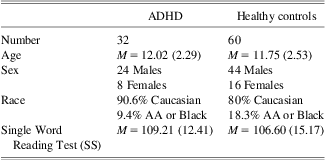
Thirty-two children diagnosed with ADHD ages 8 to 15 years (Mean = 12.02; SD = 2.29) were enrolled and completed computer-based and paper and pencil tests of executive function at BCH. The sample included 24 boys and 8 girls with an ethnic breakdown of: 90.6% Caucasian and 9.4% African American or Black. With regard to ADHD subtype, 71.9% had combined type and 28.1% inattentive type. With regard to medication, 81.3% were prescribed short-acting stimulant medication to treat ADHD symptoms; however, parents were instructed to withhold their child's medication on the day of testing. The study was approved by the BCH's Institutional Review Board. All children received gift cards for their participation.
Sixty healthy control children ages 8–16 years (mean =11.75; SD = 2.53) were chosen from the database of participants recruited by other institutions participating in the larger multi-site study. All participating sites administered tests using standardized instructions and procedures to minimize differences across setting. The control sample consisted of 44 males and 16 females with an ethnic breakdown of: 80% Caucasian and 18.3% African American or Black. One participant's race was unknown. Controls were selected to roughly match the ADHD participants with respect to age and gender. This ensured minimal group demographic differences; however, variable matching was not exact for all cases. Of the controls included, three were enrolled and tested at the University of California-San Francisco; 47 were enrolled and tested at the Developmental Cognitive Neuroscience Laboratory at the University of Nebraska–Lincoln; and 10 were enrolled and tested at the University of South Carolina Neuropsychology and Human Development Lab. Controls were excluded if they had current drug use, major psychiatric disorder, B12 deficiency or other metabolic syndrome, hypothyroidism, known HIV, renal failure, respiratory failure, or significant systemic medical illnesses.
Procedure
Eligible participants were administered paper and pencil and computer-based neuropsychological tests measuring different aspects of executive function. Parents and guardians were asked to participate in objective interviews and questionnaires. Children enrolled at BCH were also administered a screening of intelligence (IQ). The full assessment took approximately 2.5 hr to complete.
Measures
Families enrolled through BCH were administered multiple screening measures. A health and developmental history form included questions regarding the participant's birth, family, and medical history. The ADHD Rating Scale-IV was used to assess current ADHD symptoms. This behavior rating scale includes items related to the 18 symptoms of ADHD based on the DSM-IV-TR (American Psychiatric Association, 2000). Items are scored on a 0 (never or rarely) to 3 (very often) basis. Normative data based on age and gender are available, and the psychometric properties are well established (Collett, Ohan, & Myers, Reference Collett, Ohan and Myers2003; DuPaul, Power, Anastopoulos, & Reid, Reference DuPaul, Power, Anastopoulos and Reid1998). General cognitive ability was assessed using the two-subtest form of the WASI, which consists of Vocabulary and Matrix Reasoning (Wechsler, Reference Wechsler1999). The two-subtest form provides a measure of Full Scale IQ that is highly correlated with that derived from the Wechsler Intelligence Scale for Children-Fourth Edition (WISC-IV).
Learning problems were assessed using the Learning Problems subscale from the Conners 3-Parent Rating Scale (Conners 3-P; Conners, Reference Conners2008). The Conners 3-P assesses behaviors in children ages 6–18, and has links to the DSM-IV-TR. A revision of the Conners Rating Scale–Revised, it provides a thorough assessment of ADHD and co-morbidities. The parent form includes 110 items and provides an up-to-date normative sample and validity scales. The Learning Problems scale of the Conners 3-P consists of nine items that inquire about learning difficulties within the areas of reading, spelling, and math, as well as about problems that span across academic areas (e.g., problems with the ability to remember concepts). The Conners 3-T Learning Problems subscale (which contains 6 of the 9 items from the Conners 3-P) was moderately to highly correlated (r = .66–.92; p < .01) with the Learning Problems scale from the Behavior Assessment System for Children, Second Edition Teacher Report (BASC-2 TRS-C and BASC-2 TRS-A; Reynolds & Kamphaus, Reference Reynolds and Kamphaus2004), indicating decent construct validity (Conners, Reference Conners2008).
Academic achievement in reading was also assessed in children with ADHD and controls. The majority of participants were administered the Word Reading subtest from the WRAT-4 (Wilkinson & Robertson, Reference Wilkinson and Robertson2006). The controls who were tested at the University of South Carolina completed the Letter-Word Identification subtest from Woodcock-Johnson III Tests of Achievement (Woodcock, McGraw, & Mather, Reference Woodcock, McGraw and Mather2001). Both of these tests of single word reading ability have good reliability and validity, are normed for both young and older children, and can be administered efficiently.
The NIH EXAMINER was used to evaluate executive function, and specifically we used the working memory, cognitive control, and fluency scores. The executive measures that contributed to these scores are listed below. Additional measures were administered as part of the larger multi-site study to develop the NIH EXAMINER battery but are not listed because they were not included in the current analyses. Please see Kramer et al. (2013, this series) for more detailed information about each test.
Working memory
Contributing to the working memory score were the 1-Back and 2-Back tests of spatial working memory, which are based on the classic n-back paradigm and require updating processes, and the Dot Counting Test of verbal working memory, modeled after the counting span task by Case, Kurland, and Goldberg (Reference Case, Kurland and Goldberg1982). On the 1-Back and 2-Back tests, participants were shown a series of white squares that appeared in different locations on a black screen and indicated whether each square was presented in the same or different location as the one previous (for 1-Back) or from two screens ago (2-Back). On the Dot Counting Test, participants viewed a series of screens (2–7) with blue dots, green dots, and blue triangles and counted the blue dots. At the end of each trial, the participant recalled the number of blue dots from each screen in order.
Cognitive control
The cognitive control score included measures from the Flanker Test (Krueger et al., Reference Krueger, Bird, Growdon, Jang, Miller and Kramer2009) and the Antisaccade Test (Hellmuth et al., Reference Hellmuth, Mirsky, Heuer, Matlin, Jafari, Garbutt and Boxer2012) as measures of inhibition; a Set-Shifting Test that required switching between matching simple stimuli based on shape or color; and an error measure that combined dysexecutive errors across the battery (see Kramer et al., 2013, for details). On the Flanker Test, participants looked at a fixation point in the center of the screen and were presented a row of five arrows. The target (center) arrow was either congruent or incongruent to the non-target arrows and participants were instructed to indicate whether the target arrow is facing left or right. On the Antisaccade Test, participants were instructed to move their eyes upon presentation of a laterally presented stimulus in the same direction (pro-saccade) or in the opposite direction (anti-saccade). Performance was measured by accuracy on the anti-saccade trials. The Set-Shifting Test required participants to match a stimulus by cue to shape or color to two constant stimuli (red triangle and blue rectangle) in the lower corners of the computer screen.
Fluency
The fluency score combined accurate responses across measures of phonemic and category fluency. On phonemic fluency, participants were given 60 s to name as many words as they could that were not the names of people or places or numbers, first with the letter “F” and then the letter “L.” On category fluency, participants were given 60 s to name as many items belonging to the category animals, then to the category vegetables.
Statistical Analysis
Demographic comparisons between children with ADHD and controls were made using two-tailed t tests (equal variance). Item response theory was used to create composite scores from the multiple tests included in the NIH EXAMINER battery (Kramer et al., this series).
Analysis of covariance (ANCOVA) techniques compared the working memory, cognitive control, and fluency scores between children with ADHD and controls. Given that the study included a broad age range, and the executive function scores produced by the EXAMINER scoring program are not age-referenced, age was a covariate in all analyses. A hierarchical regression analysis examined the additive effects of the cognitive control, fluency, and working memory scores on parent report of learning problems. Age was a covariate in the model. All analyses were conducted using PASW Statistics 18 software.
Results
Demographic Comparisons Across Groups
Table 1 depicts demographic information of all the participants by group. Independent sample t tests compared age and word reading performance between children with ADHD and controls. There was not a significant difference in age, t(90) = −.52, p = .61, or in word reading ability, t(87) = −.83, p = .41).
Demographic information on participants

M = mean (standard deviation); AA = African American; SS = standard score.
Associations among Executive Function Scores and Covariates
Intercorrelations among the variables are shown in Table 2. All executive function scores were moderately correlated with each other. Age was positively correlated with all three executive function scores. Sex was not significantly correlated with any variables. Word reading was positively correlated with the fluency score and negatively correlated with learning problems. Learning problems was also moderately correlated with both worse fluency and working memory scores. All participants with ADHD had a WASI two-subtest IQ score that was average or better (M = 108.53; SD = 11.14, range, 88–129). None of the executive function scores were significantly associated with IQ.
Correlations among variables

Note. *p < 0.05, **p < 0.01. Sex coded as 1 = boys, 2 = girls; SS = standard score.
Group Differences in Executive Function
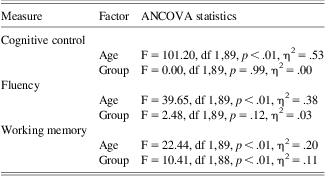
Differences in executive function scores (cognitive control, fluency, and working memory) between children with ADHD and controls were examined using a series of ANCOVAs controlling for age. Analyses are presented in Table 3. Results for the cognitive control and fluency scores indicated nonsignificant group effects. Results for the working memory score indicated a significant effect of group. Children with ADHD exhibited significantly worse performance on working memory tasks compared with controls.
Summary of ANCOVA results for group differences in executive function factor scores

ANCOVA = analysis of covariance.
Associations among Executive Function Factors and Learning Problems
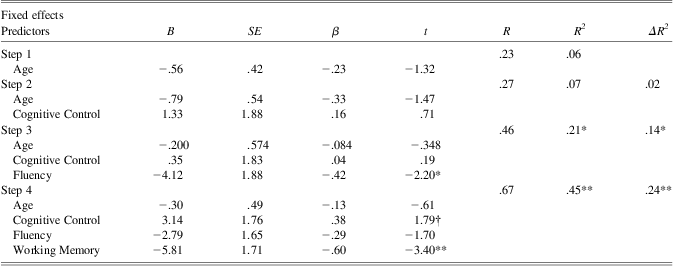
Table 4 shows the four-step hierarchical regression analysis examining the additive effects of the executive function scores on parent report of learning problems in children with ADHD. Age was entered at step 1, cognitive control at step 2, fluency at step 3, and working memory at step 4.
Summary of hierarchical regression analysis for predicting learning problems

Note. †p < 0.10, *p < 0.05, **p < 0.01.
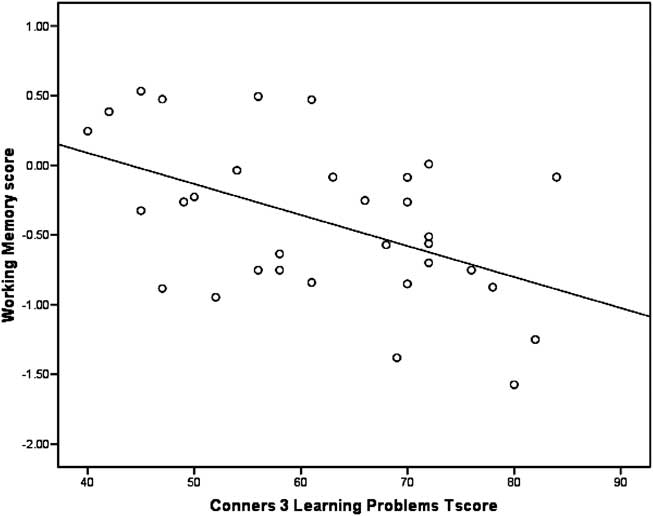
In the first step, the model was not statistically significant, F(1,30) = 1.74, p = .20 and age explained only 5.5% of the variation in parent ratings of learning problems. Introducing cognitive control in step 2 only explained an additional 1.6% of the variation in learning problems and the model was not significant, F(2,29) = 1.10, p = .35. In step 3, Fluency explained an additional 13.7% of the variation in learning problems, and the model was not significant, F(3,28) = 2.44, p = .09. Finally, the addition of working memory to the regression model explained an additional 23.8% of the variation in learning problems, and the model was statistically significant F(4,27) = 5.41, p < .01. When all four variables were included in the step 4 of the regression model, working memory was the only significant predictor of learning problems. Children with poorer working memory had significantly more parent report of learning problems (see Fig. 1). Together, the four independent variables accounted for 44.5% of the variation in parent report of learning problems.
Working memory and parent ratings of learning problems in children with ADHD.

Discussion
The present study compared executive functions in children with ADHD and healthy controls using the NIH EXAMINER battery to overcome many of the psychometric and test development issues which have hampered replication of specific executive function deficits in prior studies. The NIH EXAMINER battery, designed to be a reliable and valid battery of domain specific executive function, uses item response theory to create comparable measures of working memory, cognitive control, and fluency by combining across multiple measures. Our findings indicate that working memory ability was significantly worse in children with ADHD compared with age and gender matched healthy control children. This is consistent with literature implicating working memory impairment as a core deficit in children with ADHD (Kasper, Alderson, & Hudec, Reference Kasper, Alderson and Hudec2012; Martinussen et al., Reference Martinussen, Hayden, Hogg-Johnson and Tannock2005; Rapport, Reference Rapport2001). According to the working memory model of ADHD, if present, inhibition is a downstream product of working memory impairment (Alderson, Rapport, & Kofler, Reference Alderson, Rapport and Kofler2007; Kofler et al., Reference Kofler, Rapport, Bolden and Altro2008).
Contrary to our prediction, cognitive control was not significantly worse in children with ADHD compared with controls. This is somewhat unexpected given the literature proposing the related concept of inhibitory control as a primary deficit in children with ADHD (Barkley, Reference Barkley1997). However, the cognitive control score may not be capturing the same concept of inhibition as described in prior studies. In fact, multiple types of inhibitory processes have been proposed, suggesting that inhibitory control is not a unitary construct that cuts across both cognitive and behavioral domains (Engelhardt, Nigg, Carr, & Ferreira, Reference Engelhardt, Nigg, Carr and Ferreira2008; Logan, Cowan, & Davis, Reference Logan, Cowan and Davis1984; Nigg, Reference Nigg2000, Reference Nigg2001). In fact, Nigg (Reference Nigg2000) distinguished between eight different kinds of inhibition that fall within the categories of executive inhibitory processes, motivational inhibitory processes, and automatic attentional inhibition processes. Inhibitory deficits in children with ADHD more often occur on tasks requiring suppression of a prepotent motor response (e.g., basic go/no-go task) and are less common on tasks requiring suppression of a conflicting response (e.g., flanker test; Nigg, Reference Nigg2001). Another study of adolescents and adults with ADHD also failed to demonstrate cognitive inhibition problems compared with controls (Engelhardt et al., Reference Engelhardt, Nigg, Carr and Ferreira2008).
Another reason for the lack of significant difference in cognitive control between children with ADHD and controls may be due to this sample of children with ADHD. Children were selected to have relatively “pure” ADHD, with no co-occurring learning or behavioral disorders. Still, the literature has demonstrated that substantial comorbidity exists between ADHD and other learning and behavioral disorders (Angold, Costello, & Erkanli, Reference Angold, Costello and Erkanli1999). Furthermore, research suggests that impairment of inhibitory control processes may be worse in children with ADHD that is comorbid with other disorders, particularly learning disorders (Purvis & Tannock, Reference Purvis and Tannock2000; Willcutt et al., Reference Willcutt, Pennington, Boada, Ogline, Tunick, Chhabildas and Olson2001). Our results suggest that cognitive control may not be impaired in children with a relatively “pure” form of ADHD that is not comorbid with other disorders.
Working memory was also the only factor significantly associated with parent report of learning problems, which is consistent with prior research establishing working memory as a predictor of academic success (Alloway & Alloway, Reference Alloway and Alloway2010; Alloway et al., Reference Alloway, Gathercole and Elliott2010; Gathercole et al., Reference Gathercole, Pickering, Ambridge and Wearing2004). Behaviors associated with working memory, such as holding information in mind and managing and manipulating multiple pieces of information simultaneously, are important for learning and acquiring knowledge. Consequently, a primary deficit in working memory may underlie the academic problems found in children with ADHD compared with healthy peers.
When considering academic outcomes, the literature distinguishes between academic knowledge and school grades, which may combine effort, behavior, homework completion, and knowledge (Bowers, Reference Bowers2011; Randall and Englehard, Reference Randall and Engelhard2009). Research suggests that working memory is associated with learning and acquiring academic knowledge as measured by standardized achievement tests (Miller, Nevado-Montenegro, & Hinshaw, Reference Miller, Nevado-Montenegro and Hinshaw2012), whereas organization/planning and inhibition are associated with school grades (Langberg, Dvorsky & Evans, Reference Langberg, Dvorsky and Evans2013; Langberg et al., Reference Langberg, Molina, Arnold, Epstein, Altaye, Hinshaw and Hechtman2011). Assessment of academic knowledge in the present study was limited because children were excluded if diagnosed with a learning disorder or if word reading ability was below average; however, results still indicated working memory to be associated with learning. Thus, findings emphasize that working memory can have a measureable impact on learning even in the absence of a learning disorder. It is possible that children with ADHD and no comorbid learning or behavioral disorder may be better at compensating for working memory weaknesses when it comes to school performance. Unfortunately, we did not obtain information about school grades from children in the study sample, so we were unable to examine the effects of executive function scores on grades. Future studies should include multiple measures of academic outcomes, including both school grades and academic achievement scores, to further explore the impact of executive function deficits on school functioning.
With respect to intervention, stimulant medication is effective at diminishing parent and teacher rated inattention and hyperactivity symptoms (Swanson, Baler, & Volkow, Reference Swanson, Baler and Volkow2011; Swanson et al., Reference Swanson, McBurnett, Wigal, Pfiffner, Williams and Christian1993); however, the impact of stimulants on working memory has been less clear. A review indicated that methylphenidate improved performance in working memory in only approximately 50% of studies (Pietrzak, Mollica, Maruff, & Snyder, Reference Pietrzak, Mollica, Maruff and Snyder2006). Furthermore, many children treated with stimulants demonstrate improvements on attention and behavior ratings but make only marginal improvements on academic outcomes (Marcus & Durkin, Reference Marcus and Durkin2011; Rapport, Denney, DuPaul, & Gardner, Reference Rapport, Denney, DuPaul and Gardner1994). Thus, additional intervention options for working memory should continue to be explored.
More recently, computerized training of working memory in children with ADHD has yielded improvements on tests of working memory, response inhibition, and complex reasoning, as well as a significant reduction in the number of parent-rated inattention and hyperactivity/impulsivity symptoms (Klingberg et al., Reference Klingberg, Fernell, Olesen, Johnson, Gustafsson, Dahlstrom and Westerberg2005). Only a few studies examined how computerized training of working memory may impact academic performance. Two studies indicated promising results for improvements in math (Holmes, Gathercole, & Dunning, Reference Holmes, Gathercole and Dunning2009) and reading comprehension (Dahlin, Reference Dahlin2011). However, another study examining children with ADHD and comorbid learning disorder did not find improvement in academic scores following working memory training (Gray et al., Reference Gray, Chaban, Martinussen, Goldberg, Gotlieb, Kronitz and Tannock2012). A recent meta-analysis of studies of working memory training demonstrates short term gains in working memory, but generalization to other contexts remains in question (Melby-Lervåg & Hulme, Reference Melby-Lervåg and Hulme2013). The current findings provide justification for additional studies to examine the potential benefit of working memory training on academic outcomes in children with ADHD.
Within the context of these findings, this study has several potential limitations which provide direction for future research. First, the sample size was very small which limited our ability to examine certain variables that may be of interest. For example, research suggests that males and females with ADHD may have different neuropsychological profiles and should be examined together and separately (O'Brien, Dowell, Mostofsky, Denckla, & Mahone, Reference O'Brien, Dowell, Mostofsky, Denckla and Mahone2010). Our sample was too small to examine males and females separately. We were also unable to examine differences in executive function by subtypes of ADHD. The literature suggests that the executive function deficit profile may differ by subtype (Nigg et al., Reference Nigg, Willcutt, Doyle and Sonuga-Barke2005), and this would be worth exploring with the use of the NIH EXAMINER battery.
Another limitation was the broad age range of the sample (ages 8–16 years), which spanned important developmental periods (i.e., middle childhood through adolescence). Behavior regulation and executive function gradually improve over the course of development, and it is likely that children with ADHD also show variation in executive function deficits at different stages of development (Brocki, Fan, & Fossella, Reference Brocki, Fan and Fossella2008). Our sample size did not allow for examination of executive function deficits at different ages. Future studies should include enough participants to examine executive function differences across development.
Finally, the current study did not include a measure of intelligence in the control group. Children with ADHD who had IQ scores below 85 were excluded, but we were unable to see if group differences remained after controlling for IQ. Then again, IQ shares significant variance with working memory (Ackerman, Beier, & Boyle, Reference Ackerman, Beier and Boyle2005), and it is possible that covarying for IQ would eliminate the group difference due to shared variance. Nonetheless, future studies should include a measure of IQ to compare across groups.
In conclusion, our findings indicate that, on a valid and reliable battery of executive function tests, children with ADHD and no comorbid disorders perform significantly worse on tests of working memory ability compared with healthy control children. Furthermore, poorer working memory is associated with parent report of learning problems in children with ADHD, even in the absence of a learning disorder diagnosis. Thus, working memory impairment appears to be one of the mechanisms for poor academic outcomes in children with ADHD.
Acknowledgments
The authors report no conflicts of interest. This work was supported by the National Institutes of Health (NIH-NINDS-05-02) and the National Institute on Aging (Possin: K23AG037566).