Introduction
International emergencies, such as the coronavirus disease 2019 (COVID-19) pandemic, demand a resilient workforce in order to maintain organizational sustainability. Many organizational challenges experienced during public health emergencies include increased workloads, staff and material shortages, and rapid organizational changes. For health care workers (HCWs), fear of contagion, stress, anxiety, and concern for their well-being and significant others endanger their mental health and increase personal vulnerability. Reference Lai, Ma and Wang1 Prolonged stress can compromise effective work performance, increase staff turnover, and contribute to physical and psychological problems of HCWs. Reference Silva, Baptista and Silva2 The impact of these situations on HCWs well-being have only recently been studied. Patients with infectious diseases may require long-term assistance in hospital wards and intensive care units. Between 11.0%-73.4% of HCWs including physicians, nurses, and auxiliary staff may develop posttraumatic stress disorder (PTSD) during infectious disease outbreaks with symptoms lasting after one to three years in 10%-40% of those affected. Reference Preti, Di Mattei and Perego3
Therefore, the use of theoretical models that explore individual resilience factors and the work environment are a valuable resource for nurse executives/managers to use to cultivate resilience and retention of qualified nurses at the front-line of health institutions. One such model is titled the Health Services Workplace Environmental Resilience Model (HSWERM). This model provides a framework that brings together in a single structure the key constructs of psychological resilience and workplace environment factors that promote the resilience of health professionals, Reference Cusack, Smith and Hegney4 and this framework has been applied to assist in the synthesis of the findings of the scoping review, with a focus on nurses, midwives, and nursing students.
The HSWERM incorporates seven major organizational concepts that relate to building positive resilience in the workplace and formed the foundation of HSWERM. These concepts (strategies for Support and Development across the Professional, Practice, and Personal domains) within the workplace context link to the nurses and then impact on personal resilience and workplace outcomes. Reference Cusack, Smith and Hegney4
Promoting any strategies that buffer the detrimental effects of distress and maintain safe patient care in a heightened environment of anxiety is important for all nurse managers to consider. Reference Kalaitzaki, Tamiolaki and Rovithis5 Therefore, there is a need to synthesize available evidence of workplace factors that support nurses’ resilience, particularly during a public health emergency such as the current pandemic.
Review Methods
Aim
This scoping review explored the main environmental factors in the workplace that contribute to nursing resilience in respiratory infectious pandemic events.
Design
This scoping review was conducted by the methodological framework proposed by the Joanna Briggs Institute (JBI; Adelaide, Australia). Reference Arksey and O’Malley6 The process included: identification of research question; search for relevant literature; selection of studies; mapping and comparison of data; summarize; and reporting results. This approach was chosen because it allowed for encompassing a variety of study designs in the review. Though this approach is similar to a systematic review, it does not involve a rigorous quality assessment process and the results can be stated in a narrative format. Reference Rumrill, Fitzgerald and Merchant7 The literature review was carried out from May through December 2020, including studies in English, Spanish, and Portuguese, with no time limit. The Preferred Reporting Items for Systematic Reviews and Meta-Analyses Extension for Scoping Reviews (PRISMA-ScR) and checklist Reference Tricco, Lillie and Zarin8 guided the development of the review.
The review question was: What are the factors in the work environment that promote the resilience of nurses, midwives, and nursing students in the context of a pandemic?
Population (of interest), Concept, and Context (PCC) was applied to guide inclusion criteria with: P (nurses, midwives, and nursing students); C (environment factors that promote the resilience of the nursing, midwifery workforce); and C (COVID-19 pandemic).
Search Strategy
A priori search for literature reviews was carried out, with the contribution of a librarian, in the following platforms: Open Science Framework (Center for Open Science; Charlottesville, Virginia USA), Cochrane Library (Wiley; Hoboken, New Jersey USA), Prospero (University of York; York, United Kingdom), and the Clinical Queries of PubMed (National Center for Biotechnology Information, National Institutes of Health; Bethesda, Maryland USA). No prior systematic reviews were identified. The authors developed a PRISMA-ScR protocol Reference Tricco, Lillie and Zarin8 to conduct the review to increase reporting transparency.
Appropriate search terms started with the Medical Subject Headings (MeSh) descriptors in MEDLINE (US National Library of Medicine, National Institutes of Health; Bethesda, Maryland USA), EMBASE (Elsevier; Amsterdam, Netherlands), and then incorporated the environmental factors of the HSWERM resilience model. Combined keywords included resilience, work environment, nursing, and pandemics using Boolean operators “AND” and “OR” in order to maximize the permutations of terms (Boolean Logic; Supplementary File 1-Appendix S1; available online only). Two authors analyzed words contained in titles and abstracts. Subsequently, searches were also performed in PubMed, Scopus (Elsevier; Amsterdam, Netherlands), SciELO (Scientific Electronic Library Online; Brazil), CINAHL (EBSCO Information Services; Ipswich, Massachusetts USA), Web of Science (Clarivate Analytics; London, United Kingdom), BVS ([Biblioteca Virtual en Salud; Virtual Health Library] Latin American and Caribbean Center on Health Sciences Information; São Paulo, Brazil), and American Psychological Association (APA; Washington, DC USA) databases.
Study Selection
Two authors independently selected relevant articles, evaluating titles, abstracts, and applying eligibility criteria. Reference sections and key terms of included articles were consulted. After selecting articles, citations were imported into a spreadsheet. Data were extracted using a standardized verification table and verified by a third author. Disagreements were resolved by consensus with the aim of confirming the eligibility of a given publication. Relevant studies were retrieved from databases and imported into the EndNote (Clarivate Analytics; Philadelphia, Pennsylvania USA) bibliographic management program and duplicates manually excluded.
Search Outcome
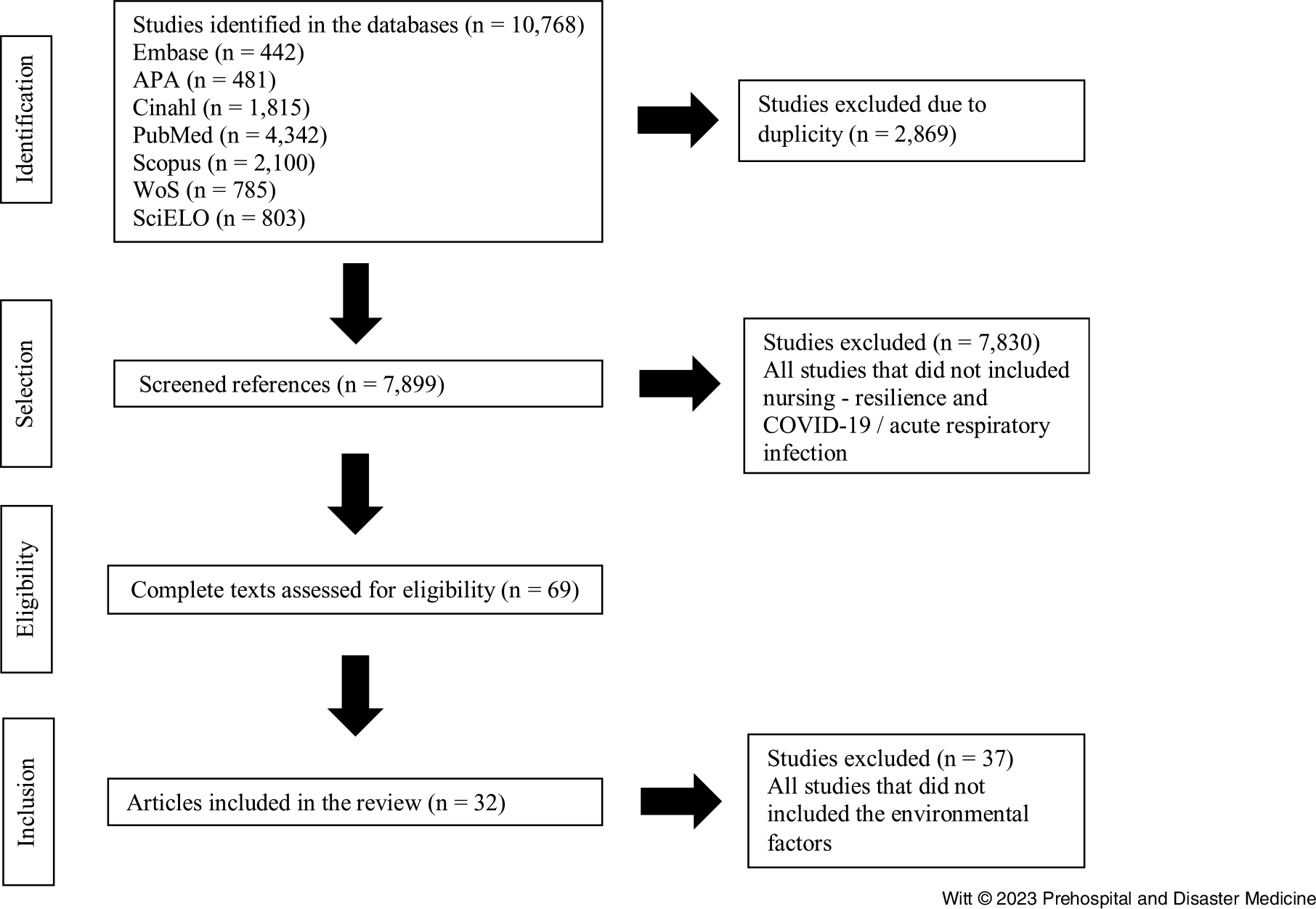
A total of 10,768 papers were identified by the research strategy with results shown in the PRISMA diagram. Reference Peters, Marnie and Tricco9 Of those, 2,869 duplicates were removed leaving 7,899 records; 7,830 were further excluded as irrelevant based on screening of title and abstract. Sixty-nine (69) full-text articles were retrieved, of which 37 were excluded and reasons documented (Figure 1).
PRISMA Diagram of Study Screening and Selection.

In total, 32 articles met the inclusion criteria for the scoping review. All papers mentioned organizational environment factors (Supplementary File 2; available online only). Methodological quality of articles was not assessed in the scope review because the aim was to map existing evidence and not find the best evidence. Reference Peters, Marnie and Tricco9,Reference Colquhoun, Levac and O’Brien10 Studies rejected at any stage were registered in an exclusion table justifying the reasons.
Data Extraction
Two independent investigators extracted data relevant to exploring environmental factors in the workplace that contribute to nursing resilience in pandemic events as well as strategies mentioned to improve the environmental supports for nurses, midwives, and nursing students.
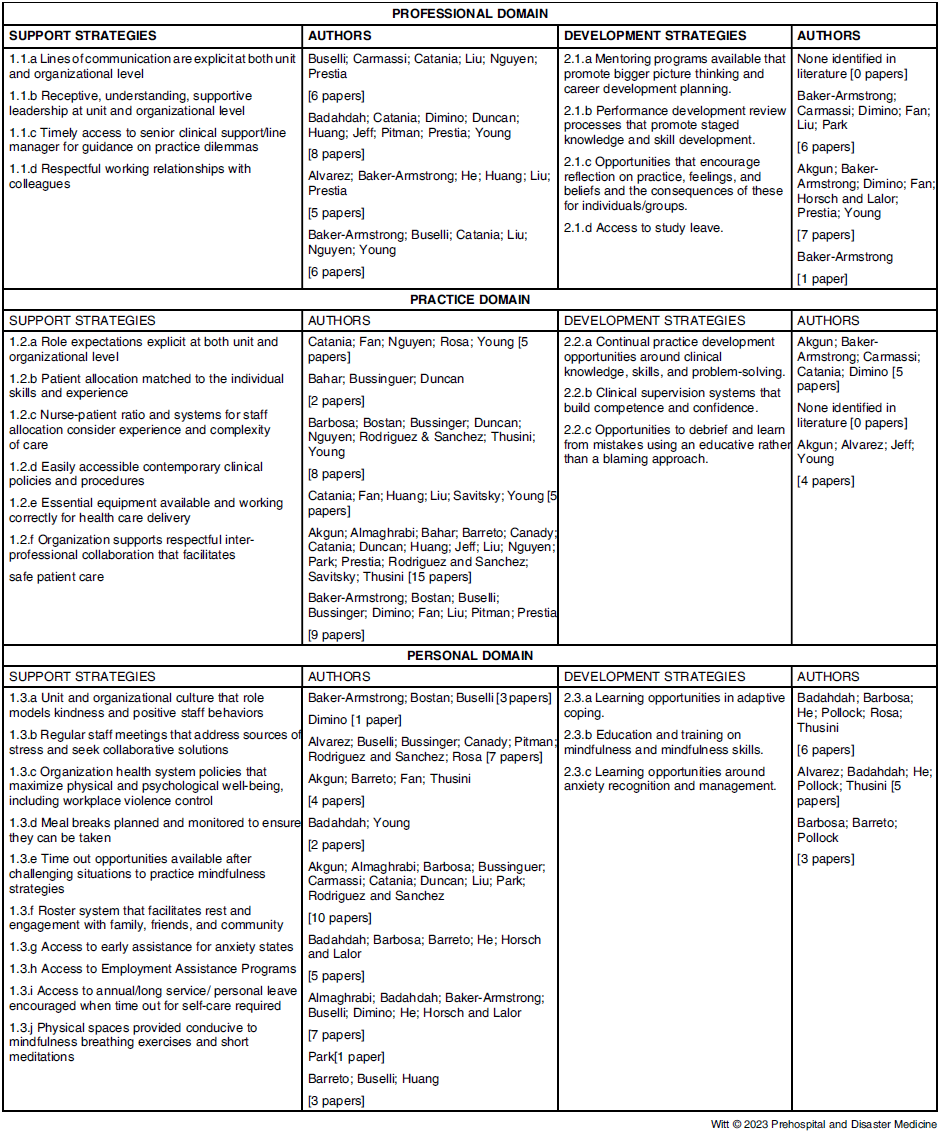
Data extraction papers were allocated by authors using the HSWERM framework (three domains: Professional, Practice, and Personal; with two strategies: Support and Development, within each domain). The purpose of this was to generate a set of statements that represented the aggregations or synthesis of findings on the basis of similar meanings (Table 1).
HSWERM Environmental Factors by Domain Identified in the Literature

Abbreviation: HSWERM, Health Services Workplace Environmental Resilience Model.
Results
Bibliographic Overview
Twenty-three (23) papers were reviewed in the current scoping review. The papers included: United States (6), China (5), Brazil (3), Ireland (2), Italy (2) Israel (2), Saudi Arabia (2), Turkey (2), Canada (1), England (1), Ecuador (1), New Zealand (1), Spain (1), Switzerland (1), France (1), and Scotland (1).
In the context of a pandemic, the HSWERM Professional Domain: 16 authors identified Support strategies and ten authors identified Development strategies for the workplace that contribute to nursing resilience. In the Practice Domain: 26 authors identified Support strategies and nine authors identified Development strategies for the workplace that contribute to nursing resilience. In the Personal Domain: 26 authors identified Support strategies and eight authors identified Development strategies for the workplace that contribute to nursing resilience. One paper specifically focused on midwives’ practice. Two papers mentioned nursing students.
Professional Domain
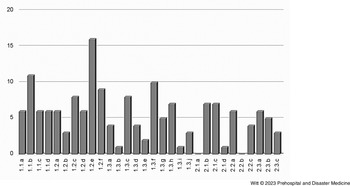
The environment Support strategy that was most frequently mentioned was related to receptive, understanding, and supportive leadership (1.1b), with the three remaining strategies all equally represented with a focus on communication (1.1a), timely access to senior clinical support/line manager for guidance on practice dilemmas (1.1c), and respectful working relationships (1.1d); Figure 2.
Summary of Frequency of Environmental Factors Found in the Literature.

In Development strategies, performance development review processes that promote relevant knowledge and skill development related to the pandemic (2.1b) and opportunities for nurses’ reflection on practice, feelings, beliefs, and consequences they were experiencing were most frequently reported (2.1c), followed by access to study leave (2.1d). Mentoring systems that promote bigger thinking (2.1a) was not mentioned by any authors (Figure 2).
Practice Domain
The environment Support strategy that was the most frequently mentioned was access to essential equipment that worked (1.2e). Next was organizational support that enabled respectful inter-professional collaboration (1.2f) and staffing ratios that considered experience and complexity of care (1.2c), followed by access to contemporary clinical policies/procedures (1.2d). Role expectations that were explicit (1.2a) was frequently mentioned within the changing context of care in the pandemic environment, and finally patient allocation matched staff skills and experience (1.2b).
In Development strategies, opportunities for continual practice development around clinical skills knowledge and decision making required in a pandemic were mentioned (2.2a), as well as opportunities to debrief using an educative rather than a blaming approach (2.2c). No papers mentioned clinical supervision systems that build competence and confidence (2.2b) as part of their response to supporting staff resilience during a pandemic (Figure 2).
Personal Domain
The environmental Support strategy most frequently mentioned was roster systems that facilitated nurses’ rest and enabled engagement with family and friends (1.3f). This was followed by organizational policies that maximized well-being, including workplace violence prevention (1.3c). Also, access to employee assistance schemes (1.3h) was noted in seven papers. Time out opportunities available after challenging situations to practice mindfulness strategies (1.3.g), meal breaks that are planned and taken (1.3d), and access to spaces for time-out (1.3e) were noted as important organizational features that support nurses’ resilience at stressful times. All of these strategies reflect an organizational culture of kindness and positive staff behavior (1.3a). One paper mentioned regular staff meetings (1.3b) as a significant requirement.
Development strategies under this domain highlighted the importance of building skills for coping (2.3a) and reducing anxiety, such as workplace mindfulness programs (2.3b). Development of senior staff skills to recognize anxiety in colleagues and to quicky instigate necessary supports was highlighted as an important strategy (2.3c).
Discussion
The workplace environmental factors that dominated in publications on nursing resilience in the context of a pandemic are related to constructs presented in the HSWERM model. These results suggest universality of the HSWERM due to the consistency of workplace environmental factors that emerged from the literature. This consistency presents reliable data, thus contributing to the understanding of resilience. The applicability of applying the HSWERM framework could be considered in further studies. The main workplace environmental factors that were identified include communication, inter-professional collaboration, access to equipment, targeted training, and supporting well-being.
Channels and styles of communication became altered during the outbreak response. Reference Catania, Zanini and Hayter11 Transparent, true, conscientious, and relevant communication is recommended for nurse leaders in the support of their staff, especially during a pandemic. Reference Prestia12,Reference Carmassi, Foghi and Dell’Oste13 Explicit lines of communication at both team unit and organizational levels are important to ensure that information provided is based on accurate sources. Reference Barbosa, Pereira Gomes and Barbosa Assumpção14,Reference Duncan15 This includes collecting factual information and providing timely notification to all HCWs and personnel departments. Reference Huang, Wang and Liu16 A lack of communicative skills Reference Buselli, Baldanzi and Corsi17 demands strategies to support nurses’ resilience as to encourage them to actively engage in providing feedback to supervisors/team leaders. Reference Akgün, Collett, Feder, Shamas and Schulman-Green18 Recommendations included supporting nurses and nursing students by equipping them with communication skills to develop positive and nurturing inter-professional collaborative relationships prior to an extreme event. Reference Buselli, Baldanzi and Corsi17,Reference Baker-Armstrong19
There was a great emphasis on the importance of respectful inter-professional collaboration as an essential factor in supporting nurses’ resilience to feel that they are part of a team, to practice safely in a pandemic, while understanding tasks that they may not be fully prepared for. Reference Prestia12,Reference Badahdah, Khamis and Al Mahyijari20–Reference Nguyen, Baillard and Samama26 In disaster situations, multidisciplinary teams may work in different locations, learn, and master new technical procedures in a short time and therefore must quickly find ways to work efficiently together. Reference Fan, Hu and Li22 In this context, nurses had a leading role in facilitating communication and collaboration with a new multidisciplinary team. Reference Fan, Hu and Li22,Reference Nguyen, Baillard and Samama26,Reference Nurses27
Nurses reported being unfamiliar with the protocols of infectious disease wards. Reference Huang, Wang and Liu16 The response to any disaster may require nurses to step outside of their usual labor regulations, because the decisions that need to be made and skills required may be different from their daily work, which also requires a rapid adaptation process by health practitioners and health care managers. Reference Fan, Hu and Li22 Because roles vary across hospitals, Reference Catania, Zanini and Hayter11 the formation of adequately staffed inter-professional teams Reference Barbosa, Pereira Gomes and Barbosa Assumpção14,Reference Duncan15,Reference Rodríguez and Sánchez28 and more detailed job classification and expected levels of accountability should be available to alleviate role ambiguity and improve work efficiency. Reference Liu, Luo and Haase23,Reference Rosa, Gray and Chow29,Reference Dimino, Horan and Stephenson30
A great concern was expressed with supply shortage, such as personnel protective equipment for nurses, other HCWs, and nursing students, Reference Jeff, Merkley and Canzian25,Reference Rodríguez and Sánchez28,Reference Almaghrabi, Alfaradi and Hebshi31–Reference Savitsky, Findling and Ereli34 as well as access to hydrogen, Reference Prestia12,Reference Barbosa, Pereira Gomes and Barbosa Assumpção14,Reference Barreto, Oliveira and Freitas35 especially in the first weeks. Reference Liu, Luo and Haase23 Irregular working conditions, without the minimum safety requirements, were reported contributing to the mental burden of these HCWs. Reference Nurses27,Reference Canady36,Reference Huang, Lin and Sun37
Unit and organizational culture for kindness and positive staff behaviors was developed in programs designed to support newly hired employees Reference Buselli, Baldanzi and Corsi17 that increased the use of positive self-talk Reference Baker-Armstrong19 and could be conducted in daily hope huddles during shift changes Reference Dimino, Horan and Stephenson30 or by an organizational debriefing following a traumatic event. Reference Pitman24 Managers were asked to ensure that time and space was given to help staff reflect on and make sense of the morally difficult decisions they took. Reference Huang, Lin and Sun37,Reference Horsch, Lalor and Downe38 Self-care strategies needed to be realistic and readily available; for example, debriefing after critical events could help nurses begin to recognize some of the challenges and pain they have experienced or small initiatives such as free lunches in break rooms. Reference Akgün, Collett, Feder, Shamas and Schulman-Green18
Although health professionals were willing to work overtime, Reference Almaghrabi, Alfaradi and Hebshi31 stressors were found to be associated with longer working hours, Reference Badahdah, Khamis and Al Mahyijari20 increased workload, Reference Bahar, Koçak and Samancıoğlu Bağlama32 the lack of visibility of their schedule, Reference Nguyen, Baillard and Samama26 and prolonged separation from the family. Reference Carmassi, Foghi and Dell’Oste13,Reference Buselli, Baldanzi and Corsi17 The use of replacement teams in some organizations enabled HCWs to rest and restore their energy. Reference Prestia12
When health systems are not ready to deal with an infectious disease outbreak, rapid facilitation of training Reference Liu, Luo and Haase23 is required. Lack of training as one of the top five barriers to safe patient care Reference Park, Behrouz-Ghayebi and Sury39 also led to higher infection rates among peers. Reference Fan, Hu and Li22 Little knowledge of COVID-19 protection measures was significantly related to lower resilience and higher levels of anxiety among nurses. Reference Huang, Wang and Liu16,Reference Savitsky, Findling and Ereli34,Reference Canady36 Pre-work training was recommended as an effective way to quickly adapt nurses to practice change as part of an emergency response. Reference Fan, Hu and Li22,Reference Akgün, Collett and Feder40 Suggested training and resources for nurses Reference Akgün, Collett, Feder, Shamas and Schulman-Green18,Reference Baker-Armstrong19,Reference Akgün, Collett and Feder40 included videos and educational materials to staff. Reference Liu, Luo and Haase23
Several papers mentioned the importance of health systems to plan urgent actions to support their employees’ mental health, Reference Badahdah, Khamis and Al Mahyijari20,Reference Canady36,Reference Alvarez, Almaguer and Santos41 with special interventions to promote mental well-being of those exposed to COVID-19 Reference Canady36,Reference Pollock, Campbell and Cheyne42 and to reduce negative mental health outcomes. Reference He, Chen and Pan43 Key lessons that can equip health care staff with positive coping strategies in a time of unprecedented pressure Reference Thusini44 included the creation of an online psychological counseling group, Reference Liu, Luo and Haase23 the provision of information for staff to easily access mental health services, Reference Alvarez, Almaguer and Santos41 and monitoring for the diagnosis of illnesses, stress, and burnout. Reference Barreto, Oliveira and Freitas35 Increasing the contact of nurses with psychologists and social workers collaborated in reducing tension, anxiety, and depression. Reference Barbosa, Pereira Gomes and Barbosa Assumpção14 Providing virtual support groups for all health care professionals led by an experienced chaplain or social worker in intensive care settings could help support teams in addition to providing individual support. Reference Bussinguer21,Reference Akgün, Collett and Feder40
Nurses were advised to seek help, contact the employee assistance program at the organization, Reference Horsch, Lalor and Downe38 and use improved emotional and cognitive resources to reinforce a sense of altruism, and to address anxiety and fear of contagion or death. Reference Buselli, Baldanzi and Corsi17 A healthy balance between work and personal life could include practicing deep breathing, positive self-talk, practicing mindfulness, and supporting others when possible, Reference Buselli, Baldanzi and Corsi17,Reference Baker-Armstrong19 as well as access to cognitive-behavioral intervention programs. Reference Badahdah, Khamis and Al Mahyijari20
Limitations of the Review
Most countries in which factors belonging to several were evidenced in large parts of North America and Europe; thus, there is a limitation in terms of the generalizability of the results and their applicability in a pandemic initiation context.
Conclusion
Scoping the literature that explores the knowledge produced on factors in the work environment that intervene to support nurses’ resilience in a pandemic provided key information for nurse managers to adapt working conditions to assist nurses’ focus on their own well-being while caring for others. There are workplace environmental factors that can be applied to build and sustain nurses’ resilience during a pandemic. Knowing about the impact of emergency events on workplace environmental factors that support nurses’ resilience will enable managers to include, in any preparation planning, contingencies to protect these factors with the view of sustainable resilience of nursing staff throughout the emergency event.
In terms of practice, the results of this review offer the views and thoughts of professionals at the origin of a global emergency. First, practitioners interested in the existing literature on conditions affecting the resilience of frontline practitioners in the context of pandemic initiation can see the evidence provided. Second, evidence comes from publications in different world regions. Therefore, the results and their applicability to the COVID-19 pandemic initiation context are reliable, and managers of health care organizations that are developing evidence-based protocols or services can use the recommendations to analyze characteristics related to coping environments of a pandemic at an early stage.
Conflicts of interest/funding
Funding was provided by the Fundação de Amparo a Pesquisa do Rio Grande do Sul. The authors declare no conflicts of interest.
Supplementary Materials
To view supplementary material for this article, please visit https://doi.org/10.1017/S1049023X23000468