Foetal supraventricular tachycardia is an uncommon condition; however, it may lead to the development of foetal heart failure – manifested as hydrops fetalis. Some forms of atrioventricular reentrant tachycardia have been reported to be resistant to drug therapy in the foetus even after birth.Reference Van Engelen, Wiejtens and Brener1 Permanent junctional reciprocating tachycardia is an orthodromic tachycardia using a concealed, slowly conducting retrograde accessory pathway. The surface 12-lead electrocardiogram characteristics of this narrow complex tachycardia are a longer RP than PR interval and an inverted P wave in the inferior leads.Reference Dorostkar, Silka, Morady and Dick2 This form of accessory pathway-mediated tachycardia, which is usually incessant, can lead to a tachycardia-induced cardiomyopathy and congestive heart failure, if left untreated.Reference Dorostkar, Silka, Morady and Dick2, Reference Vaksmann, D'Hoinne and Lucet3
Radiofrequency ablation of the accessory pathway in permanent junctional reciprocating tachycardia is a curative treatment. Resolution of the sustained tachycardia by radiofrequency ablation is associated with resolution of ventricular function deterioration.Reference Dorostkar, Silka, Morady and Dick2–Reference Gaita, Haissaguerre and Giustetto4
Case report
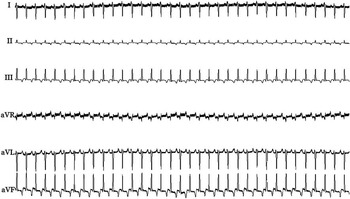
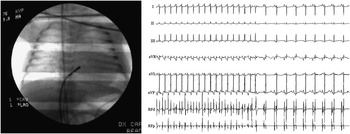
A 24 year-old healthy pregnant woman presented at 32 weeks of gestation for routine prenatal care. Ultrasound showed a 32-week estimated gestational age foetus with a tachycardia at 220 beats per minute. Treatment with digoxin and propranolol failed to provide control of the heart rate. Owing to persistent and refractory tachycardia and cardiac insufficiency – manifested as hydrops, with pericardial and pleural effusions – a caesarean section was performed at 34 weeks of estimated gestational age. A female neonate, weighing 1750 grams with 1- and 5-minute Apgar scores of 8 and 7, respectively, was born and was noted to have a heart rate of 190–220 beats per minute. The 12-lead electrocardiogram showed an incessant narrow complex tachycardia, with an RP interval greater than the PR interval and negative P waves in leads II, III, and aVF, suggesting permanent junctional reciprocating tachycardia (Fig 1). A chest X-ray showed cardiomegaly and pulmonary congestion. Later, the neonate required mechanical ventilatory support because of severe respiratory distress. An intravenous adenosine bolus (0.2 milligram per kilogram) terminated the tachycardia, which spontaneously reinitiated after two beats of sinus rhythm. Pharmacological treatment was tried with flecainide (2 milligrams per kilogram per day), digoxin (10 microgram per day) and amiodarone (15 micrograms per kilogram per minute) over 48 hours, but the tachycardia persisted. On the third day of life, the echocardiogram revealed left ventricular dysfunction with a shortening fraction of 20%, requiring inotropic support. On the fourth day of life, she underwent electrophysiologic study with ablation. A single standard 6 French, 4-millimetre tip deflectable quadripolar catheter (Cordis, Biobsense Webster, Inc, Diamond Bar, California, United States of America) was introduced through the right femoral vein for mapping, pacing, and ablation purposes. The His-bundle region was mapped and used as an anatomical reference. Incessant tachycardia was interrupted several times during manipulation of the catheter and re-initiation of the tachycardia occurred after a few sinus beats. The initial P wave of the tachycardia was identical to all subsequent P waves. The earliest retrograde atrial activation was found to be close to the ostium of the coronary sinus. Overdrive ventricular pacing during tachycardia revealed a ventricular–atrial–ventricular response, consistent with an atrioventricular nodal-dependent tachycardia. After administration of 80 units per kilogram of intravenous heparin, temperature-control radiofrequency energy was delivered using a Stocker II, Biobsense Webster catheter. Short radiofrequency energy applications were gradually delivered until the end of tachycardia – total time was 70 seconds with 55°C per 25 watts (Fig 2). The patient was observed for 30 minutes and an electrophysiology study was performed; no further tachycardia could be induced. The total procedure time was 90 minutes and the fluoroscopy time was 12 minutes. There were no intra-procedural complications. During the following hours, the haemodynamic condition improved markedly, and 72 hours later the neonate was extubated and inotropic drugs were discontinued. An echocardiogram showed improvement of left systolic ventricular function, now with a shortening fraction of 35%.
Electrocardiographic leads I, II, III, aVR, aVL, and aVF, showing a narrow QRS complex tachycardia with negative P waves in II, III, and AVF and associated RP interval greater than the PR interval.

Top panel. Left: fluoroscopic image recorded during the ablation procedure, demonstrating the site of successful ablation. It depicts a 6 French catheter located in the right posteroseptal region, close to the ostium of the coronary sinus. Right: radiofrequency application showing termination of permanent junctional reciprocating tachycardia. Lower panel. Electrocardiogram (I, II, aVR, aVL, aVF) after successful ablation.

After a follow-up of 2 years, the child remains in sinus rhythm without pharmacological treatment.
Discussion
The clinical course of supraventricular tachycardia in neonates is usually benign. The most common mechanism associated with neonatal tachycardia is one that is accessory pathway mediated. Accessory pathway-mediated supraventricular tachycardia seems to resolve in about 60% of the cases. Rarely, invasive electrophysiologic study with ablation could be considered in this age group but should be restricted to cases in which antiarrhythmic drugs are ineffective and the tachycardia supports haemodynamic compromise.Reference Bauersfeld, Pfammatter and Jaeggi5 There are concerns with regard to performing radiofrequency ablation in neonates and infants. Several studies have shown a greater complication rate in association with ablation in children weighing less than 15 kilograms,Reference Kugler, Danford and Deal6 although these increased risks could not be confirmed in the most recent large series of ablations reviewed from the Pediatric Radiofrequency Ablation Registry.Reference Blaufox, Felix and Saul7 The occurrence of complications in young children relates particularly to the handling of multiple catheters, which is thought to increase the risk of cardiac perforation. In addition, X-ray exposure is thought to be detrimental to the developing child.Reference Blaufox, Felix and Saul7
We describe a premature neonate with haemodynamic compromise as a result of drug-refractory permanent junctional reciprocating tachycardia involving a concealed slowly conducting retrograde posteroseptal accessory pathway.
This case summarised the clinical course and ablative intervention in a premature neonate. We used a single-catheter approach – one or two catheters – as an initial approach to minimise the risk of procedure-related compromise, specifically in a neonate where intravascular access is limited and challenging. This technique, described at other institutions,Reference Kuck and Schliiter8, Reference Brugada, Closas and Ordónez9 documents good results, comparable to those where multiple catheters are used.
In their series of 936 paediatric patients undergoing radiofrequency ablation, Brugada et alReference Sarquella Brugada and Brugada10 described the single-catheter approach. The average age of the patients was 12 plus or minus 4 years and the mean follow-up was 7 plus or minus 2.7 years. The overall success rate was 98% with a complication rate of 0.42% with no deaths reported. In this same cohort, when analysing the group of infants – patients less than or equal to 1 year of age – he observed that the more common substrates supporting sustained supraventricular tachycardia were mechanisms involving an accessory pathway (32.3%), permanent junctional reciprocating tachycardia (22%) and pre-excitation syndromes (20.5%). In this subgroup of patients, the percentage of immediate or primary success (first procedure) was 95% with a 9% recurrence rate, probably related to the use of lower temperatures and radiofrequency energy application times in order to reduce the possibility of complications. In this same cohort, there was a 90% success rate with a second procedure and only 2% of patients required a third procedure; demonstrating the safety and effectiveness of the procedure associated with this approach.
This series has great implications for the management of arrhythmias in infants and neonates. It suggests that the use of radiofrequency energy may be safe and effective.
Finally, these observations suggest that a specific diagnosis regarding the arrhythmia substrates is limited and in most cases to the surface electrocardiogram, which then supports and guides electrophysiologic study and an ablative strategy. The single-catheter approach is dynamic and allows manipulation of the ablation catheter to specific regions of the heart without compromising an accurate diagnosis, and this technique in addition may have advantages from the standpoint of costs, as only a limited number of catheters are used.
Conclusions
Radiofrequency ablation, using a simplified, single-catheter technique, is a feasible option in premature infants, and can be considered the treatment of choice in patients with refractory supraventricular tachycardia resulting in tachycardia-mediated cardiomyopathy.