INTRODUCTION
Since the initial development of CBT for depression in the 1970s (Beck, Reference Beck1976) the therapy has become a popular treatment option for a variety of mental health problems. In recent years CBT techniques in group and individual formats have been offered to people who experience distressing psychotic symptoms (such as auditory hallucinations) and there is now considerable evidence to support their efficacy (Birchwood et al., Reference Birchwood, Dovey, McLeod and Morris2007). There is, however, very little documented evidence regarding CBT based groups run specifically in the PICU setting and no documented reason why this is the case. Historically, the interventions offered in PICUs have consisted of psychopharmacology (Okocha, Reference Okocha, Beer, Pereira and Paton2008), a low stimuli environment and a higher ratio of staff to clients (Beer et al., Reference Beer, Pereira and Paton2008). With high numbers of clients having repeated admissions, these interventions alone are arguably ineffective in achieving and maintaining long-term mental well-being.
A key reason for admission to psychiatric wards is non-concordance with prescribed medication which precipitates significant mental state deterioration (Abas et al., Reference Abas, Vanderpyl, Prou, Kydd, Emery and Foliaki2003). Research in PICU settings suggests that this is also a significant factor influencing admission (Pereira et al., Reference Pereira, Sarsam, Bhui and Paton2005). Subsequently a primary objective for an admission is to re-stabilise a medication regime (Abas et al., Reference Abas, Vanderpyl, Prou, Kydd, Emery and Foliaki2003). It is interesting to note however, that despite developments in neuroleptic medication, a significant proportion of clients, particularly with schizophrenia, continue to experience distressing voices (Miles et al., Reference Miles, Peters and Kuipers2007) which may contribute to prolonged admissions and re-admissions.
It has been established that much of the distress caused by voices arises from the client’s beliefs about the voice rather than the voice itself (Chadwick & Birchwood, Reference Chadwick and Birchwood1995). Clients may also report symptoms such as visual hallucinations and delusions which support their beliefs about the voices (Chadwick & Birchwood, Reference Chadwick and Birchwood1995). Research has demonstrated that group and individual CBT approaches, which focus on the meaning individuals attribute to voices and their relationship to the voice, have positive impacts for voice hearers. For example, clients report that they find it beneficial to talk about their voices with others who have similar experiences and feel comforted by them (Wykes et al., Reference Wykes, Parr and Landau1999). Also positive outcomes of CBT group work have been evidenced for clients with first episode psychosis including symptom improvement and adaptation to illness (Penn et al., Reference Penn, Waldheter, Perkins, Mueser and Lieberman2005). More specifically it has been found that group CBT weakens the voices’ apparent omnipotence (Chadwick et al., Reference Chadwick, Lees and Birchwood2000).
Current national policy and guidelines advocate the use of psychosocial interventions for acute psychosis. For example, The National Institute for Clinical Excellence (NICE) guidelines for the treatment of schizophrenia state that CBT should be available as a treatment option specifically to assist the development of insight and to manage poor treatment adherence (NICE, 2002). Additionally, the schizophrenia update due for publication in March 2009 recommends, in light of new evidence regarding the effective use of some psychosocial interventions, ‘the use of antipsychotic medication and/or a psychological intervention for treatment of an acute psychotic episode’ (NICE, in press). Furthermore, it has been estimated that the cost ratio of group CBT compared with individual therapy is 14:1 (Wykes et al., Reference Wykes, Parr and Landau1999). Therefore, the challenge for acute services is to deliver evidence based psychological interventions in a collaborative, efficacious and workable manner.
In response to these recommendations, this article describes the authors experiences of developing a CBT informed ‘Living with Voices’ group for a psychiatric intensive care unit. It provides an overview of the group content, focusing on how it was specifically adapted for the PICU environment, and also presents some initial reflections by service users and practitioners on the success of the group.
The group was developed and facilitated through collaborative working of mental health practitioners, psychologists and nursing staff. The aims of the group, inspired by the work of Romme & Escher (1989; 2000), were to normalise the experience of hearing voices through sharing experiences with other service users, to equip service users with a greater sense of control over their voices and to reduce distress associated with hearing voices, rather than reducing the symptoms directly.
OVERVIEW OF THE ‘LIVING WITH VOICES’ GROUP
Considerations for PICU
The PICU ‘Living with Voices’ group sessions were carefully adapted from material developed for clients on an acute ward. A number of important changes were made. Firstly, the sessions were run at a slower pace and less material was covered each session than on the acute wards. Secondly, it was important that the session plans were flexible to suit the needs of those attending. Thirdly, given the shorter term nature of many PICU admissions and difficulties in engaging PICU patients in regular group sessions, the sessions were adapted so that although they linked together, they could also stand alone. This meant that patients would not be excluded from any sessions due to previous non-attendance. Fourth, the facilitators were mindful of the language they used and adapted this depending on the clients in the group. For example, terms such as psychosis and schizophrenia were not used with clients experiencing florid psychosis and/or limited insight, to reduce disengagement.
In the PICU environment clients are often physically restricted and beliefs that they are ‘being dictated to’ may result in non-engagement, therefore the facilitators were mindful of the need to be flexible. An inability to be flexible may have led to the facilitators feeling frustrated if the group didn’t run exactly as planned, and group members not getting the most out of the group and not wanting to attend again. Although ‘facilitated’ by practitioners, the group generally took a collaborative approach, considering what the group members wanted to discuss and how they wanted to discuss it. For example, group members often wanted to express themselves in ways other than simply discussing their experiences, therefore, they were supported to write and draw about their experiences on the group board.
The group
All sessions began with an open discussion of ground rules for the group. This made service users aware of what was and was not acceptable and ensured that all members felt safe and supported throughout the sessions.
Session 1
Session one began with a discussion of the expectations clients had of such a group and asked if they had previously attended such a group. This gave the facilitators an insight into service users’ thoughts and helped to establish realistic and achievable expectations. An exercise was then completed looking at famous voice hearers. The aim was to normalise the experience of voice hearing (Romme & Escher, Reference Romme and Escher2000) and assist in highlighting to group members that success in life can be achieved despite hearing voices. Research has shown that only one third of voice hearers from a sample of the general population report distress or impairment of functioning severe enough to meet the criteria for a psychiatric diagnosis (Tien, Reference Tien1991). The group then discussed what it is like to hear voices. Facilitators assisted in maintaining the flow of discussion, adding their knowledge and experience of working with people who experience voices, if it was felt the group would benefit from this.
Session 2
The second session aimed to normalise the experience of hearing voices. Statistics which show the high occurrence of voice hearing at some point during people’s lives were presented. Studies investigating the prevalence of voices in the general population have come up with different results, but some suggest the incidence could be above 70% (See Nelson (2005) chapter 12 for further discussion). This was often a surprise to service users, and also emphasised that high numbers of people who hear voices do not require hospitalisation. A visual illusion was used to highlight the different ways in which people perceive the world in different situations. This was one of a number of different ways in which the group was encouraged to be as interactive as possible. The aim was to avoid facilitators talking at, rather than with, clients. A discussion followed which considered the impact that hearing voices can have on one’s life.
Session 3
Session three focussed on the causes of voices. Service users were asked about when they first heard voices, and supported in sharing their first memories of hearing the voice and what they thought and felt at the time. This also provided an opportunity for them to consider how things might have changed.
The session then moved on to look at what service users believe causes voices. The facilitators presented some of the theories that have been developed to explain voices. These included social (Os & McGuffin, Reference Os and McGuffin2003), biochemical (Willner, Reference Willner1997) and genetic theories (Gottesman, Reference Gottesman1991). Stress was looked at in some depth, using the stress-vulnerability model (Zubin & Spring, Reference Zubin and Spring1977) to demonstrate the proposed relationship between stress and voices. Service users were provided information about the effects of stress on day-to-day lives, how to spot stress and how to deal with it. Clients were asked if they noticed a relationship between times of stress and frequency or severity of voices.
Session 4
The fourth session began to introduce coping strategies. It started with a discussion about which coping strategies group members currently use. The group was then asked to divide the strategies they had identified into helpful and unhelpful categories. This usually provoked a discussion as members disagreed on which category each coping strategy should be put into. Group members were then taught about and completed an exercise in progressive muscle relaxation.
Session 5
The theme of coping is continued in session five, focussing on the concept of mindfulness. Mindfulness involves purposefully paying attention to the present moment, without judgement. It has become increasingly well established as a useful tool to aid service users in managing their relationship to their voices (Chadwick, Reference Chadwick2006). The session offered information about mindfulness and then a mindfulness exercise was undertaken to help group members begin to learn the skill.
Session 6
Session six introduced the ‘ABC’ model (Kingdon & Turkington, Reference Kingdon and Turkington2002). This is a CBT tool which helps service users to reflect on their beliefs (B) about their voices (A) and the consequences (C) of these beliefs in terms of their emotions and behaviours. Group members were introduced to the concept that it is not the auditory hallucinations which cause their distress, but the beliefs that they hold about them. A simple example of this was offered by facilitators to aid the group's understanding. The group was then invited to give an example of their own. The session finished with a guided imagery exercise. Facilitators were mindful of the potential risks of using guided imagery with clients experiencing psychosis. They found however that the exercise enabled group members to finish the session relaxed rather than troubled by potentially distressing material they had discussed in the group.
Session 7
The final session focused on the power of voices and the relationship that group members had with them. Clients were encouraged to look at the evidence for their voices having power over them and were taught simple ways in which they may be able to change the power balance. At the end of the session, a short exercise in relaxation, grounding or mindfulness was completed.
ATTENDANCE OUTCOME DATA
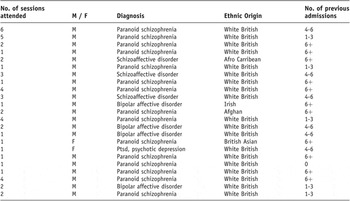
The primary focus of this pilot study was to consider whether a Voices group could be implemented and run in this setting. Table 1 documents group attendance. In terms of engaging clients, 23 clients attended the group. The number of sessions attended ranged from one to six (mean = 2.2). Attendees were predominantly male (21 male, 2 female) and the most common diagnosis was paranoid schizophrenia (n=15).
Voices group demographic information

NB Previous admissions: 0, 1-3, 4-6, 6+
DISCUSSION
This article focused upon the novel implementation of a ‘Living with Voices’ group on a PICU. In the absence of documented research on the implementation of CBT groups in this context, the authors’ primary challenge was to consider whether such groups could be implemented and run in this setting. A secondary focus was the consideration of effectiveness and impact of the group.
In relation to feasibility of implementing a voices group on a PICU, this brief pilot study demonstrates that such interventions can be undertaken in a PICU environment. The group was successfully implemented and the attendance figures indicate that the group was accessible for a range of clients. Anecdotal evidence from staff also indicated that attendance of the living with voices group correlated with increased levels of attendance of other group work (e.g. occupational therapy based activities) in the clinical area.
In relation to the effectiveness and impact of these groups, since the primary focus of the group was to engage clients, formal evaluation measures were not implemented in the initial group sessions. In the absence of a formal evaluation measure, the following anecdotal observations and comments were noted.
The group appeared to increase the rapport between service users and facilitators. Consequently, potential incidents of aggression were more successfully de-escalated by making use of this rapport. In the absence of a control group, however, it is as yet unclear whether this was a result of the group content or simply the extra time spent with clients.
Service users appeared to develop an increased awareness and empathy for the experiences of other patients on the ward after sharing their experiences during the sessions. This increased the social support network of service users and assisted in coping with distressing symptoms of psychosis that service users faced whilst in hospital.
Finally, attending the group assisted practitioners in identifying appropriate referrals for clients. Work completed in the group highlighted potentially beneficial one-to-one work that could be undertaken; it also indicated that clients may benefit from psychology input or enjoy a particular occupational activity that could be organised. Specific issues that arose from the group also indicated needs which could be included in individualised care plans (e.g. problems with literacy, difficulties concentrating on staff instructions when voices were ‘noisy’).
This study does not provide sufficient evidence to demonstrate that the PICU Voices group is as an effective treatment option – there is a need for more research to be undertaken before this conclusion can be drawn. To work towards this, the authors have recently initiated formal evaluation of these groups using brief standardised measures of mood, distress and symptoms. Additionally, simple non-standardised questionnaires are being utilised to assess whether clients feel the group is useful and which components are helpful or unhelpful. Subsequent data will be available on request from the authors.
In conclusion, the implementation of this group demonstrates that CBT informed Voices groups can be successfully undertaken in a PICU environment. There is, however, a need for the efficacy of such groups to be researched formally, ideally using standardised outcome measures.
Acknowledgements
We would like to thank Dr Laura Dannahy who developed the initial protocol for the Voices Groups at the Department of Psychiatry.