


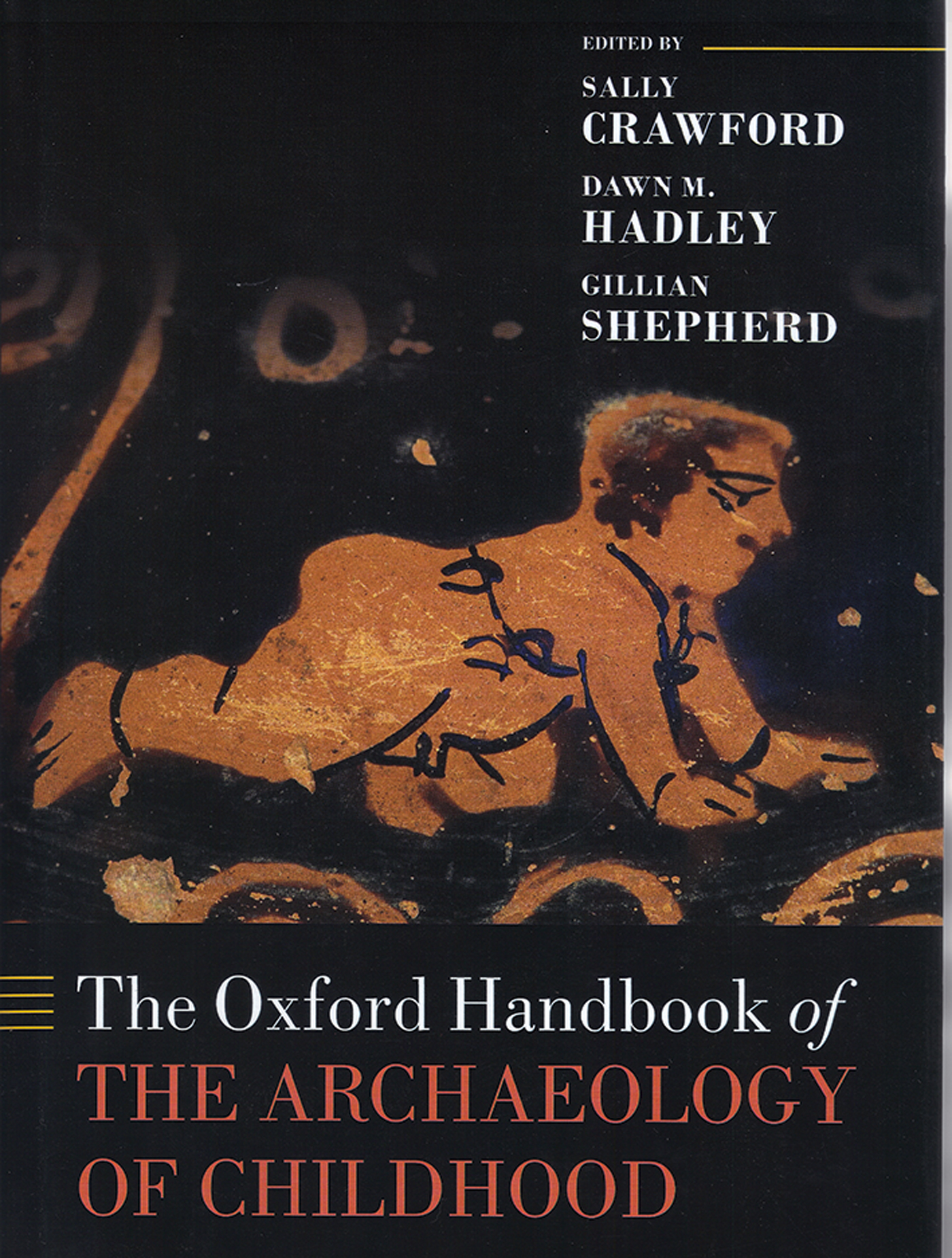
This volume represents a significant work that brings together archaeological and bioarchaeological research on children and childhood. The chapters cover an impressive chronological and geographic range. The aim of the Oxford Handbook series, as stated on their website, is to “offer authoritative and up-to-date surveys of original research in a particular subject area” where “leading figures in the discipline give critical examinations of the progress and direction of debates, as well as a foundation for future research”. This volume certainly achieves that aim, providing a topical examination of childhood in the past from multiple perspectives and showcasing a variety of approaches by leading researchers from around the globe.
This volume has an impressive 37 chapters and is edited by world-renowned leaders in the field of the archaeology of childhood. Rather than address chapters individually, I will offer some generalised observations. The volume is organised into sections around the thematic topics of: ‘The History and Impact of the Archaeology of Childhood’; ‘Defining Children and Childhood’; ‘Children, Family, and Households’; ‘Learning, Socialization, and Training’; ‘Self, Identity, and Community’; ‘Health, Disease, and Environment’; ‘Death, Memory, and Meaning’; and ‘Seeing, Presenting, and Interpreting the Archaeology of Childhood’. The use of thematic topics brings together both bioarchaeological and archaeological approaches as well as perspectives from history, art history and museum studies; indeed, some of the chapters provide a sophisticated integration of multiple approaches. This is significant for the field because much research on childhood in the past suffers from a lack of communication and collaboration between the different specialisations (Inglis & Halcrow Reference Inglis, Halcrow, Beauchesne and Agarwal2018). A further strength of the volume is that much of the bioarchaeological work presented in it is thoroughly socially contextualised.
The first section, ‘The History and Impact of the Archaeology of Childhood’, has an introductory chapter by the editors, and a chapter by Grete Lillehammer, arguably the founder of the field of childhood archaeology. These provide reviews of historical developments in the field, from the founding work in childhood studies by Philippe Ariès, to approaches to the archaeology of childhood in early works that were somewhat focused on finding childhood and justifying why we should care, to current work that is taking more sophisticated theoretical and methodological approaches. In Lillehammer's chapter, the Society for the Study of Childhood in the Past is commended for its role in the evolution of the field. Indeed, this volume demonstrates how much the discipline has developed over the past 30 years, from its early inceptions to a flourishing field with multiple approaches.
Section two, devoted to ‘Defining Children and Childhood’, encompasses papers that define childhood using biological approaches (Jo Buckberry), child growth and development (Simon Mays), the social life course (M. Annette Grove & David F. Lancy), and the investigation of the maternal-infant nexus using a life-course perspective (Rebecca Gowland). There still remains a need, however, for future studies that reconcile the biological and social approaches to age and the life course.
In section three, ‘Children, Family, and Households’, we find chapters detailing different archaeological approaches to assessing children in the domestic space in both prehistory and history (Brigitte Röder; Maureen Carroll, Penelope Allison; Supriya Varma; Rebecca Yamin). This is followed by ‘Learning, Socialization, and Training’ (section four) with chapters that consider the material culture of work and education from a diversity of places and periods (Robert W. Park; Craig Cessford; Vicki Crewe). Two chapters in this section integrate osteological and historical analyses to investigate childhood, labour and activity. These focus on the lives and deaths of children in a sixteenth- to seventeenth-century mining community in Sweden (Anne Ingvarsson Sundström, Jan Mispelaere & Ylva Bäckström) and ships boys in the late eighteenth- to early nineteenth-century Royal Navy (Ceridwen Boston).
Section five, ‘Self, Identity, and Community’, investigates a raft of topics including childhood learning and play (B. Sunday Eiselt), art (Jessica Cooney Williams; Katherine V. Huntley), socialisation and care (Margarita Sánchez Romero), representations of childhood (Olympia Bobou), and the construction of childhood within the context of migration (Dawn M. Hadley).
A selection of chapters employing a diverse range of bioarchaeological methods, including reconstructing childhood physical activity (Lesley Harrington & Benjamin Osipov), disease and trauma (Mary E. Lewis), infant head shaping (Susanne Hakenbeck), isotope analyses of childhood diet (Rebecca C. Redfern) and movement and migration (Katie A. Hemer & Jane A. Evans), make up section six—‘Health, Disease, and Environment’.
Section seven, ‘Death, Memory, and Meaning’, includes work that investigates mortuary treatment (Gillian Shepherd; Janet Huskinson; Colm J. Donnelly & Eileen M. Murphy), play (Nicola Harrington), child sacrifice and socio-political dynamics (Deborah E. Blom), and the representation of children in art (Sophie Oosterwijk).
The final section (eight), ‘Seeing, Presenting, and Interpreting the Archaeology of Childhood', investigates methods of incidental photographing of children at archaeological sites—and what that reveals about childhood at the time of excavation and attitudes to human subjects in archaeological recording (Sally Crawford & Katharina Ulmschneider), the representation of children and childhood in museums (Mark A. Hall; Sharon Brookshaw), and children's interactions with archaeological museums (Claudia Lambrugo).
I highly recommend this book as a central reference for students and researchers in the disciplines of archaeology, bioarchaeology and the history of childhood. The volume is meticulously edited, with chapters written in accessible language, and extensively illustrated. Although the price of this book, as with most books of this size, may be restrictive for early career researchers and students, it is a must-have. This volume is a brilliant showcase for the diversity and richness of the field of the archaeology of childhood.


