1. The Use of Sex-Marking Suffixes to Mark Only Gender
In German and Dutch, a noun denoting a female can be formed from a noun denoting a male by the attachment of a derivational suffix:
(1) German
a. Vorgänger ‘male predecessor’
Nur sein Vorgänger im Amt des Finanzministers, Theo Waigel, hatte sich 1996 mehr Geld gepumpt (Spiegel corpus). Footnote 1
‘Only his predecessor-masc in the office of finance minister, Theo Waigel, had borrowed more money in 1996.’
b. Vorgängerin ‘female predecessor’
Im türkisfarbenen Abendkleid nahm sie überwältigt vor Freude die Krone von ihrer Vorgängerin, der Irin Rosanna Davison, die Tochter des Sängers Chris de Burgh ist, entgegen (Spiegel corpus).
‘In the turquoise evening gown, overcome by joy, she accepted the crown from her predecessor-fem, the Irish Rosanna Davison, who is the daughter of the singer Chris de Burgh.’
(2) Dutch
a. uitgever ‘male publisher’
Want hij is uitgever en begeeft zich dus in kringen van BN'ers.Footnote 2
‘Because he is a publisher-masc and therefore sets off into circles of Dutch celebrities.’
b. uitgeefster ‘female publisher’
Uitgeefster Annemarie van Gaal hoopt nog steeds tot een oplossing te komen met Catherine Keyl.Footnote 3
‘Publisher-fem Annemarie van Gaal still hopes to come to a solution with Catherine Keyl.’
The same suffixes are also found attached to nouns referring back to the feminine subject of a sentence in contexts in which the referent of the subject is inanimate:
(3) German
Und sogar die gigantische, illuminierte Schneeflocke über der Fifth Avenue, eine Weihnachtstradition, ist dieses Jahr viel glamouröser als ihre Vorgängerin, die seit 1984 hier hing. (Spiegel corpus)
‘And even the gigantic, illuminated snowflake-fem above Fifth Avenue, a Christmas tradition, is this year much more glamorous than its predecessor-fem, which had hung here since 1984.’
(4) Dutch
Uitgeverij De Stentor is uitgeefster van een van de grootste regionale ochtendbladen van Nederland; de Stentor.Footnote 4
‘The publishing house-fem De Stentor is the publisher-fem of one of the largest regional morning newspapers in the Netherlands: De Stentor.’
In 1 and 2, the suffixes perform their prototypical role of marking female sex and feminine gender on a noun denoting a person. In cases such as 3 and 4, in which the referent of the subject is inanimate and therefore cannot be defined in terms of its sex, the suffix that attaches to the noun referring to the subject can only be responsible for the change of lexical class. The Dutch data in 4 are unexpected as a masculine/feminine distinction is generally no longer made in the standard language: the extent to which the distinction remains is described in section 4.4.
An analysis of the attachment of these suffixes to inanimate bases is problematic and the sparse literature on the phenomenon falls into two camps. One camp proposes that the use of primarily female sex-marking affixes to mark only feminine gender, shown in 3 and 4, is inflectional or inflection-like, a view which implies that these suffixes are undergoing (or have undergone) grammaticalization (Müller Reference Müller1993, Wellmann Reference Wellmann1975). The other camp claims that the phenomenon is derivational, and that the inanimate objects denoted by the subjects have been personified: a noun referring to the subject can therefore serve as a base for a suffix attached mainly to nouns denoting people (Gallmann Reference Gallmann2005, Stricker Reference Stricker2000). Neither approach fully accounts for the situation.
The difference between biological sex and grammatical gender is relevant to the two distinct functions of the suffix -in and its Dutch counterparts. In the cases examined here, exemplified in 3 and 4, the feminine subject nouns denote referents which, being inanimate, have no biological sex: that is, there is no correspondence between sex and gender in these words. This is a property specific to the phenomenon at hand: independent of context, the assumed referents of Vorgängerin and uitgeefster are human with biological sex. Thus, a distinction is followed here between (biological) sex, denoting the property of animate entities of being male or female, and (grammatical) gender, denoting the property of words being masculine, feminine, or neuter.
In this paper, the nature of constructions such as 3 and 4 is investigated with the aim of providing a satisfactory description of them and how they came into existence. Following a discussion of the background concepts relevant to the phenomenon (section 2) and a review of the literature on the phenomenon (section 3), contemporary and historical usage data from German and Dutch are presented in section 4, following which the likely diachronic transition that led to the current situation is proposed and an attempt is made to satisfactorily account for the phenomenon in a manner that covers all the data (section 5). The information that these data give regarding categories such as inflection and derivation, and agreement itself, is presented. The investigation focuses on the German suffix -in. The parallel Dutch data are introduced into the discussion in order to shed more light on the German process.
1.1. The Suffix -in
The German derivational suffix -in is the dominant and strongly productive morphological means of female sex-marking in the language (Fleischer & Barz Reference Fleischer and Barz1995:182, Motsch Reference Motsch1999:365).Footnote 5 The suffix is attached to male-denoting or non-sex-specific bases in order to form a noun explicitly denoting a female referent. The resulting derived nouns are feminine in gender for the purposes of grammatical agreement. The prototypical use of -in is attachment to nouns denoting a person, as in 5a, although it may also be attached to nouns denoting “higher” animals (Hoberg Reference Hoberg2004:101), as in 5b.
- (5)
a.

b.

With “lower” animals, derivation with -in is generally said to be systematically not possible (Haspelmath Reference Haspelmath2002:104, Plank Reference Plank1981:96) although, owing to the suffix's productivity and the transparency of its derivatives, creative formations are encountered, as in the examples in 6 (examples from Hoberg Reference Hoberg2004:101 and Irmscher Reference Irmscher and Stiller1988:53–54).
(6)
This restriction is pragmatic: “for animals like beetles and worms, it is simply not particularly useful to distinguish between males and females” (Haspelmath Reference Haspelmath2002:105). It could therefore also be expected that -in would not be used in situations involving inanimate referents among which, on account of their inanimacy, no sex distinction can be made. Nevertheless, as the example in 3 illustrates, the suffix is systematically, if relatively rarely, attached to nouns that refer back to feminine nouns whose referents are impersonal and inanimate. The purpose appears to be to make the gender of both nouns match. This function of -in is the topic of the present investigation.
2. Background Concepts
In this section the background concepts relevant to the topic are introduced and discussed: inflection and derivation, grammaticalization and language change, agreement, and the animacy hierarchy.
2.1. Inflection and Derivation
In morphology the distinction routinely made between the categories derivation and inflection is the subject of much debate. Fundamentally, derivation “serves to create new lexemes,” while inflection “serves to create different forms of the same lexeme” (Booij Reference Booij2000:360). This distinction is important here because, although the suffixes whose activity is studied here are derivational in their canonical sex-marking use, the aspect of their activity described sees them marking only gender and, in German, the marking of the gender of words—and the matching of gender between two or more words—is inflectional. A change in membership of a gender class is brought about by the application of inflectional processes. Determiners and adjectives must match the gender of the noun they modify, altering their form accordingly: an appropriate determiner is selected and an appropriate suffix is attached to the adjective: for example, ein jung-er Mann ‘a−masc young-masc Mann-masc’, die jung-e Frau ‘the-fem young-fem woman-fem’, das jung-e Mädchen ‘the-neut young-neut girl-neut’ (see Durrell Reference Durrell2002:14). The agreement is governed only by the gender of the noun and not by external factors such as the biological sex of the referent; thus, *die jung-e Mädchen ‘the-fem young-fem girl-neut’ is ungrammatical. Certainly, nominal derivational suffixes determine the gender of the noun on which they appear; for example, words derived with the suffix -er are masculine, those derived with -ung (and, as already noted, -in) are feminine, those derived with -chen are neuter, and so on. However, in the case of all these suffixes the gender classification takes place alongside the main function of the suffixes, namely the formation of a noun with a particular sense. In 3, in contrast, -in contributes nothing to the semantics of the word on which it appears: it marks only feminine gender and, in this respect, it seems to have more in common with the canonical inflectional suffixes exemplified above than it does with typical derivational affixes (including the canonical use of -in).
Because the matching of the gender of words is prototypically an inflectional matter in German and Dutch, it is pertinent to consider whether the gender-matching role of usually sex-marking derivational suffixes should also be considered inflectional. Stump (Reference Stump, Štekauer and Lieber2005:53) notes the difficulty of determining whether a morphological process is derivational or inflectional. Nonetheless, an attempt is made in this paper to decide whether the phenomenon under investigation, which appears to exhibit characteristics of both categories (leading to contrasting analyses in the literature), should be viewed as an inflectional process or as a derivational process. Several criteria for distinguishing derivational and inflectional processes have been proposed (for example, Anderson Reference Anderson1982:585–587, Stump Reference Stump, Štekauer and Lieber2005:53–56). Those most relevant to the present investigation are listed and discussed below:
i. inflectional processes are determined by—and relevant to—syntax, and are obligatory (Anderson Reference Anderson1982:587, Booij Reference Booij2000:362, Bybee Reference Bybee2000: 370, 373): this is “[t]he most robust criterion for distinguishing inflection from word-formation” (Stump Reference Stump, Štekauer and Lieber2005:55; see also Bybee Reference Bybee1985:81).Footnote 7
ii. derivational processes, but not inflectional processes, can determine word class (Anderson Reference Anderson1982:586, Stump Reference Stump, Štekauer and Lieber2005:53).
iii. the application of inflectional processes is characterized by semantic regularity (Stump Reference Stump, Štekauer and Lieber2005:55); derivational processes tend to be semantically more idiosyncratic.
iv. “derivational operations apply before inflectional operations” (Stump Reference Stump, Štekauer and Lieber2005:56).
As predicted by Stump (Reference Stump, Štekauer and Lieber2005:53), these criteria are inconclusive in deciding whether the gender-matching of nouns using canonically derivational affixes is derivational or inflectional. Gender-matching as found in 3 and 4 is not syntactically determined: both constructions would be equally grammatical if the masculine base of the noun that refers to the feminine subject remained masculine (see Durrell Reference Durrell2002:6, Sitta Reference Sitta1998:749).Footnote 8 Therefore, according to criterion (i), the process is not inflectional. The suffix -in, in either of its roles, indicates that the word on which it appears is a noun; so, by criterion (ii), the process dealt with here is, again, derivational. The attachment of -in to a noun to make the gender of that noun agree with that of the subject of a construction is semantically very regular—always denoting simply “feminine gender”—and therefore inflectional by criterion (iii). However, this criterion also implies that the canonical attachment of -in to bases denoting people, which is semantically very regular, would also be inflectional (or at least inflection-like). Criterion (iii) is, therefore, weak. Finally, by criterion (iv), the process is derivational: for example, should a plural marker—that is, a canonically inflectional suffix—be added, it would follow the suffix -in.
In sum, these criteria maintain, with one (weak) exception, that gender-matching of nouns using canonically derivational suffixes is derivational. They do not account for the difference between this use of the suffixes and their canonical use attaching to bases that denote people. However, if the fundamental characteristics of derivation and inflection noted at the start of this section are considered, the picture changes somewhat. If derivation results in new lexemes but inflection results only in different forms of an existing lexeme, a difference emerges between the canonical use of -in (and its Dutch counterparts) and its gender-matching use. In the canonical examples 1 and 2, the suffix is added to a masculine base denoting a male human. The resulting words are feminine and denote a female human, and are therefore “new,” separate lexemes. The substitution of the “female” word for the “male” word, or vice versa, would change the semantic content of the construction, that is, whether the person referred to is a man or a woman. In contrast, in 3 and 4 the suffixes are attached to masculine bases which usually denote male humans but which, in context, only refer back to a feminine noun denoting an inanimate referent. In such contexts no male/female distinction can be made. The only difference between the masculine base of the target and the feminine target itself as found in these examples is the gender of the words: the target is a feminine variant of its masculine base and therefore not a “new” lexeme. Either the masculine base or the feminine variant can appear without changing the sense of the construction. In terms of semantic content, the gender-matching process under investigation is therefore similar to inflection. Furthermore, as noted at the start of this section, the marking of gender (as opposed to sex) is inflectional in German. Accordingly, despite its many derivational characteristics (a legacy of the canonical use of -in), the attachment of -in (and its Dutch counterparts) to nouns referring to feminine nouns with inanimate referents also resembles an inflectional process in some respects. This has had implications for the way in which the process has been accounted for up to now (section 3), and also makes the process relevant to the debate on the relationship between derivation and inflection.
The split morphology hypothesis (see Anderson Reference Anderson1982, Reference Anderson1992, and Perlmutter Reference Perlmutter1988) makes a strict distinction between derivation, which forms new lexemes pre-syntactically, and inflection, which provides appropriate grammatical forms of lexemes according to the requirements of the syntax (this position is summarized by Booij Reference Booij2000:366–368). It is, however, not always clear “[w]hether a sharp demarcation of inflection with respect to derivation is possible” at all (Booij Reference Booij2000:361). The opposing position states that the difference between derivation and inflection is “a gradual rather than a discrete distinction” (Bybee Reference Bybee1985:5); that is to say, there is a cline, of which one pole is “prototypical derivation” and the other pole “prototypical inflection” (Booij Reference Booij2000:361). Between the two poles are morphological processes which resemble both derivation and inflection to a greater or lesser extent: the process examined here is one of those, and it may help to shed more light on the distinction.
2.2. Grammaticalization and Language Change
Grammaticalization is “the process whereby lexical items and constructions come in certain linguistic contexts to serve grammatical functions, and, once grammaticalized, continue to develop new grammatical functions” (Hopper & Traugott Reference Hopper and Traugott2003:xv). As a diachronic process of semantic change, grammaticalization is gradual and an element undergoing grammaticalization can be expected to exhibit characteristics both of its original category and of the category it is moving towards. Overall, “[e]very change, at any level in a grammar, involves not ‘A > B,’ i.e. the simple replacement of one item by another, but rather ‘A > A ∼ B’ and then sometimes ‘> B’ alone” (Traugott & Dasher Reference Traugott and Dasher2002:11). Heine et al. (Reference Heine, Claudi and Hünnemeyer1991:213) list a number of “common linguistic effects of grammaticalization,” several of which correspond to the use of prototypically sex-marking derivational suffixes as (putatively) gender-marking inflectional suffixes:
• transition of an element from derivation to inflection
• concrete meaning → abstract meaning
• pragmatic function → syntactic function
The attachment of -in to a noun referring back to a noun with an inanimate referent is not a requirement of syntax and its use is optional, so it cannot be claimed that -in is truly performing a “syntactic function.” However, as a derivational element undergoing grammaticalization to be used inflectionally, -in would not necessarily be expected to have prototypical characteristics of either of the poles between which it is moving. Rather, it should show only a tendency towards grammaticalization. The fact that -in is used with both derivational and inflectional characteristics (see section 2.1) is evidence of grammaticalization in progress.
2.3. Agreement and the Suffix -in.Footnote 9
The phenomenon illustrated in 3 and 4 involves the gender of one noun being changed in order to match the gender of a noun to which it refers. As such, the process appears to be a case of agreement. In this section, agreement is described in more detail and the reasons for describing the phenomenon here as agreement defended.
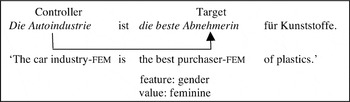
Agreement is the process that determines the “aspects of the exact form of a word which are determined by reference to the properties of some other word in the same structure” (Anderson Reference Anderson1988:25); for example, “[i]n Mary laughs, most accept that laughs is singular because Mary is singular” (Corbett Reference Corbett2006:5). In order for the existence of properties shared by two or more words to be classed as agreement, “the sharing must be systematic, […] as one element varies so will the other” (Corbett Reference Corbett2006:4). The terminology for denoting the elements involved in agreement is as follows (Corbett Reference Corbett2006:4): the controller is “the element which determines the agreement” (Mary in the above example), while the target is “[t]he element whose form is determined by agreement” (laughs in the above example), and the agreement feature is the respect in which there is agreement (number, gender, etc.). The domain is “the syntactic environment in which agreement occurs.” These terms are adopted here.
The operation of the gender-matching process shown in 3 and 4 is illustrated in figure 1 (based on Corbett Reference Corbett2006:5; example from Sitta Reference Sitta1998:749). Within the domain of the sentence, the agreement feature gender is marked by the attachment of -in to a non-feminine target noun to create a noun matching in gender that of the controller noun of which it is predicated.Footnote 10
The framework of gender agreement using -in (sentence domain).

Superficially at least, since the phenomenon under investigation involves the gender of one noun triggering the changing of gender of another noun to make the gender of the two nouns match, it resembles grammatical agreement, that is, agreement “determined solely by the grammatical properties of the words or phrases involved” (Matthews Reference Matthews1997:151). Kathol (Reference Kathol1997:21), who mentions the phenomenon briefly, describes it as agreement (and notes its optionality).
The optionality of the phenomenon, a characteristic that contrasts with prototypical inflection (section 2.1), is a consequence of the fact that the suffixes involved are not (indeed, by no means) fully grammaticalized (section 2.2); thus the phenomenon is not (yet) an obligatory syntactic process. Furthermore, in German (and Dutch), two nouns denoting the same referent generally need not agree in grammatical gender. This corresponds to the generalization across languages that nouns are less heavily involved in agreement than verbs and adjectives (Baker Reference Baker2008:1). Any matching of the genders of two nouns as found in 3, and in 7a below, could be regarded as coincidental or, at most, a matter of preference on the part of the language user. As an optional process, the gender-matching under investigation here may also be a matter of preference for the language user. In 7, the constructions differ only stylistically.Footnote 11
- (7)
a. Ich trinke nie Cola, die Brühe kommt mir nicht ins Haus.
‘I never drink cola-fem, I won't have the muck-fem in my house.’
b. Ich trinke nie Cola, der Mist kommt mir nicht ins Haus.
‘I never drink cola-fem, I won't have the junk-masc in my house.’
c. Ich trinke nie Cola, das Zeug kommt mir nicht ins Haus.
‘I never drink cola-fem, I won't have the stuff-neut in my house.’
Nonetheless, the examples in 7 are not wholly parallel to those under discussion in this paper. While in 7 the (potential) controller noun, just like the controller nouns in the cases investigated, is a feminine noun with an inanimate referent, the (potential) target nouns in 7 are all simplex nouns whose usual referent is inanimate. In contrast, the target nouns in the gender-matching examples investigated here are derived deverbal agent nouns which have explicitly been assigned masculine gender through the derivational suffix -er. Such nouns are especially frequent bases for -in derivatives: in the corpora used here, 84.72% of the bases of -in derivatives were found to be derived agent masculine nouns; 53.89% of the bases had been derived with the suffix -er (Scott Reference Scott2006a:138).
The frequent occurrence of derived agent masculine nouns as bases for -in derivatives is a consequence of their prototypical (person-denoting) use and of language users’ preference for explicitly marking sex on a noun denoting a person. Outside of specific contexts, these target nouns all denote male humans: the masculine suffix -er explicitly marks them as such despite the frequent description of such nouns as generic masculines, so-called because, despite their grammatical gender (and language users’ link between grammatical gender and biological sex), their referents are understood to be either male or female (Braun Reference Braun1996:54f.); for example, Besucher ‘visitor (male or female)’, Student ‘student (male or female).’ Nonetheless, there appears to be a widespread lack of confidence among language users in the ability of a word that is masculine in gender (despite its supposed genericness) to denote a referent of female sex. This leads to the use of forms such as Besucherin ‘visitor (female)’ and Studentin ‘student (female)’, and non-established formations such as Bossin ‘female boss’ (Der Spiegel 28/ 2005:119), Fanin ‘female fan’,Footnote 12Teenagerin ‘female teenager’ and Erstsemesterin ‘female first-semester student’ (both Sick Reference Sick2004:170); as well as the attachment of -in to masculine person-denoting nouns formed with -ling, a suffix said by Aronoff & Fuhrhop (Reference Aronoff and Fuhrhop2002:452) to prohibit further derivation with -in, for example, Flüchtlingin ‘female refugee’, Fremdlingin ‘female stranger’.Footnote 13 Language users employ various strategies to emphasize that a referent may be explicitly either male or female or, where a group of people is denoted, that the group contains males and females (or could potentially do so) (for example, Durrell Reference Durrell2002:5–6; also Sick Reference Sick2004:168–172). The most notable morphological means of achieving this is the suffix -In which first saw use in the 1980s, for example, BesucherIn ‘visitor (male or female)’, StudentInnen ‘male and female students’ (Scott Reference Scott2006b). This desire to explicitly mark female sex on nouns that supposedly denote people of both sexes is a likely influence on the explicit marking of feminine gender on nouns denoting inanimate referents where a masculine noun would also be grammatical. Thus, the bases of the target nouns involved in gender-matching are especially likely to serve as bases for derivation with -in both due to their structure and due to their semantic content. The gender-matching observed in this paper has more in common with the sex and gender-matching found with human referents than it does with the gender non-matching (shown in 7b,c) found when the referents are inanimate.
Furthermore, if the target noun is a deadjectival conversion (Fleischer & Barz Reference Fleischer and Barz1995:215–216), that is, an adjective functioning syntactically as a noun while retaining its adjectival declension, agreement with its controller is obligatory, as shown in 8. These examples, which are comparable to the cases that form the core of this investigation (inasmuch as the target noun could be replaced by a feminized noun), show that, despite the evidence of 7, the gender-matching of two nouns that share a referent may be obligatory:
- (8)
a. Die Regierung geht in die Verhandlungen als Freiwillige (*Freiwilliger) ein.
‘The government-fem goes into the negotiations as a volunteer-FEM (volunteer-masc) (that is, voluntarily).’
b. Die SPD sah sich as Vorgesetzte (*Vorgesetzter) in der Koalition.
‘The SPD-fem saw itself as the main [partner]-fem (main [partner]-masc) in the coalition.’
Therefore, the environment in which the phenomenon under investigation occurs is one in which the matching of gender between two nouns is sometimes required but generally is optional. The matching of number and gender of the controller noun and the target in the sentences in 8 resembles in nature the canonical agreement in German exemplified at the start of section 2.1. As the gender-matching investigated here similarly involves the matching of gender between the subject of a syntactic construction (the controller) and another noun referring back to the subject (the target), there is a case for stating that it, too, must be a type of agreement. The difference between an example such as 3 and the examples in 8 is that, in 8, the agreement is obligatory while in 3 it is not. The optionality of the agreement in 3 is simply another consequence of grammaticalization in progress (section 2.2).
Besides this evidence for considering the phenomenon to be a case of grammatical agreement, it also matches the characteristics of notional or semantic agreement, in which the agreement is determined “by the meaning of a word or phrase involved” (Matthews Reference Matthews1997:248, my emphasis). Although “[t]raditionally, agreement has been treated as an essentially syntactic phenomenon” (Haskell & MacDonald Reference Haskell and MacDonald2003:760), “there is a growing body of evidence that semantic factors may play a more central role in agreement computation” (Haskell & MacDonald Reference Haskell and MacDonald2003:761). Under their constraint satisfaction approach, Haskell & MacDonald observe competition between singular and plural verb forms in English cases such as 8, which occurs because “the contributions of semantic and syntactic factors combine to partially activate both singular and plural verb forms” (Reference Haskell and MacDonald2003:774). The competition arises because “[c]ollectives carry conflicting grammatical and notional number: A noun such as choir is morphologically singular, but can be notionally plural” (Bock et al. Reference Bock, Nicol and Cutting1999:340; see also the discussion in Liberman Reference Liberman2005). Example 9 is from Haskell & MacDonald Reference Haskell and MacDonald2003:769.
- (9)
a. Grammatical agreement, verb singular
The cast in the weekend performances was famous.
b. Semantic (notional) agreement, verb plural
The cast in the weekend performances were famous.
The choice faced by speakers of German and Dutch in cases such as 3 and 4 is similar to that examined by Haskell & MacDonald (Reference Haskell and MacDonald2003): either of the two possible variants is acceptable. The agreement in those cases reflects that found in preferences such as that in 10, in which 10a, where two nouns match in gender, is preferable to 10b, in which there is no such agreement.Footnote 14
- (10)
a. Die Regierung ist die Mutter des Staates.
‘The government-fem is the mother-fem of the state.’
b. ?Die Regierung ist der Vater des Staates.
‘The government-fem is the father-masc of the state.’
The source of the agreement between the impersonal feminine Regierung and the female/feminine Mutter, and of the agreement described in this paper, is the link between grammatical gender and biological sex caused by the correspondence between the two categories found in most German personal nouns, of which Mutter is an example. Once such a link has been established in speakers’ minds, agreement of the type found in 10a is preferable, in analogy to similar constructions denoting human referents, as in 11: this is extended to the impersonal constructions dealt with in this investigation.
- (11)
a. Angela Merkel ist seit 2005 Bundeskanzlerin.
‘Angela Merkel-fem has been federal chancellor-fem since 2005.’
b. ?Angela Merkel ist seit 2005 Bundeskanzler.
‘Angela Merkel-fem has been federal chancellor-masc since 2005.’
The agreement described in this paper may therefore have its source in semantic or pragmatic considerations, namely the link between feminine gender and female sex. In the terminology of Haskell & MacDonald (Reference Haskell and MacDonald2003, passim), there is competition in speakers’ choice between a non-agreeing construction, or a construction in which the gender of the two nouns agree.
While maintaining that gender agreement with -in must be classed as agreement due to the simple fact that the gender of one noun is made to match that of another noun, it is recognized that the phenomenon is an atypical form of both grammatical and notional agreement, whereby it more strongly resembles the former.
2.4. The Animacy Hierarchy
The suffix -in and its Dutch counterparts attach prototypically to bases with animate referents. In the phenomenon investigated here, however, the referents are inanimate. The animacy of the referents must therefore be introduced into in the analysis. Hierarchies indicating the relative animacy of referents are referred to under various names, for example, animacy hierarchy (Dahl Reference Dahl, Unterbeck and Rissanen1999), gender scale (Quirk et al. Reference Quirk, Greenbaum, Leech and Svartvik1985:313, 322–323) and personality scale (Kreyer Reference Kreyer2003:175). At its most basic, the animacy hierarchy follows the pattern “human > animal > inanimate” (Dahl Reference Dahl, Unterbeck and Rissanen1999:99). Collective nouns, denoting a mass of people of unspecified sex (and therefore prevented from serving as bases for the female sex-marker -in) appear between humans and animals (that is, the prototypical referents of the -in- derivatives and their bases) in the scales of Quirk et al. (Reference Quirk, Greenbaum, Leech and Svartvik1985) and Kreyer (Reference Kreyer2003). As collective nouns fall directly into the sphere of use of -in in terms of animacy, the attachment of the suffix to the targets of such nouns when performing gender agreement is unsurprising, even if it cannot perform its usual sex-marking role. Kreyer (Reference Kreyer2003) includes a “personified” category on his scale—directly below lower animals—to account for inanimate referents that are routinely personified; his examples of such nouns are sun, computer, and boat. The analysis that follows will demonstrate that many of the inanimate referents involved in the phenomenon actually appear relatively high up on an animacy hierarchy: the nouns denoting them therefore appear on the edge of -in's prototypical stock of base words.
3. Existing Approaches
The use of -in in gender agreement is not dealt with in depth in the literature and there is not yet a detailed examination of the phenomenon, which has received most attention from the prescriptive Duden Grammatik volumes; for example, Duden Reference Duden1984, Reference Duden1998, Reference Duden2005 (further examined in section 3.1). The existence of the phenomenon is excluded outright by Baeskow (Reference Baeskow2002:71) through her description of -in as a “Suffix, das ausschließlich für Substantive mit dem Merkmal [+human] sub-kategorisiert ist,” which is in any case contradicted by the use of -in with animal names (section 1.1).Footnote 15 As observed by Müller (Reference Müller1993:340), the standard textbooks on German word formation ignore the phenomenon (see, for instance, Donalies Reference Donalies2002, Eichinger Reference Eichinger2000, Erben Reference Erben2000, Fleischer & Barz Reference Fleischer and Barz1995, all of which appeared after Müller Reference Müller1993). The descriptive literature treats the phenomenon either as an inflectional (or inflection-like) process (section 3.2) or as the result of personification of the referents (section 3.3). A third possibility is that the process is a case of hypercharacterization (section 3.4). The usefulness of these approaches is evaluated in the final analysis in section 5.
3.1. The Duden Grammars
The recommendation of the Duden grammars (Duden Reference Duden1984, Reference Duden1998, Reference Duden2005) regarding the constructions investigated here has changed over time (Stricker Reference Stricker2000:159). While the fourth edition recommended the use of a feminine target, that is, as in 3 (“[w]enn feminine Wörter möglich sind, sollten sie gewählt werden;” Sitta Reference Sitta1984:657),Footnote 16 later editions express no preference for a masculine or feminine form: “[b]ei femininen Sach-bezeichnungen kann die kongruierende Personenbezeichnung maskulines oder feminines Genus haben” (Sitta Reference Sitta1998:749);Footnote 17 “[w]enn die Bezugs-phrase eine feminine Sachbezeichnung als Kern aufweist, erscheint auch in der kongruierenden Phrase ein Femininum; Maskulina sind allerdings ebenfalls zulässig” (Gallmann Reference Gallmann2005:1006).Footnote 18 The Duden grammars, perhaps because of their indecisive approach to the phenomenon, have not influenced the extent of use of gender agreement with -in, which remains low (see table 1) despite its having been prescribed at times, but never proscribed.
The extent of involvement of -in derivatives in grammatical gender agreement in the corpora.

3.2. Gender Agreement with -in as an Inflectional Process
Wellmann (Reference Wellmann1975:108), in his synchronic survey of German nominal derivational patterns, likens the use of -in as a marker of gender agreement to syntactic processes. While not categorically stating that -in itself is a syntactic element, he compares gender agreement with -in to the morphological congruence between subject and predicate; he states that the suffix clarifies the syntactic relation between the feminine controller and the target. The fact that -in is optional prevents him from concluding that it belongs wholly to syntax; rather, -in has merely a “beziehungsverdeutlichende Funktion.”Footnote 19 Müller (Reference Müller1993:340), who examines nominal word formation in Early New High German (ENHG; 1350–1650) in a corpus of the writings of Albrecht Dürer (1471–1528), agrees that this use of -in is grammatically motivated: “Der Genus-Wechsel indiziert somit in diesen Fällen keine Sexus-Differenzierung, die Ver-wendung von -in ist vielmehr ausschließlich grammatisch motiviert und stellt ein fakultatives Mittel zur Verdeutlichung kontextueller Kohärenz fem[ininen] Lexeme dar”.Footnote 20 In Early New High German, too, the agreement is optional and Dürer switches between masculine and feminine variants in his writing (Müller Reference Müller1993:341).
If the phenomenon is addressed purely on the basis of the present-day language without taking information on usage into account, the hypothesis that -in is inflectional in its role as a marker of gender agreement is appealing. The phenomenon has something of the “syntactic flavour” (Booij Reference Booij1996:1) that characterizes inflection while not exhibiting all the characteristics of a canonical inflection process.
3.3. Gender Agreement with -in as the Result of Personification
Gallmann (Reference Gallmann2005:1006), in the Duden grammar, and Stricker (Reference Stricker2000:158–159), in her study of the word formation of personal nouns in Goethe's works, treats gender agreement with -in as personification, that is, “[t]he attribution of human form, nature, or characteristics to something; the representation of a thing or abstraction as a person (esp. in a rhetorical figure or a metaphor)” (OED Online).Footnote 21 On this view, the person-denoting -in derivatives are metaphorically and semantically extended to denote impersonal referents. The basis of this analysis seems to be that, since the -in derivatives are overtly marked as personal nouns, their use in making the gender of a target noun agree with that of its controller, which denotes an inanimate entity, must result from the assignment of personal characteristics to the referent of the controller. Wellmann (Reference Wellmann1975:108) dismisses this view. Nevertheless, the hypothesis that gender agreement with -in occurs due to the personification of the referents of the controller nouns is supported by the evidence of literary occurrences of the phenomenon.
A variation of this viewpoint is that -in attaches to target nouns when the referent of the controller has stereotypically “female” or “feminine” (in a non-grammatical sense) characteristics (Jobin Reference Jobin2004:232): areas such as childcare, education, and the preservation and passing on of traditions are said to be “feminine,” while industry and trade are “masculine” (Jobin Reference Jobin2004:232). This explanation does not appear to account for any of the examples listed in section 4 (including those noted in table 2). The assignment of “feminine” properties to fully inanimate referents (that is, those at the bottom of the hierarchy) is debatable. Explaining one of her examples—reproduced here as 12—in this way, Jobin (Reference Jobin2004:235–236) states that the grammatically feminine Luft ‘air’, referred to by the masculine noun Träger ‘carrier’, is semantically more masculine than the grammatically feminine Wärme ‘warmth’, referred to by the feminine Trägerin ‘carrier’, because Wärme is more abstract and more associated with feminine characteristics than Luft.
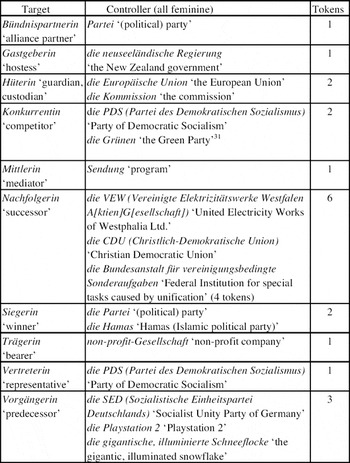
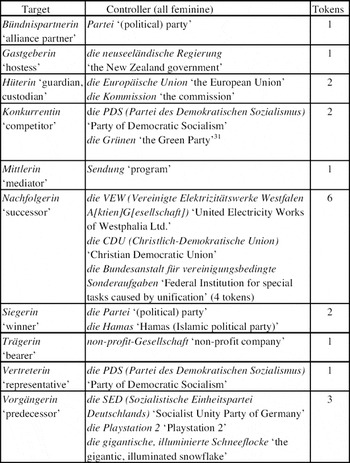
The -in derivatives involved in gender agreement in the corpora.Footnote 31
(12) Die Luft ist Träger des Stickstoffes […]. Wärme ist immer Ausdruck einer Empfindung (sie ist nicht Trägerin der Empfindung) (Jobin Reference Jobin2004:235, my emphasis).
‘The air-fem is the carrier-masc of nitrogen […]. Warmth-fem is always the expression of a sensation (it [lit. she] is not the carrier-fem of the sensation).’
In any case, Jobin (Reference Jobin2004:236) concedes that the assignment of semantically feminine properties to the referents of other nouns in her sample, such as Käsesorte ‘kind of cheese’, Eisenbahn ‘railway’, or Schlagbohrmaschine ‘hammer drill’, all of which are grammatically feminine, is unlikely.
3.4. Gender Agreement with -in as the Result of Hypercharacterization
Hypercharacterization is defined by Lehmann (Reference Lehmann2005:7) as “pleonasm at the level of grammar;” that is to say, it involves the use of elements that are pleonastic, or redundant, in linguistic constructions.Footnote 22 Under the term concord pleonasm, Lehmann (Reference Lehmann2005:12) describes a process related to the one under investigation here, albeit with personal nouns: in a construction such as weibliche Professorin ‘female professor’, the feminine gender is marked twice: once, inflectionally, on the adjective and once, derivationally, on the noun. Gender agreement with -in on nouns with impersonal referents also represents a double marking of feminine gender. The agreement of the target noun with the controller noun might be said to stem from language users’ desire for agreement which matches that found in canonical inflection: they therefore add a redundant marker of feminine gender to the target noun.
4. Data and Analysis
The examples used in this investigation are taken from two journalistic corpora (the Tiger corpus of mid-1990s Frankfurter Rundschau texts and a corpus of Spiegel Online texts collected by the author in winter 2004–2005, each containing about 700,000 tokens), from various print media, and from the web.Footnote 23 The controller and target nouns are shown in bold type.
4.1. German Data
In this section, some examples of gender agreement in use are presented to give an indication of the contexts in which it appears and the types of referents it has. I first focus on contemporary examples. Institutions, including political parties, are frequent referents of the controllers and are exemplified in 13–15.
- (13)
a. mit […] der rechtspopulistischen Dänischen Volkspartei (DVP) als MehrheitsbeschafferinFootnote 24
‘with […] the right-wing populist Danish People's Party-fem (DPP) as majority obtainer-fem’
b. Die Lega Nord, der Castelli angehört, bietet sich immer wieder als Wahrerin der Interessen des Volkes an (Neue Zürcher Zeitung 15 Aug. 2006:2).
‘The Lega Nord-fem, to which Castelli belongs, presents itself time and time again as defender-fem of the interests of the people.’
c. Die katholische Kirche ist die von Gott eingesetzte Hüterin der absoluten sittlichen Wahrheit, die ihr durch Jesus Christus ein für alle Mal offenbart wurde und deren irrtumslose Aus-legerin sie bis ans Ende aller Tage bleiben wird. (Der Spiegel 17/2005:115)
‘The Catholic Church-fem is the guardian-fem—appointed by God—of the absolute moral truth, which was revealed to it (lit. her) [the Catholic Church] once and for all by Jesus Christ and whose [Jesus Christ's] infallible interpreter-fem it (lit. she) will remain until the end of all days.’
d. Gegen die Entscheidung des Amtsgerichts will die Treuhand-Nachfolgerin, die Bundesanstalt für vereinigungsbedingte Sonderaufgaben, Beschwerde einlegen (Tiger 10807).
‘Against the decision of the district court, the East German privatization agency's successor-fem, the Federal Institution-fem for Unification-Associated Special Tasks, wants to lodge a complaint.’
In contrast to examples 13a–d and 16–19, in which the base of the target noun is an agent noun derived with the suffix -er and which seem to represent the canonical form of gender agreement with -in, the bases of the target nouns in examples 14–15, found on the web (and seemingly relatively rare), vary in nature. The bases of the targets in 14a,b are simplex nouns which usually denote male humans; the bases of the targets in 15a,b are derived agent nouns consisting of loan elements. The suffix −(at)or, seen in 15a, is the Latinate equivalent of the native -er. The relevance of the nature of the base nouns is returned to in section 5.2.
- (14)
a. […] müsse sich die Kirche als Freundin aller Menschen zeigen.Footnote 25
‘[…] the church-fem must show itself to be the friend-fem of all people.’
b. Den Sympathiebonus, den die rot-grüne Regierung als Erbin der von Willy Brandt begonnenen neuen Ostpolitik genoss, haben die Berliner verspielt.Footnote 26
‘The Berliners [that is, members of the government sitting in Berlin] have squandered the sympathy bonus which the red-green government-fem enjoyed as the heir-fem (lit., heiress) of the new Ostpolitik begun by Willy Brandt.’
Example 15a may represent an example from spoken language. In the context in which it occurs, it is clearly part of a direct quotation. It is unclear from the context, however, whether the quotation is a spoken utterance or whether it is taken from a written document:
- (15)
a. Die Landesregierung ist Initiatorin des Gesetzes, nicht wir.Footnote 27
‘The state government-fem is the initiator-fem of the law, not us.’
b. Die Vontobel HoldingAG, Zürich, Schweiz (die “Garantin”) garantiert hiermit […].Footnote 28
‘Vontobel Holding Ltd.-fem, Zurich, Switzerland (the “guarantor-fem”) hereby guarantees […].’
The referent of 16 is a type of computer; either one of the feminine nouns Playstation 2 and Konsole may be the controller of Vorgängerin.
(16) Auch die neue Playstation mit Cell-Prozessor wird den Markt gehörig verändern, wenn die Konsole eine ähnliche Verbreitung findet wie ihre Vorgängerin, die Playstation2 (Spiegel corpus).
‘The new Playstation with cell-processor will also properly change the market if the console-fem finds a similar spread to its (lit. her) predecessor-fem, the Playstation -fem 2.’
An example is found in the introduction to a prominent German grammar:
(17) Die “Einführung in die Grammatik” hat sich—ebenso wie ihre Vorgängerin, die “Einführung in die Grammatik und Orthographie der deutschen Gegenwartssprache” (1981)—vor allem im Germanistikstudium, im Sprachunterricht und in der Fortbildung bewährt (Sommerfeldt & Starke Reference Sommerfeldt and Starke1998:v).
‘The “Introduction to Grammar” has proved its worth—just as its (lit. her) predecessor -fem, the “Introduction-fem to the Grammar and Orthography of the Present-Day German Language” (1981)—above all in German Studies, in language teaching and in further education.’
The optionality of gender agreement with -in is exemplified clearly by its use in a newspaper article about a motorcycle. Motorcycles are grammatically feminine in German (Durrell Reference Durrell2002:2). Accordingly, a noun referring to the motorcycle reviewed in the article (“die neue Honda CBF 1000”) has the suffix -in:
(18) Dafür bietet die handliche Allrounderin das “Just-fit”-Konzept (Neue Zürcher Zeitung, 15 Aug. 2006:29).
‘On the other hand, the maneuverable all-rounder-fem offers the “Just-fit” concept.’
In this example the agreement operates over a domain greater than the sentence; that is, the controller is absent from the construction, an occurrence less canonical than agreement constructions in which the controller is present (Corbett Reference Corbett2006:10), and seemingly rare in German. No such examples appear in the corpora used here, for instance.
In the headline to the article, however, the target noun does not receive the suffix -in:
(19) CBF 1000—Hondas heisser Alleskönner (Neue Zürcher Zeitung, 15 Aug. 2006:29).
‘CBF 1000—Honda's hot all-rounder-masc’
Although Durrell (Reference Durrell2002:6) states that gender agreement using -in is a phenomenon of the written language, an example occurred in an interview transcribed in an article within the Spiegel corpus, showing that this is not entirely the case (see also 15a above):
(20) Meine Sendung ist eine Mittlerin zwischen Fernsehzuschauern und Lesern (Spiegel corpus).
‘CBF 1000—Honda's hot all-rounder-masc’‘My program-fem is a mediator-fem between television viewers and readers.’
Historical and literal examples are now addressed. Constructions using gender agreement with -in in Early New High German are found in the writings of Albrecht Dürer (see Müller Reference Müller1993:341). In all cases in the Dürer corpus, the controller is the feminine figur ‘figure’ (Müller Reference Müller1993:340); in one case, the controller is absent from the construction but can be understood to be figur. These examples show no evidence of personification; rather, they fit Müller's description of the process as inflectional:Footnote 29
- (21)
a.
b.
In earlier periods of New High German, the use of gender agreement with -in by Goethe (1749–1832), which is relatively rare in his works (Stricker Reference Stricker2000:159), is clearly personificative. The inanimate referents of the controllers are assigned the characteristics of a person in 22a–c.
- (22)
a. die Vernunft ist die ärgste Tyrannin (Goethe Reference Goethe and Ladenthin1992:121)
‘reason-fem is the wickedest tyrant-fem’
b. Jetzt sondere ich “Iphigenien” aus dem Paket und nehme sie mit in das schöne, warme Land als Begleiterin (Goethe Reference Goethe1816–1817[1981]: 22).
‘I now separate “Iphigenie”-fem out of the package and take it (lit. her) with me into the beautiful, warm land as my companion-fem.’
‘Now, however, I have extracted Iphigenie from a bundle of manuscripts and shall carry her with me as my travelling companion in a warm and beautiful country’ (Goethe Reference Goethe, Auden and Mayer1962 [1970]:35).
c. morgen früh geht es zu Wasser auf der Brenta fort. Heute hat's geregnet, nun ist's wieder ausgehellt, und ich hoffe, die Lagunen und die dem Meer vermählte Herrscherin bei schöner Tageszeit zu erblicken und aus ihrem Schoß meine Freunde zu begrüßen. (Goethe Reference Goethe1816–1817[1981]:63).
‘early tomorrow I continue by water on the Brenta-fem. It rained today, now it has brightened up again and I hope to see in beautiful daylight the lagoons and the conqueror-fem married to the sea, and from her lap to greet my friends.
‘Tomorrow morning I am going to travel on the Brenta by boat. It rained today but it is now clear again, and I hope to see the lagoons in brilliant sunshine and send greetings to my friends from the embrace of the Queen Bride of the sea’ (Goethe Reference Goethe, Auden and Mayer1962[1970]:73).
In these examples, the domain of use of -in is extended metaphorically to agree with controllers denoting impersonal referents that are personified by the author. An abstract concept (22a), the manuscript of a play bearing the name of its female main character (22b), and a river (22c) are all described as if they have personal characteristics. The English translators of the Italienische Reise (Goethe Reference Goethe, Auden and Mayer1962[1970]), whose translation is given in 22b,c, clearly felt Goethe's description to be personificative: in 22b the feminine pronoun her is used in place of the expected and stylistically unmarked it, while in 22c the inanimate river Brenta is described as a “Queen Bride.”
Literary examples from the 20th century are given by Wellmann (Reference Wellmann1975:108):
- (23)
a. das […] Vertrauen des späteren Schönberg auf die Verfahrens-weise als Garantin umfassender Totalität (Adorno)
‘the trust of the later Schönberg in the procedure-fem als guarantor-fem of comprehensive totality’
b. daß die Seele sich als Meisterin erweist über den Körper (Thomas Mann)
‘that the soul-fem proves itself to be master-fem over the body’
c. vor den gähnenden siegerin ewigkeit (Enzensberger)Footnote 30
‘before the yawning winner-fem, eternity-fem’
In 23a, only grammatical information regarding gender is added, while 23b,c parallel the personification found in Goethe's examples; that is to say, the referents of the controllers Seele ‘soul’ and ewigkeit ‘eternity’ are described as if they have human characteristics.
4.2. Extent of Use
In this section, the extent to which the phenomenon occurs in corpora of contemporary German is investigated. In table 1, the number of types and tokens of -in derivatives involved in gender agreement in the corpora is compared to the total number of types and tokens of -in derivatives present in those corpora. The phenomenon is seen to occur to a very limited extent: just 20 of the -in tokens from a total of 2,054 (0.97%) are involved in gender agreement.
Table 2 lists the 10 -in derivatives used in gender agreement in the corpora. Some derivatives denote a person in one context and inanimate referents in another, such as Vertreterin ‘representative [feminine]’, which denotes a person in 11 of its 12 corpus occurrences. The derivatives in table 2, which account for 2.59% of the total -in types in the corpora, are mainly targets of controllers denoting institutions (most of which are political). The importance of this characteristic to the analysis of the role of these nouns in gender agreement is explored in section 5. Exceptions to this trend are the use of Mittlerin ‘mediator [feminine]’ to agree with a controller denoting a ‘television program’ and Vorgängerin ‘predecessor [feminine]’ to agree with controllers denoting a ‘Playstation 2/Konsole’ and a ‘giant illuminated snowflake in New York’.
A complete picture of the extent to which -in is attached to the targets of controller nouns with inanimate referents can only be provided by looking also at the cases in which the gender agreement exemplified above is possible but does not occur in practice; that is to say, cases in which a feminine subject noun is referred back to by a masculine or neuter noun. Neither of the corpora used here is tagged for gender, making an accurate search for cases of non-agreement impractical (the search for cases of agreement, with the suffix -in serving as a search term, was comparatively straightforward). In lieu of a full search of the corpora, therefore, the following solution was adopted:
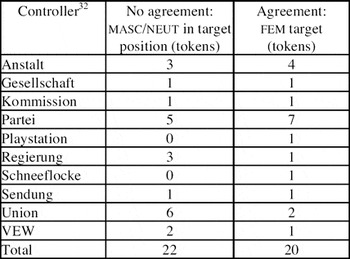
• to identify the extent to which the feminine controller nouns involved in gender agreement elsewhere in the corpus occurred with masculine and neuter “targets” (table 3).
Table 3.Extent of occurrence of feminine controllers with feminine and non-feminine targets.Footnote 32
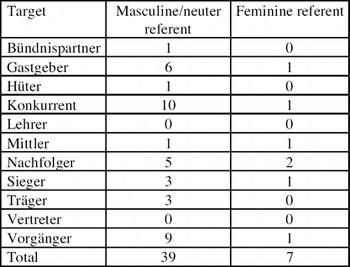
• to identify the extent to which the masculine bases of the target nouns involved in gender agreement with -in also occur with masculine and neuter controllers, and the extent to which they occur with feminine controllers (table 4).
Table 4.Extent of occurrence of masculine targets with feminine and non-feminine controllers.
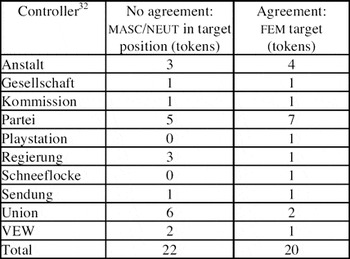

Although the figures involved are low in all cases, making strong conclusions impossible, these data give an indication of speakers’ preferences regarding possible gender agreement between two nouns that share a referent. Table 3 shows that, overall, the controller nouns involved in gender agreement using -in occur to roughly the same extent with feminine targets as with non-feminine nouns in the target position:
Some examples of non-agreement are given in 24; in 24a,b agreement would have been possible; in 24c, however, the target noun cannot serve as a base for an -in derivative *Bollwerkin ‘bulwark (feminine)’.
- (24)
a. Aus den Parlamentswahlen 1993 ging Kwasniewskis Partei als Sieger hervor […] (Tiger 36388).
‘From the parliamentary elections in 1993, Kwasniewski's party-fem emerged as victor-masc […].’
b. Die russische Regierung ist es allerdings leid, in kurzen Abständen immer wieder als Bittsteller auf der Matte zu stehen […] (Tiger 25568).
‘Even so, the Russian government-fem is tired of standing at short intervals again and again as petitioner-masc on the doorstep […].’
c. Die Selbstdarstellung der CDU als Bollwerk gegen die SED-Nachfolgepartei PDS […] (Tiger 7390).
‘The self-portrayal of the CDU-fem als the bulwark-neut against the SED's successor party PDS […].’
The masculine bases of the feminine target nouns found in gender agreement (and listed in table 2), when used as targets themselves, tend to occur most often with masculine or neuter controllers. This is shown in table 4.
Some of the mismatches in which a masculine target occurred with a feminine controller are listed in 25. All of these mismatches, that is, the seven cases in the right-hand column of table 4, could have been “remedied” by making the target noun feminine.
- (25)
a. Der Aufwand für den Nachfolger der Urversion von „Halo“ […] hat sich gelohnt (Spiegel).
‘The effort for the successor-masc of the original version-fem of “Halo” […] was worthwhile.’
b. Als Mittler eines sich wandelnden Lebensgefühls fungiert die Tageszeitung Hamschari (Mitbürger) (Tiger 20631).
‘The daily newspaper-fem Hamschari (Fellow Citizen) functions as the mediator-masc of a changing awareness of life.’
c. Oder dass Konkurrent DNAnow.ch den Kunden eine schriftlich Bestätigung abverlangt […]’ (Spiegel).Footnote 33
‘Or (the fact) that competitor-mascDNAnow.ch-fem demands a written confirmation from the customer […]’
Despite the optionality of gender agreement between two nouns denoting the same referent, there seems to be a preference for making the gender of the two nouns match.
4.3. The Related Dutch Phenomena
Two similar phenomena occur in Dutch, a language that generally does not distinguish between masculine and feminine nouns. One closely resembles the German phenomenon under investigation here and is examined in section 4.4. The other, which is more canonically inflectional in character, is described in section 4.5. These two processes are examined both with the aim of describing the phenomenon which, like its German counterpart, has been neglected in the literature (Booij Reference Booij2002 does not mention it, for instance), and in the hope that the behavior of gender agreement in Dutch, which operates in a slightly different grammatical context to that in German, might shed some more light on the equivalent process in German.
4.4. Gender Agreement with a Derivational Female Sex-Marker
The original three-way Dutch gender system (of masculine, feminine and neuter as in German) became a two-way system (common v. neuter) as a result of a lack of explicit gender marking on the nouns and the reduction of adjectival and determiner patterns through syncretism (Audring Reference Audring2006:85). In the dialects of the southern part of the Dutch-speaking area, that is, Limburg and Brabant as well as Flanders, the three-way distinction remains (E-ANS 1997; also Audring Reference Audring2006:85).Footnote 34 Although the masculine and feminine nouns were subsumed into the common category in Standard Dutch, the three-way distinction does remain in the standard language to some extent. In dictionaries, information on whether a noun of common gender is masculine or feminine is often listed alongside the word; for instance: “stichting, de[v.]” and “aanblik, de[m.]” (EGB 1996), where “[v.]” stands for vrouwelijk “feminine” and “[m.]” for mannelijk “masculine.” The distinction between masculine and feminine on nouns with inanimate referents is now only made in the written language, with the words’ suffixes serving as an indication of their gender (Audring Reference Audring2006:92). The application of this information in language use, however, in spite of normative attempts to (re-)introduce it (noted by Audring Reference Audring2006:92) tends to be restricted to language users of an affected and overly formal style of Dutch; generally, language users are unaware of the distinction.Footnote 35
The treatment of common nouns as specifically masculine or feminine, when it occurs at all, varies throughout the Dutch-speaking area (from E-ANS 1997):
• in the north, in spoken language, common nouns are generally treated as masculine.
• in the north, in written language, words ending in the following suffixes are treated as feminine: -de/-te, -heid, -ij, -nis and -st.
• in the south, in spoken language, a number of common nouns are treated as feminine, even when they are not formally marked as feminine (that is, by ending in one of the above suffixes); this presumably stems from dialectal usage being transferred to the standard language.
This situation manifests itself as variation within the standard language (E-ANS 1997); that is to say, it is not restricted to the dialects. The issue of whether the nouns are masculine or feminine mostly arises when selecting an appropriate pronoun (Audring Reference Audring2006:88).
While German has one dominant derivational suffix for marking female sex, Dutch has an inventory of ten, the use of which is often decided by the morphological form of the base word (see Booij Reference Booij2002:102–104): -e, -es, -esse, -euse, -ica, -ière, -in, -ix, -rice, and -ster (Booij Reference Booij2002:102). In the examples listed below, -es and -ster are, in the same way as German -in, attached to the targets of controller nouns with inanimate referents to make two nouns agree in gender. As noted above, the distinction made between masculine and feminine gender in the standard language is now rather artificial and restricted to the written language. The attachment of a female sex-marking suffix to the target of a controller noun with an inanimate referent in Dutch must therefore be carried out deliberately. This contrasts with German, where the process can be considered an extension of the standard masculine/feminine distinction. While Dutch language users do not generally make the distinction between masculine and feminine gender, they are aware of it and may consciously choose to mark a noun of ostensibly common gender as explicitly feminine. Dutch speakers must base their use of gender agreement on their regional or dialectal usage, or on the gender information given in dictionaries and prescriptive works.
Some examples of the phenomenon, found on the web, are listed here. Examples 26 (and 4), involve controllers that are overtly marked as feminine.
- (26)
a. De stichting is eigenares en beheerster van een tiental studentenhuizen en studiecentra in enkele steden van het land.Footnote 36
‘The foundation-fem is owner-fem and administrator-fem of ten student houses and study centres in a few towns in the country.’
b. Stichting Nidos is voogdes, d.w.z. dat zij de uiteindelijke verantwoordelijkheid heeft over de minderjarigen.Footnote 37
‘The foundation-fem Nidos is the guardian-fem, i.e., that it (lit. she) has the final responsibility for the minors.’
Example 27, by contrast, involves a simplex controller (kerk ‘church’) for which no gender information (beyond the fact that it is common) is given in EGB (1996) or van Dale (Reference Dale1997).
(27) De kerk is behoedster en verkondigster van de waarheid die God in Jezus Christus aan de wereld meegedeeld heeft.Footnote 38
‘The church-common is the guardian-fem and proclaimer-fem of the truth that God, in Jesus Christ, told the world.’
Finally, example 28 unexpectedly involves a neuter “controller.” In each case the alternative to, and origin of, the target is a noun whose default referent is a male human: not all are derived agent nouns (see voogd ‘guardian’). For example, an eigenaar ‘owner’ is normally a human and, outside mixed company, male.
(28) Het onderwijs is behoedster en overdraagster van de cultuur en tevens instrument tot vernieuwing van deze cultuur.Footnote 39
‘Education-neut is the guardian-fem and imparter-fem of culture and at the same time is an instrument in the renewing of this culture.’
Because the controller nouns involved in 4 and 26 are feminine and marked as such (that is, they have a suffix associated with feminine gender), these are cases of gender agreement directly comparable to the German cases. In 27, kerk is not marked as feminine either morphologically or in dictionaries; its treatment as feminine is thus in accordance with the southern usage outlined in E-ANS 1997 and, indeed, the website on which the example appears belongs to a Roman Catholic organization—Roman Catholicism is the dominant religion of the southern Netherlands and Belgium—with a Dutch and Flemish editorial staff.
Example 28, which involves a neuter in the controller position, is anomalous because it does not involve gender agreement as such: the neuter gender of onderwijs does not agree with the common/feminine gender of behoedster and overdraagster. Booij (Reference Booij2002:37) observes a tendency “to use the [feminine] possessive pronoun haar in relation to nouns that designate institutions,” which would also explain both the agreement with the simplex controller kerk in 27 and that with onderwijs, which in this example denotes the institution of education (and the people involved in providing it) as opposed to the concept of education. Audring (Reference Audring2006:95), in contrast, lists instances in which neuter nouns receive a masculine pronoun. Overall, therefore, there appears to be an occasional link in language users’ minds between neuter nouns and common gender (whether masculine or feminine). The inflection hypothesis, therefore, which is based on the resemblance of the process to canonical inflectional gender agreement, is invalid here. Either the animacy characteristics of the referent and the link between feminine gender and institutions caused the use of a feminine suffix in 28 or, as suggested by native speakers, the use of a feminine target noun to refer to the neuter controller is a hypercorrect overgeneralization of the gender agreement rule for feminine nouns, possibly due to its association with elevated style. The site on which the example appears is based in the northern Netherlands; thus, the hypercorrection cannot have been due to the more widespread use of the feminine in southern Dutch.
The phenomenon portrayed in 26–28 can be explained in two contrasting ways. On the one hand, it appears to be a relic of the masculine/feminine distinction in the syntax of standard Dutch and shows that the distinction still remains: this view is supported by the evidence of pronoun agreement described by Audring (Reference Audring2006) and Booij (Reference Booij2002). On the other hand, the fact that the masculine/feminine distinction is so minor in the standard language supports the view that the female sex-marking suffixes are attached to the targets of controllers whose inanimate referents have been metaphorically extended and personified, possibly even via an association with a “feminine-”type role performed by the referent, as Jobin (Reference Jobin2004) suggests for German.
4.5. Sex Concord
A further, similar process of gender agreement found in Dutch is described by van Marle (Reference van Marle1996) under the name “sex concord” (for example, van Marle Reference van Marle1996:71, from which 29 is taken). The gender of inhabitive nouns must agree with the sex of the referent (hence the use of “sex” rather than “gender” in van Marle's terminology). This agreement is compulsory; without sex/gender agreement between the two nouns, a construction is ungrammatical, as shown in 29.
(29) Marie is een echte Amsterdamse v. *Marie is een echte Amsterdammer
‘Marie is a real Amsterdammer-fem v. *Marie is a real Amsterdammer-masc.
Van Marle (Reference van Marle1996:71) states that the agreement taking place in sex concord is “‘relevant to’ syntax” and that it “appears to have an inflection-like dimension.” He observes further that “seemingly purely derivational categories may apparently develop properties of an inflection-like character” (van Marle Reference van Marle1996:71) and concludes that the Dutch inhabitive sex concord could also be seen as “the syntactic manifestation of a semantic rule” (van Marle Reference van Marle1996:80). This conclusion rests on the obligatory nature of Dutch sex concord. In contrast, the optionality of the German gender agreement using -in (and its Dutch counterpart described in section 4.4), despite its clear relation to Dutch inhabitive sex concord, makes a putative syntactic status more tenuous.
5. Explaining Gender Agreement with -in
In the preceding description of gender agreement with -in in German it was shown that none of the treatments of the process in the literature accurately captures its nature. In this section a solution is proposed, beginning with a hypothesis on the origin of gender agreement with -in (section 5.1), followed by an analysis of the phenomenon taking the existing positions described in section 3 as a starting point (section 5.2). As throughout this paper as a whole, the focus is on the German process with -in: the Dutch data are brought into the discussion to shed more light on why the phenomenon occurs.
5.1. The Origin of the Phenomenon
Gender agreement with -in involves the attachment of the predominantly person-denoting suffix to target nouns whose controllers denote inanimate referents. The original semantic content of the suffix (female sex) is necessarily lost (inanimate entities cannot be characterized by sex) and only the grammatical content of the suffix (feminine gender) is retained. The target nouns usually denote humans. The underlying factor behind this phenomenon is the fact that “[c]orrelations may exist between the meanings of nouns and the genders to which they belong” (Stump Reference Stump, Spencer and Zwicky1998:27). The association of female biological sex with feminine grammatical gender has enabled the analogical spread in the sphere of use of -in from attachment to nouns denoting animate referents (that is, those whose biological sex is a defining characteristic) to attachment to the targets of controller nouns which denote inanimate referents.
The use of the suffix -in to create an explicitly feminine and female-denoting noun in preference to the masculine base with supposedly generic referents when referring to people (section 2.3) is likely to be influential in situations in which impersonal referents are denoted. Faced with the prospect of using an explicitly masculine, male-denoting noun to refer back to a referent denoted by a feminine noun (the controller), some language users opt to replace the masculine noun with a feminine equivalent. This parallel between the use of the suffix when the referent of the controller is human and the use of the suffix when the referent of the controller is inanimate might seem to suggest that personification of the inanimate referents is a likely contributing factor in the use of -in. This seems not to be the case. Instead, the relative animacy of the referents of the controller nouns, when placed on an animacy scale, influences the way that speakers treat the target nouns whose controllers denote inanimate entities.
Based on the data presented in this investigation the activity of the suffix -in can be divided into four categories:
i. prototypical attachment to bases denoting humans and animals.
ii. attachment to bases existing in an agreement relationship with feminine controllers denoting inanimate referents that are personified in context.
iii. attachment to bases existing in an agreement relationship with controllers which are feminine collective nouns (that is, nouns that are semantically animate but grammatically inanimate).
iv. attachment to bases existing in an agreement relationship with controllers denoting inanimate referents.
The data presented in section 4.1 confirm the necessity of dividing the attachment of -in to targets whose controllers denote inanimate referents into more than one category. With the exception of Jobin (Reference Jobin2004), no such distinction was found in any of the works dealing with the phenomenon.
The four types of the use of -in, set out in points (i)–(iv) above, correspond to the most probable explanation of the process by which -in has come to be used in contexts where reference is made only to feminine gender and not to female sex. It is posited here that this process is a diachronic transition through which the suffix has increased its sphere of use. Originally, the suffix marked only female sex on nouns denoting animate (perhaps only human) referents. This remains the suffix's main role today. The first extension of use of -in was its attachment to target nouns to make them agree with controllers denoting personified inanimate referents ((ii) above), that is, a form of notional agreement. This served as a “bridge” to the use of the suffix on targets whose controllers are collective nouns (iii) and, finally, on targets whose controllers denote non-personified inanimate referents (iv). Because the personified inanimate referents were treated in context as if they referred to people (the Goethe examples in section 4.1 are particularly clear illustrations of this), there was no barrier to the use of the person-denoting suffix -in on target nouns whose controllers refer to inanimate entities. This personificative use of -in is still found in modern German, as some of the literary examples in section 4.1 show. Once the attachment of -in to the targets of controllers denoting personified inanimate referents had become an established and accepted process, it was then possible to extend the use of -in to contexts in which the controllers denoted inanimate referents that were not personified.
This last observation is compatible with the view that -in is undergoing grammaticalization. Having increased its sphere of use from contexts involving animate referents to those involving personified inanimate referents, and then to contexts involving non-personified inanimate referents (which are “relatively animate” on animacy hierarchies), -in is currently at the point in its grammaticalization process at which it is beginning to be used on bases serving as targets for controller nouns denoting non-personified (but not “relatively animate”) inanimate referents. This use is still rare, however: examples 3 and 20, in which, respectively, Vorgängerin is the target of a controller denoting an illuminated decorative snowflake and Mittlerin that of a controller denoting a television programme, are examples of this. The process may even have stalled some time ago: the referent of the controller in the ENHG examples 21a,b is an inanimate instrument.
The relative rarity of the use of -in on target nouns to refer to controllers whose referents are inanimate was shown to have been a constant since Early New High German. A clear reason for this is that the gender of a noun which refers back to another noun need not agree with the gender of that noun. Thus, a masculine noun may refer to an entity routinely denoted by a feminine noun. However, the use of -in to mark gender agreement may also have been influenced by factors not directly related to the process. A factor likely to have favored the use of -in as a marker of feminine gender is language users’ desire to explicitly mark the fact that a noun denotes a female where the established (generic) masculine noun, which supposedly denotes both males and females, is felt to be inadequate: this corresponds to the hypothesis that the attachment of -in is the result of hypercharacterization. As already noted, the explicit marking of sex on nouns with animate referents is directly parallel to the explicit marking of gender on target nouns referring back to controllers denoting inanimate referents. At the same time, however, this association of -in with marking female sex on nouns denoting animate referents may have overshadowed its gender-marking role; that is to say, the feeling among language users that person-denoting masculine nouns denote only males but can be made to denote females through the attachment of -in (a feeling perhaps increased by relatively recent developments such as the rise of the suffix -In, which explicitly denotes both males and females, in the 1980s) will have strengthened the association of -in with the marking of female sex on nouns denoting people, possibly at the expense of the suffix's association with feminine gender marking. This may offer one explanation as to why the use of -in as a gender marking suffix attached to the targets of controllers which have inanimate referents remains infrequent.
5.2. Gender Agreement with Derivational Affixes: An Explanation
In the literature described in section 3 there were opposing analyses of the attachment of -in to the targets of controllers denoting inanimate referents: one side argues that the phenomenon is inflectional while the other side contests that the phenomenon is personificative (and therefore derivational). Neither approach (indeed, none of the individual analyses) fully accounts for the data presented in section 4.1. Here, the contrasting viewpoints are evaluated before an analysis that accounts for all the data is posited.
The attachment of -in to the target nouns does not happen at random. In all the attested cases, -in was attached to a noun that explicitly referred back to another, feminine noun that denoted an inanimate referent. The attachment of -in to a target whose controller denotes an inanimate referent is therefore clearly carried out in order to make the gender of the target match the feminine gender of its controller. In contrast to the prototypical derivational sex-marking use of -in, in which the suffix refers to semantic or pragmatic properties of the referent (that is, that the person or animal is female), the attachment of -in to the targets of controllers with inanimate referents refers only to the lexical property of gender (that is, that the noun is feminine). The marking of gender in German, and the agreement between the gender of two or more words in the same construction, is, as already discussed, an inflectional matter. Gender agreement with -in and its Dutch counterparts therefore has an inflectional character in this respect. Furthermore, when the fundamental difference between derivation, which creates new lexemes, and inflection, which results in different forms of the same lexeme, is considered, the gender agreement described here again appears to be inflectional. The words to which the suffixes have been attached do not denote a different referent to that of their base: the resulting words are simply feminine versions of the masculine bases. In contrast, the canonical derivational use of these suffixes leads to the formation of lexemes which are quite separate to their base. The semantic content of the target nouns involved in gender agreement is different to the semantic content added in the canonical use of the suffixes. The attachment of -in to the target of a collective controller noun, as in 13–15, does not indicate that all the human referents are female: the only information added concerns gender. It can therefore be proposed that -in, when attached to the targets of controllers denoting inanimate referents, is used as if it were an inflectional affix. Its role is to mark agreement in gender between two nouns. An implication of this claim is that the suffix is undergoing grammaticalization. While this may be an unconventional claim regarding one of the most productive derivational affixes in German, if it is assumed that the process of grammaticalization is incomplete, the dual activity of -in is explained.
In 5.1. a diachronic transition was posited, via which -in moved from denoting only the female sex of animate referents (a canonically derivational process) to denoting feminine gender on the targets of controllers whose referents are either personified inanimate or collective human, and then feminine gender on the targets of controllers with non-personified inanimate referents (an inflection-like process): such a step-wise transition is characteristic of semantic change, where “forms do not shift abruptly from one category to another, but go through a series of small transitions” (Hopper & Traugott Reference Hopper and Traugott2003:6). Only once a process undergoing grammaticalization to move from derivation to inflection has become fully inflectional (and has therefore lost its original derivational role) would it be expected to be obligatory, like any other inflectional process in German. While change is in progress, optionality of processes is expected. The transition of -in conforms to Bybee's definition (Reference Bybee2006: 719) of grammaticalization as “the creation of a new grammatical morpheme and a new construction out of a particular instance of an old construction” if the still productive prototypical (derivational) sex-marking role is taken to be the “old” construction. Heine & Reh (Reference Heine and Reh1984:15) describe grammaticalization as “an evolution whereby linguistic units lose in semantic complexity, pragmatic significance, syntactic freedom, and phonetic substance, respectively.” The transition from denoting “a person or animal of female sex, equivalent to the male denoted by the base” to denoting merely “feminine gender” is a clear loss of semantic complexity. There is therefore a strong case to make for the view that the suffix -in is undergoing grammaticalization to see use in an inflectional process.
Alternatively, it may be the case that this phenomenon is an example of “arrested” grammaticalization (see Hopper & Traugott Reference Hopper and Traugott2003:131). This is suggested by the fact that gender agreement with -in seems not to have increased greatly in use over time and that the primary derivational role of -in remains dominant. On this view, the process of using -in in an inflection-like manner was already present in Early New High German but—perhaps because of the strong coherence of -in in its original derivational role—the suffix was prevented from fully moving from derivation to inflection on the grammaticalization cline. This is not uncommon: Hopper & Traugott (Reference Hopper and Traugott2003:131) note that “[a] particular grammaticalization process may be, and often is, arrested before it is fully ‘implemented,’ and the ‘outcome’ of grammaticalization is quite often a ragged and incomplete subsystem that is not evidently moving in some identifiable direction.”
The view that -in is attached to the targets of controller nouns denoting inanimate referents when those referents are personified in context—and therefore may then be treated in the same way as any canonical noun with an animate referent, which permits derivation of the target with -in—does not account for all the data. While this hypothesis successfully accounts for most of the literary examples in section 4.1, and is the most likely source of the process of attachment of -in to the targets of controllers with inanimate referents, there is no evidence that the referents of the non-literary examples (from the corpus and elsewhere) have been personified. There is likewise little evidence to support the notion that -in is attached to the targets of controller nouns denoting an inanimate entity that has metaphorically feminine characteristics (although examples such as 11 appear to support the principle). Nevertheless, when the referents of the controller nouns involved in gender agreement with -in are placed on an animacy hierarchy, most of them are found to share some of the semantic characteristics of animate referents. This “near-animate” nature of the controllers’ referents allows their targets to be derived with a suffix whose usual bases predominantly denote people.
The referents of collective nouns appear high on the animacy hierarchy. These nouns denote humans although, as noted above, the attachment of -in to targets agreeing with them only adds information on the gender of the target noun and not the sex of the referents of the controller. The referents of these nouns are therefore not prototypically animate: the fact that their referents cannot be classified by sex makes them similar to nouns with inanimate referents. Slightly lower down on an animacy hierarchy are the inanimate referents routinely personified by language users: one of Kreyer's (Reference Kreyer2003) examples of a word in this category is computer, which could explain the use of -in on a target referring to the controller Playstation (example 16). There is, however, no evidence that the referent is personified in context. The position of the referents on the animacy hierarchy shows that the attachment of -in to the targets of most controllers with inanimate referents is a use not far removed from its prototypical derivational role: -in attaches to the targets of controller nouns whose referents are treated by language users as if they were animate, that is, they fall within -in's regular domain in terms of their position on the hierarchy. This is therefore entirely consistent with the primary use of -in in derivation. Noticing the feminine gender of the controllers with relatively animate referents, language users—equating grammatical gender with biological sex—add the suffix -in to the target noun just as they would to a noun denoting a person. Or equally, because the process is not compulsory, the suffix -in may not be added.
The only contemporary examples discussed here that are left unexplained in terms of their position on the gender and personality scales are the controllers Fernsehsendung ‘television program’, Grammatik ‘grammar (book)’, and Schneeflocke ‘snowflake’, which can only be placed at the bottom of an animacy scale unless expressly personified. This is not the case in context. While one explanation could be that the influence of the animacy characteristics of the referents of the controllers is only a tendency in causing gender agreement with -in, the fact that -in is only rarely attached to the targets of such controllers supports the proposed diachronic transition in the use of -in described in section 5.1. The attachment to the targets of controllers whose referents can only be construed as inanimate is the use furthest from the prototypical use of −in. It is therefore unsurprising that examples are rare; although, should the diachronic trend continue, it would be expected that more examples of this type would be encountered in future.
The emphasis of this investigation has so far been on the nature of the controller nouns. Certainly, the starting point of gender agreement using derivational suffixes in German and Dutch is a controller noun that meets the specific animacy requirements already discussed. The nature of the bases of the target nouns is also relevant: the bases must also meet certain requirements, based on their structure and semantic nature, in order to be made to agree in gender with their controller. The primary, semantic requirement is that the base must be able to receive the suffix −in, that is, it must be a noun that usually (unless a specific context is given) denotes male humans. If this condition is not met, agreement is impossible: see example 24c with the “target” Bollwerk ‘bulwark’. This condition is often sufficient to permit gender agreement, as shown by the examples in which the base of the target noun is a simplex noun denoting a male, for example, German (example 14b) with the target Erbin ‘heir−fem (heiress)’, and Dutch (26b) with the target voogdes ‘guardian-fem’. However, as indicated in the data section, such examples are rare (and were only found outside the corpus). Clearly, the fact that a noun denotes a male human, alone, is insufficient. The morphological structure of the bases of the target nouns also plays an important role. Most of the bases are derived agent nouns explicitly and transparently marked, by their suffix, as masculine and male-denoting: corpus data showed that these nouns are, in general, the bases that most favor derivation with -in. Bases derived with the suffix -er (that is, the most frequently encountered masculine male-denoting agent nouns) are by far the most frequent bases of the target nouns. Outside the corpus, examples were also found in which the bases of the target nouns were derived masculine agents of non-native origin. However, such cases appear to be rare. The dominance of agent nouns among the bases of the targets can be explained by the fact that, among the categories of derived nouns that denote people, agent nouns are by far the most common. As an illustration of this, in the corpora used here, 18.78% of all derived nouns (denoting animate and inanimate referents) have an agentive referent; 3.34% denote an inhabitant, while 1.08% denote a patientive referent.Footnote 40 Although these figures include also those nouns denoting inanimate referents, the dominance of agent nouns is clear. Potentially, derived patient nouns could serve as bases of target nouns in suitable contexts (for example, die Gruppe ist Schützlingin von […] ‘the group-fem is the protégé-fem of […]’). Such occurrences are limited by the semantic content of the words in question, and by the relative rarity of derived patient bases (such as those formed with -ling) taking the suffix -in.
The focus of this investigation has been on the attachment of the German suffix -in to the targets of controllers with inanimate referents. The conclusions reached so far in this section on the German process apply also to the equivalent Dutch phenomenon described in section 4.4. Despite the similarities, however, the Dutch phenomenon occurs in a quite different grammatical context. For a great many Dutch speakers, the gender distinction between masculine and feminine within the class common gender is unfamiliar (or, at least, artificial), making the process one that has to be learnt and used deliberately. In German, in contrast, the distinction between masculine and feminine gender is part of all speakers’ competence. The Dutch process is associated with overly careful or pedantic language users, a characteristic which may have led to the arguably hypercorrect example in 28. In German, it may well also be the case that gender agreement using -in is produced by (overly) careful language users, but it is not exclusive to them, as indicated by the varied attestations. Cases in which a feminine noun is made to agree with a masculine or neuter noun were not attested. In sum, the Dutch data represent a more extreme version of the German phenomenon, showing what happens when the gender agreement using derivational affixes is not based on the language's syntactic gender system, but rather on speakers’ individual preferences. The German process, while also dependent to some extent on the preferences of individual speakers (as to whether or not the gender of two nouns should be made to agree), seems to be carried out more as an extension of the language's syntactic system.
It is proposed here that the marking of gender agreement in German and Dutch using a primarily female sex-marking derivational suffix occurs if the referent of an inanimate feminine controller noun appears close to prototypically animate referents on an animacy hierarchy. This makes possible the attachment of a suffix that prototypically attaches to nouns that denote persons to a target noun referring to that controller. Because the referent of the controller is inanimate, however, the prototypical semantic content of the suffix (“female”) cannot apply to the target noun; only the grammatical content of the suffix (“feminine gender”) is applied to the target noun. It appears that the suffixes involved are undergoing grammaticalization, although there is no evidence that the original derivational use of the suffixes is becoming lost. Straddling the uneasy divide between derivation and inflection, and casting doubt on whether a strict divide is appropriate, gender agreement with the German suffix -in and its Dutch counterparts is derivational, albeit not prototypically so.