1. Introduction
This study addresses employers’ decisions on the provision of firm-specific training in the frictional labor market in two types of contracts, namely temporary and permanent contracts. Based on the realization of match-specific productivity when forming a match, employers endogenously determine the contract types for new employees and whether to train temporary workers. Therefore, we address the following research questions: (i) Will a policy aimed at reducing the cost of training temporary workers improve labor market performance? and (ii) Will reforming employment protection legislation (EPL) associated with permanent contracts to address labor market segmentation have a spillover effect of inducing firms to train temporary workers?
The segmentation between the markets for temporary and permanent contracts has been a long-standing unresolved problem. However, according to the European Commission (2016), countries such as France, Spain, the Netherlands, Poland, and Italy have low year-to-year transition rates from temporary to permanent employment, which declined between
 $2007$
and
 $2013$
. Furthermore, according to the Organisation for Economic Co-operation and Development (OECD (2014)), the share of temporary contracts among new employment contracts has been increasing, exceeding
 $70\%$
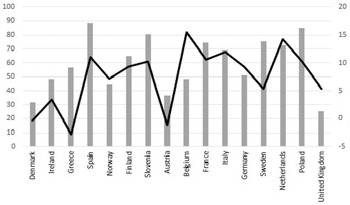
in these countries (see Figure 1). In countries with low transition rates, newly hired temporary workers are less likely to be promoted to permanent employment and more likely to suffer from less stable employment, lower earnings, and lower job satisfaction over longer periods. One way to resolve the problem of labor market segmentation is to facilitate a transition from temporary to permanent contracts. Among the empirical studies that examine whether temporary jobs are stepping stones to permanent positions,Footnote
1
based on data for 10 European countries obtained from the European Community Household Panel (ECPH), Serra (Reference Serra2016) finds the influence of training and EPL on transitions to permanent contracts to differ slightly between intra-firm and inter-firm transitions. In the former case, transitions are facilitated for workers enrolled in firms that provided training.


Unfortunately but not surprisingly, temporary workers tend to receive less training than permanent workers. As described in Figure 1, the participation rate of workers in firm-provided training differs between these two types of contracts. Moreover, several empirical studies show that holding a fixed-term contract lowers the probability of participating in work-related training.Footnote 2 This situation is particularly true in countries with significant differences in firing regulations between temporary and permanent contracts. Based on micro data from the Programme for the International Assessment of Adult Competencies in Spain, Cabrales et al. (Reference Cabrales, Dolado and Mora2017) empirically show a substantially negative and statistically significant relationship between holding a temporary contract and training incidence, with their findings supporting the existence of a positive relationship between labor market dualism and training gaps in the workplace.
As pointed out in OECD (2019a), skills demanded by employers have been gradually and consistently changing because of rapid technological progress and the associated changes in work organization. As participation in training is especially low among workers in nonstandard employment, there is an urgent need to improve the environment for updating their skills or acquiring new ones to enable them to secure the opportunity to work and receive sufficient earnings. Financial constraints are the main barrier preventing workers in vulnerable positions from participating in training because they often have few financial resources to invest in such training. Therefore, OECD (2019a) suggests that lowering the cost of training low-skilled workers would encourage firms to train them.Footnote 3 In the context of dual labor markets, firm-sponsored training should play a crucial role in providing opportunities for temporary workers to receive training. However, few studies have addressed employers’ decisions concerning investment in firm-sponsored training for temporary workers. Dolado et al. (Reference Dolado, Ortigueira and Stucchi2016) construct a theoretical model in dual labor markets by considering workers’ effort choices and firms’ decisions about the amount of occupational training.Footnote 4 They develop a partial equilibrium model, in which the asset values of unemployment and of firms with vacant jobs were exogenously given. By contrast, we construct a theoretical model with a general equilibrium approach to capture employers’ decisions concerning the provision of firm-specific training to temporary workers, which demonstrates the originality of this paper. Then, based on parameter values that capture features of the Italian labor market, including increasing unemployment and an expanded use of atypical employment contracts, we quantitatively examine the impact of reducing the cost of training temporary workers on labor market outcomes, such as the unemployment rate, labor productivity, and social welfare.
Furthermore, past studies have focused on the relationship between the EPL stringency with respect to a certain contract type and the incidence of workplace training for the corresponding contract. In other words, little attention has been paid to how relaxing firing regulations for permanent jobs affects participation in training by temporary workers. However, the possibility of such spillover effects provides us with new insights into the effectiveness of an EPL reform with strong employment protection for workers and its impact on labor productivity. Evidently, OECD (2019a) suggests that “reforming EPL to address labor market segmentation may have the spillover effect of encouraging firms to train temporary workers.” We quantitatively examine whether this spillover effect is actually observed and whether less stringent employment protection for permanent jobs could improve labor market performance.
The model developed in this study has several key features. First, the productivity of a match includes a match-specific component, and employers endogenously determine the type of contract based on the realization of this match quality. This setup is influenced by Akgündüz and van Huizen (Reference Akgündüz and van Huizen2015), who empirically show that holding a temporary contract has a negative effect on the probability of being trained in the Netherlands; however, this effect diminishes according to the quality of the job match. Based on these findings, we incorporate into the model the factor of job match quality, which is revealed after a job match is formed.Footnote 5 Second, this study does not address the employer’s decision on the amount of training; rather, it focuses on the decision about whether to provide training. In the empirical literature, training incidence (the probability of receiving training) is distinguished from training intensity (the number of training activities). To the best of our knowledge, this is the first study based on a theoretical model that focuses on training incidence in temporary jobs by considering employers’ decisions on whether to provide training.
The relationship between employment protection and the accumulation of human capital through training has been broadly explored from a theoretical perspective.Footnote 6 Several studies investigate how EPL affects workers’ investment in firm-specific knowledge, such as Wasmer (Reference Wasmer2006) and Belot et al. (Reference Belot, Boone and Van Ours2007). In terms of the efficiency of firms’ behavior regarding the financing of training in specific skills, Chéron and Rouland (Reference Chéron and Rouland2011) find that employment protection alone cannot resolve the inefficiencies arising from holdups, even if the Hosios condition is satisfied,Footnote 7 and that the implementation of both employment protection and training subsidies is necessary to sustain social efficiency. Assuming that employers decide on the proportion of workers provided with firm-specific training and that the representative firm negotiates the wages with all the workers in the firm, Tripier (Reference Tripier2011) shows that the efficiency outcomes depend on whether the training is costly and whether the returns to scale in production are constant or decreasing.Footnote 8 Note that all of the above-mentioned papers consider a single contract.
Among the studies that address two-tier employment contracts in a frictional labor market,Footnote 9 Berton and Garibaldi (Reference Berton and Garibaldi2012) incorporate temporary and permanent jobs into a directed search model and show that the coexistence of permanent and temporary jobs could be attributed to the short unemployment duration for temporary workers compared to permanent workers. They establish the conditions under which employers decide to provide firm-specific training only to permanent workers. To obtain an empirically testable hypothesis about the relationship between holding a temporary contract and training incidence, Cabrales et al. (Reference Cabrales, Dolado and Mora2017) extend the theoretical framework of Berton and Garibaldi (Reference Berton and Garibaldi2012) and incorporate the termination costs of dismissing permanent workers, which affect the conversion rate from temporary to permanent contracts. As they do not consider the provision of training to temporary workers, the research objective fundamentally differs between Cabrales et al. (Reference Cabrales, Dolado and Mora2017) and our study, which examines how labor market policies aimed at inducing employers to provide training to temporary workers affect labor market performance.
The results presented in this paper are summarized as follows. We first show that, depending on the parameters and given value of the labor market tightness, there are three types of equilibria from the viewpoint of the provision of training to temporary workers. Subsequently, by focusing on an equilibrium that entails training in temporary jobs and is most likely to occur under the parameter values capturing features of the Italian labor market, we present the following results of the quantitative analysis. First, we examine the impact of reducing the cost of training temporary workers, which aims to directly increase their participation in firm-provided training and labor productivity. A reduction in the cost of training temporary workers achieves a higher participation rate of temporary workers in training opportunities and increases social welfare. However, it should also be noted that the unemployment rate increases, and the proportion of permanent workers among total employees and labor productivity decrease. Reducing training costs in temporary jobs enhances job creation, leading to a rise in the threshold for conversion from a temporary contract to a permanent one and for hiring a permanent worker in a new match. An increase in these thresholds decreases the share of permanent workers because conversion from temporary to permanent employment is less likely to occur and because more newly created jobs are temporary positions. Then, a portion of permanent jobs is replaced by an increase in temporary jobs, which are more precarious than permanent jobs. Since an increase in the share of temporary workers generates a larger flow into the unemployment pool and a portion of these workers do not receive training, the unemployment rate increases and labor productivity decreases. Second, relaxing the firing regulations for permanent jobs not only decreases the unemployment rate but also increases the proportion of permanent workers, the participation of temporary workers in firm-sponsored training, resulting in higher labor productivity, and social welfare. Thus, policies aimed at reducing termination costs associated with permanent jobs may be able to simultaneously achieve an increase in the proportion of temporary workers who receive training (implying the emergence of spillover effects) and improve labor market performance.
The remainder of this paper is organized as follows. In Section 2, the model’s environment, Bellman equations, and surpluses of each employment state are described. In Section 3, three types of steady-state equilibria are characterized. In Section 4, we conduct a quantitative exercise and examine how changing termination policies for permanent jobs and reducing training costs in temporary jobs affect labor market performance. Section 5 concludes the paper.
2. The model
2.1 Description
We present a continuous-time model. The population of workers is normalized to 1, and there is a large supply of potential firms. All economic agents are assumed to be risk-neutral and have a common discount rate,
 $\rho$
. A production unit is a worker–firm pair, and firms use labor as the sole input for production. On-the-job search is not considered. Therefore, only unemployed workers engage in job-seeking activities. We concentrate on the steady state of the economy.
2.1.1 Match-specific productivity and basic assumptions for training
The productivity
 $a$
of a match is realized when a job seeker and a vacant firm meet, distributed on the interval
 $[\underline{a},\,\bar{a}]$
according to the cumulative distribution function
 $G(a)$
. Productivity
 $a$
is match-specific, in that it remains unchanged as long as the current employment relationship is retained. However, once a worker–firm match separates, a new value of productivity is drawn from
 $G(a)$
when a separated agent finds a new partner. Match-specific productivity is observable for both economic agents. In this model, training is provided by a firm and is firm-specific.Footnote
10
Therefore, the knowledge acquired through training is lost after the separation of a current match. The training cost in each type of contract is denoted by
 $\gamma _T$
and
 $\gamma _P$
, which is assumed to be constant
 $(T$
denotes temporary and
 $P$
denotes permanent). Following Moen and Rosen (Reference Moen and Rosen2004), we suppose that if a firm provides training, a worker becomes trained at a constant rate of
 $\xi$
. Let us term the novice period as the period when workers are provided with training but are not yet fully trained. When training is completed in a match with productivity
 $a$
, total match-specific productivity becomes
 $(1 + h) \,a$
, with
 $h \gt 0$
. Regardless of the type of contract, the total productivity of a permanent job with completed training is equal to
 $(1 + h) \,a$
.
2.1.2 Types of contracts
There are two types of contracts: temporary contracts and permanent contracts. Each firm endogenously chooses the type of contract based on the realized value of match-specific productivity when it forms a match. The main differences between the contracts are summarized as follows.
First, employers must pay termination costs when they dismiss a permanent worker. For simplicity, no cost is imposed on the dismissal of a temporary worker. Let us denote the termination costs as
 $F$
, which are dissipative ones. Permanent workers are assumed to be covered by employment protection only when they are fully trained. Second, the separation rate, which follows the Poisson process, differs between the contracts. In permanent contracts, a worker–firm match separates at the rate of
 $\lambda _P$
, which represents the arrival of negative idiosyncratic shocks. In temporary contracts,
 $\lambda _T$
is the rate at which a worker–firm match separates. We suppose that
 $\lambda _T \gt \lambda _P$
.Footnote
11
Furthermore, at the rate of
 $\delta$
, a firm with a temporary job must decide between converting its employee into permanent employment and terminating the temporary contract. This reflects that the number of renewals and maximum duration of temporary contracts are legally restricted in many countries. We suppose that
 $\delta$
is sufficiently low such that
 $\xi \, h \gt \delta$
is satisfied. Third, for simplicity, we suppose that all employers with permanent jobs choose training, while employers with temporary contracts determine whether they will provide training or not.
2.1.3 Matching technology
Labor markets entail trading frictions, which implies that both job-seeking and recruiting activities are time-consuming. The meeting process of job seekers and recruiting firms is characterized by a random matching mechanism. Following a standard setup, the meeting process can be described by the linear homogeneous matching function
 $m(u,\,v)$
, where
 $u$
and
 $v$
are the measures of unemployed workers and job vacancies. The matching function is assumed to be increasing and concave in both arguments. The rate at which a firm with a vacant job meets a job seeker is represented by
 $m(u,\,v)/ v$
. Similarly, the rate at which an unemployed worker finds a vacant job is represented by
 $m(u,\,v)/ u$
. Using the matching function and the definition of labor market tightness
 $\theta = v/ u$
, the former rate is denoted by
 $q(\theta )$
, while the latter rate is denoted by
 $\theta \,q(\theta )$
. The assumptions about the matching function imply that
 $q(\theta )$
is decreasing in
 $\theta$
and that
 $\theta \,q(\theta )$
is increasing in
 $\theta$
.
2.1.4 Wage determination and the holdup problem
The wages in each employment contract are assumed to be determined by the standard Nash bargaining problem. Ex post bargaining occurs after match-specific productivity is observed. The bargaining power of workers is denoted by
 $\beta \in (0,\,1)$
. Because there is a lag regarding the accumulation of human capital, and the training outcome is uncertain, it is reasonable to consider that permanent workers who are supposed to receive training cannot claim higher wages in the initial stage of an employment relationship. This means that the holdup problem caused by the insider wage system does not occur in this model.Footnote
12
We further note that there are two main problems regarding the training decision of an employer. The first is the problem of poaching externality, related to the fact that some of the returns of training are captured by future employers. As this study focuses on firm-specific training, meaning that the productivity of trained workers, from the viewpoint of other employers, is the same as that of untrained workers, this problem is excluded from our analysis. The second problem is the holdup problem, related to the fact that employers who invest in training are forced to share some of the revenues with employees. Although Belan and Chéron (Reference Belan and Chéron2014) examine the impact of this problem, it is also excluded from our analysis because all unemployed workers have the same skill level due to the assumption that firm-provided training increases firm-specific skills in this study.Footnote 13
2.2 Bellman Equations
2.2.1 Firms
The asset values of employers in the steady state are represented as follows:
-
 $V$
: Value to the firm of a vacant job
-
$J^{nt}_{Ti}(a)$
: Value to the firm of a temporary job with no training provided
-
$J^{nv}_{Ti}(a)$
: Value to the firm of a temporary job in the novice period
-
$J_{T}^t(a)$
: Value to the firm of a temporary job with a fully trained worker
-
$J^{nv}_{P}(a)$
: Value to the firm of a permanent job in the novice period
-
$J_{P}(a)$
: Value to the firm of a permanent job with a fully trained worker


Temporary jobs are classified into three cases: novice (abbreviated as
 $nv)$
, trained (abbreviated as
 $t)$
, and untrained (abbreviated as
 $nt)$
. Let us denote
 $w^{nt}_{Ti}(a), \, w^{nv}_{Ti}(a)$
, and
 $w^t_{T}(a)$
as the wages that correspond to each type of temporary job. Similarly,
 $w^{nv}_P(a),\, w_P(a)$
are the corresponding wages for a permanent job. Further, the states of untrained and novice periods are divided into two cases. The first case represents the situation in which match-specific productivity in a temporary job is lower than the hiring threshold for permanent jobs; therefore, the match is a dead-end one. By contrast, the second case represents the situation in which a temporary job can be converted into a permanent form (i.e., match-specific productivity is retained after conversion). The subscript
 $i$
in the above equations takes either
 $0$
or
 $1$
:
 $i = 0$
corresponds to the former case, and
 $i = 1$
corresponds to the latter case. We finally note that “untrained” workers are employed workers who do not receive training opportunities. In other words, employed workers who have received training but have not completed it are not called “untrained” in this study. The latter type of worker arises because the training outcome is uncertain.
The value to the firm of a vacant job satisfies the following Bellman equation:
 \begin{equation} \rho \, V = - \,c + q(\theta ) \bigg [ \int \max \!\left\{ J^{nt}_{Ti}(a),\, J^{nv}_{Ti}(a),\, J^{nv}_{P}(a), \, V \right\}\! dG(a) - V \bigg ], \end{equation}
where
 $c$
is the maintenance cost. When a firm with a vacant job meets a job seeker, a match is formed only when match-specific productivity exceeds the hiring threshold for temporary jobs. Furthermore, the firm must decide on (i) the form of contract and (ii) whether to provide training if the contract is temporary.
The value to the firm of a temporary job with no training for each
 $i$
is represented by:
 \begin{equation} \rho \,J^{nt}_{Ti}(a) = a - w^{nt}_{Ti}(a) + \lambda _T (V - J^{nt}_{Ti}(a)) + \delta \,[\!\max \{ J^{nv}_P(a),\,V \} - J^{nt}_{Ti}(a)]. \end{equation}
As training is not provided in this case, the flow productivity coincides with the realized value of match-specific productivity. At the arrival rate
 $\lambda _T$
, any temporary contract becomes unproductive and is terminated (the job becomes vacant). In addition, at the rate of
 $\delta$
, an employer with a temporary contract must decide whether the contract is terminated or converted into a permanent one. This decision depends on whether the match-specific productivity is greater than the threshold for forming a permanent job.
For each
 $i$
, the value to the firm of a temporary job in the novice period and the value when training for each
 $i$
is completed are represented by:
 \begin{align} \rho \,J^{nv}_{Ti}(a) &= a - w^{nv}_{Ti}(a) - \gamma _T + \lambda _T \,(V - J^{nv}_{Ti}(a)) + \delta \,\left[ \max\! \left\{ J^{nv}_P(a),\,V \right\} - J^{nv}_{Ti}(a)\right] \notag \\[2pt] & + \xi \left[ J^t_T(a) - J^{nv}_{Ti}(a)\right],\\[-9pt] \notag \end{align}
 \begin{align} \rho \, J^{t}_T(a) &= (1 + h) \,a - w^t_T(a) + \lambda _T \,(V - J^t_T(a)) + \delta \,(J_P(a) - J^t_T(a)). \end{align}
In equation (3), flow productivity increases to
 $(1 + h)\,a$
at a rate of
 $\xi$
. Otherwise, productivity remains unchanged, and the firm needs to pay the training cost again. In equation (4), flow productivity reflects the success of firm-provided training. Similar to the case of no training, the term in the max operator depends on the realization of match-specific productivity. As shown later, every fully trained temporary worker is promoted to permanent employment at the rate of
 $\delta$
. Even if training is provided, however, the timing of conversion may arrive at the rate of
 $\delta$
before the training result is realized. In this case, a match leads to separation, and the incurred training costs are wasted.
The value to the firm of a permanent job in the novice period and the value when training is completed are represented by:
 \begin{align} \rho \, J^{nv}_{P}(a) & = a - \gamma _P - w^{nv}_P(a) + \lambda _P (V - J^{nv}_P(a)) + \xi (J_P(a) - J^{nv}_P(a)),\\[-7pt] \notag \end{align}
 \begin{align} \rho \, J_{P}(a) & = (1 + h) \,a - w_{P}(a) + \lambda _P \,(V - F - J_P(a)). \end{align}
In a permanent job in the novice period, the job is not covered by employment protection, and only firms with a fully trained permanent worker need to pay termination costs when a negative economic shock occurs.
2.2.2 Workers
Let us denote the asset value of an unemployed worker as
 $U$
. During search periods, unemployed workers earn the common return
 $b$
that may represent the value of leisure or home production. The asset values of an employed worker in each type of temporary job are denoted by
 $E^{nt}_{Ti}(a),$
 $\, E^{nv}_{Ti}(a)$
, and
 $E^t_{T}(a)$
. The asset values of an employed worker in a permanent job are denoted by
 $E^{nv}_P(a)$
and
 $E_P(a)$
.
The above-defined asset values for each
 $i$
satisfy
 \begin{align} \rho \, U & = b + \theta \,q(\theta ) \bigg [ \int \! \max \{ E^{nt}_{Ti}(a),\, E^{nv}_{Ti}(a),\, E^{nv}_{P}(a), \,U \} \, dG(a) - U \bigg ],\\[-9pt] \notag \end{align}
 \begin{align} \rho \,E^{nt}_{Ti}(a) & = w^{nt}_{Ti}(a) + \lambda _T \,(U - E^{nt}_{Ti}(a)) + \delta \,\left[\!\max \{ E^{nv}_P(a),\,U \} - E^{nt}_{Ti}(a)\right], \\[-9pt] \notag\end{align}
 \begin{align} \rho \,E^{nv}_{Ti}(a) & = w^{nv}_{Ti}(a) + \lambda _T \,(U - E^{nv}_{Ti}(a)) + \delta \,\left[\! \max \{ E^{nv}_P(a),\,U \} - E^{nv}_{Ti}(a)\right] \notag\\ &\quad + \xi \,\left[ E^t_T(a) - E^{nv}_{Ti}(a)\right], \\[-9pt] \notag\end{align}
 \begin{align} \rho \, E^{t}_T(a) & = w^t_T(a) + \lambda _T \,(U - E^t_T(a)) + \delta (E_P(a) - E^t_T(a)), \\[-9pt] \notag\end{align}
 \begin{align} \rho \,E^{nv}_P(a) & = w^{nv}_P(a) + \lambda _P \,(U - E^{nv}_P(a)) + \xi (E_P(a) - E^{nv}_P(a)), \\[-9pt] \notag\end{align}
 \begin{align} \rho \, E_{P}(a) & = w_{P}(a) + \lambda _P (U - E_P(a)). \end{align}
2.3 Surpluses
For notational convenience, we introduce the following notations in later sections:
 \begin{align*} \phi _T \equiv \rho + \lambda _T + \delta, \,\, \phi _P \equiv \rho + \lambda _P, \,\, \zeta = \lambda _T + \delta + \xi . \end{align*}
2.3.1 Surplus sharing rules and the definition of surpluses
Since wages are determined by solving the Nash bargaining problem, both an individual worker and an individual firm split the surplus generated by forming a match.Footnote 14 The surplus sharing rules are represented by:
 \begin{align} \beta \,J^{j}_{Ti}(a)& = (1 - \beta ) (E^{j}_{Ti}(a) - U), \, \beta \,J^{t}_{T}(a) = (1 - \beta ) (E^{t}_{T}(a) - U),\\[-6pt]\notag \end{align}
 \begin{align} \beta \,J^{nv}_{P}(a)& = (1 - \beta )(E^{nv}_{P}(a) - U), \, \beta \,(J_{P}(a) + F) = (1 - \beta ) (E_{P}(a) - U), \end{align}
where we set the firms’ threat point (i.e.,
 $V)$
to zero and
 $j$
takes
 $nt$
or
 $nv$
.
Following the standard Nash bargaining rule, firms’ decisions are considered to be based on the surplus generated by forming a match. The surplus of a match associated with a temporary job and no training is defined by
 $S^{nt}_{Ti}(a) \equiv J^{nt}_{Ti}(a) + E^{nt}_{Ti}(a) - U$
:
 \begin{align} S^{nt}_{Ti}(a) = \frac{a - \rho U + \delta \, \max \!\left\{ S^{nv}_P(a), \,0 \right\} }{\phi _T}, \end{align}
where
 $\max \{ S^{nv}_P(a),\, 0 \}$
is equal to zero for
 $S^{nt}_{T0}(a)$
.
The surpluses of a match associated with a temporary job in the novice period and with a temporary job and a fully trained worker are defined by
 $S^{nv}_{Ti}(a) \equiv J^{nv}_{Ti}(a) + E_{Ti}^{nv}(a) - U$
and
 $S^t_{T}(a) \equiv J^t_{T}(a) + E^t_{T}(a) - U$
and are represented as follows, respectively:
 \begin{align} S^{nv}_{Ti}(a) &= \frac{a - \rho \,U - \gamma _T + \delta \, \max\! \left\{ S^{nv}_P(a),\,0 \right\} + \xi \,S^t_T(a) }{\phi _T + \xi }, \end{align}
 \begin{align} S^t_{T}(a) &= \frac{ (1 + h) \,a - \rho U + \delta \,S_P(a) - \delta \,F }{ \phi _T},\quad\qquad\qquad \end{align}
where
 $\max \{ S^{nv}_P(a),\, 0 \}$
is equal to zero for
 $S^{nv}_{T0}(a)$
.
The surpluses of a match associated with a permanent job in the novice period and with a permanent job under completed training are denoted by
 $S^{nv}_{P}(a) \equiv J^{nv}_{P}(a) + E^{nv}_{P}(a) - U$
and
 $S_{P}(a) \equiv J_{P}(a) + F + E_{P}(a) - U$
, respectively:
 \begin{align} S^{nv}_P(a) &= \frac{ (\phi _P + \xi ) (a - \rho U) - \phi _P \, \gamma _P + \xi \, h \,a - \xi \,\lambda _P F }{\phi _P (\phi _P + \xi )}, \end{align}
 \begin{align} S_P(a) &= \frac{ (1 + h) \,a - \rho U + \rho F}{ \phi _P }. \qquad\qquad\ \, \qquad\qquad\end{align}
3. Characterization of the steady-state equilibrium
3.1 Thresholds for Hiring in Temporary Jobs and for Forming a Match in a Permanent Position
If the realized match-specific productivity is significantly low, a worker–firm pair does not form a match. Let us denote
 $a_{Th}$
as the threshold for hiring in temporary jobs and
 $a_{Ph}$
as the threshold for transforming a match with a temporary job to a permanent job. When deciding on the type of contract of an initially formed match, the employer’s decision is based on the relative profitability between the two types of contracts, which is characterized in the next subsection. Employers hire a worker on each type of contract if forming a job match generates a nonnegative profit. Considering that the surplus sharing rule is applied, an employer’s expected profit is a constant fraction of the corresponding match surplus. Based on (15) and (18),
 $a_{Th}$
and
 $a_{Ph}$
are determined by
 $S^{nt}_{T0}(a_{Th}) = 0$
and
 $S^{nv}_P(a_{Ph}) = 0$
, respectively. Note that this hiring threshold for permanent jobs is also used as the conversion threshold. These two thresholds are represented by:
 \begin{align} a_{Th} &= \rho \,U, \end{align}
 \begin{align} a_{Ph} &= \frac{ (\phi _P + \xi ) \,\rho \,U + \phi _P \,\gamma _P + \xi \,\lambda _P \, F }{ \phi _P + \xi \,(1 + h) }. \end{align}
Since it is reasonable to consider that employers with a low-productivity match will offer a temporary contract to a worker,
 $a_{Th}$
should be lower than
 $a_{Ph}$
(otherwise, all temporary workers are candidates for a permanent position, which would result in too many conversions from temporary to permanent employment). This is ensured if the training costs in permanent jobs and termination costs are sufficiently high to satisfy the following condition:
 \begin{align} \rho \,U \lt \frac{ \phi _P \, \gamma _P + \xi \,\lambda _P \,F }{\xi \,h}. \end{align}
3.2 Determination of Thresholds for Training and Choosing a Type of Contract
Since both training costs and the rate of increase in productivity are assumed to be constant, a match with low productivity may yield an insufficient return from training. Furthermore, the assumption that the survival rate of temporary jobs is lower than the survival rate of permanent jobs makes employers reluctant to invest in training because it does not necessarily raise productivity, and training costs may therefore be wasted. In some cases, every employer with a temporary job chooses not to invest in training. By contrast, a portion of employers with a temporary job may provide training. These situations are distinguished based on the relationship between the thresholds for training and for choosing a type of contract. Let us denote the former as
 $a_{Tt}$
and the latter as
 $a_{Pc}$
.
First, we suppose that
 $a_{Ph}$
is higher than
 $a_{Tt}$
. This is the case in which a portion of novice temporary workers are not promoted to a permanent form until training is completed. To identify the thresholds
 $a_{Tt}$
and
 $a_{Pc}$
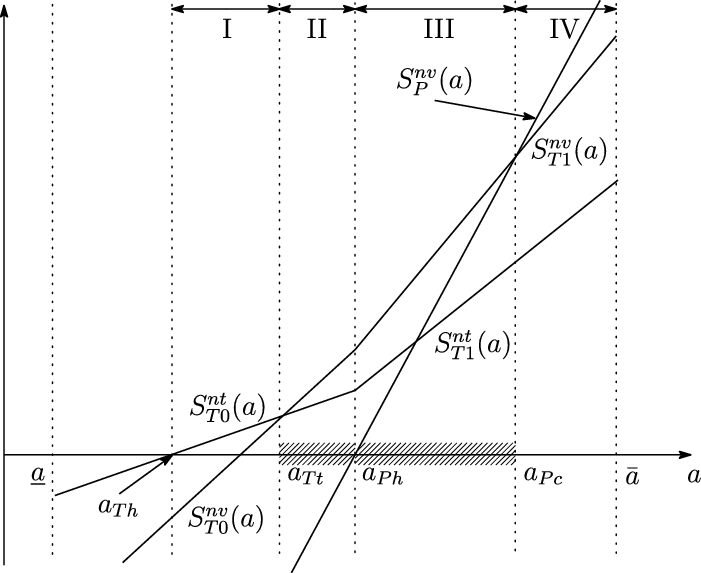
, the graphical features of match surpluses and their relationships should be explained (see Figure 2). First, straight lines representing the surplus of a match with a temporary contract have a kink at
 $a = a_{Ph}$
, and the lines become steeper for
 $a \ge a_{Ph}$
:
 $d \,S^{nt}_{T0}(a)/ d \,a \lt d \,S^{nt}_{T1}(a)/ d \,a$
, and
 $d \,S^{nv}_{T0}(a)/ d \,a \lt d \,S^{nv}_{T1}(a)/ d \,a$
. As a temporary worker in a match with
 $a \ge a_{Ph}$
has the prospect for conversion into a permanent form, the term
 $S^{nv}_P(a)$
in (15) and (16) becomes strictly positive for
 $a \gt a_{Ph}$
(note that
 $ S^{nv}_P(a_{Ph}) = 0$
by definition). Using the fact that each surplus is increasing in
 $a$
, the impact through
 $S^{nv}_P(a)$
makes
 $S^{nt}_{T1}(a)$
and
 $S^{nv}_{T1}(a)$
steeper than
 $S^{nt}_{T0}(a)$
and
 $S^{nv}_{T0}(a)$
, respectively. Second, the slope of the match surplus with a temporary contract and training provision is steeper than the slope of the surplus with no training for both
 $a \lt a_{Ph}$
and
 $a_{Ph} \le a$
:
 \begin{align*} &\frac{d \,S^{nv}_{T0}(a) }{d \, a} - \frac{d \,S^{nt}_{T0}(a)}{d \,a} = \frac{\xi \left[\delta + h \, (\phi _P + \delta )\right] }{\phi _P \, \phi _T \,(\phi _T + \xi )} \gt 0, \\[3pt] &\frac{d \, S^{nv}_{T1}(a)}{d \,a} - \frac{d \, S^{nt}_{T1}(a)}{d \, a} = \frac{\xi \, h (\phi _P + \xi + \delta ) }{\phi _T (\phi _P + \xi )(\phi _T + \xi )} \gt 0. \end{align*}
Determination of each threshold
 $(a_{Tt} \lt a_{Ph})$
: (I) temporary jobs with no training; (II) temporary jobs with training provision and no prospect of conversion; (III) temporary jobs with training provision and prospect of conversion; and (IV) permanent jobs.

This reflects the fact that for
 $a \ge a_{Tt}$
, the term
 $\xi \,S^t_T(a)$
becomes a component of the surplus
 $S^{nv}_{Ti}(a)$
, as shown in (16) because of training provision, leading to a larger slope of
 $S^{nv}_{T0}(a)$
and
 $S^{nv}_{T1}(a)$
compared with
 $S^{nt}_{T0}(a)$
and
 $S^{nt}_{T1}(a)$
, respectively. Third, the slope of the match surplus with a permanent contract is steeper than the slope of the surplus with a temporary contract and training provision:
 \begin{align*} \frac{d \,S^{nv}_P(a)}{d \,a} - \frac{d \,S^{nv}_{T1}(a)}{d \,a} &= \frac{ \phi _P \,\phi _T \, \Delta \,\lambda + \xi (1 + h) \left[\phi _T (\rho + \lambda _T + \xi ) - (\phi _P + \delta )(\phi _P + \xi )\right]}{ \phi _P \,\phi _T \,(\phi _P + \xi )( \phi _T + \xi ) } \gt 0, \end{align*}
where
 $\phi _T \gt \phi _P + \delta, \, \rho + \lambda _T + \xi \gt \phi _P + \xi$
and
 $\Delta \,\lambda \equiv \lambda _T - \lambda _P$
. As the separation rate in temporary jobs is assumed to be higher than the rate in permanent jobs (i.e.,
 $\lambda _T \gt \lambda _P)$
, the match surplus for temporary jobs is more greatly discounted, leading to a smaller slope of
 $S^{nv}_{T1}(a)$
.
The threshold
 $a_{Tt}$
is determined by the intersection of the two surpluses
 $S^{nt}_{T0}(a)$
and
 $S^{nv}_{T0}(a)$
and is located on the left-hand side of
 $a_{Ph}$
in this case, as depicted in Figure 2. At
 $a = a_{Tt}$
, employers are indifferent between providing training and no training. Based on (15)−(17),
 $a_{Tt}$
is obtained by solving
 $S^{nt}_{T0}(a_{Tt}) = S^{nv}_{T0}(a_{Tt})$
, which is represented by:
 \begin{align} a_{Tt} = \frac{\xi \,\delta \,\rho \,U + \phi _P \,\phi _T \, \gamma _T + \xi \, \delta \, \lambda _P \,F }{ \xi \, [ h \,\phi _P + \delta \,(1 + h) ] }. \end{align}
As a situation in which
 $a_{Tt} \lt a_{Ph}$
is considered (the condition ensuring it is stated below),
 $\max \{ S^{nv}_P(a),\,0 \}$
is set to be zero in the computation of (23).
It is reasonable to consider that
 $a_{Tt}$
is higher than
 $a_{Th}$
; otherwise, all temporary workers receive firm-provided training, which is not consistent with the real situation of the labor market. It follows from (20) and (23) that
 $a_{Th} \lt a_{Tt}$
is satisfied under the following condition:
 \begin{align} \rho \,U \lt \frac{ \phi _P \,\phi _T \,\gamma _T + \xi \,\delta \,\lambda _P \,F }{ \xi \,h \, (\phi _P + \delta ) }. \end{align}
(24) is likely to be satisfied if the separation rate of temporary jobs, the cost of providing training to a temporary worker, and termination costs for permanent jobs are sufficiently high.
Comparing
 $a_{Tt}$
with
 $a_{Ph}$
, the latter is higher than the former if and only if the following condition is satisfied:
 \begin{align} \frac{ \phi _T \,[\phi _P + \xi \,(1 + h)] \, \gamma _T - \xi \, [ h \, \phi _P + \delta \,(1 + h) ] \,\gamma _P - \xi \,\lambda _P \,(\xi \,h - \delta ) \, F }{ \xi \,h \,(\phi _P + \delta + \xi ) } \,\lt \, \rho \,U. \end{align}
This is likely to hold if the costs of providing training for a permanent worker (and termination costs) are significantly higher than those costs for a temporary worker. Because higher
 $\gamma _P$
and
 $F$
increase the cost of having permanent employment,
 $a_{Ph}$
becomes higher and (25) is likely to be satisfied. If (22) and (25) are simultaneously satisfied, temporary workers in a match with productivity
 $a \in [a_{Tt}, \,a_{Ph})$
are never converted into a permanent position as long as they are not fully trained.
Regarding an employer’s choice of contract type, suppose that there exists an intersection between
 $S^{nv}_P(a)$
and
 $S^{nv}_{T1}(a)$
in the interval
 $(a_{Ph},\,\bar{a})$
, ensuring the existence of the threshold
 $a_{Pc}$
within this interval. As the slope of
 $S^{nv}_P(a)$
is steeper than the slope of
 $S^{nv}_{T1}(a)$
, these two lines intersect if
 $\bar{a}$
is sufficiently large. Then, a newly formed job match with
 $a \in [a_{Pc},\,\bar{a}]$
takes a permanent form. Using (16)−(19), solving
 $S^{nv}_{T1}(a_{Pc}) = S^{nv}_P(a_{Pc})$
for
 $a_{Pc}$
yields
 \begin{align} a_{Pc} &= \frac{ \Delta \, \lambda \,[\phi _P \,\phi _T + \xi \,(\phi _T + \phi _P + \xi )] \,\rho \,U + \phi _P \,\phi _T \,(\rho + \lambda _T + \xi ) \, \gamma _P - \phi _P \,\phi _T \,(\phi _P + \xi ) \, \gamma _T }{ \Delta \, \lambda \,[\phi _P \,\phi _T + \xi \,(1 + h)(\phi _T + \phi _P + \xi )]} \notag \\[3pt] &\quad + \frac{ \xi \,\lambda _P \,[ (\rho + \lambda _T)(\rho + \lambda _T + \xi ) + \delta \,\Delta \,\lambda ] \,F }{ \Delta \, \lambda \,[\phi _P \,\phi _T + \xi \,(1 + h)(\phi _T + \phi _P + \xi )] }. \end{align}
The following proposition summarizes the conditions in which a situation of Figure 2 is realized.
Proposition 1.
Suppose that (
22
) is satisfied and
 $\bar{a}$
is set to be sufficiently high. Then, if conditions (
24) and (25
) are satisfied, the threshold for providing training to temporary workers is
 $a_{Tt}$
expressed by (
23) and the threshold for choosing a type of contract is
 $a_{Pc}$
expressed by (
26).
If a temporary worker has match-specific productivity
 $a \in [a_{Ph},\,a_{Pc})$
, they receive training opportunities and experience an increase in productivity at the rate of
 $\xi$
. As an activation of the nonrenewal clause forces employers to decide whether to dismiss a temporary worker or to promote a permanent form after the expiration of a certain period, highly productive temporary workers who have not completed training are considered for promotion to a permanent form.
Second, we assume that (22) and (24) are satisfied, but (25) is not satisfied, indicating that
 $a_{Th} \lt a_{Ph} \lt a_{Tt}$
holds. In this case, a new threshold for training provision in temporary jobs is necessary because
 $a_{Tt}$
is defined based on the premise of
 $a_{Tt} \lt a_{Ph}$
. If the surplus
 $S^{nv}_{T1}(a)$
is sufficiently large such that the threshold for training exists in the interval
 $(a_{Ph},\,a_{Pc})$
, which is determined by the intersection between the two surpluses
 $S^{nt}_{T1}(a)$
and
 $S^{nv}_{T1}(a)$
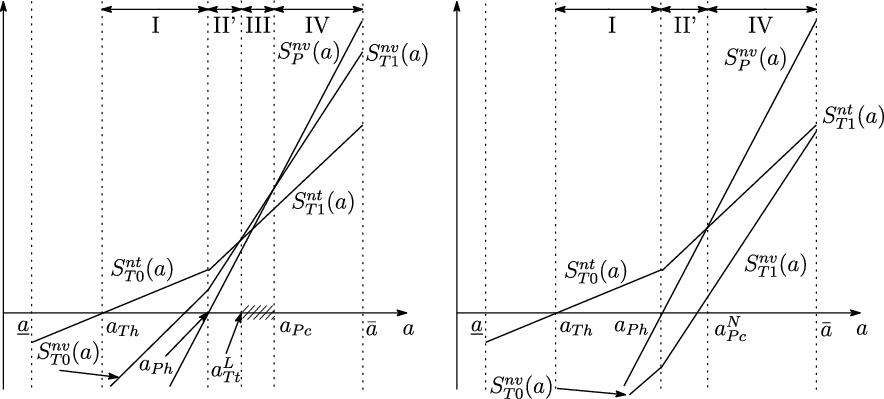
, both novice (i.e., training is provided, but not completed) workers and a portion of untrained (i.e., training is not provided) temporary workers can be converted into permanent employment (see the left portion of Figure 3). Note that these surpluses are represented by:
(Left) A portion of temporary workers are trained; (right) no temporary workers are trained: (I) temporary jobs with no training; (II’) temporary jobs with no training and the prospect of conversion; (III) temporary jobs with training provision and the prospect of conversion; and (IV) permanent jobs.

 \begin{align*} S^{nt}_{T1}(a) = \frac{a - \rho \,U + \delta \,S_P^{nv}(a)}{\phi _T}, \quad S^{nv}_{T1}(a) = \frac{ a - \rho \,U - \gamma _T + \delta \,S_P^{nv}(a) + \xi \,S^t_T(a) }{\phi _T + \xi }. \end{align*}
For a sufficiently high value of
 $a$
belonging to
 $[a_{Ph},\,a_{Pc})$
, even untrained temporary workers have a chance of being converted into a permanent position. Using (15)–(19), let us define the threshold for training in this case as
 $a^L_{Tt}$
which satisfies
 $S^{nt}_{T1}(a^L_{Tt}) = S^{nv}_{T1}(a^L_{Tt})$
:
 \begin{align} a^L_{Tt} = \frac{ \xi \, \delta \,\lambda _P \,F + \phi _T \,(\phi _P + \xi ) \,\gamma _T - \xi \, \delta \, \gamma _P }{ \xi \,h \, (\phi _P + \xi + \delta ) }. \end{align}
Unlike the case of
 $a_{Tt}$
, the expression of
 $a^L_{Tt}$
depends on the costs of providing training to a permanent worker, reflecting the possibility that temporary workers who have not completed training may be promoted to permanent employment.
Note that the threshold for choosing a form of contract in this case is given by (26). A main difference between Figure 2 and the left portion of Figure 3 is that in the latter case there are temporary workers who have the prospect of conversion but do not receive training instead of temporary workers who receive training but do not have the prospect of conversion. The former workers belong to a match with productivity
 $a \in [a_{Ph},\,a^L_{Tt})$
(denoted by (II
 $^{\prime}$
) in Figure 3). The latter workers belong to a match with productivity
 $a \in [a_{Tt},\,a_{Ph})$
(denoted by (II) in Figure 2).
If condition (25) that ensures
 $a_{Tt} \lt a_{Ph}$
does not hold, there is another case in which all temporary workers never receive training opportunities. This situation arises if training temporary workers is less profitable, because training costs
 $(\gamma _T)$
are relatively high in comparison with the outcome of training
 $(h)$
, making the surplus
 $S^{nv}_{T1}(a)$
smaller than the surplus
 $S^{nt}_{T1}(a)$
in the most (or all) area of
 $a$
. In this case, the threshold for choosing a form of contract is determined by the intersection of the surpluses
 $S^{nt}_{T1}(a)$
and
 $S^{nv}_P(a)$
, as depicted in the right portion of Figure 3. Based on (15) and (18), the threshold denoted by
 $a^N_{Pc}$
, which satisfies
 $S^{nt}_{T1}(a^N_{Pc}) = S^{nv}_{P}(a^N_{Pc})$
, is represented by:
 \begin{align} a^N_{Pc} = \frac{ \Delta \,\lambda \, (\phi _P + \xi ) \,\rho \,U + \phi _P \, (\rho + \lambda _T) \, \gamma _P + \xi \,\lambda _P \, (\rho + \lambda _T) \,F }{ \Delta \,\lambda \, (\phi _P + \xi ) + \xi \, h \, (\rho + \lambda _T) }. \end{align}
As employers do not pay any expense for investment in occupational training for temporary workers in this case,
 $a^N_{Pc}$
does not depend on the costs of providing training to these workers.
Which case in Figure 3 is realized depends on the relationship between
 $a^L_{Tt}$
and
 $a^N_{Pc}$
. A direct comparison of these thresholds finds that
 $a^N_{Pc}$
is higher than
 $a^L_{Tt}$
if the following inequality is satisfied:
 \begin{align} &\frac{ \phi _T \,[ \,\Delta \,\lambda \,(\phi _P + \xi ) + \xi \,h \,(\rho + \lambda _T)] \, \gamma _T - \xi \,[ h \,(\phi _P + \delta )(\rho + \lambda _T) + \delta \,\Delta \,\lambda ] \,\gamma _P }{\xi \,h \,\Delta \,\lambda \,(\phi _P + \xi + \delta ) } \notag \\[4pt] &\quad - \frac{ \xi \,\lambda _P \,[ (\xi \,h - \delta ) \, \lambda _T + \xi \,h \, \rho + \delta \,\lambda _P \,] \,F }{\xi \,h \,\Delta \,\lambda \,(\phi _P + \xi + \delta ) } \,\lt \, \rho \,U. \end{align}
This corresponds to the case of the left portion of Figure 3. Although we do not assume any specific relationship between the cost of training permanent workers,
 $\gamma _P,$
and the cost of training temporary workers,
 $\gamma _T$
, (29) is more likely to be satisfied if
 $\gamma _P$
is strictly higher than
 $\gamma _T$
for a given value of termination costs and labor market tightness. If
 $\gamma _T$
is equal to
 $\gamma _P$
, much larger termination costs associated with permanent jobs are necessary for the realization of equilibrium with training in temporary jobs.
The following proposition summarizes the conditions in which each situation described in Figure 3 is realized.
Proposition 2. Suppose that (
22) and (
24) are satisfied, that
 $\bar{a}$
is set to be sufficiently high and that (
25) does not hold. Then, (i) if (29) is satisfied, the threshold for providing training to temporary workers is
 $a^L_{Tt}$
given by (
27) and the threshold for choosing a type of contract is
 $a_{Pc}$
given by (
26); (ii) if (29
) is not satisfied, no temporary worker receives training and the threshold for choosing a type of contract is
 $a^N_{Pc}$
given by (28).
Finally, we show that all fully trained temporary workers can be converted into permanent positions. If the threshold of match-specific productivity that achieves zero in permanent jobs with a fully trained worker is denoted by
 $a_{Ph}^t$
, it is represented by:
 \begin{align} S_P(a^t_{Ph}) = 0 \,\, \Leftrightarrow \,\, a_{Ph}^t = \frac{ \rho \,U - \rho \,F }{ 1 + h }. \end{align}
This is lower than
 $\rho \,U$
. Because the hiring threshold in temporary jobs
 $a_{Th} = \rho \,U$
is higher than
 $a_{Ph}^t$
, all fully trained temporary workers can be converted into permanent positions.
3.3 Value of an Unemployed Worker
The sharing rules for each surplus and the free entry/exit condition indicate the value of an unemployed worker as follows:
 \begin{align} \rho \,U = b + \frac{\beta \,\theta \,c}{1 - \beta }. \end{align}
This is common to all types of equilibria which will be defined in the next section.
3.4 Parameter Space and the Determination of the Type of Equilibrium
The type of equilibrium depends on which conditions among (22), (24), (25), and (29) are satisfied (note that
 $\theta$
is given throughout this section). Let us illustrate these conditions in the parameter space
 $(\gamma _T,\,b)$
. Because (22) does not depend on
 $\gamma _T$
for a given
 $\theta$
, it is illustrated as a horizontal line:
 \begin{align} b = \frac{ \phi _P \,\gamma _P + \xi \,\lambda _P \,F }{ \xi \,h } - \frac{\beta \,\theta \,c}{1 - \beta }, \end{align}
where we use the expression of
 $\rho \,U$
given by (31). By contrast, both (24), (25), and (29) are illustrated as upward-sloping straight lines for a given
 $\theta$
:
 \begin{align} b &= \frac{ \phi _P \,\phi _T \,\gamma _T + \xi \,\delta \,\lambda _P \,F }{ \xi \,h \, (\phi _P + \delta ) } - \frac{\beta \,\theta \,c}{1 - \beta },\\[-5pt]\notag \end{align}
 \begin{align} b &= \frac{ \phi _T \,[\phi _P + \xi \,(1 + h)] \, \gamma _T - \xi \, [ h \, \phi _P + \delta \,(1 + h) ] \, \gamma _P - \xi \,\lambda _P \,(\xi \,h - \delta ) \, F }{ \xi \,h \,(\phi _P + \delta + \xi ) } - \frac{\beta \,\theta \,c}{1 - \beta },\\[-5pt]\notag \end{align}
 \begin{align} b &= \frac{ \phi _T \,[ \,\Delta \,\lambda \,(\phi _P + \xi ) + \xi \,h \,(\rho + \lambda _T)] \, \gamma _T - \xi \,[ h \,(\phi _P + \delta )(\rho + \lambda _T) + \delta \,\Delta \,\lambda ] \, \gamma _P }{\xi \,h \,\Delta \,\lambda \,(\phi _P + \xi + \delta ) } \notag \\[3pt] &- \frac{ \xi \,\lambda _P \,[ (\xi \,h - \delta ) \, \lambda _T + \xi \,h \, \rho + \delta \,\lambda _P \,] \,F }{\xi \,h \,\Delta \,\lambda \,(\phi _P + \xi + \delta ) } - \frac{\beta \,\theta \,c}{1 - \beta }. \end{align}
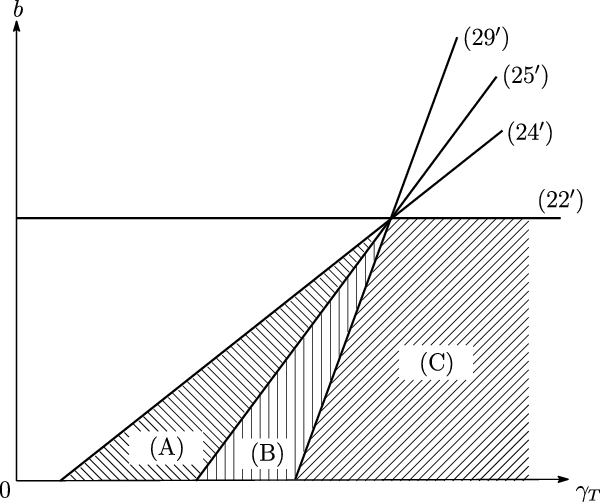
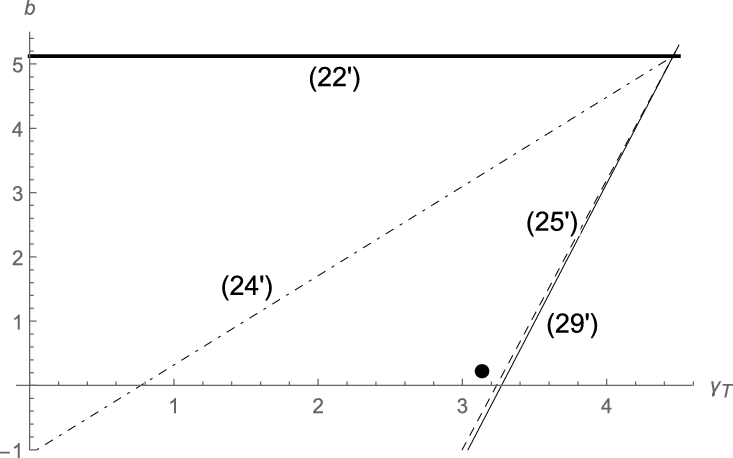
Regarding the relationship of the four lines in Figure 4, we obtain Proposition
 $3$
.
Determination of the type of equilibrium in the parameter space
 $(\gamma _T,\,b)$
.

Proposition 3. In the parameter space
 $(\gamma _T,\,b)$
,
 $\textrm{(i)}$
the slope of (29′
) is steeper than that of (25′),
 $\textrm{(ii)}$
the slope of (
25′) is steeper than that of (24′
), and
 $\textrm{(iii)}$
the four lines have one intersection, as shown in Figure
4. The training costs in temporary jobs and the value of leisure at that point take the following form, respectively:
 \begin{align*} \gamma _T = \frac{ (\phi _P + \delta ) \, \gamma _P + \xi \,\lambda _P \,F }{ \phi _T }, \,\, b = \frac{ \phi _P \,\gamma _P + \xi \,\lambda _P \,F }{ \xi \,h } - \frac{\beta \,\theta \,c}{1 - \beta }. \end{align*}
Proof
See Appendix A.
Three distinct areas are labeled (A), (B), and (C). Each area has the following properties:
-
In the area (A), all four conditions given by (22), (24), (25), and (29) are satisfied. This corresponds to the case in Figure 2. The threshold for providing training in temporary jobs
$a_{Tt}$
is given by (23), which is less than
$a_{Ph}$
and the threshold for choosing a type of contract is given by (26). Let us call the equilibrium associated with this situation Type-I equilibrium. -
In the area (B), conditions (22), (24), and (29) are satisfied, but (25) is not. This corresponds to the left portion of Figure 3. The threshold for providing training in temporary jobs
$a^L_{Tt}$
is given by (27) and the threshold for choosing a type of contract is given by (26). Note that (27) is higher than (23). Let us call the equilibrium associated with this situation Type-II equilibrium. -
In the area (C), only conditions (22) and (24) are satisfied. This corresponds to the right portion of Figure 3. Then,
$a^L_{Tt}$
is higher than
$a^N_{Pc}$
and the threshold for choosing a contract is given by (28). Therefore, no temporary workers are trained. However, workers in a match with productivity higher than
$a_{Ph}$
can be converted into a permanent position. Let us call the equilibrium associated with this situation Type-III equilibrium (i.e., training is not provided in temporary jobs).


3.5 Characterization of Type-I Equilibrium
As will be shown in Section 4.1, the area in the parameter space
 $(\gamma _T,\,b)$
that attains Type-II equilibrium is small under reasonable parameter values. Since our research interest is based on a theoretical model that captured employers’ decisions about the provision of training in temporary jobs, we concentrate on Type-I equilibrium in the following analysis. The characterization of other types of equilibria is described in Appendix B.
To characterize the steady-state equilibrium, we need to specify the job creation condition and measures of unemployment and each employment pool. The equilibrium value of labor market tightness is determined by the standard free entry/exit condition, driving the value to the firm of a vacant job to zero. According to the surplus sharing rule as a result of the Nash bargaining problem, a firm with an occupied job gains the proportion
 $1 - \beta$
of each surplus generated from forming a job match. Therefore, the RHS of (1) is expressed using the surpluses
 $S^{nt}_{T0}(a),\,S^{nv}_{T0}(a),\,S^{nv}_{T1}(a)$
, and
 $S^{nv}_P(a)$
. Based on the above argument regarding employers’ choice and the classification of an equilibrium, applying the rule of integration by parts to the RHS of (1) yields the following job creation condition:
 \begin{align} \frac{c}{(1 - \beta ) \,q(\theta )} &= \frac{d \,S^{nt}_{T0}(a)}{d \,a}\int _{a_{Th}}^{a_{Tt}} (1 - G(a)) \,da + \frac{d \,S^{nv}_{T0}(a)}{d \,a}\int _{a_{Tt}}^{a_{Ph}} (1 - G(a)) \,da \notag \\[4pt] &+ \frac{d \,S^{nv}_{T1}(a)}{d \,a}\int _{a_{Ph}}^{a_{Pc}} (1 - G(a)) \,da + \frac{d \,S^{nv}_P(a)}{d \,a}\int _{a_{Pc}}^{\bar{a}} (1 - G(a)) \,da, \end{align}
where the derivative of each surplus is represented as follows:
 \begin{align*} & \frac{d \,S^{nt}_{T0}(a)}{d \,a} = \frac{1}{\phi _T}, \,\, \frac{d \,S^{nv}_{T0}(a)}{d \,a} = \frac{1}{\phi _T} + \frac{ \xi \,\delta + \xi \,h \,(\phi _P + \delta ) }{\phi _P \,\phi _T \,(\phi _T + \xi )}, \\[4pt] &\frac{d \,S^{nv}_{T1}(a)}{d \,a} = \frac{1}{\phi _T} + \frac{ \xi \,\delta + \xi \,h \,(\phi _P + \delta ) }{\phi _P \,\phi _T \,(\phi _T + \xi )} + \frac{ \delta \,[ \phi _P + \xi \,(1 + h)] }{\phi _P \, (\phi _P + \xi )(\phi _T + \xi )}, \,\, \frac{d \,S^{nv}_P(a)}{d \,a} = \frac{ \phi _P + \xi \,(1 + h) }{ \phi _P \,(\phi _P + \xi ) }. \end{align*}
Note that the derivative of each surplus is independent of productivity
 $a$
because it is a linear function of
 $a$
.
Employers hire a worker in the form of a temporary contract for
 $a \lt a_{Pc}$
. Workers in a match with productivity
 $a \in [a_{Th}, \,a_{Tt})$
do not receive training. For
 $a \in [a_{Tt},\,a_{Ph})$
, employers with a temporary job provide training but no conversion into permanent employment occurs until training is completed. If the productivity of a match is contained in the interval
 $[a_{Ph},\, a_{Pc})$
, training is provided by employers and workers may be converted into permanent employment even if the training is not completed. Employers hire a worker initially in the form of a permanent contract for
 $a_{Pc} \le a$
. As
 $\rho \,U$
is an increasing function of
 $\theta$
and the LHS of (32) is increasing in
 $\theta$
, a unique
 $\theta$
satisfies the job creation condition.
The measures for each type of employed workers are denoted by
 $e_{T0}^{nt},\,e_{T0}^{nv},\,e^{nv}_{T1},\,e^t_{T}, \,e^{nv}_{P},\,e_P$
. The employment and unemployment flows in each pool are described by:
 \begin{align*} \dot{u} &={ - \,(1 - G(a_{Th})) \, \theta \,q(\theta ) \,u + (\lambda _T + \delta )\left(e^{nt}_{T0} + e^{nv}_{T0}\right) + \lambda _T\left(e^{nv}_{T1} + e^t_{T}\right) + \lambda _P \,(e^{nv}_P + e_P) }, \\[4pt] \dot{e}^{nt}_{T0} &= - \,(\lambda _T + \delta ) \,e^{nt}_{T0} + \left[G(a_{Tt}) - G(a_{Th})\right] \,\theta \,q(\theta ) \,u, \\[4pt]\dot{e}^{nv}_{T0} &= - \, \zeta \,e^{nv}_{T0} + \left[ G(a_{Ph}) - G(a_{Tt})\right] \,\theta \,q(\theta ) \,u, \\[4pt] \dot{e}^{nv}_{T1} &= - \, \zeta \,e^{nv}_{T1} + \left[ G(a_{Pc}) - G(a_{Ph})\right] \,\theta \,q(\theta ) \,u, \\[4pt] \dot{e}^t_{T} &= - \,(\lambda _T + \delta ) \,e^t_{T} + \xi \,(e^{nv}_{T0} + e^{nv}_{T1}), \\[4pt] \dot{e}^{nv}_P &= - \,(\lambda _P + \xi ) \,e^{nv}_P + (1 - G(a_{Pc})) \,\theta \,q(\theta ) \,u + \delta \, e^{nv}_{T1}, \\[4pt] \dot{e}_P &= - \lambda _P \,e_P + \xi \,e^{nv}_P + \delta \,e^t_{T}. \end{align*}
In the steady state, flows into and out of each employment pool must be equivalent. Then, the measures of the unemployment pool and each employment pool are derived as follows:
 \begin{align} e^{nt}_{T0} &= \frac{ [G(a_{Tt}) - G(a_{Th})] \,\theta \,q(\theta ) \,u }{ \lambda _T + \delta }, \end{align}
 \begin{align} e^{nv}_{T0} &= \frac{ [ G(a_{Ph}) - G(a_{Tt})] \,\theta \,q(\theta ) \,u }{ \zeta }, \end{align}
 \begin{align} e^{nv}_{T1} &= \frac{ [ G(a_{Pc}) - G(a_{Ph})] \,\theta \,q(\theta ) \,u }{ \zeta }, \end{align}
 \begin{align} e^t_T &= \frac{ \xi \,(e^{nv}_{T0} + e^{nv}_{T1}) }{\lambda _T + \delta }, \end{align}
 \begin{align} e^{nv}_P &= \frac{ (1 - G(a_{Pc})) \,\theta \,q(\theta ) \,u + \delta \,e^{nv}_{T1} }{ \lambda _P + \xi }, \end{align}
 \begin{align} e_P &= \frac{ \xi \,e^{nv}_P + \delta \,e^t_T }{\lambda _P}, \end{align}
and the steady-state value of the unemployment rate is represented by:
 \begin{align} u ={\frac{ \zeta \, \lambda _P \,(\lambda _T + \delta ) }{ \zeta \, \lambda _P \,(\lambda _T + \delta ) + \theta \,q(\theta )[ \zeta \,(\lambda _T + \delta ) - \zeta \,(\lambda _T - \lambda _P) \,G(a_{Pc}) - \delta \, (\lambda _T + \delta ) \,G(a_{Ph}) - \xi \,\delta \, G(a_{Tt}) - \zeta \,\lambda _P \,G(a_{Th}) ] } }. \end{align}
Proposition 4. Suppose that (22
),(
24),(25), and (29) are satisfied. Then there exists a unique steady-state equilibrium that is characterized by
 $\{ a_{Th},\,a_{Tt},\,a_{Ph},\,a_{Pc},\,\theta,\, e_{T0}^{nt},\, e_{T0}^{nv}, \, e^{nv}_{T1},\,e^t_{T}, \,e^{nv}_{P},\,e_P,\,u \}$
. These endogenous variables are determined by (
20), (21), (23), (26
), (32), (33a)-(33f
), and (34), respectively.
Once the equilibrium value of labor market tightness is uniquely determined by (32), (20), (25), (23), and (25) specify each threshold, respectively. Subsequently, the equilibrium values of the unemployment rate and measures of each employed worker are determined.
4. Quantitative analysis
4.1 Calibration
One period of time equals 1 month in this exercise. The key parameters are derived to fit into the performance of the Italian labor market, where a gap in the rate of participation in training among contracts is relatively high compared to other European countries.Footnote
15
First, we specify some functional forms. Following the literature, the matching function is assumed to be a Cobb−Douglas form:
 $m(u,\,v) = \Lambda \,u^{\alpha }v^{1-\alpha }$
with
 $\alpha \in (0,\,1)$
.
 $\Lambda$
is a mismatch parameter, which is a positive constant. Second, we suppose that match-specific productivity follows a uniform distribution with the support
 $[1,\,3]$
:
 $G(a) = (a - 1)/2$
.Footnote
16
Note that
 $\underline{a}$
is set to 1 as normalization and that
 $\bar{a} = 3$
is chosen to obtain a reasonable value of the gap in the average wage between temporary and permanent contracts. Using individual longitudinal ECPH data for
 $1995$
–
 $2001$
, Kahn (Reference Kahn2016) estimates this wage gap for workers between the age of
 $16$
and
 $65$
years in Italy to be around
 $25 \%$
. Based on the same dataset with controlling differences in individual or job characteristics, OECD (2002) finds the estimated wage penalty for temporary workers in
 $1997$
to be around
 $13 \%$
. The computed value of the wage gap in this study is
 $17.86 \%$
, which lies between OECD (2002) and Kahn (Reference Kahn2016).
The discount rate,
 $\rho$
, is set to
 $0.3 \%$
, which corresponds to a
 $1\%$
interest rate per quarter (Bentolila et al. (Reference Bentolila, Cahuc, Dolado and Le Barbanchon2012)). Following Belan and Chéron (Reference Belan and Chéron2014), the value of leisure,
 $b$
, is equal to
 $0.2$
.
 $\alpha$
is the elasticity of the matching function with respect to unemployment and is set to
 $0.5$
, in line with most of the literature. The bargaining power of workers,
 $\beta$
, is equal to
 $0.5$
, which coincides with the elasticity of the matching function. This is the standard Hosios condition. The mismatch parameter,
 $\Lambda$
, is equal to
 $0.347$
, which is chosen to ensure that the job creation condition given (32) holds under the targeted value of labor market tightness
 $\theta = 0.445$
and that calibrated parameters take a moderate value.Footnote
17
Regarding the cost of training permanent workers, it is difficult to obtain data on the actual amount because it should include not only a pecuniary component but also a nonpecuniary one, such as a reduction in the productivity of senior employees playing the role of mentor. We then set
 $\gamma _P = 12$
, which ensures a reasonable value of termination costs through calibration. If
 $\gamma _P$
becomes lower, the calibrated value of the termination costs becomes considerably high because a reduction in
 $\gamma _P$
increases the expected profit of a vacant job, and higher termination costs are necessary to satisfy the job creation condition. For a similar reason,
 $\xi$
is set to
 $0.1$
. Regarding the choice of the separation rate in temporary jobs, the value of
 $\lambda _T$
is chosen to make the calculated proportion of permanent contracts among newly created jobs approach the actual value
 $38 \%$
for Italy in the
 $2005$
−
 $2015$
period (Albanese and Gallo (Reference Albanese and Gallo2020)).Footnote
18
The activation rate of a nonrenewal clause,
 $\delta$
, is set to
 $0.02$
to fit the model to the data showing that the year-to-year transition rate in Italy is around
 $20 \%$
. Finally, following Hobijn and Sahin (Reference Hobijn and Sahin2009), who estimate the monthly job separation rate for over
 $20$
OECD countries, we set
 $\lambda _P = 0.0069$
because the estimated rate in Italy is
 $0.69 \%$
.
Based on the OECD database, we target the proportion of permanent workers and the unemployment rate in Italy to
 $87 \%$
and
 $9.3 \%$
, respectively. Following the finding reported by Peracchi and Viviano (Reference Peracchi and Viviano2004), we target a labor market tightness of
 $0.445$
. Finally, using information about the difference in the participation rate provided by OECD (2019a) and the proportion of employees participating in continuing vocational training (CVT) courses provided by Wiseman and Parry (Reference Wiseman and Parry2017), the participation rate in firm-provided training for temporary workers in Italy is obtained as
 $18.1 \%$
.Footnote
19
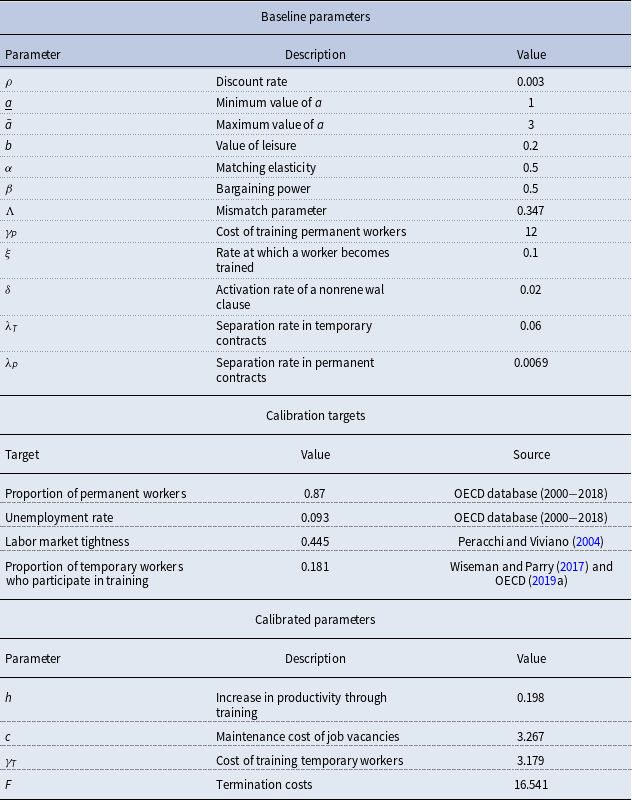
We target this value in this calibration exercise. The calibrated values of the remaining parameters,
 $h,\,c,\,\gamma _T$
, and
 $F$
, are listed at the bottom of Table 1.Footnote
20
A list of parameter values

The plotted point in Figure 5 represents the combination of the calibrated value of the cost of training temporary workers and the baseline value of leisure. The point is close to the boundary between the Type-I and Type-II equilibria but is located on its left-hand side. Together with the fact that the area in the
 $(\gamma _T,\,b)$
space that attains Type-II equilibrium is extremely small (this topic will be discussed in Section 4.4), it is reasonable to concentrate on Type-I equilibrium in the following numerical exercise. Finally, we note that the area in the
 $(\gamma _T,\,b)$
space that attains Type-I equilibrium significantly varies according to the value of
 $\lambda _T$
, which is the separation rate for temporary jobs. All other things being equal, a considerably high separation rate of these contracts (resulting in an increase in short-term temporary contracts) may generate the associated Type-III equilibrium. We will also discuss this topic in Section 4.4.
Classification of equilibrium.

4.2 The Impact of Reducing the Cost of Training Temporary Workers
Before explaining the results of this section, following OECD (2019b), we will briefly review the role of Training Funds (TFs) in Italy, which were instituted by law in
 $2000$
. TFs are associations run by social partners that support workers’ continuous learning and finance training expenses using resources collected through firms’ payroll contributions. Owing to the importance of assisting vulnerable (or low-skilled) employment groups, which is the recent policy orientation of European societies, TFs take on even greater importance in continuous vocational training in Italy. A reduction in the cost of training temporary workers in this model can be seen as a provision of more grants for vocational training to employees with temporary jobs. Although the resources available to invest in continuous vocational training have been reduced in Italy, it is easier to request more funds for training if financing firm-provided training is expected to improve the macroeconomic performance of the labor market.Footnote
21
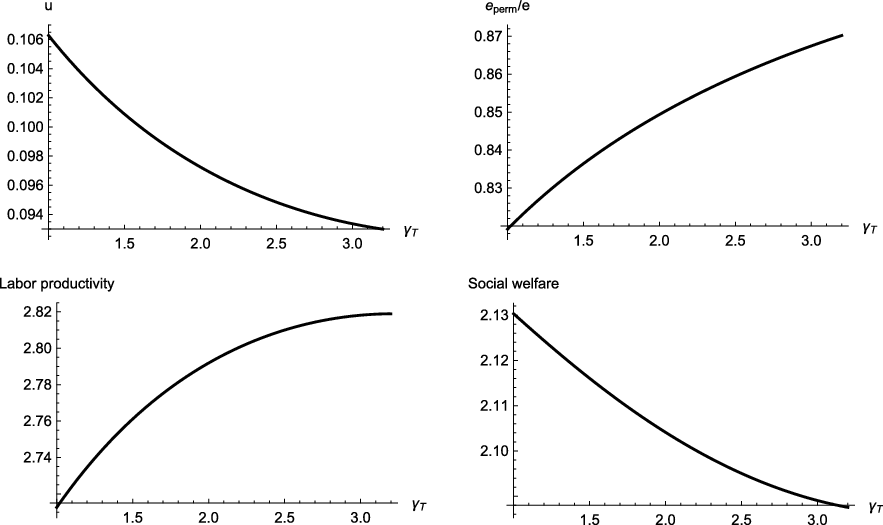
Figure 6 shows that a decrease in
 $\gamma _T$
increases the unemployment rate and decreases the share of permanent workers and labor productivity but increases social welfare (evidently, it increases the participation rate in training among temporary workers).Footnote
22
These results are interpreted as follows. A lower cost of training temporary workers increases job creation. Therefore, the thresholds
 $a_{Ph}$
and
 $a_{Pc}$
become higher, since a change in
 $\gamma _T$
has only an indirect impact on these thresholds through
 $\theta$
, and an increase in
 $\theta$
strengthens the bargaining power of workers and decreases the match surpluses arising from both types of contracts. If threshold
 $a_{Ph}$
becomes higher, more dead-end temporary jobs are the result. If threshold
 $a_{Pc}$
becomes higher, more newly formed jobs start through temporary contracts. Together with the fact that the hiring threshold for temporary jobs is also raised under higher labor market tightness, lowering the training cost of temporary jobs leads to a decrease in the share of permanent workers among total employees and an increase in the unemployment rate. Based on the parameter values listed in Table 1, a
 $10 \%$
decrease in the training cost from the baseline value leads to a decrease in the share of permanent workers of 0.46 percentage points (from
 $87$
% to
 $86.54 \%$
), an increase in the unemployment rate of
 $0.07$
percentage points (from
 $9.3 \%$
to
 $9.37 \%$
), an increase in the participation rate in training for temporary workers of
 $13.32$
percentage points (from
 $18.1 \%$
to
 $31.42 \%$
), and an increase in social welfare of
 $0.13 \%$
(from 2.08767 to 2.0904). Similarly, a
 $50 \%$
decrease in the training cost from the baseline value leads to a decrease in the share of permanent workers of 3.1 percentage points (from
 $87 \%$
to
 $83.9 \%$
), an increase in the unemployment rate of
 $0.71$
percentage points (from
 $9.3 \%$
to
 $10.01 \%$
), an increase in the participation rate in training for temporary workers of
 $61.45$
percentage points (from
 $18.1 \%$
to
 $79.55 \%$
), and an increase in social welfare of
 $1.25\%$
(from
 $2.08767$
to
 $2.11372$
).
Impact of cost of training temporary workers: (upper left) unemployment rate; (upper right) proportion of permanent workers among total employees; (lower left) labor productivity; (lower right) social welfare.

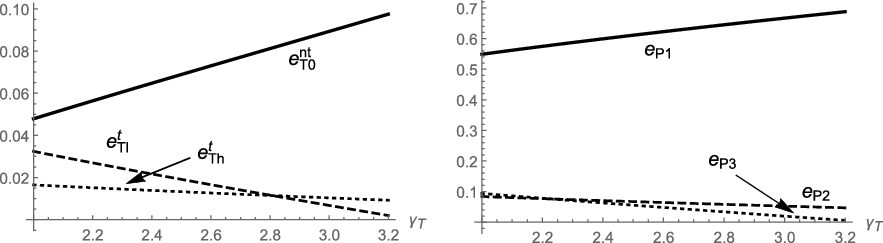
Regarding the impact on labor productivity, we focus on the replacement of permanent jobs by temporary jobs. To provide an intuition for this result, the following notations are defined (see also Appendix C): (i)
 $e^t_{Tl}$
is the measure of temporary workers who were initially in a dead-end state and completed training; (ii)
 $e^t_{Th}$
is the measure of temporary workers who initially had the prospect of being converted into permanent contracts and completed training; (iii)
 $e_{P1}$
is the measure of permanent workers who started their careers with permanent status and completed training; (iv)
 $e_{P2}$
is the measure of permanent workers working as novices with permanent contracts or converted from
 $e^t_{Th}$
into their current positions;Footnote
23
and (v)
 $e_{P3}$
is the measure of permanent workers converted from
 $e^t_{Tl}$
. As shown in the left portion of Figure 7, a reduction in
 $\gamma _T$
decreases
 $e^{nt}_{T0}$
and increases
 $e^t_{Tl}$
and
 $e^t_{Th}$
, indicating that the share of temporary workers who completed training increases unambiguously, leading to an increase in the number of trained permanent workers (an increase in
 $e_{P2}$
and
 $e_{P3})$
. However, these positive effects are not sufficient to increase the total number of permanent workers with high productivity as an outcome of training because the negative effect of a decrease in permanent workers among the new hires is significant. The decrease in permanent workers among new hires decreases the flow into
 $e_{P1}$
, which is the dominant effect with respect to the decrease in labor productivity.
Impact of the cost of training temporary workers on measures of selected employment pools: (left) measures of temporary workers who have completed training and who do not receive training; (right) measures of permanent workers who have completed training.

According to the results presented in this section, policies to reduce the burden of training expenses that target temporary workers not only achieve a higher participation rate of these workers in training opportunities but also increase social welfare, which is attributed to a reduction in the total amount paid for training costs in permanent jobs. This result indicates that the cost of training temporary workers should be reduced from the viewpoint of improving social efficiency. To implement such policies, which contribute to the opening up of vocational training opportunities for workers in vulnerable positions, policy makers should consider that additional costs may be necessary to compensate unemployed workers for their job losses due to the increase in temporary workers and unemployment rate.
4.3 Impact of Easing Employment Protection on Permanent Jobs
This section examines the impact of a reduction in employment protection on permanent contracts. In Italy, the degree of regulation of unfair dismissals is discontinuous at the
 $15$
-employee threshold; that is, considerably stringent employment protection is imposed on employers with
 $15$
employees or more, and the degree of employment protection is weak for employers with less than
 $15$
employees. Several empirical studies, such as Hijzen et al. (Reference Hijzen, Mondauto and Scarpetta2017) and Bratti et al. (Reference Bratti, Conti and Sulis2018), have investigated the effect of EPL on the composition of employment contracts and worker turnover using this size-contingent property. Because the termination costs associated with permanent contracts are uniformly imposed on employers in this study (the size of a firm is not considered), a reduction in the termination costs, which is a labor market policy that we address in this section, is assumed to be applied to every employer with a permanent contract.
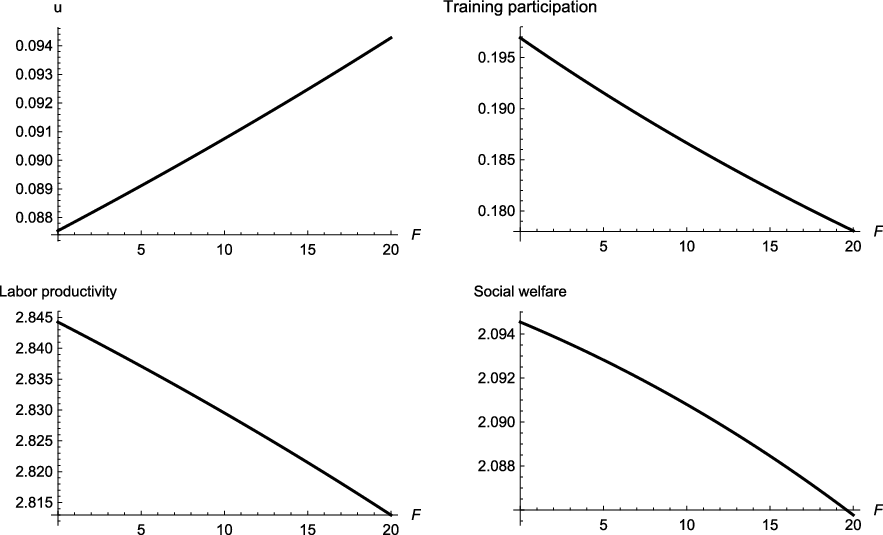
According to Figure 8, reducing the termination costs for permanent jobs decreases the unemployment rate and increases the proportion of permanent workers, the rate of participation in training for temporary workers, labor productivity, and social welfare. We first note that a decrease in
 $F$
increases the equilibrium value of labor market tightness, which is consistent with the stylized facts. Second, from (25) and (26), a reduction in the termination costs decreases both the threshold for converting from a temporary into a permanent contract,
 $a_{Ph}$
, and for choosing a permanent contract in an initially formed match,
 $a_{Pc}$
. Because lower termination costs decrease the expected labor costs in permanent jobs, these results are intuitive. Subsequently, the decrease in
 $F$
affects the threshold for hiring a temporary worker,
 $a_{Th}$
, and the threshold for providing training to them,
 $a_{Tt}$
. The result that the equilibrium value of labor market tightness is decreasing in
 $F$
shows that employers raise the former threshold, as
 $F$
has an indirect effect on
 $a_{Th}$
through
 $\theta$
, and a higher
 $\theta$
increases the outside value of a worker in wage bargaining (i.e., the value of being unemployed) and decreases the surplus from forming temporary jobs with no training. Interestingly, in contrast to the case of
 $a_{Th}$
, a change in
 $F$
has a direct impact on
 $a_{Tt}$
for the following reason. The presence of termination costs associated with permanent jobs directly affects employers’ decisions about the provision of training to temporary workers because temporary workers who have completed training may be converted into permanent contracts. Therefore, lower termination costs increase the match surplus generated from a permanent job occupied by a fully trained worker, which makes providing training to a temporary worker more attractive. This induces employers with temporary jobs to train their employees, resulting in a decrease in
 $a_{Tt}$
. This result supports the expectation of a spillover effect, encouraging firms to train temporary workers by reforming EPL to address labor market segmentation. We note that this spillover effect can arise even if employers’ decisions about the duration of temporary jobs are endogenized.Footnote
24
Although the hiring threshold in temporary jobs is raised, a higher proportion of permanent workers among total employees and a higher proportion of temporary workers who receive training opportunities contribute to a decrease in the unemployment rate and an increase in labor productivity and social welfare.
Impact of termination costs associated with permanent jobs: (upper left) unemployment rate; (upper right) proportion of temporary workers who participate in training; (lower left) labor productivity; (lower right) social welfare.

These results are consistent with the findings of Hijzen et al. (Reference Hijzen, Mondauto and Scarpetta2017) and Bratti et al. (Reference Bratti, Conti and Sulis2018). Based on a regression discontinuity design, they suggest that higher firing costs for regular workers lead firms to replace regular positions with temporary ones, thus increasing worker turnover. Their finding can be a potential explanation for the decrease in productivity observed in European countries. Moreover, Bratti et al. (Reference Bratti, Conti and Sulis2018) point out that low productivity is attributed to the fact that temporary workers tend to receive less training. The finding in this section further supports the standpoint of lowering firing costs for regular workers because it will contribute to an increase in productivity through a higher participation rate in firm-sponsored training among temporary workers.
4.4 Discussion
4.4.1 A case in which temporary jobs have a very short employment duration
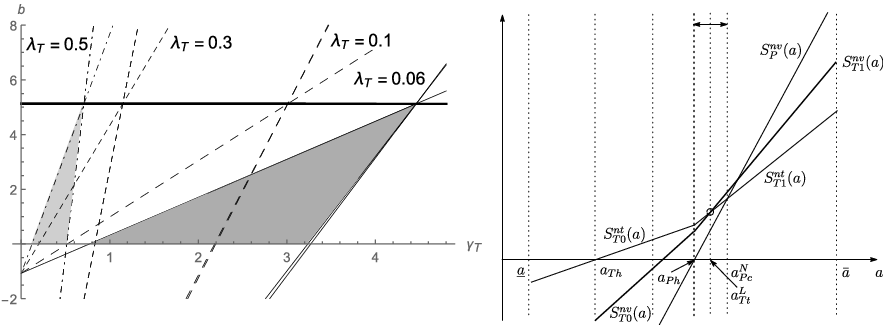
Cahuc et al. (Reference Cahuc, Charlot and Malherbet2016) and Felgueroso et al. (Reference Felgueroso, García-Pérez, Jansen and Troncoso-Ponce2018) point out that France and Spain experienced a steep increase in the volume of fixed-duration contracts lasting less than a week or month. Such an increase in the very short duration of fixed-term contracts will be relevant to the higher separation rate of these contracts, represented by a higher
 $\lambda _T$
in this study. The left part of Figure 9 represents how an increase in
 $\lambda _T$
affects the possibility of realizing each type of equilibrium. The area in the
 $(\gamma _T,\,b)$
space that attains Type-I equilibrium becomes smaller as
 $\lambda _T$
becomes larger. The light gray area corresponds to the case of
 $\lambda _T = 0.5$
, and the dark gray area corresponds to the benchmark case (i.e.,
 $\lambda _T = 0.06)$
. In other words, the area that attains Type-III equilibrium, whereby firms never provide training to temporary workers, becomes significantly larger. This implies that when analyzing the French and Spanish labor markets, we should pay attention to Type-III equilibrium and consider policy that induces employers to retain temporary jobs for longer periods because the prevalence of fixed-term contracts of very short duration will make employers reluctant to invest in firm-sponsored training. As has already been mentioned, in the Italian labor market, note that the mean tenure of temporary workers is high among other European countries and that the annual transition rate from temporary to permanent employment in Italy (approximately 20
 $\%$
) is higher than the rate in France and Spain (approximately 10
 $\%$
). Thus, employers in Italy will potentially have a stronger incentive to invest in training for temporary workers because of higher stability in these jobs compared to France and Spain.
(Left) How a change in the duration of temporary jobs affects the possibility of realizing each type of equilibrium; (right) realization of Type-II equilibrium.

According to Cahuc et al. (Reference Cahuc, Charlot and Malherbet2016), who introduce the heterogeneity of the expected duration of production opportunities, more stringent employment protection associated with permanent jobs increases the duration of temporary jobs (the share of these jobs decreases). Although the results of this study predict that less stringent employment protection will increase the participation rate of temporary workers in firm-sponsored training, how termination costs (i.e., the degree of employment protection) affect the decisions of employers regarding the provision of training through the duration of temporary jobs should be taken into account. This is an interesting research topic.
4.4.2 The reason Type-II equilibrium is less likely to arise
It seems that Type-II equilibrium depicted by the left part of Figure 3 may be more consistent with the fact that only a part of temporary workers receive opportunities for occupational training. However, Figure 5 shows that Type-II equilibrium hardly arises under the parameter values used in the calibration exercise. We will consider the reason in this section.
For the realization of Type-II equilibrium, the cost of training temporary workers must be sufficiently high but not so high that the surplus
 $S^{nv}_{T1}(a)$
is lower than the surplus
 $S^{nt}_{T1}(a)$
at
 $a = a_{Ph}$
, provided that
 $S^{nv}_{T1}(a_{Ph})$
takes a positive value (see the right part of Figure 9). Even if hiring temporary workers and providing them with training yield a positive surplus, an insufficient level of this surplus does not induce employers to invest in the training of temporary workers. Rather, they intend to hire workers in a permanent form from the beginning. As relatively higher training costs associated with temporary jobs decrease the amount of match surplus, employers are more likely to prefer a permanent contract to a temporary contract when hiring a competent person. As shown in the right part of Figure 9, Type-II equilibrium requires that the intersection of
 $S^{nv}_{T1}(a)$
and
 $S^{nt}_{T1}(a)$
belong to the interval
 $(a_{Ph},\,a^N_{Pc})$
, implying that the length of this interval determines the likelihood that Type-II equilibrium is realized. However, under the parameter values listed in Table 1 the length of the interval
 $[a_{Ph},\,a^N_{Pc}]$
is small (given by
 $a^N_{Pc} - a_{Ph} = 2.521-2.405 = 0.116)$
, compared with the length of the interval
 $[a_{Th},\,a_{Ph}]$
(given by
 $a_{Ph} - a_{Th} = 2.405 - 1.654 = 0.751)$
. This is mainly due to the fact that the slope of the surplus
 $S^{nv}_P(a)$
is relatively large and has an intersection with
 $S^{nt}_{T1}(a)$
, meaning that
 $a^N_{Pc}$
is close to
 $a_{Ph}$
.
5. Conclusions
This study focuses on the fact that temporary workers receive less training than permanent workers and that the provision of training and the accumulation of human capital explicitly affect the welfare of temporary workers and labor productivity of the economy. In recent years, owing to rapid technological progress and population aging, OECD (2019a) stresses the need to scale up and strengthen training opportunities to keep workers’ skills up-to-date and enable them to acquire new skills. Furthermore, assisting vulnerable (or low-skilled) employment groups has been an important policy orientation in European societies. However, to the best of our knowledge, little research has theoretically addressed employers’ decisions regarding investment in firm-specific training in dual labor markets, based on the general equilibrium model. Using a search and matching framework, we construct a theoretical model that accompanies the heterogeneity of match-specific productivity and employers’ investment in firm-specific training under temporary and permanent contracts. Additionally, by reflecting the realized value of match-specific productivity, the type of contract in a newly formed match is endogenously determined by employers.
Using the aforementioned framework, we first show that, depending on the parameter values, there are three types of equilibria from the viewpoint of the provision of training to temporary workers. By focusing on an equilibrium that entails training in temporary jobs and is most likely to occur, the main results of this study are obtained through a quantitative analysis of the Italian labor market. First, we examine the impact of reducing the cost of training temporary workers, which aims to directly increase their participation in firm-provided training and labor productivity. Policies to reduce the burden of training expenses that target temporary workers achieve a higher participation rate of temporary workers in training opportunities and increase social welfare. However, it should also be noted that such policies may generate the additional cost of compensating unemployed workers for their job losses due to a significant decrease in permanent contracts among new hires and a resulting larger share of temporary jobs. Second, relaxing the firing regulations for permanent jobs not only decreases the unemployment rate but also increases the proportion of permanent workers and the participation of temporary workers in firm-sponsored training, resulting in higher labor productivity and social welfare. Therefore, policies aimed to reduce the termination costs associated with permanent jobs can generate a spillover effect on training provision in temporary jobs and improve labor market performance.
For the assertions of this paper to be more plausible, we need to enrich our model by considering the following points. First, other mechanisms of wage determination should be explored. Wage determination in our current model is based on the standard Nash bargaining problem, conducted between an individual firm and a worker. However, Italy uses a collective wage bargaining system. Therefore, if this collective bargaining system is introduced, the realized wages may become less responsive to changes in labor market conditions, resulting in differences in the impact of policies. Second, the government budget constraints reflecting tax revenues and payment of various compensation/subsidies should be considered, since governments always face tough decisions about the optimal allocation of resources to each individual policy when faced with severe limitations on their budget. Since the impact of one policy measure may be either amplified or offset by other policy measures, it is important to understand how different policies (e.g., deregulation in employment contracts, unemployment insurance, and payment of subsidies for creating stable jobs and assisting in the provision of vocational training) interact with one another and to identify their optimal design by considering how they affect the amount of tax revenue and the required compensation through changes in the status of workers. In our future research, we will explore how these factors affect the results obtained in this study.
Acknowledgement
I am very grateful for the useful comments and suggestions from two anonymous referees and the Associate Editor. I am also grateful to Ryoichi Imai, Koji Kitaura, Katsuya Takii and participants of Kansai Labor Workshop at Osaka University, and the Asian and Australasian Society of Labour Economics at the National University of Singapore for their helpful comments in
 $2019$
. This work is partly supported by JSPS KAKENHI Grant Number
 $17$
K
 $03779$
. All remaining errors are mine.
Appendix
A. Proof of proposition 3
Taking a difference in slope between (25
 $^{\prime}$
) and (29
 $^{\prime}$
) yields
 \begin{align} &\mbox{Slope of $(25')$ $-$ Slope of $(29')$}, \notag \\[3pt] &= \frac{ \phi _T \,[ \phi _P + \xi \,(1 + h)] }{ \xi \,h \,(\phi _P + \delta + \xi )} - \frac{ \phi _T \,[ \Delta \,\lambda \,(\phi _P + \xi ) + \xi \,h \,(\rho + \lambda _T)] }{ \xi \,h \, \Delta \,\lambda \,(\phi _P + \delta + \xi ) } = - \, \frac{ \xi \,h \,\phi _T \,\phi _P }{ \xi \,h \, \Delta \,\lambda \,(\phi _P + \delta + \xi ) } \lt 0. \end{align}
Similarly, taking a difference in slope between (24
 $^{\prime}$
) and (25
 $^{\prime}$
) yields
 \begin{align} &\mbox{Slope of $(24')$} - \mbox{ Slope of $(25')$} = \frac{\phi _P \,\phi _T}{ \xi \, h \,(\phi _P + \delta ) } - \frac{ \phi _T \,[\phi _P + \xi \,(1 + h)] }{\xi \,h \,(\phi _P + \delta + \xi )}, \notag \\[3pt] &= -\, \frac{ \xi \, \phi _T \,[\delta + h \,(\phi _P + \delta )] }{ \xi \,h \,(\phi _P + \delta )(\phi _P + \delta + \xi ) } \lt 0. \end{align}
Next, we consider the intersection of the four lines. From (22
 $^{\prime}$
) and (29
 $^{\prime}$
), the coordinate of
 $\gamma _T$
is given by:
 \begin{align} \gamma _T &= \frac{ (\phi _P + \delta ) \, \gamma _P + \xi \,\lambda _P \,F }{ \phi _T }. \end{align}
This is equivalent to the coordinate of
 $\gamma _T$
at the intersection of (25
 $^{\prime}$
) and (29
 $^{\prime}$
) and at the intersection of (22
 $^{\prime}$
) and (24
 $^{\prime}$
). The four straight lines represented by (22
 $^{\prime}$
), (24
 $^{\prime}$
), (25
 $^{\prime}$
), and (29
 $^{\prime}$
) have only one common intersection as described in Figure 4. At this intersection, the coordinate of
 $b$
is derived from (22
 $^{\prime}$
) as follows:
 \begin{align*} &\rho \,U = b + \frac{\beta \,\theta \,c}{1 - \beta } = \frac{ \phi _P \, \gamma _P + \xi \,\lambda _P \,F }{\xi \,h} \,\,\, \Rightarrow \,\,\, b = \frac{ \phi _P \, \gamma _P + \xi \,\lambda _P \,F }{\xi \,h} - \frac{\beta \,\theta \,c}{1 - \beta }. \,\, \,\, \end{align*}
B. Characterization of type-II equilibrium and type-III equilibrium
B.1. Type-II Equilibrium
From the free entry/exit condition, the job creation condition in the case of Type-II equilibrium is represented by:
 \begin{align} \frac{c}{(1 - \beta ) \,q(\theta )} &= \frac{ d \,S^{nt}_{T0} }{ d\,a } \int _{ a_{Th} }^{a_{Ph}} (1 - G(a)) \,da + \frac{ d \,S^{nt}_{T1} }{ d\,a } \int _{ a_{Ph} }^{a^L_{Tt}} (1 - G(a)) da \notag \\[3pt] &\quad + \frac{ d \,S^{nv}_{T1} }{ d\,a } \int _{ a^L_{Tt} }^{a_{Pc}} (1 - G(a)) \,da + \frac{ d \,S^{nv}_{P} }{ d\,a } \int _{ a_{Pc} }^{ \bar{a} } (1 - G(a))da, \end{align}
where
 $d \,S^{nt}_{T1}/ d \,a$
is represented by:
 \begin{align*} \frac{ d \,S^{nt}_{T1} }{ d \,a } = \frac{1}{\phi _T} \left [ 1 + \frac{ \delta \,(\phi _P + \xi + \xi \,h) }{\phi _P \, (\phi _P + \xi )} \right ] = \frac{ (\phi _P + \xi )(\phi _P + \delta ) + \xi \,\delta \,h }{ \phi _P \,\phi _T \,(\phi _P + \xi ) }. \end{align*}
The surplus
 $S^{nt}_{T1}(a)$
, which does not emerge in (32), corresponds to the case in which untrained workers are converted from temporary into permanent employment. In this type of equilibrium, therefore, all trained temporary workers and some proportion of untrained temporary workers can be promoted to a permanent position. A unique value of
 $\theta$
that satisfies (B1) exists.
The measures for each type and each state of temporary and permanent worker are denoted by
 $e_{T0}^{nt},\,e_{T1}^{nt},\,e^{nv}_{T1},\,e^t_{T}, \,e^{nv}_{P},\,e_P$
. The employment and unemployment flows in each pool are described by:
 \begin{align*} \dot{u} &= - \,(1 - G(a_{Th})) \,\theta \,q(\theta ) \,u + (\lambda _T + \delta ) \,e^{nt}_{T0} + \lambda _T \left(e^{nt}_{T1} + e^{nv}_{T1} + e^t_T\right) + \lambda _P \,(e^{nv}_P + e_P), \\[3pt] \dot{e}^{nt}_{T0} &= - \,(\lambda _T+ \delta ) \,e^{nt}_{T0} + [G(a_{Ph}) - G(a_{Th})] \,\theta \,q(\theta ) \,u, \\ \dot{e}^{nt}_{T1} &= - \,(\lambda _T+ \delta ) \,e^{nt}_{T1} + \left[G(a^L_{Tt}) - G(a_{Ph})\right] \,\theta \,q(\theta ) \,u, \\ \dot{e}^{nv}_{T1} &= - \,\zeta \,e^{nv}_{T1} + [G(a_{Pc}) - G(a^L_{Tt})] \,\theta \,q(\theta ) \,u, \\ \dot{e}^t_T &= - \,(\lambda _T + \delta ) \,e^t_T + \xi \,e^{nv}_{T1},\\[3pt] \dot{e}^{nv}_P &= - \,(\lambda _P + \xi ) \,e^{nv}_P + (1 - G(a_{Pc})) \,\theta \, q(\theta ) \, u + \delta \,(e^{nt}_{T1} + e^{nv}_{T1}), \\[3pt] \dot{e}_P &= - \,\lambda _P \,e_P + \xi \,e^{nv}_P + \delta \,e^t_T.\end{align*}
Then, the measures of the unemployment pool and each employment pool are derived as follows:
 \begin{align} e^{nt}_{T0} &= \frac{ [G(a_{Ph}) - G(a_{Th})] \, \theta \,q(\theta ) u }{\lambda _T + \delta }, \end{align}
 \begin{align} e^{nt}_{T1} &= \frac{ \Big[G\Big(a^L_{Tt}\Big) - G(a_{Ph})\Big] \, \theta \,q(\theta ) \,u }{\lambda _T + \delta }, \end{align}
 \begin{align} e^{nv}_{T1} &= \frac{ \Big[G(a_{Pc}) - G\Big(a^L_{Tt}\Big)\Big] \,\theta \,q(\theta ) \,u }{ \zeta }, \end{align}
 \begin{align} \qquad\qquad\quad e^t_{T} &= \frac{ \xi \, e^{nv}_{T1} }{\lambda _T + \delta } = \frac{ \xi \,\Big[ G(a_{Pc}) - G\Big(a^L_{Tt}\Big)\Big] \,\theta \,q(\theta ) \,u }{ \zeta \,(\lambda _T + \delta ) }, \end{align}
 \begin{align} \qquad\qquad e^{nv}_P &= \frac{ (1 -G(a_{Pc})) \,\theta \,q(\theta ) \,u + \delta \,\Big(e^{nt}_{T1} + e^{nv}_{T1}\Big) }{ \lambda _P + \xi }, \end{align}
 \begin{align} e_P &= \frac{ \xi \,e^{nv}_P + \delta \,e^t_T }{\lambda _P}.\qquad\qquad\qquad \end{align}
The steady-state value of the unemployment rate is represented by:
 \begin{align} u = \frac{ \lambda _P \,(\lambda _T + \delta ) }{ \lambda _P \,(\lambda _T + \delta ) + \theta \,q(\theta ) [ \lambda _T + \delta - \Delta \,\lambda \, G(a_{Pc}) - \delta \, G(a_{Ph}) - \lambda _P \, G(a_{Th}))] }. \end{align}
A steady-state equilibrium in this case is characterized by
 $\{ a_{Th},\,a^L_{Tt},\,a_{Ph},\,a_{Pc},\,\theta,$
 $e_{T0}^{nt},\,$
 $e_{T1}^{nt}, \,e^{nv}_{T1},\,e^t_{T}, \,e^{nv}_{P},\,e_P,\,u \}$
and the corresponding conditions are (20), (21), (26),(27), and (B1)−(B8). This type of equilibrium is achieved if conditions (22), (24), and (29) are satisfied. The same reasoning as for determining the equilibrium values of the endogenous variables can be applied to this case.
B.2. Type-III Equilibrium
From the free entry/exit condition, the job creation condition in the case of Type-III equilibrium is represented by:
 \begin{align} \frac{c}{(1 - \beta ) \,q(\theta )} &= \frac{ d \,S^{nt}_{T0} }{ d\,a } \!\! \int _{ a_{Th} }^{a_{Ph}} \! (1 - G(a)) \,da + \frac{ d \,S^{nt}_{T1} }{ d\,a } \!\! \int _{ a_{Ph} }^{ a^N_{Pc}} \! (1 - G(a)) \,da + \frac{ d \,S^{nv}_{P} }{ d\,a } \!\! \int _{ a^N_{Pc} }^{ \bar{a} } \! (1 - G(a)) \,da. \end{align}
In this type of equilibrium, firms with a temporary job never provide training to their employees, and the employer’s decision to hire a worker in a permanent position in a newly formed match is based on
 $a^N_{Pc}$
, which is represented by (28). The measures for each type of employed worker are denoted by
 $e_{T0}^{nt},\,e_{T1}^{nt},\,e^{nv}_{P},\,e_P$
. The employment and unemployment flows in each pool are described by:
 \begin{align*} \dot{u} &= - \,(1 - G(a_{Th})) \,\theta \,q(\theta ) \,u + (\lambda _T + \delta ) \,e^{nt}_{T0} + \lambda _T \,e^{nt}_{T1} + \lambda _P \,(e^{nv}_P + e_P), \notag \\[4pt] \dot{e}^{nt}_{T0} &= - \,(\lambda _T+ \delta ) \,e^{nt}_{T0} + [G(a_{Ph}) - G(a_{Th})] \,\theta \,q(\theta ) \,u, \notag \\[4pt] \dot{e}^{nt}_{T1} &= - \,(\lambda _T+ \delta ) \,e^{nt}_{T1} + [G(a^N_{Pc}) - G(a_{Ph})] \,\theta \,q(\theta ) \,u, \notag \\[4pt] \dot{e}^{nv}_P &= - \,(\lambda _P + \xi ) \,e^{nv}_P + (1 - G(a^N_{Pc})) \,\theta \, q(\theta ) \, u + \delta \,e^{nt}_{T1}, \notag \\[4pt] \dot{e}_P &= - \,\lambda _P \,e_P + \xi \,e^{nv}_P. \notag \end{align*}
The measures for each employment and unemployment are represented by:
 \begin{align} e^{nt}_{T0} &= \frac{ [G(a_{Ph}) - G(a_{Th})] \,\theta \,q(\theta ) \,u }{ \lambda _T + \delta }, \end{align}
 \begin{align} e^{nt}_{T1} &= \frac{ [G(a^N_{Pc}) - G(a_{Ph})] \,\theta \,q(\theta ) \,u }{ \lambda _T + \delta }, \end{align}
 \begin{align} e^{nv}_P &= \frac{\theta \,q(\theta ) \,u \, [ \lambda _T \,(1 - G(a^N_{Pc})) + \delta \, (1 - G(a_{Ph}))] }{ (\lambda _P + \xi )(\lambda _T + \delta ) }, \end{align}
 \begin{align} e_P &= \frac{ \xi \,e_P^{nv} }{ \lambda _P }. \end{align}
The steady-state value of the unemployment rate is represented by:
 \begin{align} u = \frac{ \lambda _P \, (\lambda _T + \delta ) }{ \lambda _P \, (\lambda _T + \delta ) + \theta \,q(\theta ) \,[ \lambda _T + \delta - \Delta \,\lambda \,G(a^N_{Pc}) - \lambda _P \, G(a_{Th}) - \delta \, G(a_{Ph})] }. \end{align}
A steady-state equilibrium in this case is characterized by
 $\{ a_{Th},\,a_{Ph},\,a^N_{Pc},\,\theta,$
 $e_{T0}^{nt},\,e_{T1}^{nt},$
 $\,e^{nv}_{P},\,e_P,\,u \}$
and the corresponding conditions are (20), (21), (28), and (B9)-(B14). This type of equilibrium is achieved only if condition (22), (24) is satisfied. Similar to the previous two cases, a unique steady-state equilibrium in this case is determined recursively.
C. Derivation of labor productivity and social welfare in type-I equilibrium
We first review the definitions of the following notations:
-
$e^t_{Tl}\,$
: The measure of temporary workers who were initially in a dead-end state and have completed training
-
$e^t_{Th}$
: The measure of temporary workers who initially had the prospect of being converted into permanent contracts and have completed training
-
$e_{P1}$
: The measure of permanent workers who started their careers with a permanent status and have completed training
-
$e_{P2}$
: The measure of permanent workers who have either been working as novices with permanent contracts or have been converted from
$e^t_{Th}$
into their current positions
-
$e_{P3}$
: The measure of permanent workers who have been converted from
$e^t_{Tl}$


Then, labor productivity is represented by:
 \begin{align} Y &= \frac{e^{nt}_{T0}}{G(a_{Tt}) - G(a_{Th})} \! \int _{a_{Th}}^{a_{Tt}}a \,dG(a) + \frac{e^{nv}_{T0}}{G(a_{Ph}) - G(a_{Tt})} \! \int _{a_{Tt}}^{a_{Ph}}a \,dG(a) \notag \\[2pt] &\quad + \frac{e^{nv}_{T1}}{G(a_{Pc}) - G(a_{Ph})} \! \int _{a_{Ph}}^{a_{Pc}}a \,dG(a) + \frac{ e^t_{Tl}}{G(a_{Ph}) - G(a_{Tt})} \! \int _{a_{Tt}}^{a_{Ph}} (1 + h) \,a \,dG(a) \notag \\[2pt] &\quad + \frac{ e^t_{Th}}{G(a_{Pc}) - G(a_{Ph})} \! \int _{a_{Ph}}^{a_{Pc}} (1 + h) \,a \,dG(a) + \frac{e^{nv}_{P1}}{ 1 - G(a_{Pc}) } \! \int _{a_{Pc}}^{\bar{a}} a \,dG(a) \notag \\[2pt] &\quad + \frac{e^{nv}_{P2}}{G(a_{Pc}) - G(a_{Ph})} \! \int _{a_{Ph}}^{a_{Pc}} a \,dG(a) + \frac{(1 + h) \, e_{P1}}{ 1 - G(a_{Pc}) } \! \int _{a_{Pc}}^{\bar{a}} a \,dG(a) \notag \\[2pt] &\quad + \frac{(1 + h) \, e_{P2}}{G(a_{Pc}) - G(a_{Ph})} \! \int _{a_{Ph}}^{a_{Pc}}a \,dG(a) + \frac{(1 + h) \, e_{P3}}{G(a_{Ph}) - G(a_{Tt})} \! \int _{a_{Tt}}^{a_{Ph}}a \,dG(a), \notag \\[2pt] &= e^{nt}_{T0} \, E[a \,|\, a_{Th} \le a \lt a_{Tt}] + e^{nv}_{T0} \, E[a \,|\, a_{Tt} \le a \lt a_{Ph}] + e^{nv}_{T1} \, E[a \,|\, a_{Ph} \le a \lt a_{Pc}] \notag \\[2pt] &\quad + (1 + h) \, e^t_{Tl} \, E[a \,|\, a_{Tt} \le a \lt a_{Ph}] + (1 + h) \, e^t_{Th} \, E[a \,|\, a_{Ph} \le a \lt a_{Pc}] \notag \\[2pt] &\quad + e^{nv}_{P1} \, E[a \,|\, a_{Pc} \le a ] + e^{nv}_{P2} \, E[a \,|\, a_{Ph} \le a \lt a_{Pc}] + (1 + h) \,e_{P1} \, E[a \,|\, a_{Pc} \le a ] \notag \\[2pt] &\quad + (1 + h) \,e_{P2} \, E[a \,|\, a_{Ph} \le a \lt a_{Pc}] + (1 + h) \,e_{P3} \, E[a \,|\, a_{Tt} \le a \lt a_{Ph}], \end{align}
where
 $E[a \,|\, x \le a \lt y]$
is the conditional expectation for any threshold of
 $a$
in the interval
 $[x, \,y)$
, and it is defined as:
 \begin{align*} E[a \,|\, x \le a \lt y] = \frac{1}{G(y) - G(x)} \int _x^y \,a \,dG(a). \end{align*}
For notational convenience, hereafter, we denote the expression of each condition expectation as follows:
 \begin{align*} &E_1 \equiv E[a \,|\, a_{Th} \le a \lt a_{Tt}], \,\,\, E_2 \equiv E[a \,|\, a_{Tt} \le a \lt a_{Ph}], \,\,\, E_3 \equiv E[a \,|\, a_{Ph} \le a \lt a_{Pc}]\\ &E_4 \equiv E[a \,|\, a_{Pc} \le a ]. \end{align*}
Then (C1) can be rewritten as:
 \begin{align} Y &= e^{nt}_{T0} \,E_1 + e^{nv}_{T0} \,E_2 + e^{nv}_{T1} \,E_3 + (1 + h) \,e^t_{Tl} \, E_2 + (1 + h) \,e^t_{Th} \,E_3 + e^{nv}_{P1} \, E_4 + e^{nv}_{P2} \, E_3 \notag \\[3pt] &+ (1 + h) \,e_{P1} \,E_4 + (1 + h) \,e_{P2} \,E_3 + (1 + h) \,e_{P3} \,E_2, \notag \\ &= e^{nt}_{T0} \,E_1 + (e^{nv}_{T0} + (1 + h) \,e^t_{Tl} + (1 + h) \,e_{P3}) \,E_2 + (e^{nv}_{T1} + (1 + h) \,e^t_{Th} + e^{nv}_{P2} \notag \\ &+ (1 + h) \, e_{P2} ) \,E_3 + (e^{nv}_{P1} + (1 + h) \,e_{P1}) \,E_4. \end{align}
Then the one-period social welfare can be defined as:
 \begin{align} Y(t) + u(t) \,b - \theta (t) \,u(t) \,c - e^{nv}_{T}(t) \,\gamma _T - e^{nv}_P(t) \, \gamma _P, \end{align}
where
 $e^{nv}_T(t) \equiv e^{nv}_{T0}(t) + e^{nv}_{T1}(t), \, e^{nv}_P(t) \equiv e^{nv}_{P1}(t) + e^{nv}_{P2}(t)$
and
 $v(t) = \theta (t) \,u(t)$
. The dynamic equations of each unemployment and employment status are given by:
 \begin{align*} \dot{u} &= - \,(1 - G(a_{Th})) \,\theta \,q(\theta ) \,u + (\lambda _T + \delta ) (e^{nt}_{T0} + e^{nv}_{T0}) + \lambda _T \,(e^{nv}_{T1} + e^t_T) + \lambda _P \,(e^{nv}_P + e_P), \\[3pt] \dot{e}^{nt}_{T0} &= - \,(\lambda _T+ \delta ) \,e^{nt}_{T0} + [G(a_{Tt}) - G(a_{Th})] \,\theta \,q(\theta ) \,u, \\[3pt] \dot{e}^{nv}_{T0} &= - \, \zeta \,e^{nv}_{T0} + [G(a_{Ph}) - G(a_{Tt})] \,\theta \,q(\theta ) \,u, \\[3pt] \dot{e}^{nv}_{T1} &= - \,\zeta \,e^{nv}_{T1} + [G(a_{Pc}) - G(a_{Ph})] \,\theta \,q(\theta ) \,u, \\[3pt] \dot{e}^t_{Tl} &= - \,(\lambda _T + \delta ) \,e^t_{Tl} + \xi \,e^{nv}_{T0}, \\[3pt] \dot{e}^t_{Th} &= - \,(\lambda _T + \delta ) \,e^t_{Th} + \xi \,e^{nv}_{T1}, \\[3pt] \dot{e}^{nv}_{P1} &= - \,(\lambda _P + \xi ) \,e^{nv}_{P1} + (1 - G(a_{Pc})) \,\theta \,q(\theta ) \,u, \\[3pt] \dot{e}^{nv}_{P2} &= - \,(\lambda _P + \xi ) \,e^{nv}_{P2} + \delta \,e^{nv}_{T1},& \\[3pt] \dot{e}_{P1} &= - \,\lambda _P \,e_{P1} + \xi \,e^{nv}_{P1}, \\[3pt] \dot{e}_{P2} &= - \,\lambda _P \,e_{P2} + \xi \, e^{nv}_{P2} + \delta \,e^{t}_{Th}, \\[3pt] \dot{e}_{P3} &= - \,\lambda _P \,e_{P3} + \delta \,e^{t}_{Tl}, \end{align*}
where
 $e^t_T \equiv e^t_{Tl} + e^t_{Th}$
and
 $e_P \equiv e_{P1} + e_{P2} + e_{P3}$
, respectively.
Note that measures of each employment pool are given as follows:
 \begin{align} e^{nt}_{T0} &= \frac{ [G(a_{Tt}) - G(a_{Th})] \, \theta \,q(\theta ) \,u }{\lambda _T + \delta }, \,\,\,\, e^{nv}_{T0} = \frac{ [G(a_{Ph}) - G(a_{Tt})] \, \theta \,q(\theta ) \,u }{\zeta }, \notag \\[3pt] e^{nv}_{T1} &= \frac{ [G(a_{Pc}) - G(a_{Ph})] \,\theta \,q(\theta ) \,u }{ \zeta }, \, \,\,\, e^t_{Tl} = \frac{ \xi \, e^{nv}_{T0} }{\lambda _T + \delta }, \quad e^t_{Th} = \frac{ \xi \, e^{nv}_{T1} }{\lambda _T + \delta } \notag \end{align}
 \begin{align*}e^{nv}_{P1} &= \frac{ (1 -G(a_{Pc})) \,\theta \,q(\theta ) \,u }{ \lambda _P + \xi }, \, \,\,\, e^{nv}_{P2} = \frac{ \delta \,e^{nv}_{T1} }{\lambda _P + \xi }, \,\,\,\, e_{P1} = \frac{ \xi \,e^{nv}_{P1} }{\lambda _P}, \notag \\[3pt] e_{P2} &= \frac{\xi \, e^{nv}_{P2} + \delta \,e^t_{Th}}{\lambda _P}, \,\,\,\, e_{P3} = \frac{ \delta \,e^t_{Tl} }{\lambda _P }. \notag \end{align*}
Substituting these results into (C2) and (C3) yields the complete expressions of labor productivity and social welfare, respectively.