Introduction
Crop genetic resources managed by farmers (landraces) play an important role in crop production and improvement. In present traditional agricultural systems many cultivars are maintained and are still evolving. In modern plant breeding, genebanks often form the context in which genetic diversity is managed. The advocates of recently developed in situ, farmer-participatory approaches to crop genetic management suggest that many activities can or should take place on-farm (variety selection, breeding, conservation). However, with regards to in situ crop genetic management not only the farm, but also the regional landscape should be considered as part of the ‘situ’. In more general terms, insight into processes at different levels of geographical scale is needed to support the design of crop improvement and conservation efforts (Zimmerer, Reference Zimmerer2003). Understanding regional crop diversity distributions is crucial for the design of genetic resource management efforts, and it is especially important to consider the extent and location of such interventions. Should plant breeding and cultivar maintenance focus on small areas or have a more regional orientation? This will depend on previous distributions of biodiversity and the processes that underlie them. Community-based efforts may be inefficient if diversity distributions are regional. At the same time, focusing on existing exchange patterns may give useful clues about how to improve the efficiency of seed exchange and innovation.
The processes that play a role in forming regional distributions of crop genetic diversity are insufficiently studied. Over longer distances, seed exchange will tend to be the dominant form of gene flow. However, few studies directly examine the issue of regional seed exchange of food crops (notable exceptions are Dennis, Reference Dennis1987; Zimmerer, Reference Zimmerer2003). Zeven (Reference Zeven1999) observes that seed replacement in ‘traditional’ agriculture is very commonly reported in the literature, but that few explanations are offered. Since it is an important factor in crop biogeography and an important source of local innovation, regional seed exchange is an important issue for research.
Zeven (Reference Zeven1999) presents various cases in which seeds are obtained from a different growing environment than the one where it will be grown. In some cases, the seed ‘degenerates’ in the new environment, and regular refreshment from the original area is needed. Thus, it seems that physiological and ecological factors play a role in long-distance seed acquisition. Biological explanations need to be evaluated against other types of hypotheses. Also, if crop biology is an important influence, the precise factors involved need to be identified.
This study focuses on maize (Zea mays L.) in an area in the western highlands of Guatemala, and aims to explore patterns and processes of seed exchange. Several previous studies of highland Guatemala have demonstrated that maize seed exchange is mainly local in scope (Stadelman, Reference Stadelman1940; Johannessen et al., Reference Johannessen, Wilson and Davenport1970; Johannessen, Reference Johannessen1982). However, the newer literature on seed exchange and innovation, which mainly focuses on Mexico, consistently shows that a small proportion of total seed planted is reported to be imported from outside the community. This is usually between 5 and 10% (Louette et al., Reference Louette, Charrier and Berthaud1997; Louette, Reference Louette and Brush1999; Perales et al., Reference Perales, Brush and Qualset2003, Reference Perales, Benz and Brush2005). The necessity of obtaining ‘fresh’ maize seeds was documented by Wierema et al. (Reference Wierema, Almekinders, Keune and Vermeer1993) in several parts of Central America, but without specifying how farmers perceive seed degeneration. The literature suggests that these small proportions of seeds imported from outside local communities can have a significant overall impact. Genetic studies show little genetic differentiation between different communities and ethnolinguistic areas (Pressoir and Berthaud, Reference Pressoir and Berthaud2004a, Reference Pressoir and Berthaudb; Perales et al., Reference Perales, Benz and Brush2005).
This article examines regional and local maize seed exchange from different, complementary angles, based on an analysis of social survey and geographical data. It documents the geography of seed movements across the landscape and examines possible explanations of patterns of seed exchange and replacement.
Methodology
Research area
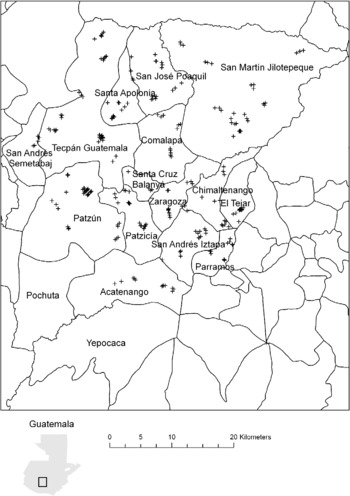
Research was conducted in 14 townships (municipios) of the department of Chimaltenango (Fig. 1). Altitude in the study area varies between roughly 1500 and 2500 m asl. The central part of the research area is a large highland basin, covered by volcanic deposits. The northern part of the area is part of the Motagua watershed and covered with alluvial soils. Chimaltenango is a section of a wider segment of the western highlands known for its long tradition in food production for urban consumption (Smith, Reference Smith1979). The ethnicity of its inhabitants is mainly Kaqchikel (native Maya group) and Ladino (Spanish-speaking persons of European, Maya or mixed descent).
Study area (department of Chimaltenango) and survey points (+). Boundaries between townships (municipios) are approximate.

In the 1940 s and 1950 s, 13 maize races were documented for Guatemala, and six of these were found in Chimaltenango. These are (in order of importance): Olotón, Negro de Chimaltenango, Comiteco, Imbricado, Nal-Tel Ocho and San Marceño (Wellhausen et al., Reference Wellhausen, Fuentes and Hernández Corzo1957). This gives an indication of the broad morphological diversity of maize in the area. Also improved varieties were developed for the highland region, mainly based on native materials (Fuentes, Reference Fuentes1997).
Questionnaire and questions
A questionnaire was developed with general questions and questions for each maize type cultivated by the household, including those cultivated in the past. Preliminary interviews in different parts of the research area and a literature search were used to design the questionnaire and select potentially important variables.
The questionnaire focused on four basic types of information. First, questions about cultivar names for each cultivated seed lot were asked. It was supposed that mapping these cultivar names might convey information about patterns of seed exchange. Even though cultivar naming applies only to a fraction of the seed lots and reflects a weak, fragmentary classification system (a contrast to the situation encountered in other areas; van Etten, Reference van Etten2001, Reference van Etten2006a), the exchange of names arguably involves processes similar to those involved in seed exchange. However, the conclusions from these data should not be pushed too far.
A second type of information concerns sources from which farmers obtain seeds. The frequency of different seed sources and their geographical pattern is an important means to assess the impact of seed movements and their role in the formation of regional patterns of maize seed diversity.
A third type of information concerned maize cultivated in the past. The reasons for discontinuation of maize seed lots households had previously utilized were considered important information. Discarding a maize seed lot, if done on purpose, involves a conscious decision about seed with well-known properties. Thus, the motives for this decision have a special weight, and provide an important indication of which are the most relevant dimensions of farmer decision making in relation to maize cultivars. Other moments of choice and outcomes of such choices (cultivar maintenance, looking for new cultivars, experimentation) seem to involve less specific motives (tradition, opportunity, curiosity, etc.). These seem less predictable, or involved factors and rationalizations beyond the scope of a survey.
A fourth type of question tried to retrieve variables relevant to explaining choices between seed sources. As argued above, it was anticipated that many factors influencing decision making about seed sources may be unpredictable or circumstantial. However, by screening a broad range of variables related to seed characteristics, environment, socio-economic conditions and geography, some of the most important variables were identified. By comparing these outcomes with the answers to the question why seed lots were discarded, more certain conclusions were obtained.
Data collection
Three bilingual Kaqchikel-Spanish research assistants and the principal researcher carried out 257 interviews across the research area in June and July 2003. All townships (municipios) of the highland part of the departamento were visited. For each township the main town (cabecera) and several rural communities (aldeas) were included. Communities were selected non-randomly from a map of each township to ensure diversity in distance from the main town and ecological conditions (altitude). Households were chosen at random, while within the towns often one or more transects were chosen to avoid bias (for a map of the survey points, see Fig. 1). When available, the head of household was interviewed. If no-one answered the door or the household did not grow maize, the closest neighbour was visited. For all households, a GPS provided geographical co-ordinates and altitude. The interviewers also scored their impression of informant reliability on a three-step scale.
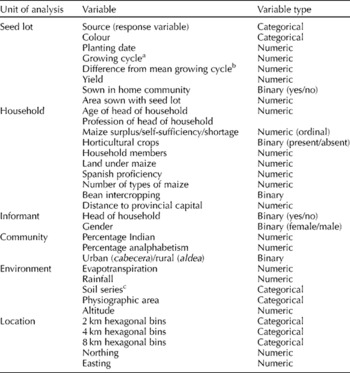
These data were supplemented with geographical data provided by the Ministry of Agriculture's GIS laboratory (MAGA, 2005). From this latter source, four environmental variables and three community variables were included in the analysis (Table 2).
Analysis of explanatory variables for seed sources
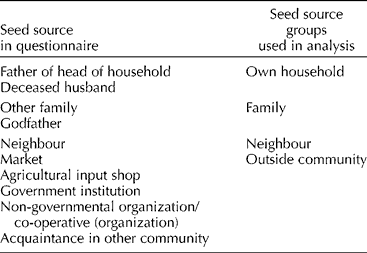
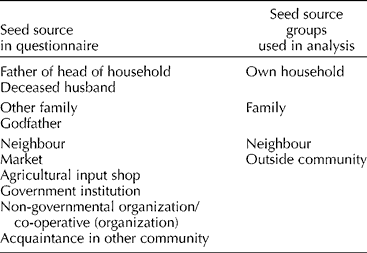
The analysis of the fourth type of information mentioned above required a specific kind of numeric analysis. Nine types of seed sources were distinguished based on questionnaire results. For the quantitative analysis, these nine groups were assigned to four broader groups (Table 1). This aggregation was done to obtain groups with sufficient cases and to have more interpretable contrasts between seed sources.
Seed sources
The variables that predict or are associated with certain sources of seeds were identified using classification trees (Breiman et al., Reference Breiman, Friedman, Olshen and Stone1984; De'ath and Fabricius, Reference De'ath and Fabricius2000). The classification tree method makes consecutive, binary splits in the data in order to achieve greater homogeneity in the resulting two groups. The method seeks the best variable, and the best value for that variable to make each split. Two important advantages of the method make it especially suited for the present analysis: it does not assume a statistical distribution for the variables and it readily accepts categorical explanatory variables.
However, the method does not inherently account for spatial relationships. To be able to detect spatial structure in the analysis, GPS co-ordinates (Northing, Easting) were included. Political boundaries were also used for spatial grouping (community and township). To account for mutual proximity as a factor in the analysis (to detect for spatially correlated variables not included in the analysis), locations were grouped using a grid of hexagonal bins at different extents (2, 4 and 8 km high) with an arbitrary origin.
Different comparisons between groups of seed sources were analysed, identifying the most important variables for each comparison. The ‘variable importance’ reporting modality in the software package CART was used to this end (Salford Systems, 2002).Footnote 1 The analysis was undertaken for all variables and different subsets of variables separately (for subsets see Table 2).
Variables included in the analysis

a Interval between planting and green harvest. This was chosen, instead of the harvest for dry grain, because the latter depends on the period allowed for drying, while green harvest is more closely determined by phenology.
b This was calculated as the interval between planting and green harvest of the seed lot minus the average for all seed lots in a 2 km radius around the seed lot, to account for growing season differences between locations.
c Based on Simmons et al. (Reference Simmons, Tarano and Pinto1959).
Results
Cultivar names and their geographical distribution
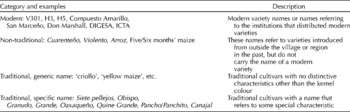
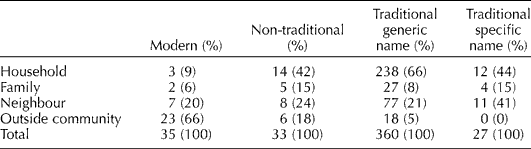
In the research area most farmer cultivar names refer to grain colour (for instance, ‘yellow maize’) only. Farmers also mentioned ‘criollo’; when applied to maize types, this is a generic marker for traditional varieties. For a total of 94 seed lots (21%) more specific cultivar names were mentioned. This included improved varieties and traditional varieties (Table 3). In 12 cases, unambiguous references to officially released varieties were made (3% of all seed lots). If also more ambiguous references are included in the category of modern varieties (such as references to the names of old varieties H3 and H5, see below), 33 cases (7% of all seed lots) fall in this category.
Categories of cultivars according to names mentioned by informants

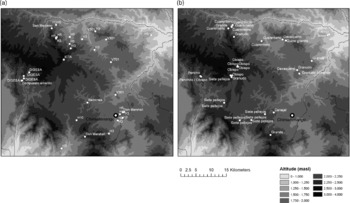
Traditional varieties show geographic patterns (Fig. 2a). Cuarenteño occurs in the northern part of the area, and below 1900 m asl. Obispo is found in the western central part (Tecpán, Santa Apolonia), in an area above 2200 m asl. Siete pellejos is found across a broad area between 2000 and 2300 m asl. These names recur in various townships (municipios).
Geographical distribution of households reporting improved varieties (a) and traditional and other varieties (b).

Modern varieties show three clusters: an eastern, northern and western one (Fig. 2b). The eastern and the northern cluster are located below 2000 m asl, while the western cluster is located above 2000 m asl. Even though different modern varieties are present in low and high areas, modern varieties are present across the altitudinal gradient.
In the east, around Chimaltenango, the provincial capital, and in the Motagua watershed in the northern part of the study area, many farmers grow improved varieties designated by the names H3 and H5. These names refer to two varieties that were released by the national agricultural research institution of El Salvador, CENTA, in the 1960s, and successfully introduced into many parts of Central America, including Guatemala. However, it seems that both names are now used in a generic sense for early maturing varieties, also by seed sellers. While the original varieties were white grained, in the research area it is common to find yellow seed lots are named ‘H3’ or ‘H5’. The original varieties have a lowland adaptation. In the study area they are mainly found below 2000 m asl.
The western cluster comprises the communities Caliaj and Caquixajay (Tecpán). Many farmers grow a cultivar introduced by DIGESA (the national agricultural extension agency, now dissolved). This cluster seems to be an exception in the area. Adoption of modern varieties is concentrated very much in this area. Such massive adoption of an improved cultivar was not found in other communities above 2000 m asl.
Seed sources
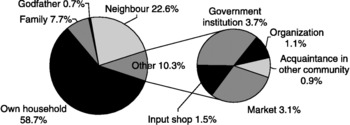
A total of 455 answers on the seed source of individual seed lots were available for analysis (Fig. 3). Of all seed lots, 267 or 58.7% came from within the household. Thus, household autonomy in seed production is the most common form of seed procurement. Interestingly, seed exchange with neighbours is more frequent than with other (extra-household) members of the family. This tendency in itself indicates that seed procurement is not about replacement only (for which the family would presumably be the default option), but also about change and enrichment of the household portfolio of maize diversity. Containment of transactions within communities is high: 408 or 89.7% of the seed lots came from within the community. Six seed lots (1%) came from outside the research area. Two of these seed lots came from adjacent communities, just outside the departamento, and four came from major cities: Guatemala City, Quetzaltenango and San Marcos (twice).
Sources of seed lots in Chimaltenango in 2003 (n = 455).

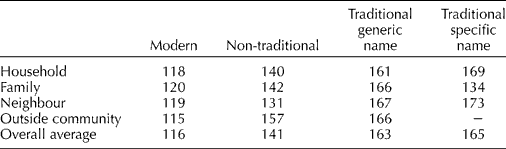
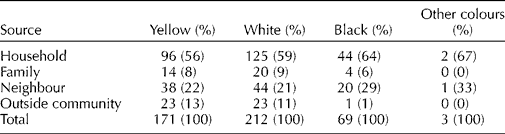
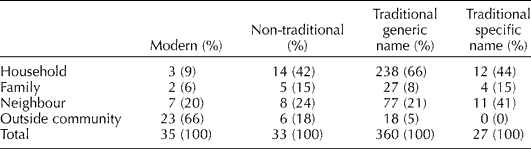
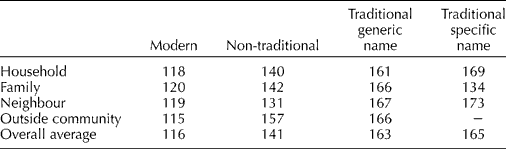
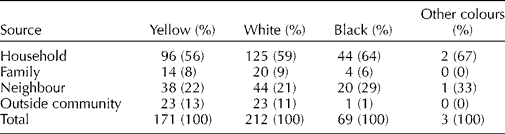
The cultivar or variety names that farmers mentioned for their seed lots served as the basis for a classification in four broad groups (Table 3). In Table 4 the sources of seeds for different types of seed is given. It is clear that for improved varieties the main sources are outside the community. However, substantial exchange of improved varieties does take place within communities. For traditional cultivars, the main sources are within the community. In Table 5 the mean growing season is given, which is an important factor in seed introduction from outside the community (see below). From Table 5 it becomes clear that improved varieties have a shorter growing season, followed by the non-traditional group. Non-traditional varieties introduced from other communities have on average a slightly shorter growing season than traditional ones. In Table 6 the sources of seed are split by colour. A contrast exists between yellow and white maize, on the one hand, and black and other colours on the other hand: the latter mostly remain within the community. Interestingly, for black and other colours, neighbours are a more important source than the family.
Sources of seed lots per category
Average growing cycle (in days) of seed lots per category
Sources of seed lots per colour
Reasons to discard or replace seed lots
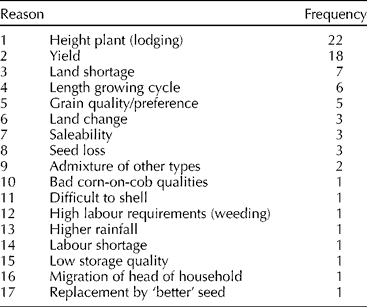
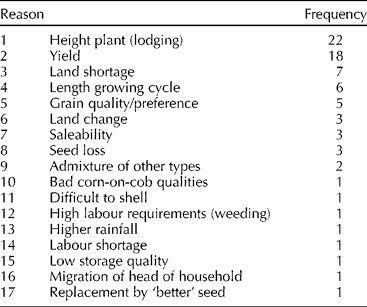
Only 78 informants reported having had other types of seeds in the past and indicated why these seed lots were discontinued (Table 7). In many cases it was motivated by the possibility of replacing the old seed lot with a new better one. Interestingly, excessive plant height (implying a higher proneness to lodging) ranks as more important (no. 1) than low yield advantages (no. 2). Land shortage is given as the third reason to discontinue a maize type. This is related to another reason: admixture of kernels of a different colour in the seed lot is another reason to discard it (no. 9). Often seeds of different grain colours are planted separately to prevent colour change through cross-pollination on adjacent plots. When the land base becomes too small to continue spatial separation of seed lots, one kernel colour is discarded. Although the growing cycle (no. 4) is highly correlated with plant height, the length of the growing cycle was often mentioned separately. This indicates that a short growing cycle is also seen as an advantage in itself.
Reasons for discontinuation of previously cultivated seed lots
Explanatory variables for seed source decisions
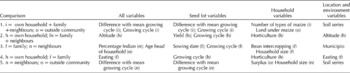
Table 8 shows the results of the classification tree analysis. For each comparison between groups of seed sources the most relevant explanatory variables are given from the full set and different subsets of variables. Based on this, the contribution of these variables can be further explored for each comparison.
Most important factors influencing seed procurement choices, as given by classification tree analysis (‘variable importance’ in CART software)a

a Between brackets class pertinence for the highest values of the variable under consideration is given. Only one variable is reported in the case where the second variable had less than 20% of the importance of the first variable. For variable subsets, see Table 2. For seed source groupings see Table 1. (Community variables were not analysed separately.)
Comparison 1
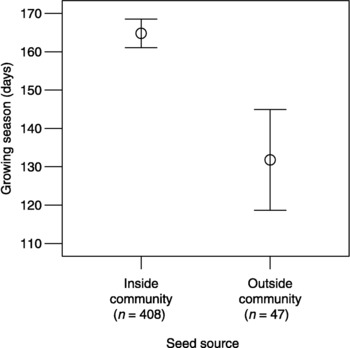
Differences between seed lots originating from outside the community and those obtained inside the community or household are mainly related to length of growing cycle. On average, seeds obtained outside the community have a growing cycle of 132 days or 33 days shorter than local seed lots (Fig. 4). Also seeds from outside sources are on average 28 days faster than the local average (2 km radius). This is mainly due to the higher proportion of relatively fast-maturing modern varieties and ‘non-traditional’ varieties among the seeds introduced to the community (Table 5). Although household characteristics are not among the most important variables, households with fewer types of maize and those with more land under maize, are slightly more likely to have maize seeds from outside sources. Households with at least one seed lot from outside have on average 6.8 cuerdas (0.76 ha) with maize, while the others have 5.5 cuerdas (0.61 ha).
Difference in growing season between seed lots from within and outside the community (mean ± 2 *standard error of the mean).

Comparison 2
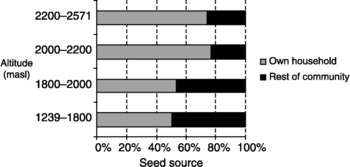
Obtaining seeds from the rest of the community as opposed to own household is more prevalent at lower altitudes. Around 2000 m asl an important break seems to take place (Fig. 5). Variables from other subsets are associated with altitude (yield, growing cycle, horticulture), so this association with altitude should be interpreted with caution. That yield is more important than growing cycle in the seed lot variables subset indicates that growing cycle is of secondary importance for this comparison.
Seed sources within the community according to altitude.

Comparison 3
The first identified variable for the contrast between family and neighbours is the percentage of Indian population per community. In communities with a higher percentage of Kaqchikel inhabitants, seed exchange between neighbours tends to be more common in the sample. Also older heads of household tend to grow more seed lots obtained from neighbours. Those heads of households growing at least one seed lot obtained from neighbours are on average 4.7 years older than others.
Comparison 4
The identification of a spatial variable for the comparison between own household versus family indicates that a spatial pattern not accounted for by the remaining variables underlies part of the variation.
Comparison 5
Compared with seeds obtained from neighbours, seeds from outside have a shorter growing cycle. This result is similar to that obtained in Comparison 1.
Discussion
Cultivar names
The absence of traditional farmer cultivar names for many seed lots in Chimaltenango contrasts with other areas in the Guatemalan highlands, including parts of Huehuetenango, and San Pedro La Laguna in Sololá, where cultivar names apply to virtually every seed lot (Stadelman, Reference Stadelman1940; Butler and Arnold, Reference Butler, Arnold, Neuenswander and Arnold1977; van Etten, Reference van Etten2001, Reference van Etten2006a). Farmer cultivar names have a more parochial spatial distribution in these other areas (mostly unique cultivar names in different townships; Stadelman, Reference Stadelman1940) than in our study area.
One possible explanation for these differences is the degree of local ecological diversity in these areas, which is due to pronounced altitudinal differences. In Chimaltenango, altitudinal differences are often not very dramatic. One settlement usually has access to only one type of environment. Differences in seed type do not come from local variation in adaptation, but refer mostly to differences in ear and kernel characteristics, and the length of the growing season.
The cultivar names indicate that some portion of the collection of seed lots present in the study area derive from improved varieties. Selection for shorter varieties with a short growing cycle has been an explicit goal of the national maize breeding programme, especially since 1973 (Fuentes, Reference Fuentes1997). At least some portion of the varieties introduced into communities in the study area originated from this plant breeding programme, and sale of these varieties is concentrated in the provincial capital.
It is remarkable that modern varieties and their derivatives are present with almost equal frequency in the higher and lower parts of the study area. In other parts of Guatemala and Mexico, modern varieties are more frequent in lower areas than in higher areas (van Etten, Reference van Etten2006a; Perales et al., Reference Perales, Brush and Qualset2003). This area is an exception to this trend. This is at least partly due to the exceptional status of the communities in the west of the study area, which form a commercial maize farming area focusing on the market of Panajachel, where maize is reportedly scarce. These farmers are eager to use and experiment with maize varieties coming from government institutions.
The broad presence of seed lots designated as Cuarenteño is interesting, because the name refers to the important characteristic of the growing cycle (see next section), and it is a cultivar name reported across the country, especially in lower areas (M. R. Fuentes, personal communication). This cultivar was already reported in 1976 in the area (Duarte et al., Reference Duarte, Hildebrand and Ruano1977). As one informant claimed, this cultivar comes from the coffee farms of the Pacific Coast, to the south of the research area. Especially from the northern part of Chimaltenango, labourers migrated every year for a few months to harvest coffee (Smith, Reference Smith1990). This substantiates that varieties with a short growing cycle were being introduced before the introduction of improved varieties with this characteristic.
The occurrence of traditional highland varieties (Obispo, Siete pellejos) provides evidence for broader exchange of seed lots within the study area. Also these names refer to specific characteristics (in this case grain related) which contrast with the common ‘nameless’ traditional farmer varieties, which apparently do not have these characteristics.
It was observed that cultivar naming in Chimaltenango did not apply to all seed lots. This lack of names influences seed exchange, as it makes it more difficult to communicate about seed lots and make comparisons between seed lots of different origins or adaptations. The informational aspect of seed exchange was also highlighted by Badstue et al. (Reference Badstue, Bellon, Juárez, Manuel and Solano2002) for Oaxaca. Modern varieties sold under a certain name tend to have stable characteristics attached to a single name, and this gives them an information advantage over seeds without a name.
Geography of seed exchange
High containment of seed lots is found in the area at different levels. Obtaining seed in a particular year is mostly done from the household as a default option. Seed from outside the household is obtained mostly within the community. Seed that is obtained outside the community is mostly from within the same department (Chimaltenango). No seed was recorded as coming from outside Guatemala.
Farmers indicated that in the past coffee farms in the southern piedmont area were important sources of new diversity in parts of the research area. This was also recorded for another area in the western highlands of Guatemala (van Etten, Reference van Etten2006a). This confirms the possibility that this is a wider trend, with a potentially important impact on current maize diversity distributions.
Currently, seed exchange outside the community is mostly focused on cities, including the departmental capital. This means that the economic geography of seed sales plays an important role. Apparently, seed sellers need regional markets to have sufficient demand. This may be due to the infrequency of seed purchases by households. It will be important to take this factor into account when designing new modalities for distributing seeds and varieties.
Past and present directionality in seed flow is important in geographical studies of maize diversity. Genetic similarity of maize from different communities may not signify seed exchange among those communities; these communities may have obtained seeds from common sources. Recent genetic investigations in maize taking a regional outlook failed to point out this possibility (Pressoir and Berthaud, Reference Pressoir and Berthaud2004a, Reference Pressoir and Berthaudb; Perales et al., Reference Perales, Benz and Brush2005).
Local and regional seed flows are different for different types of seed. Modern varieties were mainly obtained outside the community, although much exchange of modern varieties was also found within communities. Exchange of modern varieties among farmers was also reported elsewhere in Guatemala and in Chiapas (Saín and Martínez, Reference Saín and Martínez1999; Bellon and Risopoulos, Reference Bellon and Risopoulos2001). Regional seed exchange involves mostly improved varieties. Black maize mostly remains within the communities. It was observed in Oaxaca that black maize from different communities was highly differentiated, more so than white maize (G. Pressoir, personal communication, 2006).
Influence of plant characteristics
The results show in various ways that specific plant characteristics are an important aspect of seed replacement and the movement of seeds across the landscape. As was discussed in the previous section, cultivar naming practices reflect the importance of growing cycle difference in the cognitive domain (previous section). This is confirmed by two other findings. First, growing cycle and lodging risks form the most frequently mentioned reason for seed replacement. Second, growing cycle is the most important variable associated with the difference between seeds from within the community and those from outside (plant height was not included as a variable, as it was very difficult to document well in a survey, but it is largely correlated with the growing cycle).
Two other field studies confirm the importance of lodging risks in maize cultivation in the Guatemalan highlands. A study of folk soil (land) taxonomy in Chimaltenango by Rainey (Reference Rainey2005) shows that the important cold–hot dimension of farmer classification is associated with lodging risks among other factors. Windy plots are being considered ‘cold’ and sheltered plots ‘hot’. Johannessen (Reference Johannessen1982) reports that winds have been increasingly devastating for maize cultivation during the 1970s due to forest clearings in the highlands of Guatemala.
Thus seed exchange, and more specifically the introduction of seeds from outside the community, is used to achieve change in plant characteristics that are of importance to crop production. The finding that no important growing cycle differences exist between seeds from within the household, on the one hand, and from the rest of the community, on the other hand, means that the prime sources of seed lots with a short growing cycle are regional. The use of names that refer to differences in growing cycle indicates that these differences are nevertheless important in seed transactions within communities. As mentioned, these names also provide evidence for plant characteristics being a motive for regional seed exchange and replacement before the introduction of modern varieties. This has been reported also for other places in the western highlands of Guatemala (van Etten, Reference van Etten2001).
A possible explanation of a preference for regional seed sources is the local ‘degeneration’ of maize seed mentioned above (Zeven, Reference Zeven1999). In the study area, farmers fail to exercise direct selection pressure for growing cycle and plant height within the local plant populations, as selection takes place mostly in the house, where only kernel and ear characteristics can be observed. During field work farmers claimed that after introducing a variety with a short growing cycle the maize stock in question becomes longer in duration and taller as the years go by, making new introductions necessary.
In other parts of Mesoamerica, change in modern varieties has also been recognized by farmers (Almekinders et al., Reference Almekinders, Louwaars and Bruijn1994; Morris et al., Reference Morris, Risopoulos and Beck1999; Bellon and Risopoulos, Reference Bellon and Risopoulos2001; Badstue et al., Reference Badstue, Bellon, Berthaud, Ramírez, Flores, Juárez and Ramírez2005). ‘Creolized’ varieties in these contexts had advantageous characteristics, uniting the properties of modern and local materials. Most authors attribute change of modern varieties under farmer management to hybridization between modern and local materials. Segregation may cause change in hybrid varieties, but in the study area mainly open-pollinated varieties or old, recycled hybrid varieties are used for which segregation is probably not relevant. We will here underscore the possible contribution of selection.
Experimental results point to selection as an important candidate mechanism to explain change in modern varieties upon introduction. In a well-known experiment, Gardner (Reference Gardner1961) and his co-workers selected individual maize plants for yield while controlling for environmental variation using stratification in Lincoln, Nebraska. As yield increased, days to flowering and ear height increased concurrently (4 days and 25 cm longer over 10 generations) (Gardner, Reference Gardner1961, Reference Gardner1969). However, yield reached a plateau after a number of generations. Interestingly, the variety Gardner and co-workers worked with was a variety introduced to the selection environment from elsewhere. Donald and Hamblin (Reference Donald and Hamblin1983), commenting on this particular experiment, interpret this as a process of reaching an equilibrium between increased competitive advantage, on the one hand, and increased lodging and reduced harvest index on the other. While local varieties have reached such equilibrium already, an introduced variety is still subject to adaptation. Donald and Hamblin (Reference Donald and Hamblin1983) indicate that parallel processes occurred in experiments with other cereal crops, substantiating the existence of a general mechanism.
The same mechanism seems to hold in the study area. Farmers generally select large, well-filled ears from the harvest for seed (Johannessen, Reference Johannessen1982). In field study of maize in Oaxaca, Mexico, long and thick ears were associated with larger plants (Soleri and Smith, Reference Soleri and Smith2002). Following Donald and Hamblin (Reference Donald and Hamblin1983), we may expect that such ear-based selection will result for introduced short-duration varieties in increased plant height and duration until some equilibrium is reached. On the other hand, local cultivars may be expected to have already achieved equilibrium with their environment.
This scenario seems consistent with other findings in Oaxaca. Farmers in this area did not see artificial selection as a major means to change the characteristics of the crop which are under genetic control (Soleri and Cleveland, Reference Soleri and Cleveland2001). Farmer selection of local maize seed (based on ear and kernel characteristics, not plant characteristics) did not have a measurable genetic effect over several years, in spite of significant broad heritability for some characters, including the growing cycle (Soleri et al., Reference Soleri, Smith and Cleveland2000; Soleri and Smith, Reference Soleri and Smith2002). This could be interpreted as local cultivars being in equilibrium with their environment. If such a tendency towards equilibrium of locally grown cultivars exists, constant introductions from elsewhere would be needed to maintain varieties with short growing seasons in the area.
Environmental influences
The influence of altitude is clear in the spatial distribution of cultivar names. The data also showed that in higher areas, households tend to be more self-sufficient in seed procurement. Altitude is a major axis of environmental diversity in the study area, and many other variables are associated with it (climate, land use). Thus, a clear-cut explanation of the impact of this variable is not easy to formulate. However, storage problems are generally more prominent in lower areas, where the seed storage period is longer (shorter growing season) and insect infestation is more serious (Stadelman, Reference Stadelman1940). Drought is also more prominent at lower altitudes in the Motagua valley in the north of the study area. The literature suggests that this difference in altitudinal gradients in seed exchange frequency is general. More self-sufficiency in seed at higher altitudes is also evident in a transect study in central Mexico (Perales Rivera, Reference Perales Rivera1998).
Ethnic influences
There is an interesting difference between communities with Indian inhabitants and those with a higher percentage of Ladino members (comparison 3 in Table 8). In the first instance neighbours seem to be more frequent sources for intracommunity seed procurement than in the latter communities. Atran et al. (Reference Atran, Medin, Ross, Lynch, Coley, Ek and Vapnarsky1999) show that with regards to ecological knowledge exchange, in Petén, Guatemala, the Ladino community is less integrated than the Q'eqchi' community (an ethnic group originally from the highlands). While the Ladino knowledge exchange network is dominated by a few leaders and contains various cliques, the Q'eqchi' one is more egalitarian and is less factionalized. Thus, this difference between (highland) Maya and Ladino communities may be part of a regional trend.
Conclusions
In the research area, small proportions of seeds are introduced from regional sources into local communities, consistent with findings for Mexican rural communities (see Introduction). It was observed, however, that seed exchange was largely confined to sources from within the department and from areas within the same altitudinal zone. Thus, since this will generally lead to interregional genetic differences between populations, spatial differences need to be taken into account in planning in situ crop genetic management. At lower altitudes households exchange seed more frequently. Local genetic differences between household seed stocks will be more pronounced at higher altitudes.
The focus of regional seed exchange on the departmental capital and other major cities indicates that regional seed flows are not occurring in all directions and thus suggests that also within the region spatial genetic differences are likely. This urban focus of seed flows also indicates that seed sellers need considerable marketing areas to generate sufficient demand. This is another important consideration for future interventions; local seed sales in rural communities are not likely to be sustainable.
The main goal of regional seed exchange is to obtain plant characteristics that are not easily controlled by farmer seed selection, including growing cycle and plant height. Local sources of diversity for these traits are limited and also difficult to access due to problems in information transmission (cultivar names). Also, in the study area degenerative processes take place. This article presented unconscious selection (unintentional human selection) as a possible mechanism of degeneration, which is probably at work in the study area. This possibility should also be given attention in the many other cases of regional cereal seed procurement due to degeneration of seed (Zeven, Reference Zeven1999). Thus regional seed exchange should be considered as an important source of innovation in maize farming systems in the study area.
The article presented evidence for regional exchange preceding the introduction of varieties (cultivar names, and additional evidence from historical sources). This indicates that the availability of modern varieties did not set in motion a new process of introduction of foreign cultivars. The occurrence of regional seed exchange in the past indicates that spatial genetic differences between localities within the study area will not be based on long-term isolation-by-distance producing ‘deep’ local gene pools. It is more reasonable to expect that within altitudinal zones, different degrees of receptivity to different regional sources of seed combined with relatively frequent local seed exchange, will produce a ‘chequered’ pattern of spatial difference of locally differentiated patches (communities, valleys), which may be rather redundant when broader, regional scales (several departamentos or the entire highlands) are considered.
Thus in this study area, variation of maize according to space and scale is important to consider in the design of interventions, which should be conceived from a combined local and regional perspective (cf. Zimmerer, Reference Zimmerer2003). Given the many spatial constraints to regional seed exchange, to support continued innovation in the area, seed collection will need to incorporate diversity in breeding programmes by spatial stratification, taking into account altitude and geographical distance. On the other hand, interventions should foster further regional integration and economies of scale in seed production and crop improvement. In the past, some interventions have tried to improve farmer mass selection skills to enhance innovation (van Etten, Reference van Etten2006b). However, few farmers adopted the promoted techniques systematically. Combining such training with opportunities to establish a broader commercial organization for seed marketing could provide the economic incentives to make crop improvement activities sustainable. Such experiences with seed production already exist for eastern Guatemala (Warren, Reference Warren2005). A regional approach should also take advantage of environmental similarities and complementarities between places for crop improvement, perhaps through a network of farmer-breeders. Seed sales, even when organized through regional outlets in major towns, should be tailored to the environmental conditions and other requirements of farmers by providing specific information about seed characteristics in an easily understandable format. Information derived from centralized seed sales (especially the demand per variety and geographical provenance of clients) could also be used to monitor diversity dynamically and to adjust breeding and conservation goals and methods accordingly.
Acknowledgements
The authors thank the informants for their generous collaboration and the research assistants for their efficient and dedicated work. Also the comments of two anonymous reviewers are appreciated.