Introduction
Notions of ecological sustainability ideology (the capacity of the biosphere to meet the needs of the present generation, without hindering future generations from being able to meet their needs) are reinforced in cultural practices such as children’s literature. Social discourse is prompted by the images and narratives of the story. We wondered if authors, illustrators and editors paid attention to the collective messaging that they were encouraging through published children’s literature regarding ecological sustainability ideology, in the same way that they might with regard to race and gender. We found no evidence of this as a practice, so we devised a framework that might provide the scaffolding needed for such considerations. This paper described the process of designing the framework as well as its application on three award-winning books in the Children’s Book Council of Australia (CBCA) awards.
Sustainability as Reflected Through Literature
Kirk and Karbon (Reference Kirk and Karbon1986) conducted a review spanning 22 years of children’s literature (1960–1982) and found that all but 6 of the 72 books analysed had some environmental content or messaging. In 2014, a team of researchers tracked the environmental content in children’s picture books from 1955 to 2014 and found that over this time images of natural environments decreased while images of urban environments increased and the inclusion of native animals decreased (Babb, McBurnie, & Miller, Reference Babb, McBurnie and Miller2017). These findings indicate that authors and illustrators are including environmental messaging, however, this messaging is becoming increasingly urbanised.
In 2010, Bigger and Webb explored environmental agency and engagement of young people through fiction that lead them to recommend ‘the focussed discussion of fiction to promote environmental learning; and for writers to engage more with themes of environmental responsibility and agency’ (p. 401). In recent years, researchers have found that some children’s literature texts have become embedded with socially constructed notions and discourses that create the narratives of sustainability and give meaning to its reading (Reid, Payne, & Cutter-Mackenzie, Reference Reid, Payne, Cutter-Mackenzie, Cutter-Mackenzie, Payne and Reid2011). There has been some excellent work in children’s literature exploring the role of place (Cutter-Mackenzie, Payne, & Reid, Reference Cutter-Mackenzie, Payne, Reid, Cutter-Mackenzie, Payne and Reid2011), investigating the possibilities for new knowledge of environmental sustainability and accommodation of that knowledge (Reid, Payne, & Cutter-Mackenzie, Reference Reid, Payne, Cutter-Mackenzie, Cutter-Mackenzie, Payne and Reid2011) and the opportunities of ideologically positioning children as agents of sustainability (Baratz & Hazeira, Reference Baratz and Hazeira2012). However, the texts analysed in these documents are not representative as they are texts that focus explicitly on environmental messaging and, so, we raised concerns regarding the inclusion of sustainability ideology messaging that is often uncritically and incidentally included in children’s literature. Drawing on the concepts of ecological sustainability in the context of children’s texts, this paper analyses CBCA award-winning texts to interrogate the presence of or silences in ecological sustainability knowledge.
In this paper, we explore the question: do the images and words from CBCA Notable award-winning texts challenge and disrupt nonsustainable discourses in children’s literature narratives? We present three selected examples of images taken from three of the Children’s books listed in the ‘Notables’ section to provide insight into the need for further work and consideration of how such books might support the intergenerational movement towards social change. The role of this paper is to put forward a conceptual framework and apply it to interrogate the nonsustainable practices represented in children’s literature with a view to developing a mechanism whereby texts with ideologies of sustainable futures are advantaged in the future awards. This work is framed by an imagined future Teachers’ reflections about the school library books and the ideology they reflect to students.
An imagined future Teachers’ reflections
We begin this exploration by offering a short fictional narrative of a future scenario to introduce a productive ambiguity into the research (Watson, Reference Watson2011). This device is employed to provide a future context as to how children’s literature might become critically analysed. The scene is set in a school library but could be applied in a variety of settings.
It is 2050 and seven teachers are asked to revise the children’s literature in the school library. As teachers do, they begin talking about their practices for using literature to reflect on and teach social ideologies. They talk about how the Convention on the Rights of the Child (UNICEF, 1989) and the Melbourne Declaration (MCEETYA, 2008) have stood the test of time providing authors and editors with a framework of inclusiveness around gender and racial issues. They discuss how, for example, the Emissions Trading Scheme has been in operation in Australia for over a generation, yet they wonder if ecological sustainability as an ideology has been taken up to the same extent. The teachers come across three Notable children’s texts from the 2015 Children’s Book Council Awards (Children’s Book Council Australia, 2016). As they review these texts they question if the messages in the texts advocate for ecological sustainability in ways that are now culturally acceptable, or not.
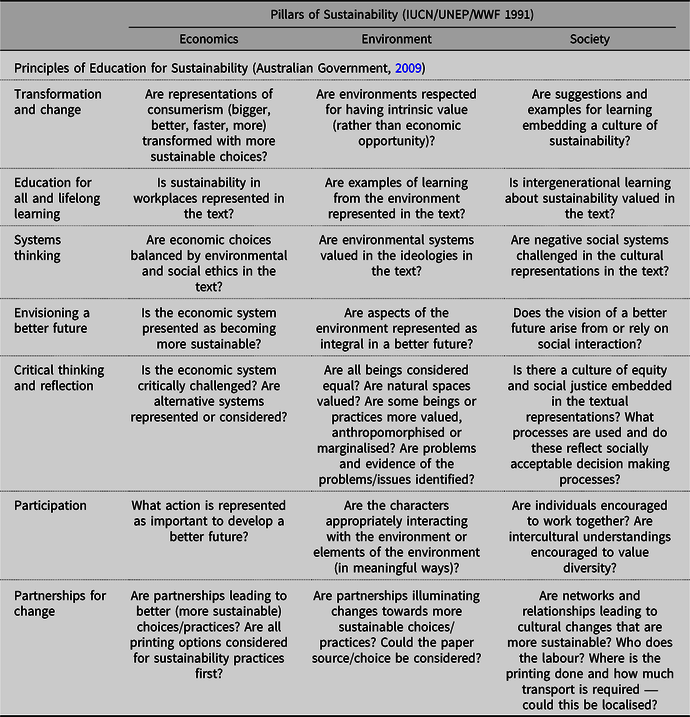
We propose that children’s literature can be reimaged to align with an ecological sustainability social discourse in a similar way to how gender and race-related discourse is represented respectfully in high-quality children’s literature. We present a ‘Framework for Ecological Sustainability Education’ (Table 1) that integrates the three pillars of sustainability (environment, society and economics) (World Conservation Union United Nations Environment Programme and World Wildlife Fund for Nature, 1991) and the seven principles of Education for Sustainability (Australian Government, 2009) which include transformation and change, systems thinking and participation in education. While the complex and changing nature of ecological sustainability ideology is not completely framed by these pillars and principles, the framework establishes a starting point for future contemplation and conversation.
A Framework for Ecological Sustainability of Children’s Literature

The framework generates a series of questions designed to critique the representations of ecological sustainability in children’s literature. These questions provide a guide to future authors, illustrators and editors, as well as teachers, parents and students/children. The framework aims to encourage the production of children’s literature texts that showcase good practice, ethical consideration, cultural considerations and social discourse towards ecological sustainability. The application of the framework forms the basis of a critical discourse analysis (CDA) of a selected sample of the 2015 Notables to reveal the nonsustainable practices in the images and words of three texts. We conclude by arguing that ecological sustainability is not yet common discourse in children’s literature while texts like the ones analysed in this paper are receiving awards. It is to be expected that as ideologies of ecological sustainability take hold in Australia, texts will be considered for removal from future library shelves, just as gender and racially biased texts have already been removed.
Background Literature
Ideologies and discourses in texts
An important function of texts is to inculcate, sustain or change ideologies that establish, maintain or change social relations of power, domination and exploitation (Fairclough, Reference Fairclough2003). Ecological sustainability education is reflected in children’s literature, although often through its absence in any storyline considerations or through unsustainable practices portrayed by characters. In a metaanalysis of literary theory, Fairclough (Reference Fairclough2003) argues that ‘texts have causal effects upon, and contribute to changes in, people (beliefs, attitudes, etc.), actions, social relations, and the material world’ (p. 8). The nonneutrality of texts is widely recognised. Meanings in texts are constructed by cultural, social, historical and political practices (Knobel, Reference Knobel, Knobel and Healy1998). There are ‘implicit and explicit meanings mediated by texts and therefore what is said in a text always rests upon unsaid assumptions, so part of the analysis of texts is trying to identify what is assumed’ (Fairclough, Reference Fairclough2003, p. 11).
The relatively recent changes in representations of race and gender in Children’s literature reflect social change, indicating that there is a need for ecological sustainability to be taken up as in important issue, now we are of the Anthropocene (Angus, Reference Angus2015; Purey, Reference Purey2015). In the past, children’s literature has been used to disrupt narratives of gendered and racist practices that threatened participation in education (Bradford, Reference Bradford2007). The nonneutrality of texts is easy to see with reference to gender and race. Increased sexist belief and gendered practices have been linked to the exclusion or trivialisation of girls or women in the media (Diekman & Murnen, Reference Diekman and Murnen2004). Similarly, Welch (Reference Welch2016) argues that the normality of whiteness in children’s literature contributes to representations of racial bias. While inclusiveness has been a focus of critique in children’s literature, attention to issues of ecological sustainability has not been as adequately addressed. Some texts such as Uno’s Garden (Base, Reference Base2006), The Lorax (Geisel, Reference Geisel1972) and Circle (Baker, Reference Baker2016) have an overt organisation of social values of ecological sustainability. In this paper, we are exploring narratives that are not overtly organised around ideologies of ecological sustainability but uphold these values in the representations in the texts. One might have expected award-winning texts to incorporate issues of racial and gender inclusiveness and ecological sustainability without an explicit focus on these discourses.
Ecological sustainability
In the 1980s, the term ‘sustainability’ was applied to human systems and the Brundtland Commission (Reference Brundtland1987) defined sustainable development as ‘development that meets the needs of the present without compromising the ability of the future generations to meet their own needs’ (n. p.). More recently the term ecological sustainability has removed references to development with the focus now on the capacity of the biosphere which appropriately positions humans within the ecosystem.
Moving forward from the decade of Education for Sustainable Development (2005–2014), a reorientation was realised towards environmental integrity, economic validity and just society for present and future generations (UNESCO, 2016). We apply the discourse of ecological sustainability to evoke considerations of the pillars of sustainability, within a context of the need for socioecological change. If shared reading between adults and children provides important opportunities for learning about the world (Nicholas & Paatsch, Reference Nicholas and Paatsch2018), then sustainable representations in texts in the Anthropocene are important.
In 2009, the Australian Government chose the term ‘Education for Sustainability’ to bring clarity to the need for change through education (Australian Government, 2009). The challenges and problems arising from unsustainable lifestyle choices require a shared commitment to education that leads and empowers people to make changes (UNESCO, 2009). Ecologically sustainable ideology relating to all aspects of our lives, like that of inclusivity and diversity, can be infused throughout children’s literature in subtle ways using ‘unsaid assumptions’ (Fairclough, Reference Fairclough2003, p. 11). This teaching approach may generate greater awareness of and action towards ecological sustainability compared to overt messaging through the subtle and holistic infusion of sustainable ideologies into everyday practices. The inclusion of sustainable practices in narratives of children’s lives normalises these practices at the same time as allowing consumers (teachers, parents and students) to recognise and draw attention to the importance of these practices. Thus, the inclusion of culturally appropriate ecological sustainable practices becomes a socially just act (Bigger & Webb, Reference Bigger and Webb2010). The framework presented in this paper supports a transition to social justice through a focus on children’s literature and sustainable practices.
Children’s literature and ecological sustainability
Young children think about ecological sustainability and the environment (Madden & Liang, Reference Madden and Liang2016; Melson, Reference Melson2013). There are many environmentally focused school-based programmes that scaffold and support students to engage in sustainability practices to reduce consumption and waste generation (such as nude food https://www.nudefoodmovers.com.au/). Although teaching for sustainability is mandated as a cross-curriculum priority in the Australian National Curriculum (Australian Curriculum Assessment and Reporting Authority, 2016), reporting on this priority is not taken up in many schools (Barnes, Moore, & Almeida, Reference Barnes, Moore and Almeida2019; Nicholls & Thorne, Reference Nicholls and Thorne2017).
It seems that striving for social justice representations in children’s literature regarding sustainability is worthy. Bradbery (Reference Bradbery2013) outlines the important position children’s literature can play in making children responsible for creating and enjoying an ecological sustainability ethic. Payne (Reference Payne2014) argued that there was (still) a lack of consideration about children in environmental education research. In line with a change to how children are involved with research, should come to a change in how children have nature–culture interactions reflected them, especially through literature mediated by adults. Malone (Reference Malone2016) offers three propositions that require addressing: Children are viewed as outside of nature; Nature is viewed and described as an inanimate object and Childhood is idealised as white middle-class America. The framework presented in this paper offers scaffolding to promote ecological sustainability in/through children’s literature in the hope that authors, illustrators and editors will take up these propositions in meaningful ways.
A framework for ecological sustainability of children’s literature
The framework for an ecological sustainability of Children’s literature required some careful consideration as to what would be privileged and included in ways that allowed enough flexibility and breadth to remain useful (dynamic and complex as well as implicit and explicit). The framework for the ecological sustainability of Children’s literature (Table 1) was developed after dialogue between authors around the two existing guiding frameworks in ecological sustainability. The three pillars of sustainability (World Conservation Union United Nations Environment Programme and World Wildlife Fund for Nature, 1991) were considered integral and consequently were used as the foundational pillars for the framework. Positioning the pillars alongside the seven Education for Sustainability principles (Australian Government, 2009) exemplifies how to bring into education the actions and ideologies that allow sustainability to be enacted and unsaid assumptions revealed. Questions that prompt sustainable thinking and action specifically related to the production of children’s literature are integral to the framework. The questions suggest ways to think about addressing the principles through the lens of the specific pillar of sustainability.
The three pillars of sustainability have been critiqued and redesigned as their introduction. For example, the ‘Circles of Sustainability’ (James, Reference James2015) (https://www.circlesofsustainability.org/) added the fourth dimension of culture and reframed the relationships between the elements. However, the three pillars were maintained in this framework because of their recognisability and simplistic structure. All representations are partial and it is anticipated that future users of the framework will recognise that the pillars and principals have implicit and explicit complexities and will consider the implications (the gaps and the simplifications), compensating for real-world complexity.
While the framework might appear a reductionist way of teasing out interrelated concepts of economics, environment and societal dimensions of ecological sustainability, we have purposely used these three pillars and seven principles to ask specific questions about representations in children’s literature. One would expect the award-winning children’s literature to combine these pillars and principles in ways that showcase how ecological sustainability can reimagine a world-view where these ideas are interrelated throughout the text. For the purposes of this paper, we are analysing where there might be gaps in ecological sustainable representations using each pillar and principle separately.
Methodology
Three of the 2015 Notable texts were analysed using the above framework (Table 1) to illustrate the limited ecological sustainability in the award-winning texts. The potentially emancipatory framework may work to scaffold the societal discourses, through intergenerational storytelling, towards greater appreciation and action for ecological sustainability. CDA focuses on ‘socio-political domination, which includes issues of social change, power abuse, ideological imposition, and social injustice by critically analysing language as social action’ (Bhatia, Flowerdew, & Jones, Reference Bhatia, Flowerdew, Jones, Bhatia, Flowerdew and Jones2008, p. 11). It is the role of CDA to bring awareness to people about how they are positioned in relation to the power structures of society and how to bring about change that is more socially just (Flowerdew, Reference Flowerdew, Bhatia, Flowerdew and Jones2008). This approach is well-suited to analysing the taken for granted practices in children’s literature. Researchers using a CDA approach do not consider language as neutral but rather see it as influencing, shaping and changing ideological positions in the taken for granted practices of society.
The selection of children’s literature
Each year the CBCA provides awards for children’s literature for various reading ages. They award a winner in each category of Early Childhood, Younger Readers, Older Readers, Picture Books and Information Books. In each of these categories, the CBCA begins by identifying ‘Notable texts’ that are shortlisted. In 2015, there were 59 entries in the Early Childhood books of which 15 were listed as Notables and 6 of these were shortlisted. The judging of the books ‘concentrates on the appeal of the story and illustrations, and especially the suitability for early childhood, pre-reading development’ (Children’s Book Council Australia, 2016, para 23). With the development of the framework (Table 1) and illustrations of its application through CDA, it is anticipated that the social discourses represented within the narrative, especially those around ecological sustainability, will come to form part of the judging criteria in future years.
We reviewed the 15 Early Childhood Notables listed on the CBCA web site for 2015, looking for examples of nonsustainable practices. Publishers of six books that included nonsustainable practices were contacted requesting permission to use the texts in this paper. Of these six, four gave permission and we selected three to present in this analysis. It was felt that three different narratives provided adequate variety to exemplify the framework’s application.
The analysis of children’s literature
The framework (Table 1) provides questions to interrogate children’s literature regarding the limited representations of ecological sustainability. For each text, we located the main principle (from the seven) and then explored the questions across economics, environment and society pillars. Insights into the sociopolitical discourses represented in each text are presented in the following findings.
Findings
For each of the three texts selected, one image is analysed according to the framework presented in the literature review. The discourses of limited ecological sustainability are discussed below.
Scary Night by Gibbes and King (Reference Gibbes and King2014)
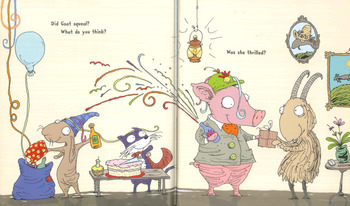
The narrative explores the events leading up to a birthday celebration (situated in western society). The story is bound by characters travelling through various landscapes at night to celebrate with their friend. The story ends with the giving of a present and the associated celebrations (Figure 1).
The second last double page from the book Scary Night. Text copyright Lesley Gibbes and illustrations copyright © Stephen Michael King, 2014. First published by Working Title Press, 2014. Reproduced by permission of Working Title Press.

We used the framework to locate the most appropriate critique for this image (as it illustrates the story) and the principle of participation and the environmental pillar were selected. The question of the text asks if the characters are appropriately interacting with the environment or elements of the environment (in meaningful ways)? The theme of participation also covers how the characters interact with the environment. In this story, the environment is framed as scary and frightening as the characters move through the landscapes at night to get to the party. While the scary environment may provide useful dramatic props, the implications of rendering the environment scary because of the time of the day highlights many cultural implications that will ‘shadow’ children’s experience.
The final celebration scene in Scary Night is ideologically problematic. While the image identifies the individuals working together to celebrate a birthday, the excesses of food and drink, and decorations including hats, streamers and balloons that are all one-use items normalise the representations of nonsustainable celebrations common in our present time. Although these decorations might be recycled, the representations of these artefacts are clean and crisp normalising a one-use practice, supported also with the image of a balloon filled with a gas lighter than air. The image of celebration does not challenge alternative actions that can provide children with a deeper understanding of the economics of participating in celebrations and associated or alternative sustainable practices. Although this practice of a party might be normalised for many teachers, it would take an astute teacher to tease out the violation of the principles and the pillars of sustainability in this image.
Go to Sleep Jessie by Gleeson and Blackwood (Reference Gleeson and Blackwood2014)
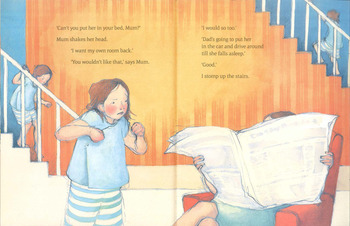
The story focuses on a young child who will not go to sleep and her older sibling complaining about it. Although the older sibling eventually finds a sustainable solution, to sleep next to her younger restless sister, she goes through various scenarios to try to get her to sleep before finding an acceptable solution. One of these proposed solutions is outlined in Figure 2, where the father suggests that he will drive the younger sister around in the car until she goes to sleep.
A double page depicting a text about putting a crying baby in a car and driving around until the baby goes to sleep, from the book Go To Sleep Jessie by Libby Gleeson. Text and illustrations copyright © Libby Gleeson, 2014. First published by Hardie Grant Egmont, 2014. Reproduced by permission of Hardie Grant Egmont.

The principle of critical thinking challenges the practice of driving a baby around in the car. The text provides a noncritical analysis of the ideological implications of wasting nonrenewable resources to put a baby to sleep. The readers are not provided with an explicit opportunity to critique the practice of driving the baby around. Another nonsustainable proposal is to find or make a space in the house so the siblings are separate. Both these proposals mediate the ‘careless’ use of resources that do not adhere to the principle of transformation and change needed for a sustainable future (Bigger & Webb, Reference Bigger and Webb2010). The economic pillar of sustainability is not explored in these proposals that are based on overusing resources. While the outcome of siblings looking after each other is an example of an ecologically sustainable practice, teachers would need to be conscious of the explicit teaching about resource use and needs versus want within this text to disrupt the nonsustainable ideologies that might be overlooked by students.
Snail and Turtle are Friends by King (Reference King2014)
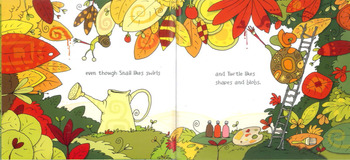
This story is about how Snail and Turtle engage in a range of experiences while building a friendship. The text explores the relationship they have that includes negotiating each other’s different preferences. The story associated with Figure 3 is about the different preferences of the snail and the turtle when they are painting what appears to be living leaves.
A double page near the end of the narrative with leaves that had been painted by the Snail and the Turtle. From the book Snail and Turtle are Friends by Stephen Michel King. Text and illustrations copyright © Stephen Michael King, 2014. First published by Scholastic Press, a division of Scholastic Australia Pty Limited, 2014. Reproduced by permission of Scholastic Australia Pty Limited. Peta White is a Senior Lecturer in Science and Environmental Education at Deakin University. Her passion for initial teacher education, activist environmental education and action-orientated research methodologies drives her current teaching/research scholarship.

The image challenges the principle of systems thinking outlined in the framework. First, the painting of the plants with paint implies the natural world is not beautiful enough without the touch of some anthropomorphised painting from the snail and the turtle. Second, the act of painting hinders the respiration and photosynthesis of the plants, something not considered in this representation overlooking the importance of the environmental pillar. Other organisms could be affected by the toxicity of the paint and as the paint then enters the ecosystem as the painted leaves fall off the tree the toxicity could continue to have a deleterious effect. The act of painting a few leaves on the tree could be a wonderful metaphor for pollution or carbon emissions for savvy teachers. However, in this representation, it is as if the painting a few leaves on the tree would not cause damage in any way, just like releasing a few carbon atoms in the atmosphere will not cause global warming. The ethics of individually polluting is a tacit part of this story that is not challenged or disrupted through the text. If teachers were to replicate this practice of painting leaves with their early childhood students as modelled in the book, they would be indoctrinating young children into nonsustainable practices in subtle ways.
Returning to the Imagined Future Teachers’ Reflections
Teachers play a role in selecting texts and then designing experiences to enhance student learning and engagement with that text. Copying scenarios and undertaking similar activities is common practice, especially in early childhood settings. For this reason, it is important to ensure that awarded texts, in particular, offer socially appropriate discourses for our future generations.
We now return to the narrative device of imagining our future teachers tasked with revising the children’s literature.
Troubled by the need to remove any reading material, the teachers consolidate their thinking around the content of these stories. They remind each other that if they don’t provide strong models and insight into the implications of choices that they remain complicit in promoting unsustainable practices. They remember how difficult it was initially to take the time to re-consider their everyday practices around issues of race and gender. They recall the educational programs designed to help them make the necessary transitions. They discussed the programs based on ecological sustainability that have been well established in their schools for years now: waste minimisation programs, energy consumption reducing programs, localised food security programs, and even school transport programs. They had a robust discussion about using the books as a stimuli for talking around ecological sustainability but they decided that if one student consumed the imagery uncritically the school would not be educating for ecological sustainability. They decide that removing the books with inappropriate ideological representations is another important step to take towards creating and supporting social change. The books were composted.
Conclusion
The absence of explicit attention towards the place and ecological sustainability is a weakness in approaches to literacy (Comber, Nixon, & Reid, Reference Comber, Nixon, Reid, Comber, Nixon and Reid2007). Parents and teachers provide important role modelling to children in the reading of children’s literature with regard to the creation of both explicit and implicit social discourse. The framework presented provides authors, illustrators and editors, those who produce texts, with deeper understandings of how high-quality children’s literature can mediate messages of economic, environmental and societal nonsustainably. The framework has been useful to problematise the limited focus on ecological sustainability in award-winning texts and has offered a set of questions to support the judging of these texts. We hope that further development of this framework will also support teachers in their engagement with children’s literature with their students to produce deeper understandings and appropriate social discourse around sustainable practices.
If the history of children’s literature is anything to go by, the removal of children’s literature with nonsustainable representations will begin long before 2050. Children’s literature, which had representations of gender bias, were being removed long before the ideals of gender equity were realised. Children’s literature should represent the ideals of ecological sustainability even if these practices are not enacted in broader societal discourses. The agenda of ecological sustainability in schools will be derailed if award-winning texts in classrooms are mediating messages of nonsustainability to children. We have presented an argument for representations of ecological sustainability to play a stronger role in what counts as quality in children’s literature.
Acknowledgements
None.
Financial Support
This research received no specific grant from any funding agency, commercial, or not-for-profit sectors.
Conflicts of Interest
None.
Peta J. White is a Senior Lecturer in Science and Environmental Education at Deakin University. Her passion for initial teacher education, activist environmental education, and action-orientated research methodologies drives her current teaching/research scholarship.
Glenn Auld is a Senior Lecturer in Language and Literacy at Deakin University. His research and teaching explore digital literacies, Aboriginal and Torres Strait Islander Education and critical research methodologies.
Muriel Wells is a Lecturer in Language and Literacy at Deakin University. Her teaching and research are predominantly in the areas of digital literacies, teachers professional learning and action research as a methodology to support practitioner-led changes within schools.