1. Introduction
This paper focuses on how gender is assigned to Basque nouns occurring in mixed Spanish–Basque determiner phrases (DPs). Although this question has already been raised regarding Spanish in contact with English, which, like Basque, lacks grammatical gender, Basque and Spanish are more different than English and Spanish in terms of word order among other morphosyntactic features. Spanish is a head-initial language and Basque is a head-final language. Specifically, a conflict site arises within mixed Spanish–Basque DPs since the determiner appears in contrasting positions in the two languages. Spanish has the determiner placed before the noun ([DP la [NP manzana]] “the apple”), but in Basque the determiner appears suffixed to the noun ([DP [NP sagarr]-a] “the apple”). This is also the citation form in all dialects, as stated by Michelena (Reference Michelena1979; also cited by Trask, Reference Trask2003).
Spanish is a language with a binary masculine/feminine gender system. When a Spanish determiner is followed by a noun from another language, specifically an ungendered language like English or Basque, an interesting question is raised as to how the gender of the determiner will be decided. Corbett (Reference Corbett1991, p. 71) considers “whether there are solid grounds for postulating any additional mechanisms which apply only to the assignment of borrowings and not to that of native words”.
In their investigation of Spanish gender assignment to English words in a corpus of Puerto Rican Spanish, Poplack, Pousada and Sankoff (Reference Poplack, Puousada and Sankoff1982) found that English nouns with animate referents took gender according to sex and that for others, phonological factors played a role as in Spanish nouns. An interesting additional factor, however, was the gender of the Spanish equivalent of the English noun, which also played a role and sometimes competed with phonological factors. Phonological factors turned out to be less important in another corpus including English words, of Montreal French, leading the authors to claim that “the factors governing gender assignment are language-specific: they follow from the particularities of the host language” (Poplack et al., Reference Poplack, Puousada and Sankoff1982, p. 25).
In their analysis of a Spanish–English corpus collected from Latin American Spanish speakers, Jake, Myers-Scotton and Gross (Reference Jake, Myers-Scotton and Gross2002) set out to determine the relative importance of phonological factors and analogical gender (the gender of the translation equivalent of the loanword) in determining the gender of English nouns. They found that analogical gender was the most important factor, accounting alone for the gender of 36% of the English nouns. Phonological shape accounted alone for 23% of the nouns, and both analogical gender and phonological shape together accounted for 15% of the nouns. This left 38 nouns out of 151, or 25%, for which gender assignment could not be explained in terms of either phonological factors or analogical gender. Thirty-seven of these nouns were assigned masculine gender, leading the authors to conclude that “masculine is clearly the default gender” (Jake et al., Reference Jake, Myers-Scotton and Gross2002, p. 83). This conclusion is in line with work by Roca (Reference Roca1989, Reference Roca2005) and Harris (Reference Harris1991) on gender in monolingual Spanish. Additionally, Liceras, Fernández-Fuentes, Perales, Pérez-Tattam and Spradlin (Reference Liceras, Fernández Fuentes, Perales, Pérez-Tattam and Spradlin2008) found that balanced bilingual adults preferred a default masculine determiner, whereas first language (L1) Spanish learners of English preferred a feminine determiner where the translation equivalent was feminine.
In the present paper we aim to investigate which are the factors that govern gender assignment in Spanish–Basque mixed DPs with Basque nouns and Spanish determiners by means of data gathered by different methods. To this end the article is organized as follows. In Section 2 previous research is reviewed. In Section 3 we present the specificities of the three types of data collected and the main results of each of the tasks. Finally, we present the discussion in Section 4 and the main conclusions in Section 5.
2. Previous research
2.1 Other-language insertions
Previous research involving contact between two languages within a sentence has established that nouns are the most frequently inserted “other-language” items (see Muysken, Reference Muysken2000; Poplack, Sankoff & Miller, Reference Poplack, Sankoff and Miller1988). Indeed Jake et al. (Reference Jake, Myers-Scotton and Gross2002, p. 72) report that “mixed NPs, with a determiner [D] from one language and a noun from another . . . form the bulk of all observed Spanish–English [code-switched] data”. Example (1) below illustrates the type of insertion which interests us here, where a Basque noun (in italics) is inserted in an otherwise Spanish utterance (Deuchar, Epelde, Oyharçabal & Parafita Couto, Reference Deuchar, Epelde, Oyharçabal and Parafita Couto2010).
-
(1)


There is an extensive literature (see most recent Poplack & Dion, Reference Poplack and Dion2012; Stammers & Deuchar, Reference Stammers and Deuchar2012) on whether this kind of single-word insertion should be considered to belong to the host language (in this case Spanish) or the source language (in this case Basque). In the former case it may be called a borrowing and in the latter case a (code-)switch. Poplack and Meechan (Reference Poplack and Meechan1998) consider borrowings to be linguistically integrated whereas switches are not, while Myers-Scotton (Reference Myers-Scotton2002, p. 41) uses (high) frequency as a criterion for borrowings and insists less on a categorical difference between the two categories. For the purposes of this paper we take the position that an absolute distinction between the two categories need not be drawn. The focus of our investigation is how Spanish gender is assigned to Basque items inserted in Spanish, whether or not these items are considered to be switches or borrowings.
Myers-Scotton (Reference Myers-Scotton2002) argues that single other-language items tend to be inserted in the morphosyntactic frame of the host language. According to Jake et al.'s (Reference Jake, Myers-Scotton and Gross2002, p. 79) Bilingual NP Hypothesis, there is a preference for other-language nouns to be preceded by host-language rather than other-language determiners. Since Spanish determiners (unlike Basque) are gendered, this means that Basque nouns will be inserted after Spanish determiners, which are either masculine or feminine. The focus of this paper is how the gender of these determiners is decided, given that Basque does not have grammatical gender.
2.2 Gender assignment to other-language words
2.2.1 Gender in Spanish and Basque
Spanish is a language with a binary masculine/feminine gender system. Roca (Reference Roca1989) and Harris (Reference Harris1991) agree that the masculine gender is default and Roca (Reference Roca1989, p. 26) proposes a binary gender feature is [± FEMALE]. According to this approach, gender is an inherent part of each lexical entry. If words are lexically marked for gender, then in order to find the rules for gender assignment one needs to find the patterns of each gender category. These patterns should be the criteria by which gender is assigned to loanwords (Corbett, Reference Corbett1991). Harris (Reference Harris1991) and Roca (Reference Roca2005) argue that gender is an idiosyncratic property of every nominal morpheme, hence word endings are not responsible for the gender of words. Therefore, although -o is a typical Spanish masculine ending, it can also appear in feminine words, such as in mano “hand-fem”. Similarly, words with the typical feminine word ending, -a, can be masculine, such as tema “topic-masc”. The default agreement in Spanish is [–F] (i.e. masculine) and the word ending, unless otherwise specified, is -o. Similarly, if a noun is lexically specified to be feminine, its word ending, unless lexically specified otherwise, is -a. Moreover, some words can refer to both males and females with the same, feminine-shaped ending; e.g. la Belga “the Belgian woman” and el Belga “the Belgian man”. Shape becomes relevant for gender only in new words because they do not have inherent gender.
It should also be noted that according to the frequency analysis by Teschner and Russell (Reference Teschner and Russell1984) based on an unpublished inverse dictionary of Spanish incorporating all words listed in the 18th edition of the Spanish Royal Academy's dictionary, the phonological ending of the word appears to be a good predictor of gender in Spanish, since the vast majority of the words ending in -o are masculine (99.87%) and most of the words ending in -a are feminine (96.30%).
In the case of Basque, although this language has no grammatical gender as a rule, as Trask (Reference Trask2003) indicates, it has imported Romance-style sex-marking (-o for masculine and -a for feminine) for some nouns and adjectives in western varieties. This is the case of Basque word gixajo “poor fellow”, which appears with its female variant gixaja. Occasionally, sex-marking is also attested in lexical adjectives, mostly borrowed from Spanish, such as majo “nice” with its female counterpart maja, or tonto/tonta “foolish” or katoliko/katolika “Catholic”.
Note that some words in Basque have stem-final lexical -a Footnote 1 (e.g. gauza “thing”, giltza “key”, eliza “church”, etc.), which is homophonous with the gender-marking -a in Spanish. Stem-final -a is occasionally omitted despite being prescriptively ungrammatical in Standard Basque.Footnote 2
2.2.2 Gender assignment to single words
Regarding gender assignment to loanwords, Corbett (Reference Corbett1991) posits that gender is assigned on the basis of the semantic and phonological regularities of the borrowing language. Hock (Reference Hock1986) mentions four assignment parameters for the gender of loanwords:
-
• semantic-based assignment (sex)
-
• shape-based assignment
-
• analogical gender
-
• default gender (resorted to only if the other criteria cannot be employed)
These criteria were considered by Poplack et al. (Reference Poplack, Puousada and Sankoff1982) in their study of gender assignment to English loanwords in Spanish and French. These authors state that “it has often been suggested that loanwords tend to adopt the unmarked gender of the language into which they are borrowed” (Poplack et al., Reference Poplack, Puousada and Sankoff1982, p. 21). However, while they do find evidence for this process in French, in their Spanish data phonological shape and analogical gender are more important. For Spanish they thus report “no clear evidence in these data there is some underlying tendency independent of the shape and the meaning of the word for borrowed nouns to take on masculine gender” (Poplack et al., Reference Poplack, Puousada and Sankoff1982, p. 21).
There has been research that investigated to what extent phonological regularities play a part in gender outcome. Zubin and Köpcke (Reference Zubin and Köpcke1984) present evidence for a range of gender assignment rules for German based on phonological shape, showing a strong correlation between phonological shape and gender, and contending that it is the shape of the word that determines the gender. In contrast, according to the assumption that gender is part of each lexical entry (Harris, Reference Harris1991; Roca, Reference Roca1989, Reference Roca2005), shape becomes relevant for gender only to new words because they do not have inherent gender.
Previous studies (e.g. Liceras et al., Reference Liceras, Fernández Fuentes, Perales, Pérez-Tattam and Spradlin2008, inter alia) have shown that, for language pairs in which only the nouns in one of the languages bear a gender feature, early bilinguals and adult learners behave differently when judging/producing mixed noun phrases. Early bilinguals and L1 Spanish speakers prefer mixings where the determiner bears the gender of the translation equivalent of the English noun (analogical gender). Conversely, L1 English speakers prefer mixings where the masculine determiner is used as the default form. Eye-tracking work on the insertion of English nouns into Spanish suggests that there may be a masculine default gender (Dussias, Valdés Kroff, Guzzardo Tamargo & Gerfen, Reference Dussias, Valdés Kroff, Guzzardo Tamargo and Gerfen2013).
Given the previous findings we were therefore curious to determine which factors determine gender assignment to (ungendered) Basque nouns. On the basis of the results from Spanish gender assignment to English nouns (Dussias et al., Reference Dussias, Valdés Kroff, Guzzardo Tamargo and Gerfen2013; Jake et al., Reference Jake, Myers-Scotton and Gross2002; Poplack et al., Reference Poplack, Puousada and Sankoff1982), we predicted similar findings regarding Spanish gender assignment to Basque nouns since these, as in English, are ungendered. We expected therefore that both phonological factors and analogical gender would be influential as with English nouns, but that for any nouns where these factors did not apply, the masculine default gender would be assigned.
2.3 The situation of Basque
The Basque language (euskara in Basque) is spoken in the Basque Country, an area spanning part of northeast Spain and southwest France. According to the last sociolinguistic survey (Basque Government, 2012) there are 714,136 Basque speakers in the whole Basque speaking area. These speakers make up 27% of the population aged 16 and above, and speak either Spanish or French along with Basque. As for language use, the results of the survey show that 24.2% of the bilinguals report using Basque to a greater or lesser extent, though the level of use varies within the territories.
Because all adult speakers of Basque also speak either Spanish or French, the Basque language is open to the effects of language contact. Research on language contact between Spanish/French and Basque appears to be particularly interesting to address grammatical phenomena influenced by language contact. One such aspect of language contact which most concerns us in this paper is that resulting in code-switching between Basque and Spanish.
Code-switching in the Basque Country is a relatively new area of research, but some initial findings are reported by Epelde and Oyharçabal (Reference Epelde, Oyharçabal, Fernández, Albizu and Etxepare2010), Ibarra (Reference Ibarra2011) and Lantto (published online August 31, 2012), among others (see also Ezeizabarrena, Reference Ezeizabarrena and Grinstead2009; Ezeizabarrena & Aéby, Reference Ezeizabarrena, Aéby and Oliviéri2010; Ezeizabarrena & Munarriz, Reference Ezeizabarrena, Munarriz, Cestero Mancera, Molina Martos and Paredes García2012, for studies on Spanish–Basque code-switching in children and aphasics). In their study on French–Basque code-switching Epelde and Oyharçabal (Reference Epelde, Oyharçabal, Fernández, Albizu and Etxepare2010) report on the insertion of French prepositional phrases into an otherwise Basque morphosyntactic frame by four balanced bilinguals (all aged over 60). Although Basque is most commonly the morphosyntactic frame or matrix language, there are also clauses with French morphosyntactic frames into which Basque prepositional phrases are inserted. More phrases are inserted into Basque morphosyntactic frames than into French morphosyntactic frames. The authors also report the insertion of single Basque nouns into French morphosyntactic frames and single French nouns into Basque morphosyntactic frames. The examples of inserted Basque nouns include a Basque postponed determiner -a even though they are inserted following the French determiner le (the-masculine) or ce (this-masculine) and thus double marking arises (see Myers-Scotton, Reference Myers-Scotton2002). Ibarra (Reference Ibarra2011) reports on data collected from 35 Spanish–Basque bilinguals aged 17–25 in the capital of Navarre, Pamplona. Most of the participants had acquired Spanish at home and Basque through immersion at school. Ibarra provides examples of both intrasentential and intersentential code-switching. The examples of intrasentential code-switching demonstrate that Spanish words and phrases are sometimes inserted in a Basque morphosyntactic frame, often at the end of the clause. There are also examples of Basque nouns inserted in otherwise Spanish clauses: in cases where a Spanish determiner is used, its gender corresponds to its analogical gender in Spanish.
Lantto (published online August 31, 2012) reports on a study in Bilbao based on 22 hours of naturalistic recordings between 22 speakers, some of whom are L1 and others non-native (L2) speakers of Basque. Basque is described as the “base language” of the conversations, and the examples reported suggest that it provides the morphosyntactic frame of most bilingual clauses, into which there are Spanish insertions. Lantto's study converges with Etxebarria's (Reference Myers-Scotton2004) study who reports on Spanish insertions into the Basque in the Basque dominant areas of Bermeo and Gernika.
In this paper we shall be interested primarily in code-switched DPs where Spanish provides the morphosyntactic frame. We decided to focus initially on L1 speakers of Spanish (who had acquired Basque either as L2 or simultaneously with Spanish) because of the finding by Liceras et al. (Reference Liceras, Fernández Fuentes, Perales, Pérez-Tattam and Spradlin2008) that in judgment data L1 Spanish speakers preferred English nouns to have analogical gender whereas L2 Spanish speakers preferred masculine.
3. The study
We designed a study to evaluate gender conflict resolution within Spanish–Basque mixed nominal constructions by using a multi-task approach with tasks varying in the degree of spontaneity and restrictiveness in order to find the most reliable data for the study of such a stigmatized phenomenon (see Gullberg, Indefrey & Muysken, Reference Gullberg, Indefrey, Muysken, Bullock and Toribio2009). From these we derived three sets of data, which will each be discussed in turn in the following sections:
-
(i) naturalistic data: spontaneous observation data (Section 3.1)
-
(ii) semi-experimental data: director–matcher task (Section 3.2)
-
(iii) experimental data: auditory judgment task (Section 3.3)
The naturalistic data set the scene for further studying the phenomenon experimentally. The director–matcher task and the auditory judgment task were carried out with the same pool of participants, who were tested following the same procedure and by the same experimenter, a Spanish–Basque highly proficient speaker. First, the participants were required to read an information sheet and sign a consent form. Secondly, they did the director–matcher elicitation task in pairs. Thirdly, they were individually tested in the judgment tasks. Finally, they were asked to complete a background questionnaire about language history and use which was available in Spanish and Basque (see questionnaire in Supplementary Materials Online available along the online version of the present paper via journals.cambridge.org/bil). The entire procedure for a pair of participants lasted about 45 minutes. All participants voluntarily agreed to participate in the experiment for free.
It is worth mentioning that the linguistic profile and the sociolinguistic background of the participants whose naturalistic data are reported differ from those of the participants recruited for the semi-experimental and experimental tasks. The possible influence of these factors in the results obtained will be addressed in the discussion.
3.1 Naturalistic data
Deuchar et al. (Reference Deuchar, Epelde, Oyharçabal and Parafita Couto2010) collected naturalistic data from spontaneous conversations from adult highly proficient bilinguals (L1 Basque, L2 Spanish). These speakers, who are used to code-switching, frequently produce Spanish–Basque mixed nominal constructions with a Spanish determiner and a Basque noun. Within the 92 examples of this type that were collected, a large number of feminine determiners was observed (72/92, 78.3%) as feminine determiners appeared both with nouns whose analogical gender was feminine, see (2a), (35/72, 48.61%) but even also with nouns whose Spanish equivalents were masculine, see (2b). In contrast, masculine determiners were mostly used with Basque nouns whose translation equivalents were masculine, as in (3a) (17/20, 85%), and they were very scarce with nouns whose translation equivalents were feminine, exemplified in (3b) (3/20, 15%).
-
(2)
-
(3)


Besides, when considering the phonological shape of the Basque nouns, it was observed that feminine determiner appeared with nouns ending with either a consonant, as in (2) above or a vowel, as in (4) below. Interestingly, most of the Basque nouns ended in -a (69/72, 95.8%), due to the fact that Basque noun insertions appear with the Basque determiner suffix -a, see (2) and (4), which is crucially homophonous with the Spanish feminine marker. In contrast, masculine determiner appeared always (20/20, 100%) with nouns whose ending was different from -a and appeared without the determiner suffixed, see (3) above and (5) below. Words ending in -o appeared in all cases with masculine determiner, irrespective of its analogical gender being masculine, as in (3a), or feminine, as in (3b).
-
(4)
-
(5)


To sum up, both analogical gender and phonological shape together account for 53% of the data (49/92), though in the rest of examples phonological shape appears to be the most relevant factor, since it accounts for 43% of the Basque nouns (40/92), in contrast to analogical gender which accounts for the remaining 3% (3/92). Thus, a preliminary analysis of the corpus led Deuchar et al. (Reference Deuchar, Epelde, Oyharçabal and Parafita Couto2010) to conclude that there might be a reinterpretation of the determiner suffix (-a) as a feminine gender marker, due to their homophony. In order to investigate further how gender is assigned in Spanish–Basque code-switched nominal constructions and, more specifically, to explore the effects of analogical gender and phonological shape, we designed two experimental tasks, an elicitation task and an auditory judgment task.
3.2 Semi-experimental data: Director–matcher elicitation task
The director–matcher elicitation task also known as “the toy task” (Gullberg et al., Reference Gullberg, Indefrey, Muysken, Bullock and Toribio2009) is a guided production task presented as a game where one participant, the director, has to instruct the other, the matcher, where to locate certain objects on a board.
3.2.1 Participants
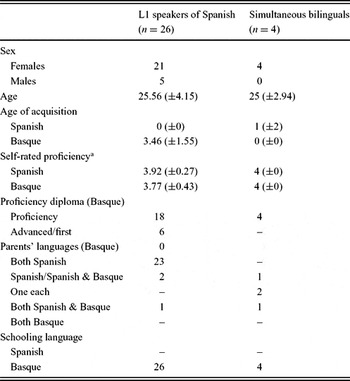
Thirty neurologically healthy Spanish–Basque bilinguals were recruited for the semi-experimental and experimental tasks: 26 native speakers of Spanish (21 females, five males; mean age 25.38 years, SD = 4.14) who acquired Basque at school (age of acquisition = 3.46, SD = 1.56) and four simultaneous Spanish–Basque bilingual speakers (four females; mean age 25 years, SD = 2.55). See Table 1 for details of the participants.
Summary of the results reported by the participants regarding language acquisition and proficiency (n = 30).

a Participants rated their proficiency according to a four-point Likert scale.
At the time of the experiments, all participants lived in the vicinity of Pamplona (Navarre), a mainly Spanish-speaking area where Basque is not an official language, although Basque speakers have some rights with regard to administration and education in this area. According to the most recent sociolinguistic survey (Basque Government, 2012), 11.7% of the inhabitants are Spanish–Basque bilinguals in Navarre.
When completing the language questionnaire (see Supplementary Materials Online), participants rated themselves as being proficient in Basque though generally less than in Spanish (see Table 1). Specifically, L1 Spanish participants’ self-proficiency mean rate was 3.92 for Spanish and 3.77 for Basque on a four-point Likert scale. All simultaneous bilinguals rated their Spanish and Basque proficiency at 4. However, the results from the self-rated proficiency must be interpreted with caution; for example, some participants did not rate their proficiency in L1 at 4. As an additional measure of proficiency, we also considered the fact that 73.3% of the participants have obtained the highest proficiency certificate in Basque (Table 1), which is used in order to assess proficiency in academic and professional domains in the Basque Country
3.2.2 Procedure
Participants were seated at a table face-to-face and they were asked to work in pairs to complete a game-like task. In the middle of the table there was a screen, so that participants could not see anything on the other side of the screen. Each participant had in front of him/her a board with cards with 16 images of everyday objects. Each board was divided into 16 grids, each grid containing one image. The objects of both boards were identical, but they were pre-arranged differently in each grid. Participants were told that the aim of the game was to end with the same arrangement of the objects on both boards as quickly as possible. In order to arrive at the same arrangement, participants were told that one of the participants, the “director”, had to give instructions to the other, the “matcher”, on how to distribute the objects in the grid so that they would end in the same order and position on both sides of the screen. The matcher was told that (s)he could ask questions in order to ensure (s)he had understood the instructions correctly. The roles of director and matcher were assigned randomly by the experimenter.
Participants were given the instructions in Spanish–Basque code-switching mode (see Appendix 1). The instructions were written down, and the experimenter read them aloud as if they were spontaneously produced. This way, all participants received exactly the same instructions. Two pairs of participants asked about the language of the task. They were told that they could speak whichever language they wanted as long as they ended up with the grids organized in the same way as quickly as possible. The entire task, instructions included, was audio-taped for later transcription.
3.2.3 Materials
Two boards with 16 grids drawn on them, a screen and cards with 16 images of everyday objects were required for the task. The images of everyday objects were chosen so that there were two of each kind that only differed in colour and shape. Thus, the speakers were forced to use nouns with modifying adjectives in order to identify each picture unambiguously.
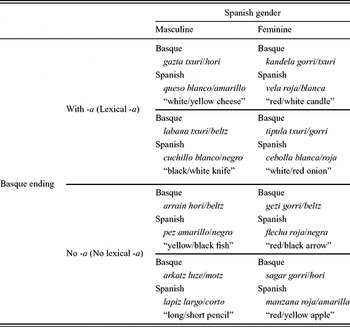
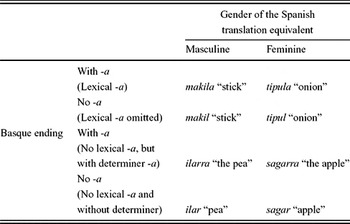
Since this task was designed in order to examine gender in Spanish–Basque code-switched DPs, the objects and adjectives were controlled for gender in Spanish (eight masculine and eight feminine) and for the phonological ending of the Basque nouns (eight nouns with lexical -a vs. eight nouns without lexical -a). Besides, only adjectives that have gender agreement in Spanish were chosen (e.g. blanco.masc/blanca.fem “white”). Objects and adjectives that were loanwords were avoided. Characteristics of the noun phrases (NPs) that correspond to the images used in this task are reported in Table 2.
Characteristics of the noun phrases corresponding to the objects used in the director–matcher task.

3.2.4 Data analysis
The recordings were analyzed in order to detect the switches. Once a language switch was found, the whole sentence was transcribed.
3.2.5 Results
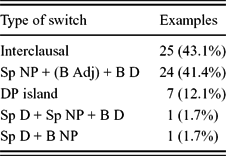
Fifty-eight language switches were obtained and classified according to the following taxonomy: interclausal switches, embedded DP islands, Spanish noun with a Basque determiner and in some cases a Basque adjective, Spanish determiner and noun with Basque determiner and Spanish determiner with a Basque NP, as in (6) below.
-
(6)

As Table 3 indicates, most of the switches were interclausal or Spanish lexical insertions into a Basque DP. All the mixed expressions were produced in utterances where Basque was the matrix language. No example was obtained where Spanish was the matrix language.
Taxonomy of the switches produced in the director–matcher elicitation task (n = 58).

Sp = Spanish, B = Basque
Thus, the only example that allows us to analyze gender assignment in mixed nominal construction is (6), which has a Spanish determiner and a Basque noun. In this example, feminine gender assignment can be explained by both analogical gender (cebolla “onion” is feminine) and phonological shape (-a ending).
3.3 Experimental task: Auditory judgment task
The auditory judgment task is a modified version of the written grammaticality judgment task, whose aim is to obtain participants’ intuitions on the code-switched items provided. We used the auditory version of this task since code-switching tends to be an oral phenomenon rather than a written one, and we wanted to limit any possible effects of prescriptive attitudes.
3.3.1 Participants
The participants in this task were the same as in the director–matcher elicitation task (see Section 3.2.1 and Table 1 above).
3.3.2 Procedure
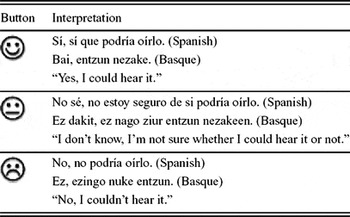
Participants were seated in front of a laptop that had a button box, with headphones on their lap. Before starting the task, the participants were required to read the instruction sheet that was provided in both languages. In the instructions participants were told that they were going to hear several recordings of short utterances and they had to give their opinion about them, by pressing one of the buttons on the response box. They were informed that all the utterances contained some Spanish and Basque, and they had to listen to them and imagine that they heard them in an informal conversation. Some might sound perfectly natural and acceptable to them, while others might sound a bit odd and unacceptable. It was also emphasized that there was not a “right” answer, but that the experimenters were interested in receiving the intuition of the participants regarding the utterances by using the response box (Table 4). They had to give their opinion by pressing the button that matched their opinion best. The experimenter insisted on the fact that the participants were not asked whether they would produce the utterances but rather whether they might hear something similar in an informal context.
Response options for the participants in the auditory judgment task.

DMDX (3.2.6.4. version) program was used for the presentation of the stimuli and for the recording of the answers and the response times. In order to hear the oral stimuli, the participants had to press the spacebar. They were asked to respond as soon as possible by pushing one of the three buttons in the response box (Table 4). If they made an error, they could press again and the last response would also be recorded. Then they had to press the spacebar again in order to listen to the next trial.
For each trial, a fixation cross was displayed for 500 ms before presenting the stimuli. The utterances were presented orally (stereo) while the fixation cross remained on the screen. After the response, the fixation cross remained on the screen until the participant pressed the spacebar to start the next clip with the presentation of the next trial. The experiment started with a training session where 12 fillers were displayed in order to ensure that the participants understood the task. Each utterance was presented once during the experiment and the order of presentation of the trials was randomized at every run of the experiment.
3.3.3 Materials
Participants were presented with 88 mixed utterances in total, 24 fillers and 64 experimental trials. In all the experimental sentences the matrix language (Spanish) and the sentence frame were kept constant and trials only differed in the mixed DP, which was the direct object of the transitive sentence, as illustrated in (7) below. This was done in order to ensure that the differences in the results were only caused by the mixed DPs. All mixed DPs had a Spanish determiner (D) and a Basque noun (N) and an either Basque or Spanish adjective (Adj). This is illustrated by example (7).
-
(7)

Several characteristics were controlled in the experimental materials. Four inanimate nouns were chosen and manipulated in order to present them with different characteristics regarding phonological ending in Basque (with and without lexical -a) and analogical gender (half masculine and half feminine in Spanish) (see Table 5). All nouns were controlled for frequency and length,Footnote 3 and all of them were found in mixed constructions in the naturalistic corpus (Deuchar et al., Reference Deuchar, Epelde, Oyharçabal and Parafita Couto2010). Nouns with biological gender were avoided in this experiment, although, in another experiment, it would be interesting to compare them with nouns with only grammatical gender.
Characteristics of the nouns used in the judgment task.

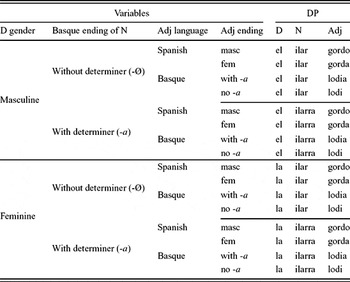
The ending of the Basque nouns was manipulated; all of them were presented with -a (lexical or morphological, corresponding to the determiner) and without -a (bare nouns without lexical -a or the nouns with lexical -a with the stem-final -a deleted) (see Table 6). Each noun was associated with an adjectiveFootnote 4 that was displayed according to two variables: (i) language of the adjective (Spanish or Basque), and (ii) gender in the case of Spanish adjectives (masc. or fem.) and phonological ending in the case of Basque adjectives (with a determiner (-a) or without a determiner (-Ø)). Finally, half of the NPs were assigned a feminine determiner (la) and half a masculine determiner (el). Table 6 shows all the combinations for the experimental item ilar “pea”, which has no lexical -a and whose translation equivalent in Spanish (guisante) is masculine.
Combinations for the noun ilar “pea” used in the experiment.

3.3.4 Data analysis
Two kinds of analyses were conducted. First, the pattern of responses within the fastest responses was analyzed to explore the characteristics of the most automatic and instinctive responses of the participants. Only answers that met the following two criteria were included: (i) answers provided within 4000 ms, and (ii) trials were given a response by 80% of the participants. As a result, 24 experimental trials were selected for the first analysis. In this analysis the general picture was analyzed by means of descriptive statistics.
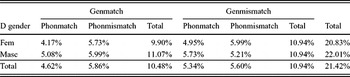
In the second analysis, the general pattern of responses was analyzed in order to see the effect of the two main factors that could influence gender assignment: phonological shape in Basque, and analogical gender. Data from some responses were excluded from the analyses presented in this paper, namely where participants failed to respond and where their responses indicated uncertainty. From the total amount of 1536 responses obtained, 1207 were considered for the statistical analyses. Although the exclusion of these data entails not considering 21.42% of the responses, it is important to mention that excluded responses were almost equally distributed across conditions (see Table 7). Consequently, the picture that emerged regarding the acceptance rate when all data were included and when the no-responses and uncertain responses were excluded was almost the same. However, owing to the fact that the statistical analyses were performed on accepted and rejected responses only, quantitative data and figures correspond to the data where missing responses and responses that indicated uncertainty were excluded.
Rate of excluded responses across variables in the judgment task.

Genmatch: DPs where the analogical gender in Spanish matched the gender of the Spanish D.
Genmismatch: DPs where the analogical gender in Spanish did not match the gender of the Spanish D.
Phonmatch: DPs where the phonological shape of the Basque noun matched the Spanish D, namely feminine D with -a phonological ending and masculine D with a phonological ending different from -a.
Phonmismatch: DPs where the phonological shape of the Basque noun did not match the Spanish D, namely feminine D with a noun with phonological ending different from -a and masculine D with a noun with -a phonological ending.
For comparisons between factors determining gender assignment, within-subject analyses were performed. The number of acceptable utterances was calculated for each condition, that is, the number of responses where participants found the utterances acceptable. The percentage of the accepted responses for each condition was obtained for each subject, an arcsine transformation was performed and several t-tests for dependent samples were carried out using the transformed data in order to compare the effects of the variables mentioned. In conditions where the dependent variable was not normally distributed (as revealed by the Kolmogorov-Smirnov test), a Wilcoxon's matched pairs test was used.
Some participants were excluded from the analyses, namely, participants that did not finish the whole experiment in the first analysis (n = 2) and participants that did not have time to respond to at least 50% of the experimental items in the second analysis (n = 6). Thus, 28 and 24 participants were analyzed in the first and the second analyses, respectively.
3.3.5 Results
First analysis: Fastest responses
The analyses of the pattern of responses among fastest responses provided a general picture of the participants’ preferences in mixed nominal constructions (see Appendix 2 for details). First, the general observation within the fastest responses was that they corresponded mostly to rejected trials. Of all the trials, 71% (17/24) were rejected, as over 65% of the participants stated that they thought they would not hear them in spontaneous conversation and less than 8% of the participants admitted the possibility of hearing some of them. The rest of the trials (7/24, 29%) were generally accepted by over 40% of the participants. In general, decisions were quite robust regarding rejection/acceptance for all participants.
Secondly, considering the rejected trials, the main pattern observed was that all of the rejected trials (17/17, 100%) had the adjective in Spanish and thus were all instances of two switches exemplified in (8).
-
(8)

Additionally, most (14/17, 82.4%) of the trials rejected by the participants had a mismatch between the gender of the Spanish determiner and the gender of the Spanish adjective, as in (8b, c), so they might have been excluded on the basis of Spanish grammar, as one of the reviewers suggested. Regarding the gender of the determiner, half of the trials had a masculine determiner (9/17, 52.9%) and half a feminine determiner (8/17, 47.1%). No clear preference was observed concerning phonological ending of the noun and the adjective. Within nouns, half had a Basque noun ending in -a (9/17, 52.9%), and within adjectives more masculine than feminine adjectives where observed (11/17, 65%). However, phonological ending does not appear to have a strong effect, as more or less half of the rejected trials (8/17, 47.1%) had an ending that matched the determiner, as in (8a) above. Concerning the congruency between the determiner and the gender of the Spanish translation equivalent of the Basque noun, no clear effect was observed either, because in several cases, such as (8b, c), they matched (7/17, 41.2%). Note that the effects of analogical gender and/or the phonological shape might have been diminished due to the mismatch of the gender of the determiner and the adjective, see examples (8b, c).
The third finding in this analysis concerns accepted trials. We observed that most of these trials were one-switch trials (6/7, 86%), that is, trials that had the adjective in Basque, as in the example in (9a) below. Most of the trials (6/7, 86%) had a feminine determiner (see examples (9a, b)) and nouns ending in -a (6/7, 86%) either lexical -a, as in (9b), or morphological (determiner), as in (9a). Besides, the ending of the adjective generally matched the ending of the noun (5/7, 71.4%) because it had a determiner in Basque (-a ending) (see example (9a)) or it had a feminine agreement marker in Spanish, as in (9b). Thus, most of the accepted trials (5/7, 71.4%) corresponded to trials that had a determiner which was congruent with the phonological shape of the Basque noun, except for two, which were of two types, namely a masculine determiner with a Basque noun ending in -a, shown in (9c), and a feminine determiner with a Basque noun with an ending different from -a, shown in (9d). Finally, in most of the cases the determiner and the gender of the Spanish translation equivalent of the Basque noun were congruent (6/7, 86%), see (9a–d).
-
(9)

In summary, the first analysis showed that the fastest-rejected trials were DPs with two switches, that is lexical insertions from Basque to Spanish, with a mismatch between the gender of the determiner and the gender of the adjective in Spanish. No clear effect of the phonological shape of the Basque noun or of the gender of the Spanish translation equivalent was observed within the rejected responses. The analysis of the trials preferred within the fastest responses showed that most DPs had a feminine determiner and a single switch, with nouns whose phonological ending is -a and whose corresponding translation equivalent is feminine. Although a slight preference for feminine determiners was observed, these data did not allow disentangling the possible effects of the phonological shape of the Basque nouns and of the analogical gender in Spanish.
Second analysis: Analogical gender vs. phonological shape
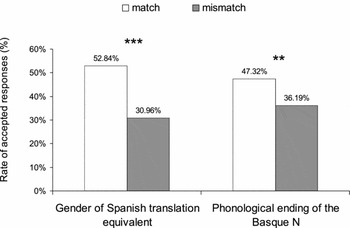
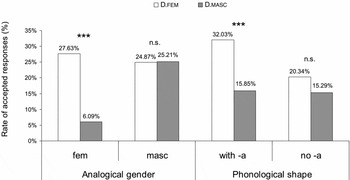
The analyses of the general effects of analogical gender and/or phonological shape in the rate of accepted responses revealed that both variables appear to have an influence on the participants’ preferences regarding gender assignment. Figure 1 shows the general acceptance rate for the trials whose determiner matched and mismatched (i) the analogical gender and (ii) the phonological shape.
General pattern of responses in the judgment task.

Concerning the effect of analogical gender, as Figure 1 shows, participants’ acceptance rate was higher for trials such as those in (10) below, whose determiner matched the analogical gender in Spanish, than for trials such as those in (11), whose determiner did not match the analogical gender (52.84% vs. 30.96%; t(23) = 9.377, p < .0001).
-
(10)
-
(11)


Regarding the phonological ending of the Basque nouns, Figure 1 shows that participants accepted more those trials in which the determiner matched the phonological ending of the Basque noun, as in (10a) and (11b), than those in which the determiner did not match it, as in (10b) and (11a) (47.32% vs. 36.19%; t(23) = 3.200, p = .004).
A comparison between the acceptance rates for the gender match condition and the phonological match condition suggests that the trials with nouns whose analogical gender in Spanish is congruent with the gender of the determiner (52.84%) are more accepted than the trials with nouns whose phonological ending is congruent with the determiner (47.32%) (t(23) = 2.344, p = .028) (Figure 1). However, such difference observed within the match trials is not observed in the mismatch condition (t(23) = –1.763, p = .091). These preliminary results point towards the influence of both analogical gender and phonological shape in gender assignment in Spanish–Basque mixed DPs.
Furthermore, in order to see the effect of these two factors in depth, separate analyses were conducted for the two genders separately. As Figure 2 shows, the effect of the gender of translation equivalents revealed a different pattern for masculine and feminine determiners. A similar acceptability rate was observed for feminine (24.87%) and masculine (25.21%) determiners when they appeared with nouns whose corresponding Spanish equivalents were masculine (t(23) = 0.076, p = .940). In contrast, a remarkable statistical difference was observed in the acceptance of the determiners with nouns whose translation equivalents were feminine; the acceptance rate for feminine determiners (27.63%) dropped considerably when nouns appeared with masculine determiners (6.09%) (t(23) = 11.730, p < .0001).
Effects of analogical gender and phonological shape.

This result suggests that there is an asymmetry in the assignment of gender to Basque nouns; feminine determiners can appear either with nouns whose translation equivalent is feminine, as in (10) above, or masculine, as in (12a) below, though masculine determiners appear to be only compatible with nouns whose translation equivalent is masculine, like that in (12b). Masculine determiners with nouns whose translation equivalents are feminine, such as those in (11) above, are generally accepted less (Figure 2).
-
(12)

Besides, feminine determiners with Basque nouns whose translation equivalents are feminine (27.63%) were preferred over feminine determiners with Basque nouns whose translation equivalents are masculine (24.87%) (t(23) = 2.386, p = .026). Similarly, a gender match was clearly preferred for the assignment of the Spanish masculine determiner, that is masculine determiners were clearly preferred when translation equivalents were masculine (25.21%) than when they were feminine (6.09%) (t(23) = –7.324, p < .0001). These results indicate that the analogical gender has an influence in the assignment of gender, though this effect is more powerful in the case of Basque nouns whose Spanish translation is masculine.
As for the influence of the phonological shape of the Basque nouns in the assignment of gender to mixed DPs, results revealed that phonological ending of the Basque nouns had an effect but only when the phonological ending was -a. As Figure 2 indicates, feminine determiners (20.34%) and masculine determiners (15.29%) were similarly accepted when they appeared with nouns whose ending was different from -a (see (12a) and (12b) above for feminine and masculine determiners, respectively) (t(23) = 1.363, p = .186). Importantly, the acceptance rate of the participants was higher for feminine determiners with nouns with -a phonological ending, such as (10a), than for masculine determiners with nouns with -a phonological ending, such as (11a) (32.03% vs. 15.85%; t(23) = 7.722, p < .0001).
Besides, though no statistical difference was observed for masculine determiners in the two conditions (t(23) = 0.738, p = .468), feminine determiners were clearly preferred more with nouns ending in -a than with nouns that did not have an -a phonological ending (32.03% vs. 20.34%; t(23) = 4.237, p < .0001). These results indicate that phonological ending has an asymmetric effect in the assignment of masculine or feminine determiners. That is, although nouns with a different phonological ending from -a are accepted at similar rates with feminine or masculine determiners, nouns with -a phonological ending are clearly preferred with feminine.
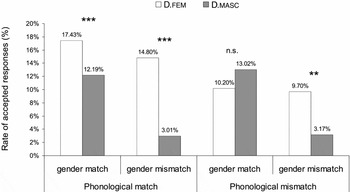
However, note that in the results reported up to now both conditions are merged, and thus it is not possible to disentangle the effect that each of these conditions might have. When analyzing separately these two main factors, a clearer picture emerges. Figure 3 shows the general acceptance rate for the trials that match and mismatch across conditions.
Effects of match and mismatch conditions of gender and phonological ending.

As Figure 3 illustrates, feminine determiners were preferred in all conditions except for the condition where gender matched but there was a phonological mismatch, since in this condition masculine determiners, like that in (13), were similarly accepted in comparison to feminine determiners, like that in (14) (t(23) = –1.656, p = .111).
-
(13)
-
(14)


In the rest of the conditions, a feminine determiner was clearly preferred over a masculine determiner. First, within the phonological match condition, the acceptance rate for feminine determiners was higher than for masculine determiners, both in the gender match condition (for example, (10a) above was preferred over (12b)) (t(23) = 4.74, p < .0001) and in the gender mismatch condition (for example, (15) was preferred over (11b) above) (Z = –4.107, p < .0001).
-
(15)

Secondly, and crucially, in the case of trials which have a mismatch of both phonological ending and analogical gender, feminine determiner like that in (12a) above was preferred over masculine determiner like that in (11a) (9.70% vs. 3.17%; Z = –2.627, p = .009). These results show that when neither the phonological shape of the Basque noun nor the analogical gender is congruent with the gender of the determiner, the participants’ acceptance rate of mixed DPs is higher for feminine determiners than for masculine determiners. The preference for feminine observed in the data, especially in cases where neither of the factors is congruent, suggests that feminine gender might operate as the default gender in Spanish–Basque mixed DPs. Moreover, a comparison across trials which matched in only one of the factors revealed that trials with masculine determiners with congruent analogical gender and incongruent phonological shape, such as (13) above, did not differ from trials with feminine determiners with analogical gender congruent and phonological shape incongruent, such as (14). This result confirms the acceptance rate for nouns with the suffixed -a even in the case of nouns whose analogical gender is masculine and which appear with masculine determiners. Appendix 3 sets out the values for all the statistical comparisons of phonological shape and analogical gender illustrated in Figure 3.
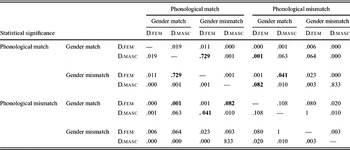
Taking into consideration that some of the trials, namely those which appear with a Spanish adjective whose gender is incongruent with the determiner (see the pattern of rejected responses among the fastest responses), could be judged exclusively on the basis of Spanish grammar, the results previously reported were replicated analyzing only trials with Spanish convergent gender between the determiner and the adjective. Interestingly, the results obtained were similar to the ones reported previously and illustrated in Figure 3 (see also Appendix 3), which confirms the consistency of the preference for the feminine determiner.
Similarly, it was investigated whether some of the trials tested could have been judged on the basis of Basque grammar, which merges the determiner with the whole NP. Among the trials tested, some combinations within Basque NPs (e.g. noun + adjective) are banned. They include examples like (15) above, which have the morphological -a suffixed to the noun and appear with a bare adjective, or (16) below, which have both the noun and the adjective appearing with the determiner, or (12) above, which have no Basque determiner neither in the noun nor in the adjective.
-
(16)

In contrast, the only trials that are grammatical according to Basque grammar would be those with the morphological -a in the adjective and no morphological -a in the noun, like the example in (17).
-
(17)

A comparison of these trials revealed that DPs which had the morphological -a in both the noun and the adjective (16) (i.e. banned by Basque grammar) were preferred over DPs with “Basque grammatical DPs” such as (17) (6.27% vs. 4.26%; p < .001) and over those trials which would not be grammatical in Basque, like (15), (6.27% vs. 4.22%; p < .001) or (12) (6.27% vs. 3.58%; p < .0001). Moreover, the acceptance rate for trials with the -a morphological suffix on the adjective, as in (17), did not statistically differ with respect to the one found in NPs without any Basque determiner, such as (12), and to the NPs with the morphological suffix on the noun, as in (15). These results indicate that the participants were not rating the trials based on Basque grammar.
Finally, following reviewers’ suggestions, the effect of the morphological -a was compared to the one from the stem-final lexical -a. The results showed that there was no difference in the acceptance rate of lexical and morphological -a, both when considering all the results and when analyzing only trials with convergent gender between the Spanish adjective and the determiner. Nouns with both lexical and morphological -a are preferred over nouns without them, though the differences were more prominent when considering all the results than when considering the trials with Spanish adjective convergent with the determiner (p < .01 in the case of lexical -a and p = .056 in the case of morphological -a).
Overall, the second analysis carried out in the judgment task has yielded two main findings: first, that both analogical gender and phonological shape influence gender assignment in Spanish–Basque mixed DPs, and second, that there was a preference for feminine in most of the conditions, even when neither the analogical gender nor the phonological shape were convergent (see Figure 3). These results seem to point towards a feminine as default determiner in Spanish–Basque mixed DPs. Moreover, nouns with -a phonological ending were preferred over nouns with a phonological ending different from -a irrespective of whether this -a was lexical or morphological.
4. Discussion
In this study we used a combination of methodologies to investigate the potential factors that may govern gender assignment in Spanish–Basque mixed DPs. In the introductory section we considered Corbett's (Reference Corbett1991) question as to whether or not other-language words are assigned gender like words of the recipient language. This appears to depend on the language pair involved and our results suggest that special provisions apply for Spanish–Basque.
The naturalistic data indicated a preference for feminine gender, with the phonological shape of Basque nouns being more important than analogical gender in Spanish. These findings contrast with those of Jake et al. (Reference Jake, Myers-Scotton and Gross2002) regarding English nouns inserted in Spanish. The elicitation task did not yield sufficient data of the type we needed to test our predictions. The auditory judgment task yielded further evidence for the feminine preference, showing that both phonological shape and analogical gender are relevant factors for gender assignment. Feminine determiners were preferred overall but within nouns assigned feminine determiners, there was a preference for nouns with feminine translation equivalents over masculine translation equivalents. Interestingly, masculine determiners with nouns having feminine translation equivalents were dispreferred in the auditory judgment task. Feminine determiners, however, were accepted similarly with nouns whose translation equivalents were both masculine and feminine. Most importantly, when there was a mismatch of both phonological ending and analogical gender, the feminine was still preferred. These results suggest that feminine is the unmarked gender and as a consequence has default status in Spanish–Basque mixed nominal constructions rather than the expected masculine gender, at least for the Spanish–Basque adult bilinguals under study (but see Ezeizabarrena, Reference Ezeizabarrena and Grinstead2009 and Larrañaga & Guijarro-Fuentes, Reference Larrañaga and Guijarro-Fuentes2013, for different patterns in Basque–Spanish bilingual children). Thus, Spanish–Basque adult bilinguals use different resources from English–Spanish bilinguals for gender assignment, resulting in two defaults: masculine for Spanish–English (Dussias et al., Reference Dussias, Valdés Kroff, Guzzardo Tamargo and Gerfen2013; Jake et al., Reference Jake, Myers-Scotton and Gross2002; Poplack et al., Reference Poplack, Puousada and Sankoff1982) and feminine for Spanish–Basque.
One possible explanation for why feminine has emerged with this default status is that the speakers initially took the phonological cue of the Basque determiner -a as a marker of feminine gender (due to their homophony), giving rise to a cross-language effect. The fact that the citation form in Basque includes the determiner (Michelena, Reference Michelena1979; Trask, Reference Trask2003), as well as the fact that Basque definite determiner -a is a bound suffix, might favour the “duplication” of the determiner, Spanish D prenominally and Basque D postnominally (DSpanish N–DBasque). This leads us to speculate that the determiner (-a) might be stored as part of the lexical entry, and thus it might have lost its value as a definite determiner. Further evidence that this is the case comes from examples in the naturalistic corpus where the Basque noun with the Basque determiner appears with Spanish indefinite determiners (e.g. unas ilarras “some peas” or unas piperras “some peppers”). This study has shown that feminine is even extended to cases where (i) the analogical gender is masculine and (ii) that -a is not present, which supports its default status.
As a consequence, this phenomenon previously reported as determiner doubling in Basque–Spanish/French code-switching (Deuchar et al., Reference Deuchar, Epelde, Oyharçabal and Parafita Couto2010; Epelde & Oyharçabal, Reference Epelde, Oyharçabal, Fernández, Albizu and Etxepare2010; Ezeizabarrena & Munarriz, Reference Ezeizabarrena, Munarriz, Cestero Mancera, Molina Martos and Paredes García2012) could be considered as a mixed nominal construction including a Spanish determiner plus a Basque noun with a lexically stored stem-final -a. Note that some established Basque-origin loanwords in Spanish follow similar patterns, such as chatarra “junk” (from Basque txatar), chamarra/zamarra “coat” (from Basque txamar/zamar).
Our results seem to support the existence of a bilingual mode where the speakers use resources for gender assignment different than those when they are in monolingual mode. Besides, our adult data is compatible with the suggestion that although no clear rule for gender assignment is observed in Spanish–Basque bilingual children, it is very plausible that they become aware of word-ending regularities at a later stage (see Ezeizabarrena, Reference Ezeizabarrena and Grinstead2009; Larrañaga & Guijarro-Fuentes, Reference Larrañaga and Guijarro-Fuentes2013). While in Spanish, masculine is default (Harris, Reference Harris1991; Roca, Reference Roca2005), in Spanish–Basque bilingual mode the default is feminine. We argue that this is an outcome of interacting processes happening at the interfaces (lexicon, phonology, morphosyntax) of both languages, resulting in the cross-language effects observed. Gender in bilinguals seems to be a more complex phenomenon than in Spanish monolingual data, where gender can be explained as a lexical property (Harris, Reference Harris1991; Roca, Reference Roca2005). Hence, the Spanish–Basque mixed nominal constructions under study seem to pose a challenge for pure lexicalist approaches (the idea that language differences are encoded in words rather than the syntax), as these constructions involve cross-linguistic interface operations and cannot simply be the result of the union of two lexicons (MacSwan, Reference MacSwan2005a, Reference MacSwanb).
The present study has several limitations. On the one hand, as noted by one reviewer, we focused on the effect of the ending -a vs. any other ending, but it remains to be studied what would happen with words ending in -o (masculine in Spanish).Footnote 5 On the other hand, we focused on one type of adult bilinguals (L1 Spanish – L2 Basque), and it would be interesting to see whether these results could be replicated with other types of bilinguals such as L1 Basque – L2 Spanish adults. In fact, given our findings, we could speculate that the cross-language effect observed would still be more salient in L1 Basque – L2 Spanish speakers, due to the weaker effect of the gender of the translation equivalent in L2 speakers of Spanish compared to L1 speakers. We would need to collect data from different bilingual groups (with L1 Basque and different degree of competence for both L1 and L2 Spanish/Basque) to see how gender is perceived and used across different types of bilinguals.
Since Basque is also in contact with French, a further study could also be conducted with Basque–French bilinguals to see whether they would behave like the Spanish–English or the Spanish–Basque bilinguals as the individual language properties differ. Further research in this direction would help elucidate the effects that phonological shape and analogical gender might play in gender choices in different types of bilinguals.
Despite the caveats mentioned above, this study has presented convincing evidence that cross-language effects between Spanish and Basque result in a feminine default for the Spanish–Basque bilinguals under study.
5. Conclusion
We designed a study to test the gender assignment strategies that bilinguals may use in mixed nominal constructions with determiners from a language that marks gender (Spanish) and nouns from a language that lacks gender (Basque). We focused on Spanish–Basque mixed nominal constructions and used a multi-task approach comprising (i) naturalistic observations, (ii) an elicitation task, and (iii) an auditory judgment task. In particular we tested the role of the gender of the translation equivalent and the phonological ending. The data from the naturalistic observations pointed to a preference for feminine gender. The data from the judgment task supported and reinforced the observation in the naturalistic data, i.e., feminine is default in this type of bilingual speakers.We have argued that the feminine default may have originated from the (morpho-)phonological property of the Basque determiner (-a) suffixed to Basque nouns, which gave rise to a cross-language effect. Owing to its homophony with the feminine gender marker in Spanish, the Basque determiner may have been reinterpreted as a feminine marker. This cross-language effect seems to be extended to other environments since it is observed even when the -a ending is not present. Our results show that in the case of Spanish–Basque DPs, special gender assignment rules applying only to mixed combinations are in operation.
Crucially, our findings support the importance of considering the properties of the languages in contact when analyzing gender assignment in bilinguals (Poplack et al., Reference Poplack, Puousada and Sankoff1982). This study has shown that bilinguals may differ in their preferences for gender assignment depending on the characteristics of the languages as revealed by (i) the difference in the resulting default gender in Spanish–Basque bilinguals (feminine) and Spanish–English bilinguals (masculine) (Dussias et al., Reference Dussias, Valdés Kroff, Guzzardo Tamargo and Gerfen2013; Jake et al., Reference Jake, Myers-Scotton and Gross2002), and (ii) the different reliance on analogical gender for L1 Spanish in contact with Basque (main factor: phonological shape) and with English (main factor: analogical gender) (Liceras et al., Reference Liceras, Fernández Fuentes, Perales, Pérez-Tattam and Spradlin2008).
Appendix 1. Instructions for the director–matcher elicitation task
To the two participants:
“Bueno, orain tenéis que hacer una ariketa con unas imágenes. Estaréis eserita bata bestearen aurrean.”
“Well now you have to do a task with some pictures. You will be sitting one in front of the other.”
To the director:
“Tú tienes que darle instrucciones al otro para que estén jolasaren amaieran los dos tableros organizados igual. Berak egin ditzake las preguntas que quiera jakiteko ea ulertu duen.”
“You will have to provide the other with instructions in order to have at the end of the game the two boards similarly organized. (S)he can ask all the question (s)he wants to find out whether (s)he has understood well.”
To the matcher:
“Tú tienes que escuchar bien las instrucciones de tu bikote, eta berrantolatu irudiak tableroan, para que al final estén igual. Puedes hacer nahi dituzun galdera guztiak para asegurarte de que entiendes los agindus.”
“You have to listen carefully to the instructions given by your partner and reorganize the images on the board, so that at the end they are similar. You can ask all the questions you want to make sure that you understand the instructions.”
To the two participants:
“Es una ariketa erraxa, pero tenéis que hacerla azkar-azkar eta ondo, tan rápido como podáis. Por cada irudi que tengáis mal bukaeran, puntu bat gutxiago.”
“It is an easy task, but you have to do it very fast and well, as fast as you can. For each image that you have misplaced at the end, (you will be given) fewer points.”
Appendix 2. Trials with fastest responses in the judgment task analyzed in the first analysis
The acceptability scores obtained as a result of the responses are listed in descending order (n = 24).

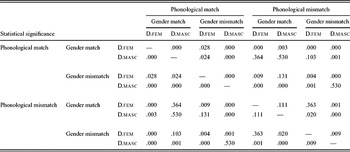
Appendix 3. Statistical values for the effects of the match and mismatch conditions of analogical gender and phonological shape
Significance values from comparing acceptability judgments across conditions (illustrated in Figure 3).

Significance values from comparing acceptability judgments across conditions only in the trials with Spanish adjective convergent with the Spanish determiner. Differences in the significance values with regard to the table above are in bold.