Introduction
Pearl millet is considered as an important staple food crop for millions of people living in Africa and Asia, especially in the dry areas. Its production is always constrained with many biotic challenges; the most important being downy mildew (DM). Grain yield losses up to 80% have been reported in India and several African countries (Howarth and Yadav, Reference Howarth and Yadav2002).
Unlike in India where farmers treat pearl millet grains with metalaxyl to reduce pearl millet DM incidence, pearl millet seeds are often sown directly into the soil without seed treatments in most of the African countries. Additionally, most resource-poor farmers in Africa cannot afford the recommended insecticide treatment for DM control due to lack of financial resources and the use of the insecticides is harmful to the environment. Thus, use of resistant varieties as a management strategy is considered to be cost-effective and eco-friendly. Therefore, searching for new sources of resistance for this disease is essential for a successful breeding programme. The objective of this study was therefore to identify new sources of resistance among West and Central African pearl millet germplasm.
Materials and methods
A total of 101 genotypes including resistant and susceptible checks were screened under field condition at Bambey and Nioro, Senegal (online Supplementary Table S1). The inbred lines were developed by ICRISAT and IRD teams from a collection of landraces originating from West and Central Africa (Haussmann et al., Reference Haussmann, Boubacar, Boureima and Vigouroux2006; Gemenet et al., Reference Gemenet, Hash, Sy, Zangre, Sanogo, Leiser, Parzies and Haussmann2014). The experiment was laid out in an augmented design of 11 blocks during the rainy season of 2016. An infector row was established as border throughout the entire length of the field in order to increase the disease pressure using a mixture of a local landrace (Souna3) and a highly susceptible line (7042S). In general, the temperature and relative humidity were the same over the two locations and were favourable for DM disease development. In average, the minimum temperature was 24°C and the maximum was 33°C. The minimum and maximum relative humidity values were 67.0 and 98%, respectively (online Supplementary Table S2). DM incidence was calculated 30 DAS by dividing the total number of infected plants per plot by the total number of plants. Disease severity score was taken after flowering on each individual plants in each plot using a 1–5 scale and the DM severity was calculated using the formula described by Williams et al. (Reference Williams, Singh and Pawar1981). Plant height, panicle length, number of productive tillers and flowering time were also recorded. The analysis of variance was performed using restricted maximum likelihood estimation method with genotypes and locations as fixed while block was considered as random. Hierarchical ascendant clustering was carried out using Ward's method based on Euclidean distances. A factorial discriminant analysis was performed in order to refine the clustering.
Results
Highly significant differences among genotypes were observed for all the traits measured (Table 1). Genotype × location interaction effects were also significant for all the traits except for plant height. The DM parameters and the productive tillers were not affected by location effect. Flowering time ranged from 44 DAS to 75 DAS with a mean of 55 DAS (online Supplementary Table S3). The panicle length ranged from 10 to 56 cm with a mean of 30 cm. Shorter plants (<1 m) were observed in plots sown with IBL174-3-1, IBL121-2-1 and IBL037-5-1, while taller plants (>2.6 m) were observed in plots sown with IBL094-2-1, IBL119-B-1 and IBL053-2-1. Inbred lines IBL174-3-1 and IBL037-5-1 did not produce any productive tillers, while other lines such as IBL040-1-1, IBL065-B-1, IBL098-1-1 and IBL071-4-1 produced more than four productive tillers/plant. Out of the 101 lines, 55 were resistant, 16 moderately resistant, 20 susceptible and 10 highly susceptible. Among the 55 resistant genotypes, 20 of them were disease-free.
F value from ANOVA for measured traits under artificial downy mildew infestation fields at Bambey and Nioro research stations during the rainy season 2016

DF, degree of freedom; DMI, downy mildew incidence.
*, **, ***, Significant at 0.05 and 0.01 and 0.001 probability levels, respectively.
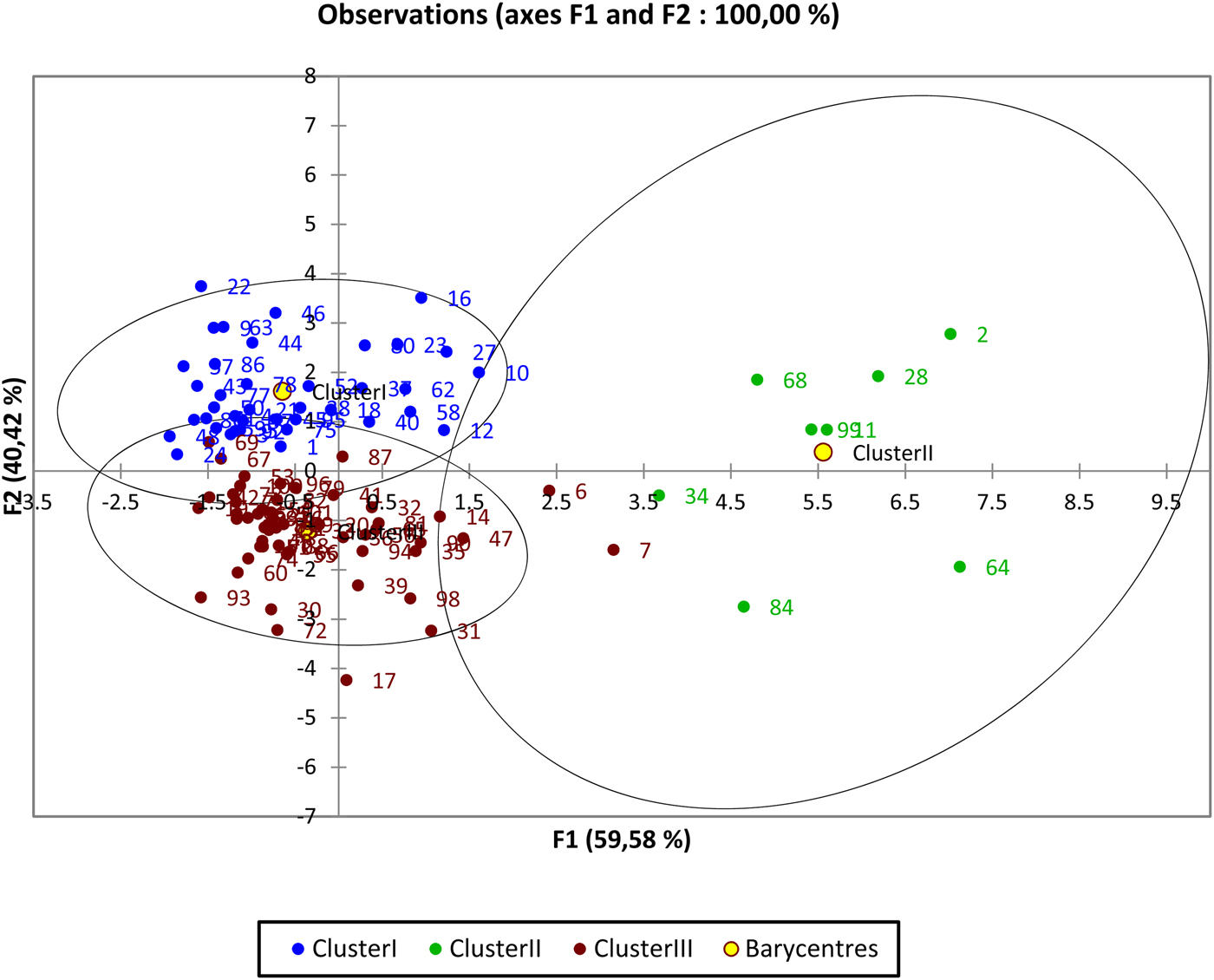
Hierarchical ascendant cluster analysis sorted out the 101 lines in three clusters (Fig. 1). The disease parameters and plant height was the most discriminant parameters (online Supplementary Table S4). Cluster I contains 38 lines and is characterized by resistant lines. It has also the tallest plants (225 cm) with the longest panicles (32 cm), early flowering (55 DAS) and moderate number of productive tillers. Cluster II encompasses the lowest number of entries, including the susceptible check 7042S, which are susceptible to DM disease and produces the lower number of productive tillers. It showed also the late flowering (63 DAS) lines with short plants (147 cm) and short panicles (25 cm). Cluster III contains moderately resistant lines. It showed, however, early flowering plants (54 DAS) with intermediate panicle length (29 cm).
Factorial discriminant analysis based on the study entries.

Discussion
The present study aimed at exploring the phenotypic variability among pearl millet inbred lines derived from West and Central African pearl millet landraces for DM and agronomic traits under DM-infested fields. The pearl millet lines display tremendous phenotypic variability for all the traits assessed. For example, the DM incidence ranged from 0 to 95% and 20 lines were disease-free. This huge phenotypic variation was also noted in the accessions where these inbred lines were derived (Haussmann et al., Reference Haussmann, Boubacar, Boureima and Vigouroux2006). This finding indicated that these lines are useful resources and their use in pearl millet breeding programme will help in creating genetic variation and improvement of elite pearl millet germplasm. Furthermore, these contrasting morphological phenotypes for the observed traits could be exploited by developing mapping population for any genetic analysis. The genotypes were ranked into three clusters, which mainly contrasted in term of DM incidence, severity and plant height. This finding is consistent with Kumari et al. (Reference Kumari, Bag, Pandey, Jha, Chauhan, Jha, Gautam and Dutta2016) who also classified 221 Indian pearl millet accessions into three clusters based on agronomic and DM resistance traits. Six lines which belong to cluster I were ranked by Gemenet et al. (Reference Gemenet, Hash, Sy, Zangre, Sanogo, Leiser, Parzies and Haussmann2014) as among the 15 best inbred lines under low P conditions. These lines included IBL047-1-1, IBL055-4-1, IBL065-B-1, IBL161-1-1, IBL155-2-1, IBL149-1-1 and IBL003-B-1 and should be good candidates for developing improved varieties which will perform well under low P conditions and combine short flowering time, long panicle and resistance to pearl millet DM.
Supplementary material
The supplementary material for this article can be found at https://doi.org/10.1017/S1479262117000405.
Acknowledgements
The authors are thankful to the West Africa Agricultural Productivity Program (WAAPP). This work could not have been done without the funding received from the WAAPP. The authors also thank the ICRISAT pearl millet breeding programme based in Sadore, Niger, for providing the seeds for the genotypes studied.