Introduction
Global warming has a potentially enormous negative impact on crop production. High temperatures have a direct damaging effect on crop development and yields (Sarsu et al., Reference Sarsu, Ghanim, Das, Bahuguna, Kusolwa, Ashraf, Singla-Pareek, Pareek, Forster and Ingelbrecht2018). Global environmental projections forecast that during the 21st century, global surface temperatures are expected to rise by 1.1–2.9°C for the lowest carbon emission scenarios and by 2.4–6.4°C for the highest emission scenarios (IPCC, 2012). Rice is a major crop species that provides food for half of the global population (Tonini and Cabrera, Reference Tonini and Cabrera2011) and rice yield losses due to high temperatures have already been reported in many countries, such as Australia, Bangladesh, China, India, Japan, Pakistan, the Philippines and Thailand (Osada et al., Reference Osada, Sasiprapa, Rahong, Dhammanuvong and Chakrabandho1973; Matsushima et al., Reference Matsushima, Ikewada, Maeda, Honda and Niki1982; Xia and Qi, Reference Xia and Qi2004; Tian et al., Reference Tian, Luo, Zhou and Wu2009). Baker et al. (Reference Baker, Allen and Boote1992) reported that a 7– 8% reduction in rice yield is associated with each 1°C rise in daytime temperature from 28 to 34°C. Thus, short-term predictions indicate that rice production could decrease by 10–25% in the near future because of higher temperatures (Sarsu et al., Reference Sarsu, Ghanim, Das, Bahuguna, Kusolwa, Ashraf, Singla-Pareek, Pareek, Forster and Ingelbrecht2018). The most effective way to solve the heat stress problem in rice production is to breed heat-tolerant varieties in rice planting regions with extreme heat stress (Wang et al., Reference Wang, Wang, Zhou, Hu, Chen, Xiang, Zhang, Zeng, Shi, Zhu and Zhang2019). In addition, the management practices focusing on early or late sowing of rice to escape the flowering time from heat stress. However, the adjustment of sowing time is difficult, as it also affects the preceding crop and farmers have to plan about the cropping pattern of the whole year (Khan et al., Reference Khan, Anwar, Ashraf, Khaliq, Sun, Hussain, Gao, Noor and Alam2019).
Many reports have confirmed that high temperature affects all stages of rice growth, from emergence to ripening. Increased temperatures cause reductions in the rate of photosynthesis and stomatal conductance at all growth stages in the life cycle of rice in both the vegetative and reproductive stages (Yoshida, Reference Yoshida1981; Sanchez-Reinoso et al., Reference Sanchez-Reinoso, Garces-Varon and Restrepo-Diaz2014). In Asia, rice crops are particularly vulnerable to high temperatures (those above 33°C) during the sensitive flowering and early grain-filling stages (Wassmann et al., Reference Wassmann, Jagadish, Sumfleth, Pathak, Howell, Ismail, Serraj, Redoña, Singh and Heuer2009). Therefore, the reproductive stage is more vulnerable to heat stress than the vegetative stage in many crop species. Reduced fertility is a common problem associated with heat and has been found to be caused by high temperatures in various species, e.g., Arabidopsis, tomato, cowpea and rice (Giorno et al., Reference Giorno, Wolters-Arts, Mariani and Rieu2013; Jagadish et al., Reference Jagadish, Craufurd, Shi and Oane2013; Bac-Molenaar et al., Reference Bac-Molenaar, Fradin, Becker, Rienstra, van der Schoot, Vreugdenhil and Keurentjes2015). High temperature affects plant growth, meiosis, anther dehiscence, pollination and pollen germination, which leads to spikelet sterility and yield loss (Yoshida, Reference Yoshida1981; Wassmann et al., Reference Wassmann, Jagadish, Sumfleth, Pathak, Howell, Ismail, Serraj, Redoña, Singh and Heuer2009; Shah et al., Reference Shah, Huang, Kul, Nie, Shah and Chen2011; Prasanth et al., Reference Prasanth, Chakravarthi, Vishnu, Venkateswara, Panigrahy and Mangrauthia2012; Tenorio et al., Reference Tenorio, Ye, Redona, Sierra, Laza and Argayoso2013; Sanchez-Reinoso et al., Reference Sanchez-Reinoso, Garces-Varon and Restrepo-Diaz2014; Malumpong et al., Reference Malumpong, Cheabu, Mongkolsiriwatana, Detpittayanan and Vanavichit2019; Wang et al., Reference Wang, Wang, Zhou, Hu, Chen, Xiang, Zhang, Zeng, Shi, Zhu and Zhang2019). Exposure of rice plants to temperatures above 35°C for short periods during anthesis may result in varying degrees of pollen and spikelet sterility, which leads to significant yield losses and low grain yields (Jagadish et al., Reference Jagadish, Craufurd and Wheler2007; Ye et al., Reference Ye, Tenerio, Argayoso, Laza, Koh, Redeno, Jagadish and Gregorio2015).
Breeding heat-tolerant rice is one of the strategies for developing crops adaptable to the effects of climate change, particularly in major rice-growing regions that are vulnerable to increased temperature (Redona et al., Reference Redona, Manigbas, Laza, Sierra, Bartolome, Nora, Barroga and Noriel2009; Sarsu et al., Reference Sarsu, Ghanim, Das, Bahuguna, Kusolwa, Ashraf, Singla-Pareek, Pareek, Forster and Ingelbrecht2018). The heat tolerance of rice is a complex quantitative trait, being controlled by diverse sets of genes and varies with the development stages and tissues of the plant (Khan et al., Reference Khan, Anwar, Ashraf, Khaliq, Sun, Hussain, Gao, Noor and Alam2019). Recently, various researches have been conducted for the identification of quantitative trait loci (QTLs) for heat stress. However, QTL regions can be quite large and may contain many genes to be investigated as potential candidate genes, and many QTL studies had limited value for breeding because of low marker density (Shanmugavadivel et al., Reference Shanmugavadivel, Amitha Mithra, Chandra, Ramkumar, Ratan, Trilochan and Singh2017; Kilasi et al., Reference Kilasi, Singh, Vallejos, Ye, Jagadish, Kusolwa and Rathinasabapathi2018; Nubankoh et al., Reference Nubankoh, Wanchana, Saensuk, Ruanjaichon, Cheabu, Vanavichit, Toojinda, Malumpong and Arikit2019). Therefore, conventional breeding efforts toward the development of heat-tolerant cultivars are comparatively less common among different crop species. This emphasis has been quite recent and some efforts are being made in several important food crop species, such as wheat, rice, maize, tomato and potato (Govindaraj et al., Reference Govindaraj, Pattanashetti, Patne, Kanatti and Ciftci2018). The new heat stress-tolerant rice cultivars have been generated by conventional breeding; examples include heat-tolerant lines and released cultivars such as NH 219, Dular, Nipponbare and WAB56-125. These are popular heat-tolerant cultivars in Southeast Asia, particularly in the Philippines, Vietnam, Indonesia and Cambodia (Poli et al., Reference Poli, Basava, Panigrahy, Vinukonda, Dokula and Voleti2013; Manigbas et al., Reference Manigbas, Lambio, Madrid and Cardenas2014).
The backcrossing method is an effective means of improving heat tolerance (Wang et al., Reference Wang, Wang, Zhou, Hu, Chen, Xiang, Zhang, Zeng, Shi, Zhu and Zhang2019). For example, introgression breeding has facilitated the transfer of heat tolerance from the N22 to Xieqingzao B lines by developing BC1F8 lines (Jiang-lin et al., Reference Jiang-lin, Hong-yu, Xue-lian, Ping-an and Ying-jin2011). Additionally, the genetic variation in sterility percentage among selected backcross populations grown under high temperature showed that a large number of plants can be identified and selected on the basis of a high percentage of fertility (Manigbas et al., Reference Manigbas, Lambio, Madrid and Cardenas2014). In addition, Meng et al. (Reference Meng, Ma, Tang, Sheng, Cui, Cai, Chen, Xu and Li2012) used Chaoyou 1 as a recurrent parent to obtain high-yielding and heat-tolerant polymerization lines and Zhang et al. (Reference Zhang, Huang, Wang, Qi, Zhong, Li, Liu and Kuang2004) obtained pure lines with heat tolerance during the early grain-filling stage, which can provide a reference for breeding rice at the flowering stage. However, given uncontrollable environmental factors and the influence of additional biotic stresses, it can be difficult to select for high-temperature tolerance by conventional breeding in the field. Therefore, improved methods are needed for conducting more accurate GH experiments (Tayade et al., Reference Tayade, Nguyen, Oh, Hwang, Yoon, Deshmuk, Jung and Park2018). In addition, many studies have demonstrated genotypic variation in spikelet sterility at high temperatures (Satake and Yoshida, Reference Satake and Yoshida1978; Prasad et al., Reference Prasad, Bootee, Sheehy and Thomas2006) and the spikelet fertility at high temperature can be used as morphological markers for heat tolerance at the reproductive stage (Shah et al., Reference Shah, Huang, Kul, Nie, Shah and Chen2011, Ye et al., Reference Ye, Tenerio, Argayoso, Laza, Koh, Redeno, Jagadish and Gregorio2015, Cheabu et al., Reference Cheabu, Panichawong, Rattanametta, Wasuri, Kasemsap, Arikit, Vanavichit and Malumpong2019, Malumpong et al., Reference Malumpong, Cheabu, Mongkolsiriwatana, Detpittayanan and Vanavichit2019).
Mutation breeding is an effective approach for developing heat stress-tolerant crop species. Therefore, rice mutation breeding for adaptation to high temperatures could be used to maintain crop yields (Forster et al., Reference Forster, Till, Ghanim, Huynh, Burstmayr and Caligari2014). In Thailand, the indica rice genotype M9962, a fast neutron-induced mutant, was identified as being heat-tolerant. This line originated from a total of 10 000 M4 plants within the Jao Hom Nil mutant population and was treated with high temperature (40–45°C) during the daytime (6 h) from the booting stage to the harvest stage. M9962 had high spikelet fertility (78%) under heat stress (Cheabu et al., Reference Cheabu, Panichawong, Rattanametta, Wasuri, Kasemsap, Arikit, Vanavichit and Malumpong2019). In addition, Cheabu et al. (Reference Cheabu, Moung-Nham, Arikit, Vanavichit and Malumpong2018) reported that M9962 was the 3rd most heat-tolerant line, followed by N22, AUS17, M9962, SONALEE and AUS16. In terms of spikelet fertility, M9962 has high spikelet fertility, as its anther dehiscence, pollen viability and pollen germination are only slightly affected by heat stress. In addition, M9962 also carry a desirable trait for heat avoidance like early maturity (Cheabu et al., Reference Cheabu, Panichawong, Rattanametta, Wasuri, Kasemsap, Arikit, Vanavichit and Malumpong2019: Malumpong et al., Reference Malumpong, Cheabu, Mongkolsiriwatana, Detpittayanan and Vanavichit2019). Thus, M9962 is a potential genetic stock like N22 which use as a donor parent to maintain spikelet fertility at high temperature in breeding programmes. However, both M9962 and N22 have some undesirable phenotypic characteristics, such as small-sized grains and low in grain yield (Bahuguna et al., Reference Bahuguna, Jha, Pal, Shah, Lawas, Khetarpal and Jagadish2015; Malumpong et al., Reference Malumpong, Cheabu, Mongkolsiriwatana, Detpittayanan and Vanavichit2019).
PSL2, the famous cultivar in the dry season, is a non-photosensitive and high-amylose (28.6%) cultivar released by the Rice Department, Ministry of Agriculture and Cooperative. Farmers in 29 provinces of Thailand grow this cultivar in irrigated areas during the dry season (February–May) across a total of 77 559 ha, obtaining an average yield of 5043 kg/ha. (Department of Agricultural Extension, 2016). However, an average maximum daytime temperature during the months of April and May was up to 40°C (Meteorological Development Bureau, 2016). Thus, the flowering stage during these months occurs during the period with the highest temperature, which can adversely affect rice yields. In addition, Cheabu et al. (Reference Cheabu, Panichawong, Rattanametta, Wasuri, Kasemsap, Arikit, Vanavichit and Malumpong2019) and Pansrithong et al. (Reference Pansrithong, Romkaew, Malumpong, Thongket and Thongjoo2019) reported that PSL2 is classified as moderate heat-tolerant. The spikelet fertility per panicle and panicle weight of PSL2 plants that grew in the glasshouse under heat stress during the reproductive phase decreased to 33% and 40%, respectively, compared with those under normal conditions (Cheabu et al., Reference Cheabu, Panichawong, Rattanametta, Wasuri, Kasemsap, Arikit, Vanavichit and Malumpong2019). Thus, PSL2 must be improved for heat-tolerant that can maintain the spikelet fertility and grain yield under high temperature during the dry season.
Thus, in this breeding programme, the backcross method was performed to improve spikelet fertility under heat stress in PSL2 from BC1F1 to both BC2F7 and BC3F6 using M9962 as the donor parent. In addition, the evaluation of genetic backgrounds using the genotype-by-sequencing (GBS) technique was analysed to create a phylogenetic tree followed by a comparison of the new PSL2 heat-tolerant (PSL2-HT) lines with the original PSL2 line. Finally, promising heat-tolerant lines were evaluated based on the performance of grain yield, spikelet fertility and yield stability under field condition at four locations.
Materials and methods
Plant materials and breeding scheme
The procedure used to improve spikelet fertility for the heat-tolerant lines is shown in Fig. 1. The donor parent M9962 (Cheabu et al., Reference Cheabu, Panichawong, Rattanametta, Wasuri, Kasemsap, Arikit, Vanavichit and Malumpong2019; Malumpong et al., Reference Malumpong, Cheabu, Mongkolsiriwatana, Detpittayanan and Vanavichit2019) was crossed with the recurrent parent PSL2 in wet season 2013 (WS2013) at the Rice Science Centre (RSC), Kasetsart University, Kamphaeng Saen Campus, Nakhon Pathom Province, Thailand. A resultant F1 plant was backcrossed to PSL2 to produce 210 BC1F1 seeds and 44 BC1F1 plants were selected (spikelet fertility > 60%). Each of the 44 selected BC1F1 plants was backcrossed with PSL2 to produce BC2F1 seeds. Ten backcross seeds from each of the 44 BC2F1 plants (440 plants in total) were sown, after which 35 selected plants were both selfed and backcrossed with PSL2 to produce BC2F2 and BC3F1 seeds, respectively. Afterwards, the breeding scheme was divided into two ways. First, the ten backcross seeds from each of the 35 BC3F1 plants (350 plants in total) were sown, after which seven selected plants were selfed to produce BC3F2 seeds. For the other way, the ten selfing seeds from each of the 35 BC2F2 plants (350 plants in total) were sown, after which seven selected plants were selfed to produce BC2F3 seed.
Breeding scheme for spikelet fertility under heat stress during the reproductive stage using M9962 as the donor parent and PSL2 as the recurrent parent from 2013 to 2019.

In DS2016, the panicles/row from seven lines of the BC2F3 were grown and four lines were selected and grown for BC2F4. On the other hand, the panicles/row from seven lines of the BC3F2 were grown. However, the intraline plants exhibited some variation. Thus, 15 plants were selected from both inter- and intra-lines for the BC3F3 generation.
The heat-tolerant candidate lines (15 lines of the BC3F4 and four lines of BC2F5) were subjected to preliminary yielded trials under both field and greenhouse conditions in the DS2017 at RSC. The two selected lines from the BC3F4 and two selected lines from BC2F5 were selfed and grown for BC3F5 and BC2F6 in the WS2018 to increase BC3F6 and BC2F7 seeds for use in yield trials at four locations (three locations in the field and one location in the greenhouse) in the DS2018.
Growth conditions for selection in the greenhouse
The parents and progeny in all generations were seeded in a field nursery. After 30 days, the rice seedlings were transplanted to pots (30 cm in height and 25 cm in diameter). Each pot was filled with 8 kg of sieved sandy loam soil. The soil properties are shown in Table 1. Amounts of 0.5 g and 0.6 g of urea were applied to each pot at the mid-tillering (45 days) and panicle initiation stages (65 days), respectively. The other management practices followed those of conventional high-yield cultivation approaches. The reproductive stage of rice was determined in accordance with the methods of Counce et al. (Reference Counce, Keisling and Mitchell2000). The rice plants were maintained under natural conditions (NC) from the seedling stage (VE) until the booting stage (R2) (Jagadish et al., Reference Jagadish, Craufurd, Shi and Oane2013), after which every pot was subjected to heated conditions (HC) in a greenhouse until harvest (R9), which spanned approximately 30 days.
Weather data of the three locations during the yield trials in DS2019 (February–May)

RSC, Rice Science Centre; TRSI, Thailand Rice Science Institute; PTRC, Pathum Thani Rice Research Centre; GH, greenhouse.
a The rice plants in the greenhouse experiment were moved to the greenhouse at the booting stage until harvest (April–May).
The greenhouse was maintained at high temperatures (from 40 to 45°C) with relative humidity (RH) of 50–60% and a light intensity of 900–1000 μmol/(lux/m2/s). The greenhouse temperature gradually increased from approximately 30°C in the morning at 06:00 h to 40–45°C at 10:00 h. The door and windows were opened whenever the indoor temperature was above 45°C during the daytime and the rice plants were treated with HC for six consecutive hours until 16:00 h, with gradual adjustments of the greenhouse temperature until it reached 28–29°C at night (18:00 to 06:00 h on the following day) (Jagadish et al., Reference Jagadish, Craufurd and Wheeler2008). The fans in both the day and night compartments circulated air continuously. The air temperature, RH and light intensity were recorded every 5 min using dataloggers (WatchDog 1000 Series Micro Station, Spectrum Technologies, Inc., USA) at three positions.
Plant selection for spikelet fertility
Spikelet fertility at maturity was used as a parameter to assess the heat tolerance of the selected genotypes. Breeding lines with M9962 (heat-tolerant control) and PSL2 were used as standards for comparative purposes. At the flowering stage (R4), four panicles, including the panicle from the main culm and those from the 2nd, 3rd and 4th tillers, were selected on each plant and tagged. The spikelets from each panicle were collected after maturing (R9). The spikelet fertility was estimated as the ratio of the number of filled grains to the total number of reproductive sites (florets) and is shown as a percentage (by counting the empty and grain-filled spikelets). The spikelet fertility was used to identify the level of heat tolerance (IRRI, 2013) for each generation in accordance with the following scale: <11%, highly susceptible; 11%-40%, susceptible; 41%–60%, moderately tolerant; 61%-80%, tolerant; and >80%, highly tolerant.
A rice plant with spikelet fertility greater than 60% was selected for each generation. From BC1F1 to BC2F1/BC3F1, the selected plants tillered again under the field conditions to develop the new panicles for creating BC2 and BC3 by backcrossing with PSL2. On the other hand, the selected lines from BC3F1 to BC3F6 or from BC2F1 to BC2F7 were collected from selfing seeds from individual plants. Afterwards, the seeds produced from the selfing of BC2F5, BC3F4, BC2F6 and BC3F5 were harvested and bulked for each line; any off-type plants within each line were removed before harvest.
Preliminary yield trial experiments
The four candidate lines of BC2F5 and 15 candidate lines of BC3F4 were grown for preliminary yield trials with M9962 and PSL2 at the RSC under both field and greenhouse conditions from February–May 2017 (DS2017). The experiment in the field was conducted as a randomized complete block design (RCBD), with three replications. The plot size for each treatment was 2.5 × 2.5 m (6.25 m2), with a spacing of 25 × 25 cm2. The soil properties are shown in Table 1. The agronomic traits, including days of flowering, plant height, spikelet fertility, 1000-grain weight and grain yield, were recorded. The weather data, including the air temperature, RH and amount of rain in the field, were measured every 10 min from planting until harvest by a datalogger (WatchDog 2000 Series Micro Stations, Spectrum Technologies, Inc., USA). On the other hand, the experiment in the greenhouse was conducted in pots (30 cm in height and 25 cm in diameter) as a completely randomized design (CRD) with three replications (five pots/line). The duration and data records were the same as those in the field experiment. The air temperature, RH and light intensity in the greenhouse were recorded with a WatchDog 1000 Series Micro Station (Spectrum Technologies, Inc., USA).
Yield trial experiments
In the BC2F7 and BC3F6 generations, the four candidate lines were grown with M9962 and PSL2 at four locations: the RSC (14°02′13.5″ N, 99°57′45.0″ E, 10 m above sea level), Pathum Thani Rice Research Centre (PTRC) (14°00′50.9″ N, 100°43′31.7″ E, 15 m above sea level), Thailand Rice Science Institute (TRSI) (14°28′33″ N, 100°25′05″ E, 10 m above sea level) and in the greenhouse at the RSC from February to May 2018 (DS2018). The RSC, PTRC and TRSI experiments were conducted in the field as RCBD with three replications. The plot size for each treatment was 2.5 m × 3.5 m (8.75 m2), with a spacing of 20 × 20 cm2. On the other hand, the experiment in the greenhouse was conducted in pots as a CRD with three replications. Agronomic traits including days of flowering, plant height, spikelet fertility, 1000-grain weight, grain yield/ha and grain shape were measured. The weather data were collected from weather stations at each research site. The soil properties and weather data of the three locations are shown in Tables 1 and 2. In addition, the grain qualities, including the amylose content and alkaline test data, of the four candidate lines were evaluated and compared with those of PSL2 and M9962, the procedures of which are described below.
Soil properties of the plots of the preliminary yield trial and yield trial experiments

Amylose content
A measure of 100 mg of each milled rice was added to 1 ml of ethanol (95%) and 9 ml of 1 N NaOH. Each sample was heated for 10 min in a boiling water bath to gelatinize the starch. The samples were then cooled and transferred to a 100-ml volumetric flask. Starch solution of 5 ml and 1 ml of 1 N acetic acid were then added. Iodine solution of 2 ml (0.2% resublimed iodine in 2% potassium iodide) was then added, after which the volume was brought to 100 ml. The flask was subsequently shaken and allowed to stand for 20 min. The per cent transmittance at 620 nm was measured using an ultraspectrophotometer and the total amylose content of each sample was determined via a previously calibrated standard amylose curve (Juliano, Reference Juliano1971).
Gelatinization temperatures
Gelatinization temperature (GT) was determined using an alkali digestion test (Little and Hilder, Reference Little and Hilder1958). Three replicates in each treatment of ten whole-milled grains without cracks were selected and placed in a Petri dish. A measure of 10 ml of 1.7% (0.3035 M) KOH solution was then added. The samples were arranged to provide enough space between kernels to allow for spreading. The Petri dishes were subsequently covered and incubated for 24 h at room temperature (approximately 32°C). The starchy endosperm was rated visually based on a seven-point numerical spreading scale in accordance with the standard evaluation system for rice (IRRI, 2013). According to the alkali spreading value score, the GT of the rice grains could be classified into four groups: high (1–2), high-intermediate (3), intermediate (4–5) and low (6–7) (Juliano, Reference Juliano1985).
Phylogenetic analysis based on the genotype-by-sequencing approach
Genomic DNA was prepared from a single plant of each candidate line and their parents (M9962 and PSL2). DNA from leaves was isolated according to a DNeasy Plant Mini Kit (Qiagen) protocol. The DNA quantity was tested by a NanoDrop 8000 and the concentration exceeded 50 ng/μl. The DNA was then sequenced on an Illumina HiSeq X system by Novogene AIT, Singapore (online Supplementary Table S1). The Bowtie 2 programme (Langmead and Salzberg, Reference Langmead and Salzberg2012) was subsequently used to align the nucleotides and the GATK programme (McKenna et al., Reference McKenna, Hanna, Banks, Sivachenko, Cibulskis, Kernytsky, Garimella, Altshuler, Gabriel, Daly and DePristo2010) was used to analyse the genetic distance for each sample. Finally, the nucleotide sequences from the candidate lines and their parents were used to construct a phylogenetic tree using the MEGA X programme.
Statistical analysis
All statistical analyses were performed using the R libraries (R Core Team, Reference R Core Team2014). The means were separated using Duncan's test at an alpha level of P < 0.05. If there was no significant difference among the experiments for a given parameter, then the values from all of the experiments for that parameter were used to obtain the mean and standard error.
The additive main-effects and multiplicative interaction model was used to analyse the G × E interactions (Gauch, Reference Gauch1988) based on the following model:

where Yij is the trait of genotype i in environment j, μ is the grand mean, αi is the genotype i mean deviation, βj is the environment j mean deviation, λn is the singular value for PCA axis n, ξin is the genotype i eigenvector value for PCA axis n, ηjn is the environment j eigenvector value for PCA axis n and θij is the residuals.
Results
Weather data in the breeding programme
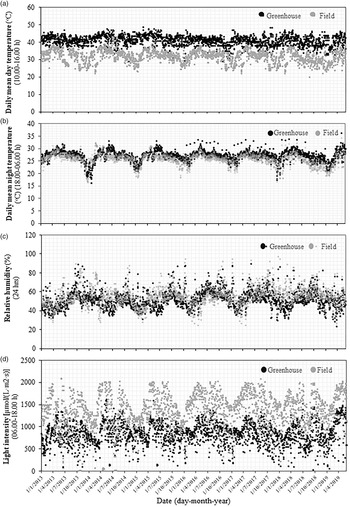
The weather data, which included the air temperature, RH and light intensity, were recorded both in the greenhouse and field conditions during the breeding programme for 6 years from 2013 to 2019; the results are shown in Fig. 2. The average day temperature in the greenhouse and field conditions from 10.00 to 16.00 h across all 6 years was 41.1°C and 31.9°C, respectively (a 9.2°C difference) (Fig. 2a), while the average night temperature in the greenhouse and field conditions was 27.2°C and 25.8°C, respectively, (a 1.4°C difference) (Fig. 2b). The RH levels in the greenhouse and field conditions (24 h) were 52.1% RH and 55.3% RH, respectively (a 3.2% RH difference) (Fig. 2c). In addition, the light intensity from 06.00 to 18.00 h in the greenhouse was lower than that in the field conditions in the daytime (843.36 μmoles/m2/s in the greenhouse and 1366.05 μmoles/m2/s in the field conditions) (Fig. 2d).
Weather data of the field conditions and controlled greenhouse from 2013 to 2019, including the (a) daily mean day temperature (10.00–16.00 h), (b) daily mean night temperature (18.00–6.00 h), (c) mean relative humidity (24 h) and (d) mean light intensity (6.00–18.00 h).

Breeding programme for heat tolerance
Early generations
After M9962 (heat-tolerant) was crossed with PSL2 (DS2013) and then backcrossed to PSL2 to produce BC1F1 (DS2014), BC2F1 (DS2015) and BC3F1 (WS2016), the variability of spikelet fertility percentage in each population under heat stress was assessed, the results of which are shown in Fig. 3. The percentage of spikelet fertility was divided into five groups from very susceptible to highly tolerant (IRRI, 2013). The spikelet fertility distribution of the BC1F1, BC2F1 and BC3F1 populations displayed a skewed-right pattern. Most rice plants in every generation were organized into a heat-sensitive group (<40% fertility), while ten, seven and two plants from the BC1F1, BC2F1 and BC3F1 generations, respectively, showed spikelet fertility of more than 80%, which were considered part of the highly tolerant group. Moreover, the mean spikelet fertility of M9962 and PSL2, which were used as controls, under high temperature in the three generations was 73% (tolerant) and 32% (susceptible), respectively. In the last of the early generation, seven lines from BC2F3 and seven lines from BC3F2 (DS2016) that showed spikelet fertility of more than 60% (Fig. 4) were continued through the next generation.
Population segregation in terms of spikelet fertility in the BC1F1, BC2F1 and BC3F1 populations under heat stress in a controlled greenhouse.

Seven selected lines from BC3F1 and seven selected lines from BC2F2 showed a spikelet fertility percentage of more than 60% under heat stress in a controlled greenhouse.

Advancement of generations
The four lines of the BC2F5 and the 15 lines of BC3F4 were evaluated in a preliminary yield trial both in field conditions and in a controlled greenhouse in DS2017 (February–May) at the RSC. When considering both conditions (in the field and greenhouse conditions), The four candidate lines had spikelet fertility percentages that were greater than 60%: BC2F5-8-6-3-2-1-1, BC2F5-6-5-4-1-21, BC3F4-1-3-25-2-2 and BC3F4-1-1-3-25-3-2 (Fig. 5a, c). Moreover, the percentages of spikelet fertility of M9962 and PSL2 in the field conditions were 70.2% and 36.7%, respectively, while in the controlled greenhouse, the percentages were 73.2% and 29.4%, respectively (Fig. 5a, c).
Spikelet fertility and grain yield of selected lines from BC2F5 and BC3F4 compared with their parents in field conditions (a, b) and controlled greenhouse conditions (c, d).

The grain yield of the four candidate lines under the field conditions was higher than that of PSL2 and BC3F4-1-1-3-25-2-2 (488 g/m2) had the highest grain yield under the field conditions; however, that of PSL2 was 232 g/m2 and that of M9962 was 253 g/m2 (Fig. 5b). In the greenhouse, the four candidate lines also had grain yields that were higher than those of PSL2; BC2F5-8-6-3-2-1-1 (73.77 g/plant) had the highest grain yield, while the grain yield of PSL2 was 11.7 g/plant and that of M9962 was 25.5 g/plant (Fig. 5d). Therefore, these four candidate lines were evaluated for their spikelet fertility, grain yield and stability at four locations (three fields and one greenhouse) as part of yield trials in DS2018.
In the BC2F6 and BC3F5 generations, the four candidate lines were grown in the WS2018 (from June to September) to increase seeds (data not shown) for the yield trial experiment in DS2018. The spikelet fertility among the four candidate lines and parent lines was not significantly different (62.4–70.2% fertility) because the air temperature during this period was not high. However, the grain yield of BC2F6-8-6-3-2-1-1 (468.75 g/m2) was the highest compared with that of the other three candidate lines (302.45–310.88 g/m2), while PSL2 and M9962 had grain yields of 231.59 and 253.04 g/m2, respectively.
Genetic background of candidate heat-tolerant lines
On the basis of the results obtained for the GBS analysis, a phylogenetic tree showing the relationships among ten breeding lines (four lines from the BC2F5 population and six lines from the BC3F4 population) along with PSL2 and M9962 was constructed (Fig. 6). The phylogenetic tree in this experiment was divided into two groups. Group I contained all ten breeding lines, and PSL2 (recurrent parent) and M9962 (donor parent) were clearly separated from the other group. The genetic background of the breeding lines from the backcross breeding programme was confirmed to have drifted from PSL2. Group I was subdivided into two subgroups, which indicated that the genetic background of BC2F5-8-6-3-2-1-1 and BC2F5-6-5-4-1-1-21 (BC2F5 heat-tolerant candidate lines) had closer relationships with PSL2 than did BC3F4-1-1-3-25-2-2 and BC3F4-1-3-25-3-2 (BC3F4 heat-tolerant candidate lines). In addition, BC2F5-2-6-10-5-1-1 had the closest genetic background with that of PSL2. However, this line showed spikelet fertility of 66.45% under field conditions but less than 60% (58.4% fertility) under greenhouse conditions (Fig. 5a, b). Moreover, the grain yield of this line was lower than that of the other four candidate lines (310 kg/m2 in the field and 23.64 g/plant in the greenhouse) (Fig. 5c, d). Thus, this line was not selected for the next generation. However, it was surprising that the genetic background of BC2F5 was closer to that of PSL2 than the background of BC3F4.
Phylogenetic tree of ten candidate heat-tolerant lines in the BC2F5 and BC3F4 generations compared with their parents based on the genotype-by-sequencing approach. The numbers at the node indicate the percentage obtained with 1000 bootstraps.

Yield trials in the field and greenhouse
The yield trial experiment was conducted in DS2019 (February–May). The four candidate lines (two lines from the BC2F7 population and two lines from the BC3F6 population) along with PSL2 and M9962 were grown in field conditions at three locations and in a controlled greenhouse. The weather data in the field conditions at the three locations and in the controlled GH are shown in Table 1. The mean daytime (6.00–18.00 h) temperature of the 4 months was highest in the greenhouse (39.4°C), while the temperatures at the RSC, PTRC and TRSI (field conditions) were 34.1, 36.3 and 35.7°C, respectively; however, the mean daytime temperatures in the field in April during the flowering period (which is sensitive to heat stress) were 36.8, 37.0 and 37.8°C, respectively, while the mean temperature in the greenhouse was 40.4°C (Table 1).
The spikelet fertility of the four candidate lines at the three locations was higher than 60% (as it was in M9962), while PSL2 had the lowest fertility at all three locations. Moreover, the spikelet fertility at the RSC and TRSI for every genotype was higher than that at the PTRC (Fig. 7). In addition, the pattern of spikelet fertility in the greenhouse was the same as that in the field conditions. BC2F7-8-6-3-2-1-1 showed good performance at all four locations and had spikelet fertility of 82.8%, 75.4%, 75.7% and 78.9% at the RSC, PTTRRC and TRSI and in the greenhouse, respectively (Fig. 7). Moreover, the other three candidate lines presented a slight variation across the four locations.
Percentage of spikelet fertility of four candidate heat-tolerant lines compared with that of their parents at the Rice Science Centre, Thailand Rice Science Institute, Pathum Thani Rice Research Centre and in the greenhouse.

PSL2 had the lowest grain yield at the PTRC and TRSI but not at the RSC. In addition, the highest grain yield of the four candidate lines at both the PTRC and TRSI was recorded for BC2F7-8-6-3-2-1-1, which also had the highest spikelet fertility. On the other hand, BC2F7-6-5-4-1-1-21 had the highest grain yield at the RSC; however, the highest spikelet fertility at the RSC was recorded for BC2F7-8-6-3-2-1-1. Moreover, the grain yield of BC2F7-8-6-3-2-1-1 at the RSC was lower than that of PSL2.
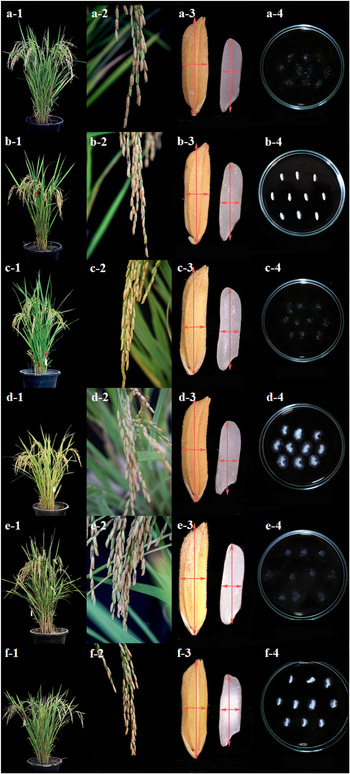
The agronomic traits, including days of flowering, plant height and 1000-grain weight, of the genotypes at the three locations and the greenhouse were closely related to those of PSL2 (Table 3). However, the number of days from planting to flowering in the greenhouse for all genotypes was higher than that of the genotypes in the field, but the plant height of all genotypes grown in the greenhouse was lower than that in the field. The plant type of BC2F7-6-5-4-1-1-21 was similar to that of PSL2 rather than that of the other three candidate lines (Fig. 8c-1, 8e-1), while the type of BC2F7-8-6-3-2-1-1 was similar to that of M9962 (Fig. 8d-1, 8f-1). In addition, the grain weight of M9962 was the lowest compared with that of PSL2 and the four candidate lines.
Colour online. Plant type, panicle type, grain shape and alkaline test of the candidate heat-tolerant lines (a1–4) BC3F6-1-1-3-25-2-2, (b1–4) BC3F6-1-1-3-25-3-2, (c1–4) BC2F7-6-5-4-1-1-21, (d1–4) BC2F7-8-6-3-2-1-1 and (e1–4) as well as PSL2 and (f1–4) M9962 grown in a controlled greenhouse at Rice Science Centre.

Agronomic traits and grain yield of four candidate heat-tolerant lines compared with those of their parents under field conditions in the dry season of 2019 at four locations

Grain size and grain quality
The F-values of grain size and grain quality were also different among the lines/varieties (Table 4). The paddy grain and milled grain of BC2F7-6-5-4-1-1-21 were similar to those of PSL2, especially the grain length (Fig. 8c-3, 8e-3); however, the paddy grain and milled grain of the other three candidate lines were similar to those of M9962, which were shorter than those of PSL2. The alkaline test to evaluate the GT revealed that BC3F6-1-1-3-25-2-2 and BC2F7-6-5-4-1-1-21 scored the same as did PSL2 (alkaline score = 7) (Table 4 and Fig. 8a-4, 8c-4, 8e-4), which is identified as a low GT, while BC3F6-1-3-25-3-2 and BC2F7-8-6-3-2-1-1 had high GTs similar to the temperature of M9962 (alkaline score = 2-3) (Table 4 and Fig. 8b-4, 8d-4, 8f-4). However, when considering the amylose content, it was found that BC3F6-1-1-3-25-3-2 (31.7% amylose) and BC2F7-6-5-4-1-1-21 (30.7% amylose) were not significantly different from PSL2 (31.7% amylose). In addition, BC3F6-1-1-3-25-2-2 had the lowest amylose content (20.2% amylose) (Table 4). Therefore, in terms of grain size and grain quality, BC2F7-6-5-4-1-1-21 was more similar to PSL2 than to other lines. Moreover, the milled grain of BC2F7-6-5-4-1-1-21 had a greater proportion of translucency than that of PSL2 under heat stress conditions (Fig. 8c-3 and 8e-3).
Grain size, alkaline test and amylose content of four candidate heat-tolerant lines compared with those of their parents in a controlled greenhouse

a Different letters in the same column indicate significant difference at the 0.05 level using LSD.
Stability of candidate heat-tolerant lines
The relationship between grain yield and PCA1 is shown in Fig. 9. The candidate lines that had grain yields higher than the overall mean were BC2F7-6-5-4-1-1-21 and BC2F7-8-6-3-2-1-1, although the three locations produced different grain yields. The highest mean grain yield was at the TRSI, followed by the PTRC and RSC. In addition, the PCA1 of BC3F6-1-1-3-25-3-2 was the lowest (−0.11) among the four candidate lines. This means that the stability of this line was greater than that of the other lines at all three locations. However, the grain yield of BC3F6-1-1-3-25-3-2 was low. Moreover, the relation among candidate lines and locations indicated that BC2F7-6-5-4-1-1-21 was suitable at the PTRC, while BC3F6-1-1-3-25-3-2 was suitable at the TRSI (Fig. 9).
Biplot graphs of the PC1 score v. the mean grain yield per plant (a) and spikelet fertility (c) and biplot graphs of the PC1 score v. the PC2 score for the grain yield (b) and spikelet fertility (d) of four candidate lines and their parents at different locations.

With respect to the spikelet fertility trait, the candidate lines whose spikelet fertility was higher than the overall mean included BC3F6-1-1-3-25-2-2, BC3F6-1-1-3-25-3-2 and BC2F7-8-6-3-2-1-1, while the three locations did not differ in terms of spikelet fertility. In addition, the PCA1 of BC2F7-8-6-3-2-1-1 was the lowest (0.15). This means that the stability of this line was greater than that of the other lines at all three locations. Moreover, the relation among candidate lines and locations indicated that BC2F7-8-6-3-2-1-1 was suitable at the PTRC and TRSI (Fig. 9).
Discussion
In this research, the breeding lines in every generation were maintained in a controlled greenhouse. Sarsu et al. (Reference Sarsu, Ghanim, Das, Bahuguna, Kusolwa, Ashraf, Singla-Pareek, Pareek, Forster and Ingelbrecht2018) mentioned that the effective treatment for heat stress in the greenhouse depends on species, ecotype and cultivar differences in spikelet fertility of rice in response to high-temperature stress. However, the most effective treatment when used N22 as heat-tolerant control is at 39°C for 4 days (6 h/day). In this research, the rice plants were treated with 40–45°C for 6 h during the daytime from R2 until R9 (30 days), which was 9.2°C higher than the outside temperature. Thus, this condition was the extreme level of heat stress. In addition, the high temperature, RH and light intensity in the greenhouse were uniform from 2013 to 2019. However, the light intensity in the greenhouse was lower under HC than under NC due to the plastic sheet on the greenhouse. The light intensity in the greenhouse was the same as that in the experiment by Jagadish et al. (Reference Jagadish, Craufurd and Wheler2007), who set the light intensity at 650 μmol/(lux/m2/s) in a growth chamber. Thus, the selected plants in each generation should be reliable as heat-tolerant lines. Moreover, the candidate heat-tolerant lines in the preliminary yield trials and yield trials both in the field and greenhouse conditions showed the same results in terms of spikelet fertility. Therefore, breeding for heat tolerance can be performed in a controlled greenhouse before yield trials are performed in the field.
At present, modern breeding approaches involving QTL mapping have not been used extensively for heat stress tolerance (Fahad et al., Reference Fahad, Bajwa, Nazir, Anjum, Farooq, Zohaib, Sadia, Nasim, Adkins, Saud, Ihsan M, Alharby, Wu, Wang and Huang2017). However, QTLs related to spikelet fertility traits involved in heat tolerance at the reproductive stage of rice have been identified (Jagadish et al., Reference Jagadish, Cairns, Lafitte, Wheeler, Price and Craufurd2010; Jiang-lin et al., Reference Jiang-lin, Hong-yu, Xue-lian, Ping-an and Ying-jin2011; Lang et al., Reference Lang, Ha, Tru, Toam, Buu and Cho2015; Shanmugavadivel et al., Reference Shanmugavadivel, Amitha Mithra, Chandra, Ramkumar, Ratan, Trilochan and Singh2017). QTLs for heat tolerance have been mapped to different chromosomes of rice by different research groups during the last decade (Chen et al., Reference Chen, Yu, Li and Mou2008; Zhang et al., Reference Zhang, Yang, Jiang, Huang, Sun, Chen and Zheng2008; Zhang et al., Reference Zhang, Chen, Xiao, Xiao, Chen and Zhang2009; Jagadish et al., Reference Jagadish, Cairns, Lafitte, Wheeler, Price and Craufurd2010; Xiao et al., Reference Xiao, Pan, Luo, Zhang, Deng, Dai, Liu, Tang, Chen and Wang2011; Poli et al., Reference Poli, Basava, Panigrahy, Vinukonda, Dokula and Voleti2013; Ye et al., Reference Ye, Tenerio, Argayoso, Laza, Koh, Redeno, Jagadish and Gregorio2015; Shanmugavadivel et al., Reference Shanmugavadivel, Amitha Mithra, Chandra, Ramkumar, Ratan, Trilochan and Singh2017). Therefore, no QTL markers are 100% accurate in terms of the stability of target QTLs in breeding programmes for heat tolerance. In this study, the donor parent used for the backcross programme was not Nagina 22 and the putative QTL markers that had already been reported by many research groups were not specific to M9962. QTL markers for M9962 were developed by QTL-seq from the F2 population of a cross between M9962 and Sinlek (heat sensitive), and three QTLs, qSF1, qSF2 and qSF3, were detected on chromosomes 1, 2 and 3 (Nubankoh et al., Reference Nubankoh, Wanchana, Saensuk, Ruanjaichon, Cheabu, Vanavichit, Toojinda, Malumpong and Arikit2019). However, these QTLs were detected when the breeding programme was nearly finished. Thus, the spikelet fertility used as a parameter to screen the germplasm for heat tolerance of rice at the reproductive stage in many previous studies (Prasad et al., Reference Prasad, Bootee, Sheehy and Thomas2006; Tenorio et al., Reference Tenorio, Ye, Redona, Sierra, Laza and Argayoso2013; Huang et al., Reference Huang L, Sun, Peng and Wang2016; Moung-ngam, Reference Moung-ngam2016; Prasanth et al., Reference Prasanth, Basava, Babu, Venkata Tripura, Rama Devi, Mangrauthia, Voleti and Sarla2016) has been used as a good selection index for heat tolerance at the flowering stage in this breeding programme.
Heat tolerance at the flowering stage in rice is attributed to multiple genes with cumulative effects on trait expression, otherwise called QTLs (Cao et al., Reference Cao, Zhao, Zhan, Li, He and Cheng2003; Xiao et al., Reference Xiao, Pan, Luo, Zhang, Deng, Dai, Liu, Tang, Chen and Wang2011). The breeding populations from BC1F1 until BC2F5 and BC3F4 exhibited variation in spikelet fertility. In addition, the four candidate lines from BC2F7 and BC3F6 in the yield trial experiment showed variation among locations, although the field data showed the same trend with the preliminary yield trial, yield trial and greenhouse results. Many factors in the field, such as air temperature, amount of rain, soil properties and biotic factors, also affected to spikelet fertility, which did not occur in the greenhouse.
Surprisingly, the genetic background of most BC2F5 lines, especially BC2F5-2-6-10-5-1-1, was closer to that of PSL2 rather than that of the BC3F6 lines. According to the theory of backcross breeding, 93.8% of the genetic background in BC3 is close to that of the recurrent parent, while 87.5% of that in BC2 is close to the recurrent parent (Allard, Reference Allard1960). In addition, in this breeding programme, backcrossing to the recurrent parent (PSL2) finished in BC2 and BC3 due to the recurrent parent recovery increases so does the backcross progenies resemblance to the original recurrent parent and then spikelet fertility may be decreased. Therefore, the two candidate lines from BC2Fx rather than BC3Fx showed good performance under heat stress.
In the yield trial experiment, the temperature in the field at the three locations during the flowering to harvest stages (April–May) was greater than 35°C (the critical point at the flowering stage) (Matsui et al., Reference Matsui, Namuco, Ziska and Horie1997; Jagadish et al., Reference Jagadish, Craufurd and Wheler2007; Ye et al., Reference Ye, Tenerio, Argayoso, Laza, Koh, Redeno, Jagadish and Gregorio2015), while the temperature in the greenhouse was at a severe level of heat stress (40.1°C). The average yield of PSL2 under normal conditions is 5043 kg/ha (Department of agricultural extension, 2016), while in this experiment, PSL2 presented an average spikelet fertility and grain yield in the field of 61.6% and 3641 kg/ha, respectively. Moreover, the spikelet fertility and grain yield of the four candidate lines were higher than those of PSL2. Thus, these candidate lines can be confirmed as PSL2-HT line. In addition, M9962 had the highest spikelet fertility at every location, but its weight was the lowest because the size of the grains of M9962 was smaller than that of the other lines. In addition, M9962 matured early; as such, this genotype could be considered an escape genotype under heat stress. Thus, selection for early flowering and maturity also has other selection indexes available that aid in the identification of rice genotypes that can escape heat stress.
The agronomic traits, spikelet fertility and grain yield in each breeding line were varied among locations. In theory, the level of homozygosity in BC3F6 and BC2F7 is high and the plant type is very uniformity (Acquaah, Reference Acquaah2012). Mondal et al. (Reference Mondal, Singh, Mason, Huerta-Espino, Autrique and Joshi2016) reported that the heritability for grain yield in the breeding of heat-tolerant in wheat ranged from 0.52 to 0.67 across locations in 5 years. The four candidate lines and their parents at the PTRC had low grain yield compared with those at the RSC and TRSI. Thus, in this experiment, the variation of grain yield and agronomic traits in yield trails experiment may get affected by environmental factors including, soil pH, soil type, amount of rainfall and RH. However, the four candidate lines among the three locations and the greenhouse showed the same trend of which the spikelet fertility and grain yield were higher than those of PSL2. In addition, the plant type, grain shape and grain quality of the four candidate lines, especially BC2F7-6-5-4-1-1-21, were most similar to those of PSL2. Therefore, based on phenotypic acceptability and the data of the agronomic traits, spikelet fertility, yield potential, yield stability and grain quality, the four candidate lines were ultimately approved as being promising for PSL2-HT lines.
Conclusion
These important findings indicate that heat-tolerant genotypes may be selected by conventional methods in greenhouse conditions prior to field trials. The backcross breeding programme using spikelet fertility as a selection index for heat tolerance at the reproductive stage seems like a good approach to develop promising heat-tolerant lines. The developed QTL markers for M9962 will be used to confirm the heat tolerance traits at the next step. Finally, the four promising lines, BC2F7-8-6-3-2-1-1, BC2F7-6-5-4-1-1-21, BC3F6-1-1-3-25-2-2 and BC3F6-1-1-3-25-3-2, should be evaluated more in regional adaptability tests in the central part of Thailand under heat stress conditions in research stations and farmer's fields in the dry season. The best line will be released as a rice variety for reducing damage caused by high temperature during the reproductive stage in irrigated areas in the dry season.
Supplementary material
The supplementary material for this article can be found at https://doi.org/10.1017/S0021859620000957
Financial support
The authors would like to acknowledge the Agricultural Research Development Agency (Public Organization), Thailand for financing the study and the provision of this research (Grant No. PRP5905021150).
Conflicts of interest
None.
Ethical standards
Not applicable.