INTRODUCTION
Of the estimated 400,000 new strokes per year, it is expected that 80,000 will result in aphasia (Post-stroke rehabilitation Guideline Panel, 1996). Additionally, aphasia recovery decreases considerably after six months and is reported as relatively completed by one year. It is estimated that approximately 50% to 60% of individuals with aphasia survive with a persistent, chronic communicative impairment (Kertesz, 1984; Kertesz & McCabe, 1977). Further, the loss of efficient and effective verbal communication associated with aphasia is socially isolating and poses tremendous levels of handicap for the victim as well as a burden for caregivers.
Research has suggested greater improvement in patients who undergo aphasia treatment, as compared to those who do not (Basso et al., 1979; Broida, 1977; Elman & Bernstein-Ellis, 1999; Holland et al., 1996; Odell et al., 1997; Poeck et al., 1989; Wertz et al., 1986). Whereas meta-analyses have confirmed the positive effects of aphasia treatment (Robey, 1994; 1999), others have found the evidence unconvincing or disappointing (Ferro et al.,1999; Greener et al., 1998; Siegel, 1987). A recent review concluded that there were still “major gaps in knowledge concerning the effectiveness of specific interventions to remedy communication disorders” (Aichner et al., 2002).
Evidence of neural plasticity in the adult brain found in the animal and human literature supports the notion of post-stroke recovery potential. Lesion and functional neuroimaging studies support the presence of more than one mechanism for re-organization of language-specific cortex (Karbe et al., 1998; Warburton et al., 1999; Weiller et al., 1995). Furthermore, recent studies have provided evidence that training may exploit this neural plasticity and induce functional brain re-organization even in chronic stroke (Aichner et al., 2002; Meinzer et al., 2004; Musso et al., 1999), motivating continued efforts to improve the repertoire of therapy techniques.
A set of interventions referred to as “constraint induced therapy” (CIT) has been described that applies principles of use-dependent learning. Constraint Induced Movement Therapy (CIMT) is based on the notion that the potential rehabilitation of the affected limb is detrimentally influenced by the compensatory use of the unaffected limb, through a process of learned non-use (Dromerick et al., 2000; Kopp et al., 1999; Taub, 2000). The deleterious effects of disuse after injury have been observed in animal studies (Nudo et al., 1996; Taub, 2004), which provide the basis for the application of the theory of learned non-use in rehabilitation from stroke.
Investigations of CIMT in chronic stroke have suggested substantial increases in the amount and quality of movement which translated to real-world improvements in use of the affected limb (Kunkel et al., 1999; Miltner et al.,1999; Taub, 2000, 2004; Taub et al., 1999). In addition to chronic stroke rehabilitation, CIMT has been effective in subacute (Blanton & Wolf, 1999) and acute rehabilitation (Dromerick et al., 2000). Studies of patients with chronic hemiparesis who benefited from CIMT have demonstrated neuroimaging evidence of re-organization of motor cortex, suggesting that even in chronic patients, use-dependent learning may result in recruitment of additional neocortex that may be exploited in rehabilitation (Liepert et al., 2000; Taub et al., 1999). Furthermore, gains observed post CIMT not only persisted after therapy ceased, but in many cases continued with increased performance at 3-month follow-up (Blanton & Wolf, 1999; Kopp et al., 1999).
The key principles of CIMT include (1) massed practice occurring in an enriched environment, (2) constraint of the unaffected limb during all waking hours using a sling, and (3) forced use of the affected limb (Kunkel et al., 1999; Taub et al., 1999). Whereas further investigations have yielded conflicting results with respect to the amount of restraint and massed practice needed (Page et al., 2004, 2001; Sterr et al., 2002), these principles form the basis of use-dependent learning in stroke rehabilitation and seem to have merit.
Recently, Pulvermüller et al. (2001) incorporated these core features of use-dependent learning in the context of language. They studied 17 inpatients with chronic aphasia who had received prior language therapy and were believed to have exhausted their recovery potential. Ten subjects participated in small group therapeutic activity intensively for three hours per day over a two-week period. The comparison group received “conventional” speech/language therapy consisting of a “syndrome specific” approach over a distributed period of time for the same total number of hours in therapy.
The results of this preliminary study showed significant improvement for the experimental group in the amount and quality of communication, as measured by a communicative activity log (CAL), a questionnaire developed to record language use outside of treatment by the patient and by clinicians and on a standard aphasia battery. The comparison group did not demonstrate improvement. These results were confirmed in a further study using the standard CILT and a modification of the intervention that included writing assignments for homework and training of communication partners outside of the therapy (Meinzer et al., 2005).
Whereas the importance of these findings is noteworthy, the specific underlying mechanisms that are associated with the observed treatment gains remain unclear. In the earlier study, the two groups differed in the intensity of the treatment provided as well as in the nature of the treatment, and in the later study both groups received the CILT intervention. Differences in intensity of the intervention may be significant in light of recent reports that intensity may be an important factor in outcomes of speech therapy (Bhogal et al., 2003; Mackenzie, 1991; Poeck et al., 1989; Robey, 1998). Despite the total amounts of therapy being equal, it is possible that the difference in outcomes for the two groups was the result of differences in the intensity of the interventions. Furthermore, the behavioral relevance of the intervention also differed, due to differences in the task demands between the two groups. Reports of CIMT stress the importance of real-world application to the activity. It is possible that the therapeutic game context is a more potent method of treatment delivery, accounting for the differences in results for the two groups.
Purpose
Based on this pioneering work we sought to explore the merits of this approach and determine if there is an advantage to delivering this type of intervention over the more typical approach to therapy in this population. In addition, we aimed to determine if forced use of the spoken modality was a critical component for the success of this intervention, by keeping treatment intensity and the nature of the therapeutic activities constant for the experimental and comparison groups, altering solely the response modality required between the two groups.
METHODS
Design
This is a prospective, repeated measures pilot study to detect treatment outcomes within and between groups. To assess behavioral change, the aphasia measures were administered pre- and post-therapy and at one month after therapy was finished.
Measures
We used the following measures to determine the presence and severity of aphasia pre-therapy, and to measure change in performance immediately upon completion of therapy and again one month after therapy was concluded: The Aphasia Quotient (AQ) from the Western Aphasia Battery (WAB) (Kertesz, 1982), the Boston Naming Test (BNT) (Kaplan et al., 2000) raw score, Action Naming Test (ANT) (Nicholas et al., 1985) raw score, Apraxia Battery for Adults-2, (ABA-2) (subtest 2A repeated words) (Dabul, 2000), and a narrative discourse sample (Cinderella retelling). The WAB has been shown to be a reliable measure upon repeated administrations, and a change of five points or more has been demonstrated to be clinically significant (Shewan & Donner, 1988). A change score of two SD or more from the mean was used to indicate clinically significant change on the BNT and the ANT, which amounts to a difference in eight or six points respectively. Subtest 2A from the ABA (repeated words) was used as the measure of apraxia of speech severity because it has been shown to have good discrimination and reliability (Dabul, 2000).
Unlike the Pulvermüller study (Pulvermüller et al., 2001), we elected not to use a CAL. This study was conducted on an outpatient basis and the environments to which each participant returned every day were so highly variable that the quality of the data provided would have been very subjective and difficult to equate. We used retelling of the Cinderella story as a measure of narrative discourse, using the guidelines provided in the Quantitative Production Analysis (QPA) (Berndt et al., 2000) to extract the samples and determine the number of narrative words, utterances, sentences, and mean utterance length. Following the coding conventions in the QPA, utterances were listed as sentences if they contained a predicate-argument structure, regardless of morphologic agreement and content. In other words, if they contained the syntactic elements for a sentence, they were coded as sentences, even if they were not well formed or they contained lexical or phonemic paraphasias. In addition, the narrative samples were evaluated by eight experienced speech-language pathologists who were blinded as to the participant and time period of each sample. The raters were asked to choose the better sample among matched pairs of written transcriptions (either pre-post or pre-follow-up), or to determine if both samples were qualitatively equal. The percentage of raters who scored the sample as superior was then tabulated to yield a subjective assessment of the narrative samples. Analysis of narrative discourse by clinician judgment has been shown to be a reliable method for evaluating change in spontaneous language of aphasia participants (Shewan & Donner, 1988).
Subjects
Participants were recruited through professional referrals and study brochures at the Michael E. DeBakey VA Medical Center, Houston, TX and the Malcom Randall VA Medical Center in Gainesville, FL. The study was approved and monitored by the Institutional Review Board of Baylor College of Medicine and the University of Florida Health Science Center and the respective VA research subcommittees. The research was completed in accordance with the guidelines of the Helsinki Declaration and all participants provided written informed consent prior to participation.
The participants were selected based on their interest and motivation, their having met the inclusion criteria, and their willingness to comply with the time demands of the study. Inclusion criteria were a single, left hemisphere CVA at least one year prior (confirmed by CT or MRI), right hand dominance, and English speaking with a negative history of other neurologic impairments or learning disability. All participants had previously received speech-language intervention and had been discharged from therapy prior to participating in the study.
Given the sample size, group assignment to the Constraint Induced Language Therapy (CILT) group or the comparison group (described below) could not be randomized without the risk of having different aphasia syndromes and severities in the two groups. Therefore, group assignment was determined by the first author, and was alternated such that participants for the comparison group were selected to balance with the participants in the CILT group, based on aphasia severity and degree of apraxia of speech. There were five participants in the CILT group and six participants in the comparison group. Two participants, one from each group, withdrew prior to completing the study: one was scheduled for elective surgery, and the other withdrew because of transportation difficulties. Individual demographic data for the nine participants who completed the study and group means for these variables are presented in Table 1. There were no significant group differences for age (t =1.4, p = .2), education (t = .88, p = .4), apraxia of speech (t = .22, p = .81), WAB AQ (t = .52, p = .61), BNT (t = .22, p = .82) or ANT (t = .23, p = .82) prior to treatment.
Participant characteristics for the Constraint Induced Language Therapy (CILT) and the Comparison Therapy (PACE) groups

All participants presented with a persistent moderate aphasia as indicated by the WAB. In addition, all presented with significant word retrieval deficits as indicated by the BNT and the ANT. Whereas there were no statistical group differences for apraxia of speech severity, only one of the participants in the CILT group demonstrated severe apraxia of speech on the ABA-2. Three of the participants in the comparison group demonstrated apraxia of speech in the severe range. The presence of severe apraxia of speech may have a negative impact on verbal output and response to treatment. This issue will be addressed later in the discussion. All participants were screened for depression using the Geriatric Depression Scale (Yesavage et al., 1982; Yesavage, 1988), and all fell within the normal (n = 8) or mild (n = 1) range.
Intervention
There were two types of therapy administered; (1) the experimental therapy, Constraint Induced Language Therapy, (CILT) or (2) the comparison therapy, “Promoting Aphasic Communicative Effectiveness (PACE)” therapy (Davis & Wilcox, 1985). Therapy for both groups consisted of three-hour sessions, four days a week, for two weeks. Therapy was conducted in dyads or triads of participants, with two speech-language therapists typically participating in each therapy group. The main difference between the experimental (CILT) and the comparison (PACE) therapy was the availability of alternative methods to support communication. The therapy tasks remained consistent for both conditions.
Constraint was operationally defined as limiting the response to spoken verbal production only. Participants in the CILT group were restricted to spoken output and were not permitted to use any alternative communication mode (e.g., writing, gesturing, pointing, etc.). All other modes of communication were inhibited, including self cuing. No written, gestured or any other non-verbal self-cuing strategies were allowed, and the participants were instructed to only use spoken output in all communication attempts during therapy and at home. If participants resorted to any of these strategies during the therapy session, they were reminded to use only speech and to “sit on their hands” if necessary. However, compliance with this constraint was not monitored outside of the therapy sessions. The forced use of spoken communication was accomplished by placing a visual barrier on the table between the participants so they could not see each other except for eye contact. This barrier forced the participants to use the spoken modality to accomplish the interaction.
For the comparison group intervention was modeled after a modified PACE treatment approach (Carlomagno, 1994; Chin Li et al., 1988; Davis & Wilcox, 1985; Glindemann & Springer, 1995). The PACE participants were permitted to communicate in any and all modalities (e.g., gesturing, pointing, writing, etc) throughout the therapy session. This version of PACE differed from the conventional version of PACE in that the treatment stimuli were semantically organized and the subjects were required to express each element of the utterance rather than the communication of a general idea. Response modes were flexible and participants were encouraged to use any and all methods available to complete the task. All modes of responding were reinforced and errors were cued using the response modality selected by the participant. For example, if the participant chose to gesture a response but was not successful, intervention was aimed at producing a better-gestured response. Verbal responses were neither discouraged nor encouraged, and they were never offered as an alternative response mode.
An additional component of the CILT intervention modeled after CIMT included a reinforcement strategy called shaping (Taub et al., 1994; Taub, 2004). This concept is grounded in operant training and refers to the gradual, successive approximation of behavior in small steps toward the desired goal. In this study, we gradually increased the response required from single words to sentences as our shaping mechanism. The therapist provided as much cuing as necessary (individualized for each participant) for a successful response. Furthermore, the CILT participants were encouraged to reduce error as much as possible by only producing a response when they were confident it would be correct, and to use the therapist for help in producing a correct response. This error-reduction component of the shaping process was variable in its success. Typically the participants preferred to attempt the response independently rather than ask for assistance. In all cases, the participants ended each trial with a successful response, using whatever means necessary (e.g., phonemic or semantic cuing, repetition etc.). The amount of support provided was gradually reduced, based on the participants' needs.
The therapy tasks used in this study were the same in both conditions. The majority of therapy time was spent on a dual-card task. In that task, each participant had four or five cards with pictures of different exemplars of a semantic category (e.g., fruit). The goal of the task was to collect as many pairs of matching cards as possible. For each “turn” one participant (the speaker) asked the other participant (the receiver) if he/she had a particular card, and the receiver answered with an explicit reply. The request and response had to be successfully completed for the turn to be over. If the receiver had the card, it was given to the speaker and the speaker took another turn. If the receiver did not have the card, the speaker selected another card from the deck and it was the receiver's turn to request a card. The sequence continued until all cards from the deck were matched.
There were several levels of task difficulty (see appendix A), based on the nature of the required response. Initially, a participant might be required to only produce the noun correctly (e.g., “book?”), or to produce the listener's name plus the noun in a rising inflection (e.g., “Bill, book?”). The required response was gradually increased to the highest level of difficulty, which involved addressing the listener by name and requesting an item by specifying the number of items and an adjective (e.g., “Bill, do you have three red books?”). For the CILT participants, the request and the response were limited to only spoken words. For the PACE participants, any modality was allowed except for simply showing the other participant the card. Each piece of information had to be communicated somehow; by speaking, gesturing, drawing etc.
The therapists were free to move up and down the task hierarchy to keep the participants both successful and challenged. Once the participants were successful at producing the longest question and reply (i.e., Level 4), a new set of cards with low frequency exemplars of semantic categories was introduced and the hierarchy was repeated. There were five semantic categories for each verbal frequency level (Francis & Kucera, 1982).
In summary, in both conditions the amount of therapy, the therapy tasks, the levels of difficulty, and the communication burdens were the same. As participants progressed in therapy, the communication burden also increased because there was progressively more information they needed to communicate. Therapists provided as much cuing as necessary to yield a successful turn. The only difference between the two groups was the restriction of the experimental group to spoken modality only.
All testing and 20% of the treatment sessions were videotaped for reliability purposes. All standard aphasia tests were scored by at least two therapists for accuracy. A separate therapist who was not involved in the treatment viewed the taped sessions to ensure treatment fidelity.
RESULTS
All participants in both groups increased at least two levels of difficulty by the end of the second week, suggesting that both groups increased the accuracy and amount of information communicated during therapy. All participants reported enjoying the intervention and anecdotal reports indicated that participants in both groups felt the intervention was beneficial. There were two participants in the CILT group who appeared frustrated at not being able to write responses to assist their communication. They had to be reminded frequently not to use writing as a response mode. Interestingly, there were two participants in the PACE group who were resistant to using alternative modalities of communication, and indeed one participant (P5) refused to use any modality other than speech, making his experience more like the CILT training.
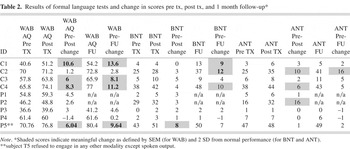
Pre-, post- and one-month follow-up testing data are provided in Table 2. Because of the concerns over using parametric statistics with such a small sample, both non-parametric and parametric statistics were completed to evaluate the results of the study. The results were the same for both types of analyses; therefore we are reporting the parametric statistics only. Using repeated measures ANOVA, both groups demonstrated significant change pre- to post-therapy on the WAB (f = 17.58, p = .004). However there was no effect of group and no significant group by time interaction, (f = 2.5, p = .15) suggesting the differences between the two groups were not significant. Both groups also demonstrated significant change on the BNT (f = 14.74, p = .006) and the ANT (f = 5.25, p = .056) but no group effects and no group by time interactions (BNT: f = .17, p = .81; ANT: f = .18, p = .68). Whereas the sample size is too small to draw firm conclusions on this group analysis, it does suggest that both therapies were active and resulted in positive outcomes. The follow-up period was not analyzed statistically because two of the PACE group members did not return for follow-up testing.
Results of formal language tests and change in scores pre tx, post tx, and 1 month follow-up*

Looking at the individual case data (see Table 2) three of the four participants in the CILT group showed change of 5 points or more on the WAB AQ, (shaded in gray) and this gain was further increased at the one-month follow-up. There was also evidence of change for three of the CILT participants on the BNT, but this was evident only at the one-month follow-up. Two of the CILT members improved on the ANT Post TX, one of whom maintained gains at one month.
In contrast, only one member of the PACE group evinced the same mount of change on the WAB and BNT, and this was the participant who selected the spoken modality almost exclusively in therapy. Another member of the PACE group demonstrated substantial change on the ANT post-treatment. There was no evidence of continued gains during the follow-up interval for any of the PACE participants for whom follow-up data were available.
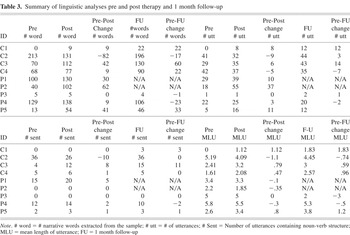
Results of the linguistic analyses for the narrative discourse are presented in Table 3. Twenty-five percent of the narrative samples were transcribed and coded by two therapists independently for reliability purposes, yielding an average inter-judge agreement of 91% (range of 83% to 98%). Intra-judge reliability on 20% of the samples for both therapists completing the linguistic analyses was over 90%. The linguistic analyses revealed an increase in the number of words, utterances and sentences produced following treatment for most of the participants in both groups, though a few of these increases were minimal. In some cases the amount of output decreased. However, results of the subjective assessment of narrative discourse by experienced speech-language pathologists, blinded to group membership or sample order, suggest that the post-treatment and follow-up narrative samples were qualitatively different for the two groups. These data are presented in Fig. 1. The portion of each bar that is darker indicates the percent of the raters that selected the post- or follow-up samples as superior to the pre-TX samples. Whereas each participant should be considered separately (as his/her own control), the overall picture for the CILT group is one of improved story re-telling following therapy. The majority of raters preferred post-therapy samples to pre-therapy samples for three of the four CILT participants, and preferred follow-up to pre-therapy samples for all four of the CILT participants, suggesting improved performance on story re-telling.
Summary of linguistic analyses pre and post therapy and 1 month follow-up


For each subject, blackened portions of the bar indicate the percent of raters that preferred the post therapy (first bar) or the one month follow-up (second bar) versions of the narrative sample; lightened area of the bar represent the percent of raters that preferred the pre-therapy version of the narrative sample.
In contrast, only two of the PACE group's post therapy samples were preferred by raters. Unfortunately the follow-up sample for one of these participants was not available, but the other maintained this improvement at one month. It must be noted that P5 had elected to only use speech as his mode of communication. For the samples that were available, his was the only one to show continued improvement during the follow-up interval. Because firm conclusions cannot be made on such a limited sample, and it is not clear upon what the blinded experts were basing their judgments, it seems that the overall pattern of improvement on narrative discourse might have been stronger for the CILT group. However, clearly some of the subjects in both groups demonstrated this improvement.
DISCUSSION
A purpose of this pilot study is to explore the application of CIT principles for the rehabilitation of chronic aphasia. Results support the notion that principles of use-dependent learning may be applied to the rehabilitation of aphasia. There was a consistent pattern of improvement in patients who underwent two weeks of intensive CILT on standard test measures and on some aspects of narrative discourse. Substantial improvement appears to have been achieved and maintained more in the CILT group. These findings are consistent with what had been previously reported (Pulvermüller et al., 2001) and further those findings by adding the follow-up time period. Our results do differ from the Pulvermüller study in that there were also some positive outcomes in our comparison PACE group. Whereas one participant (P5) almost exclusively chose speech as his method of communication, making his experience more like the CILT group than his PACE cohort, there was substantial improvement for a second PACE participant on the ANT following therapy, and in narrative discourse. This suggests that the modified PACE treatment also had some positive impact on speech output. This was not entirely unexpected, because previous reports have suggested that when PACE is modified along linguistic principles, increases in word retrieval may be observed (Chin Li et al., 1988; Glindemann & Springer, 1995). Minimally this highlights the fallacy of the conventional position that aphasia in the chronic phase of recovery is intractable.
One potentially confounding factor in our study was the higher incidence of severe apraxia of speech impairment in the comparison group. Indeed, the presence of severe apraxia of speech could have been a limiting factor not only during therapy but also in the use of speech outside of treatment. It should be noted that one of the subjects in the CILT group also demonstrated severe apraxia of speech and made significant improvement on the WAB and BNT post treatment. Thus the notion that the presence of severe apraxia of speech will necessarily limit the potential for improvement on language measures is not correct. Unfortunately, this issue cannot be resolved in the present study and will require a larger investigation with better controls of co-morbidities that may influence outcome.
It should be noted that our study differed from the Pulvermüller et al. (2001). The comparison intervention (PACE) differed from the conventional treatment used in the Pulvermüller study along 2 potentially important parameters: (1) the use of therapeutic games and (2) the intensity of the intervention. In the Pulvermüller study the comparison group participated in “conventional” language activities, but they did not use the same stimuli and emphasize the relevance of the tasks the way the CILT group did. In our study, we kept the relevance of the activity and the intensity of intervention constant across the two groups, and varied only the dimension of language constraint. Either or both of those factors may have played a role in the gains that were observed in the PACE group.
Based on these data it would be premature to conclude that there is a clear advantage to applying constraint principles to aphasia rehabilitation over other types of intensive intervention. However, the data suggest that there is some aspect of the CILT approach that confers additional benefit. Whereas intensity has been reported to be an important factor in the outcomes of aphasia rehabilitation (Bhogal et al., 2003; Hinckley & Craig, 1998; Mackenzie, 1991; Poeck et al., 1989; Robey, 1999), intensity alone cannot explain the positive differences between the two groups' performance, because intensity was controlled.
Another important finding was the continued impact CILT had after therapy was terminated. The three participants that made substantial change maintained those gains, and in some cases they continued to make gains on both objective language measures and the subjective assessments of their narrative discourse. This is consistent with findings reported elsewhere (Meinzer et al., 2005) and in the motor literature (Liepert et al., 1998; Taub, 2004). The mechanisms of this continued improvement are yet to be determined and are beyond the scope of the current work. However, the results of this investigation suggest that the impact of CILT may continue to be active beyond the direct treatment period, and this warrants further investigation.
The results of this pilot study support previous work that this approach may be applied to individuals with chronic aphasia safely. All of the participants completed the intervention without incident. The two withdrawals in the study (one in each group) were for reasons unrelated to the treatment. The treatment schedule and demands did not seem to be a deterrent, although there were a number of potential participants who cited the schedule as a reason for not participating. Concerns seemed to center around transportation issues and the length of the treatment sessions. The same issues have been raised for CIMT, resulting in intensity modifications to that protocol. Some have reported relatively little negative impact on the outcome (Dettmers et al., 2005; Levine & Page, 2004; Page et al., 2001), whereas others have found less time in therapy to be less effective (Sterr et al., 2002). It remains to be seen if CILT delivered under different conditions would still yield a positive result.
There are a number of limitations to this study that necessitate caution when attempting to generalize these findings on a broader scale. First, this was a sample of convenience, not a randomized clinical trial. Efforts to accommodate examiner bias, such as reliability measures, multiple scorers for the standard language measures, and blinded raters for the narrative discourse, strengthen the findings but do not replace the value of blinded scoring. The use of a pre/post assessment study design would be strengthened by using a multiple baseline design, and the addition of a periodic treatment probe would help to specify the treatment response. Finally, the impact of PACE on other communication modalities was not formally assessed. Even with these concerns, the results of this investigation are provocative and warrant further investigation.
ACKNOWLEDGMENTS
This work was supported by the Department of Veterans Affairs, Veterans Health Administration, Rehabilitation Research and Development C2670CA (Lynn M. Maher and Diane Kendall), C3091R (Lynn M. Maher), and Center Grant F2182C (Leslie J. Gonzalez Rothi). The authors acknowledge Thomas Elbert, Amber Hollingsworth, Cynthia Ochipa, Diana Rintala, Jay Rosenbek, Steve Sandifer and Arthur Sherwood for their support of and assistance with this project. The authors also thank the stroke survivors and their significant others who volunteered their time to participate in this study. Portions of this research were presented at the International Neuropsychological Society North American Meeting in 2003. The manuscript is new, is not currently under review by any other publication, and has never been published either electronically or in print. There are no financial or other relationships associated with this manuscript that would constitute a conflict of interest.
APPENDIX A
TREATMENT TASK SEQUENCE AND LEVELS OF DIFFICULTY
Treatment Type: Constrained
Subjects are restricted to spoken output only and not permitted to use any alternative or augmentative communication mode (e.g. writing, gesturing, pointing) in generating or communicating the target.
Modified PACE
Subjects are permitted to use any alternative or augmentative communication mode (e.g. writing, gesturing, pointing, drawing) to communicate the target.
A: high frequency words: material constraints:
Level 1: Materials: Semantic categories cards: each set of cards has two exact same pictures of each item in the category, all in black and white.
Shaping rule constraints: Single words: subjects communicate item on card
Request: Speaker communicates: “book?”
Response: receiver communicates: “ yes + book” or “No + book”.
Level 2: Materials: Same as Level 1.
Shaping rule constraints: carrier phrase + noun:
Request: Speaker communicates: “Bill, Do you have a book?”
Reply: Receiver communicates: “yes Patrick, have a book.” Or “No Patrick, I do not have a book.”
Level 3: Materials: Level 3 cards: each set has two pairs of matching cards: each item is a descriptor + noun: e.g. a red book, or an old shoe, requiring subjects to communicate both descriptor and object to label the card correctly
Shaping rule constraints: carrier phrase + adjective + noun
Request: Speaker communicates: “Bill, Do you have a red book?
Reply: Receiver communicates: “Yes Patrick, I have a red book” or “No Patrick, I do not have a red book.”
Level 4: Materials: Level 4 cards: each card varies in number of items, descriptors and nouns. For example: Tow + red + books, requiring subjects to produce all three words to label the card correctly.
Shaping rule constraint: carrier phrase + number + adjective + noun
Request: Speaker communicates: “Bill, Do you have three red books?
Reply: Receiver communicates, “Yes Patrick, I have a three red books” or “No Patrick, I do not have three red books.”