Introduction
L-carnitine is a biologically active compound of carnitine that plays a fundamental role in myocardial metabolism. Reference Bremer1–Reference Arsenian3 It exists in both free and esterified forms, with free carnitine serving as the metabolically available fraction that facilitates the transport of long-chain fatty acids into mitochondria by forming acylcarnitine complexes, which are transported across the inner mitochondrial membrane and then converted back to acyl-coenzyme A (acyl-CoA). Reference Bremer1,Reference Bieber4,Reference Steiber6 The regenerated acyl-CoA then enters β-oxidation, producing adenosine triphosphate (ATP) and supporting metabolic flexibility and sustained energy production. Reference Bieber4–Reference Steiber6
While endogenous synthesis of carnitine primarily occurs in the liver and kidneys, dietary intake contributes a substantial portion of the body’s carnitine supply. Reference Steiber6–Reference Reuter and Evans7 Carnitine homeostasis is tightly regulated by renal reabsorption, with the kidneys recovering over 95% of circulating carnitine to maintain plasma levels. Reference Reuter and Evans7–Reference Pekala8. The myocardium derives up to 90% of its energy from fatty acid oxidation Reference Stanley and Chandler5 ; However, the heart lacks the capacity to synthesise carnitine and relies entirely on circulating free carnitine to meet its metabolic demands. Reference Ferrari9–Reference Rebouche and Seim10 Maintaining adequate serum free carnitine levels is therefore critical, especially in conditions such as CHDs, Reference Flanagan2,Reference Pauly and Pepine11 where metabolic challenges arising from hypoxia, renal dysfunction, and systemic stress can disrupt carnitine homeostasis, potentially exacerbating myocardial energy deficits. Reference Pauly and Pepine11–Reference Iliceto12
Carnitine deficiency is well-documented to impair myocardial energy production, leading to reduced contractility and increased susceptibility to ischaemia and cardiac dysfunction. Reference Song13–Reference Weng14 Under ischaemic conditions, oxygen restriction forces the myocardium to shift its metabolic strategy, reducing oxidative phosphorylation efficiency. Reference Liedtke15,Reference Oliveira19 This alteration may result in the accumulation of long-chain acyl-CoA and acylcarnitine intermediates, which disrupt mitochondrial integrity, interfere with ion transport, and inhibit key enzymatic functions. Reference Corr16,Reference Corr17 Excess acylcarnitine accumulation further compromises mitochondrial membrane permeability, increasing the risk of arrhythmias and contractile failure. Reference Corr16–Reference Corr17
In paediatric patients with CHDs undergoing open-heart surgery, maintaining myocardial energy balance is particularly challenging due to the metabolic stress imposed by cardiopulmonary bypass. Reference Lango18–Reference Oliveira19 Cardiopulmonary bypass, a standard technique in paediatric cardiac surgeries, triggers systemic inflammation, hemodynamic fluctuations, and ischaemia-reperfusion injury. Reference Milei20–Reference Prabhu21 These disturbances impair mitochondrial function and shift metabolism toward anaerobic glycolysis, leading to lactate accumulation and oxidative stress. Reference Liedtke15,Reference Oliveira19 Such metabolic disruptions may contribute to alterations in serum carnitine levels, potentially prolonging myocardial dysfunction and increasing the risk of postoperative complications and morbidity. Reference Schmidt-Sommerfeld22,Reference Corr17
Despite the well-established role of L-carnitine in cardiac metabolism and the significant metabolic shifts occurring during the perioperative period, research on serum carnitine alterations in children with CHDs undergoing open-heart surgery remains limited. Understanding perioperative trends in serum carnitine profiles may provide crucial insights into the potential benefits of carnitine supplementation in improving postoperative myocardial recovery.
We hypothesise that open-heart surgery with cardiopulmonary bypass induces a transient disruption in serum carnitine homeostasis that correlate with cardiopulmonary bypass duration in children with CHDs.
Study population, design, and serum carnitine measurement
This prospective observational study was conducted at a single academic centre from April 2018 to June 2019. Patients were consecutively enrolled based on specific inclusion and exclusion criteria to minimise confounding factors that could affect serum carnitine profiles. The inclusion criteria included patients younger than 36 months of age, diagnosed with CHDs, and scheduled for elective palliative or corrective open-heart surgery requiring cardiopulmonary bypass. Patients were excluded from the study if they had any known condition affecting serum carnitine profile levels such as carnitine deficiency, carnitine supplementation, pre-existing metabolic disorders affecting carnitine metabolism, severe hepatic or renal impairment, severe heart failure, or those requiring perioperative extracorporeal membrane oxygenation. Before enrolment, written informed consent was obtained from the parents or legal guardians of all participating children, following the guidelines set by the West Virginia University Office of Research Integrity and Compliance. The study was approved by the institutional ethics committee and conducted in adherence to ethical research standards.
We measured free carnitine, acylcarnitine, and the acylcarnitine-to-free carnitine ratio. Blood samples were collected at six time points: baseline (preoperatively), immediately post-surgery, and at 6, 12, 18, and 24 hours postoperatively. Serum samples were analysed using tandem mass spectrometry to quantify total and free carnitine levels. The acylcarnitine-to-free carnitine ratio was calculated to assess carnitine esterification. Based on paediatric reference values, free carnitine levels>20 nmol/mL and an acylcarnitine-to-free carnitine ratio ≤0.4 were considered normal. Reference Schmidt-Sommerfeld, Werner and Penn26
Additionally, demographic and surgical variables including patient age, sex, type of CHD, cardiopulmonary bypass time, and aortic cross-clamp time were recorded to explore correlations with serum carnitine levels.
Statistical analysis
Statistical analyses were performed to evaluate perioperative changes in serum carnitine profiles and their association with cardiopulmonary bypass duration. Data are presented as absolute values and as mean ± standard error of the mean. A one-way repeated-measures analysis of variance was used to assess changes in serum carnitine profiles, including free carnitine, acylcarnitine, and the acylcarnitine-to-free carnitine ratio, across multiple time points. When significant differences were identified by analysis of variance, post-hoc pairwise comparisons were conducted using Tukey’s Honest Significant Difference test to explore differences between specific time points.
To examine the relationship between serum carnitine profiles and cardiopulmonary bypass duration, Pearson’s correlation coefficient was calculated. This analysis aimed to identify significant associations between bypass duration and postoperative changes in free carnitine levels and the acylcarnitine-to-free carnitine ratio. A p-value of <0.05 was considered statistically significant for all analyses. All statistical tests were conducted using R Markdown 2.6 on a MacBook running macOS Ventura 13.6.9.
Results
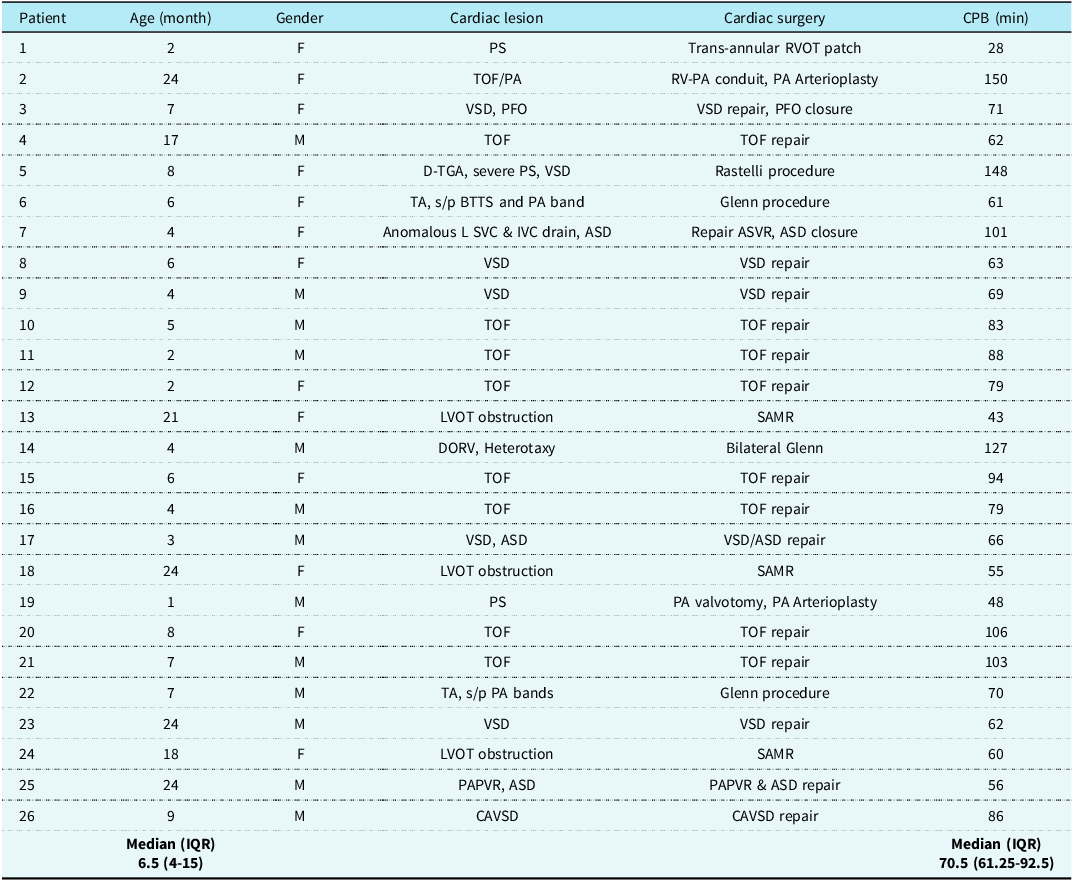
A total of 26 paediatric patients were enrolled, with ages ranging from 1 to 24 months and a median age of 6.5 months. The female-to-male ratio was 1.1, indicating a near-equal gender distribution. Table 1 summarises some patients’ demographics and surgical characteristics of the cohort. Tetralogy of Fallot was the most frequently observed CHD, accounting for 34.62% of cases (n = 9), with the remaining patients presenting various other forms of CHDs. Among the study participants, only three patients underwent single ventricle operations (11.54%) compared with twenty-three patients who underwent biventricular procedures (88.46%). Preoperative assessment revealed that one patient (3.8%) had a serum free carnitine level below the normal reference value of 20 nmol/mL. Additionally, eight patients (30.8%) exhibited an elevated preoperative acylcarnitine-to-free carnitine ratio above 0.4, indicating potential baseline metabolic variations.
Patient demographics and surgical characteristics

ACC = Aortic cross clamp; ASD = Atrial septal defect; BTTS = Blalock-Thomas-Taussing shunt; CAVC = Complete atrioventricular septal defect; CBP = Cardiopulmonary bypass; DORV = Double outlet right ventricle; D-TGA = Dextro-transposition of great arteries; IVC = Inferior vena cava; LSVC = Left superior vena cava; LVOT = Left ventricular outlet; PA = Pulmonary artery= PAPVR = Partial anomalies pulmonary venous return; PFO = Patent foramen ovale; PS = Pulmonary stenosis; RVOT = Right ventricular outlet; RV-PA = Right ventricle-pulmonary artery; SAMR = Sub-aortic membrane resection; TA = Tricuspid atresia; TOF = Tetralogy of Fallot; TOF/PA = Tetralogy of Fallot/ pulmonary atresia; VSD = ventricular septal defect.
A significant reduction in serum free carnitine levels was observed at multiple postoperative time points compared to baseline (34.81 ± 1.76 nmol/mL). Immediately following surgery, serum free carnitine levels dropped sharply to 16.27 ± 1.76 nmol/mL (p < 0.0001) and remained significantly reduced at 6 hours postoperatively (17.65 ± 1.10 nmol/mL, p < 0.0001). By 12 hours, a modest increase to 20.23 ± 1.67 nmol/mL was noted, though levels remained significantly lower than baseline (p < 0.0001). At 18 hours, levels partially recovered to 26.48 ± 2.61 nmol/mL but were still significantly below preoperative values (p = 0.007). At 24 hours post-surgery, 14 patients (53.8%) continued to show free carnitine levels below baseline, indicating prolonged depletion following surgery. The overall distribution of serum free carnitine levels over the perioperative period and the trajectories of individual patients are illustrated in Figure 1.
Boxplot (top) and individual (bottom) trajectories of serum free carnitine levels across perioperative time points.

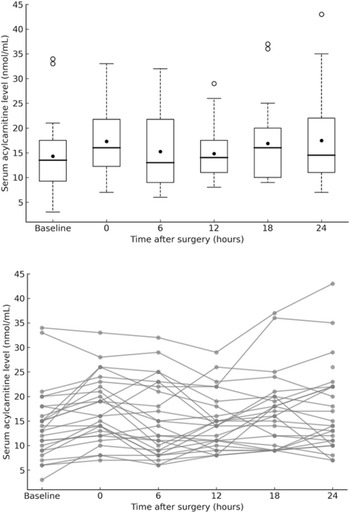
Although a general upward trend in acylcarnitine concentrations was observed postoperatively, these changes did not reach statistical significance compared to the preoperative baseline of 14.31 ± 1.44 nmol/ml. Immediately after surgery, levels increased to 17.31 ± 1.32 nmol/mL (p = 0.1309), followed by 15.23 ± 1.48 nmol/mL (p = 0.6579) at 6 hours, 14.81 ± 1.13 nmol/mL (p = 0.7859) at 12 hours, 16.88 ± 1.53 nmol/mL (p = 0.2270) at 18 hours, and 17.48 ± 1.73 nmol/mL (p = 0.1679) at 24 hours. The overall perioperative fluctuations in serum acylcarnitine levels and the distribution of patients’ values over time are illustrated in Figure 2.
Boxplot (top) and individual (bottom) trajectories of serum acylcarnitine levels across perioperative time points.

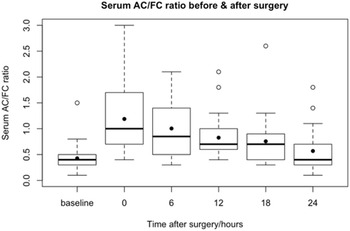
A significant increase in the serum acylcarnitine to free carnitine ratio was observed following surgery. The baseline ratio was 0.43 ± 0.05, which increased dramatically to 1.19 ± 0.12 immediately after surgery (p < 0.0001). This elevated ratio remained significantly higher at all subsequent time points: 1.00 ± 0.15 at 6 hours (p < 0.0001), 0.83 ± 0.08 at 12 hours (p = 0.001), and 0.76 ± 0.09 at 18 hours (p = 0.01). At 24 hours, 11 patients (42.3%) continued to show an elevated AC/FC ratio, suggesting ongoing metabolic stress and impaired carnitine homeostasis. These changes in the serum acylcarnitine to free carnitine ratio over the perioperative period are illustrated in Figure 3.
Boxplot illustrating the distribution of serum acylcarnitine (AC) to free carnitine (FC) ratios at multiple perioperative time points.

Further analysis revealed a significant negative correlation between postoperative serum free carnitine levels and cardiopulmonary bypass duration (p = 0.017, R = −0.47) (Figure 4). In contrast, the serum acylcarnitine to free carnitine ratio demonstrated a significant positive correlation with cardiopulmonary bypass duration (p = 0.012, R = +0.49) (Figure 5).
Scatter plot illustrating the relationship between serum free carnitine (FC) levels and cardiopulmonary bypass time (CPB).

Scatter plot illustrating the relationship between serum acylcarnitine (AC) to free carnitine (FC) ratio and cardiopulmonary bypass time (CPB).

Discussion
This study provides valuable insights into the dynamic changes in serum carnitine profiles following open-heart surgery in paediatric patients with CHDs. The observed significant decrease in free carnitine levels, alongside the increase in the acylcarnitine to free carnitine ratio, and their correlation with cardiopulmonary bypass duration, indicate that open-heart surgery, particularly when cardiopulmonary bypass is employed, could lead to substantial alterations in carnitine metabolism. Given the critical role of free carnitine in mitochondrial β-oxidation, which fuels myocardial energy production, postoperative depletion of serum free carnitine may impair this process, potentially compromising myocardial function during the early postoperative recovery period. These observed disturbances in carnitine homeostasis may reflect a multifactorial response to surgery that includes hemodilution from intraoperative fluid administration, impaired renal reabsorption due to altered perfusion, and systemic inflammation leading to oxidative stress. These mechanisms could collectively drive the reduction in free carnitine levels and the shift toward higher acylcarnitine to free carnitine ratio observed postoperatively. Reference Bremer1–Reference Arsenian3 The increase in the acylcarnitine-to-free carnitine ratio, despite a modest and statistically insignificant rise in acylcarnitine, points to a metabolic shift in carnitine metabolism rather than a gross accumulation of acylcarnitine. This proposes either heightened fatty acid oxidation or mitochondrial dysfunction, both known contributors to oxidative stress and myocardial injury. However, the absence of a significant acylcarnitine accumulation indicates that while fatty acid metabolism is under stress, mitochondrial function remains preserved.
The significant negative correlation between cardiopulmonary bypass duration and serum free carnitine levels, coupled with the positive correlation with acylcarnitine to free carnitine ratios, indicates that longer cardiopulmonary bypass duration will be associated with lower serum free carnitine levels and higher acylcarnitine to free carnitine ratio postoperatively. This highlights the impact of prolonged bypass on carnitine metabolism. Cardiopulmonary bypass introduces systemic stressors—such as inflammation, ischaemia-reperfusion injury, and oxidative stress—that may deplete metabolic substrates like carnitine and disturb mitochondrial homeostasis. Reference Corr17,Reference Lango18
Overall, these findings indicate a shift in carnitine metabolism postoperatively without a complete disruption of fatty acid oxidation. They also underscore the potential importance of monitoring carnitine profiles in paediatric patients undergoing open-heart surgery with cardiopulmonary bypass. The persistent depletion of free carnitine postoperatively raises the possibility that intervention, such as carnitine supplementation, may mitigate metabolic stress and support myocardial recovery. However, Potential confounding factors such as patient age, weight, and surgical complexity including single ventricle versus biventricular operations must be considered, as they may influence carnitine metabolism. Further research with larger cohort is warranted to control for these variables and validate these findings.
Our findings align with previous research reporting perioperative declines in carnitine levels. For instance, Kaneda et al. observed a 39.9% reduction in free carnitine levels in paediatric patients undergoing cardiopulmonary bypass cardiac surgery, compared to a 53.3% reduction in our study. The greater decline observed here may reflect differences in patient characteristics, surgical approaches, or perioperative management. Moreover, while Kaneda et al. focused on pre-surgery and daily comparisons of serum carnitine levels, our study provides a detailed profile of serum carnitine dynamic changes over the first 24 postoperative hours. Reference Kobayashi, Kuwata, Okamoto, Harada and Minakata23
Proulx et al. also reported frequent disturbances in plasma and urinary carnitine in critically ill children, including those undergoing cardiac surgery. Reference Proulx, Lacroix, Qureshi, Nadeau, Gauthier and Lambert24 Additionally, altered carnitine homeostasis has been associated with oxidative stress and cardiac dysfunction in children with ventricular septal defects and increased pulmonary blood flow. Reference Black, Field-Ridley and Sharma25
Collectively, these studies and our findings demonstrate the impact of critical illness and major surgeries, such as open-heart surgery with cardiopulmonary bypass, on disrupting carnitine metabolism. They highlight the importance of perioperative monitoring of serum carnitine levels and maybe the consideration of targeted therapeutic strategies.
This study contributes to the growing body of literature by characterising the transient changes in serum carnitine profiles after cardiopulmonary bypass. These results propose that monitoring and potentially supplementing carnitine could benefit postoperative recovery and cardiac function in this vulnerable population. Future research should validate these findings in larger cohort and further explore the mechanisms underlying carnitine metabolism disturbances in children with CHDs.
Limitations and future directions
Although this study’s primary aim was to characterise perioperative changes in serum carnitine levels following cardiopulmonary bypass open heart surgery, several limitations should be considered. The small sample size limits the generalizability of our findings and precludes multivariate analysis to adjust for potential confounders such as age, weight, or surgical complexity, including differences between single-ventricle and biventricular circulations. The study population was predominantly White/Caucasian, which may further limit the generalizability of the results. Future multicenter studies with larger cohorts are warranted to validate our findings and better delineate the influence of these factors on perioperative carnitine metabolism. This study did not include data on preoperative nutritional status, dietary intake, or baseline metabolic health, all of which may affect carnitine regulation. Because carnitine levels can also be influenced by fasting duration, intraoperative medications, and overall metabolic conditions, future research should incorporate comprehensive metabolic profiling and nutritional assessments to clarify these relationships. Furthermore, the absence of direct (echocardiography) and indirect cardiac functional assessments limits the ability to determine the clinical implications of transient alterations in carnitine homeostasis and their potential association with postoperative low cardiac output states. Correlating biochemical findings with clinical outcomes—such as postoperative systemic ventricular function, inotrope use, and ICU length of stay would enhance the translational relevance of these results.
Conclusion
Paediatric patients undergoing open-heart surgery with cardiopulmonary bypass experience significant disruptions in serum carnitine homeostasis. The observed reduction in free carnitine and the elevated acylcarnitine to free carnitine ratio may reflect a metabolic response to surgical and bypass-related stress. These findings warrant further investigation into the potential role of carnitine monitoring and supplementation in supporting postoperative myocardial recovery.