Analyzing the Iranian rural development organization, Construction Jihad (Jahad-i Sazandigi, hereafter CJ), this article explores how the Islamic Republic of Iran instrumentalized development to consolidate power at home and project influence abroad. Officially established on 16 June 1979, shortly after the Iranian Revolution, CJ won rural hearts and minds and neutralized domestic opponents through an ambitious development campaign and by spreading revolutionary and Islamic values in the countryside, where nearly half of the population resided. During the Iran–Iraq War, CJ provided logistical support to Iranian troops on the front and helped them repel invading Iraqi forces. After helping the state consolidate power in 1983, CJ transformed into a ministry and helped to expand Iran's influence to other parts of the Muslim and developing world, particularly sub-Saharan Africa.
This analysis of CJ contributes to the extant scholarship on the Islamic Republic's foreign policy in terms of geography, periodization, and tactics. Geographically, the literature tends to focus on the United States and the Middle East, especially its Shiʿi territories and communities. Numerous books examine the root causes of the adversarial relationship between the United States and Iran as well as the possibilities for détente.Footnote 1 Other works explore Iranian influence in neighboring Arab countries along the so-called Shiʿi Crescent (Lebanon, Syria, Iraq, Bahrain, and Yemen). These works overlook the Islamic Republic's relations with Sunni and non-Muslim countries. Attention to CJ is instructive for understanding Iran's foreign policy in such countries in Africa.
With respect to periodization, the few studies on Iran's role and presence in Africa focus on the years 2005–13, when the principlists pursued an assertive and radicalized foreign policy on the continent. Broadening the scope, this article examines how disparate political elites and dominant social forces (radicals, conservatives, moderates, reformists, and principlists) came to power at different stages of state formation, possessed varying interpretations of what exporting the revolution meant, and distinctly shaped Iran's foreign policy in Africa—even as development remained a key component of this policy and an effective soft power mechanism on the continent.
Most scholars of post-1979 Iran assume that the deradicalization of its foreign policy did not occur until after the death of Ayatollah Ruhollah Khomeini in 1989 and, more particularly, during the administration of the Islamic Republic's moderate fourth president, Hashemi Rafsanjani (1989–97), who pragmatically practiced active neutrality during the Gulf War in 1990–91.Footnote 2 However, my discussion of CJ demonstrates that deradicalization began several years earlier in 1984, when the conservatives took control of the government from the radicals.Footnote 3 This transition marked the first time that the Islamic Republic instrumentalized development to advance its strategic interests in Africa. This analysis also illustrates that shifts in Iran's foreign policy in Africa during the last thirty years coincided with changes in Iran's domestic political landscape. For the Islamic Republic's diverse factions, CJ's developmental activities in Africa served as a means to different ends, reflecting a fragmented and disjointed foreign policy with gains and setbacks.
From the standpoint of tactics, the literature on Iran's foreign policy focuses largely on covert military and financial assistance (hard power) as well as ideological indoctrination and religious proselytization (soft power). Scholars have argued that the Islamic Republic's clandestine operations and ideological propagation have enabled it to expand its reach by creating and reinforcing connections with civic activists, protest movements, opposition parties, rebel and insurgent groups, and religious leaders and communities in the Shiʿi Middle East.Footnote 4 Meanwhile, they have downplayed the inherent costs and limitations of these activities—how they have occasionally subjected Iran to public condemnation and embarrassment, reaffirmed its status as a so-called international pariah or rogue state, and led to the cooling of relations with African countries, which subsequently expelled Iran's officials and closed its embassies and cultural centers.
The scholarship on Iran's foreign policy has placed little emphasis on development as a soft power mechanism that forges and enhances relations with other countries, particularly in the developing world. Similarly, the few studies that examine Iran's presence and role in Africa downplay development and exclude CJ as a primary means for the Islamic Republic to improve relations with and advance its interests on the continent.Footnote 5 Developing nations in Africa and elsewhere remain in urgent need of developmental assistance, and Iran has effectively leveraged its comparative advantage in healthcare, training, and rural and agricultural development to meet these demands. As the case of CJ reveals, development as a soft power foreign policy tool has been less fraught with the risks and pitfalls associated with covert military assistance and religious proselytization, while it offers equal, if not greater, material and ideological benefits.
Based on one year of archival research and interviews in Iran, this article examines CJ's developmental activities in Africa as a window into the Islamic Republic's foreign policy on the continent. The first section analyzes the foreign policy element through the theoretical framework of complex realism. I consider how the international, regional, and domestic contexts structurally facilitated and constrained the foreign policymaking decisions, actions, and outcomes of Iranian leaders and elites. At the same time, I grant agency to these leaders and elites by taking into account how their disparate priorities, preferences, and perceptions affected foreign policymaking processes and outcomes.
The second and third sections explore respectively the deradicalization of the Islamic Republic's foreign policy in Africa and the origins of CJ's developmental activities on the continent beginning in the mid-1980s. This period of relative state consolidation was significant because it marked the first time that the Islamic Republic integrated development into its foreign policy in Africa. Under the conservatives, a newly consolidated and increasingly confident, yet internationally isolated and economically strained, Iran instrumentalized development to maximize its longterm security and survival by establishing and strengthening diplomatic and commercial relations with Africa. During the subsequent period of high state formation under the moderates, the Islamic Republic expanded its developmental activities on the continent to repair its image, showcase its technical capabilities, and elevate its status as a developmental patron state in a hierarchical global system.
The fourth and fifth sections investigate respectively the reradicalization of the Islamic Republic's foreign policy and the expansion in Africa of CJ's successor, the Ministry of Agricultural Jihad (Vizarat-i Jahad-i Kishavarzi, hereafter MAJ), which advanced Iran's economic, geopolitical, and ideological interests. These sections show how the MAJ helped an increasingly threatened and assertive Islamic Republic mitigate its isolation, balance against the United States, evade and delegitimize its sanctions, and expand Iran's nuclear program and military presence. They also reveal the limitations of the MAJ's activities in Africa in light of the Islamic Republic's geostrategic interests beyond the continent and the MAJ's allocation of greater resources and personnel to other regions.
The conclusion assesses the mixed performance record of Iran's foreign policy and the effectiveness of the MAJ's developmental activities in Africa during late 2005. In the end, the clandestine operations, religious proselytization, and ideological propagation of other Iranian institutions created friction with Africa due to the continent's inauspicious internal demographics. Another constraint was fierce external pressure from the Islamic Republic's regional competitors and the global system's core states in the areas of military hardware, technical expertise, diplomatic recognition and support, political and religious ideas, and foreign aid, investment, and trade. Development, rather than arms or ideology, served as the most effective and promising means for Iran to make deep inroads into Africa.Footnote 6
IRAN'S FOREIGN POLICY IN AFRICA: COMPLEX REALISM
In this article, I use Anoushiravan Ehteshami and Raymond Hinnebusch's theory of complex realism to trace the trajectory of Iran's foreign policy and CJ's developmental activities in Africa between the 1980s and the 2000s.Footnote 7 Classical realism assumes that the international system is intrinsically anarchic, that states are proverbial black boxes, that socially constructed ideas are instruments rather than influencers of foreign policy, and that the latter is unaffected by state formation and domestic politics. By contrast, complex realism—which combines realist, constructivist, and liberal principles—posits that states uniquely formulate foreign policy responses based on their relative power positions, resources, and capabilities in a hierarchical global and regional environment. This theory simultaneously grants agency to the domestic political elites and dominant social forces in power during the various stages of state formation in terms of their formulation of foreign policy, which they base on their competing priorities, preferences, and perceptions.
Using complex realism, I argue that Iran's foreign policy was influenced by four interacting variables: a hierarchical and dynamic, global and regional environment that dictated Iran's foreign policy opportunities and challenges based on its relative power position, resources, and capabilities; the Islamic Republic's state formation, which occurred over various phases and determined its responses to these opportunities and challenges; Iranian leaders and elites’ differing priorities, preferences, and perceptions surrounding the state's role in the region and the world, which further shaped these responses and their outcomes; and the Islamic Republic's bifurcated power concentration and decision making, which created intraelite conflict and a fragmented foreign policy—even as development continued to be a key component of this policy.
Between 1979 and 1982, the Islamic Republic was in a phase of low state formation during which it encountered formidable and existential, internal and external threats from a myriad of domestic opponents (monarchists, liberals, leftists, and Sunni and ethic groups) and from invading Iraqi forces backed by the United States, the Soviet Union, and other core states in the international system. Consistent with complex realism's predictions regarding the foreign policymaking outcomes of states besieged from within and without, the Islamic Republic's initial foreign policy in Africa—which was formulated by radical political elites and social forces—was predicated on self-help, alliance making, and power balancing through ideological propagation and military buildup. This was due to Iran's inability to “bandwagon with an external power to get the support/resources to balance against” Iraq and its powerful backers.Footnote 8 Under the radicals, the Islamic Republic employed in Africa the radical, nationalist, and anti-imperialist rhetoric that it used to mobilize domestic support. It also allocated part of its sizeable military budget to providing arms, funding, and training to self-proclaimed revolutionary leaders and national liberation movements on the continent.
Between 1983 and 1989, Iran transitioned into a phase of relative state consolidation. While the Iranian government consolidated power against its domestic opponents and went on the offensive against Iraqi forces, it remained embroiled in a costly war against them while confronting economic sanctions from the United States and increasing isolation. As a consequence, Iran's foreign policy in Africa shifted materially to developmental assistance. Ehteshami and Hinnebusch predict that, “if the precarious economic health of a state threatens internal security, acquiring economic resources may move to the top of the foreign policy agenda.”Footnote 9 Under the conservatives, who came from and were affiliated with the bāzārī merchant class, a newly consolidated and increasingly confident, yet economically strained and internationally isolated, Islamic Republic practiced self-help, alliance making, and power balancing by instrumentalizing development to establish and strengthen diplomatic and commercial relations with African countries in the global periphery.Footnote 10 At the same time, the conservatives promoted an ideological foreign policy that undermined these relations because it shifted the focus from anti-imperialism to Shiʿism on an overwhelmingly non-Muslim and Sunni continent.
Between 1989 and 2003, the Islamic Republic, now under the moderates and reformists, shifted into a phase of high state formation, with internal and external threats becoming manageable. The moderates and the reformists enjoyed domestic support, practiced neutrality, pursued diplomacy with the West, and cooperated rather than interfered with the United States as it contained, neutralized, and/or eliminated two neighboring enemies: the Taliban in Afghanistan and Saddam Husayn in Iraq.Footnote 11 Complex realism predicts that, “in larger states (if internal [and external] threats are manageable), regional leadership (power) is more likely prioritized.”Footnote 12 With robust resources and capabilities in the form of substantial oil and natural gas reserves, geographic depth and strategic location, and a large and educated population, the Islamic Republic—which still suffered from an ideological and identity-based deficit as a so-called international pariah or rogue state—attempted to enhance its standing as an emerging regional power. These attempts transcended reductionist assumptions regarding Iran's so-called expansionist and hegemonic aspirations to export the revolution throughout the region and the globe. During this period, the goal of the Islamic Republic's developmental foreign policy in Africa was to improve its tarnished image and gain international acceptance. Iran sent a message to its citizens, regional competitors, and the core states that it possessed the requisite resources, capabilities, and technical skills to undertake developmental aid programs on the continent.
Under the moderates and the reformists, the Islamic Republic's developmental foreign policy in Africa was fragmented and undermined by the conservatives, who prioritized ideology and possessed higher power concentration and decision-making authority. The Islamic Republic's state formation spawned a unique hybrid regime with bifurcated institutions in which the division of labor and decision making is divided between elective institutions (e.g., the presidency and parliament) and a parallel set of more powerful, nonelective institutions (e.g., the Supreme Leader's Office and the Guardian Council).Footnote 13 Technically, the president is responsible for Iran's foreign policy and, with a parliamentary vote of confidence, appoints the minister of foreign affairs to his cabinet. The supreme leader oversees parallel institutions that counterbalance and supersede the authority of the Ministry of Foreign Affairs. These institutions—some of which are affiliated with the Revolutionary Guards—have kept in check successive moderate and reformist presidents and foreign ministers whose foreign policy priorities, preferences, and perceptions have diverged from those of the supreme leader and other conservatives. This outcome conforms with Ehteshami and Hinnebusch's observation that “characteristic of the Middle East has been the dominating role of the military and intelligence services at the expense of the diplomats.”Footnote 14 The power struggle between the supreme leader and successive presidents also manifested itself within CJ and its successor, the MAJ. Even today, the MAJ is the only ministry that contains both a minister, who is appointed by and reports to the president, and a representative, who is appointed by and reports to the supreme leader.
Between 2003 and 2013, the Islamic Republic under the reformists and particularly under the principlists once again confronted serious external and internal threats. During this period, the United States labeled it a member of the “axis of evil,” occupied neighboring Iraq, and increased sanctions against Iran's nuclear program, which had been expanded to deter an American military invasion and regime change. Inside Iran, the principlists faced growing opposition from citizens, who objected to heightened political and social restrictions and perceived electoral fraud. In response to these mounting external and internal threats and in the midst of rising international oil prices, the Islamic Republic under the principlists pursued an assertive foreign policy and increased developmental aid to Africa. Since the Islamic Republic could not bandwagon with an external power or rely on a global protector in a unipolar system, it practiced self-help and power balancing through the buildup of its nuclear program, increased naval presence, arms trafficking, and proxy warfare. It also intensified alliance making with fellow peripheral states in Africa in an attempt to balance the United States at the core. Conforming to the predictions of complex realism, the principlists responded to growing domestic opposition by adopting a “radical nationalist rhetoric to mobilize internal support.”Footnote 15 They spread this rhetoric, which combined the radicals’ anti-imperialism and the conservatives’ religious–political doctrine, to Africa.
THE DERADICALIZATION OF IRAN'S FOREIGN POLICY IN AFRICA
In the early 1980s, Iranian radicals under president Mohammad-Ali Rajai (1981) and the radical-majority first parliament (1980–84) dominated the government. In this period of low state formation, they faced formidable and existential, internal and external threats from domestic opponents (royalists, liberals, leftists, and Sunni and ethnic groups) and invading Iraqi forces backed by the United States and the Soviet Union, among other countries. Unable to bandwagon with an external power, the radicals pursued a foreign policy in Africa based on self-help, alliance making, and power balancing through ideological propagation and military build up. Ideologically, the radicals interpreted and framed their efforts to export the revolution to Africa and elsewhere as fulfilling the revolutionary and anti-imperialist, global mission of “recognizing, attracting, educating, and organizing the destitute and oppressed masses [maḥrūmīn va mustażʿafīn]” to “develop common interests in the fight against the arrogance of imperial powers [mustakbarīn].”Footnote 16
Throughout the 1980s, the Islamic Republic aligned itself with radical authoritarian rulers in Africa, including Tanzania's Julius Nyerere (1965–85), Ghana's Jerry John Rawlings (1981–2001), Sierra Leone's Saidu Momoh (1985–92), and Sudan's ʿUmar al-Bashir (1989–present), who received Iranian military and financial backing during his 1989 coup.Footnote 17 These alliances were the byproduct of Iran's radicalized foreign policy in Africa during the early 1980s and this policy's momentary continuation under the radical prime minister Mir-Hossein Mousavi (1981–89) and the radical-majority third parliament (1988–92). The abovementioned African leaders and many of their citizens—Muslims and non-Muslims alike—were inspired and galvanized by Ayatollah Khomeini and the Iranian Revolution. The Islamic Republic's radical elites found common cause with these African leaders, who portrayed themselves as anti-Western, anti-imperialist, populist, socialist, and revolutionary—even if most of them came to power through military coups that differed from Iran's bottom-up popular revolution.
The year 1983 was seminal for Iranian foreign policymaking in Africa. During that year, the Islamic Republic consolidated power against its internal and external opponents by foiling remaining military plots, solidifying control over the armed forces, quelling a series of opposition uprisings, dissolving the last remaining leftist party of consequence (Tudeh), and remaining on the offensive against Iraqi forces inside their territory.Footnote 18 These successful measures endowed Iran with the confidence to pursue developmental initiatives abroad. In 1983, the newly consolidated state brought CJ under its direct control by converting it from a revolutionary organization into a cabinet-level ministry. Several years later, the government deployed CJ to Africa, beginning with Tanzania in 1987 and Ghana in 1989.
Nevertheless, Iran encountered serious external threats to its long-term security and survival. In the wake of the American embassy hostage crisis (1979–81) and in the midst of the Iran–Iraq War (1980–88), Iran became increasingly isolated and its resources were strained by costly economic sanctions and sizeable military expenditures and losses.Footnote 19 Through CJ, the Islamic Republic mitigated its isolation and bolstered its security by establishing and strengthening diplomatic and commercial relations with Africa. For Iran, Africa represented the ideal locale to pursue this policy given the continent's sizeable agrarian economy, widespread rural poverty, and formidable developmental challenges.Footnote 20
Domestically, the mid-1980s marked the decline of the radicals and the rise of the conservatives. In 1984, during the presidency of Ali Khamenei (1981–89) (who later succeeded Khomeini as supreme leader), the conservatives displaced the radicals in the second parliament (1984–88) and controlled the Guardian Council (Shura-yi Nigahban-i Qanun-i Asasi), a body appointed by the supreme leader that vets candidate lists and vetos parliamentary legislation. Coinciding with this sweeping change, Iran's foreign policy in Africa and elsewhere shifted in a less radical direction.
According to Hafizullah Emadi, conservative political elites and social forces “de-radicalized Iran's domestic and foreign policy orientation in mid-1984 in order to improve Iran's commerce and trade relations with the outside world.”Footnote 21 In contrast to the radicals, many conservatives hailed from or were connected to the bāzārī merchant class.Footnote 22 As such, they leveraged CJ's developmental activities in Africa to help Iranian companies secure business contracts and open export markets. Unlike the radicals, the conservatives promoted not antigovernment insurgents or anti-imperialist ideology, but rather stability and the forging of new alliances and trading partners.
At the same time, through institutions other than CJ under the purview of the conservatives, the latter ideologically interfered in Africa's domestic affairs by promoting Shiʿi Islam and the Guardianship of the Jurist (vilāyat-i faqīh)—the idea that a leading jurist should rule over Islamic government in accordance with Islamic law. The conservatives’ religious proselytization and ideological propagation interfered with their diplomatic and commercial priorities, as evidenced by the Senegalese government's closure of the Iranian embassy in 1984 for its Islamic propaganda.Footnote 23 In the words of the Islamic Republic's former minister of economy and deputy minister of CJ, Mohammad Javad Iravani, the focus of the ideological discourse shifted from radical themes of rescuing the oppressed and fighting imperialism to conservative themes related to economics and religion: “restoring [Iran's] historical presence and authority” in the Muslim world, “recovering lost religious, cultural, and economic relations” with Muslim nations, tapping into the “cultural, social, technical, scientific, and economic potential” of these countries, and “introducing [Iran's] distinct expertise and technical talents beyond its borders.”Footnote 24
Despite the radicals’ control of the Office of the Prime Minister (which was permanently dissolved in 1989) and the third parliament, Iran's deradicalized foreign policy in Africa, which began under the conservatives, gained added traction and momentum with the ascendancy of Rafsanjani and the moderates. The moderates enjoyed domestic support and pragmatically remained actively neutral as the United States defeated and contained Iran's chief regional adversary, Iraq, through military operations, no-fly zones, and economic sanctions during and after the Gulf War. Like the conservatives, Rafsanjani and the moderates recognized CJ's ability and potential to advance Iran's strategic interests in Africa.
In terms of ideology and identity, extending developmental aid to Africa through CJ enabled the Islamic Republic to repair its image, gain acceptance at home and abroad, and improve its standing as a developmental patron state. CJ's developmental aid programs on the continent showcased Iran's budding technical talents and paradigmatic socioeconomic coherence to its citizens, regional competitors, and the core states. These programs also demonstrated that the Islamic Republic did not perpetually rebel against the global system, but constructively contributed to it through development. Like other regional powers, Iran utilized development to redefine the international system's hierarchal core–periphery boundaries and dynamics. While it remained a middle-income country, it elevated its status as a patron state that provided developmental assistance to client states in the African periphery.
Ideologically, Rafsanjani and the moderates believed that the foreign policy of Iran—particularly outside its immediate surroundings and sphere of influence (the Middle East and Central Asia)—should remain devoid of the radicals’ revolutionary anti-imperialism and the conservatives’ religious–political doctrine. The purpose of this de-ideologized foreign policy was to avoid creating and exacerbating tensions with Africa, as had occurred with Senegal during Khamenei's presidency. The Senegalese government subsequently permitted the reopening of the Iranian embassy in Dakar during Rafsanjani's presidency in the early 1990s.Footnote 25 Differences over the prioritization of ideology and religion in foreign policy constituted one factor among others that caused a rift between the conservatives and the moderates.Footnote 26 As a consequence, the moderates aligned with the radicals, many of whom became reformists during the years leading up to the electoral victory of the reformist fifth president, Mohammad Khatami (1997–2005).
In contrast to the conservatives, the reformists advocated the empowerment of Iran's elective institutions and the pursuit of diplomatic engagement with the West. Until the last two years of Khatami's presidency, the Islamic Republic's internal and external threats remained manageable. Like Rafsanjani and the moderates, Khatami and the reformists won convincing electoral victories and earned high approval ratings. Whereas the moderates remained neutral with regard to the American containment of Iraq, the reformists cooperated with the United States between 2001 and 2003 as it subdued Iran's other neighboring foe, the Taliban in Afghanistan. Materially, the reformists maintained the moderates’ development-centered foreign policy in Africa—even though they scaled back on CJ's overseas operations in response to fluctuating international oil prices during the late 1990s and early 2000s. Ideologically, Khatami's mantra of the “dialogue of civilizations”—which advocated rapprochement with the United States—offered Africa the diplomatic flexibility and geopolitical capital to develop closer ties with Iran.Footnote 27
At the international level, the fall of the Soviet Union in 1991 further weakened the radicals inside Iran and encouraged them to shift toward reformism. In Africa, this momentous event led to seismic changes. After losing Soviet patronage, many of the continent's so-called revolutionary, anti-imperialist, socialist, and populist leaders (not including al-Bashir in Sudan) gave way to new governments that underwent democratization—albeit with limitations and setbacks—to attract Western aid, investment, and support.Footnote 28 In light of these new geopolitical realities in a unipolar world, development comprised a safer and surer path for the Islamic Republic to maintain and expand its diplomatic and commercial ties with Africa. As a consequence, CJ became the main conduit for Iran to preserve and extend its influence on the continent. After entering Tanzania and Ghana in the late 1980s, CJ set its sites on Sudan and Sierra Leone in 1991.
CONSTRUCTION JIHAD IN AFRICA (1985–91)
During its period of relative state consolidation between 1983 and 1989, the Islamic Republic confronted threats to its long-term security and survival. In the wake of the American embassy hostage crisis and during the remainder of the Iran–Iraq War, Iran encountered increased international isolation, economic sanctions, and military expenditures and losses that took a toll on its image, resources, and capabilities. As members and associates of the bāzārī merchant class, the conservatives were particularly concerned about this outcome, bore the brunt of it, and felt an urgency to remedy it. As such, they became intent on instrumentalizing development by deploying CJ to Africa in order to establish and strengthen diplomatic and commercial relations on the continent. Through these relations, the conservatives sought to mitigate Iran's growing isolation and to improve its struggling economy.
CJ's operations in Africa commenced in 1985, two years after the revolutionary organization became a full-fledged ministry and fell under the full control and direct supervision of the conservative government. Far from being spontaneous, CJ's operations in Africa unfolded in a highly formalized, professionalized, and routinized manner. Prior to undertaking operations overseas, CJ—like other ministries—had to secure budgetary funds and other resources from parliament. Unlike other ministries, however, CJ contained a representative of the supreme leader. This representative was able to secure extra budgetary and discretionary funds from the Supreme Leader's Office (Daftar-i Rahbari).
Before CJ planned and implemented projects on the ground, high-level officials from Iran and Africa held meetings, negotiated terms of service, and obtained consent and approval through bilateral memoranda of understanding and other agreements. After visiting several African countries in 1986, President Khamenei met with Tanzanian officials and assigned CJ the “mission of surveying and studying rural development plans in Tanzania.”Footnote 29 During the implementation of CJ's projects, Iranian and Tanzanian officials “toured the organization's project sites to evaluate progress and ensure that commitments were being met.”Footnote 30 A former CJ official commented on the formal and high-level nature of the ministry's activities in Africa and elsewhere:
During their visits to Iran, ambassadors from Africa [and elsewhere] would ask the Iranian government if they could use Construction Jihad's services. As a result, Construction Jihad worked in various developing countries inside and outside of Africa, including Tanzania, Sudan, Lebanon, Ghana, Sierra Leone, Pakistan, Afghanistan, and Bosnia during its war [in the early 1990s] . . . Other developing countries in Africa and Asia saw Construction Jihad as a model. Construction Jihad took visiting presidents and foreign ministers on missions to [Iranian] villages to show them the organization's work. These political officials from Tanzania [and elsewhere] signed protocols requesting that Construction Jihad come to their countries to help. Presidents of these countries would send notes to Iran thanking it for the services rendered by Construction Jihad.Footnote 31
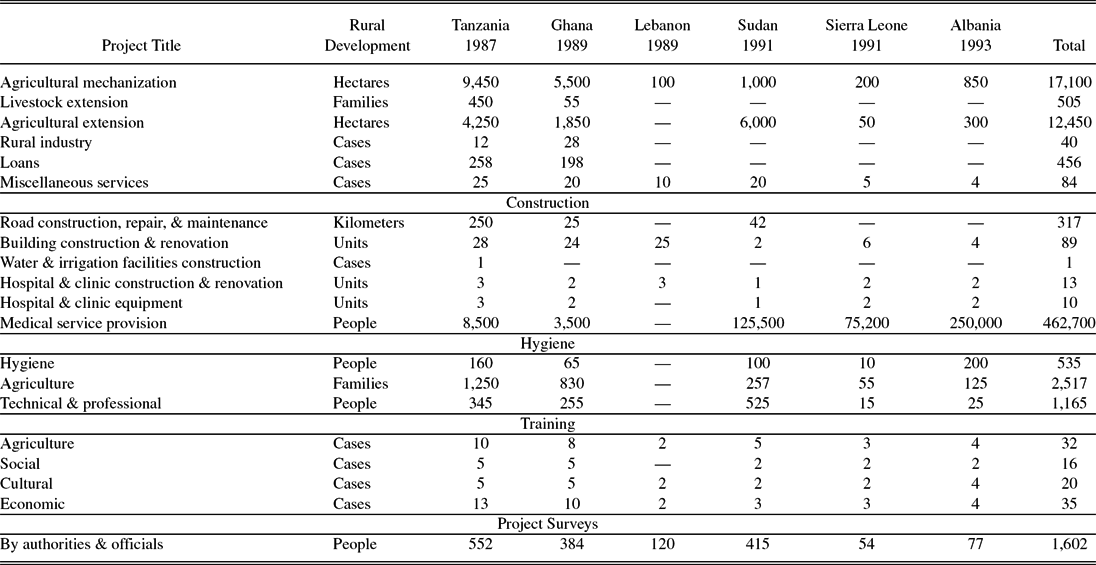
Following preliminary visits to Tehran by Tanzanian and Ghanaian officials, CJ began implementing agricultural and rural development projects in Tanzania in 1987 and Ghana in 1989. The ministry sent a delegation of experts to expand mechanized agriculture, improve farming (dry, wet, and integrated), and increase the production of strategic crops (rice and corn), livestock, and fish. To this end, CJ donated tractors and fishing equipment, offered technical training, and opened service and marketing centers. In the areas of healthcare and human capital, the ministry offered medications, vaccinations, and vocational training. To a lesser extent, CJ offered loans, supplied irrigation and drinking water, supported rural industry (quarries, factories, and processing plants), and constructed roads, dams, hospitals, and health clinics (see Table 1).Footnote 32 CJ established branch offices in Tanzania and Ghana, and sent employees to work there for two to four years. It undertook projects in remote and isolated villages, located hundreds of kilometers from the capital. Before being sent to Tanzania and Ghana, employees received technical and cultural training and learned local languages, such as Swahili, which is a mixture of Persian, Arabic, and Bantu. CJ's activities mainly consisted of opening health clinics and helping villagers with farming (plowing, sowing, harvesting, and irrigation) and raising livestock. One former employee who worked in Tanzania and Ghana reported “bringing goats from Iran [which he jokingly referred to as ‘Jihadi goats’], and teaching villagers how to care for the goats and convert their milk into butter and other dairy products.”Footnote 33
Construction Jihad's overseas operations from 1987 until March 1993

Source: Ministry of Construction Jihad's Office of Statistics and Information in Iravani, Nihadgirayi, 262.
Former employees reported that they generally maintained good relations with locals and earned their trust and respect while working under adverse conditions. The above-mentioned informant revealed that his colleague “was bitten by a snake while building a clinic in Tanzania, and that the locals cared for him in their homes and removed the venom from his leg with a knife.”Footnote 34 This informant also recounted how “CJ's office in Ghana came close to being destroyed and its personnel nearly injured or killed during riots organized by a mob of angry villagers in response to alleged crimes perpetrated by Ghanaian soldiers.”Footnote 35
During the late 1980s and early 1990s, the moderates enjoyed domestic support, the Iran–Iraq War came to an end, and the United States defeated and contained Saddam Husayn. At the same time, the Islamic Republic continued to face an ideological and identity-based deficit as a so-called international pariah and rogue state. As a consequence, an isolated and stigmatized Islamic Republic expanded CJ's presence and operations in Africa to gain international acceptance and increased status as a developmental patron state in the hierarchical global system. Through CJ's developmental aid projects, the Islamic Republic showcased its technical prowess and socioeconomic coherence to its citizens, regional competitors, and the core states.
Having commenced operations in Tanzania and Ghana, CJ entered Sudan and Sierra Leone in 1991. Even before then, in 1986, Chairman of Parliament Rafsanjani met with his counterpart from Sierra Leone to obtain official approval for CJ to “commence preliminary activities in Sierra Leone.”Footnote 36 While CJ distributed medication in Sudan and Sierra Leone, the ministry was considerably more active in the former country with respect to agricultural mechanization and extension, road construction, and hygiene (see Table 1). The reason for this was twofold: first, CJ's arrival in Sierra Leone coincided with or was triggered by the outbreak of the civil war (1991–2002), which created instability that rendered service delivery outside of medical and humanitarian assistance difficult; second, Iran's relations with Sudan developed earlier than those with Sierra Leone. Whereas the Islamic Republic supported Sudan's al-Bashir during his rise to power in 1989, its political and trade cooperation with Sierra Leone did not intensify until Khatami's presidency.Footnote 37
In contrast to CJ's activities in Iran, the ministry's initial operations in Africa focused more on agricultural and rural development than on ideological propagation and religious proselytization. One former employee explained, “we [initially] felt the need, through rural development, to introduce foreigners to revolutionary and Islamic culture, [but these activities] became a lot less meaningful and very outdated.”Footnote 38 The focus on development related to three factors. First, CJ sought to concentrate on its core competency and to leave propagating ideology and religion to other Iranian institutions, including the Iranian embassy's cultural section, the International Department of the Revolutionary Guards, the Organization of Islamic Propagation, the Islamic Culture and Relations Organization, the World Forum for Proximity of Islamic Schools of Thought, and the World Forum for the Family of the Prophet. The Iranian cultural attaché and the International Department of the Revolutionary Guards fell under the direct purview of Supreme Leader Ali Khamenei (1989–present).Footnote 39 Established by Khamenei in 1990, the World Forum for Proximity of Islamic Schools of Thought or Ecumenical Society (Muʾasasih al-Majmaʿ al-ʿAlami li-l-Taqrib bayn al-Madhahib al-Islamiyya) is an international organization that promotes dialogue and reconciliation between Shiʿa and Sunnis. It is “led by a mixed Sunni and Shiʿi board of directors from Iran and abroad, including Nigeria,”Footnote 40 where many Muslims convert to Shiʿism.Footnote 41 The World Forum for the Family of the Prophet (al-Majmaʿ al-ʿAlami li-l-Ahl al-Bayt), or Ahl ul-Bayt Institute, which is funded by the Iranian Ministry of Culture and Guidance, engages in religious proselytization outside of Iran and attempts to persuade Muslims to follow Khamenei as their source of emulation (marjaʿ taqlīd), or supreme spiritual and legal authority.Footnote 42 The Ahl ul-Bayt Institute has established associations and schools in Ghana, Kenya, Nigeria, and other African countries, where it trains religious leaders and converts locals to Shiʿism.Footnote 43
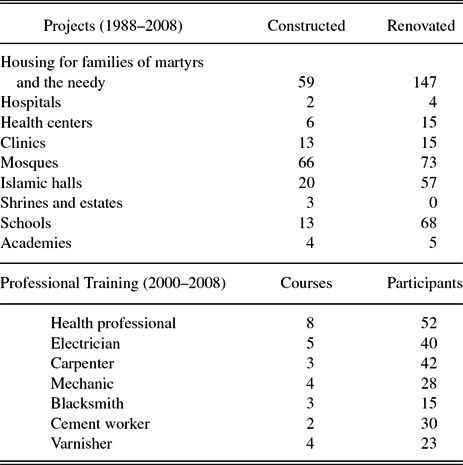
Second, CJ adhered to the foreign policy doctrine espoused by Rafsanjani involving the judicious use of ideological propagation and religious proselytization, especially in countries outside of Iran's immediate surroundings that had no substantial Shiʿi communities. This policy conflicted with the priorities and preferences of Khamenei, who relied heavily on the Guardianship of the Jurist as a legitimizing ideology because he lacked Khomeini's religious credentials and charismatic authority. In Africa, CJ largely concentrated on agriculture, infrastructure, training, and healthcare. By contrast, CJ's Lebanese branch, Jihad al-Binaʾ—the Arabic equivalent of Construction Jihad and an affiliate of Hizbullah—built and renovated more mosques, congregation halls (ḥusayniyya), seminaries (ḥawza), and schools than hospitals, health centers, and clinics (see Table 2).Footnote 44
Construction Jihad's developmental activities in Lebanon (1988–2008)
Sources: “Jihad al-Binaa Development Association,” Jihad al-Binaʾ, accessed 25 September 2013, http://www.jihadbinaa.org.lb; “Waad Rebuild,” The Waʿad Project, accessed 20 July 2013, http://www.waad-rebuild.com.
Third and finally, CJ faced unfavorable demographics and foreign competition on the continent. Former employees acknowledged that Africa's “linguistic, cultural, and religious space was so different [compared to that of Iran] that it created obstacles for projects involving propaganda, let alone more important ones involving infrastructure and services.”Footnote 45 One of these informants also remarked that the robust and comprehensive propaganda and proselytization campaigns in Africa by Iran's regional Sunni competitors—including Saudi Arabia, Turkey, and Pakistan—limited and discouraged CJ from undertaking similar initiatives.Footnote 46 Demographically, Tanzania and Ghana were non-Muslim-majority countries while Sudan and Sierra Leone were, respectively, 97 and between 60 and 70 percent Sunni.Footnote 47 Unlike in Lebanon and other Arab countries along the so-called Shiʿi Crescent, Iran's Shiʿi-centric ideology, which revolved around the Guardianship of the Jurist, did not resonate as widely in Africa, even as Khamenei and other conservatives sought to cast this ideology in a Pan-Islamic mold.
At the same time, CJ deliberately serviced predominantly Muslim regions in Africa. The ministry sent delegations of experts to conduct preliminary surveys and assessments in Tanzania's Ikwiriri region, located 175 kilometers south of Dar es Salaam, and in Ghana's northern provinces—both of which have Muslim majorities.Footnote 48 Although Muslims in Ghana and Tanzania are mostly Sunni, some are Ahmadis while others are Ismaʿili and Khoja Shiʿa.Footnote 49 These populations partially explain why CJ first entered and was more active in Tanzania and Ghana compared to Sudan and Sierra Leone. That CJ operated mainly in Muslim regions in African countries meant that it likely laid the groundwork for the conservatives’ religious and ideological institutions to enter and operate there as well. In the event that CJ's moderate and reformist ministers and officials resisted such cooperation, the latter conceivably came to fruition through the supreme leader's representative inside CJ.
THE RERADICALIZATION OF IRAN'S FOREIGN POLICY IN AFRICA
During the last two years of Khatami's presidency and culminating with the ascendancy of his principlist successor, Mahmoud Ahmadinejad (2005–13), the Islamic Republic once again confronted serious internal and external threats to its security and survival. Despite the reformists’ push for diplomacy and cooperation in Afghanistan, the United States included Iran in the “axis of evil.” To deter an invasion and regime change in Iran by an American military already in neighboring Afghanistan and Iraq, Ahmadinejad and the principlists expanded the Islamic Republic's nuclear program against which the United States imposed stricter sanctions.Footnote 50 Internally, Ahmadinejad—who had lost the first round of the 2005 presidential election but won the second round—encountered challenges to his tenuous legitimacy and authority. Citizens opposed the heightened political and social restrictions that he and other principlists imposed.Footnote 51 This domestic opposition culminated in 2009 when thousands of demonstrators around the country took to the streets to protest Ahmadinejad's controversial re-election.Footnote 52 In response to these mounting external and internal threats and in the midst of rising international oil prices, the Islamic Republic's foreign policy in Africa entered a phase of assertiveness and reradicalization. Through the MAJ—the byproduct of the 2001 merger between CJ and the Ministry of Agriculture under Khatami and the reformists—the principlists increased developmental aid to the continent in order to defend and advance Iran's economic, geopolitical, and ideological interests.
The MAJ's operations in Africa corresponded with the Islamic Republic's efforts to mitigate its isolation, balance against the United States, evade and delegitimize its sanctions, and expand Iran's nuclear program and military presence. Unable to rely on a global protector in a unipolar system, the Islamic Republic attempted to balance against the United States at the core through alliance making with fellow peripheral states in Africa. Through the MAJ, the Islamic Republic maintained and expanded diplomatic and commercial relations with African countries. The MAJ signed bilateral development, investment, and trade agreements with these countries that reduced Iran's isolation and enabled its companies to circumvent sanctions. Through the MAJ's African clients and partners, Iranian companies secured business contracts, opened export markets, accessed raw materials, and cut production costs.
Iran also used the MAJ to forge and extend bilateral and multilateral relations with Africa by participating in conflict mediation and joining regional organizations. Through the MAJ, the Islamic Republic offered bilateral diplomatic recognition and developmental assistance to African countries that the United States had similarly branded as international pariahs or rogue states and subjected to economic sanctions. Through the MAJ's African clients and partners, the Islamic Republic attempted to court United Nations (UN) votes in its favor. Although this policy gained momentum under Ahmadinejad, it began in 2005 under his reformist predecessor, Khatami, after diplomatic talks between the United States and Iran over its nuclear program stalled.Footnote 53 The MAJ became increasingly active in African countries with temporary membership status to the UN Security Council (UNSC) and the International Atomic Energy Agency (IAEA) Board of Governors.
Additionally, the MAJ's developmental activities in Africa allowed Iran to advance its nuclear capabilities, naval presence, arms trafficking, and proxy warfare. In countries where the MAJ operated, the Islamic Republic tapped into uranium deposits and deployed its navy to strategic routes along the Red Sea. Gaining access to these routes enabled Iran not only to evade sanctions on its oil exports, but also to reduce the threat of piracy to its cargo ships and smuggle weapons to its clients and proxies in West Africa and the Middle East.
For the principlists and the conservatives, the domestic goal of these clandestine operations was to further undermine the marginalized moderates and reformists, who had sought détente with the United States. To mobilize internal support and preserve their legitimacy and authority in the face of intensified domestic opposition, the principlists adopted a rhetoric of radical and religious nationalism. In African countries where the MAJ operated, the principlists engaged in ideological propagation that combined the radicals’ anti-imperialism and the conservatives’ religious–political doctrine.
AGRICULTURAL JIHAD IN AFRICA (2007–9)
Facing heightened external and internal threats, the principlists significantly expanded Iran's developmental operations in Africa to maintain and extend alliance making on the continent. The Islamic Republic leveraged its diplomatic and commercial relations with African countries in an attempt to mitigate its isolation, balance against the United States, evade and delegitimize its sanctions, and expand Iran's nuclear program and military presence. Although the Islamic Republic confronted increased economic sanctions, its developmental expansion in Africa coincided with robust state resources and capabilities resulting from rising international oil prices.Footnote 54
Within the MAJ's Office of International Affairs and International and Regional Organizations resided the Office of Developmental Cooperation with Africa.Footnote 55 By the late 2000s, near the end of Ahmadinejad's first term, the MAJ's operations extended well beyond Tanzania, Ghana, Sudan, and Sierra Leone. Between 2008 and 2009, the MAJ sent delegates to Burkina Faso, Comoros, Djibouti, Eritrea, Ethiopia, Gambia, Ghana, Kenya, Malawi, Mozambique, Senegal, South Africa, and Sudan.Footnote 56 Continuing where CJ had left off, the MAJ regularly received high-level, African officials, including heads of state, vice presidents, ambassadors, ministers, and parliamentarians. With these officials, the MAJ held joint meetings and signed memoranda of understanding on agricultural and rural development, technical training, economic assistance, and investment in infrastructure and industry, including power plants as well as production and processing units.
Like its predecessor, the MAJ provided African countries with assistance in agriculture and fisheries. Between 2007 and 2008, the MAJ “donated one Lavar fishing ship, five fiberglass motor boats, and thirty electric pumps to Comoros's fisheries.”Footnote 57 Between 2008 and 2009, the MAJ's Jihad Water and Energy Research Company “delivered small-scale irrigation to Ethiopia.”Footnote 58 During that time, Senegal's ministers of energy, agriculture, and water toured the MAJ's agricultural centers and facilities in Tehran, and both countries facilitated exchanges between their fishery boards.Footnote 59 Between 2007 and 2009, the MAJ sent delegations of experts to Niger, Nigeria, Senegal, and Sudan to assess their agricultural needs, explore areas of agricultural cooperation and research, and assist with the cultivation and production of wheat and other strategic crops.Footnote 60 During the same period, the Senegalese and Ugandan governments transferred land to the MAJ and the Industrial and Agricultural Group of Iran for the cultivation of oil seeds and other crops.Footnote 61
In addition, the MAJ offered vocational training to Africans, who worked in agriculture and other sectors. Between 2008 and 2009, the MAJ trained Ghanaian farmers in pest and plant disease control, agricultural mechanization and development, soil and water management, plant exchange, and methods for improving general and organic farming.Footnote 62 It also trained Senegalese agricultural experts in Iran, and the Iranian Organization of Technical and Vocational Training organized workshops in Iran and Senegal for Senegalese aspiring to transition out of farming and work as electricians and plumbers.Footnote 63 Given that the MAJ's Fisheries Organization of Iran operated lucrative fisheries in the Caspian Sea and Persian Gulf, the ministry held training sessions for Ugandan fisheries.Footnote 64 In addition to providing professional training, the MAJ “awarded scholarships to university students in African countries, such as Comoros, to study in Iran.”Footnote 65
The Islamic Republic signed investment and trade agreements with the MAJ's African clients and partners that served their commercial interests and allowed Iranian companies to bypass sanctions. Between 2008 and 2009, Iran and several African countries—including Ghana, Senegal, and Tanzania—granted each other favorable investment conditions and terms of trade. These bilateral agreements included avoiding double taxation, reducing customs duties and other trade barriers, and cooperating on shipping and transportation. The Islamic Republic also signed a preferential trade agreement with Senegal, and both the Iranian Chamber of Commerce and the Ministry of Industry and Mines invested in various industrial projects and established a commercial center for Senegal's private sector.Footnote 66 Moreover, Iran and Kenya signed a memorandum of understanding to identify trade opportunities related to the import and export of tea and other commodities through the Iranian free trade and industrial zone at Chabahar.Footnote 67 Finally, the MAJ explored purchasing phosphate from Togo to use as a chemical fertilizer.Footnote 68
The most significant of these trade and investment agreements was the opening of Iranian tractor and automobile factories in Africa. Between 2008 and 2009, the Tractor Manufacturing Company of Iran, or Traktur-Sazi, opened manufacturing and assembly plants in Tanzania, Uganda, and Zimbabwe, and had plans to do the same in Senegal.Footnote 69 The Iranian automobile manufacturer Iran Khodro “opened factories to assemble taxis and other commercial vehicles in Senegal,” and had plans to do the same in Nigeria.Footnote 70 The Islamic Republic's tractor and automobile plants ostensibly offered employment opportunities to African laborers and infused Africa's industry with foreign direct investment. These ventures came with the expectations that parts imported from Iran would be replaced by locally produced components, and that product lines would be expanded into regional markets.
From the standpoint of overhead, marketing, and exports, these agreements benefitted Iran's automobile sector, which, as the second largest sector after oil and natural gas, contributed up to 10 percent of the gross domestic product.Footnote 71 Traktur-Sazi and Iran Khodro's manufacturing and assembly plants reduced production costs by leveraging Africa's inexpensive labor. The presence of both companies in Africa allowed them to increase revenues by marketing and exporting their product lines there. Between 2008 and 2009, Traktur-Sazi “featured [its] tractors at a Tanzanian trade exhibition in Dar es Salam.”Footnote 72 By 2013, Traktur-Sazi exported tractors to South Africa, Sudan, and Uganda, while Iran Khodro exported taxis, buses, and other commercial vehicles to Gambia, Ghana, Mali, and Senegal.Footnote 73
Beyond tractors and automobiles, African countries that received agricultural, technical, vocational, and professional assistance from the MAJ awarded contracts to Iranian companies in other sectors that had been constrained by and suffered from stricter sanctions. Between 2008 and 2009, the Senegalese Ministry of Water and Energy awarded a contract to the Iranian utilities firm Sanir to “participate in the country's water and electricity projects.”Footnote 74 Meanwhile, Tanzania and Ghana tendered Iran's Saramjad Company to digitize and automate the country's radio and television networks.Footnote 75 Iran's radio and television agreements with Tanzania and Ghana also extended to broadcasting rights. During these two years, both countries allowed Islamic Republic of Iran Broadcasting (Sida va Sima) to broadcast radio and television programs and documentaries within their borders.Footnote 76
These broadcasting rights gave the principlists and the conservatives the ability to disseminate political, religious, and cultural content over Tanzanian and Ghanaian airwaves. Highlighting the influence of the principlists in the government and the supreme leader's representative at the MAJ, this agreement ran counter to the Islamic Republic's previously established, pragmatic foreign policy under the moderates and the reformists, which relegated ideological propagation and religious proselytization to Iran's neighboring states. It also constituted a low-risk proposition for Tanzania and Ghana, both of which presumably monitored and controlled the nature and content of Iranian programming on state-run media outlets.
The MAJ also contributed to Iran's efforts to balance against the United States. In Darfur and Somalia, the Islamic Republic helped manage the ongoing crises, and it reduced persistent tensions between Chad and Sudan as well as Eritrea and Ethiopia.Footnote 77 Between 2008 and 2009, the MAJ was active in Eritrea and Ethiopia, where it deployed fifteen delegates, the second most after Kenya.Footnote 78 Although the MAJ's presence in these two countries expanded under the principlists, it illustrated the legacy of Rafsanjani's pragmatic, active neutrality.
Beyond conflict mediation, the MAJ's bilateral relations with African countries opened the door for Iran to join or assume a leadership role in multilateral organizations, including the African Union, the Organization of African Unity, the Non-Aligned Movement, and the Organization of the Islamic Conference.Footnote 79 Participation in these institutions and their summits afforded the Islamic Republic the opportunity to establish new relations and solidify existing ones with Africa. It also delegitimized US-led sanctions and mitigated their isolating effects by raising Iran's profile and improving its image as a regional and global player. Through the MAJ, the Islamic Republic further discredited the sanctions by granting much-needed diplomatic recognition and developmental assistance to African countries that the United States and its allies similarly shunned and isolated. These countries consisted of Eritrea, Sudan, and Zimbabwe—all of which were subjected to international sanctions and embargoes for alleged human rights violations.Footnote 80 Even African countries that were not considered international pariahs or rogue states leveraged their relationship with Iran to balance against foreign powers at the core and extract maximum concessions from them—as these same countries had successfully done with the United States and the Soviet Union during the Cold War.Footnote 81
To further evade and delegitimize US-led sanctions, the Islamic Republic leveraged the MAJ in an attempt to win pivotal votes in the UN against sanctions targeting Iran's nuclear program and human rights record. Between 2007 and 2009, the MAJ was active in African countries with nonpermanent membership to the UNSC and the IAEA Board of Governors.Footnote 82 As nonpermanent members of the UNSC, Tanzania (2005–6), Ghana (2006–7), South Africa (2007–8, 2011–12), Burkina Faso (2008–9), Uganda (2009–10), Nigeria (2010–11, 2014–15), and Togo (2012–13) could have voted against resolutions condemning the Islamic Republic's nuclear program and increasing economic sanctions against the country. Through designated and elected memberships to the IAEA Board of Governors, Niger (2010–12), Tanzania (2011–13), South Africa (2012–13), Nigeria (2012–14), and Kenya (2013–14) had the ability to vote against resolutions imposing heightened restrictions, safeguards, and inspections on the Islamic Republic's nuclear program. Aside from the fact that Kenya imported Iranian oil, carpets, and chemicals,Footnote 83 its membership in the IAEA Board of Governors helped explain why, between 2008 and 2009, it received more MAJ delegates (seventeen) than anywhere else in Africa.Footnote 84
In the end, the Islamic Republic's expansion of developmental activities and exertion of soft power as a means of gaining UN votes brought mixed results. On the one hand, Iran's attempts to influence the UNSC's African members to vote against nuclear-related sanctions failed.Footnote 85 On the other hand, the Islamic Republic succeeded to convince many of the same countries in the UN General Assembly to vote against resolutions condemning Iran's human rights record.Footnote 86 Some of these countries did so less out of support for Iran than out of concern for the future condemnation of their own human rights records. Nevertheless, these votes were significant because the United States could only impose unilateral rather than multilateral sanctions against Iran's human rights record.
The MAJ also assisted Iran with enhancing its nuclear capabilities, naval presence, arms trafficking, and proxy warfare. As the Islamic Republic confronted elevated external and internal threats, it leveraged the MAJ's extended presence in Africa to tap into the chief resource for its nuclear program: uranium. Between 2008 and 2009, the MAJ was active in Malawi, Niger, Sierra Leone, South Africa, Togo, Uganda, and Zimbabwe—countries that contained, produced, and/or exported uranium. Through the MAJ's Eritrean and Sudanese clients and partners, Iran projected force by deploying and stationing naval vessels at ports on the Red Sea.Footnote 87 Along these strategic routes and shipping lanes, the Islamic Republic exported oil to African countries, reduced the threat of piracy to its cargo ships, and smuggled weapons to clients and proxies in West Africa and the Middle East that supposedly included the Houthis in Yemen as well as Hamas and Islamic Jihad in the Gaza Strip.Footnote 88
After pursuing a conservative and pragmatic foreign policy between the mid-1980s and the mid-2000s, the Islamic Republic reverted to militarily supporting insurgents beyond its immediate borders. Specifically, Tehran sought to destabilize and pressure governments in West Africa and the Middle East that were closely aligned with the United States and its allies. These clandestine operations were undertaken by the Revolutionary Guards’ Quds Force, which reported to Khamenei and contained a large contingent that supported Ahmadinejad.
To mobilize internal support and preserve their legitimacy and authority in the face of mounting domestic opposition, the principlists adopted a rhetoric of radical and religious nationalism. In Africa, they engaged in ideological propagation that combined the radicals’ anti-imperialism and the conservatives’ religious–political doctrine. In an attempt to garner support from African leaders and citizens, the principlists placed greater emphasis on anti-imperialism in the MAJ's non-Muslim-majority clients and partners, such as Eritrea, Djibouti, Kenya, and Zimbabwe.Footnote 89 The principlists used the same discourse as their radical predecessors, emphasizing the “disinherited, helpless, and oppressed” Iranians and Africans who experienced Western “colonialism” and “pillage.”Footnote 90 In Africa's Muslim-majority countries and communities, the principlists and the conservatives promoted Shiʿi Islam and the Guardianship of the Jurist through Iranian mosques and cultural centers—some of which had been constructed by CJ.
To counter heightened internal and external threats, the principlists intensified the MAJ's developmental activities to pursue an assertive and reradicalized foreign policy in Africa. Yet the MAJ's presence there should not be overstated; in fact, it sheds light on the limitations of Iran's expansion on the continent. While important, Africa comprised but a component of the Islamic Republic's geostrategic interests and the MAJ's global operations. In the words of Houchang E. Chehabi, “Iran is located on the cross-roads between Asia, Europe, and Africa, which means that it needs to maintain an eye on a greater number of regions.”Footnote 91 For this reason, the MAJ dedicated just as many, if not more, resources and personnel to regions beyond Africa. Issa Kalantari, the Islamic Republic's minister of agriculture between 1989 and 2001, commented on the limited funding allocated to the MAJ for its operations in Africa:
[The MAJ's] assistance [to Africa] is very minor. The total budget . . . that this brings in annually is, for example, ten million dollars. This is very little when one considers that Iran's UN membership dues alone are twenty million dollars.Footnote 92
Due to geostrategic considerations and budgetary constraints, the MAJ dedicated more resources and personnel to regions outside of Africa between 2007 and 2009. In 2007–8, the MAJ hosted more officials from Africa (52) than Europe (47), Latin America (6), and Australia (1).Footnote 93 However, compared to Asia (75), Africa placed a distant second.Footnote 94 In 2008–9, the MAJ dispatched more personnel to Asia (199), Latin America (158), and Europe (111) than to Africa (66).Footnote 95 Compared to any single African country, the MAJ dispatched more delegates to Brazil (132), Syria (43), India (33), Turkey (26), and Italy (19).Footnote 96
The reasons for the MAJ's allocation of more personnel to these non-African countries were logical: Brazil ranked among the world's leading emerging economies and agricultural producers. Syria, which contained a robust agricultural sector, remained Iran's closest Middle Eastern ally. Located in close geographic proximity, India, Turkey, and Italy represented important export markets and trading partners. In 2011, India, Turkey, and Italy accounted for 9.3, 8.7, and 5.2 percent of Iranian exports, respectively, while Turkey accounted for 4.2 percent of Iranian imports.Footnote 97 In 2010, Brazil and Turkey unsuccessfully attempted to reduce economic sanctions against Iran's nuclear program and broker a deal in which the Islamic Republic would send enriched uranium to Russia or another country for processed nuclear fuel for a medical research reactor. That year, Brazil and Turkey voted against UNSC resolutions that increased sanctions against the nuclear program.Footnote 98
CONCLUSION: SETBACKS AND CONSTRAINTS
In the final analysis, the principlists’ foreign policy achieved some successes, but it also encountered setbacks and constraints. While the MAJ helped Africa make strides in healthcare, human capital, and rural and agricultural development, the amount of Iranian aid, investment, and trade was negligible compared to the number of signed agreements.Footnote 99 This outcome was presumably related to the limits of South–South cooperation, Iran's status as a middle-income country, and tighter sanctions against its nuclear program.Footnote 100 The principlists’ covert arms trafficking put the MAJ's African clients and partners in a precarious position due to the recognition and support they received from the United States and its allies.Footnote 101 It also exposed the Islamic Republic to public condemnation and embarrassment, reinforced its image as a so-called international pariah or rogue state, and created and aggravated tensions with African countries—as evidenced by Gambia and Senegal's severing of diplomatic ties with Iran between 2010 and 2011 after it had been caught smuggling weapons to rebels in Casamance.Footnote 102
With respect to ideology, the principlists’ anti-imperialist rhetoric caused Africa to distance itself from Iran to avoid losing foreign aid, investment, and trade from the United States and other core states.Footnote 103 Thus, while African countries refused to condemn Iran's human rights record, none of them went so far as to vote against resolutions targeting its nuclear program. Anti-imperialism aside, the principlists had difficulty converting Africans to Shiʿism and convincing them to embrace Khamenei as their source of emulation due to the continent's inauspicious demographics and to religious proselytization by Sunni regional competitors, including Pakistan, Saudi Arabia, and Turkey. As with the principlists’ clandestine operations, their religious activities provoked the hostility of host countries, including longtime ally Sudan, which closed Iran's cultural center and expelled its cultural attaché and other officials in 2014.Footnote 104
In contrast to covert arms trafficking and more overt ideological propagation, development has enabled the Islamic Republic to make significant inroads into Africa given its sizeable agrarian economies, widespread rural poverty, and formidable developmental challenges. African countries have looked to Iran and CJ/MAJ as an alternative development model and a viable investment and trading partner. After harboring high hopes, these countries became disillusioned by Iran's empty promises and unfulfilled commitments, uncomfortable with its nuclear ambitions and belligerent posture, and wary of its clandestine operations and religious proselytization. For Iran, the substantial costs of increased sanctions and isolation under the principlists, and escalating tensions with regional rivals, including Israel and Saudi Arabia, will continue to make Africa a foreign policy priority.Footnote 105
The coming years will reveal whether the Islamic Republic's centrist seventh president, Hassan Rouhani (2013–present)—who enjoys domestic support and is backed by the moderates, the reformists, and, to an extent, the conservatives—is able to diffuse the current tension, distrust, and uncertainty between Iran and Africa through development.Footnote 106 The sanctions relief that accompanies the successful implementation of the nuclear agreement will ostensibly endow the centrists with greater budgetary resources to allocate toward the MAJ's Office of Developmental Cooperation with Africa and other agencies dedicated to supplying and boosting aid, investment, and trade on the continent. As with the reformists, the centrists’ reorientation of Iran's foreign policy role toward the core states as a constructive negotiating partner will provide Africa with the geopolitical capital and strategic flexibility to re-engage Iran. For the centrists, the ultimate challenge will be convincing the principlists and the conservatives to curtail their clandestine operations and religious proselytization in Africa. The conservatives and the principlists would likely refuse such a request because it conflicts with their strategic and normative priorities and preferences, and undermines Iran's pivotal role in high priority proxy conflicts against its regional rivals in nearby Gaza and Yemen. So long as the Islamic Republic's bifurcated power concentration and decision making remain in place, its intraelite conflict in Iran and fragmented foreign policy in Africa are bound to continue.