Introduction
Self-efficacy is a cognitive construct that refers to an individual's belief in his or her capacity to successfully accomplish a specific task in confronting different barriers (Bandura, Reference Bandura1997). Self-efficacy has received increasing attention in the literature of family caregiving for people with dementia (Pinquart and Sörensen, Reference Pinquart and Sörensen2003a; Reference Pinquart and Sörensen2007; Au et al., Reference Au2009; Rabinowitz et al., Reference Rabinowitz, Mausbac and Gallagher-Thompson2009). Many studies showed that compared to other dementia-related impairments including cognitive and physical impairment, the behavioral and psychological symptoms of dementia (BPSD; Finkel et al., Reference Finkel, Costa, Silva, Cohen, Miller and Sartorius1997) were the primary barriers impairing dementia caregivers’ (CGs) confidence in managing care (Zeiss et al., Reference Zeiss, Gallagher-Thompson, Lovett, Rose and McKibbin1999; Pinquart and Sörensen, Reference Pinquart and Sörensen2003a; Depp et al., Reference Depp, Sorocco, Kasl-Godley, Thompson, Rabinowitz and Gallagher-Thompson2005); while social support was the resource enhancing CGs’ sense of self-efficacy (Zeiss et al., Reference Zeiss, Gallagher-Thompson, Lovett, Rose and McKibbin1999; Steffen et al., Reference Steffen, McKibbin, Zeiss, Gallagher-Thompson and Bandura2002; Gottlieb and Rooney, Reference Gottlieb and Rooney2003; Depp et al., Reference Depp, Sorocco, Kasl-Godley, Thompson, Rabinowitz and Gallagher-Thompson2005; Au et al., Reference Au2009). Other data show that a stronger sense of caregiver self-efficacy positively influenced CGs’ own health-related outcomes, such as reduced subjective burden (Pinquart and Sörensen, Reference Pinquart and Sörensen2003a; Reference Pinquart and Sörensen2003b; Reference Pinquart and Sörensen2007), fewer negative emotions (Au et al., Reference Au2009; Rabinowitz et al., Reference Rabinowitz, Mausbac and Gallagher-Thompson2009), and better physical health (Pinquart and Sörensen, Reference Pinquart and Sörensen2003a; Reference Pinquart and Sörensen2007).
Compared to the extensive studies on the direct influence that caregiver self-efficacy exerts on variables (such as BPSD and social support) related to caregiving situations and CGs’ health outcomes, research exploring indirect effects of self-efficacy has remained limited, particularly the ways in which CG self-efficacy might influence associations of BPSD and social support with CGs’ health-related outcomes (e.g., depression, anxiety, subjective burden, and quality of life).
According to Bandura (Reference Bandura1997), self-efficacy influences both the strategies individuals envision for reaching their goals and the efficiency and effectiveness of their problem-solving. When confronting the same situation (e.g., responding to the same severity of BPSD or perceiving the same level of social support), individuals with strong self-efficacy may regard the condition as a challenge, deal with problems using more effective strategies, and exert themselves to overcome challenges. On the other hand, individuals with a weak sense of self-efficacy doubt their capability to master the task, tend to give up easily, and experience failure more readily. Consequently, those with low self-efficacy for managing stressors may develop negative emotions, such as anxiety and depression. As an example, Rabinowitz et al., (Reference Rabinowitz, Mausbac and Gallagher-Thompson2009) found a moderating role for caregiver self-efficacy between the relationship of BPSD and CGs’ depressive symptoms.
Social support has been regarded as another situational factor influencing caregiver self-efficacy and health-related outcomes. Relatively few studies have explored the moderation effect of caregiver self-efficacy on the relationship between social support and CGs’ health-related outcomes. In addition to the research exploring that moderation effect, Au et al., (Reference Au2009) reported that caregiver self-efficacy was the partial mediator of the relationship between social support and CGs’ depressive symptoms. Our previous study (Zhang et al., Reference Zhang, Edwards, Yates, Li and Guo2014) also found a partial mediating effect of caregiver self-efficacy on the influence of social support on CGs’ HRQoL. However, mediation effects of caregiver self-efficacy on the impact of BPSD on CGs’ health-related outcomes have not received much research attention. The studies on moderation or mediation effects have mainly focused on the links of BPSD and social support with CGs’ depressive symptoms (Au et al., Reference Au2009; Rabinowitz et al., Reference Rabinowitz, Mausbac and Gallagher-Thompson2009) or mental health (Zhang et al., Reference Zhang, Edwards, Yates, Guo and Li2013a). In the dementia literature, subjective burden, which refers to the subjective impacts of caregiving on CGs (Pearlin et al., Reference Pearlin, Mullan, Semple and Skaff1990), was an important outcome variable significantly correlated with CGs’ negative emotions, including depression and anxiety (Pinquart and Sörensen, Reference Pinquart and Sörensen2003a; Reference Pinquart and Sörensen2003b; Cuijpers, Reference Cuijpers2005; Cooper et al., Reference Cooper, Balamurali and Livingston2007). Again, however, existing research literature on these relationships is sparse. The moderation and mediation effects of caregiver self-efficacy on this negative emotional outcome need further exploration. Moreover, given differences in cultural attitudes toward care for the elderly, it seems reasonable that the relationships among CG self-efficacy, BPSD, social support, and subjective burden may have a special culturally conditioned character in Chinese culture.
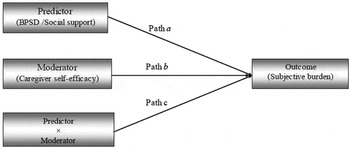
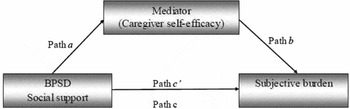
Therefore, the current study examined (a) the moderating role of caregiver self-efficacy between BPSD and subjective caregiver burden (Figure 1); (b) the moderating role of caregiver self-efficacy between social support and subjective caregiver burden (Figure 1); and (c) the mediation effects of caregiver self-efficacy on the influences of BPSD and social support on subjective caregiver burden (Figure 2).
Hypothesized moderation effects of caregiver self-efficacy on the relationships between the behavioral and psychological symptoms of dementia (BPSD)/social support and caregiver subjective burden.

Hypothesized mediating effects of caregiver self-efficacy on the relationships between the behavioral and psychological symptoms of dementia (BPSD), social support, and caregiver subjective burden.

Methods
Participants
We screened an initial sample of 196 caregivers (Zhang et al., Reference Zhang, Edwards, Yates, Ruth and Guo2013b), recruited from the neurological outpatient department of Shanghai Huashan Hospital, to arrive at a sample of 137 spouse CGs (79 wives) who provided the data in the present study. The criterion for inclusion was that the spouse provided most of the care for the patient with dementia (PWD, diagnosed using DSM-IV criteria). Spouses who were simultaneously caring for other relatives with a chronic medical condition were excluded. Permission to use the standard instruments was obtained from the original authors and ethical approval to conduct the study was also obtained by the designated institution prior to the survey. The procedure for recruitment and data collection was described in a previous article (Zhang et al., Reference Zhang, Edwards, Yates, Guo and Li2013a). Spouses simultaneously caring for any other relatives with a chronic medical condition were excluded. Thus, 137 spouses CGs completed the survey. Among the 137 participants, 131 participants completed the questionnaires at the hospital, and six at home; the latter were conducted up to 10 days after the hospital visit. The major reason for completing the questionnaires at home was the fatigue associated with doing these on the same day or inconvenience of the transportation to the hospital if participants were selected another day.
The mean age of PWDs was 71.0 years old (SD = 8.28), and that of spouse CGs was 69.9 (SD = 8.97) years old. PWDs’ stage of dementia was obtained from their medical records. Among the PWDs, 72 (52.6%) were diagnosed with mild stage of dementia, 25 (18.2%) were at a moderate stage, and 40 (29.2%) were at a severe stage.
Measures
Dementia-related impairments and subjective caregiver burden
The Mini-Mental Status Examination (MMSE) scores were obtained from the PWDs’ medical records. Levels of physical impairment and BPSD were assessed with the Chinese version of the Disability Assessment in Dementia (DAD; Mok et al., Reference Mok, Siu, Chan, Yeung, Pan and Li2005) and the Revised Memory and Behavior Problems Checklist (RMBPC; Fuh et al., Reference Fuh, Liu, Wang, Wang and Liu1999a), respectively. RMBPC data were reported by the spouses. The DAD assesses instrumental activities of daily living (DAD–IADLs, 25 items) and activities of daily living (DAD–ADLs, 22 items) during the most recent 2 weeks. The total scores on the DAD and on each of the two subscales were rated as a percentage of total possible score, with higher scores indicating better physical functioning. The psychometric properties of DAD were satisfactory: the Cronbach's α for the total score was 0.91, the test–retest reliability was 0.99, and the interrater reliability was 0.98. Total score of DAD has been reported to be significantly and inversely correlated with level of global deterioration (Spearman's rho = −0.89, p < .001; Mok et al., Reference Mok, Siu, Chan, Yeung, Pan and Li2005). The Chinese version of the RMBPC (Fuh et al., Reference Fuh, Liu, Wang, Wang and Liu1999a) measures three domains of BPSD: memory-related problems, depression, and disruption problems. The 24-item scale assesses levels of BPSD on 5-point Likert scales from 0 (never occurs) to 4 (occurs daily or more often). The total score and each subscale score range from 0 to 96. The Cronbach's α for the total score was 0.816, and the test–retest reliability was 0.89 (Fuh et al., Reference Fuh, Liu, Wang, Wang and Liu1999a). The RMBPC also comprises a subscale (RMBPCr, the Reaction scale of RMBPC) to measure caregivers’ reactions to the PWD's states. In this study, caregiver subjective burden was measured with the RMBPCr. The RMBPCr assesses the caregiver's reaction (upset) to each BPSD listed in the RMBPC from 0 (not at all) to 4 (extremely), yielding a total reaction score ranging from 0 to 96. The convergent validity of the scale was also satisfactory (Fuh et al., Reference Fuh, Liu, Wang, Wang and Liu1999a; Reference Fuh, Wang, Liu and Wang1999b).
Social support
The caregiver's perceived social support was measured with the Chinese version of the Medical Outcome Study Social Support Survey (MOS-SSS; Shyu et al., Reference Shyu, Tang, Liang and Weng2006). The MOS-SSS includes four subscales which measure positive social interaction (four items), plus three types of social support: (a) emotional and informational (eight items); (b) tangible (4 items); and (c) affectionate (3 items). Each item is rated on a 5-point scale of 1 (none of the time) to 5 (all of the time). The total score of MOS-SSS ranges from 0 to 100. Higher scores indicate more perceived social support. All Cronbach's α for the Chinese version of the scale were over 0.80, and the concurrent validity was also satisfactory (Shyu et al., Reference Shyu, Tang, Liang and Weng2006).
Caregiver self-efficacy
Caregiver self-efficacy was measured with the 27-item Self-Efficacy Questionnaire for Chinese Family Caregivers (SEQCFC) developed by the authors (Zhang et al., Reference Zhang, Edwards, Yates, Elder and Guo2012; Reference Zhang, Edwards, Yates, Ruth and Guo2013b). The questionnaire contains five domains of caregiver self-efficacy: (a) gathering information about treatment, symptoms, and health care (GI subscale, four items); (b) obtaining support (OS subscale, six items); (c) responding to behavior disturbances (RBD subscale, seven items); (d) managing the household, personal and medical care (MHPMC subscale, four items); and (e) managing distress associated with caregiving (MDC subscale, six items). The scores of total scale and subscale scores are rated as a percentage of 0% (“cannot do at all”) to 100% (“certainly can do”). Higher scores indicate a stronger sense of caregiver self-efficacy. The scale was reliable: all Cronbach's α were over 0.80, the 4-week test–retest reliabilities ranged from 0.64 to 0.85.Convergent validity was also acceptable (Zhang et al., Reference Zhang, Edwards, Yates, Ruth and Guo2013b).
Data Analysis
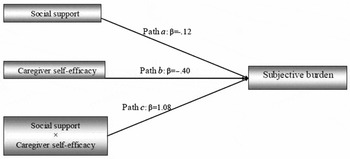
In accord with the guidelines of Baron and Kenny (Reference Baron and Kenny1986), we performed multiple regression analyses to test the hypothesized moderation (Figure 1) and mediation effects (Figure 2). To test the moderation effect of caregiver self-efficacy, the following regression equations were computed: (a) subjective burden as measured by RMBPCr, regressed on dementia–impairment variables (total scores of MMSE, RMBPC and DAD); and (b) social support (total score of MOS-SSS) (Figure 1, path a), on caregiver self-efficacy (total score of SEQCFC) (Figure 1, path b). If either BPSD or social support was a predictor of subjective burden, subjective burden would regress on the interaction of the corresponding predictor and caregiver self-efficacy (Figure 1, path c). As Baron and Kenny (Reference Baron and Kenny1986) pointed out, the mediation effect is identified when predictors significantly associate with both the mediator (Figure 2, path a) and outcome (Figure 2, path c), and when the mediator significantly influences the outcome (Figure 2, path b). We applied hierarchical multiple regression analysis to test the mediation effect of caregiver self-efficacy (Figure 2, path c and c′). The mediation effect occurred if a reduced effect of the predictor on subjective burden was observed when caregiver self-efficacy entered the equation (Figure 2, path c′). Sobel tests (Reference Sobel1986) were conducted to test the significance of the mediation effects. Prior to the analysis, normality, linearity, and homoscedasticity were tested and ensured, as was the absence of multicollinearity. All analyses were conducted using SPSS 16.0.
Results
Descriptive statistics
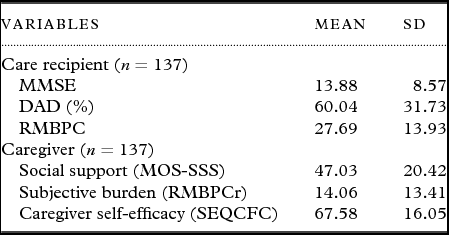
Table 1 shows the means of other variables. Measures relevant to PWDs’ are cognitive (MMSE) deficits, physical impairment (DAD), and BPSD (RMBPC). Caregiver variables are social support (MOS-SSS), self-efficacy (SEQCFC), and subjective burden (RMBPCr).
Descriptive statistics for MMSE, DAD, RMBPC, MOS-SSS, caregiver self-efficacy, and mental health

Abbreviations: MMSE, Mini-Mental Status Examination; DAD, Disability Assessment in Dementia; RMBPC, Revised Memory and Behavior Problems Checklist; MOS-SSS, Medical Outcome Study Social Support Survey; RMBPCr, Reaction Subscale of RMBPC; SEQCFC, Self-Efficacy Questionnaire for Chinese Family Caregivers.
Moderation effects
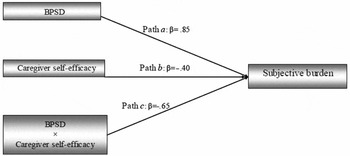
To meet the assumptions for the regression analyses, DAD was square-root transformed prior to the regression analysis. The results of moderation effect testing indicated that the composite influence of dementia-related impairments and social support was significant on caregiver subjective burden, explaining 63% of the variance in subjective burden scores (RMBPCr), F (4,136) = 58.552, p < .001, (Figure 1, path a). BPSD (RMBPC; β = 0.85, p < .001) and caregiver social support (MOS-SSS; β = −.12, p = .013) had significant and contrary influences on subjective burden. Caregiver self-efficacy (SEQCFC), the potential moderator, significantly and inversely influenced subjective burden (β = −.40, p < .001), accounting for 15% of the variance in subjective burden, F (1,136) = 25.280, p < .001 (Figure 1, path b). As each interacted predictor significantly influenced subjective caregiver burden (interaction of RMBPC and SEQCFC: β = −.65, p < .001; interaction of MOS-SSS and SEQCFC: β = 1.08, p = .013), caregiver self-efficacy demonstrated moderation effects on impact of RMBPC on subjective caregiver burden [interaction of RMBPC and SEQCFC: F (5,136) = 67.417, p < .001)] (Figure 3) and on the influence of social support on subjective caregiver burden (Figure 4), respectively [interaction of MOS-SSS and SEQCFC: F (3,136) = 11.331, p < .001)]. In addition, the results showed that RMBPC and MOS-SSS also have a moderating effect on the influence of caregiver self-efficacy on subjective burden.
Output model: caregiver self-efficacy moderating BPSD and caregiver subjective burden.

Output model: caregiver self-efficacy moderating social support and caregiver subjective burden.

Mediation effects
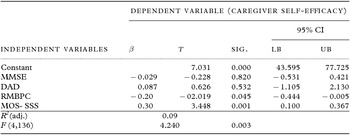
Tables 2 and 3 present the results of mediation effect testing. Table 2 shows that the composite influence of dementia-related impairment and social support variables on caregiver self-efficacy was significant, accounting for 9.0% of the variance in SEQCFC, F (4,136) = 4.240, p = .003). BPSD (RMBPC; β = −.20, p = .045) and social support (MOS-SSS; β = .30, p = .001) were two significant predictors of caregiver self-efficacy.
Regression of dementia-related impairments and social support on caregiver self-efficacy (path a)

*P ≤ .05; **P ≤ .01; ***P ≤ .001
Abbreviations: 95% CI, 95% Confidence Interval for B; LB, Lower Bound; UB, Upper Bound.
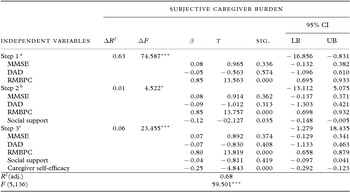
Hierarchical multiple regression of dementia-related impairments, social support, and caregiver self-efficacy on subjective caregiver burden (path c and c′)

*p ≤ .05; **p ≤ .01; ***p ≤ .001
Abbreviations: 95% CI, 95% Confidence Interval for B; LB, Lower Bound; UB, Upper Bound.
a, b Path c, influence of BPSD and social support on subjective caregiver burden.
c Path c′, mediation effects of caregiver self-efficacy on the influences of BPSD and social support on subjective caregiver burden.
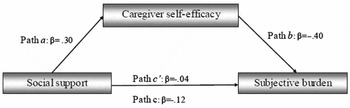
In the hierarchical multiple regression analysis (Table 3), the dementia-related impairments (MMSE, DAD, and RMBPC) entered as the first group of predictors, social support (MOS-SSS) entered as the second group of predictors, and caregiver self-efficacy entered as the third group of predictors. The results showed that the compound influence of all predictors was significant on subjective burden, F (5,136) = 59.501, p < .001. After adjusting for the influence of dementia-related impairments and social support, caregiver self-efficacy accounted for significant portions of subjective burden variance (β = −.25, ΔR 2 = .06, p < .001); the β value of RMBPC was reduced from 0.85 (p < .001) to 0.80 (p < .001); and the β value of MOS-SSS was significantly increased from −0.12 (p = .035) to −0.04 (p = .419), indicating a full mediation effect of caregiver self-efficacy between social support and subjective burden (Figure 5). But the results of Sobel tests (test statistic = 1.880, p = .06) showed caregiver self-efficacy had a borderline and partial mediation effect between the relationship of BPSD and subjective burden.
Output model: mediating effect of caregiver self-efficacy on the relationships between social support and caregiver subjective burden.

Discussion
Our study was an empirical exploration of both patient and situational influences on caregiver outcomes, adapted from Bandura's self-efficacy theory. We found links of caregiver self-efficacy to dementia-related impairments, social support, and subjective burden. Of all the dementia-related impairments, degree of severity of BPSD was a primary factor impairing caregiver self-efficacy. Spouse CGs who perceived more social support reported stronger confidence in overcoming caregiving impediments. CGs with higher self-efficacy reported less subjective burden. The findings confirmed the findings of our previous work (Zhang et al., Reference Zhang, Edwards, Yates, Ruth and Guo2013b) and related studies in terms of self-efficacy in dementia caregivers (Zeiss et al., Reference Zeiss, Gallagher-Thompson, Lovett, Rose and McKibbin1999; Gonyea et al., Reference Gonyea, O’Connor, Carruth and Boyle2005). Our results showed that CGs’ social support significantly influenced their sense of subjective burden, after controlling for PWD impairment. This finding is consistent with those of the previous studies (Pinquart and Sörensen, Reference Pinquart and Sörensen2003b; Clay et al., Reference Clay, Roth, Wadley and Haley2008; Etters et al., Reference Etters, Goodall and Harrison2008). However, the current study found that social support did not reduce the impact of PWDs’ impairment on the subjective burden variables. As the level of social support we found was not high, this result may indicate that the social support CGs perceived was too limited to managing dementia-related impairments, particularly BPSD.
The primary aim of the current study was to examine the mechanism by which caregiver self-efficacy influences subjective burden. According to Bandura (Reference Bandura1997), an individual's confidence in performing a specific task is influenced differentially by different situations. The dementia care literature highlights BPSD and social support as two primary situational factors. Our results also identified the indirect influence of social support on subjective burden through the mediation effect of caregiver self-efficacy. Au et al., (Reference Au2009) reported a partial mediation effect of caregiver self-efficacy between social support and depressive symptoms. Our findings help confirm the association of high level of subject burden with more depressive symptoms (Pinquart and Sörensen, Reference Pinquart and Sörensen2003a; Reference Pinquart and Sörensen2003b). The full mediation effect we found may indicate the importance of caregiver self-efficacy in reducing CGs’ distress due to responding to BPSD. We also found a borderline and partial mediation effect of caregiver self-efficacy on the impact of BPSD on subjective burden. The majority of PWDs in the current study were at a mild stage of dementia, and this might help explain the low levels of BPSD and subjective burden. Therefore, the identified borderline effect maybe associated with the low levels of BPSD and corresponding subjective burden. Although the borderline effect requires further exploration, the present results suggested that enhancing caregiver self-efficacy may be a possible strategy that can help to reduce the impact of BPSD on CGs’ subjective burden.
In addition, the buffering roles of caregiver self-efficacy identified in the current study indicate that the influences of BPSD and social support on subjective burden also depended on the extent of caregiver self-efficacy. The findings are potentially important contributions to caregiver self-efficacy research and can be interpreted based on Bandura's theory. Confronted with severe BPSD or perceiving a certain degree of social support, CGs with a strong sense of caregiver self-efficacy tended to view the BPSD of care recipients as a challenge to overcome, or to use supportive resources to deal with caregiving challenges more effectively and efficiently. Such CGs consequently experienced less subjective burden. CGs with a weaker sense of caregiver self-efficacy might possibly have focused on past failure experiences, regarded the same severity of BPSD as threatening, perceived the same level of support with less positive emotional responses to their caregiving role, and eventually felt a higher level of subjective burden. Therefore, the findings of our mediation and moderation exploration imply that enhancing caregiver self-efficacy can be an essential strategy in developing intervention to reduce CGs’ subjective burden.
Since this investigation was an initial study conducted in mainland China on possible buffering and mediating roles of caregiver self-efficacy on the influences of BPSD and social support on subjective burden, some limitations should be noted; those elements suggest further studies. The low levels of BPSD and subjective burden and the borderline and partial mediation effect of caregiver self-efficacy between BPSD and subjective burden were possibly associated with the single recruitment centre used in the current study. Thus, further multicentre studies would be beneficial. Further, the subjective burden measure used in this study may not have assessed a broad enough scope of CG response. The Reaction Scale of Revised Memory and Behavioral Problem Checklist (RMBPCr) used in the current study mainly focused on subjective burden specifically related to BPSD. Hence, the subjective burden related to other aspects of dementia-related impairments (cognitive impairment and disability) possibly may not have been assessed directly or adequately. This limitation suggests that subjective burden instruments used in future investigations should reflect caregivers’ reactions to all main impairments of care recipients. In addition, in future studies, a larger sample size would facilitate the exploration of more complicated relationships among the conceptual constructs. Future studies will also explore the influences of socioeconomic and demographic variables on CGs’ self-efficacy and subjective burden because of the focus of this study. Lastly, a cross-sectional design with degree of impairment as a variable could be useful and might be more practical, a longitudinal design, however, could explore the possible influence of the stages of the dementia trajectory on caregiver self-efficacy and subjective burden. Moreover, longitudinal studies could also clarify the directionality of the identified effects during this trajectory.
Nonetheless, the data presented here help elucidate the important role of caregiver self-efficacy in the paths of the two external factors (BPSD and social support), which influence subjective burden. A population-based investigation (Zhang et al., Reference Zhang2004) conducted in four large cities of China (Beijing, Xian, Shanghai, and Chengdu) reported that over one-third of dementia CGs was spouses in mainland China. Considering factors such as China's “one child” policy, increasing life expectancy, and rapid growth of the aged population in the country, it is a fairly safe prediction that increasing numbers of old people with degenerative chronic diseases such as dementia will have to depend mainly on the care from their aged and frail spouses. Therefore, our study also contributes to the research on this population in China. The findings of our study imply that enhancing caregiver self-efficacy—particularly self-efficacy for symptom management—can be considered an integral part of interventions to reduce the subjective burden of an aging, and progressively frailer, population in China.
Conflict of interest declaration
There are no known conflicts of interest associated with this publication and there has been no significant financial support for this work that could have influenced its outcome. This work is not currently under review by another journal and has not been previously published elsewhere either in printed or electronic form. All authors have contributed significantly, and all authors are in agreement with the content of the manuscript. This study was approved by the designated hospital and Human Research Ethics Committee of Queensland University of Technology (0900000393).
Description of authors’ roles
Dr. Shu Ying Zhang designed the study, conducted data collection and data analysis, and wrote the manuscript. Dr Helen Edwards and Dr. Patsy Yates supervised the study design and provided the suggestion for data collection. Dr. Qi Hao Guo supervised the study design and data collection and provided fund for data collection. Dr. Chun Bo Li supervised the study design, provided the suggestion for data collection, data analysis, and supervised the write-up.
Acknowledgment
The author wishes to thank all the participants and the cooperation of the staff at the Geriatric Psychiatry Department of Shanghai Mental Health Centre and the Neurological Institution of Shanghai Huashan Hospital. We also appreciate Dr. Guk-Hee Suh and peer reviewers for their constructive comments. This work was funded by the Scientific Research Foundation for the Returned Overseas Chinese Scholars, State Education Ministry to Dr. Shuying Zhang.