Introduction
Alveolar echinococcosis is a refractory disease caused by Echinococcus multilocularis in the metacestode stage (Moro & Schantz, Reference Moro and Schantz2009). In nature, this parasite is maintained primarily between wild foxes and many species of rodents (Eckert & Deplazes, Reference Eckert and Deplazes2004). Dogs are a minor definitive host, except in highly endemic areas such as western China and part of Alaska (Torgerson & Budke, Reference Torgerson and Budke2003; Carmena & Cardona, Reference Carmena and Cardona2013). However, dogs are highly susceptible to E. multilocularis infection. Because of the close contact between dogs and humans, infection of dogs with this parasite poses a risk to human health.
In dogs, infection with E. multilocularis is caused by predation of an intermediate host infected with the worm in the larval stage. Larval worms grow to adult worms within 4–5 weeks in the canine small intestine, where they then produce eggs. Specific antibodies have been detected in the serum of dogs experimentally infected with E. multilocularis during infection. Thus, E. multilocularis is immunogenic in the canine gastric tract (Gottstein et al., Reference Gottstein, Deplazes, Eckert, Müller, Schott, Helle, Boujon, Wolff, Wandeler, Schwiete and Moegle1991; Deplazes & Eckert, Reference Deplazes and Eckert1996; Kouguchi et al., Reference Kouguchi, Matsumoto, Katoh, Suzuki, Oku and Yagi2010, Reference Kouguchi, Matsumoto, Yamano, Katoh, Oku, Suzuki and Yagi2011). Some studies have reported that the repeated infection of dogs with Echinococcus partially reduces the worm burden (Gemmell et al., Reference Gemmell, Lawson and Roberts1986; Tanaka, Reference Tanaka1998; Rossi et al., Reference Rossi, Marqués, Gavidia, Gonzalez, Carmona, García and Chabalgoity2012). However, it remains unclear whether this is because of acquired immunity or genetic factors. In addition, in recent reports, the development of a practical vaccine for a definitive host was conducted by using a recombinant technique (Zhang et al., Reference Zhang, Zhang, Shi, Li, You, Tulson, Dang, Song, Yimiti, Wang, Jones and McManus2006; Petavy et al., Reference Petavy, Hormaeche, Lahmar, Ouhelli, Chabalgoity, Marchal, Azzouz, Schreiber, Alvite, Sarciron, Maskell, Esteves and Bosquet2008). However, technical difficulty remains in the interpretation of data from definitive hosts (Torgerson, Reference Torgerson2009). Therefore, basic data from immunized dogs would be important for the successful development of a practical vaccine for a definitive host.
Despite the need to develop new measures to control and prevent the transmission of E. multilocularis, little research has investigated E. multilocularis vaccination in dogs because of its inherent biohazards. We found previously that a glycoprotein component, SRf1, which is purified from E. multilocularis protoscoleces, showed immunoreactivity with intestinal immunoglobulin A (IgA) and serum immunoglobulin G (IgG) in infected dogs (Kouguchi et al., Reference Kouguchi, Matsumoto, Nakao, Yamano, Oku and Yagi2013). Furthermore, mucosal immunization with this component induced a significant reduction in the worm burden in immunized dogs. However, this vaccine candidate needs to be examined for its longevity of efficacy after immunization by performing experimental challenge infections.
The expulsion of worms in dogs repeatedly infected with E. multilocularis may be closely related to the immunological expulsion of worms in vaccinated dogs. In this study, the phenomenon of E. multilocularis adult worm expulsion was examined in dogs.
Materials and methods
Collection and examination of dogs
All surgery was performed under sodium pentobarbital anaesthesia, and every effort was made to minimize suffering. Fifteen female beagles aged between 3 and 14 months were purchased from Sankyo Labo Service Corporation (Sapporo, Japan) the animals were fed daily and had access to water ad libitum.
Echinococcus multilocularis isolated in Hokkaido (Nemuro strain) was routinely maintained through a dog–cotton rat life cycle at the Hokkaido Institute of Public Health (Sapporo, Japan). Protoscoleces were collected from cysts developed in cotton rats at 5–14 months after infection. All experiments in this study were performed in a specially designed safety facility at the Hokkaido Institute of Public Health.
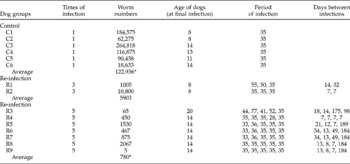
All dogs were orally administered 5 × 10⁵ E. multilocularis protoscoleces and the infection was terminated 35–77 days post-infection (dpi) by administering two tablets of Droncit® (Bayer-Animal Health, Leverkusen, Germany). After 48 h, the deworming procedure was repeated by administering one tablet of Droncit®. Re-infection of dogs was repeated from 2 to 4 times and six dogs in the control group were infected once using the same procedure (see table 1). Following the final infection the dogs were euthanized. The small intestine was removed, divided into six sections and incubated in 100 ml of Dulbecco's modified Eagle's medium (DMEM) at 4°C for 7 days. Naturally released and scraped worms were counted in dilutions of 1:125.
Infection regimes to show the number of worms of Echinococcus multilocularis removed from dog groups 35 days following the first, third and fifth days of infection with variable intervals (in days) between infections.

*Level of significance given as P < 0.05.
Collection and examination of faecal/serum samples
During the course of infection, faeces were collected daily, except for one day at the weekend, and thoroughly mixed with a rubber spatula and plastic bowl. All faecal samples were heated at 70°C overnight to remove biohazards. Serum samples were collected weekly and stored individually at − 30°C until use.
The condition of the faeces was classified into three grades – normal, mucoid and exhibiting diarrhoea. The E. multilocularis copro-antigen was detected using monoclonal antibody EmA9 sandwich enzyme-linked immunosorbent assay (ELISA), as described by Nonaka et al. (Reference Nonaka, Nakamura, Inoue, Oku, Katakura, Matsumoto, Mathis, Chembesofu and Phiri2011).
The number of eggs was examined, as described previously (Morishima et al., Reference Morishima, Tsukada, Nonaka, Oku and Kamiya1999a, Reference Morishima, Tsukada, Nonaka, Oku and Kamiyab). In brief, 1.25 g of faecal samples were suspended in distilled water. Fifty millilitres of the suspension were passed through a tea strainer and centrifuged at 2500 rpm for 15 min. Flotation was repeated twice with a sucrose solution having a specific gravity of 1.27 (Ito, Reference Ito1980). The supernatant was diluted with 10 volumes of distilled water and the sediment was recovered by centrifugation. A total of 0.6 ml of the 5 ml of clean suspension was used for egg counting.
The presence and detection of hooks in the faeces were determined by the AMS III concentration technique (Hunter et al., Reference Hunter and Hodges1948). Two grams of each faecal sample were suspended in 10 ml of distilled water and then washed well with a tea strainer and distilled water. Twenty millilitres of the final volume of the suspension was centrifuged at 3000 rpm for 15 min. Sediments were resuspended in 7 ml of the ASM III solution and 3 ml of diethyl ether and a few drops of Tween-20 were subsequently added. After vigorous mixing and centrifugation at 3000 rpm for 15 min, the ether phase and supernatant were discarded. A total of 0.1 ml of the 4 ml of clean suspension was used for counting hooks at × 200 magnification. The recovery of hooks from the faeces was 11.5 ± 3.2% in a preliminary experiment with ten normal faecal samples (water content, 60.4–79.7%).
ELISA
Specific serum antibodies to SRf1 were measured by indirect ELISA on a 96-well plate, as described previously (Kouguchi et al., Reference Kouguchi, Matsumoto, Nakao, Yamano, Oku and Yagi2013). Wells were reacted overnight at 4°C with sample sera diluted 1:100 with a dilution buffer (i.e. 1.0% (w/v) casein in phosphate-buffered saline (PBS)/Tween). Wells were then washed with PBS/Tween and incubated with horseradish peroxidase-conjugated rabbit anti-dog IgG, IgA or IgE at a dilution of 1:3000 in dilution buffer for 1 h at 37°C.
Data analysis
Data analysis was performed using R version 2.15.2 software (R Foundation for Statistical Computing, Vienna, Austria). The Shapiro–Wilk normality test demonstrated that the data were not normally distributed; therefore, the non-parametric Mann–Whitney U test was used to compare the number of parasites between single infection and five-time infection groups. A P value < 0.05 was considered to be statistically significant.
Results and discussion
There is some evidence that dogs repeatedly infected with Echinococcus organisms show partial resistance to infection, but these reports only refer to E. granulosus (Gemmell et al., Reference Gemmell, Lawson and Roberts1986; Rossi et al., Reference Rossi, Marqués, Gavidia, Gonzalez, Carmona, García and Chabalgoity2012). To our knowledge, there is one limited report describing the re-infection of dogs with E. multilocularis (Tanaka, Reference Tanaka1998). As a first step towards characterizing exclusion of this tapeworm, six dogs were experimentally infected and re-infected with E. multilocularis using various schedules. Dogs initially infected showed worm burdens ranging from 18,633 to 264,818 (table 1). Worm establishment in dogs that were repeatedly infected up to three times with E. multilocularis showed numbers up to 1005 in dog R1 and 10,800 in dog R2. The mean number of worms decreased by 91.8% in these two dogs, compared with controls. Statistical significance was not reached, probably because of the low number of dogs that were infected three times with E. multilocularis (n= 2). Worm burdens in seven dogs (dogs R3–R9) that were repeatedly infected five times ranged from 5 to 2067. The mean number of worms decreased significantly by 99.4% in repeatedly infected dogs, compared with controls (P= 0.001 by Mann–Whitney U test). Thus, all of these findings indicated that dogs repeatedly infected with E. multilocularis expelled a large number of worms, which coincided with the findings of a previous report (Tanaka, Reference Tanaka1998).
To determine whether the worm expulsion was a non-specific response, five dogs (dogs R5–9) were re-infected after a 6-month interval, following four repetitions of sequential infection. In this case, the worm burden in these dogs ranged from 5 to 2067 organisms, which suggested that the protection response in dogs that were repeatedly infected with E. multilocularis was not a temporary response. In general, the immunogenicity of the adult stage of the cestode is little or very low (Rickard, Reference Rickard, Arme and Pappas1983). However, excreted/secreted components of adult E. multilocularis stimulate the host's immune system through direct contact with the host's intestinal mucosa (Thompson & Eckert, Reference Thompson and Eckert1983; Smyth & McManus, Reference Smyth, McManus, Smyth and McManus1989). Indeed, host antibody responses against the parasite's body surface have been detected in the sera from infected beagles (Kouguchi et al., Reference Kouguchi, Matsumoto, Yamano, Katoh, Oku, Suzuki and Yagi2011, Reference Kouguchi, Matsumoto, Nakao, Yamano, Oku and Yagi2013). Because of the variability between dogs in their susceptibility to Echinococcus, such an experiment would require a large number of dogs in each group for statistical validity. Therefore, research on the immunological response in definitive hosts is limited. This was the first report of dogs (beagles) developing a resistance to E. multilocularis (Hokkaido isolate) by repeated infection and maintaining resistance against this infection for 6 months.
Naturally infected older dogs have a lower abundance and/or prevalence of E. granulosus compared to younger dogs (Lahmar et al., Reference Lahmar, Kilani and Torgerson2001; Torgerson et al., Reference Torgerson, Shaikenov, Rysmukhambetova, Ussenbayev, Abdybekova and Burtisurnov2003; Budke et al., Reference Budke, Jiamin, Craig and Torgerson2005; Moro et al., Reference Moro, Lopera, Bonifacio, Gonzales, Gilman and Moro2005; Buishi et al., Reference Buishi, Njoroge, Zeyhle, Rogan and Craig2006). Similar results have been reported in foxes naturally infected with E. multilocularis (Hofer et al., Reference Hofer, Gloor, Müller, Mathis, Hegglin and Deplazes2000; Yimam et al., Reference Yimam, Nonaka, Oku and Kamiya2002; Losson et al., Reference Losson, Kervyn, Detry, Pastoret, Mignon and Brochier2003). Rossi et al. (Reference Rossi, Marqués, Gavidia, Gonzalez, Carmona, García and Chabalgoity2012) reported that dogs receiving three or six consecutive rounds of cure and re-infection had a marked reduction in parasite burden after the last infection. By analysing cytokine gene expression, they suggested that successful establishment of E. granulosus in dogs requires immunomodulation of the host response (Rossi et al., Reference Rossi, Marqués, Gavidia, Gonzalez, Carmona, García and Chabalgoity2012). Likewise, Gemmell et al. (Reference Gemmell, Lawson and Roberts1986) showed that 50% of dogs repeatedly infected six times with E. granulosus developed a relative insusceptibility to infection. These facts all provide strong evidence that canines do become partially resistant to re-infection.
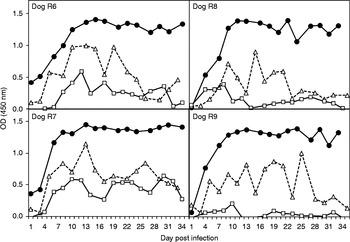
The time course of the amount of parasite antigen in the faeces from four dogs infected with E. multilocularis on the first, third and fifth infection times is shown in fig. 1. There were no clear differences between first and second, and fourth and fifth infections (data not shown). On the first infection, the parasite antigen in all dog faeces increased from 3 dpi and the ELISA absorbance reached its maximum point at approximately 12 dpi. The excretion of this level of the parasite antigen in the faeces continued to 35 dpi (i.e. the day of deworming).
Faecal examination of four dogs (R6–R9) repeatedly infected with Echinococcus multilocularis with copro-ELISA undertaken every 2 days, from day 1 to 35; absorbances were recorded on the first (●), third (△) and fifth (□) times of infection.

On the third infection, the parasite antigen level in all dog faeces increased from 5 dpi and the absorbance reached more than 0.7 at 9–12 dpi. During all periods of infection, the amount of parasite antigen in the faeces from dogs repeatedly infected for three times was lower than the amount from dogs infected for the first time. This result reflected that the worm burden in dogs repeatedly infected three times was lower than that of dogs infected for the first time. The total number of eggs from dogs repeatedly infected three times was substantially lower than that from dogs infected at the first time (table 2). This was consistent with the results from copro-ELISA showing a relation between the number of worms and the amount of parasite antigen in the faeces.
The mean number of eggs (± SE) deposited in the faeces of four dogs (R6–R9) infected with Echinococcus multilocularis following the first, third and fifth infections.

ND, not detected.
During all infection periods in the fifth infection after a 6-month interval, the time course of the ELISA values of faeces samples from dogs infected five times was lower than that of the third infection. The total number of eggs excreted in the faecal samples from four dogs infected five times (excluding dog R7) was undetermined (table 2), which was consistent with the ELISA results. These results suggested that the worm burden gradually decreased each time the dogs were re-infected.
Hooks were detected from the early stage of infection (1–6 dpi) to the patent period in all four dogs tested. In most cases, hooks were detected accompanied with diarrhoea and/or mucus during all infection periods. This result suggested that exclusion of worms started at the early stage of the infection and the exclusion was continued for all infection periods. In this assay, a large number of hooks were detected from faeces samples collected at 1–2 dpi (data not shown). It may be that these faeces samples contained most of worms that had not become established after the administration of protoscoleces.
Diarrhoea and/or mucus were observed in 2 of 4 dogs at the first infection. No diarrhoea and/or mucus were observed in these four dogs before infection. Frequent diarrhoea (sometimes bloody) and/or mucus were observed from the early stage of re-infection in all dogs repeatedly infected with the parasite. The phenomenon occurred more frequently in the third to the fifth infections. Thus, this finding suggested that repeated infection induced those physiological responses that were closely related to parasite expulsion in dogs infected repeatedly.
Kapel et al. (Reference Kapel, Torgerson, Thompson and Deplazes2006) reported the worm burden in dogs (FBI hound) experimentally infected with E. multilocularis (Swiss isolate). The dogs showed relatively more worm burden towards the end of the observation period as compared with foxes and raccoon dogs, suggesting that the immune response developed in dogs against a single infection with E. multilocularis is not highly effective in expelling the parasite. On the other hand, upon repetition of infection in our study, the worm expulsion started at the early phase of the infection, which was more obvious in re-infections than in first infections. However, it seems that dogs failed to develop an effective immune response once the parasite survived and developed into the adult stage, as suggested by our results of the copro-antigen assay. Failure to develop an effective immune response to the surviving worms during the later phases of infection is consistent with the work by Kapel et al. (Reference Kapel, Torgerson, Thompson and Deplazes2006) but contradictory to the findings in E. granulosus-infected dogs.
A mathematical modelling study was performed to explain the epidemiology of both E. multilocularis and E. granulosus in a highly endemic area in China (Budke et al., Reference Budke, Jiamin, Craig and Torgerson2005). The authors concluded that the absence of immunity was the best fit for E. multilocularis infection in dogs, whereas the presence of immunity was the best fit for E. granulosus infection. This could be an explanation for the epidemiological difference between the two species in that region.
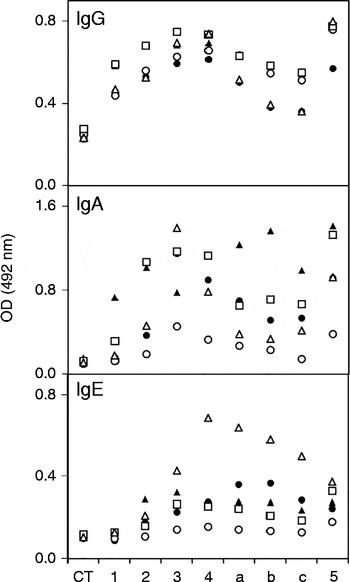
Figure 2 shows the time course of serum antibodies (i.e. IgG, IgA and IgE) against the parasite antigen SRf1 in the sera from six dogs infected five times at each 35 dpi during all infection periods. The ELISA absorbance values of IgG, IgA and IgE in the sera from dogs repeatedly infected two to five times were all higher than the absorbance of sera from the dogs before infection. These antibody titres decreased during the 6-month interval, but did not decrease to as low a level as before the infection. The ELISA absorbance values of IgG, IgA and IgE in the sera at 35 dpi after the fifth infection increased to nearly the same level as these values at the third infection. Moreno et al. (Reference Moreno, Benavidez, Carol, Rosenkranz, Welle, Carmona, Nieto and Chabalgoity2004) showed the serum IgG response to parasite antigen from six dogs experimentally infected with E. granulosus. Each of these dogs showed widely different IgE and IgA responses; however, there was no relationship between the serum IgA responses and the parasite burden. Likewise, they showed the possibility of an inverse association between the anti-parasite IgE and the parasite load. In the present work, a similar tendency was observed in dog R9. The relationship between these antibody responses and worm exclusion in dogs remains unclear, although it is important information that the antibodies against the parasite antigen are maintained for at least 6 months in the sera of dogs infected with this parasite four times.
Sera IgG, IgA and IgE responses with optical densities (492 nm) against parasite surface antigen (i.e. SRf1) in the sera of dogs R5 (●), R6 (▲), R7 (○), R8 (□) and R9 (△) infected with up to five repeated infections, including samples taken one (a), three (b) and six (c) months following the fourth infection. CT, control.

As indicated in this study, dogs appropriately immunized with a potent mucosal immunogen may have diarrhoea and/or excrete mucus in faeces accompanied by the excretion of hooks. The detection of the number of worms excluded in the faeces is often accompanied by technical difficulties. The analysis method for the detection of hooks in dog faeces presented in this study would be a useful indicator for the successful development of a vaccine for a definitive host. Further studies are required to determine how mucosal immunization induces protection against E. multilocularis infection in dogs. Histopathological examination in the early stage of infection in dogs and the identification of genes that have an important protective role will be essential for understanding the mechanisms of worm expulsion in dogs.
Acknowledgements
The authors thank Dr Kenji Ishiwata for his helpful suggestions. The authors also thank Keisuke Yokoyama, Shinobu Sato, Saori Nakamura and Mami Tanaka for their helpful assistance.
Financial support
This work was supported by JSPS KAKENHI Grant-in-aid for scientific research (C) (grant number 25460524).
Conflict of interest
None.
Ethical standards
The present study was performed in strict accordance with the Guidelines for Animal Experimentation of the Japanese Association for Laboratory Animal Science, and the protocol for the animal experiments was approved by the ethics committee of the Hokkaido Institute of Public Health (permit number: K25-02).