The Chinese Buddhist canon (hanwen fojiao da zangjing 漢文佛教大藏經), which consists of several thousand volumes of Buddhist literature, serves as the major source of Chinese Buddhist doctrines and exegesis. Initially compiled in the sixth century in handwritten form, this canon began to use printing technology in its production in the tenth century. Since then, more than twenty printed editions of it have been produced and circulated in East Asia, but most no longer exist in their entirety today. Through its wide circulation, the Buddhist canon has significantly influenced the liturgy and the life of the saṃgha (the Buddhist community), and facilitated the domestication of Buddhism in East Asia. Current scholarship on this canon is mostly philological, historical, and technological in nature, stressing the survey of diverse editions of the canon, their interrelationships, and variations in individual scriptures. In contrast, little attention has been given to its dissemination.Footnote 1 Like in other religious canons, circulation is a precondition in order that this canon could exert its intended function. This lacuna has thus prevented us from understanding not only a significant aspect of the canon itself but also the spreading of Buddhism across space and over time.
This paper is an effort to fill in this gap. It will examine the diffusion of the Northern edition produced in the Yongle period (1403–1424) (Yongle Beizang 永樂北藏; hereafter cited as Beizang) in Wanli (1573–1620) China,Footnote 2 with a focus on the socio-political dynamics behind the dissemination and its corresponding consequences. This paper will develop four sections, beginning with a survey of the circulation of this canon in Wanli China and an examination of the motivations of its main patrons. I then present two case studies, showing some monk's journeys to Beijing in pursuit of the Beizang and their experiences there. In the third section I will analyze how, and to what degree, competing agendas and interests interplayed in this process, with an emphasis on the mobilisation of local people and their active participation. In the last section, my focus will shift from cooperation to conflicts among participants, particularly those between eunuchs and local residents, and examine how these conflicts impacted the development of the temple receiving a canon. Finally, I will end this paper with some concluding remarks.
1. Distributing the Canon Nationwide: A Survey
The Beizang had a special status in all of the Buddhist canons that were carved and circulated during the Ming period (1368–1644). This dynasty created four editions of the canon, three sponsored by the government and one sponsored by private individuals.Footnote 3 Regarding the editions, a contemporary author commented as follows:
There are two versions, northern and southern, of [the Buddhist] canon [produced] in our dynasty.Footnote 4 The northern version is preserved in the inner court and cannot be obtained without the imperial bestowal. Hence, those owned by various temples are mostly the southern version. However, [the quality of the southern one] is much worse. Sometimes several words or even lines are dropped, making it no longer comprehensible. On the rare occasion that [people] obtain a copy of the northern version, [they feel] no less lucky than when they personally visit the Vulture Peak and listen to the Buddha's preaching [of Buddhist teachings].Footnote 5 我朝大藏有南北二本, 北本定大內, 非敕賜不可得, 故諸山所有南本爲多. 然差之爲特甚, 或脫數字數行至不成讀. 間得北本, 不減躬詣靈山, 聞廣長舌親宣也.Footnote 6
The southern edition refers to the Yongle southern canon (Yongle nanzang 永樂南藏) and the northern edition the Beizang, both of which were carved with government funds during the Yongle period (1403–1424).Footnote 7 The Beizang was modelled on the Yongle nanzang's content. But when compared to the latter, it is better in quality and looks more elegant because the number of words carved on each page was purposely reduced by the Yongle emperor. Afterwards, the Beizang was used explicitly as a gift by the royal family to their favourite temples and monks.
Such a special status greatly increased the difficulties in the transmission of the Beizang. Unlike the Yongle nanzang which could be purchased by anybody and taken to anywhere, the special status of the Beizang made its transmission much more complicated. To print and decorate this canon costs an estimated six hundred taels of silver, much higher than the price of the southern canon, which was in the range of 65 to 289 taels depending on the quality.Footnote 8 To deliver the Beizang was also challenging, for many of the recipient monasteries were chosen for political reasons and thus were located deep in mountainous or frontier areas. Even when the canon arrived at its destination, it did not mean the end of the trouble. A separate building was required to store the canon, and a stone stele needed to be erected with a protection edict (huchi 護敇) carved on it.
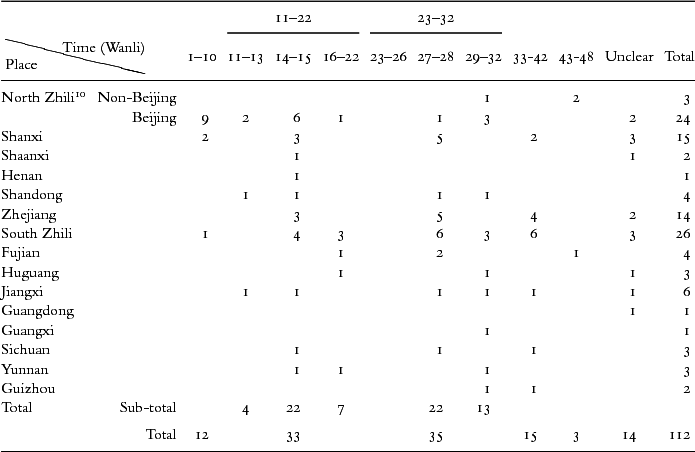
Although the carving of the Beizang was finished in Zhengtong 10 (1445), it was rarely bestowed during the following one hundred years. Things changed significantly in the Wanli period, however. Based on local and monastic gazetteers, I have identified more than one hundred copies of this canon that were bestowed across the empire. Table 1 below provides a general look at these bestowed copies of the canon.
The Spatiotemporal Feature of the Beizang Distribution in the Wanli eraFootnote 9

Based on this Table, a further spatiotemporal analysis reveals several points in the circulation deserving special attention. First, the distribution was not constant, and there were some waves of bestowal. More specifically, twelve copies were sent out in the first ten years, but this number nearly tripled to thirty-three in the next twelve years. In the decade after Wanli 22 (1594) the bestowed copies further increased, although slightly, and then dropped by 57 percent in the fourth decade. During the six years from Wanli 43 (1615) to 48 (1620), only one copy was issued. The distribution peaked during two periods, Wanli 14–15 (1586–1587) and Wanli 27–28 (1599–1600) respectively, but in the period from Wanli 23–26 no copies of the canon were despatched at all. Geographically, among all fifteen province-level administrative units, North Zhili and Shanxi received forty-two copies and South Zhili and Zhejiang forty, together taking up seventy-three percent of the canons granted in the Wanli reign. Moreover, in the first twenty-two years North Zhili and Shanxi received fifty-one percent while South Zhili and Zhejiang only got twenty-four percent of all given canons. After that, the latter outweighed the former with a ratio of forty-three to twenty-six percent. In particular, changes in Beijing's share in these two phases deserve special attention. Beijing received twenty-four copies and ranked first among all places obtaining canons, but its percentage among the whole country dropped from 40 to 8 from the first half to the second.
Since the circulation of the Beizang is significantly different in time and space, questions arise: How could temples that were far away from the capital be chosen as candidates to accept the Beizang? To what degree was the acquisition of this canon decided by chance? What elements were at work behind the acquisition of a canon? How did these conditions eventually affect the acquisition process?
We can begin with Dong Qichang 董其昌 (1555–1636; jinshi, 1589),Footnote 11 a devout Buddhist and leading artist of the time, who observed that “Currently, belief in Buddhism in the realm is rather thriving. . . . [But] it is rare [among temples] to obtain the bestowed canon of 5,480 fascicles. There is not a single copy even in an area for one thousands li around. If [a copy] does exist, the place must be as famous as the E’mei mountain and the five sacred mountains,Footnote 12 where grand ceremonies of worshipping heaven have been conducted, or in the second capital (i.e., Nanjing) and the cradle where the emperor founded the dynasty (i.e. Fengyang 鳳陽 in Anhui), where various deities have manifested themselves for the first time. If not, they should be located in [Mount] Jin, [Mount] Jiao, and the Luojia [island] (i.e. Putuo island),Footnote 13 which are the deepest point of rivers and seas”. (今海內奉大雄之教甚盛. . . .其得敕賜大藏經五千四百八十卷者蓋寥寥乎. 千里而遙, 曾無一焉. 間有之, 必其封望之名山, 如三峨五嶽者. 又不然, 則如陪京興都, 神靈之發迹也. 又不然, 則如金、焦、落伽, 江海之奧區也.)Footnote 14 Dong listed conditions for the acquisition of the Beizang, but he left some essential problems unexplored.
As spreading the Beizang was a time- and money-consuming enterprise, the first question to ask is why people would take the trouble to do it at all. Judging from the “protection edict” accompanying the bestowed canons, we now know that Empress Dowager Cisheng 慈聖 (1545–1614) and her son the Wanli emperor (r. 1573–1620) served as major benefactors for the distribution.Footnote 15 Cisheng was famous as a devoted Buddhist believer and patron of Buddhism.Footnote 16 Wanli, although less enthusiastic about Buddhism than his mother, was still a Buddhist follower.Footnote 17 Circulating the Beizang constituted an important part of their Buddhist enterprise. As a consequence, in Wanli 14 (1586) and 15 (1587), Cisheng bestowed fifteen copies of the canon to fifteen temples.Footnote 18 Three years later, she sponsored the printing and distribution of more than twenty copies at her own cost.Footnote 19 In Wanli 27 (1599) and 28 (1600), Wanli became the major driving force behind the successive waves of canon-granting.Footnote 20 Buddhism has a consistent policy of encouraging people to circulate Buddhist sutras, claiming that it is most effective in collecting merits and that in doing so people will be rewarded ten thousand times what they have expended (舍一得萬報).Footnote 21 In this sense, it is easy to understand the engagement of Cisheng and Wanli in the circulation of the Beizang.
But this explanation is not enough; the shift from Cisheng to Wanli as the primary patron circulating the canon actually hints at a strong political shift, and the imperial motives on these occasions were frequently not so much religious as they were socio-political. Protection edicts that accompanied each bestowed canon remained unaltered in content for the periods specified, and they reveal clearly a socio-political motivation. In the 1584 edict, Wanli said, “I think that Buddhist teachings have all been included in the canon. [Thus], it would be helpful to protect the state and assist the people if [we] use [the canon] to transform and guide good people and to enlighten the deluded”. (朕惟佛氏之教, 具在經典, 用以化導善類, 覺悟群迷, 于護國佑民, 不為無助.)Footnote 22 Here the emperor was simply using a traditional formulation to justify his favour of Buddhism. But in the 1587 edict, notably, Cisheng said, “[In doing so, I] wish that the emperor and the crown prince rule the world forever, and that the ministers be loyal and children be filial”. (祝皇帝皇儲而永禦萬邦, 願臣忠子孝.)Footnote 23 On the surface, it was suitable for Cisheng to express this wish given her status as the reigning emperor's mother and the head of the inner court but, in the context of the Wanli period, she actually touched upon a very sensitive political event - the succession issue that dominated the Wanli court - when mentioning the crown prince. Wanli's empress did not produce him a son. According to the established primogeniture system, his first son, born by one of his courtesans, thus had the privilege of succeeding the throne. But Wanli himself preferred his third son because the latter was born by his beloved courtesan. A stalemate, usually called the succession issue, thus formed and lasted several decades.Footnote 24 In the process, Cisheng took a stance in opposition to that of Wanli. Judging from her consistent standpoint, the crown prince mentioned in the protection edict must have referred to Wanli's oldest son,Footnote 25 and in doing so she made the bestowal of the Beizang a declaration of her stance within the strife-ridden court.Footnote 26
The political flavour is strongest in the 1599 edict. Shown in Table 1, at least twenty-one copies of the canon were bestowed in the two years of Wanli 27 and 28. Wanli himself was the driving force behind this wave of distribution, and he disclosed his intention in the protection edict: “[I wish that the circulation of copies] could make me healthy and peaceful and keep the inner court stable and in order. [I] repent for [my] previous wrongdoings and pray for longevity and permanent blessings. [I wish that] the people be tranquil, the country be safe, and the world under Heaven be peaceful. [In this way], [people] in the four seas and eight directions will all return to the teaching of benevolence and sympathy (i.e. Buddhism), and I am able to rule the state in the non-action way”. (保安眇躬康泰, 宮壺肅清, 懺已往愆尤, 祈無疆壽福, 民安國泰, 天下太平. 俾四海八方, 同歸仁慈善教, 朕成恭己無為之治道焉).Footnote 27 The most telling thing here is that the emperor himself was the only key word. Wanli's first desire was to keep the inner court stable and in order. Given that Wanli would not solve the succession issue until two years later, this edict reveals how troubled he felt about the court strife it caused. His regret for his wrongdoings is also revealing. Owing to his failure in establishing the favourite son as his heir, Wanli had refused to take his responsibility as the ruler for a long time.Footnote 28 Wanli was not a fool unable to recognise his mistakes, but he had little intention of correcting them. Instead, he wished that he could continue to rule in the so-called “non-action” way, which was a euphemism for his laziness in administration.
2. From the Inner Court to Local Temples: Two Journeys
Significant as it was, the part that the emperor and the dowager empress played in the distribution of Beizang was only one side of the story which is comparatively simple. Given that they were generally confined to the inner court, it is tricky but significant to know how their world was channelled towards the world outside and how the latter operated when pursuing the canon. For that reason, in this section, I shall examine two cases in the hope of gaining a glimpse of these important aspects.
In the autumn of Wanli 38 (1610), the monk Pumen Weian 普門惟安 (1546–1625), the abbot of Fahaichan Chapel 法海禪院 at Mount Huangshan, set off on a trip. His destination was Beijing, from which he was determined to bring home a copy of the Beizang. He made careful preparations for this trip. He took with him a local painter well known for his landscape paintings of Mount Huangshan. To their disappointment, although the paintings of Fahaichan Chapel that they submitted impressed both Wanli and the crown prince, neither of them showed interest in the temple itself.Footnote 29 Before heading for Beijing Weian also asked Bao Ying’ao 鮑應鼇 (jinshi, 1595), a native of She 歙county where Mount Huangshan was located and then an official in the Ministry of Rites, to write a “tribute essay” (shu 疏) for Fahaichan Chapel. Bao in turn persuaded Yu Yuli 于玉立 (jinshi, 1583), his fellow official in the same ministry, to write another tribute essay and to make donations to the temple.Footnote 30 Their essays attracted the attention of Tang Binyin 湯賓尹 (1569–1628?; jinshi, 1595), who wrote four lines in praise of it.Footnote 31 Tang, a native of Xuan sub-prefecture, was an influential official leading the so-called Xuan Faction (宣黨), one of the three major factions in the late Ming political context.Footnote 32 Although Tang's four-line eulogy was simple, it should have helped enhance the popularity of Fahaichan Chapel in the capital.
It was eunuchs who brought good fortune to Weian and his temple.Footnote 33 Ma Jin 馬進 (d. u.), a eunuch at the Directorate of the Imperial Stables (yuma jian 御馬監), was in charge of Ciming si 慈明寺, one of Cisheng's private temples. Upon meeting Weian, Ma Jin claimed that in meditation he had seen Weian, and thus invited the latter to stay at Ciming si. Weian accepted the invitation. Later, through Ma's network, especially a Buddhist association (hui 會) organised by eunuchs in the Directorate of Imperial Stables, Weian attracted more and more eunuchs.Footnote 34 When Ma Jin held vegetarian feasts for monks at Mount Panshan 盤山 in Ji 薊county (present-day Tianjin) at Cisheng's order, Weian went with him. This trip turned out to be a turning point in Weian's life. He met an otherwise unknown old man, Zuo Xiang 左相 (d. u.), at Mount Panshan.Footnote 35 When Zuo learnt that Weian aspired to build a monastery, complete with an imperially-bestowed canon, he gave him three hundred taels of silver. This gift further encouraged donations from Bao Ying’ao and another two natives of Huizhou 徽州. Finally, with this money, through a eunuch, Weian obtained a copy of the Beizang. Then, through the eunuch Yan Luan閻鸞 (d. u.),Footnote 36 Weian submitted a memorial to Cisheng requesting a name for the temple and a protection edict for the canon.Footnote 37 In the sixth month of Wanli 39 (1611), Wanli renamed Fahaichan Chapel as Ciguang si 慈光寺. Concurrently, a seven-tier gold-blended (shenjin 滲金) statue of the four-faced Vairocana (simian piluzhena 四面毘盧遮那) commissioned by Cisheng was about to be completed.Footnote 38 To decide where the statue should go, it was said that Cisheng, Wanli, and his empress cast three lots (nian 拈) and all their divinations pointed towards Mount Huangshan.Footnote 39 An extant memorial submitted by the otherwise unknown eunuch Cai Qin 蔡欽 (d. u.), however, records that Cai requested that the statue be given to Weian's temple. This suggests that the choice of Mount Huangshan may have been associated with the efforts of eunuchs. No matter how the decision was arrived at, the statue was finally given to Ciguang si. In addition, Cisheng awarded Weian one purple robe,Footnote 40 twelve smaller Buddha statues, one walking staff (zhang 仗), and five hundred taels of silver.Footnote 41
Weian's success in the capital became a bugle call to mobilise in the Huangshan area. Thrilled, a local of Huangshan then resident in Beijing immediately sent a messenger back reporting the bestowment of this canon and fellow locals assembled to prepare for the unusual event. Fahaichan Chapel was too small to have a separate building for storing the canon, as was required, so Weian's disciples discussed this situation with laymen, and then decided to build a new pavilion to house it temporarily. Since Tang Binyin happened to have returned home, he was invited to coordinate these matters. Tang accepted the invitation and wrote two essays requesting support for this temple.Footnote 42
It proved a big challenge to deliver the canon and statues from Beijing to south China. In the sixth month of Wanli 40 (1612), three eunuchs, including Ma Jin and Yan Luan, received Cisheng's order to escort the items to Fahaichan chapel now called Ciguang si. Although they used the postal system (yidi 驛遞), they did not arrive in Shandong until two months later. Mi Wanzhong 米萬鍾 (1570–1628; jinshi, 1595) who held Weian in high regard thus arranged grain transporting ships to take the group south along the Grand Canal. But they ran into serious trouble when they arrived in Hangzhou at the southern end of the Canal, and decided to take a rest in Zhaoqing si 昭慶寺. Hangzhou then suffered from a flood and, mysteriously, a rumour spread that this flood was created by the Buddha statues that they were carrying.Footnote 43 Hangzhou residents rallied together intending to destroy the statues, and the situation became so chaotic that it threatened to spin out of control. Yue Yuansheng 岳元聲 (1557–1628; jinshi, 1583) wrote an urgent letter on the behalf of the envoy, and local officials responded by dispatching four hundred labourers who shipped this cargo safely to She county on the same day.Footnote 44
Like Weian, monks of Huangbo si 黃蘖寺 in Fuqing 福清, Fujian, also obtained a copy of the Beizang, but the price they paid was much higher. In Wanli 29 (1601), Zhengyuan Zhongtian 正圓中天 (?-1610), who was restoring Huangbo si, set off on a long trip to the capital in an attempt to obtain the canon. He spent the following eight years in Beijing, but failed to secure the faintest hope of a bestowal and ultimately died there with regret. To fulfill his will, his grandson-disciple Xingci 興慈 (?-1618) and Xingshou 興壽 (?-1626) went to Beijing after his death.Footnote 45
This time it was not eunuchs but Ye Xianggao 葉向高 (1559–1627; jinshi, 1583),Footnote 46 then the senior grand secretary, who came to their rescue. Ye was a native of Fuqing, and Huangbo si was thus a temple of his hometown. Owing to this link, Xingci and Xingshou frequently visited him asking for help. Six years later, a chance finally came with Cisheng's death in 1614. In the autumn of that year, in order to pray for the posthumous blessings for his mother, the Wanli emperor “chose famous mountains and old monasteries in which to place the Buddhist canon. Six places were chosen in the realm, with Huangbo[si] included”. (择名山古刹, 分置藏经. 海内共六处, 而黄檗在其中.)Footnote 47 It was said that more than twenty candidate temples competed for those six copies. The names of all candidates were listed in a single memorial, and finally Huangbo si was one of the winners.Footnote 48 This result was not as accidental as it may appear however. Ye had taken trouble to handle Cisheng's funeral, and thus won Wanli's appreciation.Footnote 49 Shortly after the funeral, Ye's repeated request for retirement was finally sanctioned by the emperor, and this canon was what Wanli wanted him to boast about at home. In addition to the canon, Wanli also granted Huangbo si a name plaque, three purple robes, one walking staff, and one alms-bowl.Footnote 50 In retrospect, it took as long as at least fourteen years for Huangbo si to obtain the canon, which forms a sharp contrast to the speed with which Ciguang si obtained theirs.
Both Weian and Zhongtian were part of a group of monks in search of the Beizang. As early as Wanli 16 (1588), it was already reported that “people in the realm swarmed like porcupines into the capital seeking the canon. Officials tired of them and dared not to report their requests [to their superiors]”. (時天下乞藏, 聞風蝟集, 所司厭之, 不敢以聞.)Footnote 51 This helps explain why one year later, as mentioned above, Cisheng printed and distributed more than twenty copies at her own cost. For those aspirant monks, it was Zhongtian rather than Weian who was more representative, for their efforts mostly ended in vain or even with tragedy. In Wanli 29 (1601), for example, when a monk set off for Beijing in pursuit of a canon, Feng Mengzhen 馮夢禎 (1548–1608; jinshi, 1577) cautioned him, “Easier said than done! Last spring Dharma master Ru left [for Beijing] as vital as a dragon, but now he has been mired in Northern China and found nowhere to obtain the canon. Why should [we] make more trouble by sending you there?” (談何容易! 去春如法師行, 氣猛如龍, 今滯於北, 藏無影響, 寧煩益以子耶?)Footnote 52 Dharma master Ru referred to Furu 傅如 (fl. 1606), who had headed for Beijing one year before. It is unknown whether Feng Mengzhen finally dissuaded the monk from carrying out of his plan, but evidently his concern was not without foundation: Furu finally returned to Hangzhou, after staying in Beijing in vain for at least two years.
3. Canon, Patrons, and Local People: the Context
The high esteem in which the Beizang was held and its limited supply encouraged competition among monks aspiring for it, but how could temples like Ciguang si and Huangbo si obtain copies of the canon? To examine if there was anything other than random chance at work, I shall turn to the local context in which the monks and their temples existed.
Weian and Ciguang si cannot be fully understood without understanding Mount Huangshan, where the temple was located, and Huizhou, the jurisdiction of which the temple was subject to. The Huangshan area was five hundred kilometres in circumference, with its major part in three counties of Xiuning 休寧, She, and Taiping太平. During the period under discussion, this area was home to two most influential groups: Huizhou merchants (huishang 徽商) and a large number of jinshi holders.Footnote 53 In other words, Mount Huangshan was located in a region of wealth and literary talent, as was Ciguang si. Before the sixteenth century, local people paid little attention to the mountain. Things started to change in Jiajing 21 (1542) when sixteen local literati organised the Tiandu association (tiandushe 天都社) and spent one day together at the Tiandu peak of Mount Huangshan composing poetry.Footnote 54 These participants lacked influence even on a regional level, but the gathering soon became a memorable event locally. As local wealth increased rapidly, the social status of local sons grew quickly and the people of Huizhou felt increasingly dissatisfied with the obscurity of their hometown and wished to reshape its image. As an important step they chose to promote Mount Huangshan. Fortunately for them, this mountain was extremely beautiful. To cast it as China's foremost mountain, within a short period of time they compiled at least three voluminous books exclusively lauding this mountain.Footnote 55
Pan Zhiheng 潘之恒 (1556–1621) served as a coordinator in this movement through his extensive network of elites within Huizhou and beyond, particularly in Jiangnan.Footnote 56 Pan was born into a Huizhou merchant family, but his talent for literature showed at an early age and attracted wide attention. He re-established the Tiandu Association sixty-nine years after its first gathering. In this newly founded association, composing literary work, practicing meditation, and reciting the Buddha's name were central to the group's activities. Pan Zhiheng also organised the Pumen association, which was exclusively devoted to Buddhism. Some members of these two associations overlapped. The Tiandu Association declared itself to be the protector of the Pumen Association,Footnote 57 and they often acted together.Footnote 58 Besides, Pan Zhiheng had a close connection with leading literati of the age, like Yuan Hongdao 袁宏道 (1568–1610; jinshi, 1592), Li Zhi 李贄 (1527–1602), Tang Xianzu 湯顯祖 (1550–1616; jinshi, 1583), and Tu Long 屠隆 (1543–1605; jinshi, 1577).Footnote 59 Obviously, such a large network enabled him to get wide support for his undertakings. For example, when compiling the Huanghai 黃海 for Mount Huangshan, he attained assistance from as many as fifty-five literati to collate the draft.Footnote 60
In this process of promoting local pride, the wide connection of Huizhou people also allowed them to secure assistance from other regions. Huizhou was in the vicinity of the core region of the Jiangnan region, through which it was successful in establishing close relationships with other parts of the country. Many leading literati of the time, such as Feng Mengzhen, Yuan Huang 袁黃 (1533–1606; jinshi, 1586),Footnote 61 Ge Yinliang 葛寅亮 (jinshi, 1601), Qian Qianyi 錢謙益 (1582–1664; jinshi, 1610), and Xu Xiake 徐霞客 (1587–1641) in Jiangnan participated in this enterprise. They visited this area and composed laudatory writings for it.Footnote 62 Besides, there were even some literati who participated in the campaign but did not visit this area. For example, a literary man in Hangzhou wrote a piece to praise the purity and beauty of Mount Huangshan, but he admitted that he had never visited the mountains and his essay was based only on what he heard from Tang Binyin and Pan Zhiheng.Footnote 63 Dong Qichang moved further to rank Mount Huangshan as the sixth most important mountain in China, but he did not actually visit it as well.Footnote 64 Many of these participating literati were high-ranking officials and had national reputations. As a result of their collective acts, the influence of the Huangshan area expanded quickly.Footnote 65
The backing of Weian by Huizhou people in Beijing took place in this context and was part of an escalating long-term effort to promote local pride. The imperial presence in Ciguang si marked a peak of this campaign,Footnote 66 which in turn advanced such efforts. When comparing Buddhist temples in the area, Bao Ying’ao clearly pointed out that Ciguang si was in high esteem due to its reception of the bestowed statues.Footnote 67 Not surprisingly, therefore, Weian and the statues, as well as the canon and the gorgeous scenery, were the most common topics in the literary works related to Ciguang si. More interestingly, Weian and the canon were mentioned much more because of the royal flavour they carried than their religious value.Footnote 68
In fact, Weian's Buddhist undertaking had been interwoven with local society as early as when he started building Ciguang si. Weian, a Shaanxi native, was a disciple of Kongyin Zhencheng 空印鎮澄 (1547–1617) at Mount Wutai and had spent most of his time in North China before heading southward in Wanli 32 (1604).Footnote 69 By Wanli 34 (1606) when he decided to stay in Huangshan,Footnote 70 Buddhism had little influence in local society. Ciguang si was originally a Daoist Zhusha abbey 朱砂庵 built in the Jiajing period (1522–1566) and Wu Yangchun 吳養春 (?-1626), a wealthy Huizhou merchant,Footnote 71 was its major patron. In a visit Weian impressed Wu so deeply that the latter donated Zhusha abbey to him.Footnote 72 Weian then renamed the abbey as Fahaichan Chapel and took it as the base to start his initiative. On the model of the Shiziwo 師子窩 at Mount Wutai, he built the Pumen Association (Pumenshe 普門社) to practice meditation and a Huayan Hall for laymen to recite sutras. These programmes quickly attracted nearly one hundred followers and, by Wanli 37 (1609), twenty-four small huts intended for meditation had appeared nearby.Footnote 73 But such growing appeal did not help Weian to garner more financial support. Ultimately, this increase in the number of residents, coupled with an untimely famine, economically crushed the temple.Footnote 74 In this sense, Weian's attempt to obtain a copy of the Beizang was a desperate effort to survive.
As far as Huangbo si is concerned, although less material is available when compared with Ciguang si, it still shows its heavy reliance on local sons. Huangbo si had a much longer history than Ciguang si. This monastery was already acclaimed as a great Buddhist site in the Tang dynasty (618–907). It was destroyed by fire in Jiajing 35 (1562) when Japanese pirates threw the area into chaos, which was followed by neighbouring people preying on its land assets. Later, Zhongtian built a small yard behind the old site of the temple, but he was slow in restoring the monastery because few people found interest in it. Finally, he headed off to Beijing. Regarding his motivation, it was said that “[he] recognised that this enterprise was too big while [his personal] strength was limited, and that the grand initiative [of rebuilding the temple] could not be accomplished without having the imperial virtue and the Dharma treasure. Therefore, [he] bravely made a trip to the court requesting an imperially-bestowed canon”. (既而思業大力微, 非帝德法寶難鎮宏基, 遂奮然赴闕, 奏請龍藏.)Footnote 75 Zhongtian's efforts ended with a tragedy after being mired hopelessly in Beijing for eight years. Unlike him, his grandson-disciple changed the strategy and turned to Ye Xianggao for assistance. Ye was interested in Buddhism but was not a devoted Buddhist follower; he also had an interest in Daoism, and also in Christianity, which had recently been introduced in China.Footnote 76 Nonetheless, he still lent support to monks of Huangbo si when the chance came up.
Not only was Ye Xianggao the key to acquiring the canon, but he also played a significant role in restoring Huangbo si. He personally escorted the canon to Huangbo si. Then, with four hundred taels of silver he had personally donated, plus more he had collected from his relatives and friends, he began to build the canon-storing pavilion and other buildings. It took Ye more than one year to finish the project, during which he enlisted support from the Magistrate of Fuqing county, the Lin family nearby, and other devout believers. Besides his material contributions, Ye left at least ten poems and one tribute essay to this monastery which, later, together with his anecdotes related to the locality, became an inspiration for other visitors.Footnote 77 The project that Ye Xianggao completed was not that big in scale, but his participation set up an example for local elites to emulate and thus instilled new energy to the monastery.Footnote 78 As an acknowledgement of his efforts, the monastery even built a separate room to worship his portrait.
Nonetheless, what was motivating Ye Xianggao to act deserves further exploration. As a politician who was supposed to be Confucianism-oriented, Ye was quick to feel it necessary to justify his involvement with Buddhism. In response to criticism that he was protecting heterodox groups, he claimed that “people do not understand that there is kind of an undeniable principle in the universe. [In fact], although as holy as the founding emperor (i.e. Zhu Yuanzhang 朱元璋 [r. 1368–1398]), [he] still preserved the teaching [of Buddhism]. When I was in the secondary capital (i.e. Nanjing), I saw monastic lands everywhere in the suburbs, all bestowed by the founding emperor. It has been several thousand years since Huangbo[si] became a [Buddhist] site, which is further glorified by the order of the reigning emperor; how could we not treat it with reverence?” (不知宇宙間既有此一種道理, 自不可廢. 以高皇帝之神聖, 猶存其說. 余在留都, 見其上刹名田遍滿畿甸, 皆高皇帝所給賜也. 黃檗之為道場, 已數千年, 重以今天子之命, 安可不恭?)Footnote 79 Ye's argument was smart and potent, but it does not reveal the whole story. On a deeper level, his activities actually had much to do with his experiences in political life. In response to a friend who criticised him for neglecting contemporary politics, Ye Xianggao said:
Since I resigned office and returned home, in retrospect, I found everything like flowers in the sky and the moon in water. . . . Suddenly, your letter came. . .blaming me for not fulfilling my duty of loyalty. . . . Mr. Li Jiu said that many people have been misled by [the conviction] that they, although in seclusion, should be concerned with matters at court. He is certainly correct in this respect. . . . My hometown is a coastal region, where local people are so coarse that they lack the capability of appreciating mountains and waters. . . . There is a Buddhist site [built in honor of] Patriarch Huangbo (i.e., Huangbo Xiyun 黃蘖希運 [751?-850]),Footnote 80 and it has been in ruin for a long time. On the day when my request [for retirement] was sanctioned, the emperor ordered eunuchs to escort a canon to the monastery. [Consequently], I had no choice but try my best to restore [the monastery]. The construction project has been roughly completed, and now [the monastery] is good enough to be called an extremely beautiful Buddhist site. Furthermore, two mountains called Fulu and Lingyan are about one li away. Caves there are the most gorgeous in the realm, but no people have ever stepped in them. After I returned home, local residents, aware that I am fond of travel, took forks and hoes to dredge the blocked [watercourses] and to dispose of the filth. They took much trouble to renovate it, making [the area] several dozens of li around [as beautiful] as a fairyland. . . . I [visit] Huangbo[si] in the morning and [Mount] Lingyan and Fulu in the afternoon. In free time, [I] go to Baxian rock, where I request wine to quaff. [Then I board a boat] breaking the waves with help of the wind, and [finally] return home after crossing the sea. . . . I have surpassed the arena of reputation and interest, and acted at will without being restricted by moral regulations. 自罷政歸來, 回視一切如空花水月. . .忽奉來函. . .至責仆不能効忠. . .李九老嘗言”江湖而懷廟廊之憂, 此語誤了多少人”, 殊甚有見. . . .家在海上, 鄉人皆椎鄙, 不知山水爲何物, 登山臨水爲何事. 有一黃蘖祖師大道場, 亦久圮. 仆得請之日, 主人遣中貴人賚送藏經於其地. 不得已, 力爲經營興復, 今稍就緒, 足稱祇林絕勝. 又有福廬、靈岩二山相去里許, 岩洞之勝, 甲於宇內, 從來無有迹者. 自仆歸, 而鄉人知其好游, 乃相與持鍤荷鋤, 疏湮剪穢, 大加葺治, 迴環數十里, 煥若仙都. . .仆朝於黃蘖, 夕靈岩、福廬, 少暇則至八仙岩, 呼酒痛飲, 乘風破浪, 浮滄海而歸. . .而仆已超然名利之場, 蕩然禮法之外.Footnote 81
Mr. Lijiu refers to Li Tingji 李廷機 (1542–1616; jinshi, 1583). Li entered the Grand Secretariat (neige 內閣) in Wanli 35 (1607), but he soon became the major target of criticism from censors and was finally forced to resign office in Wanli 40 (1612).Footnote 82 Ye's appreciation of Li's words reflected a subtle situation he faced himself. Ye had submitted over seventy memorials requesting retirement before the emperor sanctioned it. On the other hand, although Ye had already become the senior grand secretary, the highest civil post in the Ming dynasty, he was then only in his forties. In this sense, his retreat from court was not so much intended to end his political career as to express his discontent with the emperor and to avoid possible dangers in an unfavourable situation.Footnote 83 Nevertheless, Ye's engagement in Huangbo si was more than a convenient and temporary fondness. In reality, he was then taking pains to advance the reputation of his hometown, and his backing of Huangbo si was part of this big plan. To that end, not unlike what Pan Zhiheng did, Ye also used his own network in officialdom and invited his friends to boast about it.Footnote 84
4. Eunuchs, Abbots, and Local Society: the Arena
Since different forces were motivated to participate in the circulation of the Beizang for different reasons, they must have had their own agendas and interests in the process. What was the interplay among these agendas? What consequences did they bring about, desired or not, when they were in direct competition with each other? These questions concern the degree to which a bestowed copy of the canon could take root in local society, and how the results affected the development of Buddhism at various but mainly local levels.
In spite of his success in obtaining the canon, Weian did not die without regret. His last words are that “I will come back to accomplish the task”. (再來了此一局) Very likely such regret was related to his failure to rebuild the temple as planned. Due to the lack of a suitable storage place, the bestowed canon was damaged by bookworms. Weian made a perfect design for the hall housing the bestowed Vairocana statue, but it was never constructed during his lifetime.Footnote 85 The statue was hence dismantled into several parts and placed in different rooms. In addition, the financial supply for Ciguang si was so unstable that it was reported that hundreds of monks had to depend on bamboo seeds for survival over a period of several months. Given that this temple had previously obtained support both from the inner court and local society,Footnote 86 such a poor condition invites explanation.
Alarmed by a much higher chance of decay in temples where abbotship was inherited only from master to disciple, Weian vowed at the outset to run the temple in the way of a public (shifang 十方) monastery.Footnote 87 Such an administrative way was particularly attractive to local patrons for two reasons. First, it proved that Weian was selfless, which in turn increased the chance to choose a qualified abbot. Pan Zhiheng pointed out that a Buddhist temple should not be headed by a selfish person, and that the decay of Buddhism in the Ming dynasty, when compared with its golden times in previous dynasties, had much to do with a shift in the selection of the abbot from public recommendation to inheritance between masters and disciples.Footnote 88
More important, a public monastery opened a door for patrons to take part in, if not control, the running of the temple. Two of three regulations that Pan Zhiheng set for the Pumen Association were as follows:
First, once the association is built, it should be permanently shared by people of the Way from ten directions, and the head of the chapel is prohibited from accepting disciples without permission. In the case that his disciples or family members attempt to control the property, [they] should be charged with stealing property of monks of the ten directions and discarded by all for the common benefit of the monastery. Second, this chapel does not establish a constant head. A virtuous person will be selected as the leader at the start of a year. All things, big or small, will be carried out according to his directions. He steps down at the end of the year. If invited for the post once again, he will lead for another year. [A leader] who is reluctant to resign would be abandoned by all people. 一、是院既成, 永與十方爲道者共, 不許火主私度弟子. 如火主弟子、家人爭主其業者, 坐盜十方僧物, 以叢林大義共擯之. 一、是院無常主, 每歲首推有德一人爲主事, 無大小悉聽施行, 至歲終告退. 如更請, 更主周歲. 貪位不退者, 共擯之.Footnote 89
Two points here deserve particular attention. First, it imposed strict restrictions on the abbot lest he take full control the association. Second, the yearly selection of the abbot paved the way for lay patrons to wade into the choosing of the leader of the temple and thus its daily running. This latter point confirms an argument presented by Jiang Wu that the involvement of literati with monastic administration was no longer a rarity but had become a reality in the late Ming and early Qing period.Footnote 90
At the same time, as the major patrons of Weian when he was in Beijing, eunuchs were also using this opportunity to their own benefit. Their interests were often found in conflict with those of local society. When the news came to the Huangshan area that three eunuchs would escort the canon to Ciguang si, for example, it created panic. Bao Ying’ao had to write a letter to reassure local people that in their visits to local communities these eunuchs would not bother them like other eunuchs did. This episode reveals a tension between eunuchs and local society, which was very popular in late Ming China.Footnote 91
What's worse was that the eunuchs seem to have arranged a monk in place of Weian to run Ciguang si. In the second month of Wanli 39 (1611), a monk called Ruxiao 如孝 (d.u.) was assigned as the abbot of Ciguang si by the Ministry of Rites. Three invitation letters to this monk are extant, written by Weian, eunuchs, and others respectively. Weian may have quit the abbotship voluntarily as planned, but this does not automatically eliminate the possibility of underhanded tactics. More important, when comparing these letters with common practice of the day, the presence of eunuchs was telling, and so was the absence of the local elite of Huizhou. Ruxiao was obviously a monk who was then in Beijing or at least North China, and it seems safe to assume that he had a close relationship with the eunuchs and his assignment was arranged mainly by eunuchs. These kinds of practices were not unusual in temples favoured by eunuchs, but local residents of the Huangshan region apparently did not welcome this arrangement. They did not hide their indifference to this new abbot, as evidenced by the fact that after his appointment, only on one occasion was Ruxiao mentioned in passing in those heavy books about Ciguang si and the mountain.Footnote 92 In sharp contrast to Ruxiao's disappearance in local history, Weian continued to enjoy support from local society. With support from local residents, for example, he built an independent hall for himself, where a Dabei Buddha with fourteen arms was erected in the middle, with Yaowang 藥王 (Bhaiṣajya-rāja) and Yaoshang 藥上 (Bhaiṣajya-rāja-samudgata) placed on both sides. His calling for the casting of a big bell for the hall received prompt response from a powerful local family.Footnote 93
It might be safe to assume that the collision between eunuchs and local residents, to a large degree, frustrated Weian's efforts to reinvigorate Ciguang si. Later, when commenting on eunuchs’ contribution, one author lamented that Ma Jin did not finish constructing the monastery because he believed an unfounded slander.Footnote 94 Although not known for sure, very likely this slander was related to friction between eunuchs and local residents. And the result was that the situation at Ciguang si became even worse in the Ming-Qing transition period.
And then once again Huizhou merchants came to rescue. Yulin Tongxiu 玉林通琇 (1614–1675) was a talented monk who was respected as the State Master (guoshi 國師) by the Shunzhi emperor (r. 1644–1661).Footnote 95 When visiting Ciguang si in 1662, Tongxiu predicted that it would revive soon.Footnote 96 Four years later, after learning from Tongxiu's disciple of the recent situation of Ciguang si, Huang Zhuan 黃僎 (fl. 1670), a local son of the Huangshan area who had been the biggest salt merchant in Yangzhou for twenty years, decided to rebuild the temple.Footnote 97 Roughly from 1666 to 1670, after spending more than forty thousand taels of silver, the project was finished. This renewed Ciguang si had the main Buddha hall, Chan hall, the pavilion for storing canon, and over one hundred rooms, thereby becoming the largest monastery in the region.Footnote 98 By the final years of the seventeenth century, more than one thousand monks were recorded to reside in this monastery. In 1737, unfortunately, Ciguang si caught fire and never recovered from the loss.
Tension between eunuchs and local society was also found in the case of Huangbo si. A eunuch called Wang Ju 王舉 (d.u.) was ordered to escort the canon to Huangbo si, with a protection edict and three hundred taels of silver as travel expenses. An interesting conversation then took place between Ye Xianggao and the eunuch in charge of Directorate of Ceremonial (sili jian 司禮監). Ye said, “The temple at the desolate hill (i.e., Mount Huangbo) has been in ruin for a long time and no longer deserves to bother eunuchs. It might be better to allow the monks to bring the canon back home by themselves”. (此荒山梵宇久废, 不足以烦中使者. 不如使僧自赍之为便.)Footnote 99 The eunuch declined the advice on the grounds that the emperor's order must be obeyed. When reaching the Huai River, however, the eunuch escorting the canon was robbed by bandits and lost all of his money. Finally, only with help from the vice censor-in-chief of Zhejiang, who allowed him to use the courier system, was the eunuch able to deliver the canon to its destination. Ye Xianggao made no comments when recounting this event, but his initial attempt to persuade eunuchs from going to Fuzhou is intriguing. Did he fear that the eunuch would bother Huangbo si and the local society around? No matter what the reason was, his role as the major patron evidently protected Huangbo si from being abused by the eunuchs.
The arrival of a bestowed canon was a sensational event in local society. People came together from all directions to witness this unprecedented event, all viewing it as a local pride. The acquisition of this canon, together with the involvement of Ye Xianggao as a senior grand secretary, indeed instigated local people to invest in the monastery. Previously, although monks had attempted to restore Huangbo si for more than four decades, they had not attracted much attention in the local society. After the bestowal, however, things changes significantly. In Chongzhen 2 (1629), resident monks Longbi 隆宓 (d.u.) and Longrui 隆瑞 (d.u.) constructed two guest halls on two sides of the hall.
A landmark event in the history of Huangbo si finally took place in Chongzhen 3 (1630). In the spring of that year, Longbi, Longrui, Ye Xianggao's grandson Ye Yifan 葉益蕃 (1595-?), and other lay followers invited Miyun Yuanwu 密雲圓悟 (1566–1642), probably the most famous contemporary Chan master of the Linji school, to be its abbot. This meant that about seventy years after Zhongtian started his efforts, Huangbo si took the first step to transform from a hereditary temple into a public one.Footnote 100 Although Yuanwu left soon afterward, this change placed the monastery on an expressway to development. In the winter of Chongzhen 6 (1633), Longbi and Longrui, in cooperation with lay followers, invited Chan master Feiyin Tongrong 费隐通容 (1593–1661) as new abbot of Huangbo si and thus made it a public monastery permanently. Tongrong, a native of Fuqing, was Yuanwu's disciple and was successful in attracting many monks. Three years later, when Tongrong left, Longrui again worked with lay followers to invite Yinyuan Longqi 隱元隆琦 (1592–1673) to be the abbot of the monastery. Longqi, also a native of Fuqing, was Tongrong's disciple. After taking up the abbotship, Longqi attracted many monks to Huangbo si in a short period of time, thereby making a greater contribution to its revival than his predecessors. In addition, he started new projects in Chongzhen 13(1640), including building the main hall on its original foundation.Footnote 101
This flourishing state of Huangbo si constitutes a sharp contrast with the happenings of Ciguang si at the same time. An author ever boasted the prosperity of Huangbo si in the Ming-Qing transition period: “The world was then in chaos, about which both the clergy and laypersons were concerned. Fortunately, the ancestral way remained the same, and the great teaching (i.e., Buddhism) did not change. [People] who mastered Mahāyāna (the great vehicle) and became enlightened with the Chan teaching were not fewer than several dozen. It is really not deceptive to say that Chang’an is chaotic while our country is in peace”. (時適世界紛紛, 僧俗戚戚, 幸祖道如故, 大教不祧, 而親領大乘, 同悟禪宗者, 不下數十人. 所謂長安甚鬧, 我國晏然, 誠不虛矣.)Footnote 102 What was the difference between these two monasteries? Two points deserve particular attention. First, the conversion of Huangbo si into a public monastery opened the door for monks belonging to Miyun Yuanwu's lineage to join it.Footnote 103 Yuanwu's lineage was the most powerful and influential force within the saṃgha of the age, and their participation in Huangbo si thus provided it with tremendous momentum to move forth. Second, it is noticeable that among nine extant essays petitioning the abbotship, some were written by the main patrons of the monastery.Footnote 104 This fact suggests a strong involvement of local elites in the management of monastic affairs, which undoubtedly increased their interest in this monastery. Eventually, with this new momentum, Longqi and Huangbo si became increasingly influential in the Ming-Qing transition period. In Shunzhi 11 (1654), after being invited many times, Longqi sailed off to Japan with thirty monks. He founded the Ōbaku sect, which gradually became the third biggest Chan School in Japan,Footnote 105 and extended Huangbo si's influence beyond the borders.
Some Concluding Remarks
Bestowals of the Beizang represent one of the major modes in the circulation of the Chinese Buddhist canon. When compared with those editions which could be purchased simply with money, this process was much more complicated. In the Wanli era, the Beizang was distributed in China at an unprecedented rate. This study has examined this striking phenomenon, and it allows us to view in some detail the rich complexity inherent in the process. We should note that the two cases under scrutiny both come from south China. Thus, some conclusions below might not be applicable to north China, where many aspects of the social, economic, regional, and cultural surroundings were distinct.
Although random chance might work sometimes, this study shows that when and where this canon travelled was not as accidental as it appeared, nor was it decided by the patrons at will. A variety of forces were involved in the bestowals, including the inner court consisting of the emperor, court women, eunuchs, and local society where local elites, merchants, and common people were active. These people played different roles, with Cisheng and Wanli at the top end of the hierarchy as the major patrons. Eunuchs served as a bridge linking the two worlds, which otherwise did not readily interact, and thus to a large part decided the selection of a favoured monk or temple. It was owing to the collective efforts of these people that the Beizang could really be bestowed from the inner court and transported to local temples.
The Beizang had a good reputation in quality but was very limited in supply. Thus it is not hard to predict that there would be strong competition among monks aspiring after it. In the strange surroundings of the imperial capital, monks coming from south China found that people from the same place as themselves were the most supportive force and thus heavily relied on them. These people were national elites but at the same time usually remained connected with their hometowns. Not only were these people able to command local resources, but they could mobilise resources outside the region through their networks, which were established primarily through the civil service examination and commerce. In this sense, the clear regional inequality in the distribution of the Beizang both resulted from and reflected regional differences in the ability to mobilise resources.
This examination through case studies, has also revealed the complexity in the motivations of people involved. All participants had their own agendas and interests, differing significantly not only between the clergy and the layperson but also among members within each group, such as the emperor and the dowager empress, or the gentry and merchants. Religious commitment was at work, but non-religious reasons were often more significant. Among all possible motivations, local pride, which seems to have become much more apparent in late Ming China than before, played a particular role in encouraging local sons to act in accord to advance the reputation of their hometown.
Thanks to the tremendous religious and non-religious capital carried by the Beizang, it could be expected that acquisition of this canon would bring new momentum to the growth of the temple involved. However, the various agendas and interests were often found to be in conflict, and that the interplay of related forces thus had a tremendous effect on the role that a bestowed canon could play. The degree that a temple rooted in local society largely decided the degree that the latter lent support to it. When a dilemma came up, the development of the temple involved would be negatively influenced. In the case of Ciguang si, for example, conflicts between eunuchs and local residents largely prevented the temple from achieving big improvements after receiving the canon.
In a broader view, the bestowal of the Beizang took place in the context of the late Ming Buddhist revival.Footnote 106 It partly reflected and partly prepared the way to the revival, and this study has thus provided us with a unique chance to view this unexpected religious movement. The involvement of participants that spanned diverse social groups points to the great popularity that Buddhism was then enjoying in south China. The arrival of the canon in local society, as demonstrated in the two cases, to a varied degree facilitated the domestication of Buddhism and helped it expand to new regions, or even to a new country, as displayed in the case of Huangbo si. On the other hand, we may have some new understanding of the relation between Buddhism and the state and local society in late imperial China. The diversity in the motivations of people involved is telling. A significant implication of this phenomenon was that their cooperation was conditional, which would dissolve relatively easily in unfavourable situations. Meanwhile, in the process of acquiring the canon, a heavy reliance on local society rather than on the saṃgha itself deserves particular attention in the sense it suggested that the revival rested on a shaky foundation.